Which of the following is not a measure of primary prevention of hypertension?
Estimation of which of the following will help in the diagnosis of a five-year-old boy who has precocious puberty along with a blood pressure of 130/80 mm Hg?
Which of the following is caused by congenital 17 hydroxylase deficiency:
2 year old child presented with sudden onset of altered sensorium. On examination, BP was 200/100. What is the most likely diagnosis?
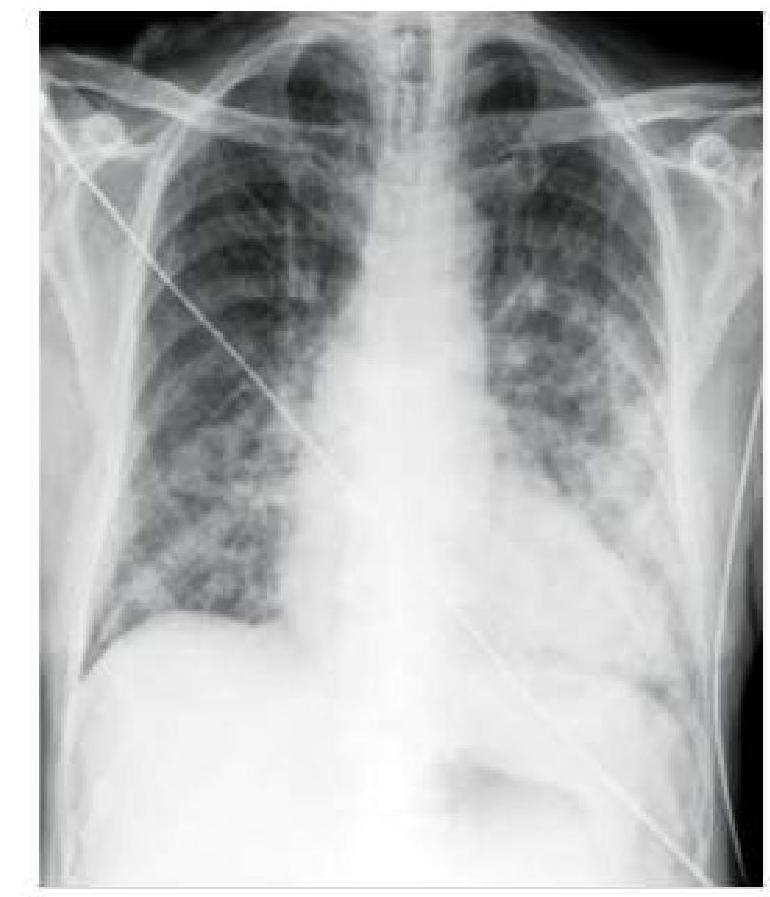
A hypertensive patient who is non-compliant with medication presents to you with sudden onset breathlessness. A chest x-ray was done, which is shown below. How will you manage this patient?
Most common cause of persistent hypertension in a child with intrinsic renal disease is -
A dense persistent nephrogram may be seen in all of the following except:
A 10 year old boy presents to the pediatric emergency unit with seizures. Blood pressure in the upper extremity is measured as 200/140 mm Hg. Femoral pulses were not palpable. The most likely diagnosis is:
An infant presents with LVH and pulmonary complications. ECG shows left axis deviation. The most likely diagnosis is:
A child presented with headache, dizziness, intermittent claudication with occasional dyspnea. The most probable diagnosis is:
Explanation: ***Early diagnosis of hypertension*** - **Early diagnosis** is a measure of **secondary prevention**, aiming to detect and manage a condition that has already developed but is not yet symptomatic or severe. - **Primary prevention** aims to prevent the disease from occurring in the first place, whereas secondary prevention seeks to halt its progression. *Weight reduction* - **Weight reduction** is a key lifestyle modification that can prevent the development of **hypertension**, especially in individuals with overweight or obesity. - Maintaining a **healthy weight** reduces the strain on the cardiovascular system and can normalize blood pressure. *Exercise promotion* - Promoting **regular physical activity** helps to improve cardiovascular health, maintain a healthy weight, and **lower blood pressure**, thereby preventing hypertension. - **Aerobic exercise** strengthens the heart and makes blood vessels more elastic, reducing the risk of developing high blood pressure. *Reduction of salt intake* - **Reducing dietary salt intake** is a well-established strategy to prevent hypertension, as excessive sodium contributes to fluid retention and increased blood pressure. - Limiting **sodium** in the diet can significantly lower the risk of developing hypertension, particularly in salt-sensitive individuals.
Explanation: ***11-Deoxycortisol*** - The combination of **precocious puberty** and **hypertension** in a 5-year-old boy strongly suggests **11β-hydroxylase deficiency** CAH, where 11-deoxycortisol is the most specific diagnostic marker. - In 11β-hydroxylase deficiency, **11-deoxycortisol accumulates** due to impaired conversion to cortisol, making it the most diagnostically accurate test for this specific enzyme deficiency that causes both virilization and hypertension. *17-Hydroxyprogesterone* - While this is the standard **general screening test** for CAH, it may be **normal or only mildly elevated** in 11β-hydroxylase deficiency [1]. - It's more useful for diagnosing **21α-hydroxylase deficiency** (the most common CAH) but less specific for the 11β-hydroxylase deficiency suggested by this clinical presentation [1]. *Aldosterone* - **Aldosterone levels** are typically **suppressed** in 11β-hydroxylase deficiency CAH due to negative feedback from elevated mineralocorticoid precursors like **DOC**. - Elevated aldosterone would suggest **primary hyperaldosteronism**, which rarely causes precocious puberty in children. *DOCA* - **DOCA (11-deoxycorticosterone)** is indeed elevated in 11β-hydroxylase deficiency and directly causes the hypertension through its **mineralocorticoid activity** [1]. - However, **direct measurement of DOCA** is less commonly available and not routinely used as a first-line diagnostic test compared to 11-deoxycortisol.
Explanation: ***Hypertension*** - **Congenital 17-hydroxylase deficiency** leads to impaired synthesis of **cortisol** and **sex steroids**, resulting in an accumulation of **mineralocorticoid precursors (corticosterone and deoxycorticosterone)** [1]. - Increased levels of these mineralocorticoids cause **sodium and water retention**, leading to **hypertension** and **hypokalemia**. *Virilism* - **17-hydroxylase deficiency** impairs **androgen synthesis**, preventing the development of male secondary sexual characteristics [2]. - Individuals with this deficiency often present with **female external genitalia** regardless of their genetic sex, or **under-virilization** in genetic males, not virilism [2]. *Hyperkalemia* - The excess mineralocorticoids (deoxycorticosterone) in **17-hydroxylase deficiency** promote **sodium reabsorption** and **potassium excretion** in the kidneys [1]. - This leads to **hypokalemia**, which is the opposite of hyperkalemia. *Hermaphroditism* - **17-hydroxylase deficiency** affects the development of gonads and internal reproductive organs depending on genetic sex. - Genetic males (**XY**) with this deficiency typically develop **female external genitalia** (pseudohermaphroditism or 46, XY DSD), while genetic females (**XX**) typically present as normal females but with **primary amenorrhea** [2]. This genetic condition does not result in true hermaphroditism (presence of both ovarian and testicular tissue) [2].
Explanation: ***Glomerulonephritis*** - **Sudden onset of altered sensorium** in a child with severe **hypertension (BP 200/100)** is highly suggestive of hypertensive encephalopathy, a common complication of acute glomerulonephritis. - **Acute glomerulonephritis** often presents with hypertension, edema, and hematuria, which can lead to neurological symptoms due to rapid and severe blood pressure elevation. *Essential hypertension* - **Essential hypertension** is extremely rare in a 2-year-old child; hypertension in this age group is typically secondary to an underlying condition. - The sudden onset of severe hypertension with neurological symptoms points away from primary hypertension, which usually develops gradually. *Renal artery stenosis* - While **renal artery stenosis** can cause hypertension, it usually presents as sustained hypertension and is less likely to cause a sudden, acute presentation with altered sensorium in a 2-year-old compared to acute glomerulonephritis. - Renal artery stenosis often causes **renovascular hypertension**, which may be indicated by abdominal bruits, but the acute neurological crisis is more characteristic of the rapid blood pressure rise seen in glomerulonephritis. *Coarctation of the aorta* - **Coarctation of the aorta** causes hypertension, but it typically presents with a **difference in blood pressure between the upper and lower extremities** or absent/diminished femoral pulses. - While it can lead to severe hypertension, the sudden onset of altered sensorium as the primary presenting feature is less typical; other signs related to the anatomical defect would usually be present.
Explanation: ***Intravenous nitroglycerin*** - The chest X-ray shows diffuse bilateral infiltrates and **cardiomegaly**, consistent with **pulmonary edema** due to **acute decompensated heart failure** in a hypertensive patient. - **Intravenous nitroglycerin** is crucial for patients with acute cardiogenic pulmonary edema, as it **reduces preload and afterload**, thereby decreasing pulmonary congestion and improving breathlessness. *Intravenous salbutamol* - **Salbutamol** is a **bronchodilator** used for bronchospasm in conditions like asthma or COPD. - It would not address the underlying pathology of **pulmonary edema** and could potentially worsen the condition by causing **tachycardia** and increasing myocardial oxygen demand. *Nebulization with salbutamol* - Similar to intravenous salbutamol, nebulized salbutamol is used for **bronchospasm** and is ineffective in treating **cardiogenic pulmonary edema**. - There is no indication of airway constriction, and its systemic effects could paradoxically **exacerbate heart failure**. *Oxygen and antibiotics* - While **oxygen** is always indicated for hypoxemia, it alone is insufficient to manage severe **pulmonary edema**. - **Antibiotics** are used to treat bacterial infections, but there are no signs of infection (e.g., fever, purulent sputum) to suggest **pneumonia** as the primary cause of breathlessness; the X-ray findings are more typical of edema.
Explanation: ***CGN*** - **Chronic glomerulonephritis (CGN)** is a leading cause of persistent hypertension in children with intrinsic renal disease due to widespread glomerular damage leading to **renin-angiotensin-aldosterone system** activation and fluid retention. - The damaged kidneys are unable to filter waste and regulate blood pressure effectively, contributing to sustained hypertension. *Chronic Pyelonephritis* - While chronic pyelonephritis can cause hypertension, it is typically due to **scarring and inflammation** affecting renal function. - However, it is not as common a cause of persistent hypertension as CGN in children with intrinsic renal disease. *Obstructive uropathy* - **Obstructive uropathy** is classified as a **post-renal (obstructive) disorder** rather than intrinsic renal disease, though it can lead to secondary renal parenchymal damage. - It can cause hypertension through renal parenchymal damage and **renin release** due to increased pressure, but it is not a primary intrinsic renal disease. *Renal tumor* - **Renal tumors**, such as Wilms' tumor, can cause hypertension through **compression of renal arteries** or increased renin production. - While a significant cause of hypertension, it is generally less common than CGN as a cause of persistent hypertension in children with *intrinsic renal disease* overall.
Explanation: ***Systemic hypertension*** - **Systemic hypertension** itself does not directly cause diffuse prolongation of the nephrogram phase unless there's an associated acute kidney injury from a different cause. - While chronic hypertension can lead to **nephrosclerosis**, which may affect contrast excretion, a persistent, dense nephrogram isn't its typical acute imaging finding. *Severe hydronephrosis* - **Severe hydronephrosis**, reflecting chronic or acute obstruction, can lead to impaired glomerular filtration and tubular function, causing delayed and prolonged contrast excretion. - The contrast remains in the dilated tubules and collecting system for an extended period, resulting in a **dense persistent nephrogram**. *Acute ureteral obstruction* - **Acute ureteral obstruction** causes increased collecting system pressure, leading to decreased glomerular filtration rate and impaired tubular flow. - This results in the contrast medium pooling in the renal tubules and interstitium, leading to a **delayed and persistent nephrogram**. *Dehydration* - **Dehydration** can lead to altered renal hemodynamics and concentrated urine, which can prolong the nephrogram phase due to slower contrast clearance. - Reduced renal blood flow and increased reabsorption of water lead to a more concentrated and thus **denser nephrogram** that persists longer than usual.
Explanation: ***Coarctation of aorta*** - The combination of **severe hypertension in the upper extremities** (200/140 mm Hg), **impalpable femoral pulses**, and seizures in a 10-year-old boy is highly suggestive of **aortic coarctation**. - Aortic coarctation causes a **pressure gradient** across the narrowed aorta, leading to high pressure proximal to the coarctation (upper body) and low pressure distal to it (lower body). *Renal parenchymal disease* - While renal parenchymal disease can cause **hypertension**, it typically does not present with **differential blood pressures** between upper and lower extremities or absent femoral pulses. - The hypertension in renal disease is usually due to **fluid overload** and **renin-angiotensin-aldosterone system activation**. *Takayasu arteritis* - Takayasu arteritis is a form of **large vessel vasculitis** that can affect the aorta and its branches, leading to differential pulses and hypertension. - However, it more commonly affects **young adult women** (typically 10-40 years old) and often presents with systemic symptoms like **fever, malaise**, and **arterial bruits**, which are not mentioned here. *Grand mal seizures* - Grand mal seizures are a neurological symptom, not a diagnosis of the underlying cause. - While **severe hypertension** from any cause can lead to seizures (hypertensive encephalopathy), this option does not explain the specific cardiovascular findings of **differential blood pressure** and **impalpable femoral pulses**.
Explanation: ***Tricuspid atresia*** - **Left ventricular hypertrophy (LVH)** is common because the left ventricle must pump blood to both the systemic and pulmonary circulations through a **ventricular septal defect (VSD)** and/or **patent ductus arteriosus (PDA)**. - **Left axis deviation** on ECG is characteristic of tricuspid atresia due to the hypoplasia or absence of the right ventricle and the dominance of the left ventricle. *TAPVC* - **Total anomalous pulmonary venous connection (TAPVC)** typically presents with right ventricular hypertrophy and right axis deviation on ECG, as the right ventricle handles the entire systemic venous return. - Pulmonary complications are common, but the cardiac structural changes and ECG findings differentiate it from tricuspid atresia. *VSD* - A **ventricular septal defect (VSD)** alone would typically cause **right ventricular hypertrophy** or biventricular hypertrophy depending on the size and shunt direction. - While a large VSD can cause **pulmonary hypertension** and complications, it usually does not present with isolated LVH and left axis deviation without other associated anomalies. *TGA* - **Transposition of the great arteries (TGA)** typically presents with **right ventricular hypertrophy** and right axis deviation on ECG, as the RV functions as the systemic ventricle. - While cyanosis and pulmonary complications occur, the ECG pattern shows RVH, not LVH with left axis deviation.
Explanation: ***Coarctation of aorta*** - **Coarctation of the aorta** presents with upper extremity hypertension and lower extremity hypotension. - This pressure difference typically causes symptoms such as **headache**, **dizziness**, and **intermittent claudication** in the legs. *PDA* - A **patent ductus arteriosus (PDA)** typically presents with a continuous murmur and, if large, signs of heart failure or pulmonary hypertension. - While it can cause dyspnea, **headache, dizziness, and claudication** are not defining symptoms. *TOF* - **Tetralogy of Fallot (TOF)** is characterized by cyanosis, exertional dyspnea, and "tet spells." - It does not typically cause **headaches, dizziness, or claudication** in the absence of severe complications. *ASD* - An **atrial septal defect (ASD)** is often asymptomatic until adulthood or presents with mild symptoms like fatigue or dyspnea with exertion. - It is not associated with **headache, dizziness, or intermittent claudication**.
Get full access to all questions, explanations, and performance tracking.
Start For Free