Which of the following conditions causes congestive heart failure in neonates?
Which one of the following congenital heart diseases presents with cyanosis without cardiomegaly and/or congestive heart failure?
In a 5-year-old child, instead of the physiological splitting of the second heart sound (S2), which is expected only during inspiration, a wide and fixed split of S2 is heard during both inspiration and expiration. What condition is associated with this finding?
Children born to mothers with systemic lupus erythematosus are likely to have which of the following anomalies?
Which of the following is NOT a feature of Atrial Septal Defect?
Which cardiac anomaly is associated with Tetralogy of Fallot?
What is the most common type of total anomalous pulmonary venous connection (TAPVC)?
What is the effect of using a small cuff size during blood pressure measurement?
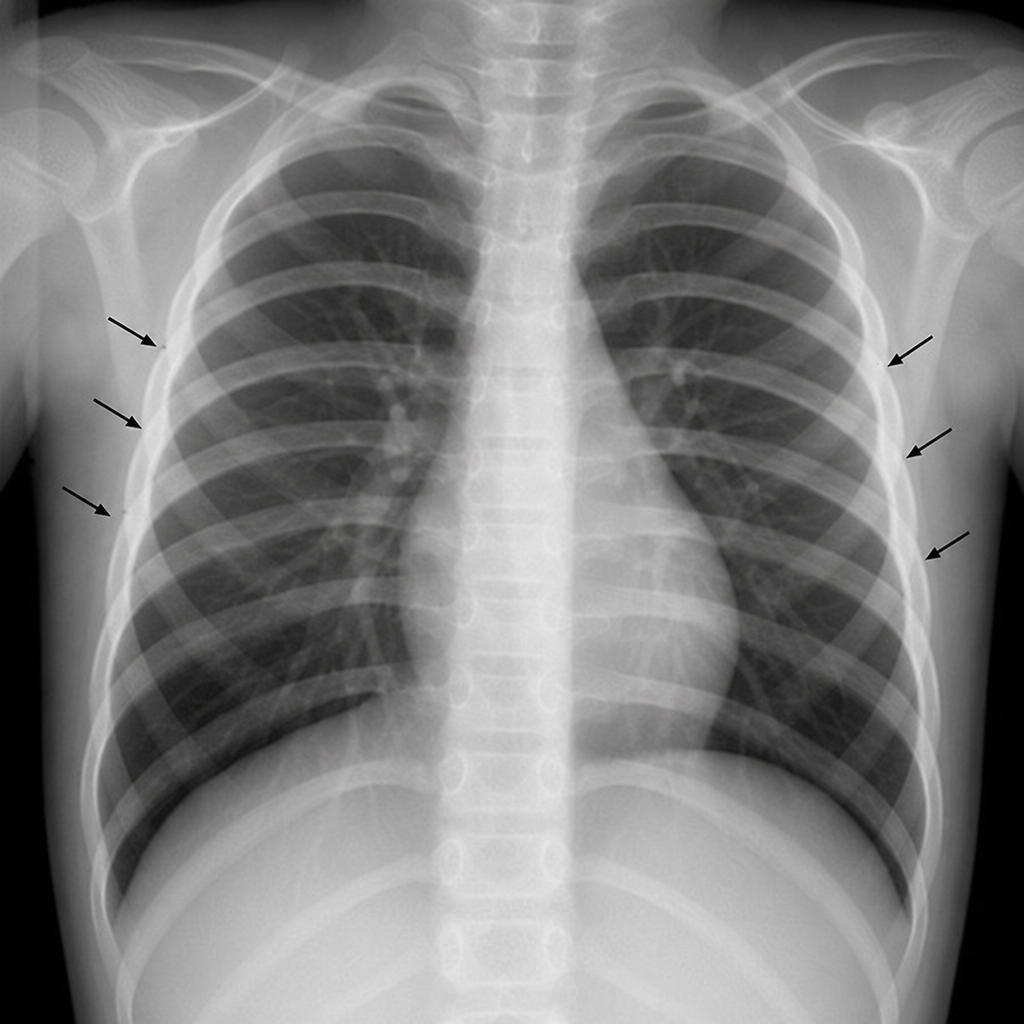
A 5-year-old child presents with exertional dyspnea and a history of cyanotic spells. On examination, there is clubbing and a harsh systolic murmur heard at the left upper sternal border. Chest X-ray is shown below. What is the most likely diagnosis?
A child presents with kawasaki disease with multiple small coronary artery aneurysms. Treatment is?
Explanation: **Explanation:** **Total Anomalous Pulmonary Venous Return (TAPVR)** is the correct answer because it is a "ductal-independent" cyanotic congenital heart disease that can present with fulminant congestive heart failure (CHF) in the neonatal period, especially the **obstructed type** (Infradiaphragmatic/Type III). In TAPVR, all pulmonary veins drain into the right atrium instead of the left. This leads to a massive volume overload of the right heart and pulmonary congestion. If the venous return is obstructed, pulmonary venous hypertension develops rapidly, leading to severe pulmonary edema and heart failure within days of birth. **Why the other options are incorrect:** * **Bicuspid Aortic Valve:** This is usually asymptomatic in the neonatal period. It typically presents in adulthood with aortic stenosis or regurgitation. It does not cause neonatal CHF unless associated with severe critical aortic stenosis. * **Tetralogy of Fallot (TOF):** TOF is characterized by **decreased** pulmonary blood flow due to right ventricular outflow tract obstruction. Because the lungs are "protected" from high pressure and volume, TOF characteristically **does not cause CHF**. It presents with cyanosis or "tet spells." * **Atrial Septal Defect (ASD):** Small or moderate ASDs are asymptomatic in neonates. Even large ASDs rarely cause CHF in infancy because the right ventricle is thick and non-compliant at birth, limiting the left-to-right shunt. CHF from an isolated ASD usually takes decades to develop. **High-Yield Clinical Pearls for NEET-PG:** * **Most common cause of CHF in the first week of life:** Hypoplastic Left Heart Syndrome (HLHS). * **Most common cause of CHF in the first 12–24 hours:** Asphyxia, sepsis, or severe anemia. * **TAPVR Radiology:** The classic "Snowman sign" or "Figure of 8" appearance is seen in Supracardiac (Type I) TAPVR, but usually not until after the neonatal period. * **Rule of Thumb:** Left-to-right shunts (VSD, PDA) typically cause CHF at 6–8 weeks of life as pulmonary vascular resistance falls, whereas obstructive lesions (TAPVR, HLHS, Coarctation) cause CHF in the first week.
Explanation: **Explanation:** The hallmark of **Tetralogy of Fallot (TOF)** is cyanosis with **decreased pulmonary blood flow**. In TOF, the right ventricular outflow tract (RVOT) obstruction limits blood flow to the lungs. Because the right ventricle (RV) can decompress into the left ventricle via the large VSD, there is no volume overload. Consequently, the heart size remains normal (though the apex may be upturned, forming the classic "boot-shaped" heart or *coeur en sabot*), and **congestive heart failure (CHF) is characteristically absent** in an uncomplicated TOF. **Analysis of Incorrect Options:** * **Transposition of Great Arteries (TGA):** This is a cyanotic heart disease with *increased* pulmonary blood flow. It typically presents with early-onset CHF and cardiomegaly (the "egg-on-a-string" appearance). * **Congenital Mitral Regurgitation:** This causes volume overload of the left atrium and left ventricle, leading to significant cardiomegaly and symptoms of left-sided heart failure. It is generally acyanotic. * **Congenital Pulmonary Stenosis:** While it may cause cyanosis if there is an associated right-to-left shunt (e.g., via a patent foramen ovale), severe stenosis leads to pressure overload and right-sided heart failure (manifesting as hepatomegaly and edema). **High-Yield Clinical Pearls for NEET-PG:** * **The "Rule of TOF":** If a cyanotic infant has a **small heart** and **clear lung fields** (oligemic lung fields) on X-ray, think TOF. * **CHF in TOF:** If a patient with TOF develops heart failure, suspect an associated complication like severe anemia or an infective endocarditis. * **Squatting episodes:** These increase systemic vascular resistance, forcing more blood through the RVOT into the lungs, thereby relieving cyanotic spells.
Explanation: ### Explanation **1. Why Atrial Septal Defect (ASD) is the Correct Answer:** The hallmark of an ASD is a **wide and fixed split S2**. * **Wide Split:** In ASD, the left-to-right shunt increases the blood volume in the right ventricle (RV), prolonging RV ejection time and delaying the closure of the pulmonary valve (P2). * **Fixed Split:** Normally, inspiration increases venous return to the right heart, delaying P2. In ASD, during expiration, the drop in systemic venous return is compensated by an *increase* in the left-to-right shunt across the defect. This keeps the RV stroke volume constant throughout the respiratory cycle, ensuring the interval between A2 and P2 remains unchanged (fixed). **2. Why Other Options are Incorrect:** * **Ventricular Septal Defect (VSD):** Typically presents with a **pansystolic murmur**. While S2 may be wide (due to early A2 closure or delayed P2), it is **not fixed**; it still varies with respiration. * **Mitral Regurgitation (MR):** Causes a wide split S2 because the left ventricle empties faster (into both the aorta and left atrium), leading to early closure of the aortic valve (A2). However, the split remains **variable** with respiration. * **Pulmonary Stenosis (PS):** Causes a **wide and variable** split S2. P2 is delayed due to prolonged RV ejection against resistance, but the split widens further during inspiration. **3. Clinical Pearls for NEET-PG:** * **ASD Murmur:** The murmur in ASD is a **midsystolic flow murmur** at the pulmonary area (due to increased flow across the pulmonary valve), NOT due to flow across the defect itself. * **Ostium Secundum:** The most common type of ASD (75%). * **ECG Finding:** Look for **RSR' pattern** in V1 (incomplete RBBB) and right axis deviation. * **Key Distinction:** If a split S2 is wide but *moves* with respiration, think PS or RBBB. If it is wide and *fixed*, it is almost always ASD.
Explanation: **Explanation:** The correct answer is **Complete Heart Block (CHB)**. This condition is a hallmark manifestation of **Neonatal Lupus Erythematosus (NLE)**. **Pathophysiology:** The mechanism involves the transplacental passage of maternal IgG autoantibodies, specifically **anti-Ro (SS-A)** and **anti-La (SS-B)**. These antibodies cross the placenta and bind to the fetal cardiac conduction system (specifically the AV node). This triggers an inflammatory response (myocarditis) followed by irreversible fibrosis and calcification, leading to a permanent third-degree (complete) heart block. While the mother may have SLE, she can also be asymptomatic or have Sjögren’s syndrome. **Analysis of Incorrect Options:** * **A, B, and C (ASD, TOF, TGA):** These are structural congenital heart diseases (CHDs). While they are common in the general population or associated with other syndromes (e.g., Down syndrome with AVSD or DiGeorge syndrome with TOF), they are **not** etiologically linked to maternal SLE or autoantibody transfer. Maternal SLE specifically targets the conduction system rather than cardiac morphogenesis. **High-Yield Clinical Pearls for NEET-PG:** * **Irreversibility:** Unlike the skin rashes or hematological abnormalities of Neonatal Lupus which resolve as maternal antibodies wane (around 6 months), **Complete Heart Block is permanent** and often requires a permanent pacemaker. * **Timing:** It is typically detected in utero between **18–24 weeks** of gestation via fetal echocardiography (bradycardia). * **Recurrence Risk:** A mother who has had one child with NLE-associated heart block has a significantly higher risk (approx. 15-20%) in subsequent pregnancies. * **Treatment:** Maternal steroids (Dexamethasone) may be used to treat associated fetal hydrops or myocarditis, but they cannot reverse a block once it is complete.
Explanation: **Explanation:** **1. Why Option A is the Correct Answer (The "NOT" feature):** In an Atrial Septal Defect (ASD), blood shunts from the left atrium to the right atrium due to the pressure gradient. This leads to **volume overload of the Right Atrium (RA) and Right Ventricle (RV)**, eventually causing right-sided chamber enlargement and hypertrophy. The left atrium (LA) does not undergo hypertrophy because it is effectively "decompressed" by the shunt; blood flows out of the LA into the RA rather than being stored under high pressure. Therefore, **Left Atrial Hypertrophy is not a feature of ASD.** **2. Analysis of Incorrect Options:** * **Option B:** ASD is often asymptomatic in childhood. Complications like pulmonary hypertension, atrial arrhythmias, and heart failure typically manifest in the **3rd or 4th decade of life**, making it a late-onset clinical entity. * **Option C:** Because it remains asymptomatic for years, ASD is the **most common** congenital heart disease (CHD) first diagnosed in **adulthood**. (Note: VSD is the most common CHD overall, but most are diagnosed in infancy). * **Option D:** A **wide, fixed split S2** is the pathognomonic physical finding of ASD. The split is "wide" due to delayed closure of the pulmonary valve (RV volume overload) and "fixed" because respiratory changes in venous return are balanced across the defect, keeping the stroke volume constant. **Clinical Pearls for NEET-PG:** * **Most common type:** Ostium Secundum (75%). * **Murmur:** ASD itself is silent. The heard murmur is a **systolic ejection murmur** at the left upper sternal border due to increased flow across the pulmonary valve (relative pulmonary stenosis). * **ECG Findings:** Right axis deviation and RSR' pattern in V1 (Partial RBBB). * **Contraindication:** ASD closure is contraindicated if Eisenmenger syndrome (irreversible pulmonary hypertension) develops.
Explanation: **Explanation:** The question asks for an *associated* cardiac anomaly rather than one of the four primary components of Tetralogy of Fallot (TOF). **1. Why Atrial Septal Defect (ASD) is the correct answer:** While TOF is classically defined by four features, a significant number of patients (approx. 10-15%) also present with an associated **Atrial Septal Defect**. When an ASD is present alongside the classic four features of TOF, the condition is clinically referred to as **"Pentalogy of Fallot."** In the context of NEET-PG, "associated" usually refers to an additional finding beyond the diagnostic criteria. **2. Why the other options are incorrect:** * **Cyanotic heart disease (A):** This is a *classification* of the disease, not a specific anatomical anomaly. TOF is the most common cyanotic congenital heart disease (CCHD) after the first year of life. * **Right ventricular hypertrophy (B) and Ventricular septal defect (D):** These are **primary components** of TOF, not "associated" anomalies. The four classic components are: 1. Subpulmonic stenosis (Infundibular stenosis) 2. Overriding of aorta 3. Large malaligned VSD 4. Right Ventricular Hypertrophy (RVH) **3. NEET-PG High-Yield Pearls:** * **Most common associated anomaly:** Right-sided aortic arch (seen in 25% of cases). * **X-ray finding:** "Boot-shaped heart" (Coeur en sabot) due to an upturned apex (RVH) and small pulmonary artery segment. * **ECG finding:** Right axis deviation and RVH. * **Management:** Squatting position during a "Tet spell" increases systemic vascular resistance (SVR), decreasing the right-to-left shunt. * **Drug of choice for Tet spell:** Morphine (to calm the child and reduce infundibular spasm) and Beta-blockers (Propranolol).
Explanation: **Explanation:** Total Anomalous Pulmonary Venous Connection (TAPVC) is a cyanotic congenital heart disease where all four pulmonary veins fail to connect to the left atrium, instead draining into the systemic venous circulation (right atrium). **1. Why Supracardiac is Correct:** The **Supracardiac type (Type I)** is the most common anatomical variant, accounting for approximately **45-50%** of all cases. In this type, the pulmonary veins typically coalesce into a common pulmonary vein, which drains via a vertical vein into the **left innominate (brachiocephalic) vein**, eventually reaching the Superior Vena Cava (SVC) and the right atrium. **2. Analysis of Incorrect Options:** * **Cardiac (Type II):** The second most common type (~25%). The pulmonary veins drain directly into the **coronary sinus** or the right atrium. * **Infracardiac (Type III):** Accounts for ~20% of cases. The common pulmonary vein drains through the diaphragm into the **portal vein**, hepatic vein, or Inferior Vena Cava (IVC). This type is most frequently associated with **severe obstruction** and early neonatal distress. * **Mixed (Type IV):** The rarest form (~5-10%), where pulmonary veins drain into multiple sites (e.g., one to the innominate vein and another to the coronary sinus). **Clinical Pearls for NEET-PG:** * **Snowman Sign / Figure-of-8 Appearance:** Classic X-ray finding seen in **Supracardiac TAPVC** (due to the dilated vertical vein, innominate vein, and SVC forming the upper loop). * **Pathophysiology:** An Atrial Septal Defect (ASD) is essential for survival to allow blood to reach the left side of the heart. * **Emergency:** Infracardiac TAPVC often presents with severe pulmonary venous obstruction and requires emergent surgical intervention.
Explanation: **Explanation:** The accuracy of blood pressure (BP) measurement is highly dependent on the relationship between the cuff size and the circumference of the arm. **Why Option A is Correct:** When a **small cuff** (or a narrow cuff) is used on a relatively larger arm, it fails to transmit pressure evenly to the underlying brachial artery. To successfully occlude the artery and stop the pulse, the clinician must over-inflate the cuff to a much higher pressure than the patient’s actual intra-arterial pressure. This results in a **falsely elevated (increased) BP reading**, a phenomenon sometimes referred to as "cuff hypertension." **Why Other Options are Incorrect:** * **Option B:** A **falsely decreased** reading occurs when the cuff is **too large** (too wide) for the arm. In this case, the pressure is distributed over a larger area, requiring less inflation to occlude the artery. * **Option C & D:** Cuff size has a predictable, systematic effect on BP readings; it does not cause random fluctuations or have "no effect." **High-Yield Clinical Pearls for NEET-PG:** 1. **Ideal Cuff Dimensions:** The bladder length should be **80%** and the width should be at least **40%** of the mid-arm circumference. 2. **Pediatric Consideration:** In children, using an inappropriately large cuff is a common cause of missed hypertension, while a small cuff leads to unnecessary workups. 3. **Positioning:** The arm should be supported at the level of the **right atrium**. If the arm is held below heart level, BP will be falsely increased; if above heart level, it will be falsely decreased. 4. **The "Tightness" Rule:** The cuff should be wrapped snugly, allowing only two fingers to fit between the cuff and the arm.
Explanation: ***Tetralogy of Fallot*** - The clinical triad of **exertional dyspnea**, **cyanotic spells** (tet spells), and a **harsh systolic murmur** at the left upper sternal border (due to pulmonary stenosis) is classic for this condition. - The chest X-ray shows a characteristic **"boot-shaped heart"** (coeur en sabot), which results from **right ventricular hypertrophy** (forming the toe) and a concave main pulmonary artery segment. *Total Anomalous Pulmonary Venous Connection* - The classic chest X-ray finding for TAPVC is a **"snowman sign"** or **"figure-of-eight"** appearance, which is not seen in the provided image. - While it is a cyanotic condition, it results from the mixing of oxygenated and deoxygenated blood and is associated with signs of right heart failure and pulmonary edema. *Transposition of the Great Arteries* - This condition typically presents with severe **cyanosis at birth** and requires immediate intervention for survival; presentation at age 5 is highly unlikely without prior surgery. - The characteristic radiographic sign is an **"egg-on-a-string"** appearance with a narrow superior mediastinum, differing from the boot shape seen here. *Atrial Septal Defect* - An ASD is an **acyanotic** heart defect (left-to-right shunt), so it does not cause cyanotic spells or clubbing in a 5-year-old. - The hallmark physical finding is a **wide, fixed splitting of S2**, not a harsh systolic murmur.
Explanation: ***Aspirin for 6 weeks*** - After the acute phase is treated with **IVIG** and high-dose aspirin, the regimen is switched to low-dose aspirin for its **antiplatelet** effects to prevent thrombosis in the affected coronary arteries. - This low-dose therapy is typically continued for 6-8 weeks, at which point a follow-up **echocardiogram** is performed and inflammatory markers (like **ESR** and **CRP**) should have normalized. *Aspirin lifelong* - Lifelong antiplatelet therapy is generally reserved for patients with **large** or **giant** coronary artery aneurysms due to a high risk of **thrombosis** and stenosis. - For small aneurysms, which often resolve, therapy is guided by serial echocardiograms and is not typically lifelong from the outset. *Aspirin for 4 weeks* - A 4-week duration is insufficient, as it may not cover the entire period of coronary wall inflammation and thrombocytosis, which usually peaks in the subacute phase. - The standard follow-up interval for re-evaluation with an **echocardiogram** is at 6-8 weeks, making it logical to continue therapy at least until that point. *Aspirin and clopidogrel for 6 weeks* - **Dual antiplatelet therapy** with aspirin and clopidogrel is recommended for patients with **medium-sized** or **giant** coronary artery aneurysms, not for small aneurysms. - The flowchart provided indicates that for small aneurysms (Z score ≥2.5 to <5), **single antiplatelet therapy** with low-dose aspirin is the appropriate treatment.
Congenital Heart Diseases: Cyanotic
Practice Questions
Congenital Heart Diseases: Acyanotic
Practice Questions
Rheumatic Heart Disease
Practice Questions
Kawasaki Disease
Practice Questions
Infective Endocarditis
Practice Questions
Myocarditis and Cardiomyopathies
Practice Questions
Arrhythmias in Children
Practice Questions
Heart Failure in Children
Practice Questions
Pulmonary Hypertension
Practice Questions
Systemic Hypertension
Practice Questions
Dyslipidemia in Children
Practice Questions
Cardiac Evaluation and Diagnostics
Practice Questions
Get full access to all questions, explanations, and performance tracking.
Start For Free