Which of the following is NOT included in the modified Jones criteria?
During a regular check-up of an 8-year-old child, you note a loud first heart sound with a fixed and widely split-second heart sound at the upper left sternal border that does not change with respirations. The patient is otherwise active and healthy. Which of the following heart lesions most likely explains these findings?
Which of the following statements about the ductus arteriosus is true?
What is the commonest cause of an enlarged cardiac shadow in a chest X-ray of a child?
Ebstein anomaly is associated with all the following except?
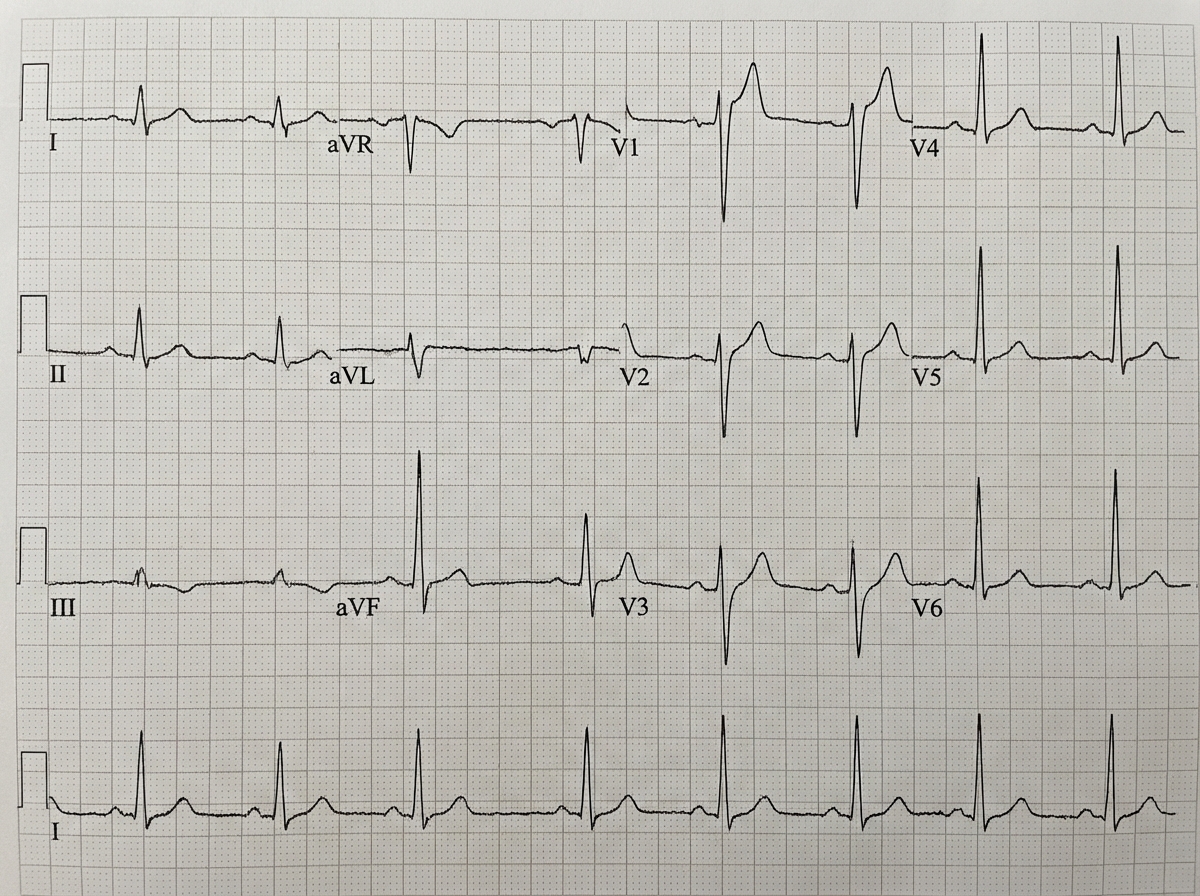
The presence of left axis deviation beyond -30 degrees in an electrocardiogram suggests which of the following?
Which ECG finding is most common in a newborn child with Down syndrome?
Which of the following clinical signs would be most obvious on examination of a patient with either tetralogy of Fallot or transposition of the great vessels?
Patent truncus arteriosus leads to which of the following?
Which of the following is a component of Tetralogy of Fallot?
Explanation: The **Modified Jones Criteria** are used for the diagnosis of Acute Rheumatic Fever (ARF), a non-suppurative sequela of Group A Streptococcal (GAS) pharyngeal infection. **Explanation of the Correct Answer:** **A. Polyalgiathritis:** This is the correct answer because it is not a recognized medical term or a component of the criteria. The major joint manifestation in Jones criteria is **Migratory Polyarthritis**. While "Arthralgia" (joint pain without inflammation) is a **Minor Criterion**, "Polyalgiathritis" is a distractor. **Explanation of Incorrect Options (Major Criteria):** The mnemonic **J♥NES** helps remember the Major Criteria: * **B. Carditis (♥):** Present in 50-70% of cases. It typically presents as pancarditis (endocarditis, myocarditis, and pericarditis). * **C. Chorea (N - Nodes/Neurological):** Also known as **Sydenham’s chorea** or "St. Vitus Dance." It is a delayed manifestation characterized by rapid, purposeless movements. * **D. Erythema marginatum (E):** A classic, non-pruritic, pink, evanescent rash with serpiginous borders, usually found on the trunk and limbs. * *(Note: The 'S' stands for Subcutaneous nodules).* **High-Yield Clinical Pearls for NEET-PG:** * **Diagnosis:** Requires **2 Major** OR **1 Major + 2 Minor** criteria, plus evidence of preceding GAS infection (e.g., elevated ASO titer, positive throat culture, or Rapid Antigen Test). * **Minor Criteria:** Arthralgia, Fever, Elevated ESR/CRP, and Prolonged PR interval on ECG. * **Exception:** Sydenham’s chorea or indolent carditis can be diagnostic of ARF even without evidence of preceding GAS infection or meeting the full criteria. * **Most Common Valve Involved:** Mitral valve (Mitral Regurgitation is the most common early finding).
Explanation: **Explanation:** The clinical presentation of a **fixed, widely split second heart sound (S2)** in an asymptomatic child is the classic hallmark of an **Atrial Septal Defect (ASD)**, specifically the ostium secundum type. **1. Why ASD is correct:** * **Wide Splitting:** In ASD, the left-to-right shunt increases the volume of blood in the right ventricle (RV). This prolongs RV ejection time, delaying the closure of the pulmonary valve (P2) relative to the aortic valve (A2). * **Fixed Splitting:** Normally, S2 splitting increases during inspiration. In ASD, the split remains constant because the large communication between the atria equalizes the respiratory variations in venous return between the left and right sides of the heart. * **Auscultation:** The loud S1 is due to increased flow across the tricuspid valve, and a mid-systolic murmur (not mentioned but common) may be heard at the upper left sternal border due to increased flow across the pulmonary valve. **2. Why other options are incorrect:** * **VSD:** Typically presents with a harsh holosystolic murmur at the lower left sternal border. S2 splitting may be wide but is **not fixed**. * **Tricuspid Regurgitation:** Presents with a holosystolic murmur at the lower left sternal border that increases with inspiration (Carvallo’s sign). It does not cause a fixed split S2. * **Tetralogy of Fallot:** Characterized by a **single S2** (due to an anteriorly displaced aorta and a faint/absent P2) and a harsh systolic ejection murmur from pulmonary stenosis. **Clinical Pearls for NEET-PG:** * **Most common ASD:** Ostium secundum (75%). * **ECG Findings:** Right axis deviation and RSR' pattern in V1 (incomplete RBBB). * **Chest X-ray:** Cardiomegaly with increased pulmonary vascular markings. * **Paradoxical Embolism:** A significant risk where a systemic venous embolus crosses the ASD to cause a stroke.
Explanation: **Explanation:** The **Ductus Arteriosus (DA)** is a vital fetal vascular connection between the pulmonary artery and the descending aorta, allowing blood to bypass the non-functional fetal lungs. **Why Option D is Correct:** When the ductus remains patent (Patent Ductus Arteriosus - PDA) after birth, blood shunts from the high-pressure aorta to the lower-pressure pulmonary artery. Because the pressure gradient between the aorta and pulmonary artery persists throughout both systole and diastole, it produces a characteristic **continuous "machinery-like" murmur**, best heard at the left infraclavicular area. **Why Other Options are Incorrect:** * **Option A:** Functional closure occurs within 10–15 hours of birth due to smooth muscle contraction. However, **anatomic closure** (fibrosis) takes much longer, usually **2–3 weeks** of life. * **Option B:** The remnant of the ductus arteriosus is the **ligamentum arteriosum**. The ligamentum venosum is the remnant of the *ductus venosus*. * **Option C:** Prostaglandins (PGE1 and PGE2) maintain patency. Closure is actually induced by the **withdrawal of prostaglandins** and the rise in arterial oxygen tension ($PaO_2$) after the first breath. **High-Yield NEET-PG Pearls:** * **Drug of Choice for Closure:** Intravenous **Indomethacin** or **Ibuprofen** (NSAIDs that inhibit prostaglandin synthesis). * **Drug to Maintain Patency:** **Alprostadil** (PGE1 infusion), used in cyanotic heart diseases (ductal-dependent circulation). * **Association:** PDA is strongly associated with **Congenital Rubella Syndrome** and **prematurity**. * **Pulse finding:** "Bounding pulses" with a wide pulse pressure are common in large PDAs.
Explanation: **Explanation:** The correct answer is **Rheumatic carditis**. In the pediatric population, particularly in developing countries like India, Acute Rheumatic Fever (ARF) remains a leading cause of acquired heart disease. Rheumatic carditis is a pancarditis involving the endocardium, myocardium, and pericardium. The enlargement of the cardiac shadow on a chest X-ray is primarily due to **myocarditis** (leading to cardiac chamber dilation) and/or significant **valvular regurgitation** (most commonly Mitral Regurgitation), which causes left atrial and ventricular enlargement. **Analysis of Incorrect Options:** * **Patent Ductus Arteriosus (PDA):** While a large PDA can cause left-sided heart enlargement due to volume overload, it is a congenital cause and less common than the systemic burden of rheumatic disease in older children. * **Coarctation of the Aorta:** This typically presents with left ventricular hypertrophy (LVH). On X-ray, the heart size often remains normal for a long time (concentric hypertrophy) unless heart failure develops. The classic sign is the "3" sign or rib notching, not generalized cardiomegaly. * **Pericarditis:** While pericardial effusion causes a "water-bottle" shaped enlarged shadow, isolated viral or idiopathic pericarditis is statistically less frequent than rheumatic carditis as a cause of cardiomegaly in clinical practice. **NEET-PG High-Yield Pearls:** * **Most common valve involved in ARF:** Mitral valve (followed by the Aortic valve). * **Earliest sign of ARF on X-ray:** Cardiomegaly (due to myocarditis or MR). * **Carey Coombs Murmur:** A mid-diastolic murmur heard in acute rheumatic carditis due to functional mitral stenosis (mitral valvulitis). * **Gold Standard for Diagnosis:** Jones Criteria (Revised). Cardiomegaly is a major criterion under "Carditis."
Explanation: **Explanation:** Ebstein anomaly is a congenital heart defect characterized by the **downward displacement of the tricuspid valve leaflets** (septal and posterior) into the right ventricle. This results in "atrialization" of the right ventricle, leading to a massive right atrium and severe tricuspid regurgitation. **Why Ventricular Septal Defect (VSD) is the correct answer:** While Ebstein anomaly is frequently associated with inter-atrial communications, it is **rarely associated with a Ventricular Septal Defect (VSD)**. The primary structural pathology involves the tricuspid valve and the right-sided chambers, not the ventricular septum. **Analysis of other options:** * **Patent Foramen Ovale (PFO) / ASD:** These are found in over 80-90% of cases. The high pressure in the right atrium causes a right-to-left shunt across the PFO/ASD, leading to cyanosis. * **Massive heart on CXR:** Due to the extreme dilation of the right atrium, the chest X-ray typically shows a **"box-shaped" or "balloon-shaped" heart** with a very high cardiothoracic ratio. * **Tall, broad P waves:** Known as **"Himalayan P waves,"** these occur due to massive right atrial enlargement. They are a classic ECG finding in Ebstein anomaly. **High-Yield Clinical Pearls for NEET-PG:** 1. **Maternal Risk Factor:** Strongly associated with maternal **Lithium** intake during the first trimester. 2. **ECG Findings:** Himalayan P waves, right bundle branch block (RBBB), and a high incidence of **Wolff-Parkinson-White (WPW) syndrome** (Type B). 3. **Auscultation:** Characterized by a "multi-click" or "sail sound" (loud T1) and a quadruple gallop rhythm. 4. **Cyanosis:** Occurs due to the right-to-left shunt at the atrial level, despite it being an obstructive-like right-sided lesion.
Explanation: **Explanation:** In pediatric cardiology, the axis on an ECG is a critical diagnostic clue. A **Left Axis Deviation (LAD)** beyond -30° in a patient with an Atrial Septal Defect (ASD) is a classic hallmark of an **Ostium Primum ASD** (part of the Endocardial Cushion Defects). **1. Why Ostium Primum ASD is correct:** In Ostium Primum defects, there is a deficiency in the atrioventricular septum. This causes an anatomical displacement of the **AV node** (positioned posteriorly) and the **Bundle of His**. The left bundle branch, specifically the left superior fascicle, is activated prematurely, leading to a "superior" or leftward axis (typically between -30° and -90°). **2. Why the other options are incorrect:** * **Fossa Ovalis (Ostium Secundum) ASD:** This is the most common type of ASD. It typically presents with **Right Axis Deviation (RAD)** and Right Ventricular Hypertrophy (RVH) due to right-sided volume overload. * **Sinus Venosus ASD:** This is often associated with a **leftward shift of the P-axis** (inverted P waves in inferior leads) because the normal pacemaker site near the SVC is displaced, but the QRS axis is usually normal or shows RAD. * **Coronary Sinus ASD:** This rare defect generally presents with a normal axis or RAD, similar to secundum defects. **Clinical Pearls for NEET-PG:** * **The "Goose Neck" Deformity:** On angiography, Ostium Primum ASD shows a narrowed left ventricular outflow tract known as the "Goose Neck" appearance. * **Triad of Ostium Primum:** LAD + RBBB (Right Bundle Branch Block) + RVH. * **Association:** Ostium Primum ASDs are frequently associated with a **cleft in the anterior mitral leaflet**, leading to mitral regurgitation. * **Down Syndrome:** Strongly associated with Endocardial Cushion Defects (AVSDs), where LAD is a pathognomonic ECG finding.
Explanation: ### Explanation **1. Why "Normal" is the Correct Answer:** While Down syndrome (Trisomy 21) is famously associated with congenital heart defects (CHDs) in approximately 40–50% of cases, it is crucial to remember that **more than 50% of newborns with Down syndrome have a structurally normal heart.** Therefore, statistically, a **normal ECG** is the most common finding in this population. Even in cases where a defect like an Atrioventricular Septal Defect (AVSD) is present, the ECG may not show significant abnormalities immediately at birth, as hemodynamic changes (like right ventricular hypertrophy or axis deviation) often take time to manifest as pulmonary vascular resistance drops. **2. Analysis of Incorrect Options:** * **B & C (ASD and VSD):** While these are common components of the "Endocardial Cushion Defect" (AVSD) seen in Down syndrome, they are pathological findings. They occur frequently, but not in the majority of patients. * **D (TAPVC):** This is a cyanotic heart disease not specifically associated with Down syndrome. It is more commonly associated with Asplenia syndrome (Right isomerism). **3. High-Yield Clinical Pearls for NEET-PG:** * **Most common CHD in Down Syndrome:** Atrioventricular Septal Defect (AVSD), also known as Endocardial Cushion Defect. * **Most common CHD overall:** Ventricular Septal Defect (VSD). * **Classic ECG finding in AVSD:** "Superior Left Axis Deviation" (Negative QRS in leads II, III, and aVF). This is a high-yield "buzzword" for exams. * **Screening Protocol:** Every newborn with Down syndrome must undergo a clinical evaluation and an **Echocardiogram**, regardless of whether the ECG or physical exam is normal, to rule out silent defects.
Explanation: ### Explanation The core clinical feature shared by **Tetralogy of Fallot (TOF)** and **Transposition of the Great Arteries (TGA)** is that they are both **Cyanotic Congenital Heart Diseases (CCHD)**. **1. Why Cyanosis is the Correct Answer:** In both conditions, deoxygenated blood enters the systemic circulation (Right-to-Left shunt), leading to arterial oxygen desaturation. * **TOF:** Characterized by pulmonary stenosis and a large VSD, which forces deoxygenated right ventricular blood into the aorta. * **TGA:** Characterized by "parallel circulation" where the aorta arises from the right ventricle. Without a mixing site (like a PDA or VSD), deoxygenated blood is continuously recirculated to the body, causing profound early cyanosis. **2. Analysis of Incorrect Options:** * **Sweaty palms:** While diaphoresis (especially during feeding) is a sign of congestive heart failure (CHF), it is more typical of **Acyanotic** heart diseases with Left-to-Right shunts (e.g., large VSD). TOF patients rarely present with CHF. * **Lack of femoral artery pulse:** This is the classic clinical hallmark of **Coarctation of the Aorta**, not TOF or TGA. * **Pulmonary hypertension:** TOF is actually associated with **decreased** pulmonary blood flow due to right ventricular outflow tract obstruction. While TGA can eventually lead to pulmonary hypertension, it is not the "most obvious" initial clinical sign. **3. High-Yield Clinical Pearls for NEET-PG:** * **TOF:** The most common cyanotic heart disease after infancy. Look for "boot-shaped heart" (Coeur en sabot) on X-ray and a harsh systolic ejection murmur. * **TGA:** The most common cyanotic heart disease presenting in the **neonatal period** (first 24 hours). Look for "egg-on-a-string" appearance on X-ray. * **The 5 T’s of Cyanotic Heart Disease:** **T**OF, **T**GA, **T**runcus Arteriosus, **T**ricuspid Atresia, and **T**otal Anomalous Pulmonary Venous Return (TAPVR).
Explanation: **Explanation:** **Patent Truncus Arteriosus (PTA)** is a cyanotic congenital heart disease where a single great artery arises from the base of the heart, supplying the systemic, pulmonary, and coronary circulations. It is almost always associated with a large ventricular septal defect (VSD). **1. Why "Both Ventricular Hypertrophy" is correct:** In PTA, the single trunk straddles a large VSD, receiving blood from both the right and left ventricles. * **Right Ventricular Hypertrophy (RVH):** Occurs because the RV must pump against systemic resistance (since the trunk is a common outlet). * **Left Ventricular Hypertrophy (LVH):** Occurs due to volume overload. Because pulmonary resistance is lower than systemic resistance, a massive amount of blood flows into the lungs and returns to the left heart. The combined pressure and volume overload lead to **biventricular hypertrophy**, a classic finding on ECG. **2. Why other options are incorrect:** * **B. Pulmonary oligemia:** PTA actually causes **pulmonary plethora** (increased lung markings) due to excessive pulmonary blood flow from the high-pressure trunk. * **C. Ductus dependent flow:** PTA does not require a PDA for survival because the trunk itself provides blood to both the body and lungs. * **D. Congestive cardiac failure (CCF) at birth:** While PTA causes early CCF, it typically manifests at **2–6 weeks of life** as pulmonary vascular resistance drops. It rarely occurs immediately at birth. **High-Yield Clinical Pearls for NEET-PG:** * **Association:** Strongly associated with **DiGeorge Syndrome** (22q11 deletion). * **Auscultation:** Characterized by a loud, single S2 (due to a single semilunar valve) and a systolic murmur at the left sternal border. * **X-ray Finding:** "Sitting duck" heart appearance with a high-arched aorta and pulmonary plethora. * **Collett & Edwards Classification:** Used to categorize PTA based on the origin of pulmonary arteries.
Explanation: **Explanation:** Tetralogy of Fallot (TOF) is the most common cyanotic congenital heart disease. It is characterized by four classic anatomical components resulting from the **anterior and cephalad deviation of the infundibular (outflow tract) septum**. 1. **Why Option A is Correct:** **Ventricular Septal Defect (VSD)** is one of the four cardinal features. It is typically a large, non-restrictive malalignment defect located in the membranous septum. The other three components are **Right Ventricular Outflow Tract Obstruction (RVOTO)** (usually infundibular stenosis), **Overriding of the Aorta**, and **Right Ventricular Hypertrophy (RVH)**. 2. **Why Other Options are Incorrect:** * **Option B (Left Ventricular Hypertrophy):** In TOF, the right ventricle faces high pressure due to pulmonary stenosis and the systemic pressure transmitted through the VSD. This leads to **Right Ventricular Hypertrophy**, not left. The left ventricle is often normal or small in size. * **Option C (Left Axis Deviation):** Due to the dominance of the right ventricle, the ECG in TOF characteristically shows **Right Axis Deviation (RAD)** and RVH. Left Axis Deviation is a classic finding in Tricuspid Atresia or AV Canal Defects, making it a high-yield "negative" finding for TOF. **High-Yield Clinical Pearls for NEET-PG:** * **X-ray Finding:** "Boot-shaped heart" (Coeur en sabot) due to an upturned apex (RVH) and a concave pulmonary segment. * **Management:** Squatting increases systemic vascular resistance (SVR), reversing the right-to-left shunt and improving oxygenation during "Tet spells." * **Murmur:** The murmur in TOF is due to **pulmonary stenosis** (crescendo-decrescendo systolic ejection murmur), NOT the VSD. A softer murmur indicates a more severe spell.
Congenital Heart Diseases: Cyanotic
Practice Questions
Congenital Heart Diseases: Acyanotic
Practice Questions
Rheumatic Heart Disease
Practice Questions
Kawasaki Disease
Practice Questions
Infective Endocarditis
Practice Questions
Myocarditis and Cardiomyopathies
Practice Questions
Arrhythmias in Children
Practice Questions
Heart Failure in Children
Practice Questions
Pulmonary Hypertension
Practice Questions
Systemic Hypertension
Practice Questions
Dyslipidemia in Children
Practice Questions
Cardiac Evaluation and Diagnostics
Practice Questions
Get full access to all questions, explanations, and performance tracking.
Start For Free