A 25-year-old female underwent septic abortion. What is the most likely site for embolism of tricuspid valve vegetation?
Which of the following arteries is most likely to be involved with serious atherosclerosis?
Churg-Strauss syndrome involves which of the following, except?
Which of the following conditions are classified as small vessel vasculitis?
Deficiency of which of the following factors increases the incidence of thrombus formation?
Which of the following statements is NOT true regarding hypersensitivity vasculitis?
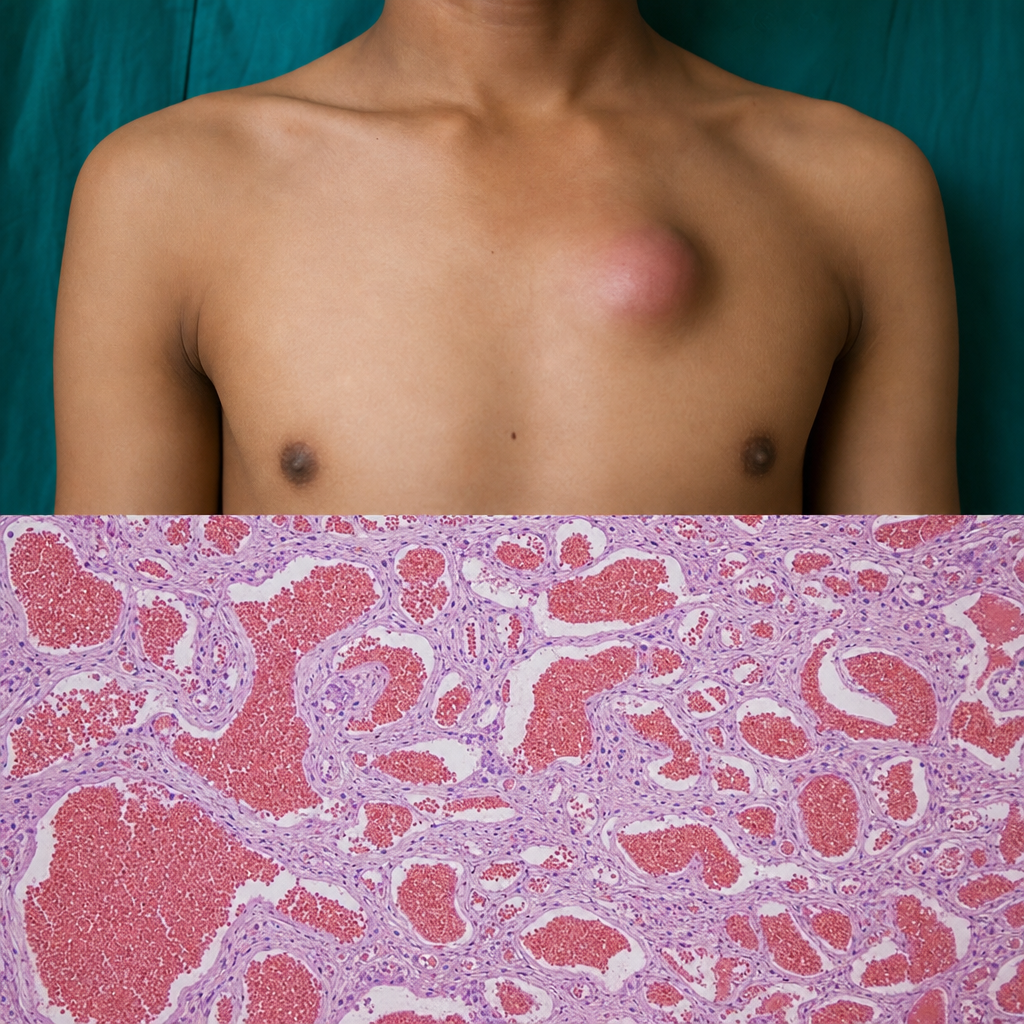
A 20-year-old patient presents with a soft to firm reddish swelling progressing in size over the precordium. Histopathological examination showed findings consistent with this lesion. What is the most likely diagnosis?

What is the most common site of acute aortic dissection?
What is an important feature in Henoch-Schönlein purpura?
Neointimal hyperplasia causes vascular graft failure as a result of hypertrophy of -
Explanation: ### Explanation **Correct Option: A. Lung** The underlying medical concept here is the **pathway of systemic venous circulation**. In the clinical context of a septic abortion, bacteria (often *Staphylococcus aureus* or *Streptococci*) enter the pelvic veins, leading to pelvic thrombophlebitis. These infected thrombi can travel to the right side of the heart, causing **Right-Sided Infective Endocarditis (RSIE)**, specifically involving the **tricuspid valve**. When vegetations (friable masses of fibrin, platelets, and microbes) detach from the tricuspid valve, they enter the right ventricle and are ejected into the **pulmonary artery**. Consequently, these emboli lodge in the **lungs**, leading to pulmonary septic emboli, lung abscesses, or infarction [1][2]. **Why the other options are incorrect:** * **B, C, and D (Liver, Meninges, Spleen):** These are sites of **systemic arterial embolism**. For an embolus to reach these organs, it must originate from the left side of the heart (mitral or aortic valves) [3] or pass through a right-to-left shunt (paradoxical embolism) [1]. Since the tricuspid valve is on the right side, the pulmonary capillary bed acts as a filter, preventing these emboli from entering the systemic arterial circulation [1][2]. **High-Yield Clinical Pearls for NEET-PG:** * **Right-Sided Endocarditis:** Most commonly associated with **IV drug users (IVDU)** and **septic abortions/pelvic infections**. * **Most Common Organism in IVDU:** *Staphylococcus aureus* (often involving the tricuspid valve). * **Complications of RSIE:** Multiple "shaggy" peripheral opacities on chest X-ray, representing septic pulmonary emboli [2]. * **Left-Sided Endocarditis:** More common in the general population; emboli typically lodge in the **brain (meninges)**, **spleen**, and **kidneys** [3]. **References:** [1] Kumar V, Abbas AK, et al.. Robbins and Cotran Pathologic Basis of Disease. 9th ed. Hemodynamic Disorders, Thromboembolic Disease, and Shock, pp. 137-138. [2] Kumar V, Abbas AK, et al.. Robbins and Cotran Pathologic Basis of Disease. 9th ed. The Lung, p. 705. [3] Kumar V, Abbas AK, et al.. Robbins and Cotran Pathologic Basis of Disease. 9th ed. Hemodynamic Disorders, Thromboembolic Disease, and Shock, pp. 136-137.
Explanation: **Explanation:** Atherosclerosis is a chronic inflammatory process affecting large and medium-sized elastic and muscular arteries [1]. In the coronary circulation, the distribution of atherosclerotic plaques is not uniform; it follows a specific hierarchy based on hemodynamic stress and flow patterns. **Why the LAD is the Correct Answer:** The **Left Anterior Descending (LAD) coronary artery** is the most common site for clinically significant atherosclerosis [2]. This is primarily due to its anatomical course and the high degree of shear stress at its bifurcation points. It supplies the majority of the left ventricle's anterior wall and the anterior two-thirds of the interventricular septum. Because of its critical territory and high frequency of occlusion, it is often referred to as the **"Widow Maker."** **Analysis of Incorrect Options:** * **Left Coronary Artery (Main):** While serious if occluded, isolated atherosclerosis of the left main trunk is statistically less common than involvement of its branches (LAD and Circumflex). * **Right Coronary Artery (RCA):** The RCA is the second most common site for significant atherosclerosis [2]. It typically supplies the posterior wall and the SA/AV nodes. * **Circumflex Coronary Artery:** This is generally the third most common site for significant atherosclerotic involvement among the major coronary vessels [2]. **NEET-PG High-Yield Pearls:** 1. **Hierarchy of Involvement:** The overall order of frequency for atherosclerosis in the body is: **Abdominal Aorta > Coronary Arteries > Popliteal Arteries > Internal Carotid > Circle of Willis.** 2. **Coronary Hierarchy:** Within the heart, the frequency is: **LAD > RCA > Circumflex.** 3. **Vessel Sparing:** Atherosclerosis characteristically **spares** the internal mammary (thoracic) arteries and the upper extremity arteries, which is why the internal mammary artery is preferred for CABG grafts. **References:** [1] Kumar V, Abbas AK, et al.. Robbins and Cotran Pathologic Basis of Disease. 9th ed. Diseases of Infancy and Childhood, pp. 507-508. [2] Kumar V, Abbas AK, et al.. Robbins and Cotran Pathologic Basis of Disease. 9th ed. The Heart, pp. 550-552.
Explanation: **Explanation:** **Churg-Strauss Syndrome (CSS)**, now known as **Eosinophilic Granulomatosis with Polyangiitis (EGPA)**, is a small-vessel necrotizing vasculitis classically characterized by a triad of asthma, peripheral blood eosinophilia, and extravascular necrotizing granulomas [1]. **Why Option D (Heart) is the correct answer (the "Except"):** While the heart can be involved in EGPA (often presenting as eosinophilic myocarditis or coronary vasculitis), it is **not** a defining or primary diagnostic feature of the syndrome compared to the other options. In the context of standard medical examinations like NEET-PG, the "classic" involvement focuses on the respiratory tract and kidneys. However, it is important to note that cardiac involvement is actually a major cause of mortality in these patients, but it is not considered a hallmark site for the initial clinical definition in the same way the lungs and small vessels are. **Analysis of Incorrect Options:** * **A. Lungs:** This is the most commonly involved organ. Patients typically present with severe asthma, allergic rhinitis, and pulmonary infiltrates [1]. * **B. Kidneys:** Though less common than in Granulomatosis with Polyangiitis (GPA), renal involvement occurs in about 25-50% of cases, typically presenting as focal segmental necrotizing glomerulonephritis [2]. * **C. Small blood vessels:** By definition, EGPA is a systemic vasculitis affecting small to medium-sized arteries and capillaries [2]. **High-Yield Clinical Pearls for NEET-PG:** * **Key Marker:** **p-ANCA** (anti-myeloperoxidase) is positive in approximately 40-50% of cases. * **Distinguishing Feature:** Unlike Wegener’s (GPA), EGPA is strongly associated with **asthma** and **marked eosinophilia** [1]. * **Histology:** Look for "allergic granulomas" (fibrinoid necrosis surrounded by eosinophils). * **Triad:** Asthma + Eosinophilia + Vasculitis. **References:** [1] Cross SS. Underwood's Pathology: A Clinical Approach. 6th ed. Common Clinical Problems From Respiratory Tract Disease, pp. 322-323. [2] Cross SS. Underwood's Pathology: A Clinical Approach. 6th ed. Common Clinical Problems From Diseases Of The Urinary And Male Genital Tracts, pp. 536-537.
Explanation: **Explanation:** Vasculitides are classified based on the size of the predominant vessels involved, as per the **Chapel Hill Consensus Conference (CHCC)**. Small vessel vasculitis primarily affects arterioles, capillaries, and venules [3]. **Why the correct answer is "All of the above":** All three conditions listed are subtypes of **ANCA-associated small vessel vasculitis**: * **Wegener Granulomatosis (Granulomatosis with Polyangiitis - GPA):** Characterized by necrotizing granulomatous inflammation of the respiratory tract and necrotizing glomerulonephritis [1]. It is strongly associated with **c-ANCA (PR3-ANCA)** [1]. * **Microscopic Polyangiitis (MPA):** A necrotizing vasculitis that lacks granulomatous inflammation [2]. It commonly involves the kidneys and lungs and is associated with **p-ANCA (MPO-ANCA)**. * **Churg-Strauss Syndrome (Eosinophilic Granulomatosis with Polyangiitis - EGPA):** Distinguished by eosinophil-rich inflammation, asthma, and peripheral blood eosinophilia. It is also associated with **p-ANCA**. **Clinical Pearls for NEET-PG:** 1. **ANCA Specificity:** Remember "C" for C-ANCA in Wegener’s (GPA). MPA and EGPA are typically P-ANCA positive. 2. **Pauci-immune:** Small vessel vasculitides are often "pauci-immune," meaning there is little to no antibody/complement deposition on immunofluorescence (unlike Henoch-Schönlein Purpura) [2]. 3. **Differential Diagnosis:** * **Large Vessel:** Giant Cell Arteritis, Takayasu Arteritis. * **Medium Vessel:** Polyarteritis Nodosa (PAN), Kawasaki Disease. 4. **Key Triad for GPA:** Upper respiratory tract involvement (sinusitis/saddle nose), Lower respiratory tract (hemoptysis), and Renal involvement (RPGN) [1]. **References:** [1] Kumar V, Abbas AK, et al.. Robbins and Cotran Pathologic Basis of Disease. 9th ed. Diseases of Infancy and Childhood, pp. 519-520. [2] Kumar V, Abbas AK, et al.. Robbins and Cotran Pathologic Basis of Disease. 9th ed. Diseases of Infancy and Childhood, pp. 518-519. [3] Cross SS. Underwood's Pathology: A Clinical Approach. 6th ed. Common Clinical Problems From Diseases Of The Urinary And Male Genital Tracts, pp. 536-537.
Explanation: ### Explanation The question asks which factor's **deficiency** increases thrombus formation. This is a classic "trap" question in NEET-PG that tests your attention to detail regarding whether an increase or decrease of a substance is pro-thrombotic. **Correct Option: A. Lipoprotein(a)** While Protein C, S, and Antithrombin III are natural anticoagulants (whose deficiency causes thrombosis), **Lipoprotein(a) [Lp(a)]** is a pro-thrombotic factor. An **increase** (elevation) in Lp(a) levels is associated with an increased risk of thrombosis and atherosclerosis. Therefore, its **deficiency** would actually be protective and **decrease** the incidence of thrombus formation. *Note: There appears to be a conceptual mismatch between the question stem ("deficiency") and the marked answer (Lp(a)). In standard pathology, deficiencies of B, C, and D cause thrombosis [1]. If the question asks which deficiency **increases** thrombus, the answer should be B, C, or D. If the answer is A, the question likely intended to ask which factor's **elevation** increases thrombus.* **Why Incorrect Options are Wrong:** * **B, C, and D (Protein C, S, and Antithrombin III):** These are endogenous anticoagulants [2]. * **Protein C & S:** Inactivate Factors Va and VIIIa [1]. * **Antithrombin III:** Inactivates Thrombin (IIa), Xa, and IXa. * **Deficiency** of any of these leads to a hypercoagulable state (Thrombophilia), significantly **increasing** the risk of venous thromboembolism (VTE) [1]. **High-Yield Clinical Pearls for NEET-PG:** * **Lp(a) Mechanism:** It is structurally homologous to **Plasminogen**. It competes with plasminogen for binding sites, thereby inhibiting fibrinolysis and promoting clot stability. * **Virchow’s Triad:** Endothelial injury, Stasis, and Hypercoagulability. * **Factor V Leiden:** The most common inherited cause of hypercoagulability (resistance to activated Protein C) [1]. * **Warfarin-Induced Skin Necrosis:** Occurs in patients with underlying **Protein C deficiency** when starting Warfarin without heparin bridging. **References:** [1] Kumar V, Abbas AK, et al.. Robbins and Cotran Pathologic Basis of Disease. 9th ed. Hemodynamic Disorders, Thromboembolic Disease, and Shock, pp. 133-134. [2] Cross SS. Underwood's Pathology: A Clinical Approach. 6th ed. Common Clinical Problems From Blood And Bone Marrow Disease, pp. 582-625.
Explanation: ### Explanation **Hypersensitivity Vasculitis** (also known as Leukocytoclastic Vasculitis) is a broad term describing a group of immune-mediated inflammatory conditions primarily affecting the **microvasculature** [1]. **1. Why Option B is the correct answer (The "False" statement):** Hypersensitivity vasculitis is strictly a **small-vessel vasculitis** [1]. It involves arterioles, capillaries, and, most characteristically, **post-capillary venules** [2]. It does **not** commonly affect medium-sized or large arteries (which are the domain of diseases like Polyarteritis Nodosa or Giant Cell Arteritis) [2]. Therefore, the statement that it affects medium and larger arteries is incorrect. **2. Analysis of other options:** * **Option A:** This is true. The pathogenesis typically involves **Type III hypersensitivity** (immune complex deposition, e.g., Henoch-Schönlein Purpura) but can also involve **Type IV (delayed-type) hypersensitivity** reactions triggered by drugs or infections [3]. * **Option C:** This is true. The condition represents an exaggerated immunologic response to exogenous antigens (drugs like penicillin, bacteria like Streptococci) or endogenous antigens (associated with SLE or malignancy) [3], [4]. **3. NEET-PG High-Yield Pearls:** * **Hallmark Clinical Feature:** **Palpable Purpura**, usually found on dependent areas like the lower extremities [1]. * **Histopathology:** Characterized by **Leukocytoclasis**—the presence of "nuclear dust" resulting from the fragmentation of neutrophils within the vessel wall, accompanied by fibrinoid necrosis [1], [2]. * **Common Triggers:** Drugs (Sulfonamides, Penicillins, NSAIDs) and Infections (Hepatitis B or C) [1]. * **Classification:** It is categorized under the Chapel Hill Consensus Criteria as a small-vessel vasculitis. **References:** [1] Cross SS. Underwood's Pathology: A Clinical Approach. 6th ed. Common Clinical Problems From Cardiovascular Disease, pp. 278-280. [2] Kumar V, Abbas AK, et al.. Robbins and Cotran Pathologic Basis of Disease. 9th ed. Diseases of Infancy and Childhood, pp. 518-519. [3] Kumar V, Abbas AK, et al.. Robbins and Cotran Pathologic Basis of Disease. 9th ed. Diseases of the Immune System, pp. 214-215. [4] Kumar V, Abbas AK, et al.. Robbins and Cotran Pathologic Basis of Disease. 9th ed. Diseases of Infancy and Childhood, pp. 520-521.
Explanation: ***Hemangioma*** - A **soft to firm reddish swelling** that progresses in size is characteristic of hemangioma, especially in a **young patient**. - Histopathologically shows **dilated blood-filled vascular channels** lined by **benign endothelial cells**, consistent with vascular proliferation. *Fibroadenoma* - This is a **benign breast tumor** composed of **glandular and stromal tissue**, not typically found over the precordium. - Presents as a **well-circumscribed, mobile mass** in the breast, usually **non-reddish** in appearance. *Lipoma* - A **benign adipose tissue tumor** that appears **yellow** and soft, not reddish as described in this case. - Histologically shows **mature fat cells** without vascular proliferation or endothelial cell lining. *Dermatofibroma* - A **benign fibrous skin tumor** that typically presents as a **firm, brownish papule**, not a reddish swelling. - Histologically shows **fibrous tissue proliferation** in the dermis, lacking the vascular channels seen in hemangiomas.
Explanation: **Explanation:** Aortic dissection occurs when blood enters the media through an intimal tear, creating a false lumen [2]. The **right lateral wall of the ascending aorta** (usually within 10 cm of the aortic valve) is the most common site for the initiating intimal tear [1]. **Why Option A is correct:** The ascending aorta is subjected to the highest **hemodynamic stress (dP/dt)** and shear forces from the left ventricular stroke volume. The right lateral wall is specifically vulnerable because it is the site where the high-velocity blood jet from the left ventricle directly impacts the aortic wall. This mechanical stress predisposes the intima to tearing, especially in patients with chronic hypertension or connective tissue disorders (e.g., Marfan syndrome). **Why other options are incorrect:** * **Option B (Arch of aorta):** While dissections can extend into the arch, it is a less frequent site for the *primary* intimal tear compared to the ascending aorta. * **Options C & D (Abdominal aorta):** The abdominal aorta is the most common site for **Atherosclerotic Aneurysms** [4], but it is a rare site for the initiation of an acute dissection. Dissections involving the abdominal aorta are usually extensions of a Stanford Type B dissection originating in the descending thoracic aorta. **High-Yield Clinical Pearls for NEET-PG:** * **Major Risk Factor:** Hypertension is the #1 risk factor for aortic dissection. * **Classification:** * **Stanford Type A:** Involves the ascending aorta (requires emergency surgery) [2]. * **Stanford Type B:** Involves only the descending aorta (usually managed medically) [2]. * **DeBakey Type I:** Originates in the ascending aorta and propagates to at least the arch. * **Histology:** The underlying pathological lesion is often **Cystic Medial Necrosis** (fragmentation of elastic tissue) [3]. * **Clinical Sign:** Sudden "tearing" chest pain radiating to the back with pulse asymmetry. **References:** [1] Kumar V, Abbas AK, et al.. Robbins and Cotran Pathologic Basis of Disease. 9th ed. Diseases of Infancy and Childhood, pp. 511-512. [2] Kumar V, Abbas AK, et al.. Robbins and Cotran Pathologic Basis of Disease. 9th ed. Diseases of Infancy and Childhood, pp. 512-513. [3] Cross SS. Underwood's Pathology: A Clinical Approach. 6th ed. Common Clinical Problems From Cardiovascular Disease, pp. 272-273. [4] Cross SS. Underwood's Pathology: A Clinical Approach. 6th ed. Common Clinical Problems From Cardiovascular Disease, pp. 271-272.
Explanation: **Explanation:** **Henoch-Schönlein Purpura (HSP)**, now commonly referred to as **IgA Vasculitis**, is a small-vessel vasculitis characterized by the deposition of immune complexes containing **Immunoglobulin A (IgA)**. 1. **Why "Raised IgA" is correct:** The hallmark of HSP is a Type III hypersensitivity reaction where IgA-dominant immune complexes deposit in the walls of small vessels (capillaries, venules, and arterioles). This leads to systemic inflammation. Clinically, serum IgA levels are elevated in approximately 50% of patients, and immunofluorescence microscopy of skin or renal biopsies characteristically shows granular IgA deposits [1]. 2. **Why other options are incorrect:** * **Membranous glomerulonephritis:** HSP is associated with **IgA Nephropathy** (Berger’s disease-like picture), characterized by mesangial proliferation [2], not membranous glomerulonephritis (which involves subepithelial IgG/C3 deposits). * **Absent radial pulse:** This is a classic feature of **Takayasu Arteritis** ("Pulseless disease"), a large-vessel vasculitis. * **Aneurysm of branching point:** This refers to **Berry Aneurysms** (associated with ADPKD) or the "string of beads" appearance seen in **Polyarteritis Nodosa (PAN)**, a medium-vessel vasculitis. **NEET-PG High-Yield Pearls:** * **Classic Tetrad:** 1. Palpable purpura (buttocks/legs), 2. Arthralgia, 3. Abdominal pain (colic/intussusception), 4. Renal disease (hematuria). * **Epidemiology:** Most common vasculitis in children; often follows an Upper Respiratory Tract Infection (URTI) [2]. * **Biopsy:** Shows Leukocytoclastic vasculitis with IgA deposition. **References:** [1] Cross SS. Underwood's Pathology: A Clinical Approach. 6th ed. Common Clinical Problems From Diseases Of The Urinary And Male Genital Tracts, pp. 535-536. [2] Kumar V, Abbas AK, et al.. Robbins and Cotran Pathologic Basis of Disease. 9th ed. The Kidney, pp. 928-929.
Explanation: **Explanation:** **Neointimal hyperplasia** is the universal response of a vessel to injury (such as vascular grafting, stenting, or balloon angioplasty) [1]. The correct answer is **Smooth Muscle Cells (SMCs)** because the hallmark of this process is the migration and proliferation of SMCs from the media into the intima [1]. 1. **Why Smooth Muscle Cells are correct:** When a vessel is injured, inflammatory mediators and growth factors (like PDGF and FGF) trigger quiescent SMCs in the tunica media to undergo a phenotypic switch [1]. They migrate into the subendothelial space (intima), proliferate, and acquire new biosynthetic capabilities [1]. This results in a thickened "neointima" that narrows the vessel lumen, leading to graft failure or restenosis [1]. 2. **Why other options are incorrect:** * **Endothelial cells:** While endothelial injury initiates the process, these cells do not undergo hypertrophy to cause luminal narrowing; rather, their dysfunction or loss triggers the SMC response. * **Collagen and Elastic fibers:** These are components of the extracellular matrix. While collagen deposition increases during intimal thickening, the primary cellular driver and the entity undergoing "hypertrophy/proliferation" is the smooth muscle cell, not the fibers themselves. **NEET-PG High-Yield Pearls:** * **Key Growth Factor:** Platelet-Derived Growth Factor (PDGF) is the most potent stimulator of SMC migration. * **Phenotypic Switch:** SMCs change from a "contractile" state to a "synthetic" state during neointimal formation [1]. * **Difference from Atherosclerosis:** Neointimal hyperplasia is a predictable, stereotyped response to mechanical injury, whereas atherosclerosis is a chronic inflammatory process involving lipid accumulation. **References:** [1] Kumar V, Abbas AK, et al.. Robbins and Cotran Pathologic Basis of Disease. 9th ed. Diseases of Infancy and Childhood, pp. 494-495.
Atherosclerosis
Practice Questions
Hypertensive Vascular Disease
Practice Questions
Aneurysms and Dissection
Practice Questions
Vasculitis
Practice Questions
Venous Disease and Thrombosis
Practice Questions
Vascular Tumors
Practice Questions
Varicose Veins and Lymphatics
Practice Questions
Pathology of Vascular Interventions
Practice Questions
Vascular Diseases in Specific Organs
Practice Questions
Congenital Vascular Anomalies
Practice Questions
Get full access to all questions, explanations, and performance tracking.
Start For Free