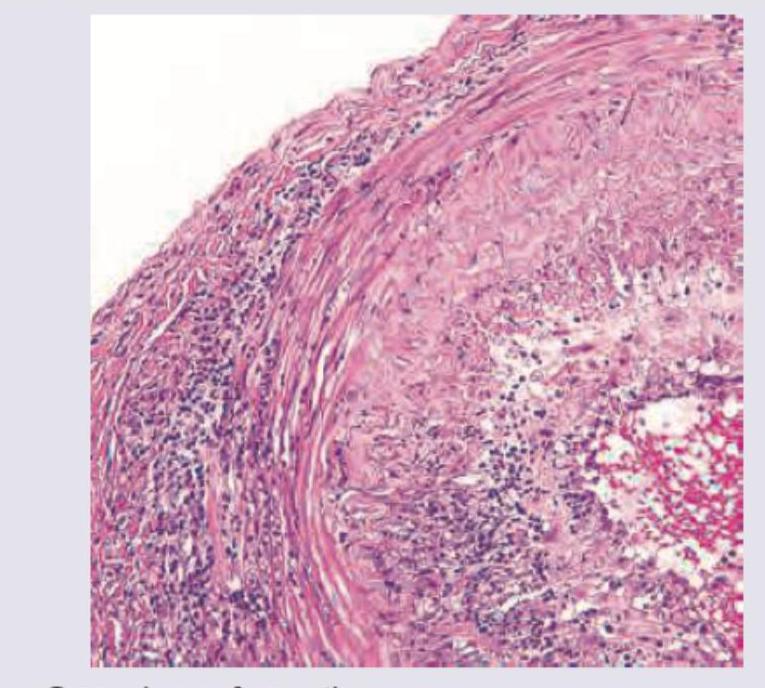
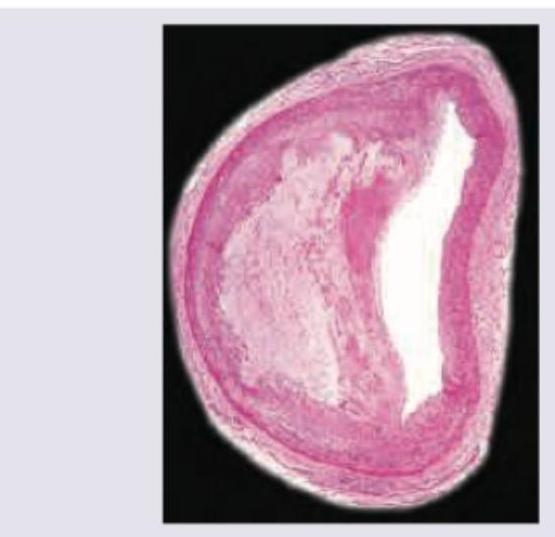
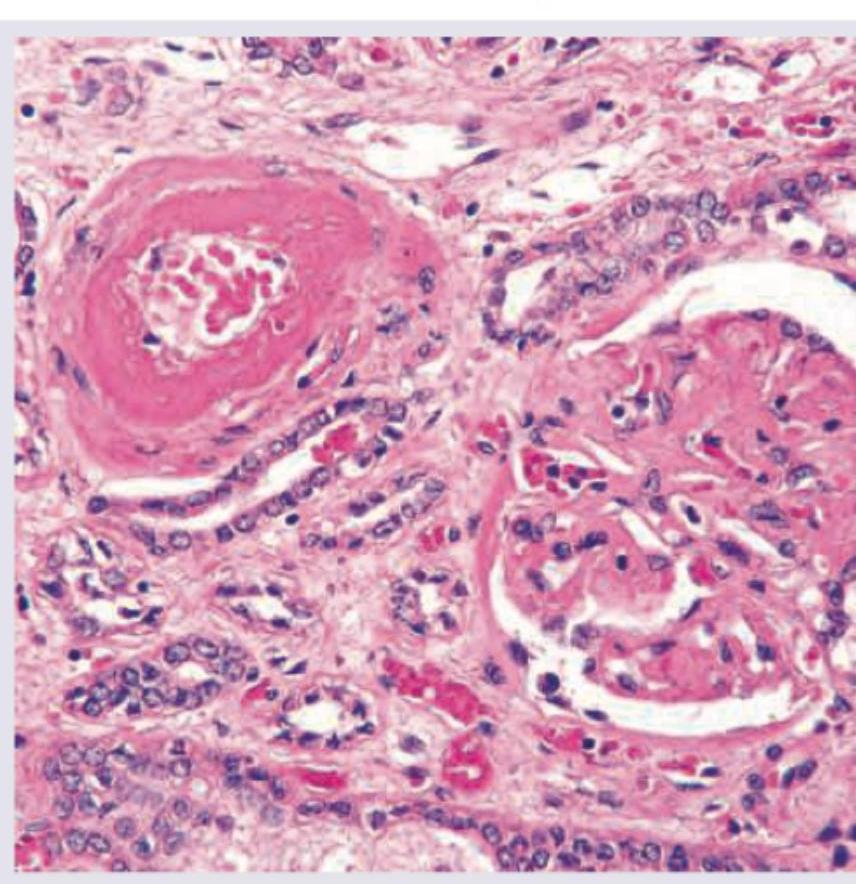
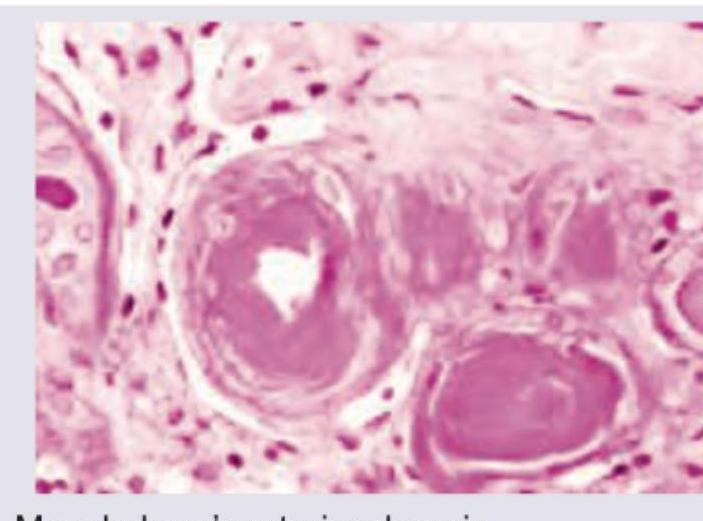
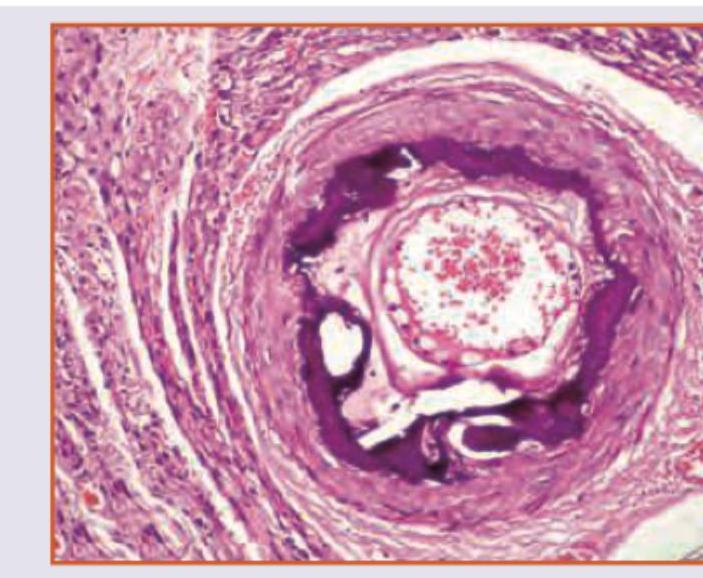
The pathogenesis of which of the following conditions is NOT granulomatous?
A study of atheromatous plaques shows that the release of growth factors, including PDGF, FGF, and TNF-a, leads to increased extracellular matrix production. As a result, the size of the plaques increases. Which of the following cells is most likely to release these growth factors in the plaques?
What causes the maximum effect of reperfusion injury in the myocardium?
Onion skin thickening of the arteriolar wall is seen in which condition?
Atheromatous changes of blood vessels affect which organ earliest?
What is the earliest manifestation in the fatty streak of atherosclerosis?
Hypersensitivity vasculitis is typically seen in which of the following vascular structures?
What is the typical histological change seen in benign hypertension?
Stewart-Treves syndrome is described as the development of which of the following?
Which of the following is a feature of temporal arteritis?
Explanation: **Explanation:** The core concept in differentiating small-vessel vasculitides is the presence or absence of **granulomatous inflammation**. **Microscopic Polyangiitis (MPA)** is the correct answer because it is a **pauci-immune, non-granulomatous necrotizing vasculitis** [1]. Unlike other ANCA-associated vasculitides, MPA lacks both granulomas and asthma [1]. It primarily involves small vessels (capillaries, venules, arterioles) and is characterized by segmental fibrinoid necrosis and the presence of **p-ANCA (MPO-ANCA)** in 70-80% of cases [1]. **Why the other options are incorrect:** * **Wegener’s Granulomatosis (GPA):** As the name suggests, it is defined by a triad of necrotizing granulomas of the respiratory tract, necrotizing vasculitis, and glomerulonephritis [2]. It is typically **c-ANCA (PR3-ANCA)** positive [2]. * **Buerger’s Disease (Thromboangiitis Obliterans):** This is characterized by an acute and chronic inflammation of intermediate and small arteries. A hallmark histological feature is the **microabscess** within the thrombus, often surrounded by **granulomatous inflammation**. * **Takayasu Arteritis:** This is a "Large Vessel Vasculitis" (Pulseless disease). The histopathology shows transmural mononuclear infiltration and **giant cell granulomatous inflammation** in the adventitia and media [3]. **High-Yield Clinical Pearls for NEET-PG:** * **ANCA Association:** GPA = c-ANCA [2]; MPA = p-ANCA [1]; Churg-Strauss (EGPA) = p-ANCA. * **Granuloma Check:** GPA and EGPA have granulomas; **MPA does NOT.** [1] * **Buerger’s Disease:** Strongly associated with heavy smoking; involves the "corkscrew collateral" sign on angiography. * **Takayasu vs. Giant Cell Arteritis:** Both are granulomatous; Takayasu affects patients <50 years (Aortic arch), while Giant Cell affects patients >50 years (Temporal artery) [3]. **References:** [1] Kumar V, Abbas AK, et al.. Robbins and Cotran Pathologic Basis of Disease. 9th ed. Diseases of Infancy and Childhood, pp. 518-519. [2] Kumar V, Abbas AK, et al.. Robbins and Cotran Pathologic Basis of Disease. 9th ed. Diseases of Infancy and Childhood, pp. 519-520. [3] Kumar V, Abbas AK, et al.. Robbins and Cotran Pathologic Basis of Disease. 9th ed. Diseases of Infancy and Childhood, pp. 516-517.
Explanation: The development of an atheromatous plaque is a dynamic process described by the **"Response to Injury" hypothesis**. The correct answer is **Smooth Muscle Cells (SMCs)** because they play a dual role in atherosclerosis: they migrate from the media to the intima [1] and switch from a "contractile" phenotype to a **"synthetic" phenotype** [3]. 1. **Why Smooth Muscle is Correct:** Once recruited to the subendothelial space, SMCs become the primary "metabolic engines" of the plaque. They secrete potent growth factors like **PDGF, FGF, and TGF-beta**, which act in an autocrine and paracrine fashion [4]. Most importantly, SMCs are the **sole source of collagen, elastin, and proteoglycans** (extracellular matrix) that form the **fibrous cap**, leading to plaque stabilization and increased size [1]. 2. **Why Other Options are Incorrect:** * **Endothelium:** While endothelial dysfunction initiates the process, these cells primarily express adhesion molecules (VCAM-1) to recruit leukocytes rather than being the primary source of the ECM-stimulating growth factors mentioned. * **Fibroblast:** Unlike in standard wound healing, traditional fibroblasts are not the dominant cell type in the arterial intima. In atherosclerosis, the SMC performs the "fibroblast-like" role of matrix synthesis [3]. * **Platelet:** Platelets do release PDGF upon initial adhesion to a denuded area, but they are not responsible for the sustained, long-term increase in plaque size or the massive production of ECM seen in established plaques [4]. **High-Yield NEET-PG Pearls:** * **PDGF (Platelet-Derived Growth Factor):** The most important factor for the **migration** and **proliferation** of SMCs [1]. * **TGF-beta:** The most important factor for **collagen synthesis** within the plaque [2]. * **Vulnerable vs. Stable Plaque:** A plaque with a thin fibrous cap (low SMC/collagen content) is "vulnerable" to rupture, whereas a thick fibrous cap (high SMC/collagen content) is "stable." **References:** [1] Kumar V, Abbas AK, et al.. Robbins and Cotran Pathologic Basis of Disease. 9th ed. Diseases of Infancy and Childhood, pp. 505-506. [2] Kumar V, Abbas AK, et al.. Robbins and Cotran Pathologic Basis of Disease. 9th ed. Inflammation and Repair, pp. 115-116. [3] Kumar V, Abbas AK, et al.. Robbins and Cotran Pathologic Basis of Disease. 9th ed. Diseases of Infancy and Childhood, pp. 494-495. [4] Kumar V, Abbas AK, et al.. Robbins and Cotran Pathologic Basis of Disease. 9th ed. With Illustrations By, pp. 31-32.
Explanation: **Explanation:** **Reperfusion injury** occurs when blood flow is restored to ischemic tissue, paradoxically causing additional cell death. The primary driver of this damage is the sudden burst of **Reactive Oxygen Species (ROS) / Free Radicals [1].** **Why Free Radicals are the Correct Answer:** When oxygen is reintroduced to previously ischemic myocardial cells, the damaged mitochondria cannot efficiently reduce oxygen, leading to the "Oxygen Paradox." This results in the massive production of free radicals (Superoxide, Hydrogen peroxide, and Hydroxyl radicals) [1]. These radicals cause: 1. **Membrane Damage:** Lipid peroxidation of mitochondrial and plasma membranes [2]. 2. **Protein Oxidation:** Denaturation of structural and enzymatic proteins. 3. **DNA Damage:** Leading to apoptosis or necrosis [1]. 4. **Mitochondrial Permeability Transition Pore (MPTP) opening:** Which leads to ATP depletion and cell death [1]. **Why other options are incorrect:** * **A. Neutrophils:** While neutrophils do migrate to the site of injury and contribute to inflammation by releasing secondary ROS and proteases, they are considered a *secondary* wave of injury. The immediate, maximum damage is initiated by the intracellular burst of free radicals. * **B & D. Monocytes and Eosinophils:** Monocytes appear later in the inflammatory cascade (chronic phase) for wound healing and debris clearance. Eosinophils are primarily involved in allergic reactions and parasitic infections, playing no significant role in myocardial reperfusion injury. **NEET-PG High-Yield Pearls:** * **Morphological Hallmark:** Reperfusion injury is characterized by **Contraction Band Necrosis** (due to hypercontraction of myofibrils from calcium overload). * **Key Enzymes:** Superoxide dismutase (SOD), Catalase, and Glutathione peroxidase act as endogenous scavengers to mitigate this damage [2]. * **Clinical Correlation:** This is why "Time is Muscle" in MI management; however, therapeutic interventions often focus on antioxidants or cooling to reduce ROS production during stenting (PCI). **References:** [1] Cross SS. Underwood's Pathology: A Clinical Approach. 6th ed. (Basic Pathology) introduces the student to key general principles of pathology, both as a medical science and as a clinical activity with a vital role in patient care. Part 2 (Disease Mechanisms) provides fundamental knowledge about the cellular and molecular processes involved in diseases, providing the rationale for their treatment. Part 3 (Systematic Pathology) deals in detail with specific diseases, with emphasis on the clinically important aspects., pp. 102-103. [2] Kumar V, Abbas AK, et al.. Robbins and Cotran Pathologic Basis of Disease. 9th ed. Cellular Responses to Stress and Toxic Insults: Adaptation, Injury, and Death, pp. 59-60.
Explanation: **Explanation:** **Hyperplastic arteriolosclerosis** is the correct answer. This condition is the hallmark of **malignant hypertension** (diastolic BP >120 mmHg) [1], [2]. The "onion skin" appearance results from the concentric, laminated thickening of the arteriolar wall due to the proliferation of smooth muscle cells and the reduplication of the basement membrane [1], [2]. This is a physiological response to severe, acute pressure elevation, often accompanied by fibrinoid necrosis (necrotizing arteriolitis), particularly in the kidneys [1]. **Analysis of Incorrect Options:** * **A. Atherosclerosis:** This involves the formation of fibrofatty plaques (atheromas) in the intima of **large and medium-sized arteries** (e.g., aorta, coronary arteries), not arterioles. * **B. Median calcific sclerosis (Mönckeberg):** Characterized by ring-like calcifications in the **media** of medium-sized muscular arteries. It does not narrow the lumen and is usually clinically silent. * **C. Hyaline arteriolosclerosis:** Seen in **benign hypertension** and diabetes mellitus [2]. It appears as a homogenous, pink, glassy thickening of the wall due to plasma protein leakage and increased matrix synthesis, lacking the laminated "onion skin" layers [2]. **NEET-PG High-Yield Pearls:** * **Hyaline = Benign** hypertension; **Hyperplastic = Malignant** hypertension [2]. * Hyperplastic arteriolosclerosis in the kidney leads to a **"flea-bitten" kidney** appearance due to pinpoint petechial hemorrhages. * The "onion skin" pattern is also classically seen in **Ewing Sarcoma** (periosteal reaction) and **Primary Sclerosing Cholangitis** (periductal fibrosis). **References:** [1] Kumar V, Abbas AK, et al.. Robbins and Cotran Pathologic Basis of Disease. 9th ed. The Kidney, p. 945. [2] Kumar V, Abbas AK, et al.. Robbins and Cotran Pathologic Basis of Disease. 9th ed. Diseases of Infancy and Childhood, pp. 498-499.
Explanation: **Explanation:** Atherosclerosis is a chronic inflammatory process affecting large and medium-sized elastic and muscular arteries [1]. The distribution of atheromatous plaques is not uniform throughout the body; it follows a specific hierarchy based on hemodynamic stress and vessel susceptibility [3]. **Why the Heart is Correct:** The **Abdominal Aorta** is the most common and earliest site for atherosclerosis, followed closely by the **Coronary Arteries (Heart)** [2]. In the context of the given options, the coronary arteries develop significant atheromatous changes much earlier than the vessels supplying the kidneys, liver, or spleen [1]. Clinical manifestations like angina or myocardial infarction often precede vascular complications in other solid organs [4]. **Why Other Options are Incorrect:** * **Kidney:** Renal artery atherosclerosis occurs later than coronary involvement [1]. While it can lead to renovascular hypertension, it is statistically less frequent and occurs later in the disease progression compared to the heart. * **Liver:** The liver has a dual blood supply (portal vein and hepatic artery). The hepatic artery is rarely a primary site for early symptomatic atherosclerosis. * **Spleen:** The splenic artery is a common site for *Mönckeberg medial calcific sclerosis* (a non-obstructive condition) and can develop atherosclerosis in the elderly, but it is not the earliest site involved. **High-Yield Facts for NEET-PG:** * **Order of Frequency/Severity:** Abdominal Aorta > Coronary Arteries > Popliteal Arteries > Internal Carotid Arteries > Circle of Willis. * **Earliest Lesion:** The "Fatty Streak" is the earliest precursor, seen even in children [2]. * **Complications:** The most common cause of death due to atherosclerosis is Ischemic Heart Disease (IHD) [4]. * **Key Risk Factor:** Hyperlipidemia (specifically high LDL) is the most significant modifiable risk factor [3]. **References:** [1] Kumar V, Abbas AK, et al.. Robbins and Cotran Pathologic Basis of Disease. 9th ed. Diseases of Infancy and Childhood, pp. 507-508. [2] Kumar V, Abbas AK, et al.. Robbins and Cotran Pathologic Basis of Disease. 9th ed. Diseases of Infancy and Childhood, pp. 504-505. [3] Kumar V, Abbas AK, et al.. Robbins and Cotran Pathologic Basis of Disease. 9th ed. Diseases of Infancy and Childhood, pp. 502-503. [4] Kumar V, Abbas AK, et al.. Robbins and Cotran Pathologic Basis of Disease. 9th ed. Diseases of Infancy and Childhood, pp. 499-500.
Explanation: **Explanation:** The **fatty streak** is the earliest visible lesion of atherosclerosis, appearing as yellow, flat macules or streaks on the intimal surface of arteries [2]. **Why Option A is Correct:** The pathogenesis of atherosclerosis begins with **endothelial dysfunction** [1]. According to the "Response to Injury" hypothesis, chronic endothelial injury leads to increased permeability. The very first microscopic change is the **accumulation of lipoproteins (mainly LDL)** within the subendothelial space and the **endothelial cells themselves**. While foam cells (macrophages) are the hallmark of a fatty streak, the initial lipid entry into the vessel wall involves the endothelial layer. **Why Other Options are Incorrect:** * **Option B:** While smooth muscle cells (SMCs) do eventually migrate from the media to the intima and ingest lipids to become "myogenic foam cells," this occurs **after** the initial lipid accumulation in the endothelium and macrophages [1]. * **Option C:** Endothelial cell **damage/dysfunction** is the *triggering event* or the "initiator," but it is not considered a "manifestation" of the fatty streak itself. The fatty streak is defined by the physical presence of lipid deposits [2]. **NEET-PG High-Yield Pearls:** * **Earliest visible lesion:** Fatty streak (can be seen in children <10 years old). * **Earliest microscopic change:** Lipid accumulation in endothelial cells. * **Foam Cells:** Derived primarily from **monocyte-derived macrophages** (and some SMCs) that ingest oxidized LDL via scavenger receptors (CD36) [1]. * **Location:** Fatty streaks often occur at sites of turbulent flow (branch points), but unlike mature plaques, they do not necessarily progress to obstructive disease in all locations [1]. * **Reversibility:** Fatty streaks are potentially reversible, whereas fibrofatty plaques are not [2]. **References:** [1] Kumar V, Abbas AK, et al.. Robbins and Cotran Pathologic Basis of Disease. 9th ed. Diseases of Infancy and Childhood, pp. 502-503. [2] Cross SS. Underwood's Pathology: A Clinical Approach. 6th ed. Common Clinical Problems From Cardiovascular Disease, pp. 268-270.
Explanation: **Explanation:** **Hypersensitivity Vasculitis** (also known as Leukocytoclastic Vasculitis or Cutaneous Small Vessel Vasculitis) is an immune-mediated inflammation of the small blood vessels [2]. **Why Postcapillary Venules are the correct answer:** The primary site of involvement in hypersensitivity vasculitis is the **postcapillary venules** [1]. This occurs because these vessels are the preferred site for the deposition of circulating immune complexes (Type III Hypersensitivity) [3]. The slow blood flow and increased permeability in the venular bed facilitate the entrapment of these complexes in the vessel wall, triggering the complement cascade and subsequent recruitment of neutrophils [1][3]. **Analysis of Incorrect Options:** * **A. Capillaries:** While technically "small vessels," they are less commonly the primary site of leukocytoclastic changes compared to the venular side of the microcirculation. * **B. Arterioles:** These are involved in systemic vasculitides like Polyarteritis Nodosa (PAN) or hypertensive changes, but they are not the classic site for hypersensitivity-induced lesions [1]. * **D. Medium-sized vessels:** These include the renal or mesenteric arteries. Involvement of these vessels is characteristic of Polyarteritis Nodosa (PAN) or Kawasaki disease, not hypersensitivity vasculitis [1]. **High-Yield NEET-PG Pearls:** * **Histopathology:** Characterized by **Leukocytoclasis** (nuclear debris or "nuclear dust" from fragmented neutrophils) and **fibrinoid necrosis** [1][2]. * **Clinical Presentation:** Typically presents as **palpable purpura**, most commonly on the lower extremities [2]. * **Common Triggers:** Drugs (Penicillin, Sulfa drugs), infections (Streptococcus, Hepatitis B/C), or systemic diseases (SLE) [2]. * **Classification:** It falls under the category of **Small Vessel Vasculitis** (Chapel Hill Consensus) [2]. **References:** [1] Kumar V, Abbas AK, et al.. Robbins and Cotran Pathologic Basis of Disease. 9th ed. Diseases of Infancy and Childhood, pp. 518-519. [2] Cross SS. Underwood's Pathology: A Clinical Approach. 6th ed. Common Clinical Problems From Cardiovascular Disease, pp. 279-280. [3] Kumar V, Abbas AK, et al.. Robbins and Cotran Pathologic Basis of Disease. 9th ed. Diseases of the Immune System, pp. 214-215.
Explanation: **Explanation:** The hallmark of **benign hypertension** is **Hyaline Arteriolosclerosis** [1], [2]. This occurs due to chronic, low-grade hemodynamic stress, which causes plasma proteins to leak across the injured endothelium into the vessel wall [1]. This is accompanied by increased smooth muscle cell matrix synthesis. Histologically, this manifests as a **homogeneous, pink, hyaline thickening** of the arteriolar walls with associated luminal narrowing [1], [2]. The "intimal proliferation and hyalinization" described in the correct option reflects this chronic adaptive and degenerative process [1]. **Analysis of Incorrect Options:** * **Option A:** Formation of new vessels (angiogenesis) is typically a response to ischemia or neoplasia, not a characteristic feature of hypertensive vascular disease. * **Option B:** While endothelial dysfunction occurs, the "loss" of cells is not the defining histological feature; rather, it is the thickening of the wall that characterizes the pathology. * **Option C:** **Fibrinoid necrosis** (along with "onion-skin" hyperplasia) is the pathognomonic feature of **Malignant Hypertension**, not benign hypertension [2], [4]. It represents acute, severe vascular injury [4]. **High-Yield Clinical Pearls for NEET-PG:** * **Hyaline Arteriolosclerosis** is most commonly seen in the kidneys of patients with benign hypertension and diabetes mellitus (**Benign Nephrosclerosis**) [1], [3]. * **Hyperplastic Arteriolosclerosis** ("onion-skinning") is the hallmark of **Malignant Hypertension** (Diastolic BP >120 mmHg) [2], [4]. * In diabetes, hyaline arteriolosclerosis involves both **afferent and efferent arterioles** of the kidney, whereas in hypertension, it primarily affects the afferent arteriole. **References:** [1] Kumar V, Abbas AK, et al.. Robbins and Cotran Pathologic Basis of Disease. 9th ed. The Kidney, pp. 943-945. [2] Kumar V, Abbas AK, et al.. Robbins and Cotran Pathologic Basis of Disease. 9th ed. Diseases of Infancy and Childhood, pp. 498-499. [3] Cross SS. Underwood's Pathology: A Clinical Approach. 6th ed. Common Clinical Problems From Diseases Of The Urinary And Male Genital Tracts, pp. 541-542. [4] Kumar V, Abbas AK, et al.. Robbins and Cotran Pathologic Basis of Disease. 9th ed. The Kidney, p. 945.
Explanation: **Explanation:** **Stewart-Treves Syndrome** refers to the development of **Lymphangiosarcoma** (a malignant tumor of lymphatic vessels) as a complication of chronic, long-standing lymphedema. 1. **Why Option A is correct:** The classic clinical scenario involves a patient who has undergone a **Radical Mastectomy** with axillary lymph node dissection for breast cancer [2]. The resulting disruption of lymphatic drainage leads to chronic lymphedema of the arm (brawny edema). After a long latency period (typically 10–15 years), the chronic stasis and localized immunodeficiency trigger the formation of lymphangiosarcoma [1], which presents as persistent cutaneous nodules or bruising. 2. **Why other options are incorrect:** * **Option B (Rhabdomyoma):** This is a benign tumor of striated muscle, most commonly associated with Tuberous Sclerosis when found in the heart. * **Option C (Angiosarcoma):** While lymphangiosarcoma is a subtype of angiosarcoma, "Lymphangiosarcoma" is the specific term used in the context of Stewart-Treves syndrome [1]. In modern pathology, they are often grouped under "Angiosarcoma associated with lymphedema," but for NEET-PG, Lymphangiosarcoma remains the classic answer. * **Option D (Mesothelioma):** This is a malignancy of the mesothelial lining (pleura or peritoneum), primarily associated with asbestos exposure. **High-Yield Clinical Pearls for NEET-PG:** * **Latency:** Usually occurs **10 years or more** post-mastectomy. * **Risk Factor:** Chronic lymphedema is the primary driver, not the radiation therapy itself (though radiation can exacerbate edema). * **Appearance:** Presents as purple-red skin nodules or a "bruise" that does not heal on the lymphedematous limb [1]. * **Prognosis:** Extremely poor due to early hematogenous spread [1]. **References:** [1] Kumar V, Abbas AK, et al.. Robbins and Cotran Pathologic Basis of Disease. 9th ed. Diseases of Infancy and Childhood, pp. 527-528. [2] Cross SS. Underwood's Pathology: A Clinical Approach. 6th ed. (Basic Pathology) introduces the student to key general principles of pathology, both as a medical science and as a clinical activity with a vital role in patient care. Part 2 (Disease Mechanisms) provides fundamental knowledge about the cellular and molecular processes involved in diseases, providing the rationale for their treatment. Part 3 (Systematic Pathology) deals in detail with specific diseases, with emphasis on the clinically important aspects., pp. 125-126.
Explanation: **Explanation:** Temporal arteritis, also known as **Giant Cell Arteritis (GCA)**, is the most common form of systemic vasculitis in adults older than 50 [1]. The correct answer is **A** because "Giant Cell Arteritis" is the synonymous medical term for this condition, reflecting its characteristic histopathology. **Understanding the Options:** * **A. Giant Cell Arteritis (Correct):** This is the definitive name for the condition. It primarily affects large to medium-sized arteries, especially branches of the carotid artery (temporal, ophthalmic, and vertebral) [3]. * **B. Granulomatous Vasculitis:** While GCA *is* a granulomatous vasculitis [2], this is a **morphological description** rather than the name of the disease itself. In the context of this specific question, Option A is the most precise clinical designation. * **C. Necrotizing Vasculitis:** This pattern is characteristic of Polyarteritis Nodosa (PAN) or Granulomatosis with Polyangiitis (GPA). GCA is characterized by granulomatous inflammation and internal elastic lamina fragmentation, not fibrinoid necrosis [1]. * **D. Leukocytoclastic Vasculitis:** This refers to small-vessel vasculitis (e.g., Henoch-Schönlein Purpura) characterized by nuclear debris (karyorrhexis) of neutrophils. **High-Yield Clinical Pearls for NEET-PG:** * **Demographics:** Females > Males; age > 50 years [2]. * **Clinical Triad:** New-onset headache, jaw claudication, and scalp tenderness [2]. * **Emergency:** Sudden painless monocular vision loss (due to ophthalmic artery involvement) is a medical emergency [3]. * **Diagnosis:** Elevated ESR (>50-100 mm/hr) is a classic screening finding [2]. Temporal artery biopsy is the gold standard (note: "skip lesions" require a long biopsy segment) [1]. * **Association:** Strongly associated with **Polymyalgia Rheumatica** (proximal muscle pain/stiffness) [2]. * **Treatment:** Immediate high-dose corticosteroids to prevent blindness. **References:** [1] Kumar V, Abbas AK, et al.. Robbins and Cotran Pathologic Basis of Disease. 9th ed. Diseases of Infancy and Childhood, pp. 515-517. [2] Cross SS. Underwood's Pathology: A Clinical Approach. 6th ed. Common Clinical Problems From Osteoarticular And Connective Tissue Disease, pp. 686-687. [3] Cross SS. Underwood's Pathology: A Clinical Approach. 6th ed. Common Clinical Problems From Osteoarticular And Connective Tissue Disease, pp. 688-689.
Atherosclerosis
Practice Questions
Hypertensive Vascular Disease
Practice Questions
Aneurysms and Dissection
Practice Questions
Vasculitis
Practice Questions
Venous Disease and Thrombosis
Practice Questions
Vascular Tumors
Practice Questions
Varicose Veins and Lymphatics
Practice Questions
Pathology of Vascular Interventions
Practice Questions
Vascular Diseases in Specific Organs
Practice Questions
Congenital Vascular Anomalies
Practice Questions
Get full access to all questions, explanations, and performance tracking.
Start For Free