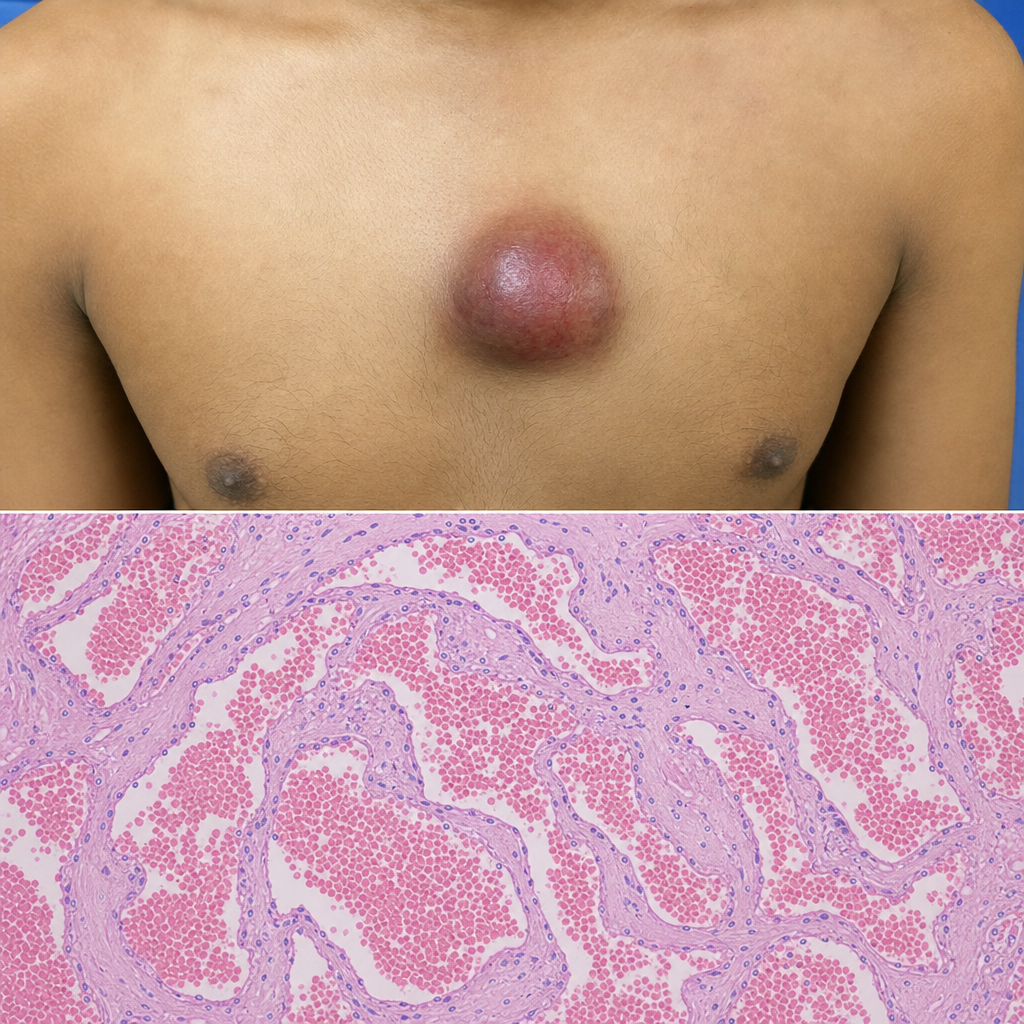
Which of the following statements is FALSE regarding fibromuscular dysplasia?
Which organ is least affected by arterial thromboembolism?
A 21-year-old female presented with aortic arch aneurysm. She underwent resection, and the specimen was sent for histopathological examination. It showed involvement of all three layers with the presence of giant cells. What is the probable diagnosis?
A segment of the aerial intima of a coronary vessel is observed at autopsy in a 56-year old man who died suddenly on rising in the morning. Which of the following abnormalities is considered a major risk factor for the development of this lesion?
What is the most common source of pulmonary embolism?
A 30-year-old male smoker presents with gangrene of his extremities. Which one of the following histologic findings from a biopsy of the blood vessels supplying this area would be most suggestive of Buerger's disease?
Which of the following is a medium-sized arterial disease?
Mitral valve vegetations do not usually embolize to which of the following locations?
What is the major change occurring in blood vessels in hypertension?
Which of the following is true about the basic structure of an atherosclerotic plaque?
Explanation: **Explanation:** Fibromuscular dysplasia (FMD) is a non-atherosclerotic, non-inflammatory vascular disease characterized by abnormal cell growth in the arterial walls. **1. Why Option C is the correct (False) statement:** FMD is significantly more common in **young to middle-aged females** (typically aged 20–50 years), with a female-to-male ratio of approximately 9:1 [1]. The statement that it is most common in young males is incorrect, making it the right choice for this question. **2. Analysis of other options:** * **Option A (Medial fibroplasia):** This is the most common histological subtype (accounting for ~80-90% of cases). It involves replacement of smooth muscle with collagen in the tunica media, leading to alternating areas of stenosis and aneurysmal dilation. * **Option B (Medium-sized vessels):** FMD primarily involves medium-sized muscular arteries. The **renal arteries** (60-75%) are most commonly affected, followed by the internal carotid and vertebral arteries. * **Option D ('String of beads'):** This is the classic angiographic hallmark of the medial fibroplasia subtype. The "beads" represent aneurysmal dilations that are wider than the normal proximal arterial segment. **High-Yield NEET-PG Pearls:** * **Clinical Presentation:** Most commonly presents as **secondary hypertension** (due to renal artery stenosis) in a young female. * **Bruit:** A systolic-diastolic bruit may be heard over the flank (renal) or neck (carotid). * **Complications:** Can lead to dissections, aneurysms, or ischemic stroke [2]. * **Diagnosis:** CTA or MRA are initial tests, but **Digital Subtraction Angiography (DSA)** remains the gold standard. **References:** [1] Kumar V, Abbas AK, et al.. Robbins and Cotran Pathologic Basis of Disease. 9th ed. Diseases of Infancy and Childhood, pp. 493-494. [2] Kumar V, Abbas AK, et al.. Robbins and Cotran Pathologic Basis of Disease. 9th ed. Diseases of Infancy and Childhood, pp. 510-511.
Explanation: **Explanation:** The susceptibility of an organ to infarction following an arterial thromboembolism depends primarily on its **vascular anatomy and blood supply**. **1. Why Liver is the Correct Answer:** The liver is remarkably resistant to infarction because it possesses a **dual blood supply**. It receives oxygenated blood from the **hepatic artery** (approx. 25%) and nutrient-rich blood from the **portal vein** (approx. 75%). If the hepatic artery is obstructed by an embolus, the portal vein continues to provide sufficient oxygenation to maintain parenchymal viability. Consequently, hepatic infarction is rare and usually only occurs if both systems are compromised (e.g., in severe systemic hypotension or transplant rejection). **2. Analysis of Incorrect Options:** * **Kidney (B):** The kidney is highly susceptible to infarction because it has **"end-arterial" circulation**. The renal arteries branch into segmental and interlobular arteries with no significant anastomoses. Obstruction leads to characteristic wedge-shaped pale infarcts. * **Heart (C):** The coronary arteries are functional end-arteries. Although some collateral circulation exists, acute thromboembolic occlusion typically leads to myocardial infarction. * **Brain (D):** The brain is extremely sensitive to hypoxia [2]. While the Circle of Willis provides some collateralization, the distal cerebral arteries are end-arteries [2]. Obstruction leads to liquefactive necrosis. **High-Yield NEET-PG Pearls:** * **Dual Supply Organs:** Liver (Hepatic artery/Portal vein) and Lungs (Bronchial/Pulmonary arteries) are resistant to infarction [1]. * **End-Artery Organs:** Spleen and Kidney (most common sites for pale/white infarcts). * **Morphology:** Most arterial occlusions in solid organs cause **White (Pale) Infarcts**, whereas venous occlusions or tissues with dual/loose supply (like lungs or GI tract) result in **Red (Hemorrhagic) Infarcts** [1]. **References:** [1] Kumar V, Abbas AK, et al.. Robbins and Cotran Pathologic Basis of Disease. 9th ed. Hemodynamic Disorders, Thromboembolic Disease, and Shock, pp. 137-138. [2] Kumar V, Abbas AK, et al.. Robbins and Cotran Pathologic Basis of Disease. 9th ed. The Central Nervous System, pp. 1266-1268.
Explanation: **Explanation:** The correct diagnosis is **Nonspecific aortitis (Takayasu Arteritis)**. In the context of the NEET-PG exam, "Nonspecific aortitis" is often used synonymously with Takayasu Arteritis in the Indian subcontinent. **1. Why Nonspecific Aortitis is correct:** The clinical presentation of a **young female** (typically <40 years) with an **aortic arch aneurysm** is classic for Takayasu Arteritis (Pulseless disease). Histologically, it is a panarteritis (involving all three layers) characterized by mononuclear infiltrates and **giant cells** in the media, leading to elastic fiber destruction, fibrosis, and subsequent aneurysmal dilation or stenosis [1]. **2. Why other options are incorrect:** * **Tubercular aortitis:** While it can cause giant cells (Langhans type), it usually presents with caseating granulomas and typically results from direct extension from adjacent lymph nodes rather than a primary arch aneurysm in a young female. * **Wegener’s granulomatosis (GPA):** This primarily affects small to medium-sized vessels (respiratory tract and kidneys). While it is a granulomatous disease, it rarely presents as a primary aortic arch aneurysm. * **Giant cell arteritis (Temporal Arteritis):** Although histologically similar to Takayasu, it almost exclusively affects patients **older than 50 years** and typically involves the branches of the carotid artery (e.g., temporal artery) rather than the aortic arch in a 21-year-old [1], [2]. **Clinical Pearls for NEET-PG:** * **Takayasu Arteritis:** Most common cause of renovascular hypertension in young females in India. * **Gold Standard Diagnosis:** Angiography (shows "string of pearls" appearance or narrowing). * **Histology Keyword:** "Panarteritis" with medial scarring and giant cells. * **Differential:** Always use **age** to distinguish between Giant Cell Arteritis (>50) and Takayasu (<40) [1]. **References:** [1] Kumar V, Abbas AK, et al.. Robbins and Cotran Pathologic Basis of Disease. 9th ed. Diseases of Infancy and Childhood, pp. 515-517. [2] Kumar V, Abbas AK, et al.. Robbins and Cotran Pathologic Basis of Disease. 9th ed. Diseases of Infancy and Childhood, pp. 515-516.
Explanation: **Explanation:** The clinical scenario describes a lesion in the **intima** of a coronary vessel in an older male who died suddenly, which is classic for **Atherosclerosis** [4]. Atherosclerosis is a chronic inflammatory response of the arterial wall to endothelial injury, primarily affecting large and medium-sized muscular arteries like coronaries [3]. **Why Hypercholesterolemia is correct:** Hypercholesterolemia (specifically elevated LDL) is a **major constitutional/modifiable risk factor** for atherosclerosis [1]. High levels of LDL lead to its accumulation in the subendothelial space, where it undergoes oxidation [3]. Oxidized LDL is chemotactic to monocytes and toxic to endothelial cells, leading to the formation of "foam cells" and the eventual development of an atherosclerotic plaque [2]. Rupture of such a plaque in the coronary artery is the most common cause of sudden cardiac death [4]. **Why other options are incorrect:** * **A. Congenital vascular muscle weakness:** This is the underlying cause of **Berry Aneurysms** (typically in the Circle of Willis), not intimal atherosclerosis. * **B. Cystic medial necrosis:** This involves the fragmentation of elastic fibers in the **tunica media**. It is the classic precursor to **Aortic Dissection** and is frequently associated with Marfan Syndrome. * **C. Syphilis:** Tertiary syphilis causes **obliterative endarteritis** of the vasa vasorum, leading to ischemic injury of the aortic media. This results in **Aortic Aneurysms** (specifically the "tree-bark" appearance of the ascending aorta), not coronary atherosclerosis. **High-Yield Pearls for NEET-PG:** * **Response to Injury Hypothesis:** The current mainstay theory for atherosclerosis pathogenesis [3]. * **Order of involvement:** Abdominal aorta > Coronary arteries > Popliteal arteries > Internal carotid arteries > Circle of Willis. * **Major Risk Factors:** Hyperlipidemia, Hypertension, Smoking, and Diabetes Mellitus [1]. * **First visible lesion:** Fatty streaks (can be seen in children <10 years). **References:** [1] Kumar V, Abbas AK, et al.. Robbins and Cotran Pathologic Basis of Disease. 9th ed. Diseases of Infancy and Childhood, pp. 500-501. [2] Kumar V, Abbas AK, et al.. Robbins and Cotran Pathologic Basis of Disease. 9th ed. Diseases of Infancy and Childhood, pp. 503-504. [3] Kumar V, Abbas AK, et al.. Robbins and Cotran Pathologic Basis of Disease. 9th ed. Diseases of Infancy and Childhood, pp. 502-503. [4] Kumar V, Abbas AK, et al.. Robbins and Cotran Pathologic Basis of Disease. 9th ed. Diseases of Infancy and Childhood, pp. 499-500.
Explanation: **Explanation:** **Correct Answer: C. Large veins of the leg** Pulmonary Embolism (PE) is a common and potentially fatal condition where an embolus obstructs the pulmonary arterial tree. In over **95% of cases**, the source is a **Deep Vein Thrombosis (DVT)** originating from the large, deep veins of the lower limbs, specifically those above the knee (e.g., popliteal, femoral, and iliac veins) [4]. Thrombi in these large-caliber vessels are more likely to propagate, fragment, and travel through the right side of the heart into the pulmonary circulation [1]. **Analysis of Incorrect Options:** * **A. Amniotic fluid embolism:** This is a rare, catastrophic complication of labor [4]. While it is a type of embolism, it is not the *most common* source of PE. * **B. Renal artery embolism:** Emboli in the renal artery typically originate from the heart (e.g., atrial fibrillation or endocarditis) and travel downstream to cause renal infarction; they do not travel to the lungs. * **D. Cardiothoracic surgery:** While surgery is a major risk factor for developing DVT (due to stasis and hypercoagulability), the surgery itself is a *predisposing factor*, not the anatomical *source* of the embolus [2]. **High-Yield NEET-PG Pearls:** * **Virchow’s Triad:** The three factors contributing to thrombosis are endothelial injury, stasis, and hypercoagulability. * **Saddle Embolus:** A large embolus that straddles the bifurcation of the main pulmonary artery, often causing sudden death. * **Gold Standard Investigation:** CT Pulmonary Angiography (CTPA) is the investigation of choice for PE [3]. * **Clinical Sign:** Homan’s sign (calf pain on dorsiflexion) is classically associated with DVT but has low sensitivity and specificity. **References:** [1] Cross SS. Underwood's Pathology: A Clinical Approach. 6th ed. (Basic Pathology) introduces the student to key general principles of pathology, both as a medical science and as a clinical activity with a vital role in patient care. Part 2 (Disease Mechanisms) provides fundamental knowledge about the cellular and molecular processes involved in diseases, providing the rationale for their treatment. Part 3 (Systematic Pathology) deals in detail with specific diseases, with emphasis on the clinically important aspects., pp. 143-144. [2] Kumar V, Abbas AK, et al.. Robbins and Cotran Pathologic Basis of Disease. 9th ed. The Lung, p. 705. [3] Kumar V, Abbas AK, et al.. Robbins and Cotran Pathologic Basis of Disease. 9th ed. The Lung, pp. 705-706. [4] Cross SS. Underwood's Pathology: A Clinical Approach. 6th ed. Common Clinical Problems From Respiratory Tract Disease, pp. 323-324.
Explanation: **Explanation:** **Buerger’s Disease (Thromboangiitis Obliterans)** is a non-atherosclerotic, segmental, inflammatory vasculitis that predominantly affects small and medium-sized arteries and veins of the extremities [1]. It is classically seen in young male smokers [1]. **Why Option D is Correct:** The hallmark histologic feature of Buerger’s disease is a **highly cellular, inflammatory intraluminal thrombus**. This thrombus often contains small foci of neutrophils surrounded by granulomatous inflammation, known as **microabscesses**. Unlike many other vasculitides, the internal elastic lamina remains intact, and the inflammation involves the entire neurovascular bundle (artery, vein, and nerve) [1]. **Analysis of Incorrect Options:** * **A. Granulomatous inflammation with giant cells:** This is characteristic of Large Vessel Vasculitis, specifically **Giant Cell (Temporal) Arteritis** [2] or **Takayasu Arteritis** [2]. * **B. Fibrinoid necrosis:** This is the pathological hallmark of **Polyarteritis Nodosa (PAN)** [3] and microscopic polyangiitis [4]. Buerger’s disease is unique because it typically lacks fibrinoid necrosis. * **C. Focal aneurysmal dilation:** This "string of pearls" appearance is classically associated with **Polyarteritis Nodosa (PAN)** due to transmural inflammation weakening the vessel wall [3]. **High-Yield Clinical Pearls for NEET-PG:** * **Triad:** Distal ischemia (claudication/gangrene), Raynaud’s phenomenon, and Migratory superficial thrombophlebitis. * **Angiographic finding:** "Corkscrew" appearance of collateral vessels. * **Treatment:** Absolute smoking cessation is the only effective strategy to prevent amputation [1]. * **Key distinction:** It is a "vasculitis" that behaves like an "occlusive disease" because the primary event is thrombosis rather than wall necrosis. **References:** [1] Cross SS. Underwood's Pathology: A Clinical Approach. 6th ed. Common Clinical Problems From Cardiovascular Disease, pp. 280-281. [2] Kumar V, Abbas AK, et al.. Robbins and Cotran Pathologic Basis of Disease. 9th ed. Diseases of Infancy and Childhood, pp. 516-517. [3] Kumar V, Abbas AK, et al.. Robbins and Cotran Pathologic Basis of Disease. 9th ed. Diseases of Infancy and Childhood, pp. 517-518. [4] Kumar V, Abbas AK, et al.. Robbins and Cotran Pathologic Basis of Disease. 9th ed. Diseases of Infancy and Childhood, pp. 518-519.
Explanation: **Explanation:** The classification of vasculitis is primarily based on the size of the blood vessels involved (Large, Medium, or Small). **Correct Option: C. Classic Polyarteritis Nodosa (PAN)** Classic PAN is the prototypical **medium-sized vessel vasculitis**. It typically involves renal and visceral arteries but characteristically **spares the pulmonary circulation**. Pathologically, it is characterized by transmural necrotizing inflammation and "fibrinoid necrosis," leading to aneurysmal nodules (the "rosary sign" on angiography) [1]. It is strongly associated with **Hepatitis B surface antigen (HBsAg)** in about 30% of cases [2]. **Incorrect Options:** * **A & D (Temporal Arteritis & Takayasu Arteritis):** These are **Large Vessel Vasculitides**. Temporal (Giant Cell) arteritis typically affects the branches of the carotid artery in patients >50 years, while Takayasu ("Pulseless disease") affects the aortic arch and its branches in younger females. * **B (Wegener’s Granulomatosis/GPA):** This is a **Small Vessel Vasculitis**. It belongs to the ANCA-associated group (specifically c-ANCA/PR3-ANCA) and typically involves the triad of the upper respiratory tract, lower respiratory tract, and kidneys [3]. **High-Yield Clinical Pearls for NEET-PG:** * **Medium Vessel Vasculitis:** Includes Polyarteritis Nodosa and Kawasaki Disease (common in children, involves coronary arteries). * **PAN Hallmark:** All stages of inflammation (acute to healed) coexist in the same vessel [1]. * **Key Exclusion:** If a question mentions "small vessel involvement" (capillaries/venules) or "glomerulonephritis," it is **Microscopic Polyangiitis**, not Classic PAN [4]. * **P-ANCA vs. C-ANCA:** PAN is generally ANCA-negative; Wegener’s is C-ANCA positive; Microscopic Polyangiitis and Churg-Strauss are P-ANCA positive [3], [4]. **References:** [1] Kumar V, Abbas AK, et al.. Robbins and Cotran Pathologic Basis of Disease. 9th ed. Diseases of Infancy and Childhood, pp. 517-518. [2] Cross SS. Underwood's Pathology: A Clinical Approach. 6th ed. Common Clinical Problems From Osteoarticular And Connective Tissue Disease, pp. 687-688. [3] Kumar V, Abbas AK, et al.. Robbins and Cotran Pathologic Basis of Disease. 9th ed. Diseases of Infancy and Childhood, pp. 519-520. [4] Kumar V, Abbas AK, et al.. Robbins and Cotran Pathologic Basis of Disease. 9th ed. Diseases of Infancy and Childhood, pp. 518-519.
Explanation: **Explanation:** The correct answer is **Lung (Option A)**. This question tests your understanding of the circulatory pathway of systemic emboli. **1. Why the Lung is the correct answer:** The mitral valve is located on the **left side** of the heart (between the left atrium and left ventricle). When vegetations (seen in Infective Endocarditis or NBTE) break off from the mitral valve, they enter the systemic circulation via the aorta [1], [4]. These emboli travel through the arterial tree to various organs. For an embolus to reach the lungs, it must originate from the **right side** of the heart (Tricuspid or Pulmonary valves) or from the venous system (DVT) [2]. Therefore, mitral valve emboli do not reach the lungs unless there is a rare "paradoxical embolism" (via an ASD or VSD) [2], [4]. **2. Why the other options are incorrect:** * **Brain (Option D):** This is the most common site for systemic embolization [1], [3]. Emboli travel up the carotid arteries, often leading to embolic strokes or mycotic aneurysms. * **Spleen (Option C) and Liver (Option B):** Both are major branches of the abdominal aorta (via the celiac trunk). The spleen is particularly prone to infarction because it has a "terminal" arterial supply [3]. **NEET-PG High-Yield Pearls:** * **Systemic Emboli Source:** 80% arise from intracardiac mural thrombi (mostly left ventricular infarcts or left atrial dilation) [4]. * **Most Common Site of Systemic Embolism:** Lower extremities (75%), followed by the Brain (10%) [1], [4]. * **Right-sided Endocarditis:** Most common in IV drug abusers, typically involving the **Tricuspid valve**, and frequently leads to **septic pulmonary infarcts**. * **Libman-Sacks Endocarditis:** Characterized by small, sterile vegetations on *both* sides of the valve leaflets, associated with SLE. **References:** [1] Cross SS. Underwood's Pathology: A Clinical Approach. 6th ed. (Basic Pathology) introduces the student to key general principles of pathology, both as a medical science and as a clinical activity with a vital role in patient care. Part 2 (Disease Mechanisms) provides fundamental knowledge about the cellular and molecular processes involved in diseases, providing the rationale for their treatment. Part 3 (Systematic Pathology) deals in detail with specific diseases, with emphasis on the clinically important aspects., pp. 145-146. [2] Cross SS. Underwood's Pathology: A Clinical Approach. 6th ed. (Basic Pathology) introduces the student to key general principles of pathology, both as a medical science and as a clinical activity with a vital role in patient care. Part 2 (Disease Mechanisms) provides fundamental knowledge about the cellular and molecular processes involved in diseases, providing the rationale for their treatment. Part 3 (Systematic Pathology) deals in detail with specific diseases, with emphasis on the clinically important aspects., pp. 144-145. [3] Kumar V, Abbas AK, et al.. Robbins and Cotran Pathologic Basis of Disease. 9th ed. Hemodynamic Disorders, Thromboembolic Disease, and Shock, pp. 136-137. [4] Kumar V, Abbas AK, et al.. Robbins and Cotran Pathologic Basis of Disease. 9th ed. Hemodynamic Disorders, Thromboembolic Disease, and Shock, pp. 137-138.
Explanation: **Explanation:** The hallmark vascular change in systemic hypertension is **Hyaline Arteriosclerosis**. This process primarily affects small arteries and arterioles [1][3]. **1. Why Hyaline Arteriosclerosis is correct:** In chronic hypertension, the increased hemodynamic pressure causes plasma proteins to leak across the injured endothelial cells into the vessel wall (extravasation). This is followed by increased smooth muscle cell matrix synthesis. Microscopically, this appears as a **homogeneous, pink, glassy (hyaline) thickening** of the arteriolar wall with associated luminal narrowing [1][2]. This change is most characteristically seen in the kidneys (benign nephrosclerosis) [1][4]. **2. Why other options are incorrect:** * **Atherosclerosis:** While hypertension is a major *risk factor* for atherosclerosis, it is not the primary pathological change of the vessel wall itself. Atherosclerosis affects large and medium-sized elastic and muscular arteries (like the aorta and coronaries), whereas hypertension specifically targets small arterioles [3]. * **Multiple small aneurysms:** While hypertension can lead to Charcot-Bouchard aneurysms in the brain, these are complications or secondary effects rather than the fundamental structural change occurring across the systemic vasculature. * **All of the above:** This is incorrect because hyaline arteriosclerosis is the specific, defining morphological change of hypertensive small vessel disease. **High-Yield NEET-PG Pearls:** * **Hyaline Arteriosclerosis:** Associated with **Benign Hypertension** and Diabetes Mellitus [2]. * **Hyperplastic Arteriosclerosis:** Associated with **Malignant Hypertension** (BP >200/120 mmHg). It shows an **"onion-skin"** appearance due to concentric laminated thickening of the wall [2]. * **Monckeberg Medial Sclerosis:** Involves calcification of the media of medium-sized arteries; it does *not* narrow the lumen and is unrelated to hypertension. **References:** [1] Kumar V, Abbas AK, et al.. Robbins and Cotran Pathologic Basis of Disease. 9th ed. The Kidney, pp. 943-945. [2] Kumar V, Abbas AK, et al.. Robbins and Cotran Pathologic Basis of Disease. 9th ed. Diseases of Infancy and Childhood, pp. 498-499. [3] Kumar V, Abbas AK, et al.. Robbins and Cotran Pathologic Basis of Disease. 9th ed. Diseases of Infancy and Childhood, pp. 491-492. [4] Cross SS. Underwood's Pathology: A Clinical Approach. 6th ed. Common Clinical Problems From Diseases Of The Urinary And Male Genital Tracts, pp. 541-542.
Explanation: ### Explanation **1. Why Option C is Correct:** An atherosclerotic plaque is an intimal-based lesion that protrudes into the vascular lumen [1]. Structurally, it consists of a superficial **fibrous cap** and a deep **necrotic core** [2]. Because the plaque bulges into the lumen of the artery, the surface facing the blood flow (the fibrous cap) adopts a **convex** shape. This cap is composed of smooth muscle cells, macrophages, foam cells, lymphocytes, and dense collagenous extracellular matrix [2]. **2. Why the Other Options are Incorrect:** * **Option A:** The fibrous cap is the "roof" of the plaque that bulges into the lumen; therefore, it is **convex**, not concave. * **Option B:** The **tunica media** is the middle layer of the vessel wall located *beneath* the plaque [2]. While it may undergo pressure atrophy or thinning due to the overlying plaque, it does not form the convex protrusion into the lumen. * **Option D:** The **necrotic core** (the "gruel") contains cholesterol crystals, cell debris, foam cells, and calcium [1]. Collagen, elastin, and proteoglycans are primarily components of the **fibrous cap**, which provides structural stability to the plaque [2]. **3. NEET-PG High-Yield Pearls:** * **Vulnerable vs. Stable Plaque:** A "vulnerable" plaque (prone to rupture) has a **thin fibrous cap**, a large lipid core, and increased inflammatory cells. A "stable" plaque has a thick, densely collagenous cap [2]. * **Most Common Sites:** In descending order of frequency: Abdominal aorta > Coronary arteries > Popliteal arteries > Internal carotid arteries > Circle of Willis. * **Key Growth Factor:** **PDGF** (Platelet-Derived Growth Factor), released by activated macrophages and platelets, is the primary mediator for smooth muscle cell migration from the media to the intima. **References:** [1] Kumar V, Abbas AK, et al.. Robbins and Cotran Pathologic Basis of Disease. 9th ed. Diseases of Infancy and Childhood, pp. 499-507. [2] Cross SS. Underwood's Pathology: A Clinical Approach. 6th ed. Common Clinical Problems From Cardiovascular Disease, pp. 268-270.
Atherosclerosis
Practice Questions
Hypertensive Vascular Disease
Practice Questions
Aneurysms and Dissection
Practice Questions
Vasculitis
Practice Questions
Venous Disease and Thrombosis
Practice Questions
Vascular Tumors
Practice Questions
Varicose Veins and Lymphatics
Practice Questions
Pathology of Vascular Interventions
Practice Questions
Vascular Diseases in Specific Organs
Practice Questions
Congenital Vascular Anomalies
Practice Questions
Get full access to all questions, explanations, and performance tracking.
Start For Free