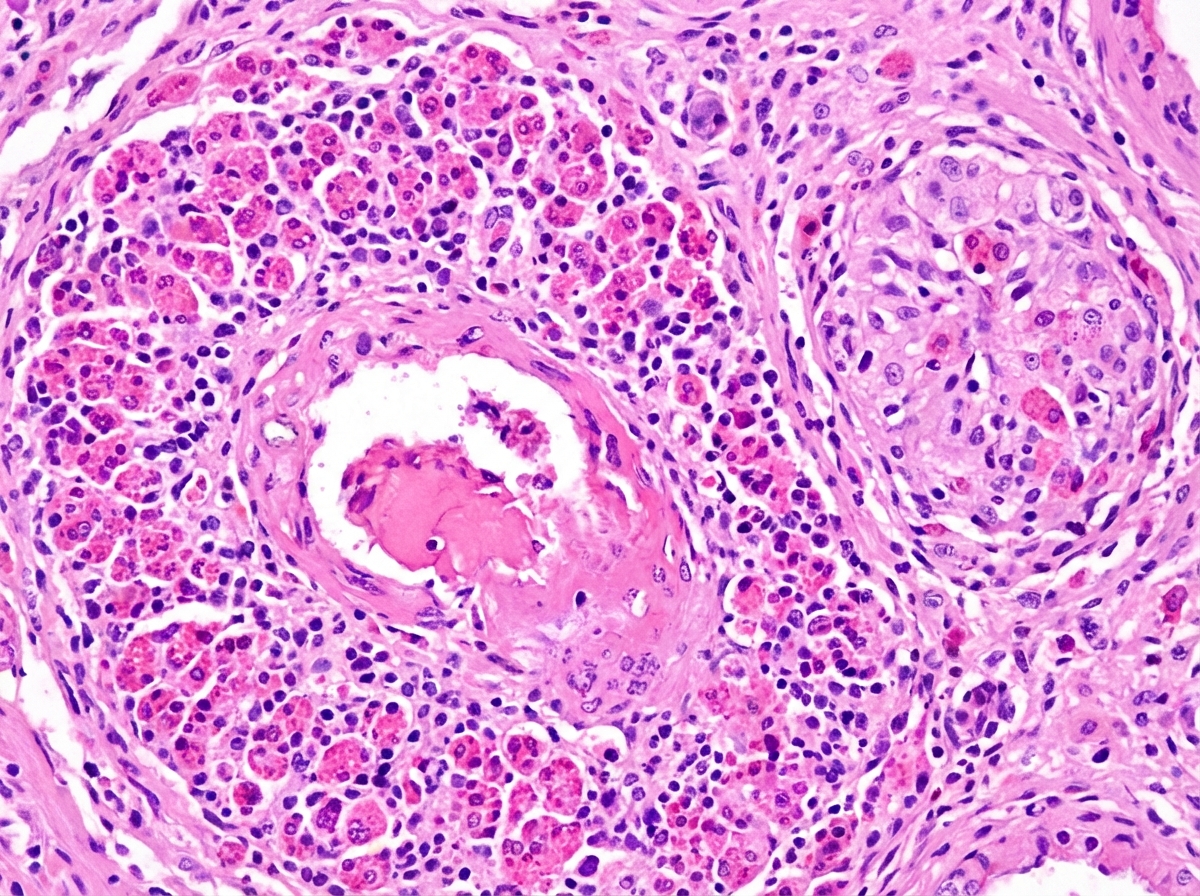
Endothelial cells are characterized by the presence of which of the following structures?
Hemorrhagic infarction is seen in all except:
Which of the following is NOT a predisposing factor for atherosclerotic plaque formation?
Which is the most accepted theory of atherosclerosis?
Which of the following is associated with Virchow's triad?
Which of the following conditions are ANCA positive vasculitis?
Which of the following malignancies is not associated with Trousseau's syndrome?
Syphilitic arterial aneurysms typically involve which of the following processes?
Which of the following is a p-ANCA associated vasculitis?
What is the pathological change seen in malignant hypertension?
Explanation: **Explanation:** **1. Why Weibel-Palade Bodies (WPB) is correct:** Weibel-Palade bodies are the hallmark ultrastructural feature of endothelial cells [1]. They are membrane-bound, rod-shaped secretory organelles. Their primary function is to store two critical proteins: * **von Willebrand Factor (vWF):** Essential for platelet adhesion during primary hemostasis. * **P-selectin:** An adhesion molecule that mediates the rolling of leukocytes during the inflammatory response [2]. The presence of vWF within these bodies makes it a reliable immunohistochemical marker (Factor VIII-related antigen) for identifying tumors of vascular origin (e.g., angiosarcoma). **2. Why other options are incorrect:** * **Gamna-Gandy Bodies:** These are small, firm, brown-to-yellow nodules found in the **spleen**. They represent areas of organized hemorrhage containing deposits of iron (hemosiderin) and calcium on fibrous tissue. They are typically seen in conditions causing congestive splenomegaly, such as portal hypertension or sickle cell anemia. * **Option C and D:** These are incorrect because the two structures are anatomically and functionally distinct; one is a normal cellular organelle (WPB), while the other is a pathological finding (Gamna-Gandy). **High-Yield Clinical Pearls for NEET-PG:** * **WPB Location:** Predominantly found in arterial endothelial cells rather than veins [1]. * **Markers for Endothelium:** CD31 (PECAM-1), CD34, and vWF (Factor VIII-related antigen). * **Desmin vs. Vimentin:** Endothelial cells express **Vimentin** (mesenchymal origin), whereas smooth muscle cells in the vessel wall express Desmin. * **Gamna-Gandy Bodies Mnemonic:** Think "Spleen and Iron" (Siderofibrotic nodules). **References:** [1] Kumar V, Abbas AK, et al.. Robbins and Cotran Pathologic Basis of Disease. 9th ed. Diseases of Infancy and Childhood, pp. 493-494. [2] Kumar V, Abbas AK, et al.. Robbins and Cotran Pathologic Basis of Disease. 9th ed. Migration in the tissues toward a chemotactic stimulus, pp. 86-87.
Explanation: Infarction is categorized into two types based on the color of the lesion: **White (Anemic)** and **Red (Hemorrhagic)** [1]. **Why Septicemia is the correct answer:** Septicemia refers to the presence of pathogenic bacteria or their toxins in the blood. While it can lead to **septic infarcts** (where an infarct becomes an abscess), septicemia itself is a systemic inflammatory state and not a primary mechanism for hemorrhagic infarction. Hemorrhagic infarcts require a specific vascular setup where blood can pool or re-enter a necrotic area, which is not the pathophysiology of septicemia. **Analysis of other options (Causes of Hemorrhagic Infarcts):** * **Venous Thrombosis (Option A):** This is a classic cause. When the venous drainage of an organ (e.g., testis or ovary) is blocked, blood cannot exit, leading to intense congestion and subsequent hemorrhage into the necrotic tissue [1]. * **Embolism (Option D):** Emboli typically cause hemorrhagic infarcts in organs with **dual blood supply** (like the lungs) or **loose tissues** [1], [2]. When an embolus blocks one artery, the secondary supply continues to pump blood into the necrotic area, causing it to turn red. * **Thrombosis (Option B):** While arterial thrombosis often causes white infarcts in solid organs, it causes hemorrhagic infarcts in tissues that are loose or have undergone **reperfusion** (where blood flow is restored to a previously ischemic/thrombosed area) [1]. **NEET-PG High-Yield Pearls:** 1. **Red (Hemorrhagic) Infarcts** occur in: * Loose tissues (Lungs) * Tissues with dual circulation (Lungs, Small Intestine) * Tissues previously congested by venous outflow obstruction [1] * When flow is restored to a site of previous arterial occlusion (Reperfusion injury) [1]. 2. **White (Anemic) Infarcts** occur in solid organs with end-arterial circulation (Heart, Spleen, Kidney) [1]. 3. **Mnemonic:** "Red is Loose/Dual, White is Solid." **References:** [1] Kumar V, Abbas AK, et al.. Robbins and Cotran Pathologic Basis of Disease. 9th ed. Hemodynamic Disorders, Thromboembolic Disease, and Shock, p. 140. [2] Kumar V, Abbas AK, et al.. Robbins and Cotran Pathologic Basis of Disease. 9th ed. Hemodynamic Disorders, Thromboembolic Disease, and Shock, pp. 137-138.
Explanation: Atherosclerosis is a chronic inflammatory response of the arterial wall to endothelial injury [1]. Understanding the biochemical mediators that promote or inhibit this process is crucial for NEET-PG. **Why Alpha 2-macroglobulin is the correct answer:** Alpha 2-macroglobulin (α2-M) is a large plasma glycoprotein that acts primarily as a **protease inhibitor**. In the context of vascular pathology, it is generally considered **protective** rather than predisposing. It helps regulate the degradation of the extracellular matrix and inhibits various inflammatory cytokines. Unlike pro-atherogenic factors, it does not promote lipid deposition or endothelial dysfunction. **Analysis of Incorrect Options:** * **Apolipoprotein E (ApoE) deficiency:** ApoE is essential for the clearance of chylomicrons and VLDL remnants by the liver. Deficiency leads to severe hypercholesterolemia and premature atherosclerosis [1]. In research, "ApoE knockout mice" are the standard model used to study atherosclerotic plaque formation [1]. * **Oxidized LDL:** This is the "hallmark" of atherogenesis. When LDL enters the subendothelial space, it becomes oxidized. Oxidized LDL is chemotactic for monocytes, inhibits macrophage mobility (trapping them in the wall), and is readily taken up by **Scavenger Receptors (SR-A/CD36)** to form **foam cells**. **High-Yield Clinical Pearls for NEET-PG:** * **Most common site:** Abdominal aorta > Coronary arteries > Popliteal arteries > Internal carotid. * **Key Cell Types:** The **Smooth Muscle Cell (SMC)** is responsible for synthesizing the collagen that forms the fibrous cap, stabilizing the plaque [1]. * **Protective Factor:** High-Density Lipoprotein (HDL) promotes "reverse cholesterol transport," moving cholesterol from the periphery back to the liver [1]. **References:** [1] Kumar V, Abbas AK, et al.. Robbins and Cotran Pathologic Basis of Disease. 9th ed. Diseases of Infancy and Childhood, pp. 499-504.
Explanation: ### Explanation **Correct Option: B. Reaction to endothelial injury** The most widely accepted theory for the pathogenesis of atherosclerosis is the **"Response-to-Injury Hypothesis,"** originally proposed by Russell Ross [1]. This theory views atherosclerosis as a chronic inflammatory and healing response of the arterial wall to endothelial injury. The process follows a specific sequence: 1. **Endothelial Dysfunction:** Chronic injury (due to hemodynamic stress, toxins, or lipids) leads to increased permeability and leukocyte adhesion [1]. 2. **Lipid Accumulation:** LDL enters the intima and becomes oxidized [5]. 3. **Monocyte Adhesion:** Monocytes migrate into the intima, becoming macrophages that engulf lipids to form **foam cells** [1], [5]. 4. **Smooth Muscle Proliferation:** Activated macrophages and platelets release cytokines (like PDGF and TGF-β), triggering smooth muscle cell migration from the media to the intima and subsequent collagen deposition [2], [5]. **Why other options are incorrect:** * **A. Lipid infiltration of intima:** While lipid accumulation is a crucial step (Virchow’s Insudation Theory), it is considered a *consequence* or a component of the process rather than the overarching unifying theory. * **C & D. Smoking and Hyperlipidemia:** These are major **risk factors** that contribute to endothelial injury, but they are not the "theory" of pathogenesis itself [1]. **High-Yield Clinical Pearls for NEET-PG:** * **Earliest visible lesion:** The **Fatty Streak** (can be seen in children <10 years) [4], [5]. * **Key Cytokine:** **PDGF** (Platelet-Derived Growth Factor) is primarily responsible for smooth muscle cell migration and proliferation [2]. * **Hallmark of Vulnerable Plaque:** A thin fibrous cap with a large lipid core and high macrophage content [3]. * **Most common site:** Lower abdominal aorta > Coronary arteries > Popliteal arteries > Internal carotid [4], [5]. **References:** [1] Kumar V, Abbas AK, et al.. Robbins and Cotran Pathologic Basis of Disease. 9th ed. Diseases of Infancy and Childhood, pp. 502-503. [2] Kumar V, Abbas AK, et al.. Robbins and Cotran Pathologic Basis of Disease. 9th ed. Diseases of Infancy and Childhood, pp. 494-495. [3] Kumar V, Abbas AK, et al.. Robbins and Cotran Pathologic Basis of Disease. 9th ed. Diseases of Infancy and Childhood, pp. 499-500. [4] Kumar V, Abbas AK, et al.. Robbins and Cotran Pathologic Basis of Disease. 9th ed. Diseases of Infancy and Childhood, pp. 504-505. [5] Kumar V, Abbas AK, et al.. Robbins and Cotran Pathologic Basis of Disease. 9th ed. Diseases of Infancy and Childhood, pp. 505-506.
Explanation: **Explanation:** **Virchow’s Triad** describes the three broad categories of factors that contribute to the formation of a thrombus (thrombogenesis) [2]. The correct answer is **Hypercoagulability** because it is one of the three primary components of the triad. The three components of Virchow’s Triad [2] are: 1. **Endothelial Injury:** Damage to the vessel wall (e.g., trauma, hypertension) [2]. 2. **Stasis or Turbulence of Blood Flow:** Disruption of normal laminar flow (e.g., immobilization, atrial fibrillation) [2]. 3. **Hypercoagulability:** An alteration in blood constituents leading to a prothrombotic state (e.g., Factor V Leiden, malignancy, oral contraceptives) [1], [3]. **Analysis of Options:** * **Option A (Correct):** Hypercoagulability is a direct constituent of the triad [2]. * **Option B (Incorrect):** Disseminated malignancy is a *cause* or clinical condition that leads to hypercoagulability (Trousseau sign), but it is not a component of the triad itself [4]. * **Option C (Incorrect):** Deep Vein Thrombosis (DVT) is the *clinical consequence* or result of the factors in Virchow’s triad, not a component of the triad. * **Option D (Incorrect):** Since B and C are clinical associations/outcomes rather than the fundamental components, "All of the above" is incorrect. **High-Yield Clinical Pearls for NEET-PG:** * **Endothelial injury** is the most important factor for thrombus formation in the **arteries** and the heart [2]. * **Stasis** is the most significant factor in **venous** thrombus formation. * **Lines of Zahn** are characteristic morphological features of thrombi formed in flowing blood, helping to distinguish a pre-mortem thrombus from a post-mortem clot. * **Trousseau Sign of Malignancy:** Migratory thrombophlebitis associated with visceral cancers (especially pancreatic cancer) due to hypercoagulability [4]. **References:** [1] Kumar V, Abbas AK, et al.. Robbins and Cotran Pathologic Basis of Disease. 9th ed. Hemodynamic Disorders, Thromboembolic Disease, and Shock, pp. 133-134. [2] Kumar V, Abbas AK, et al.. Robbins and Cotran Pathologic Basis of Disease. 9th ed. Hemodynamic Disorders, Thromboembolic Disease, and Shock, pp. 132-133. [3] Cross SS. Underwood's Pathology: A Clinical Approach. 6th ed. (Basic Pathology) introduces the student to key general principles of pathology, both as a medical science and as a clinical activity with a vital role in patient care. Part 2 (Disease Mechanisms) provides fundamental knowledge about the cellular and molecular processes involved in diseases, providing the rationale for their treatment. Part 3 (Systematic Pathology) deals in detail with specific diseases, with emphasis on the clinically important aspects., pp. 142-143. [4] Kumar V, Abbas AK, et al.. Robbins and Cotran Pathologic Basis of Disease. 9th ed. Diseases of Infancy and Childhood, pp. 522-523.
Explanation: **Explanation:** The correct answer is **D (Churg-Strauss syndrome and Wegener granulomatosis)** because both belong to the category of **Small Vessel Vasculitides** associated with Antineutrophil Cytoplasmic Antibodies (ANCA) [3]. 1. **Wegener Granulomatosis (Granulomatosis with Polyangiitis - GPA):** Characterized by a triad of necrotizing granulomas of the respiratory tract, necrotizing vasculitis, and focal necrotizing glomerulonephritis. It is strongly associated with **c-ANCA (PR3-ANCA)** [1]. 2. **Churg-Strauss syndrome (Eosinophilic Granulomatosis with Polyangiitis - EGPA):** Characterized by asthma, peripheral eosinophilia, and necrotizing vasculitis. It is primarily associated with **p-ANCA (MPO-ANCA)**. **Why other options are incorrect:** * **Option A & C:** While both are ANCA-positive, selecting either individually is incomplete as both are correct. * **Option B (Polyarteritis nodosa - PAN):** PAN is a **medium-vessel vasculitis**. A classic high-yield distinction is that **classic PAN is ANCA-negative** and is frequently associated with Hepatitis B surface antigen (HBsAg). **High-Yield Clinical Pearls for NEET-PG:** * **c-ANCA (Cytoplasmic):** Targets Proteinase 3 (PR3). Mnemonic: **C**-ANCA for **W**egener’s (The 'C' looks like a 'W' rotated) [1]. * **p-ANCA (Perinuclear):** Targets Myeloperoxidase (MPO). Associated with **EGPA** and **Microscopic Polyangiitis (MPA)**. * **Microscopic Polyangiitis (MPA):** Unlike Wegener’s, MPA lacks granulomatous inflammation [2] and is p-ANCA positive. * **Pauci-immune Glomerulonephritis:** This is the characteristic renal finding in all three ANCA-associated vasculitides (GPA, EGPA, and MPA) [2]. **References:** [1] Kumar V, Abbas AK, et al.. Robbins and Cotran Pathologic Basis of Disease. 9th ed. Diseases of Infancy and Childhood, pp. 519-520. [2] Kumar V, Abbas AK, et al.. Robbins and Cotran Pathologic Basis of Disease. 9th ed. Diseases of Infancy and Childhood, pp. 518-519. [3] Kumar V, Abbas AK, et al.. Robbins and Cotran Pathologic Basis of Disease. 9th ed. Diseases of Infancy and Childhood, pp. 514-515.
Explanation: **Explanation:** **Trousseau’s syndrome**, also known as **migratory thrombophlebitis**, is a paraneoplastic syndrome characterized by recurrent episodes of venous thrombosis in different and changing locations [1]. **1. Why Liposarcoma is the correct answer:** The underlying mechanism of Trousseau’s syndrome involves the release of **procoagulants** (like tissue factor) and **mucins** by malignant cells, which activate the coagulation cascade [1]. This phenomenon is classically associated with **adenocarcinomas** (mucin-secreting tumors) [1]. **Liposarcoma** is a mesenchymal tumor (sarcoma) of adipose tissue; it does not secrete mucin and is not typically associated with this paraneoplastic manifestation [2]. **2. Why the other options are incorrect:** * **Carcinoma of the Pancreas:** This is the most classic association. Pancreatic adenocarcinoma (especially of the body and tail) frequently presents with migratory thrombophlebitis due to high mucin production. * **Carcinoma of the Lung:** Adenocarcinomas of the lung are well-documented triggers for hypercoagulable states and Trousseau’s syndrome. * **Carcinoma of the Stomach:** As a mucin-secreting adenocarcinoma, gastric cancer is a frequent cause of paraneoplastic venous thromboembolism. **NEET-PG High-Yield Pearls:** * **Key Association:** Trousseau’s syndrome = Visceral Malignancy + Migratory Thrombophlebitis [1]. * **Most Common Site:** Tail and body of the pancreas (often a presenting sign before the tumor is diagnosed). * **Pathophysiology:** Mucin-induced platelet aggregation and activation of Factor X by cysteine proteases. * **Treatment Note:** Heparin (LMWH) is generally preferred over warfarin for managing cancer-associated thrombosis. **References:** [1] Kumar V, Abbas AK, et al.. Robbins and Cotran Pathologic Basis of Disease. 9th ed. Diseases of Infancy and Childhood, pp. 522-523. [2] Kumar V, Abbas AK, et al.. Robbins and Cotran Pathologic Basis of Disease. 9th ed. Bones, Joints, and Soft Tissue Tumors, p. 1222.
Explanation: **Explanation:** **Correct Answer: D. Endarteritis of the vasa vasorum** Syphilitic (luetic) aneurysms are a classic manifestation of tertiary syphilis, primarily affecting the **ascending aorta** [1]. The underlying mechanism is an immune-mediated inflammatory response to *Treponema pallidum*. The spirochetes trigger **obliterative endarteritis** of the vasa vasorum (the small vessels supplying the aortic wall) [1]. This leads to ischemic injury and narrowing of the vessel lumen, resulting in the destruction of the tunica media (elastic tissue and smooth muscle). The weakened aortic wall then dilates under pressure, forming an aneurysm. **Analysis of Incorrect Options:** * **A. Cystic medial sclerosis:** This involves the accumulation of mucoid material and fragmentation of elastic fibers. It is the hallmark of **Marfan Syndrome** and is not the primary mechanism in syphilis. * **B. Fatty streaks:** These are the earliest visible lesions of **atherosclerosis**, consisting of lipid-laden foam cells. While syphilis can exacerbate atherosclerosis, fatty streaks do not define the syphilitic process. * **C. Circumferential calcification:** While the ascending aorta may show calcification in syphilis, it is a secondary feature. "Eggshell calcification" is more characteristic of silicosis (lymph nodes), and circumferential calcification is not the primary pathological process of the aneurysm formation. **High-Yield Clinical Pearls for NEET-PG:** * **"Tree-bark" Appearance:** The scarring and contraction of the tunica media result in a wrinkled intimal surface, a pathognomonic gross finding. * **Location:** Syphilis typically involves the **ascending aorta** and arch, whereas atherosclerotic aneurysms usually involve the **abdominal aorta** [1]. * **Complication:** Aortic root dilatation often leads to **Aortic Regurgitation** and subsequent left ventricular hypertrophy (Cor bovinum). **References:** [1] Kumar V, Abbas AK, et al.. Robbins and Cotran Pathologic Basis of Disease. 9th ed. Infectious Diseases, pp. 388-389.
Explanation: **Explanation:** The correct answer is **Microscopic Polyangiitis (MPA)**. **1. Why Microscopic Polyangiitis is correct:** MPA is a necrotizing small-vessel vasculitis involving capillaries, venules, and arterioles [1]. It is strongly associated with **p-ANCA (perinuclear Anti-Neutrophil Cytoplasmic Antibody)**, which targets the enzyme **Myeloperoxidase (MPO)**. Unlike Granulomatosis with Polyangiitis (GPA), MPA is characterized by a lack of granulomatous inflammation and "pauci-immune" glomerulonephritis [1], [2]. **2. Why the other options are incorrect:** * **Temporal (Giant Cell) Arteritis:** A large-vessel vasculitis affecting the branches of the carotid artery. Diagnosis is via ESR and temporal artery biopsy; it is not associated with ANCA. * **Takayasu Arteritis:** Also a large-vessel vasculitis ("pulseless disease") primarily affecting the aorta and its branches in young females. It is not ANCA-associated. * **Polyarteritis Nodosa (PAN):** A medium-vessel vasculitis. Crucially, **PAN is ANCA-negative**. It is classically associated with Hepatitis B surface antigen (HBsAg) and shows a "string of pearls" appearance on angiography. **3. NEET-PG High-Yield Pearls:** * **ANCA Patterns:** * **p-ANCA (MPO-ANCA):** Microscopic Polyangiitis, Churg-Strauss Syndrome (EGPA), and Primary Sclerosing Cholangitis. * **c-ANCA (PR3-ANCA):** Granulomatosis with Polyangiitis (Wegener’s) [3]. * **Key Distinction:** MPA involves the lungs (hemoptysis) and kidneys (hematuria) but, unlike Wegener’s, it **spares the nasopharynx** and lacks granulomas [1]. * **Pauci-immune:** This term refers to the absence or scarcity of immunoglobulin/complement deposits on immunofluorescence in the glomeruli [1]. **References:** [1] Kumar V, Abbas AK, et al.. Robbins and Cotran Pathologic Basis of Disease. 9th ed. Diseases of Infancy and Childhood, pp. 518-520. [2] Cross SS. Underwood's Pathology: A Clinical Approach. 6th ed. Common Clinical Problems From Diseases Of The Urinary And Male Genital Tracts, pp. 536-537. [3] Kumar V, Abbas AK, et al.. Robbins and Cotran Pathologic Basis of Disease. 9th ed. Diseases of Infancy and Childhood, pp. 519-520.
Explanation: **Explanation:** **1. Why Hyperplastic Arteriosclerosis is Correct:** Malignant hypertension (typically defined as BP >200/120 mmHg) causes acute, severe hemodynamic stress on vessel walls [1]. This triggers a characteristic response known as **Hyperplastic Arteriosclerosis**. Pathologically, this is characterized by concentric, laminated thickening of the arteriolar walls due to the proliferation of smooth muscle cells and basement membrane duplication [2]. This appearance is classically described as **"Onion-skinning."** [1] In severe cases, it is often accompanied by **fibrinoid necrosis** (necrotizing arteriolitis), particularly in the kidneys [4]. **2. Why the Other Options are Incorrect:** * **Cystic Medial Necrosis:** This involves the accumulation of mucoid material and fragmentation of elastic fibers in the tunica media of large arteries (like the aorta). It is classically associated with **Marfan Syndrome** and aortic dissections, not hypertension-induced arteriolar changes. * **Benign Nephrosclerosis:** This is the clinical consequence of long-standing, well-controlled (benign) hypertension, leading to chronic ischemic changes in the kidney [3]. * **Hyaline Arteriosclerosis:** This is seen in **benign hypertension** and **Diabetes Mellitus** [5]. It involves the leakage of plasma proteins across the endothelium, resulting in a homogenous, pink, glassy (hyaline) thickening of the wall with luminal narrowing. **3. NEET-PG High-Yield Pearls:** * **Onion-skinning:** Pathognomonic for malignant hypertension (Hyperplastic type) [2]. * **Fibrinoid Necrosis:** Occurs when the sudden rise in BP causes acute vessel wall damage, allowing fibrin to leak into the media [4]. * **"Flea-bitten Kidney":** The gross appearance of the kidney in malignant hypertension due to pinpoint petechial hemorrhages on the cortical surface. * **Key distinction:** Hyaline = Benign/Diabetes; Hyperplastic = Malignant. **References:** [1] Kumar V, Abbas AK, et al.. Robbins and Cotran Pathologic Basis of Disease. 9th ed. The Kidney, p. 945. [2] Kumar V, Abbas AK, et al.. Robbins and Cotran Pathologic Basis of Disease. 9th ed. Diseases of Infancy and Childhood, pp. 498-499. [3] Cross SS. Underwood's Pathology: A Clinical Approach. 6th ed. Common Clinical Problems From Diseases Of The Urinary And Male Genital Tracts, pp. 541-542. [4] Cross SS. Underwood's Pathology: A Clinical Approach. 6th ed. Common Clinical Problems From Cardiovascular Disease, pp. 276-277. [5] Kumar V, Abbas AK, et al.. Robbins and Cotran Pathologic Basis of Disease. 9th ed. The Kidney, pp. 943-945.
Atherosclerosis
Practice Questions
Hypertensive Vascular Disease
Practice Questions
Aneurysms and Dissection
Practice Questions
Vasculitis
Practice Questions
Venous Disease and Thrombosis
Practice Questions
Vascular Tumors
Practice Questions
Varicose Veins and Lymphatics
Practice Questions
Pathology of Vascular Interventions
Practice Questions
Vascular Diseases in Specific Organs
Practice Questions
Congenital Vascular Anomalies
Practice Questions
Get full access to all questions, explanations, and performance tracking.
Start For Free