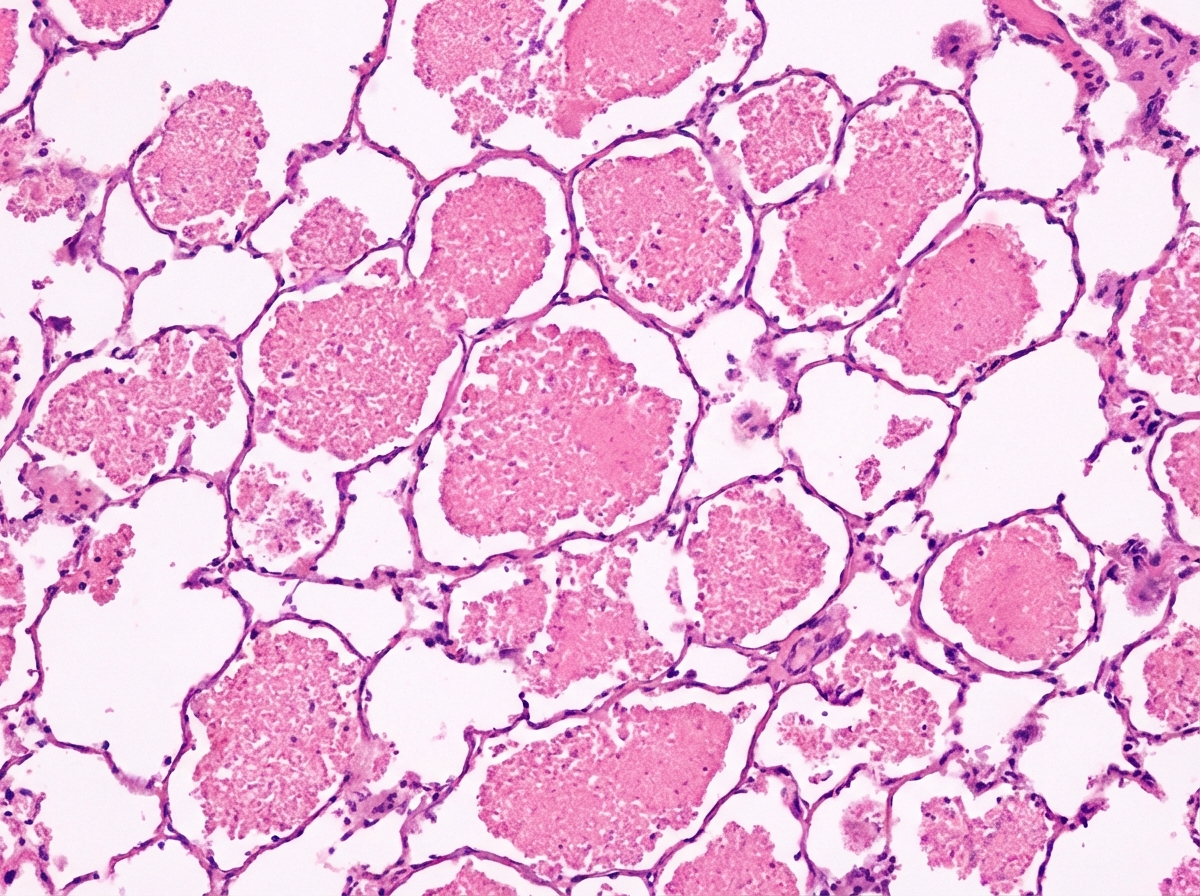
Which of the following is known to cause cavitating lung lesions?
Distension of distant alveoli is seen in which type of emphysema?
All of the following statements are true regarding idiopathic pulmonary fibrosis, except:
In which of the following forms of pulmonary carcinoma is the classic progression of metaplasia to dysplasia to carcinoma in situ observed?
A 30-year-old woman presents with a history of fever for 2 weeks and multiple episodes of haemoptysis. Bronchoscopy shows a polypoid mass covered with intact mucosa. Surgical resection was performed, and the histology slide is shown below. What is the diagnosis?

Goodpasture's syndrome is characterized by?
A 60-year-old male with a long-standing history of breathlessness and heavy smoking since the age of 20 presents with an emaciated, anxious appearance and pursed-lip breathing, but without cyanosis. The chest is barrel-shaped. The primary pathology of the lung in this patient is associated with which of the following pathogenetic mechanisms?
Cavitation of the lungs is not a feature of which of the following conditions?
Histologic sections of lung tissue from an individual with adult respiratory distress syndrome (ARDS) are most likely to reveal what finding?
A study of HIV-infected persons shows that those with CD4+ lymphocyte counts below 100 cells/mL are at increased risk for pulmonary infections. Some patients present with concurrent hepatosplenomegaly, lymphadenopathy, malabsorption with weight loss, night sweats, and fever. Bronchoalveolar lavage specimens examined microscopically reveal macrophages filled with acid-fast infectious organisms. Which of the following infections have these persons developed?
Explanation: **Explanation:** **Squamous cell carcinoma (SCC)** is the most common primary lung malignancy to undergo **central cavitation** [1]. This occurs because SCCs typically arise centrally (near the hilum) and grow rapidly as bulky masses [2]. The tumor often outstrips its own blood supply, leading to central ischemic necrosis and subsequent liquefaction, which is then expectorated, leaving a cavity [2]. On imaging, these cavities often have thick, irregular walls. **Analysis of Incorrect Options:** * **Adenocarcinoma:** This is the most common type of lung cancer overall and typically presents as a **peripheral** nodule [1]. While it can occasionally cavitate, it is far less common than in SCC. It is more frequently associated with scarring (scar carcinoma). * **Small Cell Carcinoma (SCLC):** This is a highly aggressive, centrally located neuroendocrine tumor. However, it is characterized by rapid doubling time and early metastasis rather than necrosis; it **almost never cavitates**. * **Large Cell Carcinoma:** While this is a diagnosis of exclusion and can occasionally cavitate, it is much less frequent than in the squamous subtype. **NEET-PG High-Yield Pearls:** * **The "C" Rule for Squamous Cell:** **C**entral, **C**avitation, **C**igarettes, and Hyper**c**alcemia (due to PTHrP production). * **Differential Diagnosis for Cavitating Lung Lesions:** Remember the mnemonic **"CAVITY"**: **C**ancer (Squamous cell), **A**bscess (Staph aureus, Klebsiella), **V**asculitis (GPA/Wegener's), **I**nfection (TB, Fungal/Aspergilloma), **T**rauma, and **Y**outh (Congenital cysts). * **Most common lung cancer in non-smokers:** Adenocarcinoma. * **Lung cancer with the strongest association with smoking:** Small Cell Carcinoma and Squamous Cell Carcinoma. **References:** [1] Cross SS. Underwood's Pathology: A Clinical Approach. 6th ed. Common Clinical Problems From Respiratory Tract Disease, pp. 336-337. [2] Kumar V, Abbas AK, et al.. Robbins and Cotran Pathologic Basis of Disease. 9th ed. The Lung, pp. 723-724.
Explanation: **Explanation:** Emphysema is characterized by the permanent enlargement of airspaces distal to the terminal bronchioles [1,2]. The classification depends on which part of the **acinus** (the functional unit of the lung) is involved [3]. **1. Why Paraseptal Emphysema is correct:** In **Paraseptal (Distal Acinar) emphysema**, the proximal portion of the acinus is normal, while the **distal part** (alveolar ducts and alveoli) is predominantly involved [2]. It occurs adjacent to the pleura and connective tissue septa [2]. Because it affects the periphery of the lung lobule, it often results in the formation of subpleural blebs or bullae [2]. **2. Analysis of Incorrect Options:** * **Centriacinar (Centrilobular) emphysema:** This is the most common type (associated with smoking) [1]. It involves the **proximal** parts of the acinus (respiratory bronchioles), while distal alveoli are spared [2]. It is typically more severe in the upper lobes [2]. * **Panacinar (Panlobular) emphysema:** The entire acinus, from the respiratory bronchiole to the terminal alveoli, is uniformly enlarged [2]. This type is classically associated with **Alpha-1 Antitrypsin deficiency** and involves the lower lobes [1]. * **Irregular emphysema:** This is associated with scarring (paracicatricial) [2]. The acinus is involved irregularly; it is usually asymptomatic and clinically insignificant [2]. **Clinical Pearls for NEET-PG:** * **Spontaneous Pneumothorax:** Paraseptal emphysema is the most common cause of spontaneous pneumothorax in young adults due to the rupture of subpleural bullae [2]. * **Location:** Centriacinar = Upper lobes; Panacinar = Lower lobes; Paraseptal = Subpleural/Periseptal areas [2]. * **Protease-Antiprotease Hypothesis:** The fundamental pathogenesis of emphysema involves the destruction of elastic tissue by elastases (from neutrophils/macrophages) due to a lack of protective antielastases [1]. **References:** [1] Kumar V, Abbas AK, et al.. Robbins and Cotran Pathologic Basis of Disease. 9th ed. The Lung, pp. 684-685. [2] Kumar V, Abbas AK, et al.. Robbins and Cotran Pathologic Basis of Disease. 9th ed. The Lung, p. 683. [3] Cross SS. Underwood's Pathology: A Clinical Approach. 6th ed. Common Clinical Problems From Respiratory Tract Disease, pp. 326-327.
Explanation: **Explanation:** The correct answer is **D (Masson bodies are characteristic)** because Masson bodies are the hallmark of **Cryptogenic Organizing Pneumonia (COP)** [1], not Idiopathic Pulmonary Fibrosis (IPF). Masson bodies are polypoid plugs of loose organizing connective tissue within alveolar ducts and alveoli [1]. **Analysis of Options:** * **Option A (Cobblestoned appearance):** True. In IPF, the retraction of scars along the interlobular septa leads to a characteristic "cobblestoned" appearance of the pleural surface. * **Option B (Lower lobe/Subpleural distribution):** True. IPF typically presents with a peripheral, subpleural, and basal (lower lobe) predominance. This distribution is a key feature of the **Usual Interstitial Pneumonia (UIP)** pattern [2]. * **Option C (Fibroblastic foci):** True. These are the earliest and most diagnostic lesions of IPF. They represent areas of active fibroblastic proliferation and collagen deposition, indicating "temporal heterogeneity" (lesions of different ages). **High-Yield Clinical Pearls for NEET-PG:** * **Histological Pattern:** IPF is characterized by the **UIP (Usual Interstitial Pneumonia)** pattern [2]. * **Temporal Heterogeneity:** This is the hallmark of UIP, where normal lung, fibroblastic foci, and dense collagenous scars (honeycombing) coexist in the same biopsy [2]. * **Honeycombing:** Advanced IPF leads to the destruction of alveolar architecture and the formation of cystic spaces lined by hyperplastic type II pneumocytes or bronchiolar epithelium. * **Radiology:** High-resolution CT (HRCT) shows subpleural reticular opacities and honeycombing [2]. * **Treatment:** Pirfenidone and Nintedanib are the drugs used to slow progression. **References:** [1] Cross SS. Underwood's Pathology: A Clinical Approach. 6th ed. Common Clinical Problems From Respiratory Tract Disease, pp. 330-331. [2] Kumar V, Abbas AK, et al.. Robbins and Cotran Pathologic Basis of Disease. 9th ed. The Lung, pp. 693-695.
Explanation: ### Explanation **Correct Option: D. Squamous cell carcinoma** Squamous cell carcinoma (SCC) of the lung typically arises centrally in the major bronchi. The underlying pathophysiology follows a well-defined multi-step progression: [1] 1. **Metaplasia:** Chronic irritation (primarily from cigarette smoke) causes the normal pseudostratified ciliated columnar epithelium to transform into **stratified squamous epithelium** (Squamous Metaplasia). [1] 2. **Dysplasia:** Continued insult leads to cellular atypia and disordered growth. [1] 3. **Carcinoma in situ (CIS):** Full-thickness dysplasia without basement membrane invasion. [1] 4. **Invasive Carcinoma:** Malignant cells breach the basement membrane. [1] **Analysis of Incorrect Options:** * **A. Small-cell carcinoma:** Arises from neuroendocrine (Kulchitsky) cells. It does not follow the metaplasia-dysplasia sequence; it is highly aggressive and often presents as a large perihilar mass with early metastasis. * **B. Adenocarcinoma:** Currently the most common lung cancer. It typically arises peripherally from Type II pneumocytes or Clara cells. Its precursor lesion is **Atypical Adenomatous Hyperplasia (AAH)**, which progresses to Adenocarcinoma in situ (formerly BAC), not squamous metaplasia. * **C. Large-cell carcinoma:** This is a diagnosis of exclusion (undifferentiated). It lacks the specific histological features of glandular or squamous differentiation and does not have a recognized pre-invasive metaplastic phase. [2] **High-Yield NEET-PG Pearls:** * **Location:** SCC and Small Cell are usually **Central** (mnemonic: **S**quamous and **S**mall cell are **S**moking related and **S**entral). [2] * **Histology of SCC:** Look for **Keratin pearls** and **Intercellular bridges** (desmosomes). [2] * **Paraneoplastic Syndrome:** SCC is classically associated with **Hypercalcemia** due to the secretion of Parathyroid Hormone-related Protein (PTHrP). * **Marker:** P40 and P63 are highly specific IHC markers for Squamous Cell Carcinoma. **References:** [1] Kumar V, Abbas AK, et al.. Robbins and Cotran Pathologic Basis of Disease. 9th ed. The Lung, pp. 720-724. [2] Cross SS. Underwood's Pathology: A Clinical Approach. 6th ed. Common Clinical Problems From Respiratory Tract Disease, pp. 336-337.
Explanation: ***Carcinoid tumour*** - **Young patient** with **hemoptysis** and a **polypoid endobronchial mass** with **intact mucosa** are classic features of **bronchial carcinoid**, a low-grade neuroendocrine tumor. - Histologically shows **uniform neuroendocrine cells** arranged in **nests** and **trabeculae** with characteristic **salt-and-pepper chromatin** pattern. *Large cell cancer* - Represents a **high-grade undifferentiated** lung cancer typically seen in **older smokers**, not young adults. - Shows **large pleomorphic cells** with **prominent nucleoli** and **abundant cytoplasm**, lacking the organized architecture of carcinoid. *Pulmonary hamartoma* - A **benign lesion** composed of **cartilage**, **fat**, and **epithelial elements**, typically appearing as a **coin lesion** on imaging. - Rarely causes **hemoptysis** and doesn't present as an **endobronchial polypoid mass** with intact mucosa. *Adenocarcinoma lung* - Most common lung cancer in **non-smokers** but typically presents as a **peripheral nodule** rather than an **endobronchial mass**. - Shows **glandular architecture** with **mucin production** and **irregular nuclear features**, distinct from the uniform neuroendocrine pattern of carcinoid.
Explanation: **Explanation:** Goodpasture’s Syndrome is an autoimmune disorder characterized by the presence of circulating **anti-glomerular basement membrane (anti-GBM) antibodies** [1]. These antibodies target the non-collagenous domain of the **α3 chain of collagen type IV**, which is highly expressed in the basement membranes of both the renal glomeruli and the pulmonary alveoli [4]. **Why Option A is correct:** The binding of these antibodies triggers a Type II hypersensitivity reaction. In the lungs, this leads to the destruction of the alveolar-capillary basement membrane, resulting in **necrotizing hemorrhagic interstitial pneumonitis** [2]. Pathologically, this manifests as intra-alveolar hemorrhage and the presence of hemosiderin-laden macrophages ("heart failure cells"). **Why other options are incorrect:** * **B. Alveolitis:** While inflammation occurs, "alveolitis" is a non-specific term often associated with extrinsic allergic alveolitis or idiopathic pulmonary fibrosis. It does not capture the hallmark necrotizing and hemorrhagic nature of Goodpasture’s. * **C. Patchy consolidation:** This is a classic radiological/pathological finding in bronchopneumonia. Goodpasture’s typically presents with diffuse, rather than patchy, alveolar opacities due to widespread hemorrhage. * **D. Pulmonary edema:** This is a hemodynamic or permeability issue (e.g., heart failure or ARDS) involving fluid leakage, not the primary necrotizing destruction of the interstitium seen in this syndrome. **High-Yield Clinical Pearls for NEET-PG:** * **Triad:** Diffuse pulmonary hemorrhage, glomerulonephritis, and anti-GBM antibodies [1]. * **Immunofluorescence:** Shows a characteristic **linear** deposition of IgG and C3 along the basement membranes (unlike the "granular" pattern in SLE) [3]. * **Clinical Presentation:** Hemoptysis is often the first symptom, followed by rapidly progressive glomerulonephritis (RPGN) [1]. * **Epidemiology:** Most common in young males (teens to 20s) and has a strong association with **HLA-DRB1** [1]. * **Treatment:** Plasmapheresis (to remove antibodies) and immunosuppressants [1]. **References:** [1] Cross SS. Underwood's Pathology: A Clinical Approach. 6th ed. Common Clinical Problems From Diseases Of The Urinary And Male Genital Tracts, pp. 537-538. [2] Cross SS. Underwood's Pathology: A Clinical Approach. 6th ed. Common Clinical Problems From Respiratory Tract Disease, pp. 322-323. [3] Cross SS. Underwood's Pathology: A Clinical Approach. 6th ed. Common Clinical Problems From Diseases Of The Urinary And Male Genital Tracts, pp. 526-527. [4] Kumar V, Abbas AK, et al.. Robbins and Cotran Pathologic Basis of Disease. 9th ed. The Kidney, p. 909.
Explanation: ### Explanation **Correct Answer: B. Uninhibited action of proteases** The clinical presentation describes a classic **"Pink Puffer"** (Emphysema-predominant COPD). Key features include a long smoking history, barrel chest, pursed-lip breathing, and lack of cyanosis [3]. The pathogenesis of emphysema is centered on the **Protease-Antiprotease Imbalance hypothesis** [1]. Smoking triggers an influx of inflammatory cells (neutrophils and macrophages) into the alveoli. These cells release proteases, specifically **Neutrophil Elastase**, which degrade the elastic tissue of the alveolar walls [2]. In a healthy individual, these are neutralized by Alpha-1 Antitrypsin (A1AT). However, smoking both increases protease production and oxidatively inactivates A1AT, leading to the **uninhibited destruction of elastic tissue** and permanent enlargement of airspaces [1]. **Analysis of Incorrect Options:** * **Option A (Type I Hypersensitivity):** This is the mechanism for **Atopic Asthma**, characterized by IgE-mediated mast cell degranulation, not permanent alveolar destruction [4]. * **Option C (Immune Complexes):** This mechanism (Type III Hypersensitivity) is associated with conditions like **Hypersensitivity Pneumonitis** (e.g., Farmer’s lung), not COPD. * **Option D (Deficiency of a protein produced by the liver):** While A1AT is produced by the liver, this option refers to **congenital A1AT deficiency** [1]. While it causes emphysema, the question specifies a **heavy smoker**, making smoking-induced protease-antiprotease imbalance the primary mechanism. **Clinical Pearls for NEET-PG:** * **Centriacinar Emphysema:** Most common type; associated with smoking; affects upper lobes [2]. * **Panacinar Emphysema:** Associated with A1AT deficiency; affects lower lobes [1]. * **Reid Index:** Used for Chronic Bronchitis (ratio of mucous gland thickness to wall thickness; normal < 0.4). * **Pink Puffer vs. Blue Bloater:** Pink Puffers (Emphysema) have high minute volume and normal $PaO_2$; Blue Bloaters (Chronic Bronchitis) have cyanosis and fluid retention. **References:** [1] Kumar V, Abbas AK, et al.. Robbins and Cotran Pathologic Basis of Disease. 9th ed. The Lung, pp. 683-684. [2] Kumar V, Abbas AK, et al.. Robbins and Cotran Pathologic Basis of Disease. 9th ed. The Lung, pp. 684-685. [3] Cross SS. Underwood's Pathology: A Clinical Approach. 6th ed. Common Clinical Problems From Respiratory Tract Disease, pp. 326-327. [4] Kumar V, Abbas AK, et al.. Robbins and Cotran Pathologic Basis of Disease. 9th ed. The Lung, pp. 681-683.
Explanation: **Explanation:** The hallmark of **Primary Pulmonary Tuberculosis** is the formation of the **Ghon complex** (a subpleural parenchymal lesion and involved hilar lymph nodes). In a non-sensitized individual, the immune response typically leads to fibrosis and calcification (Ranke complex). **Cavitation is rare** in primary TB because it requires a robust, pre-sensitized delayed-type hypersensitivity (DTH) reaction to cause extensive caseous necrosis and liquefaction. **Analysis of Options:** * **Secondary Pulmonary Tuberculosis:** This is the classic cause of lung cavitation [2]. It occurs in a previously sensitized host. The vigorous immune response leads to large areas of caseous necrosis that liquefy and erode into bronchi, creating thick-walled cavities, typically in the **apical segments**. * **Lung Abscess:** By definition, an abscess is a localized collection of pus that causes liquefactive necrosis of the parenchyma [1]. When it communicates with an airway, the contents drain, leaving a **radiographic cavity** often showing an air-fluid level [1]. * **Bronchogenic Carcinoma:** Squamous cell carcinoma is the most common histological type to undergo **central necrosis** due to rapid growth outstripping its blood supply, resulting in a thick, irregular, and eccentric cavity. **High-Yield Clinical Pearls for NEET-PG:** * **Ghon Complex:** Parenchymal lesion (usually mid/lower zone) + Lymphangitis + Lymphadenitis. * **Assmann Focus:** The infraclavicular lesion seen in secondary TB. * **Mnemonic for Cavitary Lung Lesions (CAVITY):** **C**ancer, **A**utoimmune (Wegener’s), **V**ascular (Infarct), **I**nfection (TB, Abscess, Fungi), **T**rauma, **Y**outh (CPAM). * **Primary TB** is usually a "silent" infection in children, whereas **Secondary TB** is the symptomatic "consumption" seen in adults [2]. **References:** [1] Kumar V, Abbas AK, et al.. Robbins and Cotran Pathologic Basis of Disease. 9th ed. The Lung, pp. 715-716. [2] Cross SS. Underwood's Pathology: A Clinical Approach. 6th ed. Common Clinical Problems From Respiratory Tract Disease, pp. 320-321.
Explanation: **Explanation:** **Correct Option (B):** The hallmark pathologic feature of **Acute Respiratory Distress Syndrome (ARDS)** is **Diffuse Alveolar Damage (DAD)** [1]. In the acute (exudative) phase, injury to the alveolar-capillary membrane leads to increased permeability [2]. This results in the leakage of protein-rich fluid into the alveolar spaces. This fluid, combined with necrotic debris from Type I pneumocytes and fibrin, organizes into characteristic **waxy, eosinophilic hyaline membranes** that line the alveolar walls [1]. These membranes impair gas exchange, leading to the clinical presentation of severe refractory hypoxemia. **Incorrect Options:** * **Option A:** Describes **Lymphomatoid Granulomatosis**, an EBV-associated B-cell lymphoma often seen in the lungs, characterized by angiocentric and angioinvasive lymphoid infiltrates. * **Option C:** Refers to **Charcot-Leyden crystals**, which are derived from eosinophil lysophospholipase (Galectin-10). These are classic findings in **Bronchial Asthma**. * **Option D:** Describes **Squamous Cell Carcinoma** of the lung. Intercellular bridges (desmosomes) and keratin pearls are the definitive histologic markers for squamous differentiation. **NEET-PG High-Yield Pearls:** * **Stages of ARDS:** 1. Exudative (Hyaline membranes), 2. Proliferative (Type II pneumocyte hyperplasia and interstitial inflammation), 3. Fibrotic (Collagen deposition) [1]. * **Pathogenesis:** Neutrophil-mediated injury is central to the development of DAD. * **Radiology:** Characterized by bilateral "white-out" or diffuse opacities on chest X-ray with a normal PCWP (non-cardiogenic pulmonary edema) [2]. **References:** [1] Kumar V, Abbas AK, et al.. Robbins and Cotran Pathologic Basis of Disease. 9th ed. The Lung, pp. 679-681. [2] Kumar V, Abbas AK, et al.. Robbins and Cotran Pathologic Basis of Disease. 9th ed. The Lung, p. 679.
Explanation: The clinical presentation describes a severely immunocompromised patient (CD4+ count < 100 cells/µL) with a **disseminated systemic infection**. The presence of hepatosplenomegaly, lymphadenopathy, and malabsorption (diarrhea/weight loss) alongside pulmonary symptoms is classic for **Mycobacterium avium-complex (MAC)** [1]. 1. **Why MAC is correct:** MAC (comprising *M. avium* and *M. intracellulare*) typically causes disseminated disease in HIV patients when CD4 counts drop below **50 cells/µL** [1]. A hallmark pathological finding is the presence of **foamy macrophages** packed with numerous **acid-fast bacilli (AFB)** [3]. Unlike *M. tuberculosis*, MAC does not usually form well-defined granulomas in late-stage AIDS due to the lack of a robust T-cell response [3]. 2. **Why other options are incorrect:** * **Aspergillus niger:** A fungus that causes "fungus balls" (aspergilloma) or invasive pulmonary disease. It appears as septate hyphae with 45-degree branching, not acid-fast bacilli within macrophages [2]. * **Candida albicans:** Usually causes oral thrush or esophagitis in HIV. While it can cause pneumonia, it presents as budding yeasts and pseudohyphae (GMS/PAS positive), not acid-fast organisms [2]. * **Legionella pneumophila:** A Gram-negative bacterium causing severe pneumonia (Legionnaires' disease). It is not acid-fast and typically presents with high fever, hyponatremia, and diarrhea, but not chronic disseminated lymphadenopathy/hepatosplenomegaly. **High-Yield Clinical Pearls for NEET-PG:** * **CD4 Cut-offs:** MAC (<50 cells/µL), CMV (<50 cells/µL), *Pneumocystis jirovecii* (<200 cells/µL). * **Prophylaxis:** Azithromycin or Clarithromycin is used for MAC prophylaxis in patients with CD4 < 50. * **Diagnosis:** MAC is best diagnosed via blood culture (BACTEC) or tissue biopsy showing AFB-positive organisms within macrophages [3]. **References:** [1] Kumar V, Abbas AK, et al.. Robbins and Cotran Pathologic Basis of Disease. 9th ed. Infectious Diseases, pp. 384-385. [2] Cross SS. Underwood's Pathology: A Clinical Approach. 6th ed. Common Clinical Problems From Respiratory Tract Disease, pp. 318-319. [3] Kumar V, Abbas AK, et al.. Robbins and Cotran Pathologic Basis of Disease. 9th ed. Infectious Diseases, pp. 383-384.
Congenital Anomalies
Practice Questions
Atelectasis and Acute Lung Injury
Practice Questions
Obstructive Pulmonary Diseases
Practice Questions
Restrictive Pulmonary Diseases
Practice Questions
Lung Infections
Practice Questions
Pulmonary Vascular Diseases
Practice Questions
Lung Tumors
Practice Questions
Pleural Diseases
Practice Questions
Interstitial Lung Diseases
Practice Questions
Occupational Lung Diseases
Practice Questions
Get full access to all questions, explanations, and performance tracking.
Start For Free