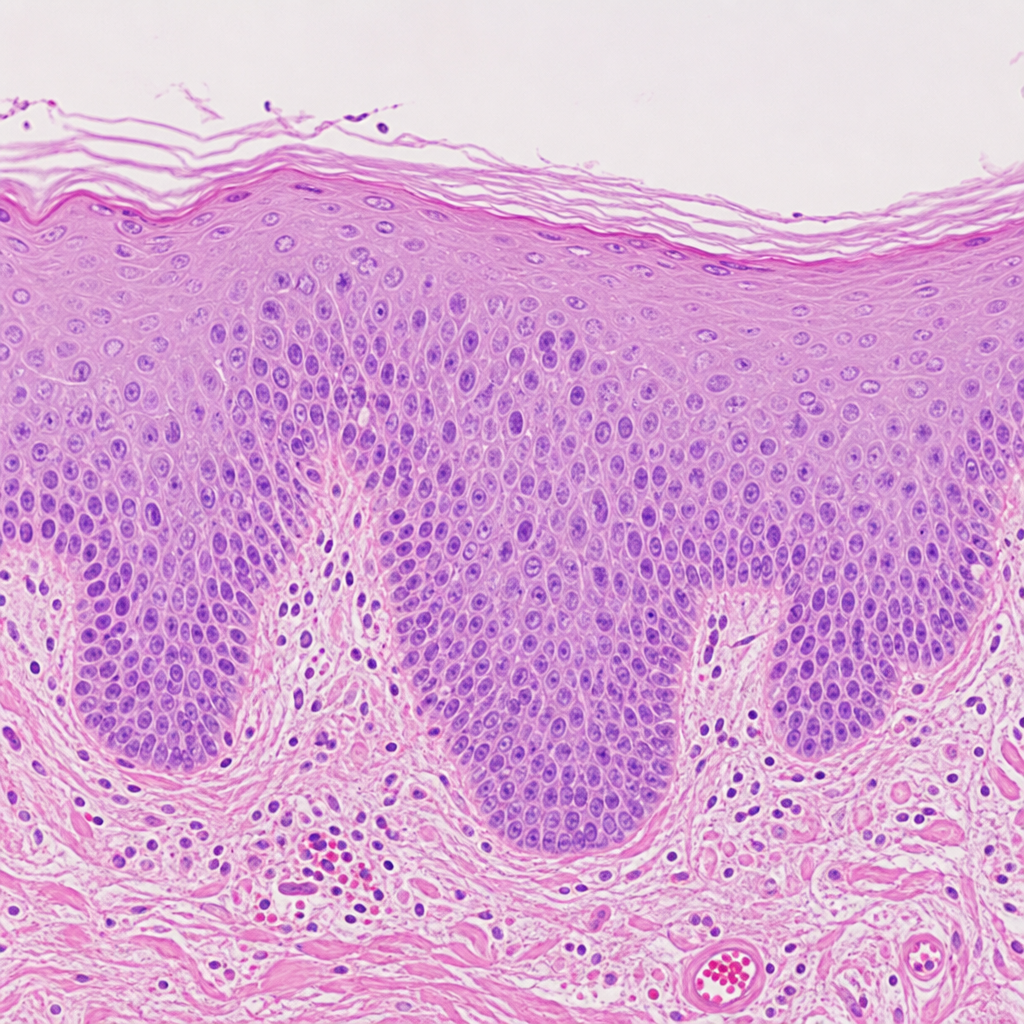
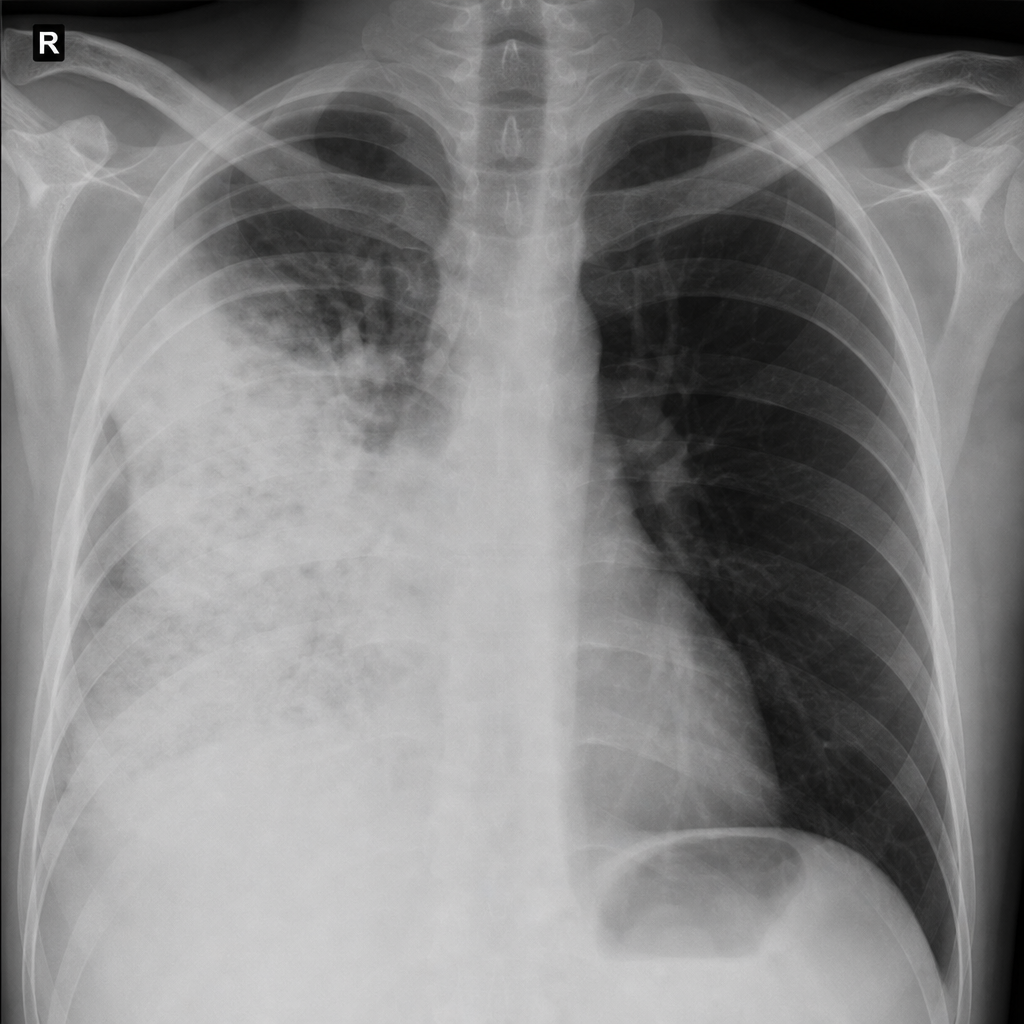
A patient underwent lung transplantation. Below is the gross appearance of the post-mortem lung. What is the most likely diagnosis?

What is the causative particle in asbestosis?
Infraclavicular lesion of tuberculosis is known as?
Which condition is characterized by alveolar hemorrhage and hemosiderin-laden macrophages?
Alpha-1-antitrypsin deficiency is associated with which type of emphysema?
Which of the following is a finding in biopsy of mesothelioma of pleura?
The alveoli are filled with exudate and the air is displaced, converting the lung into a solid organ. This description suggests:
Lymphangitis carcinomatosa is a typical feature of which of the following?
What is the synonym for shock lung?
Clubbing is the least common in which of the following conditions?
Explanation: ***Miliary tuberculosis*** - In **immunocompromised patients** (lung transplant recipients), tuberculosis can disseminate and present as **millet-seed sized nodules** scattered throughout both lungs on gross examination. - The **post-mortem lung** appearance with multiple small, uniform nodules is classic for **miliary TB**, especially in the setting of immunosuppression following transplantation. *Bronchiectasis* - Characterized by **abnormally dilated and thickened airways** with a "tram-track" appearance on imaging, not multiple small nodules. - Gross examination would show **cystic dilatation of bronchi** and bronchioles, often filled with purulent secretions. *Lung abscess* - Presents as a **single or few large cavitary lesions** filled with pus, not multiple small nodules. - Gross appearance would show **thick-walled cavities** with necrotic centers, typically larger than millet seeds. *Lung carcinoma* - Typically appears as **discrete mass lesions** or **irregular nodules** of varying sizes, not uniform small nodules. - Gross examination would reveal **heterogeneous tissue** with possible necrosis, hemorrhage, or calcification, distinct from the uniform miliary pattern.
Explanation: **Explanation:** Asbestosis is a form of pneumoconiosis caused by the inhalation of asbestos fibers. Asbestos exists in two distinct geometric forms: **Amphiboles** (straight, stiff, needle-like) and **Serpentines/Chrysotiles** (curly, flexible). **1. Why Amphibole is the correct answer:** While Chrysotile is the most commonly used form in industry, **Amphiboles** are significantly more pathogenic. Due to their straight, needle-like structure, they penetrate deep into the distal airways and align with the airflow, reaching the alveoli more effectively. They are also less soluble than chrysotiles, allowing them to persist in the lung parenchyma for decades, leading to chronic inflammation, interstitial fibrosis, and a much higher risk of **malignant mesothelioma** [1]. **2. Why the other options are incorrect:** * **B. Chrysotile:** This is the "serpentine" form. Because they are curly and flexible, they are often trapped in the upper airways by mucociliary clearance. They are also more soluble and more easily cleared from the tissues, making them less fibrogenic than amphiboles [1]. * **C. Tridymite & D. Cristobalite:** These are crystalline forms of **Silica** (Silicon dioxide) [1]. They are associated with **Silicosis**, not asbestosis. Silicosis typically presents with "eggshell calcification" of hilar lymph nodes and fibrotic nodules in the upper lobes [1]. **High-Yield Clinical Pearls for NEET-PG:** * **Pathognomonic Finding:** **Ferruginous bodies** (Asbestos bodies) – golden-brown, fusiform/beaded rods with translucent centers, coated with iron-containing protein (Prussian blue positive) [1]. * **Most Common Finding:** Benign pleural plaques (usually on the parietal pleura and diaphragm) [1]. * **Most Common Malignancy:** Bronchogenic carcinoma (risk is synergistically increased by smoking) [1]. * **Most Specific Malignancy:** Malignant Mesothelioma [1]. * **Location:** Unlike silicosis and coal worker's pneumoconiosis, asbestosis primarily affects the **lower lobes** [1]. **References:** [1] Kumar V, Abbas AK, et al.. Robbins and Cotran Pathologic Basis of Disease. 9th ed. The Lung, pp. 698-699.
Explanation: **Explanation:** The correct answer is **Assman’s focus**. This question tests the nomenclature of specific lesions in Pulmonary Tuberculosis based on their stage and anatomical location. **1. Why Assman’s focus is correct:** Assman’s focus refers to the initial area of consolidation seen in **Secondary (Reactivation) Tuberculosis**. Unlike primary TB, secondary TB typically involves the apex of the lungs (due to high oxygen tension). Specifically, an early localized area of tuberculous bronchopneumonia located in the **infraclavicular region** is termed Assman’s focus. **2. Why other options are incorrect:** * **Ghon’s focus:** This is the hallmark of **Primary Tuberculosis** [1]. It is a 1–1.5 cm area of gray-white inflammation/consolidation located typically in the lower part of the upper lobe or upper part of the lower lobe, usually close to the pleura [1]. (Ghon’s focus + Lymph node involvement = Ghon’s Complex) [1]. * **Puhl’s focus:** This refers to a specific lesion in the **apex** of the lung in secondary TB. While Assman’s is infraclavicular, Puhl’s is strictly apical. **3. NEET-PG High-Yield Pearls:** * **Ranke Complex:** A healed, radiologically visible calcified Ghon’s complex [1]. * **Simmond’s focus:** Another term for apical nodules in secondary TB (similar to Puhl's). * **Rich Focus:** A subpial or subependymal focus in the brain that ruptures into the subarachnoid space, leading to TB Meningitis. * **Weigert’s Law:** Refers to the mechanism of miliary TB where a tubercle erodes into a pulmonary vein, spreading bacilli throughout the systemic circulation. **References:** [1] Kumar V, Abbas AK, et al.. Robbins and Cotran Pathologic Basis of Disease. 9th ed. Infectious Diseases, pp. 383-384.
Explanation: **Explanation:** **Goodpasture Syndrome** is the correct answer because it is a classic cause of **Diffuse Alveolar Hemorrhage (DAH)** [2]. It is an autoimmune disorder caused by **anti-GBM antibodies** directed against the non-collagenous domain of the ̱3 chain of Type IV collagen. This collagen is found in both the glomerular basement membrane (kidneys) and the pulmonary alveolar basement membrane [2]. Damage to the alveolar capillaries leads to intra-alveolar bleeding. Over time, macrophages ingest the released hemoglobin, converting it into **hemosiderin** (hemosiderin-laden macrophages or "siderophages"), which can be visualized using **Prussian Blue stain**. **Incorrect Options:** * **Sarcoidosis:** A multi-system granulomatous disease characterized by **non-caseating granulomas**, bilateral hilar lymphadenopathy, and elevated ACE levels, not acute hemorrhage. * **Bronchial Pneumonia:** Characterized by acute suppurative inflammation of the lungs, typically showing an intra-alveolar **neutrophilic exudate** rather than diffuse hemorrhage. * **Bronchiectasis:** Defined by permanent, abnormal **dilation of bronchi** and bronchioles due to chronic infection and obstruction. While it can cause hemoptysis, the hallmark is airway remodeling and purulent sputum, not diffuse alveolar siderophages. **NEET-PG High-Yield Pearls:** * **Immunofluorescence (IF):** Goodpasture syndrome shows a characteristic **Linear IgG deposition** along the basement membranes (unlike the "lumpy-bumpy" pattern in Post-streptococcal Glomerulonephritis). * **Clinical Triad:** Hemoptysis, anemia, and diffuse pulmonary infiltrates [1]. * **Renal Pathology:** Often presents as **Rapidly Progressive Glomerulonephritis (RPGN)** with crescent formation. * **Siderophages:** Also seen in "Heart Failure Cells" in the lungs of patients with chronic left-sided congestive heart failure. **References:** [1] Kumar V, Abbas AK, et al.. Robbins and Cotran Pathologic Basis of Disease. 9th ed. The Lung, pp. 708-709. [2] Cross SS. Underwood's Pathology: A Clinical Approach. 6th ed. Common Clinical Problems From Respiratory Tract Disease, pp. 322-323.
Explanation: **Explanation** **1. Why Panacinar Emphysema is Correct:** Alpha-1-antitrypsin (AAT) is a protease inhibitor that neutralizes **neutrophil elastase** [1], [2]. In AAT deficiency, the lack of this protective enzyme leads to unchecked destruction of elastic tissue throughout the entire acinus (from the respiratory bronchiole to the alveoli). This results in **Panacinar (Panlobular) emphysema**, which characteristically involves the **lower lobes** of the lungs more severely due to higher perfusion in these areas [3]. **2. Why Other Options are Incorrect:** * **Centriacinar (Centrilobular) Emphysema:** This is the most common type and is strongly associated with **cigarette smoking** [1]. It primarily affects the proximal parts of the acinus (respiratory bronchioles) while sparing distal alveoli, and typically involves the **upper lobes** [4]. * **Paraseptal (Distal Acinar) Emphysema:** This involves the distal part of the acinus near the pleura and connective tissue septa. It is a common cause of **spontaneous pneumothorax** in young adults (rupture of subpleural blebs) [4]. * **Irregular Emphysema:** This is associated with **scarring** (healed inflammatory processes) and is usually asymptomatic as it involves the acinus irregularly [4]. **3. High-Yield Clinical Pearls for NEET-PG:** * **Genetics:** Autosomal codominant inheritance; the most common clinically significant mutation is the **PiZZ phenotype** [3]. * **Liver Involvement:** AAT deficiency also causes liver cirrhosis due to the accumulation of misfolded AAT proteins in hepatocytes, seen as **PAS-positive, diastase-resistant globules** [2]. * **Smoking Effect:** Smoking accelerates the onset of emphysema in AAT-deficient patients by recruiting neutrophils and inactivating the remaining AAT via oxidation [3]. **References:** [1] Kumar V, Abbas AK, et al.. Robbins and Cotran Pathologic Basis of Disease. 9th ed. The Lung, pp. 684-685. [2] Kumar V, Abbas AK, et al.. Robbins and Cotran Pathologic Basis of Disease. 9th ed. Liver and Gallbladder, pp. 856-858. [3] Kumar V, Abbas AK, et al.. Robbins and Cotran Pathologic Basis of Disease. 9th ed. The Lung, pp. 683-684. [4] Kumar V, Abbas AK, et al.. Robbins and Cotran Pathologic Basis of Disease. 9th ed. The Lung, p. 683.
Explanation: **Explanation:** **Malignant Mesothelioma** is a primary tumor of the pleura, strongly associated with asbestos exposure [2]. The correct answer is **Intense Fibrosis** because mesothelioma typically presents in two main histological patterns: epithelial and sarcomatoid [1]. The sarcomatoid type, and often the desmoplastic variant, is characterized by dense, haphazardly arranged collagen bundles and spindle cells, leading to significant pleural thickening and intense fibrosis. **Analysis of Options:** * **Intense Fibrosis (Correct):** The tumor cells induce a robust desmoplastic reaction. Macroscopically, this results in a thick, firm, "rind-like" encasement of the lung. * **Myelin Figures (Incorrect):** These are whorled phospholipid masses seen in reversible or irreversible cell injury (e.g., necrosis) and are not a specific diagnostic feature of mesothelioma. * **Desmosomes (Incorrect):** While mesothelioma cells *do* possess long, slender microvilli and desmosomes (visible on electron microscopy), **Intense Fibrosis** is the more characteristic finding on a standard biopsy/histopathology specimen for diagnosis. Note: Long microvilli are a classic EM finding for mesothelioma, whereas short microvilli suggest adenocarcinoma [1]. * **Weibel-Palade Bodies (Incorrect):** These are storage organelles for von Willebrand factor and P-selectin found exclusively in **endothelial cells**. They are markers for vascular tumors (e.g., angiosarcoma), not mesothelial ones. **NEET-PG High-Yield Pearls:** * **Marker of choice:** Calretinin (+), WT-1 (+), Cytokeratin 5/6 (+), and D2-40 [1]. * **CEA:** Usually negative (helps differentiate from Adenocarcinoma). * **Asbestos Link:** Longest latency period (25–40 years), with a typical interval of about 30 years [2]. Crocidolite (blue asbestos) is the most carcinogenic. * **Electron Microscopy:** Characterized by **long, slender, branching microvilli** [1]. **References:** [1] Kumar V, Abbas AK, et al.. Robbins and Cotran Pathologic Basis of Disease. 9th ed. The Lung, p. 731. [2] Cross SS. Underwood's Pathology: A Clinical Approach. 6th ed. Common Clinical Problems From Respiratory Tract Disease, pp. 339-340.
Explanation: **Explanation:** The process described in the question is **Consolidation**, which is the hallmark of **Lobar Pneumonia**. [1], [2] **1. Why Lobar Pneumonia is correct:** In lobar pneumonia, the alveolar spaces are filled with an inflammatory exudate consisting of neutrophils, fibrin, and RBCs. This replaces the air, transforming the normally spongy, aerated lung parenchyma into a solid, liver-like mass. [1] This pathological transformation is clinically and radiologically referred to as consolidation. It typically progresses through four classic stages: Congestion, Red Hepatization, Gray Hepatization, and Resolution. [2] **2. Why other options are incorrect:** * **Chronic Bronchitis:** This is a clinical diagnosis characterized by a chronic productive cough. Pathologically, it involves hypertrophy of mucus-secreting glands (increased Reid Index) and inflammation of the airways, not the filling of alveoli with exudate. * **Bronchial Asthma:** This is characterized by reversible bronchoconstriction, mucosal edema, and mucus plugging of the bronchioles. While it involves airway obstruction, it does not cause diffuse alveolar consolidation. * **Bronchiectasis:** This involves the permanent, abnormal dilation of bronchi and bronchioles due to chronic necrotizing infections. It results in "honeycombing" or dilated sacs, rather than a solid organ transformation. **High-Yield Clinical Pearls for NEET-PG:** * **Most common cause:** *Streptococcus pneumoniae* (Pneumococcus). * **Hepatization:** The term used because the consolidated lung has the consistency of the liver. [1] * **Reid Index:** Used in Chronic Bronchitis (Ratio of the thickness of the gland layer to the thickness of the wall between the epithelium and cartilage; Normal < 0.4). * **Curschmann Spirals & Charcot-Leyden Crystals:** Classic microscopic findings in Bronchial Asthma. **References:** [1] Cross SS. Underwood's Pathology: A Clinical Approach. 6th ed. Common Clinical Problems From Respiratory Tract Disease, pp. 317-318. [2] Kumar V, Abbas AK, et al.. Robbins and Cotran Pathologic Basis of Disease. 9th ed. The Lung, pp. 711-712, 715.
Explanation: **Explanation:** **Lymphangitis carcinomatosa** refers to the diffuse infiltration and obstruction of the pulmonary lymphatic vessels by metastatic tumor cells. [1] This condition leads to significant thickening of the bronchovascular bundles and interlobular septa, often presenting clinically with rapidly progressive dyspnea and a "reticulonodular" pattern on chest X-rays. **Why Option B is Correct:** The most common primary malignancies causing lymphangitis carcinomatosa are those that can easily seed the pulmonary lymphatic system. **Carcinoma of the bronchus** (Lung Cancer) is a leading cause because of its anatomical proximity and direct access to the intrapulmonary lymphatic channels. Other common primaries include cancers of the breast, stomach, pancreas, and prostate. [1] **Why Other Options are Incorrect:** * **Option A (Thyroid):** While thyroid carcinoma (especially papillary) frequently metastasizes to cervical lymph nodes and can spread to the lungs, it typically presents as discrete "cannon-ball" or miliary nodules rather than diffuse lymphatic infiltration. * **Option C (Hepatoma):** Hepatocellular carcinoma (HCC) primarily spreads via the hematogenous route (bloodstream), most commonly to the lungs as discrete nodules, rather than through the pulmonary lymphatic network. **High-Yield Clinical Pearls for NEET-PG:** * **Radiological Sign:** On HRCT, it is characterized by **irregular, beaded thickening of the interlobular septa** (the "string of beads" sign). * **Pathology:** It represents a secondary (metastatic) process, not a primary lung pathology. [1] * **Differential Diagnosis:** Must be distinguished from pulmonary edema and sarcoidosis, which also involve the lymphatic distribution. * **Prognosis:** It is generally a sign of advanced malignancy and carries a poor prognosis. **References:** [1] Cross SS. Underwood's Pathology: A Clinical Approach. 6th ed. Common Clinical Problems From Respiratory Tract Disease, pp. 338-339.
Explanation: **Explanation:** **Acute Respiratory Distress Syndrome (ARDS)** is a clinical syndrome characterized by the sudden onset of severe hypoxemia and bilateral pulmonary infiltrates in the absence of heart failure [1]. It is frequently referred to as **"Shock Lung"** because it often develops as a severe complication of systemic shock (septic, hypovolemic, or cardiogenic). The underlying pathology is **Diffuse Alveolar Damage (DAD)**, where injury to the alveolar-capillary membrane leads to increased permeability, edema, and the formation of characteristic intra-alveolar hyaline membranes [1]. **Analysis of Incorrect Options:** * **COPD (Chronic Obstructive Pulmonary Disease):** This is a chronic inflammatory lung disease (including chronic bronchitis and emphysema) characterized by long-term breathing problems and poor airflow, not an acute manifestation of shock. * **Alveolar Proteinosis:** A rare condition where surfactant compounds accumulate in the alveoli. It is characterized by a "crazy paving" pattern on CT and PAS-positive intra-alveolar material, unrelated to shock. * **Hyaline Membrane Disease (HMD):** Also known as Infant Respiratory Distress Syndrome (IRDS), this is caused by a **deficiency of surfactant** in premature neonates. While it shares the histological feature of hyaline membranes with ARDS, the etiology is developmental rather than a response to systemic shock or injury. **NEET-PG High-Yield Pearls:** * **Histological Hallmark:** Diffuse Alveolar Damage (DAD). * **Stages of ARDS:** Exudative (first 7 days, hyaline membranes), Proliferative (7–21 days), and Fibrotic (after 21 days) [1]. * **Berlin Criteria:** Used for clinical diagnosis (Acute onset <1 week, Bilateral opacities, Respiratory failure not explained by heart failure, and PaO2/FiO2 ratio <300 mmHg). * **Common Causes:** Sepsis (most common), diffuse pulmonary infections, gastric aspiration, and severe trauma [1]. **References:** [1] Kumar V, Abbas AK, et al.. Robbins and Cotran Pathologic Basis of Disease. 9th ed. The Lung, pp. 679-681.
Explanation: Digital clubbing (hypertrophic osteoarthropathy) is a clinical sign characterized by the focal bulbous enlargement of the distal segments of fingers and toes due to connective tissue proliferation. **Explanation of the Correct Answer:** **Small cell carcinoma (SCLC)** is the least likely lung malignancy to be associated with clubbing. SCLC is a neuroendocrine tumor that typically presents as a central mass [3]. While it is notorious for causing various paraneoplastic syndromes (like SIADH or Cushing’s syndrome due to ACTH production) [1], it is statistically and clinically rare to see clubbing or Hypertrophic Pulmonary Osteoarthropathy (HPOA) in these patients. **Analysis of Incorrect Options:** * **Adenocarcinoma:** This is the **most common** lung cancer associated with clubbing and HPOA. Since it is usually peripherally located [2], it is frequently linked to the production of growth factors like VEGF and PDGF, which trigger the soft tissue changes seen in clubbing. * **Squamous cell carcinoma:** This is also frequently associated with clubbing, though slightly less so than adenocarcinoma. It is more commonly associated with hypercalcemia (due to PTHrP) [4]. * **Mesothelioma:** This pleural tumor is strongly associated with clubbing and HPOA in a significant percentage of cases (up to 40-50%). **High-Yield Clinical Pearls for NEET-PG:** * **Most common cause of clubbing:** Respiratory diseases (70-80%), specifically Bronchogenic carcinoma. * **Cardiovascular causes:** Cyanotic congenital heart diseases (e.g., Tetralogy of Fallot) and Subacute Bacterial Endocarditis (SBE). * **The "Schamroth Sign":** The loss of the normal diamond-shaped window between the nail beds when fingers are opposed; a key clinical test for clubbing. * **Pathogenesis:** Often attributed to megakaryocytes escaping the pulmonary capillary bed and entering systemic circulation, where they release **PDGF and VEGF** at the fingertips. **References:** [1] Kumar V, Abbas AK, et al.. Robbins and Cotran Pathologic Basis of Disease. 9th ed. The Lung, pp. 725-727. [2] Cross SS. Underwood's Pathology: A Clinical Approach. 6th ed. Common Clinical Problems From Respiratory Tract Disease, pp. 335-337. [3] Cross SS. Underwood's Pathology: A Clinical Approach. 6th ed. Common Clinical Problems From Respiratory Tract Disease, pp. 337-338. [4] Kumar V, Abbas AK, et al.. Robbins and Cotran Pathologic Basis of Disease. 9th ed. Neoplasia, pp. 338-339.
Congenital Anomalies
Practice Questions
Atelectasis and Acute Lung Injury
Practice Questions
Obstructive Pulmonary Diseases
Practice Questions
Restrictive Pulmonary Diseases
Practice Questions
Lung Infections
Practice Questions
Pulmonary Vascular Diseases
Practice Questions
Lung Tumors
Practice Questions
Pleural Diseases
Practice Questions
Interstitial Lung Diseases
Practice Questions
Occupational Lung Diseases
Practice Questions
Get full access to all questions, explanations, and performance tracking.
Start For Free