Bilateral malignant pleural effusion is most often seen in which of the following conditions?
On biopsy, a characteristic finding of malignant mesothelioma is:
Collar button lesions are characteristic of which of the following conditions?
All of the following statements about Emphysema are true, except:
What is true about Alpha-1 antitrypsin deficiency?
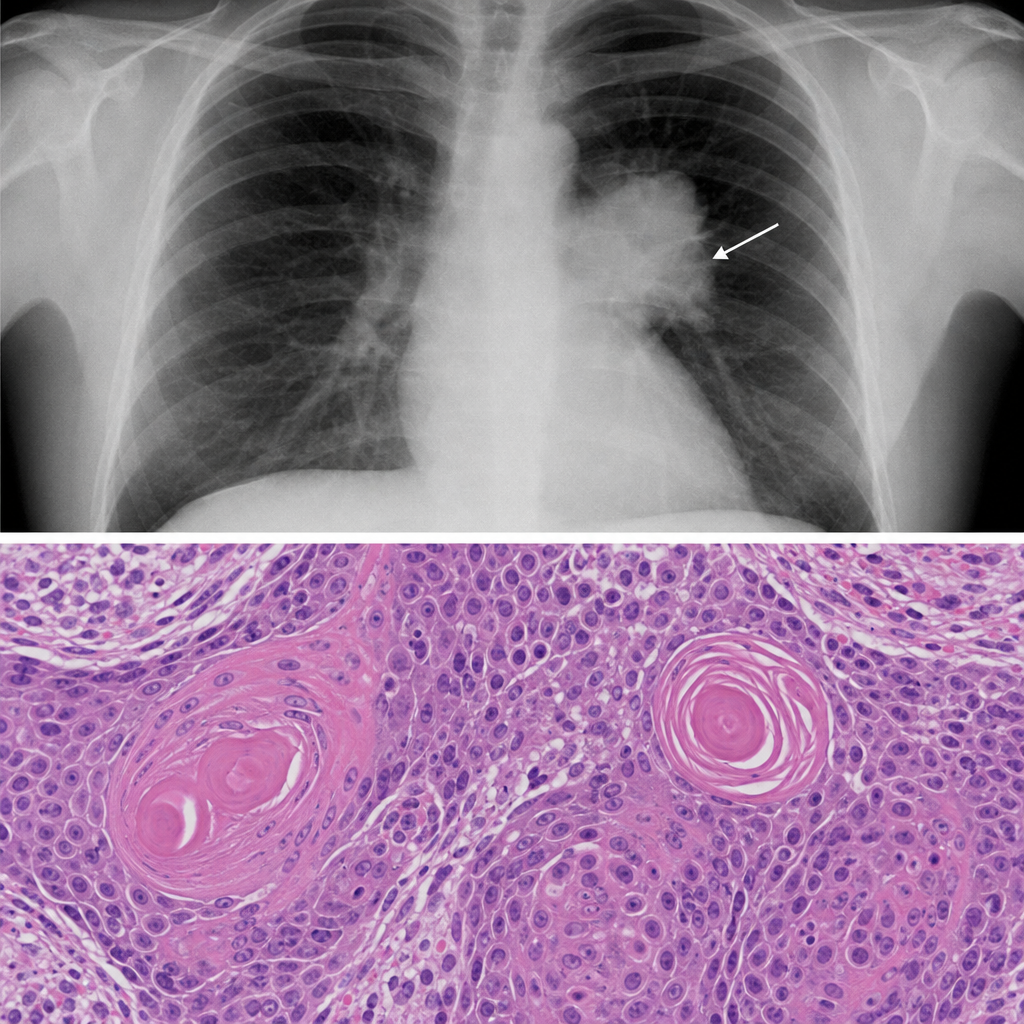
A 56-year-old man with a history of cigarette smoking presents with difficulty swallowing and a muffled voice. Laryngoscopy reveals a 2-cm laryngeal mass. If this mass is a malignant neoplasm, which of the following is the most likely histologic diagnosis?
Smoking is generally not associated as a risk factor with which of the following?
Carcinoid tumors of the lung arise from which of the following cells?
A 40-year-old female presented with a 3-month history of fever, loss of appetite, weight loss, cough, and weakness. A chest X-ray revealed consolidation in the upper lung. She died a few days after admission. Autopsy revealed gross lung findings and biopsy findings. What is your diagnosis?

Caplan syndrome is seen in which of the following conditions?
Explanation: **Explanation:** **Correct Answer: C. Mesothelioma** Malignant pleural effusion (MPE) is a common complication of advanced malignancies [1]. While lung cancer is the most frequent cause of *unilateral* MPE, **Mesothelioma** is the classic association for **bilateral** malignant pleural effusion. Mesothelioma arises from the mesothelial cells of the pleura and typically spreads by direct extension along the pleural surface. Because it encases the lung and can easily cross the mediastinal structures or involve the pericardium, it frequently leads to bilateral involvement and extensive pleural thickening (pleural rind). **Analysis of Incorrect Options:** * **A. Breast Carcinoma:** This is the second most common cause of MPE in women. It usually presents as a unilateral effusion via lymphatic spread, though bilateral involvement can occur in end-stage systemic metastasis. * **B. Lung Carcinoma:** This is the overall most common cause of MPE [2]. However, it typically presents as a **unilateral** effusion on the same side as the primary tumor due to direct pleural invasion [2]. * **D. Lymphoma:** While lymphoma can cause bilateral effusions (often chylous due to thoracic duct obstruction), it is statistically less common than mesothelioma for primary malignant pleural involvement in this context. **High-Yield Clinical Pearls for NEET-PG:** * **Most common cause of MPE (Overall):** Lung Adenocarcinoma. * **Most common cause of MPE (Women):** Breast Carcinoma. * **Diagnostic Gold Standard:** Pleural fluid cytology (initial) or Pleural biopsy (confirmatory) [3]. * **Mesothelioma Marker:** **Calretinin** is the most specific immunohistochemical marker. * **Asbestos Exposure:** The strongest risk factor for mesothelioma (latent period of 20–40 years), though smoking does *not* increase the risk of mesothelioma specifically (unlike bronchogenic carcinoma). **References:** [1] Kumar V, Abbas AK, et al.. Robbins and Cotran Pathologic Basis of Disease. 9th ed. The Lung, pp. 728-729. [2] Cross SS. Underwood's Pathology: A Clinical Approach. 6th ed. Common Clinical Problems From Respiratory Tract Disease, pp. 334-335. [3] Cross SS. Underwood's Pathology: A Clinical Approach. 6th ed. (Basic Pathology) introduces the student to key general principles of pathology, both as a medical science and as a clinical activity with a vital role in patient care. Part 2 (Disease Mechanisms) provides fundamental knowledge about the cellular and molecular processes involved in diseases, providing the rationale for their treatment. Part 3 (Systematic Pathology) deals in detail with specific diseases, with emphasis on the clinically important aspects., pp. 234-235.
Explanation: ### Explanation **Correct Answer: D. Branching microvilli** **Why it is correct:** Malignant Mesothelioma is a primary tumor of the pleura, strongly associated with asbestos exposure. On **Electron Microscopy (EM)**, which is the gold standard for distinguishing it from adenocarcinoma, mesothelioma cells exhibit characteristic **long, slender, and branching microvilli**. These microvilli typically have a high length-to-diameter ratio (often >10:1). In contrast, adenocarcinoma cells show short, blunt, and non-branching microvilli. **Analysis of Incorrect Options:** * **A. Myelin:** Myelin figures are whorled phospholipid masses seen in reversible or irreversible cell injury (representing damaged membranes). They are not specific to mesothelioma. * **B. Desmosine:** This is an amino acid found in **elastin** fibers. It is a marker for connective tissue breakdown (e.g., in emphysema) but has no diagnostic role in mesothelioma. * **C. Weibel-Palade bodies:** These are storage organelles found in **endothelial cells** containing von Willebrand factor and P-selectin. They are markers for vascular tumors like angiosarcoma. **NEET-PG High-Yield Pearls:** 1. **Immunohistochemistry (IHC):** Mesothelioma is typically **Calretinin (+)**, Cytokeratin 5/6 (+), and WT-1 (+). It is **CEA (-)** (CEA is positive in adenocarcinoma) [1]. 2. **Gross Appearance:** It characteristically "encases" the lung, forming a thick, firm, grayish-white pleural rind. 3. **Asbestos Association:** While asbestos causes both, **Bronchogenic Carcinoma** is actually the *most common* cancer associated with asbestos; however, Mesothelioma is the *most specific*. 4. **Ferruginous Bodies:** These are asbestos bodies coated with iron-containing protein (Prussian blue positive) found in the lungs of exposed individuals. **References:** [1] Kumar V, Abbas AK, et al.. Robbins and Cotran Pathologic Basis of Disease. 9th ed. The Lung, p. 731.
Explanation: **Explanation:** **Carcinoid tumors** are neuroendocrine neoplasms that typically arise from the bronchial mucosa [1]. The characteristic **"collar-button" lesion** (also known as a dumbbell lesion) occurs because these tumors often grow in a dual fashion: they have a small endobronchial component that protrudes into the airway lumen and a much larger, bulky extrabronchial component that extends into the adjacent lung parenchyma or peribronchial soft tissue. On imaging or gross specimen, the narrow neck at the bronchial wall connecting these two masses resembles a collar button. **Why other options are incorrect:** * **Adenocarcinoma:** This is typically a peripheral lung tumor that arises from surface epithelium or mucous glands. It usually presents as a solid mass or ground-glass opacity rather than a trans-mural "collar-button" growth. * **Squamous Cell Carcinoma:** While these are often central/hilar, they are characterized by endobronchial obstruction, cavitation, and local invasion. They tend to be exophytic or ulcerative rather than forming the distinct dumbbell shape seen in carcinoids. **NEET-PG High-Yield Pearls:** * **Origin:** Derived from **Kulchitsky cells** (enterochromaffin cells) of the bronchial epithelium. * **Histology:** Shows a "monotonous" appearance with organoid, trabecular, or palisading patterns and **"salt and pepper" chromatin** [1]. * **Markers:** Positive for **Chromogranin A**, Synaptophysin, and CD56. * **Clinical:** Most are non-secretory; however, if they metastasize to the liver, they can cause **Carcinoid Syndrome** (flushing, diarrhea, wheezing). * **Classification:** Divided into Typical (low grade, <2 mitoses/10 HPF, no necrosis) and Atypical (intermediate grade, 2-10 mitoses/10 HPF, focal necrosis) [1]. **References:** [1] Kumar V, Abbas AK, et al.. Robbins and Cotran Pathologic Basis of Disease. 9th ed. The Lung, p. 727.
Explanation: ### Explanation **Core Concept:** Emphysema is a classic example of **Obstructive Lung Disease**. It is characterized by the permanent enlargement of airspaces distal to the terminal bronchioles, accompanied by the destruction of alveolar walls [1]. This destruction leads to a loss of elastic recoil and air trapping. **Why Option C is the Correct Answer (The "Except"):** In Emphysema, Pulmonary Function Tests (PFTs) show an **Obstructive pattern**, not a restrictive one. Key findings include: * **Decreased FEV1/FVC ratio** (< 0.7). * **Increased Total Lung Capacity (TLC)** and **Residual Volume (RV)** due to hyperinflation and air trapping. Restrictive patterns (decreased TLC) are seen in conditions like Interstitial Lung Disease or Kyphoscoliosis. **Analysis of Other Options:** * **Option A:** Dyspnea (breathlessness) is the hallmark and usually the first symptom. Patients are often called "Pink Puffers" because they remain well-oxygenated by hyperventilating until late stages. * **Option B:** The destruction of alveolar walls reduces the total surface area available for gas exchange [2]. This leads to a **decreased DLCO** (Diffusing Capacity of the Lungs for Carbon Monoxide), a key differentiator from chronic bronchitis. * **Option C:** Unlike asthma, the airflow obstruction in emphysema is largely **irreversible** [3]. While bronchodilators may provide symptomatic relief, they do not significantly improve the underlying lung function or FEV1. **NEET-PG High-Yield Pearls:** * **Centriacinar Emphysema:** Most common; associated with smoking; affects upper lobes [1]. * **Panacinar Emphysema:** Associated with **α1-Antitrypsin deficiency**; affects lower lobes [1]. * **Microscopic Hallmark:** "Thinning and destruction of alveolar walls" without significant fibrosis [2]. * **Radiology:** Flattened diaphragm, increased retrosternal airspace, and hyperlucent lung fields. **References:** [1] Kumar V, Abbas AK, et al.. Robbins and Cotran Pathologic Basis of Disease. 9th ed. The Lung, pp. 684-685. [2] Cross SS. Underwood's Pathology: A Clinical Approach. 6th ed. Common Clinical Problems From Respiratory Tract Disease, pp. 326-327. [3] Kumar V, Abbas AK, et al.. Robbins and Cotran Pathologic Basis of Disease. 9th ed. The Lung, pp. 681-683.
Explanation: **Explanation:** Alpha-1 Antitrypsin (AAT) deficiency is an autosomal codominant disorder characterized by low serum levels of AAT, a protease inhibitor [1]. **1. Why Option A is Correct:** AAT normally inhibits **neutrophil elastase**, an enzyme that breaks down elastin in alveolar walls [2]. In its absence, unchecked elastase activity leads to the destruction of the pulmonary parenchyma, resulting in **panacinar emphysema** [3]. This typically presents as severe pulmonary disease, especially in the lower lobes, and is significantly exacerbated by smoking [2]. **2. Why Options B and C are Incorrect:** * **Option B:** While liver involvement occurs due to the misfolding and accumulation of the mutant protein in hepatocytes, the characteristic granules are **PAS-positive and diastase-resistant** [1]. Diastase digests glycogen; since these inclusions are glycoproteins, they remain visible (resistant) after diastase treatment. * **Option C:** This is a tricky distractor. While the **PiZZ genotype** is indeed associated with the lowest levels of AAT and the highest risk of disease, the question asks for "what is true" among the choices [2]. In many standard medical examinations, if one option is technically flawed (like the diastase sensitivity in B), "All of the above" becomes incorrect. Option A remains the most definitive clinical hallmark. **Clinical Pearls for NEET-PG:** * **Genetics:** Located on Chromosome 14 [1]. PiMM is normal; PiZZ is the most severe disease-causing phenotype [2]. * **Morphology:** Look for "magenta-colored" globular inclusions in periportal hepatocytes on PAS stain. * **Clinical Triad:** Panacinar emphysema (lower lobes), Liver Cirrhosis, and occasionally Panniculitis [1]. * **Smoking:** Accelerates the onset of emphysema in AAT-deficient patients by decades [2]. **References:** [1] Kumar V, Abbas AK, et al.. Robbins and Cotran Pathologic Basis of Disease. 9th ed. Liver and Gallbladder, pp. 856-858. [2] Kumar V, Abbas AK, et al.. Robbins and Cotran Pathologic Basis of Disease. 9th ed. The Lung, pp. 683-684. [3] Kumar V, Abbas AK, et al.. Robbins and Cotran Pathologic Basis of Disease. 9th ed. The Lung, pp. 684-685.
Explanation: **Explanation:** **1. Why Squamous Cell Carcinoma (SCC) is correct:** Squamous cell carcinoma is the most common primary malignancy of the larynx, accounting for approximately **95% of all laryngeal cancers**. The larynx is lined by respiratory epithelium (pseudostratified ciliated columnar), but the true vocal cords are lined by stratified squamous epithelium [1]. Chronic irritation from **cigarette smoking** and alcohol consumption leads to squamous metaplasia and dysplasia, eventually progressing to SCC [2]. Clinical features like dysphagia (difficulty swallowing) and a muffled voice ("potato voice") or hoarseness are classic presentations of laryngeal masses. **2. Why the other options are incorrect:** * **A. Adenocarcinoma:** These are rare in the larynx and typically arise from the minor salivary glands located in the supraglottic or subglottic regions. * **B. Leiomyosarcoma:** This is a malignant mesenchymal tumor of smooth muscle origin. Sarcomas of the larynx are extremely rare compared to epithelial tumors. * **C. Small cell carcinoma:** While strongly associated with smoking, small cell carcinoma is primarily a lung pathology [3]. Neuroendocrine tumors of the larynx do exist but are significantly less common than SCC. **3. NEET-PG High-Yield Pearls:** * **Risk Factors:** Smoking is the #1 risk factor; synergistic effect with alcohol [2]. HPV (types 16 and 18) is also implicated in a subset of cases. * **Most Common Site:** The **glottis** (vocal cords) is the most common site for laryngeal SCC, followed by the supraglottis. * **Precursor Lesion:** Often preceded by **leukoplakia** (white patch) or erythroplakia (red patch) showing squamous dysplasia [2]. * **Staging:** The most important prognostic factor is the stage at the time of diagnosis. Glottic tumors have a better prognosis because they present early with hoarseness and have sparse lymphatic drainage. **References:** [1] Cross SS. Underwood's Pathology: A Clinical Approach. 6th ed. Common Clinical Problems From Respiratory Tract Disease, pp. 314-315. [2] Kumar V, Abbas AK, et al.. Robbins and Cotran Pathologic Basis of Disease. 9th ed. Head and Neck, pp. 746-747. [3] Cross SS. Underwood's Pathology: A Clinical Approach. 6th ed. Common Clinical Problems From Respiratory Tract Disease, pp. 336-337.
Explanation: **Explanation:** The correct answer is **Bronchiolitis Obliterans Organizing Pneumonia (BOOP)**, now more commonly referred to as **Organizing Pneumonia (OP)**. **1. Why BOOP/OP is the correct answer:** Unlike many interstitial and airway diseases, BOOP is **not** linked to cigarette smoking. It is a clinicopathologic syndrome characterized by plugs of loose connective tissue (Masson bodies) within alveolar ducts and alveoli [1]. It is most commonly idiopathic (Cryptogenic Organizing Pneumonia) or associated with connective tissue diseases, drug toxicity, or post-infectious states [3]. Interestingly, some studies suggest that smoking may even have a paradoxical "protective" effect or a lower incidence in BOOP patients, similar to Sarcoidosis and Hypersensitivity Pneumonitis [1]. **2. Analysis of Incorrect Options:** * **Small cell carcinoma:** This is the lung malignancy most strongly associated with smoking (nearly 99% of cases occur in smokers). It is characterized by neuroendocrine differentiation and early metastasis. * **Respiratory bronchiolitis:** This is a "smoker’s disease" characterized by the accumulation of pigmented macrophages (smoker's macrophages) within the respiratory bronchioles [2]. When symptomatic, it is called Respiratory Bronchiolitis-Associated Interstitial Lung Disease (RB-ILD). * **Emphysema:** Smoking is the primary etiology [4]. It causes an imbalance between proteases (elastase) and anti-proteases, leading to the permanent enlargement of airspaces distal to the terminal bronchioles [4]. **High-Yield Clinical Pearls for NEET-PG:** * **Smoking-Related ILDs:** Respiratory Bronchiolitis-ILD (RB-ILD) and Desquamative Interstitial Pneumonia (DIP) are directly caused by smoking [2]. * **Masson Bodies:** The hallmark histological finding in Organizing Pneumonia [1]. * **Reverse Halo Sign (Atoll Sign):** A high-yield radiological finding on CT scan highly suggestive of Organizing Pneumonia. * **Non-Smoker Lung Cancer:** Adenocarcinoma is the most common lung cancer in non-smokers and females. **References:** [1] Kumar V, Abbas AK, et al.. Robbins and Cotran Pathologic Basis of Disease. 9th ed. The Lung, pp. 693-695. [2] Kumar V, Abbas AK, et al.. Robbins and Cotran Pathologic Basis of Disease. 9th ed. The Lung, pp. 702-703. [3] Cross SS. Underwood's Pathology: A Clinical Approach. 6th ed. Common Clinical Problems From Respiratory Tract Disease, pp. 333-334. [4] Cross SS. Underwood's Pathology: A Clinical Approach. 6th ed. Common Clinical Problems From Respiratory Tract Disease, pp. 326-327.
Explanation: **Explanation:** **1. Why Kulchitsky (K) cells are correct:** Carcinoid tumors are well-differentiated neuroendocrine neoplasms [2]. They arise from the **Kulchitsky (K) cells**, which are part of the diffuse neuroendocrine system (DNES) located within the bronchial epithelium. These cells are characterized by the presence of dense-core neurosecretory granules in their cytoplasm, which stain positive for markers like **Chromogranin A, Synaptophysin, and CD56** [1]. **2. Why other options are incorrect:** * **Type-II pneumocytes:** These cells are responsible for surfactant production and alveolar repair. They are the progenitor cells for **Adenocarcinoma** of the lung, not carcinoid tumors. * **Mucus (goblet) cells:** These are specialized epithelial cells that secrete mucin. While they can undergo hyperplasia in chronic bronchitis, they are not the origin of neuroendocrine tumors. * **Clara cells (Club cells):** Located in the terminal bronchioles, these cells protect the bronchiolar epithelium. They are associated with certain subtypes of adenocarcinoma (formerly bronchioloalveolar carcinoma). **3. High-Yield Clinical Pearls for NEET-PG:** * **Location:** Most carcinoid tumors are **central** (arising in mainstem bronchi), presenting with cough, hemoptysis, or obstructive pneumonia. * **Morphology:** Histologically, they show a "salt and pepper" chromatin pattern and a nested (organoid) growth pattern. Electron microscopy shows characteristic dense-core granules [1]. * **Carcinoid Syndrome:** Rare in lung carcinoids (seen in <5% of cases), it occurs only when there are massive liver metastases, leading to flushing, diarrhea, and wheezing due to serotonin release [1]. * **Classification:** Divided into **Typical** (<2 mitoses/10 HPF, no necrosis) and **Atypical** (2-10 mitoses/10 HPF or focal necrosis) [1]. Atypical carcinoids have a higher metastatic potential. **References:** [1] Kumar V, Abbas AK, et al.. Robbins and Cotran Pathologic Basis of Disease. 9th ed. The Lung, p. 727. [2] Kumar V, Abbas AK, et al.. Robbins and Cotran Pathologic Basis of Disease. 9th ed. The Gastrointestinal Tract, pp. 780-781.
Explanation: ***Tuberculosis of the lung*** - The combination of **constitutional symptoms** (fever, weight loss, loss of appetite) with **upper lobe consolidation** on chest X-ray is classic for pulmonary tuberculosis. - Autopsy findings would show **caseating granulomas** with **caseous necrosis** and **Langhans giant cells**, pathognomonic for TB. *Sarcoidosis* - Typically presents with **non-caseating granulomas** without central necrosis, unlike the caseating pattern seen in TB. - More commonly affects **bilateral hilar lymph nodes** and lower lobes, not upper lobe consolidation as described. *Carcinoma of the lung* - Histology would show **malignant epithelial cells** and **pleomorphic nuclei**, not granulomatous inflammation. - While constitutional symptoms can occur, the **upper lobe predilection** and granulomatous response favor infectious etiology. *Bronchiectasis* - Characterized by **airway dilation** and **chronic suppurative infection**, not consolidation or granulomas. - Typically presents with **chronic productive cough** with purulent sputum, not the acute presentation described.
Explanation: **Explanation:** **Caplan Syndrome** (also known as Rheumatoid Pneumoconiosis) is a clinical entity characterized by the coexistence of **Rheumatoid Arthritis (RA)** and **Pneumoconiosis**. It was originally described in coal miners but can occur with exposure to silica or asbestos [1]. 1. **Why Pneumoconiosis is Correct:** The syndrome manifests as the sudden development of multiple, well-defined, rounded nodules (0.5–5 cm) in the lungs, primarily in the periphery. These nodules represent an exaggerated inflammatory response to inhaled dust (like coal or silica) in individuals with a pre-existing hyper-reactive immune system due to Rheumatoid Arthritis. Other lung manifestations include rheumatoid nodules, Caplan's syndrome, vasculitis and obliterative bronchiolitis [1]. Histologically, these nodules resemble rheumatoid nodules but have a central core of dust and necrotic tissue. 2. **Why Other Options are Incorrect:** * **COPD:** Characterized by chronic bronchitis and emphysema; it involves airway obstruction and alveolar destruction, not the formation of fibro-inflammatory nodules. * **Pulmonary Edema:** Involves fluid accumulation in the alveoli due to cardiac or non-cardiac causes; it is an acute hemodynamic or permeability issue. * **Bronchial Asthma:** A reversible obstructive airway disease characterized by bronchial hyperresponsiveness and eosinophilic inflammation, not associated with pneumoconiotic nodules. **High-Yield Clinical Pearls for NEET-PG:** * **Triad:** Pneumoconiosis + Rheumatoid Arthritis + Multiple Pulmonary Nodules. * **Radiology:** "Snowstorm appearance" (multiple discrete nodules) on a background of pneumoconiosis. * **Commonest Association:** Coal Worker’s Pneumoconiosis (CWP) is the most frequent association. * **Differentiation:** Unlike simple pneumoconiosis, Caplan nodules can develop rapidly and may cavitate or calcify. **References:** [1] Cross SS. Underwood's Pathology: A Clinical Approach. 6th ed. Common Clinical Problems From Respiratory Tract Disease, pp. 333-334.
Congenital Anomalies
Practice Questions
Atelectasis and Acute Lung Injury
Practice Questions
Obstructive Pulmonary Diseases
Practice Questions
Restrictive Pulmonary Diseases
Practice Questions
Lung Infections
Practice Questions
Pulmonary Vascular Diseases
Practice Questions
Lung Tumors
Practice Questions
Pleural Diseases
Practice Questions
Interstitial Lung Diseases
Practice Questions
Occupational Lung Diseases
Practice Questions
Get full access to all questions, explanations, and performance tracking.
Start For Free