What statement is FALSE regarding the Reid index?
All of the following statements are true regarding primary ciliary dyskinesia, except:
A 56-year old male, with a 20-year history of working in an asbestos factory, presented with a lesion at the lung apex. Electron microscopy of a lung biopsy revealed characteristic findings. What is your diagnosis?

Sputum from an asthma patient may show which of the following findings?
Radon-222 is believed to be a risk factor for which of the following cancers?
The Azzopardi effect is a characteristic finding associated with which of the following lung tumors?
Which type of lung carcinoma is most commonly associated with producing superior vena cava syndrome?
Small cell carcinoma commonly metastasizes to which of the following organs?
Sputum analysis of an asthma patient shows Charcot Leyden crystals. From where are these crystals derived from?
Which of the following is true about silicosis?
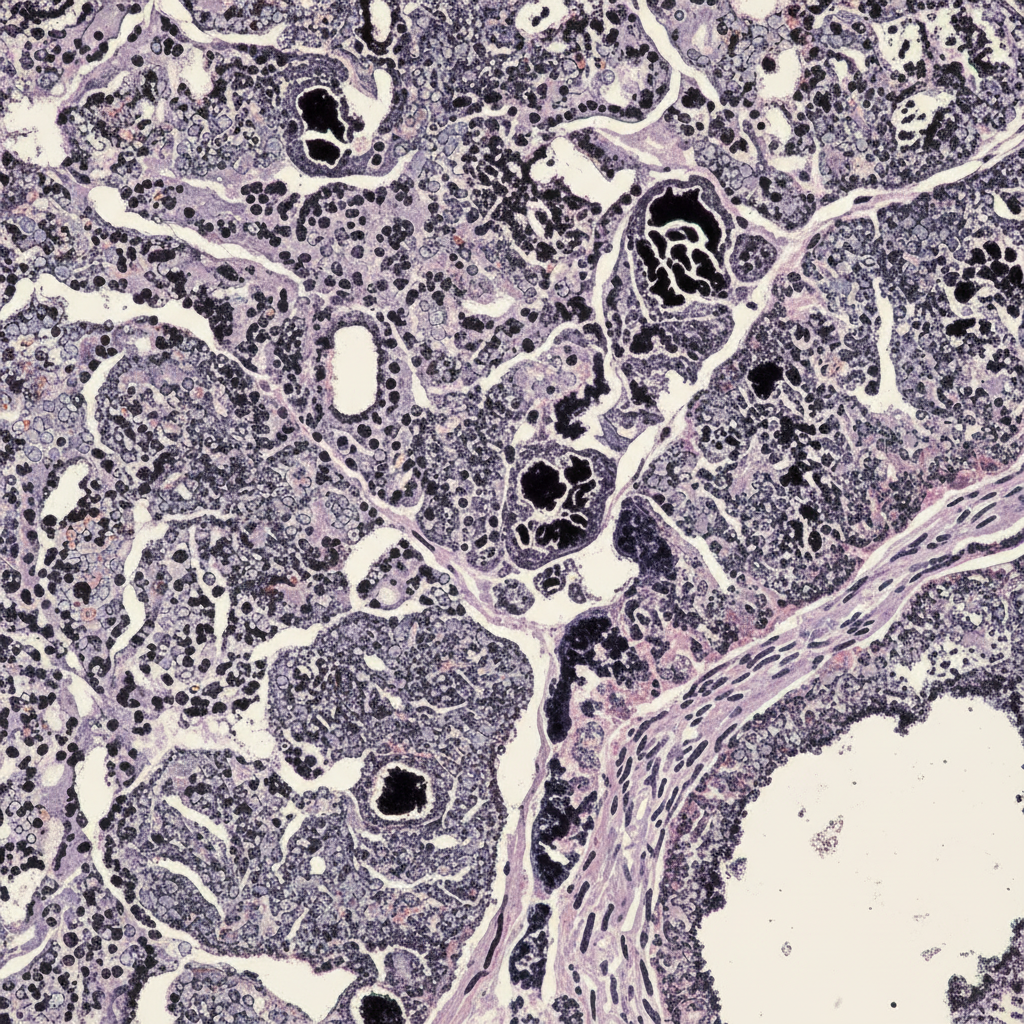
Explanation: ### Explanation The **Reid Index (RI)** is a pathological parameter used to quantify the severity of **chronic bronchitis**. It is defined as the ratio of the thickness of the bronchial submucosal glands to the total thickness of the bronchial wall (measured from the basement membrane of the surface epithelium to the perichondrium of the bronchial cartilage). **Why Option C is the correct (False) statement:** While the Reid Index is used to assess gland enlargement, it technically measures **hyperplasia** (increase in the number of cells) rather than hypertrophy (increase in cell size). More importantly, the index is a **ratio of thicknesses**, not a direct measurement of the glands alone. In chronic bronchitis, the submucosal glands expand, increasing the numerator and thus the overall ratio [1]. **Analysis of other options:** * **Option A:** In a healthy individual, the normal Reid Index is typically **<0.4** (or less than 40% of the wall thickness). * **Option B:** In chronic bronchitis, the mucous-secreting glands undergo significant hyperplasia to compensate for chronic irritation (usually from smoking), leading to an **increased RI (>0.5)** [1]. * **Option D:** There is a direct clinical-pathological correlation between an increased Reid Index and the volume of **daily sputum production**, which is the hallmark clinical feature of chronic bronchitis [1]. ### High-Yield Clinical Pearls for NEET-PG: * **Definition of Chronic Bronchitis:** Productive cough for at least **3 months** in at least **2 consecutive years** [1]. * **Specimen Site:** The RI is best measured in the **major bronchi**; it is not applicable to small airways (bronchioles) as they lack submucosal glands and cartilage [1]. * **Histology:** Look for an increased number of **Goblet cells** in the surface epithelium and squamous metaplasia. * **Formula:** $RI = \frac{\text{Gland Thickness}}{\text{Wall Thickness (Basement Membrane to Cartilage)}}$. **References:** [1] Kumar V, Abbas AK, et al.. Robbins and Cotran Pathologic Basis of Disease. 9th ed. The Lung, pp. 685-686.
Explanation: ### Explanation **1. Why Option A is the Correct Answer (The Exception):** Primary Ciliary Dyskinesia (PCD) is primarily an **Autosomal Recessive** disorder, not X-linked recessive. It is a genetically heterogeneous condition caused by mutations in over 30 different genes (most commonly *DNAH5* and *DNAI1*) that encode for the structural proteins of the cilia. **2. Analysis of Incorrect Options:** * **Option B:** The most common structural defect in PCD is the **absence or abnormality of outer and/or inner dynein arms**. Dynein is an ATPase motor protein responsible for the sliding of microtubules, which generates ciliary movement. * **Option C:** **Kartagener Syndrome** is a specific subset of PCD (occurring in about 50% of cases) characterized by the clinical triad of **Situs Inversus, Bronchiectasis, and Sinusitis**. The lack of ciliary motion during embryogenesis leads to the random orientation of internal organs. * **Option D:** Cilia and flagella share a similar structural blueprint (the 9+2 microtubule arrangement). In PCD, **sperm flagella are immobile**, leading to male infertility. Females may also experience reduced fertility due to impaired ciliary function in the fallopian tubes. **3. NEET-PG High-Yield Pearls:** * **Structure:** Normal cilia have a "9+2" microtubule arrangement. * **Clinical Presentation:** Recurrent "cold" since birth, chronic cough, bronchiectasis, and neonatal respiratory distress. * **Diagnosis:** The screening test of choice is **low nasal Nitric Oxide (nNO) levels**. Definitive diagnosis is made via high-speed video microscopy or electron microscopy showing dynein arm defects. * **Dextrocardia:** Always suspect PCD/Kartagener if a patient presents with chronic respiratory infections and a right-sided heart apex.
Explanation: ***Mesothelioma*** - **20-year asbestos exposure** history is a classic risk factor for pleural mesothelioma, with a **latency period** of 20-40 years. - Electron microscopy shows characteristic **long, thin, bushy microvilli** on tumor cells, distinguishing it from adenocarcinoma. *Adenocarcinoma of the lung* - Electron microscopy would show **short, stubby microvilli** rather than the long, bushy ones seen in mesothelioma. - While it can occur at the lung apex (**Pancoast tumor**), the strong **asbestos exposure** history makes mesothelioma more likely. *Lung metastasis* - Would require identification of a **primary tumor** elsewhere in the body, which is not mentioned in this case. - Electron microscopy findings would reflect the **primary tumor type**, not the characteristic mesothelioma microvilli pattern. *Benign pleural fibroma* - This is a **non-malignant** condition not associated with asbestos exposure. - Electron microscopy would show **fibroblastic features** without the characteristic microvilli pattern of mesothelioma.
Explanation: In bronchial asthma, the airway undergoes chronic inflammatory changes characterized by Type I hypersensitivity and eosinophilic infiltration [1]. The sputum findings reflect this underlying pathophysiology: 1. **Numerous Eosinophils:** Asthma is primarily an eosinophilic inflammatory disease [1]. These cells are recruited to the airway by IL-5 and play a central role in tissue damage and bronchial hyperreactivity [1]. 2. **Curschmann’s Spirals:** These are microscopic "plugs" of concentrated mucus [2]. They represent cast-like arrangements of shed epithelium and mucus formed within the small distal airways (bronchioles). 3. **Charcot-Leyden Crystals:** These are slender, needle-shaped, bipyramidal crystals. They are composed of **galectin-10**, a protein derived from the breakdown of eosinophil cell membranes. Their presence is a hallmark of eosinophil-rich inflammation. **Why "All of the above" is correct:** All three findings are classic morphological markers of asthma. While none are strictly pathognomonic (they can appear in other hypereosinophilic states), their presence in a patient with episodic wheezing is highly diagnostic. **High-Yield Clinical Pearls for NEET-PG:** * **Creola Bodies:** Another high-yield finding; these are ciliated columnar epithelial cell clusters shed from the bronchial mucosa. * **Airway Remodeling:** Chronic asthma leads to subepithelial fibrosis (thickening of the basement membrane) and hypertrophy of smooth muscle/mucous glands. * **Cytokine Profile:** Driven by **Th2 cells**, specifically IL-4 (IgE isotype switching), IL-5 (eosinophil activation), and IL-13 (mucus production) [1]. **References:** [1] Kumar V, Abbas AK, et al.. Robbins and Cotran Pathologic Basis of Disease. 9th ed. The Lung, pp. 688-689. [2] Cross SS. Underwood's Pathology: A Clinical Approach. 6th ed. Common Clinical Problems From Respiratory Tract Disease, pp. 328-329.
Explanation: **Explanation:** **Correct Option: D (Lung cancer)** Radon-222 is a colorless, odorless, radioactive gas produced by the natural decay of **Uranium-238** found in soil and rocks. It is the **second most common cause of lung cancer** in the general population, following cigarette smoking [2]. Radon decays into alpha-emitting particles (polonium-214 and polonium-218). When inhaled, these particles deposit in the respiratory epithelium, causing direct DNA damage and mutations (specifically in the *TP53* gene), leading to bronchogenic carcinoma [1], [3]. It is a significant occupational hazard for **uranium miners** and a domestic hazard in homes with poor ventilation built on granite-rich soil. **Incorrect Options:** * **A (Stomach cancer):** Primarily associated with *H. pylori* infection, dietary nitrates, and chronic gastritis. While some studies investigate radon in drinking water, there is no established causal link to gastric malignancy. * **B (Bladder cancer):** The major risk factors are smoking, occupational exposure to **arylamines (aniline dyes)**, and *Schistosoma haematobium* infection [2]. * **C (Brain tumor):** Risk factors include ionizing radiation (X-rays/Gamma rays) and certain genetic syndromes (e.g., NF1, Li-Fraumeni), but not radon gas. **High-Yield Clinical Pearls for NEET-PG:** * **Synergy:** There is a potent **synergistic effect** between radon exposure and cigarette smoking, exponentially increasing the risk of lung cancer. * **Type of Cancer:** Radon exposure is most commonly associated with **Small Cell Lung Carcinoma (SCLC)** and Squamous Cell Carcinoma [1]. * **Environmental Health:** In residential settings, radon levels are highest in **basements** due to proximity to the soil. **References:** [1] Kumar V, Abbas AK, et al.. Robbins and Cotran Pathologic Basis of Disease. 9th ed. The Lung, pp. 720-721. [2] Kumar V, Abbas AK, et al.. Robbins and Cotran Pathologic Basis of Disease. 9th ed. Infectious Diseases, pp. 423-424. [3] Kumar V, Abbas AK, et al.. Robbins and Cotran Pathologic Basis of Disease. 9th ed. Neoplasia, pp. 331-332.
Explanation: ### **Explanation** **Correct Answer: C. Small cell carcinoma** **The Azzopardi Effect:** The Azzopardi effect refers to the presence of intense basophilic (blue/purple) staining in the walls of blood vessels within a tumor. This occurs due to the **deposition of DNA** released from necrotic tumor cells. Small cell carcinoma (SCLC) is characterized by a very high proliferation rate and extreme fragility of cells [1]. When these cells undergo necrosis, their nuclear material (DNA) leaks out and adheres to the walls of nearby venules and capillaries, creating this distinct histological appearance. **Why the other options are incorrect:** * **A. Adenocarcinoma:** This is the most common lung cancer in non-smokers and typically shows glandular differentiation or mucin production. It does not exhibit the high degree of nuclear fragility required for the Azzopardi effect. * **B. Squamous cell carcinoma:** Characterized by keratin pearls and intercellular bridges. While it can undergo central necrosis (cavitation), it does not typically show DNA encrustation of vessel walls. * **D. Large cell carcinoma:** This is a diagnosis of exclusion (undifferentiated). While it can be aggressive, the specific phenomenon of DNA deposition is classically associated with the "small cell" morphology [1]. **High-Yield Clinical Pearls for NEET-PG:** * **Small Cell Carcinoma (SCLC):** Strongly associated with smoking; central location; neuroendocrine origin (positive for Chromogranin, Synaptophysin, and CD56) [1]. * **Paraneoplastic Syndromes:** SCLC is most commonly associated with **SIADH** and **ACTH** (Cushing syndrome), as well as **Lambert-Eaton Myasthenic Syndrome** [2]. * **Genetics:** Nearly 100% of SCLC cases show mutations in **RB1** and **TP53**. * **Histology Tip:** Look for "Nuclear Molding" (nuclei pressing against each other) and "Salt and Pepper" chromatin, alongside the Azzopardi effect [1]. **References:** [1] Cross SS. Underwood's Pathology: A Clinical Approach. 6th ed. Common Clinical Problems From Respiratory Tract Disease, pp. 337-338. [2] Kumar V, Abbas AK, et al.. Robbins and Cotran Pathologic Basis of Disease. 9th ed. The Lung, pp. 725-727.
Explanation: **Small Cell Carcinoma (SCLC)** is the most common cause of Superior Vena Cava (SVC) Syndrome among lung malignancies [1]. This is primarily due to its **central location** and aggressive biological behavior [2]. SCLC typically arises from the peribronchial tissues and rapidly involves the mediastinal lymph nodes. Because the SVC is a thin-walled, low-pressure vessel located in the tight space of the middle mediastinum, it is easily compressed by the bulky hilar masses and extensive lymphadenopathy characteristic of SCLC [1]. **Analysis of Incorrect Options:** * **Squamous Cell Carcinoma:** While also centrally located, it is more likely to cause bronchial obstruction (leading to collapse/obstructive pneumonia) or cavitate [3]. It is the second most common cause of SVC syndrome but lags behind SCLC in frequency. * **Adenocarcinoma:** This is the most common lung cancer overall, but it typically presents as a **peripheral lesion** [3]. Being far from the mediastinum, it is less likely to compress the SVC unless there is advanced nodal metastasis. * **Anaplastic (Large Cell) Carcinoma:** This is a diagnosis of exclusion. While it can be aggressive, it is significantly less common than SCLC and Squamous cell carcinoma. **High-Yield Clinical Pearls for NEET-PG:** * **SVC Syndrome:** Presents with facial puffiness, plethoric "moon face," and dilated neck/chest veins (Pemberton’s sign may be positive) [1]. * **Small Cell Carcinoma Associations:** Most strongly linked to smoking, neuroendocrine origin (Kulchitsky cells), and **Paraneoplastic Syndromes** (SIADH, ectopic ACTH/Cushing’s, and Lambert-Eaton Syndrome) [2]. * **Pancoast Tumor:** Usually caused by Squamous cell or Adenocarcinoma at the apex, leading to Horner’s Syndrome, not SVC syndrome. **References:** [1] Kumar V, Abbas AK, et al.. Robbins and Cotran Pathologic Basis of Disease. 9th ed. The Lung, p. 725. [2] Cross SS. Underwood's Pathology: A Clinical Approach. 6th ed. Common Clinical Problems From Respiratory Tract Disease, pp. 337-338. [3] Cross SS. Underwood's Pathology: A Clinical Approach. 6th ed. Common Clinical Problems From Respiratory Tract Disease, pp. 336-337.
Explanation: **Explanation:** Small cell carcinoma (SCLC) is a highly aggressive neuroendocrine tumor characterized by rapid doubling time and early hematogenous spread [2]. While SCLC can metastasize to multiple organs, the **brain** is the most common and clinically significant site of distant metastasis [3]. Approximately 10–15% of patients have brain metastases at the time of diagnosis, and up to 50% will develop them during the course of the disease. This high propensity is due to the tumor's ability to easily cross the blood-brain barrier. **Analysis of Options:** * **A. Brain (Correct):** SCLC is the most common lung cancer to involve the CNS [3]. Because of this high risk, **Prophylactic Cranial Irradiation (PCI)** is often standard of care for patients who respond well to initial systemic therapy. * **B. Liver:** While the liver is a frequent site of metastasis for SCLC, it is statistically less common as an initial or isolated site compared to the brain in the context of neuroendocrine spread [1]. * **C. Bone:** SCLC frequently causes osteolytic lesions [1], but it is less characteristic than brain involvement. * **D. Kidney:** Though hematogenous spread can reach the kidneys, it is a rare site for primary metastasis compared to the "big four" (Brain, Liver, Bone, and Adrenals) [3]. **High-Yield Clinical Pearls for NEET-PG:** * **Origin:** Derived from **Kulchitsky cells** (APUD system). * **Location:** Typically **central/hilar** [2] (like Squamous Cell Carcinoma). * **Paraneoplastic Syndromes:** Most commonly associated with **SIADH** and **ACTH (Cushing syndrome)**. It is also linked to **Lambert-Eaton Myasthenic Syndrome**. * **Histology:** Shows "Oat cell" morphology [2], high N:C ratio, and **Azzopardi effect** (DNA staining of vessel walls). * **Key Marker:** Chromogranin A, Synaptophysin, and CD56 [2]. **References:** [1] Kumar V, Abbas AK, et al.. Robbins and Cotran Pathologic Basis of Disease. 9th ed. The Lung, pp. 724-725. [2] Cross SS. Underwood's Pathology: A Clinical Approach. 6th ed. Common Clinical Problems From Respiratory Tract Disease, pp. 337-338. [3] Kumar V, Abbas AK, et al.. Robbins and Cotran Pathologic Basis of Disease. 9th ed. The Central Nervous System, pp. 1317-1318.
Explanation: **Explanation:** The correct answer is **B. Eosinophils**. **1. Why Eosinophils are correct:** Charcot-Leyden crystals are hallmark microscopic findings in conditions associated with eosinophilic inflammation, most notably **Bronchial Asthma**. These crystals are composed of **Galectin-10**, a protein that is highly concentrated within the cytoplasm of eosinophils. When eosinophils degranulate and undergo lysis at the site of inflammation, Galectin-10 crystallizes into characteristic hexagonal, bipyramidal, needle-like structures. Their presence in sputum indicates active eosinophilic infiltration [1]. **2. Why other options are incorrect:** * **A. Macrophages:** While alveolar macrophages are the most numerous immune cells in the lung and may contain "hemosiderin" (siderophages) in heart failure, they do not produce Galectin-10 or Charcot-Leyden crystals. * **C. Basophils:** Although basophils contain some Galectin-10, they are present in negligible numbers in asthmatic sputum compared to eosinophils, which are the primary source. * **D. Neutrophils:** These are associated with acute bacterial inflammation. Their breakdown leads to the formation of purulent exudate, but not Charcot-Leyden crystals. **3. High-Yield NEET-PG Clinical Pearls:** * **Curschmann Spirals:** Another classic sputum finding in asthma; these are spiral-shaped mucus plugs derived from subepithelial mucous gland ducts [1]. * **Creola Bodies:** Ciliated columnar epithelial cells shed from the bronchial mucosa, seen in sputum of asthma patients [1]. * **Galectin-10:** This is the specific biochemical component of Charcot-Leyden crystals (frequently asked in recent exams). * **Other associations:** Besides asthma, these crystals are seen in allergic rhinitis, eosinophilic pneumonia, and parasitic infections (e.g., *Ascariasis*). **References:** [1] Kumar V, Abbas AK, et al.. Robbins and Cotran Pathologic Basis of Disease. 9th ed. The Lung, pp. 688-689.
Explanation: **Silicosis** is the most common chronic occupational lung disease worldwide, caused by the inhalation of proinflammatory crystalline silicon dioxide [1]. ### **Explanation of Options:** * **A. Starts in the upper zone:** Unlike many other pneumoconioses (like asbestosis) [2], silicosis characteristically involves the **upper lobes** of the lungs in its early stages. It presents as tiny, pale-to-black nodules in the hilar lymph nodes and upper zones. * **B. Crystalline form is more fibrogenic:** Silica exists in crystalline and amorphous forms [1]. The **crystalline forms** (quartz, cristobalite, and tridymite) are significantly more toxic and fibrogenic. When inhaled, these particles are engulfed by macrophages, leading to the release of pro-inflammatory cytokines (IL-1, IL-18) and ROS, which trigger massive fibrosis. * **C. Associated with pleural thickening:** As the disease progresses, individual silicotic nodules may coalesce into hard, collagenous scars. This fibrotic process often extends to the visceral pleura, leading to **pleural thickening** and adhesions. ### **High-Yield Clinical Pearls for NEET-PG:** 1. **Eggshell Calcification:** A classic radiological finding characterized by calcium deposits in the periphery of hilar lymph nodes. 2. **Microscopy:** Under polarized light, silicotic nodules show **birefringent** silica particles. 3. **Increased Infection Risk:** Silicosis specifically predisposes patients to **Tuberculosis (Silicotuberculosis)** because silica impairs macrophage function (phagolysosome formation) [1]. 4. **PMF:** Progressive Massive Fibrosis occurs when nodules coalesce into scars larger than 2 cm. 5. **Occupations:** Sandblasting, stone cutting, mining, and ceramics [3]. **References:** [1] Kumar V, Abbas AK, et al.. Robbins and Cotran Pathologic Basis of Disease. 9th ed. The Lung, pp. 697-698. [2] Kumar V, Abbas AK, et al.. Robbins and Cotran Pathologic Basis of Disease. 9th ed. The Lung, pp. 698-699. [3] Kumar V, Abbas AK, et al.. Robbins and Cotran Pathologic Basis of Disease. 9th ed. The Lung, p. 695.
Congenital Anomalies
Practice Questions
Atelectasis and Acute Lung Injury
Practice Questions
Obstructive Pulmonary Diseases
Practice Questions
Restrictive Pulmonary Diseases
Practice Questions
Lung Infections
Practice Questions
Pulmonary Vascular Diseases
Practice Questions
Lung Tumors
Practice Questions
Pleural Diseases
Practice Questions
Interstitial Lung Diseases
Practice Questions
Occupational Lung Diseases
Practice Questions
Get full access to all questions, explanations, and performance tracking.
Start For Free