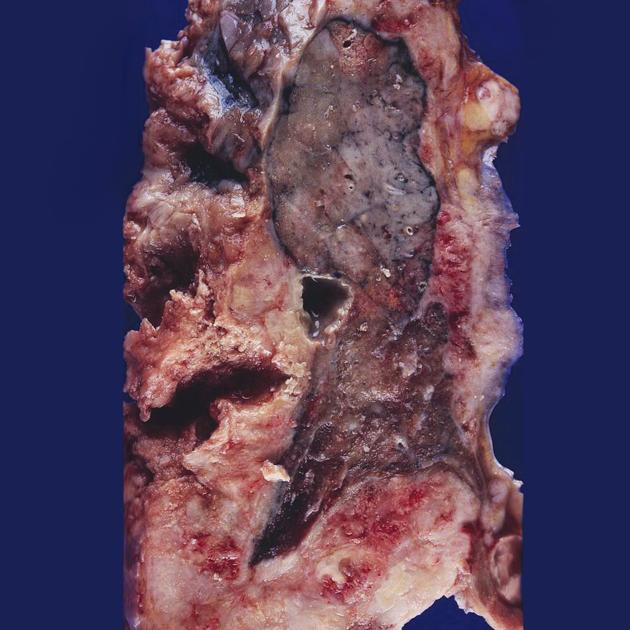
Pulmonary hyaline membrane is an important cause of perinatal death in which of the following conditions?
The Reid index is useful in the assessment of which condition?
A 75-year-old female with a long history of cigarette smoking is found to have a small tumor at the periphery of her right upper lobe. Initially, the tumor was believed to be a Stage I carcinoma (T1 NO MO), but after surgery it is found to be Stage II (T1 N1 MO). What finding at surgery changed the staging?
The Reid index is increased in which of the following conditions?
A 51-year-old male smoker presents with fever and a cough productive of greenish-yellow sputum. The patient states that he had a morning cough with excessive mucus production for the past 5 years. Which of the following abnormalities would MOST likely be found in this patient?
The percentage of pulmonary emboli that proceed to infarction is approximately?
A 40-year-old man presents with a chronic cough and fever for several months. Chest radiography shows a diffuse reticulonodular pattern. Microscopic examination of a transbronchial biopsy reveals focal areas of inflammation containing epithelioid cell granulomas, Langhans giant cells, and lymphocytes. These findings are typical for which of the following types of hypersensitivity immunologic responses?
ARDS is due to a defect in which of the following?
A 25-year-old man experiences acute onset of fever, cough, dyspnea, headache, and malaise a day after moving into a new apartment. His symptoms subside over 3 days when he visits a friend in another city. On the day of his return, the symptoms recur. There are no remarkable findings on physical examination. A chest radiograph also is unremarkable. Which of the following pathogenic mechanisms is most likely to produce these findings?
A 78-year-old man has had increasing dyspnea without cough or increased sputum production for the past 4 months. On physical examination, he is afebrile. Breath sounds are reduced in all lung fields. A chest CT scan shows a dense, brightly attenuated pleural mass encasing most of the left lung. Microscopic examination of a pleural biopsy specimen shows spindle and cuboidal cells that invade adipose tissue. Inhalation of which of the following pollutants is the most likely factor in the pathogenesis of this mass?
Explanation: **Explanation:** The formation of **Pulmonary Hyaline Membranes** is the hallmark of **Respiratory Distress Syndrome (RDS)**, also known as Hyaline Membrane Disease [2]. This condition is primarily caused by a deficiency of **surfactant**, which leads to high alveolar surface tension, progressive atelectasis, and ischemic injury to the alveolar wall [3]. 1. **Why Option B is correct:** Hyaline membranes are not present at birth. They require a period of breathing (usually **30 minutes to several hours**) to develop [2]. As the infant struggles to breathe, the resulting alveolar injury leads to the leakage of plasma proteins (fibrin) into the airspaces. These proteins, combined with necrotic epithelial debris, form the eosinophilic, "glassy" membranes. These membranes typically reach peak development around **24–48 hours** after birth [1]. 2. **Why other options are incorrect:** * **Option A (Stillborn infant):** A stillborn infant has never breathed. Since hyaline membrane formation requires the mechanical process of respiration and the subsequent inflammatory response to air-breathing in collapsed lungs, it is **never** seen in a stillborn [1]. * **Option C (Diabetic newborn):** While maternal diabetes is a major risk factor for RDS (insulin inhibits surfactant production), the primary driver in this specific question is the combination of **prematurity** and the **timing of death**. Option B is the more classic pathological representation of the disease progression. **NEET-PG High-Yield Pearls:** * **Composition:** Hyaline membranes consist of **fibrin** mixed with cell debris. * **Risk Factors:** Prematurity (most common), Maternal Diabetes, and Cesarean section (lack of "thoracic squeeze") [3]. * **L/S Ratio:** A Lecithin-to-Sphingomyelin ratio of **<2:1** in amniotic fluid indicates fetal lung immaturity. * **Morphology:** Lungs are heavy, "liver-like," and sink in water (atelectasis) [2]. **References:** [1] Kumar V, Abbas AK, et al.. Robbins and Cotran Pathologic Basis of Disease. 9th ed. Diseases of Infancy and Childhood, pp. 466-467. [2] Cross SS. Underwood's Pathology: A Clinical Approach. 6th ed. Common Clinical Problems From Respiratory Tract Disease, pp. 313-314. [3] Kumar V, Abbas AK, et al.. Robbins and Cotran Pathologic Basis of Disease. 9th ed. Diseases of Infancy and Childhood, pp. 465-466.
Explanation: **Explanation:** The **Reid Index** is a pathological measurement used specifically to quantify the severity of **Chronic Bronchitis**. It is defined as the ratio of the thickness of the submucosal mucus-secreting glands to the total thickness of the bronchial wall (measured from the epithelium to the inner surface of the cartilage). [1] 1. **Why Chronic Bronchitis is Correct:** Chronic bronchitis is characterized by the hypertrophy and hyperplasia of mucus-secreting glands in the trachea and bronchi due to chronic irritation (usually smoking). [1] In a healthy individual, the Reid Index is typically **< 0.4**. In chronic bronchitis, the expansion of the glandular layer causes the index to increase, often exceeding **0.5**. 2. **Why Incorrect Options are Wrong:** * **Glomerulonephritis:** Assessed via renal biopsy focusing on glomerular cellularity, basement membrane thickening, and immunofluorescence patterns. * **Cirrhosis:** Characterized histologically by bridging fibrosis and regenerating nodules; the Reid index has no application in hepatic pathology. * **Myocardial Infarction:** Evaluated through cardiac biomarkers (Troponin) and histological changes like coagulation necrosis and contraction band necrosis. **High-Yield Clinical Pearls for NEET-PG:** * **Definition of Chronic Bronchitis:** A clinical definition—persistent cough with sputum production for at least 3 months in at least 2 consecutive years. [1] * **Reid Index Formula:** $\frac{\text{Gland Thickness}}{\text{Wall Thickness (Epithelium to Cartilage)}}$. * **Key Histology:** The index does **not** include the thickness of the surface epithelium, cartilage, or adventitia. * **Associated Finding:** Look for "Curshmann spirals" or "Charcot-Leyden crystals" in sputum to differentiate other obstructive conditions like Asthma. **References:** [1] Kumar V, Abbas AK, et al.. Robbins and Cotran Pathologic Basis of Disease. 9th ed. The Lung, pp. 685-686.
Explanation: **Explanation:** The staging of lung cancer follows the **TNM (Tumor, Node, Metastasis)** classification system [1]. The shift from Stage I to Stage II in this patient is determined by the involvement of regional lymph nodes [3]. **1. Why the correct answer is right:** * **Stage I (T1 N0 M0):** Characterized by a small tumor (≤3 cm) confined to the lung parenchyma without any lymph node involvement. * **Stage II (T1 N1 M0):** The transition to Stage II occurs when there is involvement of **ipsilateral peribronchial and/or hilar lymph nodes (N1)** [3]. In this case, finding positive bronchial lymph nodes during surgery upgrades the nodal status from N0 to N1, thereby changing the stage from I to II. **2. Why the incorrect options are wrong:** * **A. Involvement of the chest wall:** This would change the **T-stage** to T3. T3 N0 M0 is classified as Stage IIB [1], but chest wall involvement is a more advanced local invasion than N1 nodal spread [3]. * **C. Small cell histology:** Staging for Small Cell Lung Cancer (SCLC) is typically categorized as "Limited" or "Extensive" rather than the TNM system used for Non-Small Cell Lung Cancer (NSCLC). Histology alone does not change the TNM stage [2]. * **D. Tumor at the carina:** Involvement of the carina (without a separate tumor mass) classifies the tumor as **T4**, which would typically place the patient in Stage IIIA or higher. **Clinical Pearls for NEET-PG:** * **N1 Nodes:** Ipsilateral hilar/peribronchial (Stage II). * **N2 Nodes:** Ipsilateral mediastinal/subcarinal (Stage IIIA). * **N3 Nodes:** Contralateral mediastinal/hilar or supraclavicular (Stage IIIB). * **Adenocarcinoma** is the most common lung cancer in non-smokers and females, often presenting as a **peripheral** lesion (as seen in this patient) [2]. **References:** [1] Kumar V, Abbas AK, et al.. Robbins and Cotran Pathologic Basis of Disease. 9th ed. The Lung, p. 725. [2] Kumar V, Abbas AK, et al.. Robbins and Cotran Pathologic Basis of Disease. 9th ed. The Lung, pp. 721-723. [3] Cross SS. Underwood's Pathology: A Clinical Approach. 6th ed. Common Clinical Problems From Respiratory Tract Disease, pp. 334-335.
Explanation: **Explanation:** The **Reid Index (RI)** is a pathological parameter used to assess the severity of **Chronic Bronchitis** [1]. It is defined as the ratio of the thickness of the submucosal mucus-secreting glands to the total thickness of the bronchial wall (measured from the epithelium to the inner surface of the perichondrium). * **Why Chronic Bronchitis is correct:** In chronic bronchitis, chronic irritation (usually from smoking) leads to **hypertrophy and hyperplasia of the submucosal mucous glands** in the trachea and bronchi [1]. This increases the numerator of the ratio. A normal Reid Index is **< 0.4**. In chronic bronchitis, this value typically exceeds **0.5**, reflecting excessive mucus production. **Analysis of Incorrect Options:** * **Emphysema:** This involves the permanent enlargement of airspaces distal to the terminal bronchioles due to alveolar wall destruction, not glandular hypertrophy of the bronchial wall [2], [3]. * **Bronchiectasis:** This is characterized by permanent, abnormal dilation of the bronchi due to chronic infection and inflammation. While mucus is present, the diagnostic hallmark is airway dilation and wall destruction, not a specific increase in the Reid Index. * **ARDS:** This is an acute condition characterized by diffuse alveolar damage (DAD) and hyaline membrane formation, affecting the alveolar-capillary unit rather than the bronchial mucous glands. **High-Yield Clinical Pearls for NEET-PG:** * **Normal RI:** < 0.4 (or 40%). * **Diagnostic Criteria for Chronic Bronchitis:** Productive cough for at least **3 consecutive months** in at least **2 consecutive years**. * **Key Histological Change:** Goblet cell metaplasia in the small airways and submucosal gland hypertrophy in the large airways [1]. * **Location:** The Reid Index is measured in the **bronchi**, not the bronchioles (as bronchioles lack submucosal glands). **References:** [1] Kumar V, Abbas AK, et al.. Robbins and Cotran Pathologic Basis of Disease. 9th ed. The Lung, pp. 685-686. [2] Cross SS. Underwood's Pathology: A Clinical Approach. 6th ed. Common Clinical Problems From Respiratory Tract Disease, pp. 326-327. [3] Kumar V, Abbas AK, et al.. Robbins and Cotran Pathologic Basis of Disease. 9th ed. The Lung, pp. 684-685.
Explanation: The clinical presentation of a long-term smoker with a chronic productive cough (lasting at least 3 months in 2 consecutive years) is classic for **Chronic Bronchitis**, a component of Chronic Obstructive Pulmonary Disease (COPD) [1]. ### **Explanation of the Correct Answer** The hallmark pathological change in chronic bronchitis is the hypertrophy and hyperplasia of mucus-secreting glands in the submucosa of the large airways. This is quantified by the **Reid Index**, which is the ratio of the thickness of the submucosal gland layer to the total thickness of the bronchial wall (between the epithelium and the cartilage). * **Normal Reid Index:** < 0.4 (40%) * **Chronic Bronchitis:** > 0.5 (50%) ### **Why Other Options are Incorrect** * **A. Apical cavitary lesions:** These are characteristic of **Secondary (Reactivation) Tuberculosis**, not chronic bronchitis. * **B. Curschmann spirals:** These are spiral-shaped mucus plugs found in the sputum of patients with **Bronchial Asthma**. * **C. Elevated sweat salt levels:** This is the diagnostic finding for **Cystic Fibrosis**, a genetic disorder causing bronchiectasis and pancreatic insufficiency, typically presenting in childhood. ### **High-Yield Clinical Pearls for NEET-PG** * **Definition:** Chronic bronchitis is a clinical diagnosis, whereas emphysema is a pathological diagnosis [2]. * **Blue Bloaters:** Patients with chronic bronchitis are often called "blue bloaters" due to hypoxemia (cyanosis) and fluid retention (cor pulmonale/edema). * **Microscopic findings:** In addition to an increased Reid Index, look for squamous metaplasia of the bronchial epithelium and a chronic inflammatory infiltrate (lymphocytes) [1]. * **Primary Driver:** Tobacco smoke is the most common trigger, leading to oxidative stress and inactivation of antiproteases [1]. **References:** [1] Kumar V, Abbas AK, et al.. Robbins and Cotran Pathologic Basis of Disease. 9th ed. The Lung, pp. 685-686. [2] Cross SS. Underwood's Pathology: A Clinical Approach. 6th ed. Common Clinical Problems From Respiratory Tract Disease, pp. 326-327.
Explanation: **Explanation:** The correct answer is **5-15% (Option B)**. This is a classic high-yield fact in respiratory pathology based on the unique physiological characteristics of the lungs [1]. **Why 5-15% is correct:** Pulmonary infarction is relatively rare following a pulmonary embolism (PE) because the lung tissue has a **dual blood supply** [1]. The lungs receive deoxygenated blood via the **pulmonary arteries** (for gas exchange) and oxygenated blood via the **bronchial arteries** (from the systemic circulation). Even when a pulmonary artery branch is obstructed by an embolus, the bronchial circulation usually provides sufficient oxygenation to prevent tissue necrosis (infarction) [1]. Infarction typically only occurs if there is pre-existing compromise of the bronchial circulation or left-sided heart failure (causing pulmonary venous congestion) [1]. **Analysis of Incorrect Options:** * **Option A (0-5%):** Too low. While rare, the incidence is high enough in patients with underlying cardiopulmonary disease to fall into the 10% range [1]. * **Options C & D (20-40%):** These percentages are too high. If 30-40% of emboli led to infarction, PE would be a much more lethal and necrotic process than clinically observed. **NEET-PG High-Yield Pearls:** 1. **Morphology:** Pulmonary infarcts are typically **hemorrhagic (red)** and **wedge-shaped**, with the apex pointing toward the hilum and the base toward the pleura [2]. 2. **Location:** They most commonly involve the **lower lobes** (due to preferential blood flow). 3. **Lines of Zahn:** These are characteristic laminations (pale platelet/fibrin layers alternating with darker red cell layers) found in thrombi formed in flowing blood, helping to distinguish a pre-mortem embolus from a post-mortem clot. 4. **Clinical Sign:** Pleuritic chest pain and hemoptysis in PE usually indicate that infarction has occurred, involving the subpleural lung tissue [2]. **References:** [1] Kumar V, Abbas AK, et al.. Robbins and Cotran Pathologic Basis of Disease. 9th ed. Hemodynamic Disorders, Thromboembolic Disease, and Shock, pp. 137-138. [2] Kumar V, Abbas AK, et al.. Robbins and Cotran Pathologic Basis of Disease. 9th ed. The Lung, pp. 705-706.
Explanation: The clinical presentation and histopathological findings describe a **granulomatous inflammatory response**, which is the hallmark of a **Type IV (Delayed-type) Hypersensitivity** reaction [1][2]. **Why Type IV is Correct:** Granuloma formation is a cell-mediated immune response (T-cell mediated). It occurs when an antigen (like *Mycobacterium tuberculosis* or sarcoid antigens) cannot be easily eliminated [3]. CD4+ T-cells (Th1 subtype) recognize the antigen and release cytokines, primarily **Interferon-gamma (IFN-γ)**. This activates macrophages, transforming them into **epithelioid cells**, which can fuse to form **Langhans giant cells** [1]. This process takes days to weeks to develop, hence the term "delayed" [2]. **Why Other Options are Incorrect:** * **Type I (Immediate):** Mediated by IgE and mast cell degranulation (e.g., Asthma, Anaphylaxis). It occurs within minutes. * **Type II (Antibody-mediated):** Involves IgG or IgM binding to fixed cell-surface antigens, leading to complement activation or ADCC (e.g., Goodpasture syndrome). * **Type III (Immune Complex):** Involves deposition of antigen-antibody complexes in tissues, causing neutrophil recruitment (e.g., SLE, Hypersensitivity Pneumonitis - Arthus reaction). **NEET-PG High-Yield Pearls:** * **Key Cytokine:** IFN-γ is the most critical cytokine for granuloma formation as it activates macrophages [1]. * **TNF-α:** Essential for maintaining the structural integrity of a granuloma. (Anti-TNF drugs can cause "breakdown" of old TB granulomas). * **Differential Diagnosis:** In India, a case of chronic cough with granulomas is **Tuberculosis** until proven otherwise. If non-caseating and involving bilateral hilar lymphadenopathy, consider **Sarcoidosis** [3]. **References:** [1] Kumar V, Abbas AK, et al.. Robbins and Cotran Pathologic Basis of Disease. 9th ed. Inflammation and Repair, p. 109. [2] Cross SS. Underwood's Pathology: A Clinical Approach. 6th ed. (Basic Pathology) introduces the student to key general principles of pathology, both as a medical science and as a clinical activity with a vital role in patient care. Part 2 (Disease Mechanisms) provides fundamental knowledge about the cellular and molecular processes involved in diseases, providing the rationale for their treatment. Part 3 (Systematic Pathology) deals in detail with specific diseases, with emphasis on the clinically important aspects., pp. 173-174. [3] Cross SS. Underwood's Pathology: A Clinical Approach. 6th ed. (Basic Pathology) introduces the student to key general principles of pathology, both as a medical science and as a clinical activity with a vital role in patient care. Part 2 (Disease Mechanisms) provides fundamental knowledge about the cellular and molecular processes involved in diseases, providing the rationale for their treatment. Part 3 (Systematic Pathology) deals in detail with specific diseases, with emphasis on the clinically important aspects., pp. 198-200.
Explanation: **Explanation:** Acute Respiratory Distress Syndrome (ARDS) is characterized by **diffuse alveolar damage (DAD)** [1]. The fundamental pathophysiology involves an acute injury to the **alveolar-capillary membrane**, which is composed of both the microvascular endothelium and the alveolar epithelium. **Why Endothelial Cells are the Correct Answer:** In the early (exudative) phase of ARDS, the primary event is often **endothelial activation and injury** [1]. Damage to the pulmonary capillary endothelial cells leads to increased vascular permeability. This allows protein-rich fluid to leak into the alveolar spaces, forming the characteristic **hyaline membranes** [1]. While both epithelial and endothelial cells are damaged, the initial "leak" and the recruitment of neutrophils (which release ROS and proteases) are heavily driven by the endothelial insult. **Analysis of Incorrect Options:** * **Type I Pneumocytes:** These cells cover 95% of the alveolar surface and are highly sensitive to injury. While they are destroyed during ARDS, the question asks for the primary defect leading to the syndrome's hallmark (non-cardiogenic pulmonary edema), which is initiated by endothelial permeability [1]. * **Type II Pneumocytes:** These cells produce surfactant and act as stem cells to replace Type I cells. In ARDS, their damage leads to surfactant depletion (atelectasis), but they are not the primary site of the initial defect [1]. * **Clara Cells (Club Cells):** These are found in the bronchioles, not the alveoli. They secrete uteroglobin and protect the bronchiolar epithelium; they are not involved in the pathogenesis of ARDS. **High-Yield Clinical Pearls for NEET-PG:** * **Morphological Hallmark:** Hyaline membranes lining the alveolar walls [1]. * **Key Mediator:** **IL-8** (potent neutrophil chemoattractant) and **TNF**. * **Stages of ARDS:** 1. Exudative (first 7 days), 2. Proliferative (7–21 days), 3. Fibrotic (after 3 weeks). * **Clinical Definition (Berlin Criteria):** Acute onset, bilateral opacities on imaging, and a PaO2/FiO2 ratio < 300 mmHg, not fully explained by heart failure [1]. **References:** [1] Kumar V, Abbas AK, et al.. Robbins and Cotran Pathologic Basis of Disease. 9th ed. The Lung, pp. 679-681.
Explanation: ### Explanation The clinical presentation describes **Hypersensitivity Pneumonitis (HP)**, also known as Extrinsic Allergic Alveolitis [1]. The key diagnostic clue is the temporal relationship between the patient’s symptoms and his environment (symptoms appear at home and disappear when away). **1. Why Option A is Correct:** Hypersensitivity Pneumonitis is an immunologically mediated inflammatory lung disease [1]. It involves a **combined Type III (Immune-complex mediated)** and **Type IV (Delayed-type)** hypersensitivity reaction [1], [3]. * **Acute Phase:** Inhaled organic antigens (e.g., molds in a new apartment) react with specific antibodies, leading to **antigen-antibody complex deposition** in the alveolar walls, triggering complement activation and neutrophil recruitment [1]. This explains the rapid onset of flu-like symptoms (fever, dyspnea) within hours of exposure. **2. Why the Other Options are Incorrect:** * **Option B:** Refers to **Type II Hypersensitivity**, characteristic of **Goodpasture Syndrome** (anti-GBM antibodies). This typically presents with hemoptysis and glomerulonephritis, not reversible flu-like symptoms. * **Option C:** Describes **Tuberculosis**. TB is a chronic infection characterized by night sweats, weight loss, and apical cavitary lesions on X-ray, rather than acute symptoms that resolve within days of leaving a location. * **Option D:** Describes **Type I Hypersensitivity (Asthma)**. While asthma causes episodic dyspnea, it is mediated by IgE and mast cells (not primarily basophil-generated prostaglandins) and usually presents with wheezing [2], [3], which is absent here. **Clinical Pearls for NEET-PG:** * **Common Triggers:** Farmer’s Lung (Actinomycetes), Bird Fancier’s Lung (Avian proteins), Humidifier Lung (Thermophilic bacteria) [3]. * **Histology:** Look for the "Triad" of HP: Interstitial pneumonitis, non-caseating **loose granulomas**, and bronchiolitis obliterans [1]. * **Radiology:** Acute cases often show a normal CXR or ground-glass opacities; chronic cases show honeycombing (fibrosis). **References:** [1] Kumar V, Abbas AK, et al.. Robbins and Cotran Pathologic Basis of Disease. 9th ed. The Lung, pp. 701-702. [2] Cross SS. Underwood's Pathology: A Clinical Approach. 6th ed. Common Clinical Problems From Respiratory Tract Disease, pp. 332-333. [3] Cross SS. Underwood's Pathology: A Clinical Approach. 6th ed. Common Clinical Problems From Respiratory Tract Disease, pp. 329-330.
Explanation: The clinical presentation and imaging findings are classic for **Malignant Mesothelioma**. The key diagnostic features in this case are the **pleural mass encasing the lung** (often described as a "pleural rind") and the **biphasic histological pattern** (spindle/sarcomatoid and cuboidal/epithelioid cells) invading local adipose tissue [1]. **1. Why Asbestos is correct:** Asbestos exposure is the primary risk factor for mesothelioma, with a long latency period (25–40 years) [3]. Asbestos fibers (particularly amphibole types) reach the pleura, causing chronic inflammation and oncogenic transformation [2]. While asbestos also increases the risk of bronchogenic carcinoma, mesothelioma is the most specific tumor associated with it. **2. Why other options are incorrect:** * **Bird dust:** Associated with **Hypersensitivity Pneumonitis** (Bird Fancier’s Lung), which presents as an interstitial lung disease rather than a pleural mass. * **Coal dust:** Leads to **Coal Worker’s Pneumoconiosis (CWP)** and Anthracosis. It typically involves the lung parenchyma (macules and nodules) rather than the pleura. * **Cotton fibers:** Causes **Byssinosis** ("Monday morning chest tightness"), an occupational airway disease, not malignancy. **NEET-PG High-Yield Pearls:** * **Most common site:** Pleura (followed by peritoneum). * **Marker of choice:** **Calretinin (+)**, WT-1 (+), and Cytokeratin 5/6 (+) [1]. It is typically **CEA negative** (helps differentiate from adenocarcinoma). * **Imaging:** CT shows nodular pleural thickening and calcified pleural plaques (though plaques indicate exposure, not necessarily malignancy) [4]. * **Smoking:** Does **not** increase the risk of mesothelioma (unlike bronchogenic carcinoma, where asbestos and smoking have a synergistic effect). **References:** [1] Kumar V, Abbas AK, et al.. Robbins and Cotran Pathologic Basis of Disease. 9th ed. The Lung, p. 731. [2] Kumar V, Abbas AK, et al.. Robbins and Cotran Pathologic Basis of Disease. 9th ed. The Lung, p. 699. [3] Cross SS. Underwood's Pathology: A Clinical Approach. 6th ed. Common Clinical Problems From Respiratory Tract Disease, pp. 339-340. [4] Kumar V, Abbas AK, et al.. Robbins and Cotran Pathologic Basis of Disease. 9th ed. The Lung, pp. 698-699.
Congenital Anomalies
Practice Questions
Atelectasis and Acute Lung Injury
Practice Questions
Obstructive Pulmonary Diseases
Practice Questions
Restrictive Pulmonary Diseases
Practice Questions
Lung Infections
Practice Questions
Pulmonary Vascular Diseases
Practice Questions
Lung Tumors
Practice Questions
Pleural Diseases
Practice Questions
Interstitial Lung Diseases
Practice Questions
Occupational Lung Diseases
Practice Questions
Get full access to all questions, explanations, and performance tracking.
Start For Free