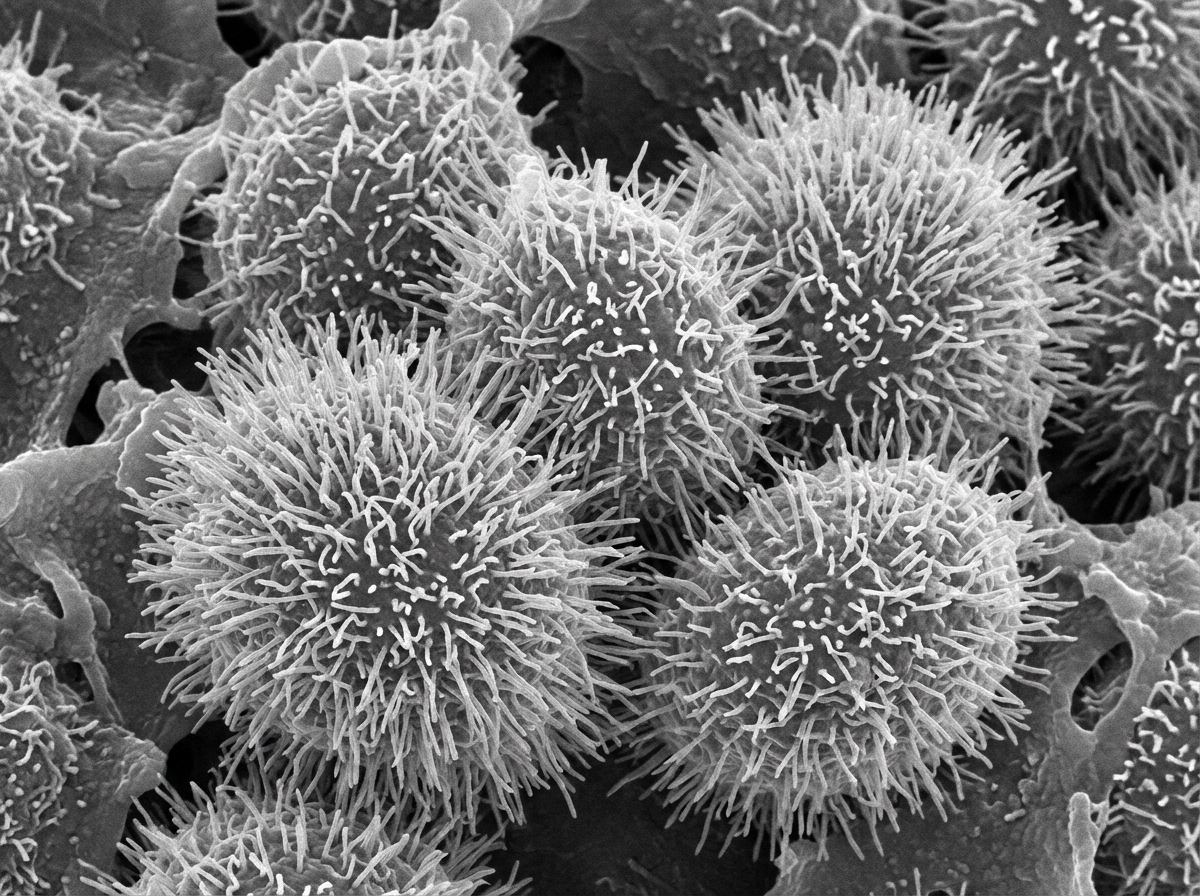
Which of the following is a marker for mesothelioma?
All of the following are features of non-specific interstitial pneumonia (NSIP), except:
A 44-year-old man, a nonsmoker, experienced a 3-kg weight loss over the past 3 months. He recently developed a low-grade fever and cough with mucoid sputum production, and after 1 week, he noticed blood-streaked sputum. On physical examination, his temperature is 37.7°C. There are bilateral crackles in the left upper lobe on auscultation of the chest. Chest CT scan shows a 3-cm left upper lobe nodule with decreased attenuation centrally. Laboratory studies show hemoglobin, 14.5 g/dL; platelet count, 211,400/mm³; and WBC count, 9890/mm³ with 40% segmented neutrophils, 2% bands, 40% lymphocytes, and 18% monocytes. Which of the following findings in his sputum sample is most likely to be present?
A 40-year-old woman with leukemia is treated with chemotherapy. During treatment she develops increasing cough and shortness of breath. A chest X-ray shows diffuse lung infiltrates. Sputum cultures are negative and the patient does not respond to routine antibiotic therapy. An open lung biopsy is diagnosed by the pathologist as viral pneumonia. Which of the following histopathologic findings would be expected in the lungs of this patient?
Reactivation of TB affects which lung segments?
Which of the following dust exposures has been linked to the development of mesothelioma?
What is the most common site of metastasis from bronchogenic carcinoma?
Cavitation in pulmonary metastasis is commonly associated with which of the following tumor types?
Cannon balls seen in the lungs are characteristic of which of the following?
Which of the following statements about emphysema is true?
Explanation: **Explanation:** **Malignant Mesothelioma** is a primary tumor of the pleura, strongly associated with asbestos exposure. Differentiating it from lung adenocarcinoma is a classic high-yield topic in NEET-PG, as both can present with pleural involvement. **Why CK7 is the correct answer:** Mesotheliomas are derived from mesothelial cells, which characteristically express specific low-molecular-weight cytokeratins [1]. **Cytokeratin 7 (CK7)** is a primary immunohistochemical (IHC) marker for mesothelioma. It is almost universally positive in these tumors. However, because CK7 is also positive in many adenocarcinomas (like lung and breast), it is used as part of a diagnostic panel rather than in isolation. **Analysis of incorrect options:** * **CK12, CK22, and CK24:** These are not standard diagnostic markers in surgical pathology for mesothelioma. CK12 is typically associated with corneal epithelium, while while CK22 and CK24 are rarely used in clinical IHC panels for serosal tumors. **High-Yield Clinical Pearls for NEET-PG:** To confirm a diagnosis of Mesothelioma, pathologists look for a **combination of positive and negative markers** [1]: 1. **Positive Markers (The "Big Four"):** Calretinin (most specific), WT-1, CK5/6, and D2-40 (Podoplanin) [1]. 2. **Negative Markers (To rule out Adenocarcinoma):** CEA, MOC-31, Ber-EP4, and TTF-1 (specific for lung origin). 3. **Electron Microscopy (EM) Finding:** Long, slender, branching microvilli (Adenocarcinoma has short, blunt microvilli). 4. **Genetic Hallmark:** Deletion of **BAP1** (detected by loss of nuclear staining on IHC) is a highly specific marker for malignancy in mesothelial proliferations. **References:** [1] Kumar V, Abbas AK, et al.. Robbins and Cotran Pathologic Basis of Disease. 9th ed. The Lung, p. 731.
Explanation: **Explanation:** Non-specific Interstitial Pneumonia (NSIP) is a distinct entity of idiopathic interstitial pneumonia that must be differentiated from Usual Interstitial Pneumonia (UIP) [1]. **Why Option C is correct:** **Honeycomb fibrosis** is the hallmark histological feature of **UIP/Idiopathic Pulmonary Fibrosis (IPF)** [2]. In NSIP, the lung architecture is generally preserved. While fibrosis occurs in the fibrosing pattern of NSIP, it lacks the severe architectural distortion, fibroblastic foci, and cystic changes (honeycombing) characteristic of UIP [1]. **Analysis of other options:** * **Option A (Cellular pattern):** NSIP is histologically divided into two patterns. The cellular pattern consists of mild-to-moderate chronic interstitial inflammation (lymphocytes and plasma cells) in a uniform distribution [1]. * **Option B (Fibrosing pattern):** Unlike the "temporal heterogeneity" seen in UIP (where old scars mix with new fibroblastic foci), the fibrosing pattern of NSIP shows **temporal homogeneity** [1]. The fibrotic lesions are all roughly at the same stage of development. * **Option D (Prognosis):** NSIP carries a significantly **better prognosis** than UIP. Patients typically respond well to oral corticosteroids, whereas UIP is progressive and often refractory to treatment [1]. **High-Yield Clinical Pearls for NEET-PG:** * **Demographics:** NSIP is often seen in female non-smokers in their 50s-60s [1]. * **Associations:** Strongly associated with **Connective Tissue Diseases (CTD)** like Scleroderma and Rheumatoid Arthritis. * **Radiology:** Characterized by bilateral, symmetrical ground-glass opacities (GGO) on HRCT, often with subpleural sparing [1]. * **Key Distinction:** NSIP = Temporal Homogeneity; UIP = Temporal Heterogeneity + Honeycombing [1]. **References:** [1] Kumar V, Abbas AK, et al.. Robbins and Cotran Pathologic Basis of Disease. 9th ed. The Lung, pp. 693-695. [2] Kumar V, Abbas AK, et al.. Robbins and Cotran Pathologic Basis of Disease. 9th ed. The Lung, pp. 691-692.
Explanation: ### Explanation The clinical presentation is highly suggestive of **Secondary (Reactivation) Pulmonary Tuberculosis (TB)**. **1. Why the Correct Answer is Right:** The patient presents with classic constitutional symptoms (weight loss, low-grade fever) and respiratory symptoms (cough, hemoptysis) localized to the **upper lobe**. In a non-smoker, a 3-cm upper lobe nodule with **central decreased attenuation** on CT strongly indicates **caseous necrosis** and cavitation [1]. * **Laboratory Clue:** The differential WBC count shows **monocytosis (18%)** and lymphocytosis. Activated macrophages secrete TNF and chemokines which promote recruitment of more monocytes [1]. * **Microscopy:** The gold standard for initial diagnosis in sputum is the identification of **Acid-fast bacilli (AFB)** using Ziehl-Neelsen staining, representing *Mycobacterium tuberculosis* [1]. **2. Why the Incorrect Options are Wrong:** * **B. Branching septate hyphae:** Suggests *Aspergillus*. While *Aspergillus* can colonize old TB cavities (Aspergilloma), the primary presentation of fever, weight loss, and monocytosis points toward the underlying TB infection itself. * **C. Charcot-Leyden crystals:** These are breakdown products of eosinophils found in the sputum of patients with **Bronchial Asthma** or tropical pulmonary eosinophilia, not cavitary nodules. * **D. Foreign body giant cells:** While granulomas are present in TB, they contain **Langhans giant cells** (peripheral arrangement of nuclei) [1]. Foreign body giant cells have haphazardly arranged nuclei and are seen in response to inert materials, not typically in sputum for TB diagnosis. **3. NEET-PG High-Yield Pearls:** * **Location:** Secondary TB typically affects the **apical/posterior segments of the upper lobes** due to high oxygen tension. * **Ghon Complex:** Seen in Primary TB (Subpleural lower lobe lesion + hilar lymph node). * **Monocytosis:** Always consider TB, Malaria, or Malignancy (CMML) when monocyte counts are elevated in exam questions. * **Gold Standard for TB Diagnosis:** Sputum culture (Lowenstein-Jensen medium), though Nucleic Acid Amplification Tests (CBNAAT/GeneXpert) are now the preferred initial rapid test [1]. **References:** [1] Kumar V, Abbas AK, et al.. Robbins and Cotran Pathologic Basis of Disease. 9th ed. Infectious Diseases, pp. 379-384.
Explanation: The clinical presentation describes an immunocompromised patient (leukemia/chemotherapy) presenting with acute respiratory distress and diffuse infiltrates, diagnosed with **viral pneumonia**. [1], [3] **1. Why Option D is Correct:** Viral pneumonias (and other causes of Diffuse Alveolar Damage - DAD) typically manifest histologically as **interstitial inflammation** [2] and the formation of **hyaline membranes**. [1] * **Interstitial Inflammation:** The inflammatory response is primarily localized within the alveolar septa (interstitium), consisting of lymphocytes and plasma cells, rather than within the alveolar spaces (as seen in bacterial pneumonia). [2] * **Hyaline Membranes:** Damage to Type I pneumocytes and capillary endothelium leads to protein-rich fluid leakage. This fluid, combined with necrotic cell debris, organizes into waxy, eosinophilic "hyaline membranes" lining the alveoli. [1] This is the hallmark of the exudative phase of ARDS. **2. Why Other Options are Incorrect:** * **Options A & B:** Clusters of epithelioid macrophages and caseous necrosis are characteristic of **Granulomatous inflammation**, typically seen in Tuberculosis or fungal infections (like Histoplasmosis), not primary viral pneumonia. [3] * **Option C:** Fibrous scarring represents the **organizing/chronic phase** of lung injury. While it can follow viral pneumonia, the acute presentation of cough, dyspnea, and diffuse infiltrates points toward the active, exudative phase characterized by hyaline membranes. [1] **Clinical Pearls for NEET-PG:** * **Common Viral Pathogens:** In immunocompromised hosts, consider CMV (look for "Owl’s eye" inclusions), HSV, or Influenza. [3] * **Histology Hint:** If the question mentions "intra-alveolar neutrophils," think Bacterial Pneumonia. If it mentions "interstitial infiltrates," think Viral or Mycoplasma (Atypical) Pneumonia. * **DAD Stages:** Exudative (Hyaline membranes) $\rightarrow$ Proliferative (Type II pneumocyte hyperplasia) $\rightarrow$ Fibrotic. [1] **References:** [1] Kumar V, Abbas AK, et al.. Robbins and Cotran Pathologic Basis of Disease. 9th ed. The Lung, pp. 679-681. [2] Kumar V, Abbas AK, et al.. Robbins and Cotran Pathologic Basis of Disease. 9th ed. The Lung, pp. 693-695. [3] Cross SS. Underwood's Pathology: A Clinical Approach. 6th ed. Common Clinical Problems From Respiratory Tract Disease, pp. 318-319.
Explanation: **Explanation:** The correct answer is **B. Apical and posterior segments of the upper lobe.** **1. Why it is correct:** Reactivation tuberculosis (Secondary TB) occurs in a previously sensitized host [1]. *Mycobacterium tuberculosis* is an **obligate aerobe**, meaning it thrives in environments with high oxygen tension. In an upright individual, the **apical and posterior segments of the upper lobes** have the highest ventilation-to-perfusion (V/Q) ratio. This results in the highest alveolar oxygen concentration ($P_{A}O_{2}$) in the lungs, providing an ideal environment for the bacilli to proliferate. Additionally, lymphatic drainage is less efficient in these regions, hindering the local immune clearance. **2. Why other options are incorrect:** * **Option A:** The anterior segment of the upper lobe is rarely the primary site for reactivation; it is more commonly involved in primary TB or as part of a spreading secondary infection. * **Options C & D:** The lower lobes (specifically the subpleural regions) and the lower part of the upper lobes are the classic sites for **Primary TB** (Ghon focus) [1]. While the **superior segment of the lower lobe** can be involved in reactivation, the apical/posterior segments of the upper lobe remain the most characteristic sites. **3. High-Yield Clinical Pearls for NEET-PG:** * **Ghon Complex:** Seen in Primary TB; consists of a parenchymal lesion (usually subpleural) + draining lymphadenopathy [1]. * **Ranke Complex:** A healed, calcified Ghon complex. * **Assmann Focus:** The initial infraclavicular lesion seen in secondary (reactivation) TB. * **Cavitary Lesions:** Secondary TB is characterized by extensive tissue destruction and cavitation due to a vigorous Type IV hypersensitivity reaction [1]. * **Miliary TB:** Occurs when bacilli hematogenously spread [2], resembling "millet seeds" on imaging. **References:** [1] Cross SS. Underwood's Pathology: A Clinical Approach. 6th ed. Common Clinical Problems From Respiratory Tract Disease, pp. 319-320. [2] Cross SS. Underwood's Pathology: A Clinical Approach. 6th ed. Common Clinical Problems From Respiratory Tract Disease, pp. 320-321.
Explanation: **Explanation:** **Correct Answer: A. Asbestos** Asbestos is a naturally occurring silicate mineral linked to several pulmonary pathologies [1]. **Mesothelioma**, a rare malignant tumor of the pleura (or peritoneum), is most strongly associated with asbestos exposure, particularly the **crocidolite (blue asbestos)** amphibole fibers [1], [2]. These thin, needle-like fibers reach the distal lung and pleura, where they induce chronic inflammation, generate reactive oxygen species, and cause direct DNA damage, leading to oncogenic transformation. Notably, while asbestos is the primary cause of mesothelioma, the most common cancer associated with asbestos exposure is actually **Bronchogenic Carcinoma** [1], [2]. **Incorrect Options:** * **B. Barium:** Exposure to barium dust causes **Barytosis**, a benign form of pneumoconiosis characterized by dense radiopaque shadows on X-ray without significant functional impairment or malignancy risk [1]. * **C. Silica:** Crystalline silica causes **Silicosis** [1]. It is characterized by "eggshell calcification" of hilar lymph nodes and silicotic nodules. It significantly increases the risk of **Tuberculosis (Silicotuberculosis)** and bronchogenic carcinoma, but not mesothelioma. * **D. Cotton:** Inhalation of cotton, flax, or hemp fibers leads to **Byssinosis** (Monday Morning Fever). It is an occupational airway disease causing chest tightness and wheezing, not malignancy. **High-Yield Clinical Pearls for NEET-PG:** * **Latent Period:** Mesothelioma has a long lag period (25–40 years) after initial asbestos exposure [2]. * **Smoking Link:** Smoking does **not** increase the risk of mesothelioma in asbestos workers, but it synergistically increases the risk of **Bronchogenic Carcinoma** by ~55-fold [2]. * **Histology:** The presence of **Ferruginous bodies** (asbestos bodies coated with iron-protein complexes) in lung tissue is a hallmark of exposure. * **Marker:** **Calretinin** is a highly specific immunohistochemical marker for diagnosing mesothelioma. **References:** [1] Kumar V, Abbas AK, et al.. Robbins and Cotran Pathologic Basis of Disease. 9th ed. The Lung, pp. 695-699. [2] Cross SS. Underwood's Pathology: A Clinical Approach. 6th ed. Common Clinical Problems From Respiratory Tract Disease, pp. 339-340.
Explanation: **Explanation:** Bronchogenic carcinoma is notorious for early and widespread metastasis [1]. While it can spread to various organs, the **Bone** is statistically the most common site of distant metastasis [2]. **1. Why Bone is Correct:** Approximately 30–40% of patients with advanced lung cancer develop bone metastases. The spread occurs primarily via the hematogenous route. These lesions are typically **osteolytic** (bone-destroying) in nature, often involving the ribs, vertebrae, and pelvis [2]. Among all subtypes, Adenocarcinoma is the most frequent culprit for skeletal involvement. **2. Analysis of Incorrect Options:** * **Liver (Option C):** This is the second most common site of metastasis. While frequently involved, it statistically trails behind bone in overall incidence [1]. * **Brain (Option A):** The brain is a very common site, particularly for Small Cell Lung Cancer (SCLC) and Adenocarcinoma [1]. In fact, lung cancer is the most common source of *secondary* brain tumors, but it is not the #1 overall site for lung cancer spread. * **Spine (Option D):** The spine is the most common *location* within the skeletal system for metastasis [2], but "Bone" (Option B) is the broader and more accurate categorical answer for the primary site of spread. **3. NEET-PG High-Yield Pearls:** * **Adrenal Glands:** Lung cancer has a unique predilection for the adrenal glands (often asymptomatic), making them a high-yield "classic" site mentioned in exams [1]. * **Most common subtype to metastasize:** Small Cell Lung Carcinoma (SCLC) is usually metastatic at the time of diagnosis [3]. * **Pancoast Tumor:** A tumor at the lung apex that can cause Horner’s Syndrome and involve the brachial plexus [4]. * **Sentinel Sign:** Virchow’s node (supraclavicular lymphadenopathy) can sometimes be the first sign of an underlying bronchogenic carcinoma. **References:** [1] Kumar V, Abbas AK, et al.. Robbins and Cotran Pathologic Basis of Disease. 9th ed. The Lung, pp. 724-725. [2] Cross SS. Underwood's Pathology: A Clinical Approach. 6th ed. Common Clinical Problems From Osteoarticular And Connective Tissue Disease, pp. 671-672. [3] Cross SS. Underwood's Pathology: A Clinical Approach. 6th ed. Common Clinical Problems From Respiratory Tract Disease, pp. 337-338. [4] Cross SS. Underwood's Pathology: A Clinical Approach. 6th ed. Common Clinical Problems From Respiratory Tract Disease, pp. 334-335.
Explanation: **Explanation:** **1. Why Squamous Cell Carcinoma (SCC) is correct:** Cavitation in pulmonary metastasis is most frequently associated with **Squamous Cell Carcinoma**, particularly those originating from the head and neck or cervix [1]. The underlying mechanism involves **rapid tumor growth** that outstrips its blood supply, leading to central **ischemic necrosis** [2]. The necrotic debris is then expectorated through a communicating bronchus, leaving a hollowed-out cavity. Radiologically, these cavities often exhibit thick, irregular walls [1]. **2. Analysis of Incorrect Options:** * **Adenocarcinoma:** While this is the most common primary lung cancer, it typically presents as peripheral solid nodules or ground-glass opacities [1]. Cavitation is significantly less common in adenocarcinoma compared to SCC [1]. * **Chondrosarcoma & Osteosarcoma:** These sarcomas are known for causing "cannonball metastases." While they can rarely cavitate, they are more classically associated with **calcification** or **ossification** within the metastatic nodules and a higher risk of spontaneous pneumothorax. **3. NEET-PG High-Yield Pearls:** * **Most common primary lung cancer to cavitate:** Squamous Cell Carcinoma [1]. * **Most common metastatic tumor to cavitate:** Squamous Cell Carcinoma (Head/Neck, Cervix, Esophagus). * **Thin-walled cavities:** Often seen in metastatic sarcomas or after chemotherapy (treatment response). * **Differential Diagnosis for Cavitary Lung Lesions (Mnemonic: CAVITY):** **C**ancer (SCC), **A**utoimmune (Wegener’s), **V**ascular (Septic emboli), **I**nfection (TB, Fungal, Abscess), **T**rauma, **Y**outh (Congenital cysts). * **Chemotherapy effect:** Sometimes, solid metastases (like those from germ cell tumors) cavitate only *after* starting treatment due to rapid tumor lysis. **References:** [1] Cross SS. Underwood's Pathology: A Clinical Approach. 6th ed. Common Clinical Problems From Respiratory Tract Disease, pp. 336-337. [2] Kumar V, Abbas AK, et al.. Robbins and Cotran Pathologic Basis of Disease. 9th ed. The Lung, pp. 723-724.
Explanation: **Explanation:** **Cannon ball metastases** refer to multiple, well-circumscribed, large, and dense circular nodules seen on a chest X-ray or CT scan. This radiological pattern is a classic sign of hematogenous spread of a primary malignancy to the lungs [2]. **Why Hypernephroma is correct:** **Hypernephroma (Renal Cell Carcinoma - RCC)** is the most common primary tumor associated with cannon ball metastases. RCC has a high propensity for vascular invasion, specifically into the renal vein and inferior vena cava, leading to early hematogenous dissemination to the lungs [1]. The nodules are typically large, peripheral, and "fleshy" in appearance [3]. **Analysis of Incorrect Options:** * **Seminoma of the testes:** While testicular tumors can metastasize to the lungs, they more commonly present with retroperitoneal lymphadenopathy. Choriocarcinoma (another germ cell tumor) is more famously associated with hemorrhagic lung nodules rather than classic cannon balls. * **Carcinoid tumor:** These are usually slow-growing neuroendocrine tumors. Bronchial carcinoids are typically central (hilar) masses, and metastatic carcinoids do not typically present with the "cannon ball" radiological pattern. * **Pheochromocytoma:** This is a tumor of the adrenal medulla. While malignant pheochromocytoma can metastasize, it is rare, and it does not characteristically produce large, multiple globular lung nodules. **High-Yield Pearls for NEET-PG:** * **Top 3 causes of Cannon Ball Metastases:** 1. Renal Cell Carcinoma (Hypernephroma), 2. Choriocarcinoma, 3. Prostate Cancer (occasionally Osteosarcoma). * **Differential Diagnosis:** Multiple nodules can also be seen in Wegener’s Granulomatosis (often cavitating) and Rheumatoid nodules. * **RCC Triad:** Hematuria, flank pain, and palpable mass (seen in only 10% of cases). * **Paraneoplastic syndromes in RCC:** Polycythemia (due to EPO), Hypercalcemia (due to PTHrP), and Hypertension (due to Renin). **References:** [1] Kumar V, Abbas AK, et al.. Robbins and Cotran Pathologic Basis of Disease. 9th ed. The Kidney, pp. 959-961. [2] Kumar V, Abbas AK, et al.. Robbins and Cotran Pathologic Basis of Disease. 9th ed. Neoplasia, p. 282. [3] Cross SS. Underwood's Pathology: A Clinical Approach. 6th ed. Common Clinical Problems From Respiratory Tract Disease, pp. 338-339.
Explanation: **Explanation:** **Emphysema** is defined morphologically as the abnormal, permanent enlargement of airspaces distal to the terminal bronchioles, accompanied by the **destruction of their walls** without obvious fibrosis [1]. This destruction reduces the surface area available for gas exchange and leads to loss of elastic recoil, which is the hallmark of the disease. **Analysis of Options:** * **Option B (Correct):** The core pathology involves the imbalance between proteases (like elastase) and anti-proteases (̑1-antitrypsin), leading to the breakdown of alveolar septa and permanent airspace dilation [2]. * **Option A:** While emphysema and Obstructive Sleep Apnea (OSA) can coexist (Overlap Syndrome), emphysema is primarily a disease of small airway collapse and alveolar loss, whereas OSA is characterized by upper airway collapse. * **Option C:** **Centriacinar (centrilobular)** emphysema, most commonly associated with smoking, typically affects the **upper lobes** (especially the apical segments) [1]. In contrast, **Panacinar** emphysema, associated with ̑1-antitrypsin deficiency, is more prominent in the **lower lobes** [2]. * **Option D:** Emphysema, along with Chronic Bronchitis, is a major component of **Chronic Obstructive Pulmonary Disease (COPD)** [1]. **High-Yield NEET-PG Pearls:** 1. **Pink Puffers:** Clinical phenotype of emphysema (dyspneic, hyperventilating, thin, barrel-chested). 2. **Microscopy:** Characterized by "floating septa" (club-shaped ends of alveolar walls) due to septal destruction. 3. **Genetics:** ̑1-antitrypsin deficiency is linked to the **PiZZ phenotype** and causes panacinar emphysema [2]. 4. **Paraseptal Emphysema:** Often occurs near the pleura; it is a common cause of spontaneous pneumothorax in young adults [3]. **References:** [1] Kumar V, Abbas AK, et al.. Robbins and Cotran Pathologic Basis of Disease. 9th ed. The Lung, pp. 684-685. [2] Kumar V, Abbas AK, et al.. Robbins and Cotran Pathologic Basis of Disease. 9th ed. The Lung, pp. 683-684. [3] Kumar V, Abbas AK, et al.. Robbins and Cotran Pathologic Basis of Disease. 9th ed. The Lung, p. 683.
Congenital Anomalies
Practice Questions
Atelectasis and Acute Lung Injury
Practice Questions
Obstructive Pulmonary Diseases
Practice Questions
Restrictive Pulmonary Diseases
Practice Questions
Lung Infections
Practice Questions
Pulmonary Vascular Diseases
Practice Questions
Lung Tumors
Practice Questions
Pleural Diseases
Practice Questions
Interstitial Lung Diseases
Practice Questions
Occupational Lung Diseases
Practice Questions
Get full access to all questions, explanations, and performance tracking.
Start For Free