Which of the following are predisposing factors for Testicular germ cell tumor?
A 4-year-old girl is brought to the physician by her parents who report seeing blood in the child's urine. A CT scan reveals a neoplasm of the urinary bladder. Which of the following is the most likely diagnosis?
Which of the following is NOT a testicular tumor marker?
Which of the following cell type(s) secrete prostate-specific antigen (PSA)?
A 22-year-old woman has an abnormal cervical Pap smear. A biopsy is obtained from a suspicious area on the cervix. The pathology report describes changes including loss of normal squamous cell orientation, atypical cells with wrinkled nuclei and perinuclear halos involving the full thickness of the squamous epithelium, and an intact basement membrane. What is the most likely diagnosis?
A 46-year-old chronic alcoholic complains of infertility. What is the cause of testicular atrophy?
What is the most common cause of a Krukenberg tumor?
Funisitis describes infection of which of the following?
A middle-aged man operated for testicular cancer presents with histological examination showing primitive looking 'ugly' cells with abundant mitotic cells. The tumor cells are positive for cytokeratin and CD30. What is the likely type of tumor?
Which of the following are predisposing features for germ cell tumor?
Explanation: The development of Testicular Germ Cell Tumors (TGCT) is a multifactorial process involving genetic predisposition and environmental triggers. **Why Klinefelter’s Syndrome (47, XXY) is the correct answer:** While Klinefelter’s syndrome is most classically associated with a significantly increased risk (up to 50 times) of **extragonadal germ cell tumors** (specifically in the mediastinum), it is also a recognized predisposing factor for testicular germ cell tumors. The underlying pathophysiology involves primary testicular failure, elevated gonadotropins (FSH/LH), and gonadal dysgenesis, which create a microenvironment conducive to malignant transformation of germ cells. **Analysis of Incorrect Options:** * **Cryptorchidism (Option A):** This is the **most common** risk factor for TGCT (3 to 4-fold increase) [1]. However, in the context of many NEET-PG style questions, if Klinefelter's is provided as a specific genetic syndrome associated with germ cell neoplasia (especially mediastinal), it is often the prioritized academic answer. *Note: In many clinical scenarios, Cryptorchidism is actually a stronger risk factor for inguinal TGCT than Klinefelter's.* [2] * **Testicular Feminization Syndrome (Option B):** Now known as Complete Androgen Insensitivity Syndrome (CAIS). While these patients have an increased risk of gonadoblastoma or TGCT in their undescended testes, the risk is generally lower than in other forms of gonadal dysgenesis and usually manifests after puberty. * **Radiation (Option C):** Unlike many other cancers (like leukemia or sarcoma), ionizing radiation is not a primary established predisposing factor for the development of testicular germ cell tumors. **High-Yield Clinical Pearls for NEET-PG:** * **Isochromosome 12p [i(12p)]:** Present in virtually all TGCTs and is a pathognomonic genetic marker. * **Precursor Lesion:** Germ Cell Neoplasia In Situ (GCNIS) is the precursor for most TGCTs (except yolk sac tumors and teratomas in children). * **Most common TGCT:** Seminoma (corresponds to Dysgerminoma in females). * **Mediastinal GCT:** Strongly linked to Klinefelter's syndrome; these patients often present with hematologic malignancies (like AML) later in life. **References:** [1] Kumar V, Abbas AK, et al.. Robbins and Cotran Pathologic Basis of Disease. 9th ed. The Lower Urinary Tract and Male Genital System, pp. 976-977. [2] Cross SS. Underwood's Pathology: A Clinical Approach. 6th ed. Common Clinical Problems From Diseases Of The Urinary And Male Genital Tracts, pp. 508-509.
Explanation: **Explanation:** The correct diagnosis is **Embryonal Rhabdomyosarcoma (Sarcoma Botryoides variant)**. **Why it is correct:** Embryonal rhabdomyosarcoma is the most common soft tissue sarcoma in children [3], typically occurring in those under age 5. When it arises in hollow organs like the urinary bladder or vagina, it often presents as a bulky, grape-like mass (hence the name *Sarcoma Botryoides*) [1]. Clinically, it presents with hematuria or a palpable mass. Histologically, it is characterized by "cambium layers" (dense zones of rhabdomyoblasts beneath the epithelium) and cells that may show cross-striations, staining positive for **Desmin** and **Myogenin** [2]. **Why the other options are incorrect:** * **Angiosarcoma:** A malignant vascular tumor that typically occurs in older adults, often in the scalp or areas with chronic lymphedema/radiation exposure. It is extremely rare in the pediatric bladder. * **Leiomyosarcoma:** A malignant tumor of smooth muscle. While it is the most common primary bladder sarcoma in adults, it is very rare in children. * **Liposarcoma:** A malignant tumor of fat cells. It typically occurs in the retroperitoneum or deep soft tissues of the lower extremities in middle-aged to older adults. **High-Yield Clinical Pearls for NEET-PG:** * **Classic Presentation:** A young child (< 5 years) with a "grape-like" mass protruding from the vagina or causing hematuria. * **Key Markers:** Desmin, Myogenin, and MyoD1 (highly specific for skeletal muscle differentiation) [2]. * **Cytogenetics:** Unlike the Alveolar variant (t(2;13)), the Embryonal variant does not have a characteristic translocation but often shows gains in chromosome 8. * **Histology:** Look for "tadpole" or "strap cells" with eosinophilic cytoplasm. **References:** [1] Kumar V, Abbas AK, et al.. Robbins and Cotran Pathologic Basis of Disease. 9th ed. The Female Genital Tract, pp. 1004-1005. [2] Kumar V, Abbas AK, et al.. Robbins and Cotran Pathologic Basis of Disease. 9th ed. Bones, Joints, and Soft Tissue Tumors, pp. 1224-1225. [3] Kumar V, Abbas AK, et al.. Robbins and Cotran Pathologic Basis of Disease. 9th ed. Diseases of Infancy and Childhood, pp. 483-484.
Explanation: The diagnosis and monitoring of germ cell tumors (GCTs) rely heavily on serum tumor markers. **CA-125 (Cancer Antigen 125)** is the correct answer because it is primarily a marker for **non-mucinous epithelial ovarian cancer** and certain benign gynecological conditions (e.g., endometriosis). It has no clinical utility in the management of testicular malignancies. **Analysis of other options:** * **Alpha-fetoprotein (AFP):** This is a crucial marker for **Yolk Sac Tumors** (Endodermal Sinus Tumors). It is also elevated in mixed germ cell tumors containing yolk sac elements. Importantly, AFP is **never** elevated in pure seminomas. * **Human Chorionic Gonadotropin (HCG):** This is always elevated in **Choriocarcinomas** (100% of cases) [2]. It is also elevated in approximately 10–15% of pure seminomas that contain syncytiotrophoblastic giant cells [3]. * **Alpha-1 antitrypsin (AAT):** While less commonly used than AFP, AAT is a recognized immunohistochemical marker for **Yolk Sac Tumors**. It can be found in the characteristic Schiller-Duval bodies and hyaline droplets. **High-Yield Clinical Pearls for NEET-PG:** * **Lactate Dehydrogenase (LDH):** Though non-specific, LDH levels correlate with the overall tumor burden and growth rate in testicular GCTs. * **Pure Seminoma:** AFP is always normal. If AFP is elevated in a suspected seminoma, it indicates a non-seminomatous component (Mixed GCT) [1]. * **Most sensitive marker for Choriocarcinoma:** HCG [2]. * **Most common testicular tumor in infants:** Yolk Sac Tumor (AFP is the marker of choice). **References:** [1] Cross SS. Underwood's Pathology: A Clinical Approach. 6th ed. Common Clinical Problems From Diseases Of The Urinary And Male Genital Tracts, pp. 512-513. [2] Kumar V, Abbas AK, et al.. Robbins and Cotran Pathologic Basis of Disease. 9th ed. The Lower Urinary Tract and Male Genital System, p. 982. [3] Kumar V, Abbas AK, et al.. Robbins and Cotran Pathologic Basis of Disease. 9th ed. The Lower Urinary Tract and Male Genital System, pp. 980-982.
Explanation: Prostate-Specific Antigen (PSA) is a serine protease of the kallikrein family (hK3) produced primarily by the **columnar epithelial cells** lining the prostatic acini and ducts [1]. **1. Why Option C is Correct:** PSA is an organ-specific, but not cancer-specific, marker. It is synthesized by both **benign and malignant prostatic epithelium** [3]. In a healthy state, PSA is secreted into the seminal fluid to aid in the liquefaction of the seminal coagulum. In both Benign Prostatic Hyperplasia (BPH) and Prostate Adenocarcinoma, the total volume of epithelial cells increases or the glandular architecture is disrupted, leading to increased leakage of PSA into the systemic circulation [3]. **2. Why Other Options are Incorrect:** * **Options A & B:** These are partially correct but incomplete. PSA is not exclusive to either state. While serum levels are often higher in malignancy due to the loss of cell polarity and basement membrane integrity, benign cells remain a significant source of the enzyme. * **Option D:** The prostate consists of a fibromuscular stroma and glandular epithelium [2]. PSA is a product of the **glandular (epithelial) component** only; stromal cells do not possess the machinery to secrete this protease [2]. **Clinical Pearls for NEET-PG:** * **Normal Range:** Generally <4 ng/mL. However, age-specific ranges are preferred. * **Free vs. Bound PSA:** Patients with prostate cancer tend to have a **lower percentage of free PSA** (more is bound to alpha-1-antichymotrypsin) compared to those with BPH. * **PSA Velocity:** An increase of >0.75 ng/mL per year is highly suspicious for malignancy, even if the total PSA is <4 ng/mL. * **Other causes of elevated PSA:** Prostatitis (highest elevations), digital rectal exam (DRE), ejaculation, and recent cystoscopy [3]. **References:** [1] Cross SS. Underwood's Pathology: A Clinical Approach. 6th ed. Common Clinical Problems From Diseases Of The Urinary And Male Genital Tracts, pp. 496-497. [2] Kumar V, Abbas AK, et al.. Robbins and Cotran Pathologic Basis of Disease. 9th ed. The Lower Urinary Tract and Male Genital System, pp. 986-988. [3] Cross SS. Underwood's Pathology: A Clinical Approach. 6th ed. Common Clinical Problems From Diseases Of The Urinary And Male Genital Tracts, pp. 499-500.
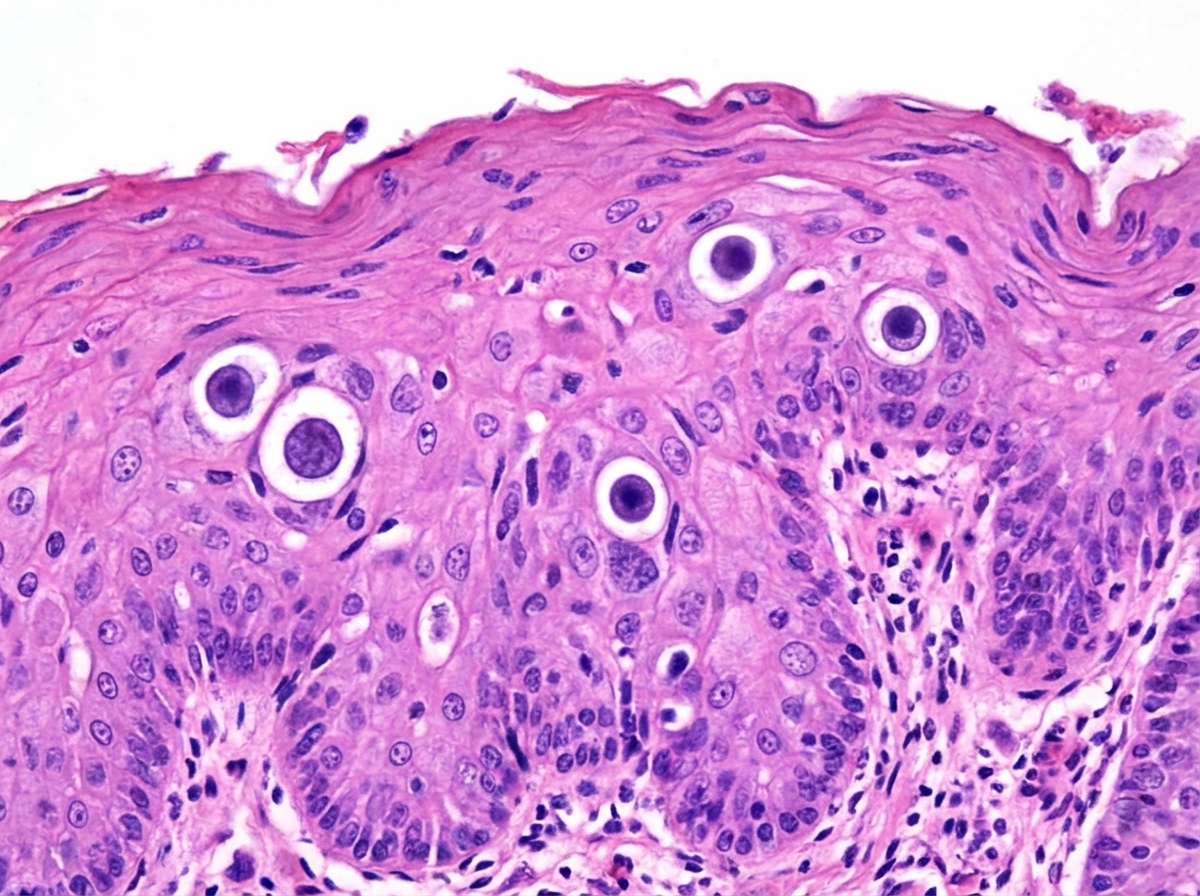
Explanation: ### Explanation The correct diagnosis is **CIN III with koilocytic atypia**. **1. Why the Correct Answer is Right:** The key to this diagnosis lies in the **extent of epithelial involvement**. The pathology report describes atypical cells involving the **full thickness** of the squamous epithelium. * **CIN III (Severe Dysplasia/Carcinoma in situ):** Characterized by loss of maturation and presence of atypical cells (increased N:C ratio, hyperchromasia) extending beyond the upper third of the epithelium to involve the full thickness [1], [3]. * **Koilocytic Atypia:** The description of "wrinkled nuclei and perinuclear halos" is the classic pathognomonic feature of **Human Papillomavirus (HPV)** infection, known as koilocytosis [1], [2]. * **Intact Basement Membrane:** This confirms that the lesion is pre-invasive (dysplasia) and has not yet progressed to invasive squamous cell carcinoma. **2. Why the Other Options are Wrong:** * **CIN I (Option A):** Dysplastic changes are limited to the **lower one-third** of the epithelial thickness [1]. While koilocytosis is common here, the "full thickness" involvement in the prompt rules this out. * **CIN II (Option B):** Dysplastic changes involve the **lower two-thirds** of the epithelium [1]. * **Inflammatory Atypia (Option D):** This typically shows reactive nuclear enlargement with prominent nucleoli but maintains normal cellular orientation and lacks the full-thickness architectural distortion and specific koilocytic features described. **3. High-Yield Clinical Pearls for NEET-PG:** * **HPV Strains:** High-risk types **16 and 18** are most commonly associated with CIN II/III and invasive cancer (E6 inhibits p53; E7 inhibits RB) [1]. * **Koilocyte:** A squamous cell with a "raisinoid" nucleus (shrunken/wrinkled) surrounded by a clear halo [2]. * **Transformation Zone:** The most common site for CIN and cervical cancer development (junction of squamous and columnar epithelium) [3]. * **Bethesda System:** CIN II and CIN III are collectively categorized as **HSIL** (High-grade Squamous Intraepithelial Lesion) in cytology [2]. **References:** [1] Kumar V, Abbas AK, et al.. Robbins and Cotran Pathologic Basis of Disease. 9th ed. The Female Genital Tract, pp. 1008-1010. [2] Kumar V, Abbas AK, et al.. Robbins and Cotran Pathologic Basis of Disease. 9th ed. The Female Genital Tract, p. 1010. [3] Cross SS. Underwood's Pathology: A Clinical Approach. 6th ed. Common Clinical Problems From Female Genital Tract Disease, pp. 467-468.
Explanation: ### Explanation **Correct Answer: A. Liver dysfunction** The primary mechanism of testicular atrophy in chronic alcoholics is **hyperestrogenism** resulting from liver dysfunction [1]. In chronic liver disease (cirrhosis), the liver’s ability to metabolize and clear endogenous estrogens is significantly impaired. Additionally, alcohol has a direct toxic effect on the germinal epithelium and Leydig cells [2]. The pathophysiology involves: 1. **Decreased Estrogen Clearance:** The liver fails to degrade estrogen, leading to increased circulating levels. 2. **Increased Peripheral Conversion:** There is an increased conversion of adrenal androgens (androstenedione) into estrogens in peripheral tissues. 3. **Hormonal Feedback:** Elevated estrogen levels exert negative feedback on the hypothalamus and pituitary, decreasing the secretion of FSH and LH, which leads to secondary testicular atrophy and infertility. --- ### Why the other options are incorrect: * **B. Thrombosis of testicular vessels:** While ischemia can cause atrophy, it is typically an acute event (e.g., testicular torsion) rather than a chronic complication of alcoholism. * **C. Vitamin B12 deficiency:** While common in alcoholics due to malnutrition or gastritis, B12 deficiency primarily causes megaloblastic anemia and subacute combined degeneration of the spinal cord, not testicular atrophy. * **D. Peripheral neuropathy:** This is a common neurological complication of chronic alcoholism (due to direct toxicity and Thiamine deficiency), but it does not have a direct causal link to the structural atrophy of the testes. --- ### NEET-PG High-Yield Pearls: * **Clinical Signs of Hyperestrogenism in Cirrhosis:** Testicular atrophy, gynecomastia, spider angiomata, and palmar erythema [1]. * **Alcoholic Testicular Damage:** Alcohol is a direct gonadotoxin; it inhibits the enzyme **alcohol dehydrogenase** in the testes, which is required for the conversion of Retinol to Retinoic acid (essential for spermatogenesis). * **Histology:** Testicular atrophy is characterized by the thickening of the basement membrane of seminiferous tubules, arrest of spermatogenesis, and interstitial fibrosis [2]. **References:** [1] Cross SS. Underwood's Pathology: A Clinical Approach. 6th ed. Common Clinical Problems From Liver And Biliary System Disease, pp. 388-389. [2] Kumar V, Abbas AK, et al.. Robbins and Cotran Pathologic Basis of Disease. 9th ed. Liver and Gallbladder, p. 850.
Explanation: **Explanation:** A **Krukenberg tumor** refers to a metastatic signet-ring cell carcinoma of the ovary, where the primary malignancy arises from a gastrointestinal site. **Why Stomach Cancer is Correct:** The most common primary site for a Krukenberg tumor is the **stomach** (specifically the gastric antrum), accounting for approximately 70% of cases. The characteristic histological feature is the **signet-ring cell**, where intracellular mucin displaces the nucleus to the periphery. The spread typically occurs via retrograde lymphatic dissemination rather than direct peritoneal seeding. **Why Other Options are Incorrect:** * **Ovarian Cancer:** Krukenberg tumors are by definition metastatic. Primary ovarian cancers (like serous or mucinous cystadenocarcinomas) arise within the ovary itself and do not show the classic signet-ring morphology associated with Krukenberg tumors. * **Liver Cancer:** Primary hepatocellular carcinoma rarely metastasizes to the ovaries. * **Small Bowel Cancer:** While any GI malignancy can theoretically spread to the ovary, the small bowel is a much rarer primary site compared to the stomach or the large bowel (colon). **High-Yield Clinical Pearls for NEET-PG:** * **Bilateralism:** Krukenberg tumors are characteristically **bilateral** (80% of cases), whereas primary ovarian tumors are more likely to be unilateral. * **Histology:** Look for "Signet-ring cells" and a dense "sarcomatoid-like" reactive stroma. * **Stain:** They stain positive for **PAS** and **Mucicarmine** (due to mucin content). * **Differential:** If the primary is not in the stomach, the second most common site is the **colon**.
Explanation: **Explanation:** **Funisitis** refers specifically to the inflammation of the **umbilical cord** connective tissue (Wharton’s jelly). It is a histological hallmark of the **Fetal Inflammatory Response Syndrome (FIRS)**. The infection typically ascends from the maternal birth canal, leading to the migration of fetal neutrophils from the umbilical vessels into the surrounding cord matrix. [1] **Analysis of Options:** * **Option C (Correct):** Funisitis is the involvement of the umbilical cord. It is often preceded by vasculitis (inflammation of the umbilical vein, followed by the umbilical arteries). [1] * **Option A (Incorrect):** Infection or inflammation of the decidua (maternal uterine lining during pregnancy) is termed **deciduitis**. * **Option B (Incorrect):** Infection of the chorionic villi is termed **villitis**. This is more commonly associated with hematogenous (transplacental) infections, such as the TORCH group, rather than ascending bacterial infections. [1] * **Option D (Incorrect):** The placental septa are projections of the decidua; their inflammation does not have a specific clinical name like funisitis. **High-Yield NEET-PG Pearls:** 1. **Chorioamnionitis:** Inflammation of the fetal membranes (chorion and amnion), usually due to ascending bacterial infection (e.g., *E. coli*, Group B *Streptococcus*). [1] 2. **Sequence of Infection:** Ascending infections typically follow a pattern: **Chorioamnionitis** (maternal response) → **Umbilical Vasculitis** → **Funisitis** (fetal response). 3. **Gross Appearance:** In severe cases, the umbilical cord may show "barer pole" spiraling or yellowish-white plaques. 4. **Clinical Significance:** Funisitis is strongly associated with increased neonatal morbidity, including sepsis and cerebral palsy. **References:** [1] Kumar V, Abbas AK, et al.. Robbins and Cotran Pathologic Basis of Disease. 9th ed. The Female Genital Tract, pp. 1041-1042.
Explanation: The correct answer is **Embryonal Carcinoma**. **1. Why Embryonal Carcinoma is correct:** Embryonal carcinoma is a highly aggressive non-seminomatous germ cell tumor (NSGCT). Histologically, it is characterized by "primitive" or "ugly" pleomorphic cells arranged in sheets, cords, or papillary patterns [1]. These cells exhibit large nuclei, prominent nucleoli, and high mitotic activity. The definitive diagnostic feature in this question is the **immunohistochemical (IHC) profile**: Embryonal carcinomas are characteristically **CD30 positive** and **Cytokeratin (CK) positive**, while being negative for markers like CD117 (which identifies Seminoma). **2. Why the other options are incorrect:** * **Choriocarcinoma:** Characterized by the presence of both syncytiotrophoblasts and cytotrophoblasts. The hallmark marker is significantly elevated **hCG**, not CD30. * **Yolk Sac Tumor:** Histology typically shows Schiller-Duval bodies and lace-like (reticular) patterns. The characteristic IHC marker is **Alpha-fetoprotein (AFP)**. * **Teratoma:** Composed of tissues derived from multiple germ layers (ectoderm, mesoderm, endoderm) such as cartilage, muscle, or neural tissue [3]. It does not typically present as a homogenous mass of primitive "ugly" cells. **3. High-Yield Clinical Pearls for NEET-PG:** * **CD30** is the most specific IHC marker to differentiate Embryonal Carcinoma from other germ cell tumors. * **Seminoma vs. Embryonal Carcinoma:** Seminomas are CD117+ and PLAP+, but **CD30 negative** and usually CK negative [2]. * Embryonal carcinoma is often a component of "Mixed Germ Cell Tumors." * It is more aggressive than seminoma and often presents with metastasis at the time of diagnosis. * **IHC Summary:** * Embryonal: CD30+, CK+, OCT3/4+ * Seminoma: CD117+, OCT3/4+, CD30- * Yolk Sac: AFP+, Glypican-3+ **References:** [1] Kumar V, Abbas AK, et al.. Robbins and Cotran Pathologic Basis of Disease. 9th ed. The Lower Urinary Tract and Male Genital System, pp. 979-980. [2] Kumar V, Abbas AK, et al.. Robbins and Cotran Pathologic Basis of Disease. 9th ed. The Lower Urinary Tract and Male Genital System, pp. 980-982. [3] Kumar V, Abbas AK, et al.. Robbins and Cotran Pathologic Basis of Disease. 9th ed. The Lower Urinary Tract and Male Genital System, pp. 982-983.
Explanation: **Explanation:** The development of Testicular Germ Cell Tumors (GCTs) is linked to a combination of genetic factors, developmental anomalies, and environmental influences. 1. **Why Option C is correct:** * **Cryptorchidism:** This is the most significant risk factor [1, 2]. An undescended testis has a 3 to 10-fold increased risk of malignancy. Notably, the risk also exists (though lower) in the contralateral descended testis [2]. * **Testicular Feminizing Syndrome (Androgen Insensitivity Syndrome):** Individuals with 46,XY karyotype and female phenotypes are at high risk for gonadoblastomas and dysgerminomas/seminomas due to gonadal dysgenesis. * **Klinefelter’s Syndrome (47,XXY):** Associated specifically with an increased risk of **extragonadal germ cell tumors**, particularly in the mediastinum. * **Laterality:** GCTs are slightly more common on the **right side**, mirroring the higher incidence of right-sided cryptorchidism. 2. **Why other options are wrong:** * **Smoking:** While smoking is a major risk factor for many cancers (like bladder or lung cancer), it has **not** been definitively established as a primary predisposing factor for testicular germ cell tumors in standard pathology textbooks (e.g., Robbins). Options A, B, and D are incorrect because they include smoking as a key feature [3]. **High-Yield Clinical Pearls for NEET-PG:** * **Isochromosome 12p [i(12p)]:** Present in virtually all GCTs; it is a pathognomonic genetic marker. * **Precursor Lesion:** Most GCTs arise from **Germ Cell Neoplasia In Situ (GCNIS)**, except for pediatric yolk sac tumors and teratomas. * **Family History:** A first-degree relative with a GCT increases the risk significantly (8-fold to 10-fold for brothers). * **Age Peak:** Most common in the 15–34 age group. **References:** [1] Kumar V, Abbas AK, et al.. Robbins and Cotran Pathologic Basis of Disease. 9th ed. The Lower Urinary Tract and Male Genital System, pp. 976-977. [2] Cross SS. Underwood's Pathology: A Clinical Approach. 6th ed. Common Clinical Problems From Diseases Of The Urinary And Male Genital Tracts, pp. 508-509. [3] Kumar V, Abbas AK, et al.. Robbins and Cotran Pathologic Basis of Disease. 9th ed. The Lower Urinary Tract and Male Genital System, pp. 975-976.
Diseases of Male Genital Tract
Practice Questions
Testicular Tumors
Practice Questions
Prostate Pathology
Practice Questions
Diseases of Female Genital Tract
Practice Questions
Cervical Pathology and Neoplasia
Practice Questions
Endometrial Pathology
Practice Questions
Ovarian Diseases and Tumors
Practice Questions
Gestational Trophoblastic Disease
Practice Questions
Placental Pathology
Practice Questions
Sexually Transmitted Infections
Practice Questions
Get full access to all questions, explanations, and performance tracking.
Start For Free