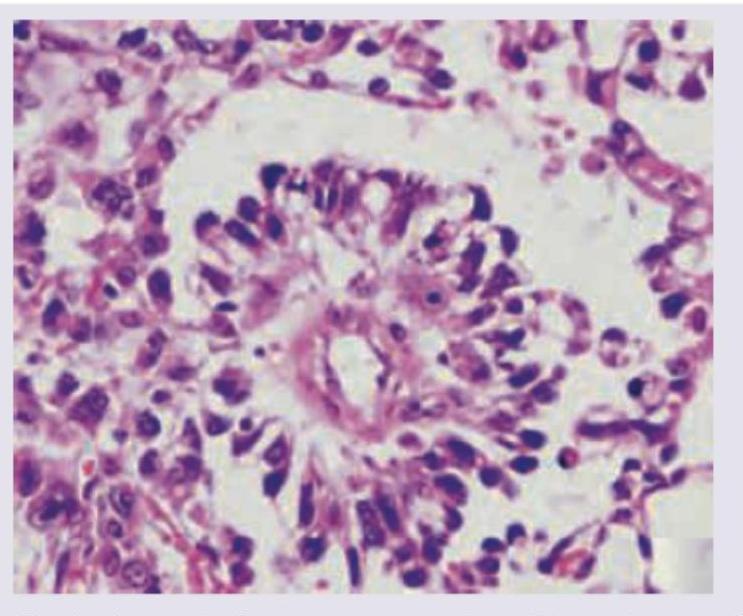
What condition is the Lendrum stain primarily used to diagnose?
In which organ are corpora amylacea typically observed in a pathological context?
Transitional cell carcinoma of the bladder is associated with which of the following?
All of the following statements are true about Gleason score, except:
This type of endometrial hyperplasia leads to an increased risk of endometrial cancer.
What is the most common histological variety of uterine carcinoma?
Call-Exner bodies are seen in:
Call-Exner bodies are identified in?
Not a histological marker for choriocarcinoma:
Which of the following testicular tumors is not a germ cell neoplasm?
Explanation: ***Amniotic fluid embolism*** - The **Lendrum stain** (specifically the modified Lendrum stain) is used to detect **fetal squamous cells** and **mucin** in maternal lung tissue, which are markers for amniotic fluid embolism [1]. - It helps confirm the diagnosis of this rare but severe obstetric emergency characterized by the entry of **amniotic fluid** into the maternal circulation [1]. *Air embolism* - Air embolism is diagnosed based on the presence of **gas bubbles** in blood vessels, often visualized by imaging or directly during autopsy, not by a specific tissue stain [1]. - Histologically, air emboli lead to characteristic foam-like structures in vascular lumens, but no specific stain highlights the air itself. *Fat embolism* - Fat embolism is diagnosed by the presence of **fat globules** in pulmonary capillaries and other organs, typically stained with **oil-soluble dyes like Oil Red O** or Sudan stains on frozen sections. - The Lendrum stain is designed for mucin and keratin, not neutral lipids like fat. *Thromboembolism* - Thromboembolism involves **blood clots** that occlude vessels and is diagnosed using routine H&E staining, which shows fibrin, platelets, and red blood cells [1]. - Special stains like **phosphotungstic acid-hematoxylin (PTAH)** or **Martius scarlet blue (MSB)** may be used for fibrin, but the Lendrum stain is specifically designed for amniotic fluid components, not thrombi. **References:** [1] Cross SS. Underwood's Pathology: A Clinical Approach. 6th ed. Common Clinical Problems From Respiratory Tract Disease, pp. 323-324.
Explanation: ***Prostate*** - **Corpora amylacea**, also known as prostatic concretions, are common, benign findings in the prostate gland, especially with increasing age. - They are composed of glycoproteins and often found within the **acini and ducts of the prostate**. *Thymus* - The thymus is known for **Hassall's corpuscles**, which are epithelial reticular cells arranged concentrically, playing a role in T-cell selection. - **Corpora amylacea** are not typically found in the normal thymus. *Lymph node* - Lymph nodes are characterized by their lymphoid follicles, germinal centers, and medullary cords. - While they can have various inclusions or changes in disease states, **corpora amylacea** are not a typical pathological finding in lymph nodes. *Spleen* - The spleen is primarily involved in filtering blood and immune responses, with distinct red and white pulp regions. - **Corpora amylacea** are not associated with the normal or pathological histology of the spleen.
Explanation: ***Schistosomiasis*** - Schistosomiasis, particularly from *Schistosoma haematobium*, is a well-known risk factor for **transitional cell carcinoma of the bladder** due to chronic irritation and inflammation [1]. - The association arises due to the **presence of eggs in the bladder**, leading to calcification and eventually cancer development. *Malaria* - Malaria is primarily associated with **hemolytic anemia** and does not have a direct correlation with **bladder cancer**. - Its causative agents, *Plasmodium* species, do not typically lead to **urological malignancies** like transitional cell carcinoma. *Ascarasis* - Ascarasis, caused by *Ascaris lumbricoides*, primarily affects the **intestines** and is more associated with gastrointestinal issues. - There is no significant link between ascarasis and the **development of bladder cancer**. *Any of d above* - As this option suggests all listed conditions, it incorrectly implies that **malaria** and **ascarasis** are linked to bladder cancer, which they are not. - Transitional cell carcinoma is specifically associated with **schistosomiasis**, making this option misleading. **References:** [1] Kumar V, Abbas AK, et al.. Robbins and Cotran Pathologic Basis of Disease. 9th ed. The Lower Urinary Tract and Male Genital System, pp. 968-970.
Explanation: ***Scores range from 2-10*** - The **Gleason score** is obtained by summing the two most predominant architectural patterns of tumor growth, with each pattern graded from 1 to 5. The lowest possible sum is 2 (1+1) and the highest is 10 (5+5). However, **Gleason scores are now reported from 6 to 10** for clinical purposes, as grade 1 and 2 patterns are rarely seen in biopsies, and for practical purposes, anything less than a 3+3=6 is considered benign or low-risk. [1] - While mathematically the range is 2-10, in modern clinical practice, a score of 6 is the lowest grade assigned to prostate cancer, making the statement that scores range from 2-10 clinically inaccurate. *Used for grading prostate cancer* - The **Gleason score** is a well-established and widely used histological grading system specifically for prostate adenocarcinoma. [2] - It assesses the **architectural patterns** of glandular differentiation in prostate cancer to predict its aggressiveness. *Higher the score, poorer the prognosis* - A **higher Gleason score** indicates a more poorly differentiated and aggressive tumor, which correlates with a greater likelihood of metastasis and recurrence. [2] - This directly translates to a **poorer prognosis** for the patient. *Helps in planning management* - The **Gleason score** is a critical factor, along with PSA levels and clinical staging, in determining the risk stratification of prostate cancer. - This risk stratification guides treatment decisions, such as whether to pursue active surveillance, radiation therapy, surgery, or systemic therapy. **References:** [1] Kumar V, Abbas AK, et al.. Robbins and Cotran Pathologic Basis of Disease. 9th ed. The Lower Urinary Tract and Male Genital System, pp. 990-992. [2] Kumar V, Abbas AK, et al.. Robbins and Cotran Pathologic Basis of Disease. 9th ed. The Lower Urinary Tract and Male Genital System, pp. 993-994.
Explanation: ***Atypical*** - **Atypical endometrial hyperplasia** shows both glandular architectural abnormalities and features of cellular atypia, such as nuclear pleomorphism and prominent nucleoli [1]. - The presence of cellular atypia is the key differentiator and significantly increases the risk of progression to **endometrial adenocarcinoma**, with up to 30% progressing to cancer [2]. *Simple* - **Simple endometrial hyperplasia** involves an increase in the number of endometrial glands, which retain their normal shape and uniform distribution [1]. - While it represents abnormal proliferation, the risk of progression to **endometrial cancer** is very low (less than 1%) [2]. *Complex* - **Complex endometrial hyperplasia** shows architectural crowding and branching of glands, but without cellular atypia [2]. - The glands are no longer uniformly spaced, creating a more complex pattern, but the individual cells do not show features of malignancy; therefore, the risk of progression to **endometrial cancer** is low (around 3%) [2]. *Secretive* - **Secretory endometrium** is a normal physiological phase of the menstrual cycle, occurring after ovulation under the influence of progesterone. - This term describes the histological appearance of the endometrium, not a type of hyperplasia or a premalignant condition. **References:** [1] Kumar V, Abbas AK, et al.. Robbins and Cotran Pathologic Basis of Disease. 9th ed. The Female Genital Tract, pp. 1016-1018. [2] Cross SS. Underwood's Pathology: A Clinical Approach. 6th ed. Common Clinical Problems From Female Genital Tract Disease, pp. 473-475.
Explanation: ***Adenocarcinoma*** - **Endometrial adenocarcinoma** is by far the most common type of uterine carcinoma, accounting for about 80% of all cases [1]. - It arises from the **glandular epithelial cells** lining the endometrium and is typically associated with **estrogen exposure** [1]. *Squamous cell carcinoma* - **Squamous cell carcinoma** of the uterus is extremely rare and usually occurs in the cervix, not the uterine body. - While it can occur in the endometrium in specific circumstances (e.g., in association with pyometra), it is not the most common type. *Serous carcinoma* - **Uterine serous carcinoma** is a more aggressive, high-grade subtype that accounts for a smaller percentage (5-10%) of uterine cancers. - It is typically seen in older women and often presents at an advanced stage, but it is not the most common overall. *Mixed carcinoma* - **Mixed carcinoma** of the uterus contains elements of more than one histological type, typically adenocarcinoma and another more aggressive component. - These are uncommon and represent a smaller fraction of uterine cancers compared to pure adenocarcinoma. **References:** [1] Kumar V, Abbas AK, et al.. Robbins and Cotran Pathologic Basis of Disease. 9th ed. The Female Genital Tract, pp. 1016-1018.
Explanation: ***Granulosa cell tumor*** - **Call-Exner bodies** are characteristic histological features of **granulosa cell tumors**, appearing as small, fluid-filled spaces resembling immature ovarian follicles [1]. - They are formed by granulosa cells arranged around an eosinophilic, fluid-filled space containing hyaluronic acid [1]. *Dysgerminoma* - Dysgerminomas are characterized by large, uniform cells with clear cytoplasm and prominent nuclei, often separated by fibrous septa infiltrated by lymphocytes [1]. - They do not typically exhibit Call-Exner bodies; instead, they are the ovarian counterpart of testicular seminomas [1]. *Polyembryoma* - Polyembryoma is a rare and highly malignant germ cell tumor characterized by the formation of **embryoid bodies** that mimic early embryonic development [1]. - These tumors do not contain Call-Exner bodies and are distinct in their histological appearance [1]. *Theca cell tumor* - Theca cell tumors (thecomas) are benign ovarian tumors composed of spindle-shaped cells resembling normal ovarian stromal cells, often arranged in fascicles [1]. - They are known for their hormonal activity, particularly estrogen production, but lack Call-Exner bodies in their histological structure [1]. **References:** [1] Kumar V, Abbas AK, et al.. Robbins and Cotran Pathologic Basis of Disease. 9th ed. The Female Genital Tract, pp. 1026-1037.
Explanation: ***Granulosa cell tumour*** - **Call-Exner bodies** are a characteristic histological feature of granulosa cell tumors, appearing as small, gland-like structures filled with eosinophilic fluid and surrounded by granulosa cells [2]. - They represent an abortive attempt at **follicle formation** by the neoplastic granulosa cells [2]. *Endodermal sinus cell tumour* - This tumor is characterized by **Schiller-Duval bodies**, which are glomerulus-like structures, a key diagnostic feature, not Call-Exner bodies. - It is a **germ cell tumor** that typically produces alpha-fetoprotein (AFP). *Ovarian fibroma* - An ovarian fibroma is a **benign stromal tumor** characterized histologically by bundles of spindle cells with abundant collagen, lacking Call-Exner bodies. - This tumor is often associated with **Meigs' syndrome** (ascites, pleural effusion, and ovarian fibroma). *Teratoma* - Teratomas are **germ cell tumors** composed of various mature or immature tissues derived from multiple germ layers (ectoderm, mesoderm, endoderm) [1], [3]. - They do not typically contain Call-Exner bodies; instead, they show a disorganized mixture of tissues like skin, hair, teeth, bone, and neural tissue [1], [3]. **References:** [1] Cross SS. Underwood's Pathology: A Clinical Approach. 6th ed. Common Clinical Problems From Female Genital Tract Disease, pp. 480-481. [2] Kumar V, Abbas AK, et al.. Robbins and Cotran Pathologic Basis of Disease. 9th ed. The Female Genital Tract, pp. 1036-1037. [3] Kumar V, Abbas AK, et al.. Robbins and Cotran Pathologic Basis of Disease. 9th ed. The Female Genital Tract, pp. 1033-1034.
Explanation: ***Villous*** - The absence of **chorionic villi** is a key histological feature distinguishing choriocarcinoma from other gestational trophoblastic diseases. - Choriocarcinoma is characterized by the proliferation of **cytotrophoblasts** and **syncytiotrophoblasts** without an organized villous structure. *Cytotrophoblast* - **Cytotrophoblasts** are one of the two main cell types found in choriocarcinoma, forming solid nests or cords [1]. - These cells typically have clear cytoplasm and distinct cell borders [1]. *Syncytiotrophoblast* - **Syncytiotrophoblasts** are also a prominent component of choriocarcinoma, often forming multinucleated giant cells [1]. - These cells are responsible for producing **human chorionic gonadotropin (hCG)**, which is elevated in choriocarcinoma [1]. *Bizarre nuclei* - **Bizarre and pleomorphic nuclei** are characteristic of the highly anaplastic and aggressive nature of choriocarcinoma cells [2]. - This feature reflects the significant **cellular atypia** and rapid proliferation seen in this malignancy [2]. **References:** [1] Kumar V, Abbas AK, et al.. Robbins and Cotran Pathologic Basis of Disease. 9th ed. The Lower Urinary Tract and Male Genital System, pp. 980-982. [2] Kumar V, Abbas AK, et al.. Robbins and Cotran Pathologic Basis of Disease. 9th ed. Neoplasia, p. 278.
Explanation: ***Sertoli cell tumor*** - Sertoli cell tumors are classified as **sex-cord stromal tumors** [1][2], not germ cell neoplasms, and arise from **Sertoli cells** in the testis. - They are characterized by **hormonally active** properties and may lead to conditions like **gynecomastia** due to estrogen production. *Seminoma* - Seminomas are a type of **germ cell tumor** [2][3], derived from the germ cells in the testes, and typically present with **elevated AFP** and **hCG** levels. - Known for their **slow growth** and better prognosis compared to non-seminomatous germ cell tumors. *Yolk sac tumor* - Also a germ cell neoplasm [3], yolk sac tumors typically produce **alpha-fetoprotein (AFP)**, indicating their germinal origin. - Commonly occur in **younger males** and present as a **rapidly growing** tumor with a poor prognosis if not treated early. *Teratoma* - Teratomas are categorized as germ cell tumors [3] that can contain differentiated tissues and arise from **primitive germ cells**. - They are generally classified as either **mature** or **immature**, with the immature type being more aggressive and occurring primarily in **younger patients**. **References:** [1] Cross SS. Underwood's Pathology: A Clinical Approach. 6th ed. Common Clinical Problems From Diseases Of The Urinary And Male Genital Tracts, pp. 513-514. [2] Cross SS. Underwood's Pathology: A Clinical Approach. 6th ed. Common Clinical Problems From Diseases Of The Urinary And Male Genital Tracts, pp. 510-512. [3] Kumar V, Abbas AK, et al.. Robbins and Cotran Pathologic Basis of Disease. 9th ed. The Lower Urinary Tract and Male Genital System, pp. 979-980.
Diseases of Male Genital Tract
Practice Questions
Testicular Tumors
Practice Questions
Prostate Pathology
Practice Questions
Diseases of Female Genital Tract
Practice Questions
Cervical Pathology and Neoplasia
Practice Questions
Endometrial Pathology
Practice Questions
Ovarian Diseases and Tumors
Practice Questions
Gestational Trophoblastic Disease
Practice Questions
Placental Pathology
Practice Questions
Sexually Transmitted Infections
Practice Questions
Get full access to all questions, explanations, and performance tracking.
Start For Free