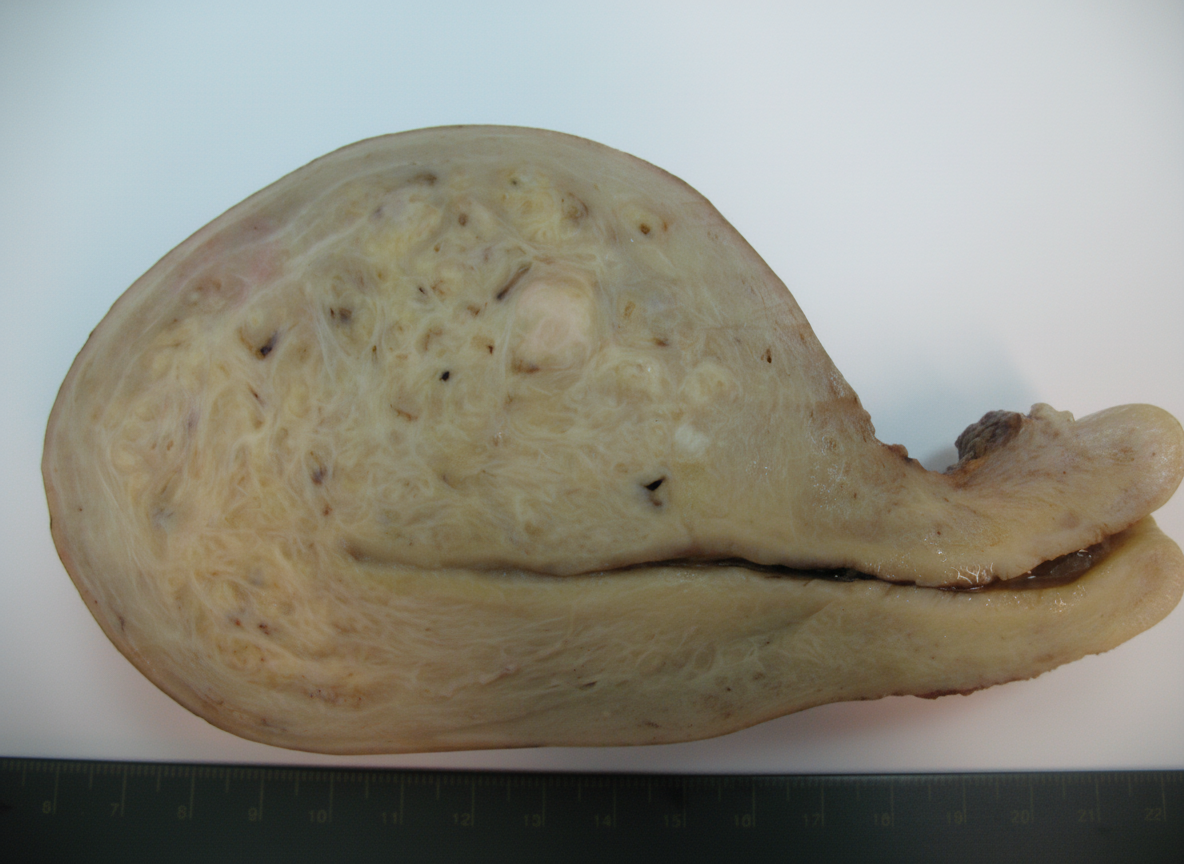
Ovarian hyperthecosis is characterized by
The BRCA1 gene is associated with which type of breast carcinoma?
Which is the most common germ cell tumor?
A postmenopausal woman presents with pruritic white lesions on the vulva. A punch biopsy of a representative area is obtained. Which of the following histologic findings is consistent with the diagnosis of Lichen sclerosis?
Intratubular germ cell neoplasia unclassified (ITGCNU) is typically found adjacent to which of the following testicular tumors?
A 35-year-old woman presents with a 2.2-cm mass in her left breast. The mass is excised, and histologic sections reveal a tumor composed of a mixture of ducts and cells. The epithelial cells within the ducts are not atypical in appearance. There is a marked increase in the stromal cellularity, but the stromal cells are not atypical in appearance and mitoses are not found. Which of the following is the most likely diagnosis?
A patient presents with suspected ovarian tumors. On laparotomy, bilaterally enlarged ovaries with a smooth surface are observed. What is the most likely diagnosis?
Krukenberg tumour of the ovary is most commonly due to a primary carcinoma of which organ?
Congenital adrenal hyperplasia (CAH) is associated with which of the following?
All of the following are true about Krukenberg's tumor except?
Explanation: **Explanation:** **Ovarian Hyperthecosis** is a disorder of ovarian androgen excess characterized by the presence of **nests of luteinized theca cells** scattered throughout a hypercellular ovarian stroma [1]. Unlike Polycystic Ovary Syndrome (PCOS), where luteinization is typically confined to the areas around cystic follicles, in hyperthecosis, these cells are found deep within the ovarian medulla and cortex. * **Why Option B is correct:** The hallmark histological feature is the transformation of stromal cells into rounded, lipid-rich, eosinophilic luteinized cells, often visible as discrete nests with vacuolated cytoplasm [1]. These cells function as an endocrine organ, producing high levels of testosterone. * **Why Option A is incorrect:** While ovaries can be slightly enlarged, they are often normal in size or show uniform stromal hyperplasia without the classic "string of pearls" follicular enlargement seen in PCOS. * **Why Options C & D are incorrect:** Ovarian hyperthecosis is considered a **more severe** variant of the PCOS spectrum, not less. It is associated with significantly higher serum androgen levels, leading to profound virilization (clitoromegaly, deepening of voice, temporal balding) rather than simple hirsutism [1]. It is also more strongly associated with severe insulin resistance and acanthosis nigricans. **High-Yield Clinical Pearls for NEET-PG:** * **Patient Profile:** Often presents in postmenopausal women (unlike PCOS, which is typically reproductive age). * **Clinical Presentation:** Rapidly progressing virilization and refractory hypertension/insulin resistance. * **Diagnosis:** Suggested by testosterone levels often >200 ng/dL; confirmed by histopathology showing stromal luteinization [1]. * **Key Distinction:** PCOS = Follicular theca interna hyperplasia; Hyperthecosis = Diffuse stromal luteinization. **References:** [1] Kumar V, Abbas AK, et al.. Robbins and Cotran Pathologic Basis of Disease. 9th ed. The Female Genital Tract, pp. 1026-1028.
Explanation: **Explanation:** The **BRCA1 gene** (located on chromosome 17q) is a tumor suppressor gene involved in DNA repair via homologous recombination. While BRCA1 is most famously associated with **Medullary Carcinoma** [2] (a subtype of invasive ductal carcinoma characterized by a triple-negative phenotype and lymphocytic infiltrate), it also shows a statistically significant association with **Mucinous (Colloid) Carcinoma**. In the context of competitive exams like NEET-PG, BRCA1-associated breast cancers are typically high-grade, poorly differentiated, and often "triple-negative" [3]. However, among the specific histological subtypes listed, Mucinous carcinoma is recognized in various pathology datasets as having a higher prevalence in BRCA1 carriers compared to the general population. **Analysis of Options:** * **A. Lobular Carcinoma:** This is primarily associated with the loss of **E-cadherin** expression (CDH1 gene mutation) [1]. It is more commonly seen in BRCA2 carriers than BRCA1. * **B. Mucinous Carcinoma (Correct):** Characterized by "clusters of tumor cells floating in lakes of extracellular mucin." It is one of the specific subtypes linked to the BRCA1 mutation profile. * **C. Tubular Carcinoma:** This is a well-differentiated, low-grade cancer with an excellent prognosis, usually associated with sporadic mutations rather than the high-risk BRCA1 germline mutation. * **D. Papillary Carcinoma:** A rare subtype usually seen in older postmenopausal women; it does not have a strong genetic link to BRCA1. **High-Yield Clinical Pearls for NEET-PG:** * **BRCA1:** Chromosome 17; associated with Medullary breast CA, Serous Ovarian CA, and Prostate CA. * **BRCA2:** Chromosome 13; associated with **Male Breast CA**, Pancreatic CA, and Melanoma. * **Most common type of breast cancer in BRCA1/2:** Invasive Ductal Carcinoma (No Special Type). * **Molecular Subtype:** BRCA1 cancers are most frequently **Basal-like (Triple Negative)** [3]. **References:** [1] Kumar V, Abbas AK, et al.. Robbins and Cotran Pathologic Basis of Disease. 9th ed. The Breast, pp. 1068-1069. [2] Cross SS. Underwood's Pathology: A Clinical Approach. 6th ed. Common Clinical Problems From Liver And Biliary System Disease, pp. 455-456. [3] Kumar V, Abbas AK, et al.. Robbins and Cotran Pathologic Basis of Disease. 9th ed. The Breast, pp. 1064-1066.
Explanation: **Explanation:** The correct answer is **Seminoma**. Germ cell tumors (GCTs) account for approximately 95% of all testicular tumors [1]. Among these, **Seminoma** is the most common histological subtype, representing about 50% of all cases. It typically occurs in the 4th decade of life and is highly radiosensitive, carrying an excellent prognosis. **Analysis of Options:** * **A. Embryonal Teratoma:** While teratomas are common GCTs, they are less frequent than seminomas in adults [1]. In children, mature teratomas are more common, but they do not surpass the overall incidence of seminomas across the general population. * **B. Dermoid (Mature Cystic Teratoma):** This is the most common germ cell tumor of the **ovary** (female). However, in the context of general "germ cell tumors" or specifically testicular tumors, seminoma remains the most frequent. * **C. Rhabdomyosarcoma:** This is a malignant tumor of mesenchymal origin (skeletal muscle differentiation), not a germ cell tumor. It is the most common soft tissue sarcoma in children but is irrelevant to GCT classification. **High-Yield Clinical Pearls for NEET-PG:** * **Marker:** Seminomas are typically negative for AFP and hCG, though 10% may show elevated hCG due to syncytiotrophoblastic giant cells [1]. **PLAP** (Placental-like Alkaline Phosphatase) is a characteristic marker [1]. * **Morphology:** Look for "clear cells with distinct cell borders" and "lymphocytic infiltration" in the stroma. * **Ovarian Counterpart:** The female equivalent of a seminoma is the **Dysgerminoma** [2]. * **Most common GCT in infants/children:** Yolk Sac Tumor (Endodermal Sinus Tumor), characterized by Schiller-Duval bodies and elevated AFP [1]. **References:** [1] Kumar V, Abbas AK, et al.. Robbins and Cotran Pathologic Basis of Disease. 9th ed. The Lower Urinary Tract and Male Genital System, pp. 979-982. [2] Kumar V, Abbas AK, et al.. Robbins and Cotran Pathologic Basis of Disease. 9th ed. The Female Genital Tract, pp. 1034-1035.
Explanation: **Explanation:** **Lichen Sclerosus (LS)** is a chronic inflammatory dermatosis that most commonly affects the vulva in postmenopausal women. It presents clinically as "parchment-like" or "cigarette paper" thinning of the skin with white plaques (leukoplakia) [1]. **Why Option A is correct:** The hallmark of Lichen Sclerosus is **atrophy of the epidermis**. Histologically, this manifests as the **blunting or complete loss of rete pegs**, leading to a flattened dermo-epidermal junction [1]. This thinning is what gives the skin its fragile, translucent appearance. **Analysis of Incorrect Options:** * **B. Excessive hyalinization:** While subepithelial (dermal) fibrosis and hyalinization are characteristic of LS, the question asks for a finding consistent with the diagnosis. While hyalinization occurs, it is specifically **subepithelial zone homogenization** rather than generalized "excessive hyalinization." However, in the context of NEET-PG, epidermal thinning/loss of rete pegs is the more specific diagnostic histological marker for the "atrophic" nature of LS [1]. * **C. Acute inflammatory infiltration:** LS is characterized by a **chronic** inflammatory infiltrate (primarily lymphocytes) in the mid-dermis, not an acute (neutrophilic) infiltrate [1]. * **D. Increased number of cellular layers:** This describes **hyperplasia** (acanthosis), which is characteristic of *Lichen Simplex Chronicus* (LSC), not Lichen Sclerosus. LS is defined by epithelial thinning. **NEET-PG High-Yield Pearls:** * **Clinical Appearance:** "Parchment-like" skin, "Cigarette paper" atrophy, and "Figure-of-eight" involvement (perianal and vulvar). * **Malignancy Risk:** LS is associated with a slightly increased risk (1-5%) of developing **Squamous Cell Carcinoma (SCC)** of the vulva (HPV-independent pathway). * **Microscopic Triad:** 1. Thinning of epidermis (loss of rete pegs), 2. Degeneration of basal cells, 3. Sclerotic (hyalinized) superficial dermis with a deeper lymphocytic band [1]. **References:** [1] Kumar V, Abbas AK, et al.. Robbins and Cotran Pathologic Basis of Disease. 9th ed. The Female Genital Tract, p. 1000.
Explanation: **Explanation:** **Intratubular Germ Cell Neoplasia, Unclassified (ITGCNU)**, now officially termed **Germ Cell Neoplasia In Situ (GCNIS)** by the WHO, is the common precursor for most malignant testicular germ cell tumors (GCTs) [3]. 1. **Why Dysgerminoma is correct:** Dysgerminoma is the ovarian counterpart of the testicular **Seminoma** [1]. In the context of testicular pathology, ITGCNU/GCNIS is found in the adjacent non-neoplastic parenchyma in approximately 90-95% of all **"post-pubertal type" germ cell tumors**, which includes Seminomas, Embryonal carcinomas, Teratomas, and Choriocarcinomas [3]. Since the question identifies Dysgerminoma (the morphological equivalent of Seminoma [2]), it represents the group of tumors derived from GCNIS. 2. **Why other options are incorrect:** * **Spermatocytic Seminoma:** This is a distinct clinico-pathological entity occurring in older men [2]. It is **not** derived from ITGCNU/GCNIS and has a benign clinical course with no association with other GCTs [3]. * **Yolk Sac Tumor (Pre-pubertal):** While post-pubertal yolk sac tumors are associated with GCNIS, the "pure" yolk sac tumors seen in infants and young children (pre-pubertal type) are **not** associated with ITGCNU [3]. * **All of the above:** Incorrect because Spermatocytic Seminoma and pediatric GCTs are specifically GCNIS-negative [3]. **High-Yield Pearls for NEET-PG:** * **Markers for ITGCNU:** Positive for **OCT3/4, PLAP, and c-KIT (CD117)** [2]. * **Chromosomal Abnormality:** ITGCNU and its derived tumors (post-pubertal) typically show **isochromosome 12p [i(12p)]** [4]. * **Exceptions:** Tumors NOT arising from ITGCNU include Spermatocytic Seminoma, Pediatric Yolk Sac Tumor, and Pediatric Teratoma [3]. **References:** [1] Kumar V, Abbas AK, et al.. Robbins and Cotran Pathologic Basis of Disease. 9th ed. The Female Genital Tract, pp. 1034-1035. [2] Kumar V, Abbas AK, et al.. Robbins and Cotran Pathologic Basis of Disease. 9th ed. The Lower Urinary Tract and Male Genital System, pp. 980-982. [3] Kumar V, Abbas AK, et al.. Robbins and Cotran Pathologic Basis of Disease. 9th ed. The Lower Urinary Tract and Male Genital System, pp. 979-980. [4] Kumar V, Abbas AK, et al.. Robbins and Cotran Pathologic Basis of Disease. 9th ed. The Lower Urinary Tract and Male Genital System, pp. 982-983.
Explanation: ### Explanation The correct diagnosis is **Benign Phyllodes Tumor**. **1. Why the Correct Answer is Right:** Phyllodes tumors are fibroepithelial lesions characterized by both epithelial and stromal proliferation [1]. The key distinguishing feature from a fibroadenoma is the **marked increase in stromal cellularity** [1]. In this case, the presence of a biphasic tumor (ducts and stroma) with significant stromal expansion but **no cellular atypia or mitoses** points specifically to a **benign** phyllodes tumor. These tumors often exhibit a "leaf-like" (phyllodes) growth pattern on low power due to the overgrowth of stroma pushing into the ductal spaces [1]. **2. Why Incorrect Options are Wrong:** * **Fibroadenoma (C):** While also a biphasic tumor, fibroadenomas have a much lower stromal-to-epithelial ratio [2]. The "marked increase in stromal cellularity" described in the question is the classic differentiator that upgrades the diagnosis to a phyllodes tumor [1]. * **Malignant Phyllodes Tumor (D):** A malignant diagnosis requires evidence of stromal malignancy, including high mitotic activity (usually >10 per 10 HPF), marked cellular pleomorphism/atypia, stromal overgrowth (absence of epithelial elements), and infiltrative borders [1]. None of these were present. * **Atypical Epithelial Hyperplasia (A):** This refers to a proliferation of ductal or lobular epithelial cells with some features of carcinoma in situ [3]. It does not involve the stromal proliferation described. **3. NEET-PG High-Yield Pearls:** * **Age:** Phyllodes tumors typically occur in the 4th–5th decade (older than fibroadenoma). * **Management:** Unlike fibroadenomas, phyllodes tumors must be excised with **wide margins (1 cm)** because they have a high rate of local recurrence, even when benign [1]. * **Metastasis:** If malignant, they spread via the **hematogenous** route (like sarcomas), not lymphatics; axillary lymph node dissection is usually not required [1]. **References:** [1] Kumar V, Abbas AK, et al.. Robbins and Cotran Pathologic Basis of Disease. 9th ed. The Breast, p. 1074. [2] Cross SS. Underwood's Pathology: A Clinical Approach. 6th ed. Common Clinical Problems From Liver And Biliary System Disease, pp. 448-449. [3] Cross SS. Underwood's Pathology: A Clinical Approach. 6th ed. Common Clinical Problems From Liver And Biliary System Disease, pp. 445-446.
Explanation: ### Explanation **Correct Answer: B. Krukenberg tumor** The clinical presentation of **bilaterally enlarged ovaries** with a **smooth, bosselated surface** is a classic macroscopic description of a Krukenberg tumor. **Why it is correct:** A Krukenberg tumor is a metastatic signet-ring cell carcinoma to the ovary, most commonly originating from a primary gastric cancer (diffuse type). Key diagnostic features include: * **Bilateral involvement:** Occurs in over 80% of cases. * **Morphology:** The ovaries maintain their general shape (ovoid/kidney-shaped) with a smooth, non-adherent capsule, despite being significantly enlarged [1]. * **Microscopy:** Characterized by mucin-secreting signet-ring cells and a dense stromal reaction (desmoplasia). **Why other options are incorrect:** * **Granulosa cell tumor:** These are typically **unilateral** (95% of cases) and often present with symptoms of estrogen excess such as endometrial hyperplasia [2]. * **Dysgerminoma:** This is the most common malignant germ cell tumor. While it can be bilateral (10-15%), it usually presents as a **solid, fleshy, unilateral mass** in younger women. * **Primary adenocarcinoma:** Most primary epithelial ovarian tumors (like serous or mucinous cystadenocarcinomas) are often unilateral (except serous, which is frequently bilateral) but typically present with **irregular, cystic-solid surfaces** and adhesions, rather than a smooth, preserved contour [3]. **NEET-PG High-Yield Pearls:** * **Most common primary site:** Stomach (Pylorus); followed by colon, breast, and appendix [3]. * **Route of spread:** Historically thought to be transcoelomic (seeding), but now believed to be primarily **retrograde lymphatic spread**. * **Stain of choice:** PAS or Mucicarmine (to highlight intracellular mucin in signet-ring cells). * **Tumor Marker:** Often associated with elevated **CEA** rather than CA-125. **References:** [1] Kumar V, Abbas AK, et al.. Robbins and Cotran Pathologic Basis of Disease. 9th ed. The Female Genital Tract, pp. 1026-1028. [2] Cross SS. Underwood's Pathology: A Clinical Approach. 6th ed. Common Clinical Problems From Female Genital Tract Disease, pp. 481-482. [3] Cross SS. Underwood's Pathology: A Clinical Approach. 6th ed. Common Clinical Problems From Female Genital Tract Disease, pp. 478-480.
Explanation: **Explanation:** **Krukenberg tumor** is a specific type of metastatic signet-ring cell carcinoma of the ovary. The correct answer is **Stomach** because approximately 70% of Krukenberg tumors originate from a primary gastric malignancy (typically the diffuse type, characterized by *CDH1* mutations) [1]. * **Underlying Concept:** The tumor is characterized histologically by **signet-ring cells** (mucin-filled cells that displace the nucleus to the periphery) infiltrating a dense, reactive fibroblastic stroma [1]. The spread is traditionally thought to occur via lymphatics rather than direct peritoneal seeding, often presenting as bilateral, multinodular ovarian masses. **Analysis of Incorrect Options:** * **B. Lung:** While lung cancer can metastasize to the ovary, it is rare and does not typically present with the classic signet-ring morphology of a Krukenberg tumor. * **C. Central Nervous System:** Primary CNS tumors (like glioblastoma) almost never metastasize outside the cranium to the ovaries. * **D. Thyroid:** Thyroid malignancies (like papillary or follicular carcinoma) spread to cervical lymph nodes or bone/lung, but not typically to the ovaries. **NEET-PG High-Yield Pearls:** 1. **Primary Sites:** Stomach (most common) > Colon > Breast > Appendix. 2. **Laterality:** Usually **bilateral** (80% of cases), which helps distinguish it from primary ovarian surface epithelial tumors. 3. **Histology:** Look for the "Signet-ring" appearance and a positive **PAS stain** (due to intracellular mucin) [1]. 4. **Clinical Presentation:** Patients may present with an adnexal mass before the primary gastric lesion is even symptomatic. Always perform an upper GI endoscopy if a bilateral signet-ring ovarian tumor is found. **References:** [1] Kumar V, Abbas AK, et al.. Robbins and Cotran Pathologic Basis of Disease. 9th ed. The Gastrointestinal Tract, p. 779.
Explanation: **Explanation:** **Congenital Adrenal Hyperplasia (CAH)** is a group of autosomal recessive disorders characterized by a deficiency in enzymes required for cortisol synthesis, most commonly **21-hydroxylase deficiency** (90% of cases) [1]. **Why Option B is Correct:** In CAH, the block in the cortisol pathway leads to an accumulation of precursors (like 17-OH progesterone), which are shunted into the **androgen synthesis pathway** [1]. In a genetically female fetus (46,XX), these excess adrenal androgens cause virilization of the external genitalia (clitoromegaly, labial fusion) while the internal genitalia (ovaries, uterus) remain normal because there is no Anti-Müllerian Hormone (AMH). This mismatch between female genotype/internal organs and masculinized external genitalia defines **Female Pseudohermaphroditism**. **Why Other Options are Incorrect:** * **A. Male Pseudohermaphroditism:** This occurs in 46,XY individuals with feminized external genitalia, typically due to Androgen Insensitivity Syndrome or 5-alpha reductase deficiency, not CAH. * **C. True Hermaphroditism:** Now termed "Ovotesticular DSD," this requires the presence of both ovarian and testicular tissue in the same individual, which is a chromosomal/gonadal defect, not an enzymatic one. * **D. Cushing Syndrome:** This is characterized by cortisol *excess*. CAH involves a cortisol *deficiency*, which triggers high ACTH levels, leading to adrenal hyperplasia [1]. **High-Yield Clinical Pearls for NEET-PG:** * **Most common enzyme deficiency:** 21-hydroxylase (leads to salt-wasting, hypotension, and virilization) [1]. * **11-beta-hydroxylase deficiency:** Causes virilization PLUS **hypertension** (due to 11-deoxycorticosterone buildup). * **17-alpha-hydroxylase deficiency:** Causes hypertension but **delayed puberty/lack of virilization** (androgens cannot be formed). * **Diagnostic Marker:** Elevated serum **17-hydroxyprogesterone** is the gold standard for screening 21-hydroxylase deficiency. **References:** [1] Kumar V, Abbas AK, et al.. Robbins and Cotran Pathologic Basis of Disease. 9th ed. The Endocrine System, pp. 1130-1133.
Explanation: **Explanation:** A **Krukenberg tumor** is a metastatic signet-ring cell carcinoma of the ovary, most commonly originating from a primary site in the gastrointestinal tract. **1. Why Option A is the correct answer (False statement):** Krukenberg tumors are characteristically **solid** and firm upon gross examination. They do not typically present with large cystic spaces; instead, they have a multinodular surface and a variegated cut surface that may show areas of necrosis or hemorrhage, but the overall architecture remains solid due to the dense stromal reaction (desmoplasia) induced by the infiltrating signet-ring cells. **2. Analysis of Incorrect Options (True statements):** * **Option B (Maintains ovarian shape):** Despite significant enlargement, these tumors characteristically preserve the general **kidney-shaped or ovoid contour** of the ovary. * **Option C (Bilateral involvement):** Metastatic tumors to the ovary are classically **bilateral** (seen in >80% of cases), which helps distinguish them from primary ovarian surface epithelial tumors, which are more frequently unilateral. * **Option D (Arises from stomach carcinoma):** The most common primary site is the **stomach** (specifically gastric adenocarcinoma, linitis plastica type). Other sites include the colon, appendix, and breast. **Clinical Pearls for NEET-PG:** * **Microscopy:** Look for **Signet-ring cells** (mucin-filled cytoplasm displacing the nucleus to the periphery) and a dense **sarcomatoid stroma**. * **Staining:** Positive for **PAS** and **Mucicarmine** (due to intracellular mucin). * **Route of Spread:** Traditionally thought to be via retrograde lymphatic spread rather than transcoelomic seeding. * **Rule of Thumb:** If an ovarian mass is bilateral and solid, always suspect a Krukenberg tumor and investigate the GI tract.
Diseases of Male Genital Tract
Practice Questions
Testicular Tumors
Practice Questions
Prostate Pathology
Practice Questions
Diseases of Female Genital Tract
Practice Questions
Cervical Pathology and Neoplasia
Practice Questions
Endometrial Pathology
Practice Questions
Ovarian Diseases and Tumors
Practice Questions
Gestational Trophoblastic Disease
Practice Questions
Placental Pathology
Practice Questions
Sexually Transmitted Infections
Practice Questions
Get full access to all questions, explanations, and performance tracking.
Start For Free