Oestrogen causes proliferation of which cells in the vaginal epithelium?
Which of the following is NOT true about spermatocytic seminoma?
What is the most common testicular tumor in the prepubertal age group?
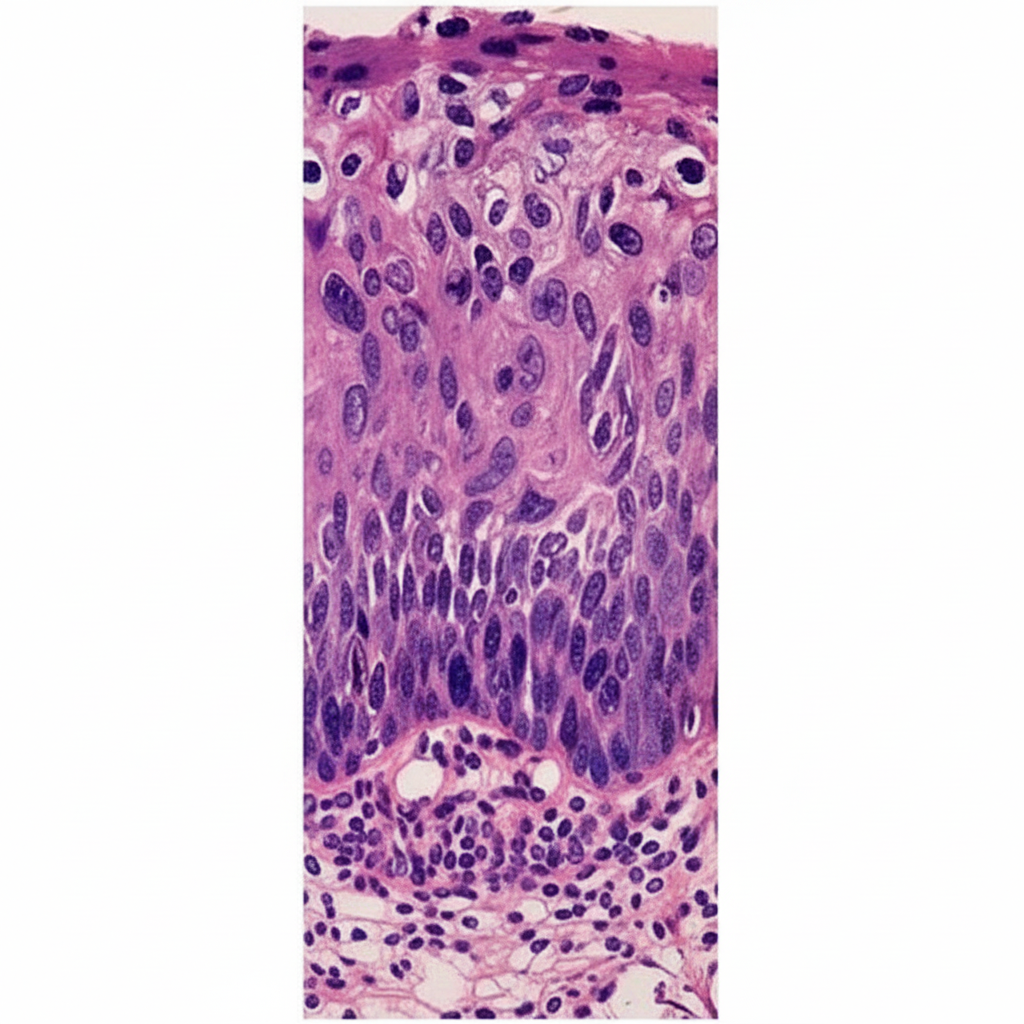
What is the interpretation of the given cervix biopsy of a 50-year-old lady?
What is the earliest morphological evidence of ovulation?
Call-Exner bodies are seen in which of the following tumors?
Which testicular tumor is associated with high HCG levels?
Women carrying the BRCA1 gene are more likely to develop which type of breast carcinoma?
Streak gonads are seen in which of the following conditions?
Which of the following predisposes to breast cancer?
Explanation: The vaginal epithelium is a non-keratinized stratified squamous epithelium that undergoes cyclic changes under the influence of ovarian hormones. **Explanation of the Correct Answer:** **Estrogen** is the primary hormone responsible for the **maturation and proliferation** of the vaginal squamous epithelium. It stimulates the maturation of cells from the basal layer up to the **superficial layer**. Therefore, a high estrogenic state (like the ovulatory phase) is characterized by a predominance of **superficial cells** (large, flat cells with pyknotic nuclei). These cells are rich in glycogen, which is fermented by Doderlein’s bacilli to maintain an acidic vaginal pH. **Analysis of Incorrect Options:** * **Intermediate cells:** These cells predominate under the influence of **Progesterone**. In the luteal phase of the menstrual cycle or during pregnancy, the maturation process stops at the intermediate level. * **Basal/Parabasal cells:** These are the least mature cells. They predominate in **low-estrogen states**, such as prepuberty or menopause (atrophic vaginitis). * **Both superficial and intermediate cells:** While estrogen promotes the transition through all layers, its specific "end-point" effect and the hallmark of high estrogenic activity is the presence of superficial cells. **High-Yield Clinical Pearls for NEET-PG:** * **Maturation Index (MI):** Reported as a ratio of (Parabasal : Intermediate : Superficial cells). * **Shift to the Right:** High Estrogen (e.g., 0:40:60) → Predominance of Superficial cells. * **Shift to the Mid:** High Progesterone (e.g., 0:90:10) → Predominance of Intermediate cells. * **Shift to the Left:** Low Estrogen (e.g., 80:20:0) → Predominance of Parabasal cells (Atrophy). * **Fern Test:** Estrogen causes "ferning" of cervical mucus; Progesterone inhibits it.
Explanation: ### **Explanation: Spermatocytic Seminoma** **1. Why Option A is the Correct Answer (The "NOT True" Statement):** While spermatocytic seminoma is characterized by a **polymorphic** population of cells, it classically consists of **three distinct cell sizes**, not "types" in the sense of different lineages. These are: * **Small cells (6–8 µm):** Resemble secondary spermatocytes. * **Medium-sized cells (15–18 µm):** The most numerous population. * **Giant cells (50–100 µm):** Often multinucleated or containing large single nuclei. The statement in Option A is technically the "correct" answer because, in the context of NEET-PG pathology, the hallmark is the **tripartite cell population** based on size, but the question likely targets the distinction that it lacks the lymphocytic infiltrate and granulomas seen in classical seminoma [1]. **2. Analysis of Incorrect Options:** * **Option B:** True. Unlike classical seminoma (peak age 30–40), spermatocytic seminoma occurs in older men, typically **over age 65** [1]. * **Option C:** True. It is a **slow-growing** tumor that rarely metastasizes [1]. Orchiectomy is usually curative, and radiation/chemotherapy is seldom required. * **Option D:** True. It is distinct from classical seminoma because it: * Does **not** arise from Germ Cell Neoplasia In Situ (GCNIS) [1]. * Is **not** associated with cryptorchidism. * Lacks the characteristic fibrous septa and lymphocytic infiltrate [1]. **3. NEET-PG High-Yield Pearls:** * **Markers:** Negative for **OCT3/4**, PLAP, and hCG (unlike classical seminoma) [1]. * **Origin:** Thought to arise from post-meiotic germ cells. * **Prognosis:** Excellent; it is considered a benign-behaving malignancy. * **Gross Appearance:** Pale grey, soft, and friable, often with mucoid/gelatinous cysts. * **Key Distinction:** It never occurs at extragonadal sites (classical seminoma can). **References:** [1] Kumar V, Abbas AK, et al.. Robbins and Cotran Pathologic Basis of Disease. 9th ed. The Lower Urinary Tract and Male Genital System, pp. 980-982.
Explanation: **Explanation:** The correct answer is **Yolk sac tumors** (also known as Endodermal Sinus Tumors). **1. Why Yolk Sac Tumor is correct:** In the prepubertal age group (infants and children up to 3 years), the Yolk sac tumor is the most common primary testicular neoplasm [1]. Unlike the adult version, which usually occurs as a component of a mixed germ cell tumor, the prepubertal type typically occurs in a **pure form** and carries a very good prognosis [1]. A key diagnostic feature is the elevation of **Alpha-Fetoprotein (AFP)** in the serum. **2. Why the other options are incorrect:** * **Seminomas:** These are the most common testicular germ cell tumors in **adults** (peak age 30–50 years) [4]. They are extremely rare in prepubertal children [1]. * **Sertoli and Leydig cell tumors:** These are Sex Cord-Stromal tumors [2]. While they can occur in children (often presenting with precocious puberty due to hormone production), they are significantly less common than germ cell tumors like the Yolk sac tumor [2], [3]. **3. NEET-PG High-Yield Pearls:** * **Pathognomonic Feature:** Presence of **Schiller-Duval bodies** (glomeruloid-like structures with a central vessel surrounded by tumor cells) is seen in 50% of cases. * **Cytoplasmic Inclusions:** Look for eosinophilic, PAS-positive hyaline droplets. * **Tumor Marker:** Serum **AFP** is the gold standard for diagnosis and monitoring recurrence. * **Most common testicular tumor overall:** Seminoma [3]. * **Most common testicular tumor in elderly (>60 years):** Testicular Lymphoma (usually Diffuse Large B-Cell Lymphoma) [2]. **References:** [1] Kumar V, Abbas AK, et al.. Robbins and Cotran Pathologic Basis of Disease. 9th ed. The Lower Urinary Tract and Male Genital System, pp. 979-980. [2] Cross SS. Underwood's Pathology: A Clinical Approach. 6th ed. Common Clinical Problems From Diseases Of The Urinary And Male Genital Tracts, pp. 513-514. [3] Cross SS. Underwood's Pathology: A Clinical Approach. 6th ed. Common Clinical Problems From Diseases Of The Urinary And Male Genital Tracts, pp. 510-512. [4] Kumar V, Abbas AK, et al.. Robbins and Cotran Pathologic Basis of Disease. 9th ed. The Lower Urinary Tract and Male Genital System, pp. 980-982.
Explanation: ***Carcinoma in situ*** - Shows **full-thickness dysplasia** (CIN 3) with complete loss of cellular maturation from basal to surface epithelium, maintaining an **intact basement membrane**. - Characterized by **hyperchromatic nuclei**, increased **nuclear-to-cytoplasmic ratio**, and numerous **mitotic figures** throughout all epithelial layers. *CMV infection* - Would show characteristic **owl's eye inclusions** (large eosinophilic intranuclear inclusions with clear halos) in infected cells. - Associated with **inflammatory infiltrate** and **cytomegaly**, not the organized dysplastic changes seen in CIN 3. *Cervical carcinoma* - Would demonstrate **invasion through the basement membrane** into underlying stroma, which is not present in carcinoma in situ. - Shows **stromal desmoplastic reaction** and **inflammatory response** around invasive tumor nests. *HPV induced koilocytosis* - Characterized by **koilocytes** - cells with enlarged nuclei surrounded by **perinuclear halos** and **wrinkled nuclear membranes**. - Represents **low-grade dysplasia** (CIN 1) with preserved epithelial maturation, unlike the full-thickness involvement in CIN 3.
Explanation: **Explanation:** The correct answer is **Basal vacuolation**. This is a classic high-yield concept in reproductive pathology regarding the dating of the endometrial cycle. **Why it is correct:** Ovulation marks the transition from the proliferative phase (estrogen-driven) to the secretory phase (progesterone-driven) [2]. The earliest histological sign of progesterone's effect on the endometrium—and thus the earliest evidence that ovulation has occurred—is the appearance of **subnuclear (basal) vacuoles** containing glycogen [1]. These appear on **Day 16** of a standard 28-day cycle (approximately 36–48 hours post-ovulation) [2]. **Analysis of incorrect options:** * **A. Pseudostratification:** This is a hallmark of the **proliferative phase** (pre-ovulatory). Under the influence of estrogen, glandular cells divide rapidly, leading to crowded nuclei that appear stratified [2]. * **C. Decrease in glycogen content:** This is incorrect because glycogen content actually **increases** after ovulation. It is first concentrated in basal vacuoles and later secreted into the glandular lumina [2]. * **D. Predecidual reaction:** This refers to the enlargement of stromal cells with eosinophilic cytoplasm. It is a **late secretory phase** change, occurring around Day 23–24, roughly 9–10 days after ovulation [1]. **High-Yield Clinical Pearls for NEET-PG:** * **Dating the Endometrium:** Based on the **Noyes criteria**. * **Day 17:** Vacuoles become more prominent and uniform (the "piano key" appearance). * **Day 20:** Peak of secretory activity; glycogen moves from the base to the apex of the cell (supranuclear) [2]. * **Day 21-22:** Optimal time for implantation; characterized by maximal **stromal edema** [1]. * **Day 25-26:** If no pregnancy occurs, PMN (neutrophil) infiltration and stromal breakdown begin, leading to menstruation [1]. **References:** [1] Kumar V, Abbas AK, et al.. Robbins and Cotran Pathologic Basis of Disease. 9th ed. The Female Genital Tract, pp. 1012-1013. [2] Kumar V, Abbas AK, et al.. Robbins and Cotran Pathologic Basis of Disease. 9th ed. The Female Genital Tract, pp. 1011-1012.
Explanation: **Explanation:** **Call-Exner bodies** are the pathognomonic histological feature of **Granulosa Cell Tumors (GCT)**, specifically the adult type. These are small, fluid-filled spaces surrounded by granulosa cells in a rosette-like or follicular arrangement. The eosinophilic fluid within these spaces represents basement membrane-like material. On microscopy, the cells also exhibit characteristic "coffee-bean" nuclei due to prominent longitudinal grooves. **Analysis of Options:** * **A. Yolk sac tumor:** Characterized by **Schiller-Duval bodies** (glomeruloid structures with a central vessel) and elevated levels of Alpha-Fetoprotein (AFP). * **C. Hilus cell tumor:** These are pure Leydig cell tumors of the ovary. They are characterized by **Reinke crystals** (intracytoplasmic eosinophilic inclusions) [1] and typically cause virilization [1]. * **D. Brenner tumor:** A surface epithelial tumor composed of transitional cells (urothelium). It is characterized by **Walthard cell nests** and "coffee-bean" nuclei, but it does *not* form Call-Exner bodies. **Clinical Pearls for NEET-PG:** * **Granulosa Cell Tumor:** The most common malignant sex cord-stromal tumor. It is clinically significant for secreting **Estrogen**, leading to endometrial hyperplasia or carcinoma and precocious puberty in children. Elevated levels of inhibin are associated with these tumors [1]. * **Tumor Marker:** **Inhibin** (specifically Inhibin B) is the most reliable marker for diagnosis and monitoring recurrence [1]. * **Histology Summary:** Call-Exner bodies + Coffee-bean nuclei + Inhibin positivity = Granulosa Cell Tumor. **References:** [1] Kumar V, Abbas AK, et al.. Robbins and Cotran Pathologic Basis of Disease. 9th ed. The Female Genital Tract, pp. 1036-1038.
Explanation: ### Explanation **1. Why Choriocarcinoma is Correct:** Choriocarcinoma is a highly aggressive germ cell tumor (GCT) characterized by the proliferation of two specific cell types: **syncytiotrophoblasts** and **cytotrophoblasts** [1]. Syncytiotrophoblasts are physiologically responsible for producing **Human Chorionic Gonadotropin (hCG)** [1]. Consequently, 100% of choriocarcinomas show markedly elevated serum hCG levels. Clinically, these high levels can lead to paraneoplastic syndromes like gynecomastia or even hyperthyroidism (due to the structural similarity between hCG and TSH). **2. Analysis of Incorrect Options:** * **Seminoma:** While the majority of seminomas do not produce markers, about 10–15% may contain scattered syncytiotrophoblasts, leading to *mild* elevations in hCG [2]. However, they never produce AFP. * **Endodermal Sinus Tumor (Yolk Sac Tumor):** This is the most common testicular tumor in infants. Its characteristic hallmark is the production of **Alpha-Fetoprotein (AFP)**, not hCG. Histologically, it is identified by Schiller-Duval bodies. * **All of the above:** This is incorrect because the primary and definitive association with high hCG is specific to Choriocarcinoma. **3. High-Yield NEET-PG Pearls:** * **Tumor Marker Summary:** * **Yolk Sac Tumor:** ↑ AFP (100%) * **Choriocarcinoma:** ↑↑ hCG (100%) * **Seminoma:** Usually normal; occasionally mild ↑ hCG; **AFP is always normal.** * **Embryonal Carcinoma:** May increase both AFP and hCG. * **Hematogenous Spread:** Unlike most GCTs that spread via lymphatics, Choriocarcinoma is notorious for early **hematogenous spread**, often presenting with pulmonary "cannonball" metastases before a primary testicular mass is even palpable. * **Reinke Crystals:** Pathognomonic for Leydig Cell Tumors (Non-germ cell tumor). **References:** [1] Kumar V, Abbas AK, et al.. Robbins and Cotran Pathologic Basis of Disease. 9th ed. The Lower Urinary Tract and Male Genital System, p. 982. [2] Kumar V, Abbas AK, et al.. Robbins and Cotran Pathologic Basis of Disease. 9th ed. The Lower Urinary Tract and Male Genital System, pp. 980-982.
Explanation: **Explanation:** The association between **BRCA1 mutations** and specific breast cancer phenotypes is a high-yield topic in pathology. Women with germline BRCA1 mutations have a significantly higher risk of developing **Medullary Carcinoma** of the breast. **Why Medullary Carcinoma is correct:** Medullary carcinoma is a distinct subtype of invasive ductal carcinoma characterized by a well-circumscribed mass, sheets of large pleomorphic cells, and a prominent **lymphoplasmacytic infiltrate** [1]. Pathologically, BRCA1-associated tumors are frequently "Triple Negative" (ER, PR, and HER2/neu negative) [2] and often exhibit "medullary features." While medullary carcinoma is rare in the general population, it is disproportionately overrepresented in BRCA1 carriers. **Analysis of Incorrect Options:** * **B. Lobular Carcinoma:** This is more commonly associated with mutations in the **CDH1 gene** (encoding E-cadherin). It is characterized by "indian filing" of cells and a lack of cell cohesion [3], [4]. * **C. Colloid (Mucinous) Carcinoma:** This subtype typically occurs in older women and is characterized by clusters of tumor cells floating in "lakes of mucin." It generally has a favorable prognosis and is not specifically linked to BRCA1. * **D. Secretory Carcinoma:** A rare, low-grade tumor often seen in children (formerly called juvenile breast cancer), characterized by the ETV6-NTRK3 gene fusion. **High-Yield Clinical Pearls for NEET-PG:** * **BRCA1:** Located on **Chromosome 17q**. Associated with Medullary Breast CA and Serous Ovarian CA. * **BRCA2:** Located on **Chromosome 13q**. Associated with **Male Breast Cancer** and Pancreatic Cancer. * **Molecular Subtype:** BRCA1 tumors are usually of the **Basal-like subtype** (Triple Negative) [2]. * **Morphology:** Despite their high-grade histological appearance, medullary carcinomas often have a slightly better prognosis than standard invasive ductal carcinomas of the same grade [1]. **References:** [1] Cross SS. Underwood's Pathology: A Clinical Approach. 6th ed. Common Clinical Problems From Liver And Biliary System Disease, pp. 455-456. [2] Kumar V, Abbas AK, et al.. Robbins and Cotran Pathologic Basis of Disease. 9th ed. The Breast, pp. 1064-1066. [3] Kumar V, Abbas AK, et al.. Robbins and Cotran Pathologic Basis of Disease. 9th ed. The Breast, pp. 1068-1069. [4] Cross SS. Underwood's Pathology: A Clinical Approach. 6th ed. Common Clinical Problems From Liver And Biliary System Disease, pp. 454-455.
Explanation: **Explanation:** **Turner Syndrome (45, XO)** is the most common cause of primary amenorrhea and is characterized by the presence of **streak gonads** [1]. In this condition, the accelerated loss of oocytes occurs during fetal development (oocyte attrition). By birth, the ovaries are replaced by fibrous tissue strands devoid of follicles, appearing as "streaks." Because these gonads fail to produce estrogen, there is a lack of secondary sexual characteristics and a compensatory rise in LH and FSH (hypergonadotropic hypogonadism). **Analysis of Incorrect Options:** * **Klinefelter’s Syndrome (47, XXY):** This condition affects males [2]. The gonads are not "streaks" but are typically **small, firm testes** characterized by hyalinization of seminiferous tubules and Leydig cell hyperplasia. * **Down’s Syndrome (Trisomy 21):** This is a chromosomal disorder involving autosomes, not sex chromosomes [2]. While it can be associated with reduced fertility, it does not characteristically present with streak gonads. **High-Yield Clinical Pearls for NEET-PG:** * **Karyotype:** 45, XO is the most common, but mosaicism (e.g., 45,X/46,XX) can occur. * **Cardiovascular:** Bicuspid aortic valve (most common) and Coarctation of the aorta. * **Renal:** Horseshoe kidney. * **Physical Findings:** Short stature, webbed neck (cystic hygroma remnant), widely spaced nipples (shield chest), and increased carrying angle (cubitus valgus) [1]. * **Tumor Risk:** If a Y chromosome fragment is present (e.g., 45,X/46,XY mosaicism), there is a high risk of **Gonadoblastoma** in the streak gonads, necessitating prophylactic gonadectomy. **References:** [1] Kumar V, Abbas AK, et al.. Robbins and Cotran Pathologic Basis of Disease. 9th ed. Genetic Disorders, pp. 175-177. [2] Kumar V, Abbas AK, et al.. Robbins and Cotran Pathologic Basis of Disease. 9th ed. Genetic Disorders, pp. 174-175.
Explanation: **Explanation:** The risk of developing invasive breast cancer is categorized based on the histological findings of benign breast lesions [4]. **Correct Answer: D. Epitheliosis** Epitheliosis, also known as **Ductal Hyperplasia**, refers to an increase in the number of cell layers (more than two) within the ducts and acini [1]. * **Hyperplasia without atypia** (e.g., florid hyperplasia) carries a **mildly increased risk** (1.5 to 2 times) [2]. * **Atypical hyperplasia** (ductal or lobular) carries a **moderately increased risk** (4 to 5 times) [3]. Because it involves cellular proliferation, it is a precursor on the spectrum toward malignancy. **Incorrect Options:** * **A, B, & C (Adenosis, Fibrosis, Blue domed cysts):** These are all components of **Fibrocystic Changes (FCC)** of the non-proliferative type [4]. * **Fibrosis:** Increase in stromal connective tissue. * **Adenosis:** Increase in the number of acini per lobule. * **Blue domed cysts:** Dilated ducts filled with fluid [1]. These "Non-proliferative" changes carry **no increased risk** (Relative Risk 1.0) for developing breast cancer [4]. **High-Yield Clinical Pearls for NEET-PG:** * **No Risk (RR 1.0):** Fibrosis, Cysts, Adenosis, Apocrine metaplasia, Mild hyperplasia [4]. * **Slight Risk (RR 1.5–2.0):** Moderate to florid hyperplasia (Epitheliosis), Sclerosing adenosis, Complex sclerosing lesion (Radial scar), Small duct papilloma [2]. * **Moderate Risk (RR 4.0–5.0):** Atypical Ductal Hyperplasia (ADH) and Atypical Lobular Hyperplasia (ALH) [3]. * **High Risk (RR 8.0–10.0):** LCIS and DCIS (Carcinoma in situ). * **Note:** Apocrine metaplasia is a common feature of FCC but, notably, does *not* increase cancer risk. **References:** [1] Cross SS. Underwood's Pathology: A Clinical Approach. 6th ed. Common Clinical Problems From Liver And Biliary System Disease, pp. 446-447. [2] Kumar V, Abbas AK, et al.. Robbins and Cotran Pathologic Basis of Disease. 9th ed. The Breast, pp. 1052-1054. [3] Kumar V, Abbas AK, et al.. Robbins and Cotran Pathologic Basis of Disease. 9th ed. The Breast, pp. 1054-1056. [4] Kumar V, Abbas AK, et al.. Robbins and Cotran Pathologic Basis of Disease. 9th ed. The Breast, p. 1052.
Diseases of Male Genital Tract
Practice Questions
Testicular Tumors
Practice Questions
Prostate Pathology
Practice Questions
Diseases of Female Genital Tract
Practice Questions
Cervical Pathology and Neoplasia
Practice Questions
Endometrial Pathology
Practice Questions
Ovarian Diseases and Tumors
Practice Questions
Gestational Trophoblastic Disease
Practice Questions
Placental Pathology
Practice Questions
Sexually Transmitted Infections
Practice Questions
Get full access to all questions, explanations, and performance tracking.
Start For Free