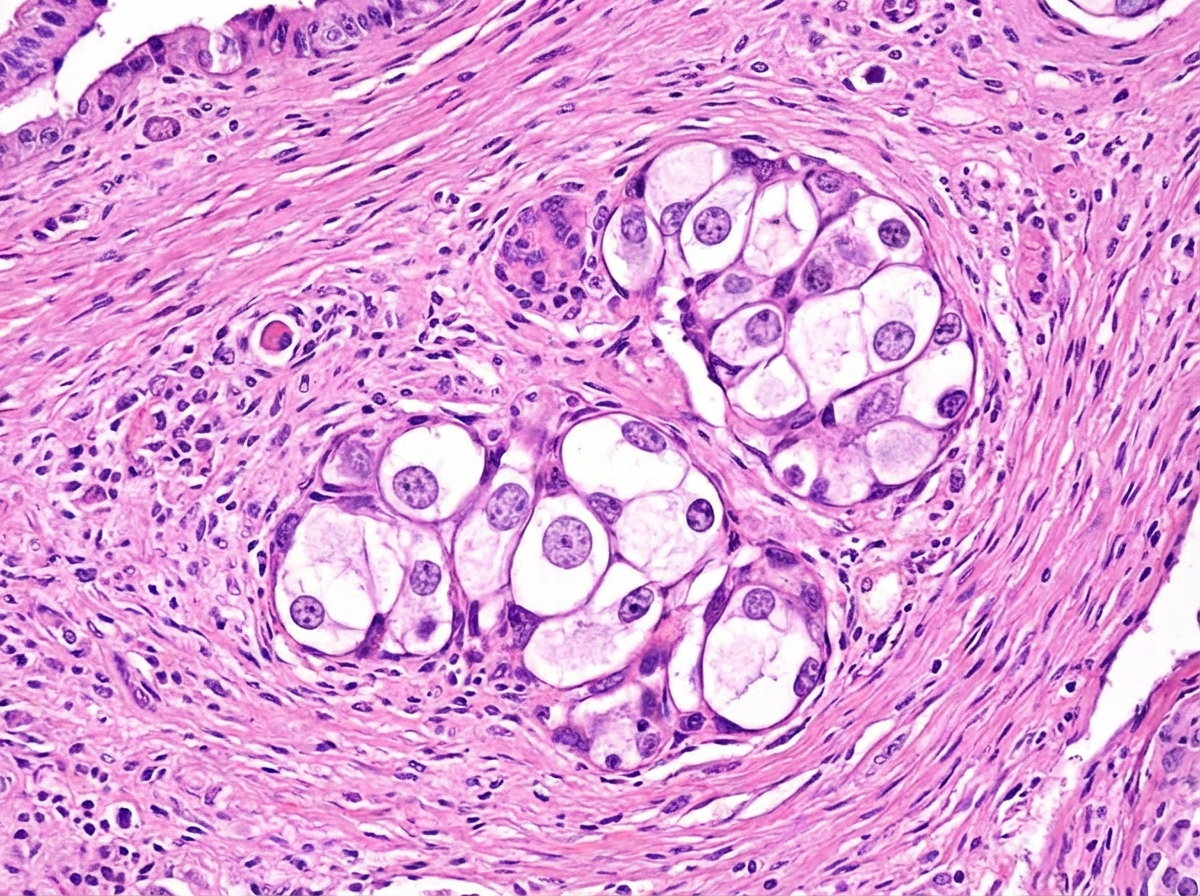
What is the cause for nipple retraction in breast carcinoma?
A 21-year-old woman is in the third trimester of an uncomplicated pregnancy. She has noted an enlarging nodule in her mouth for the past 2 weeks. On physical examination, there is a 1-cm red nodule on the left lateral gingiva below the first molar. The nodule regresses following delivery. What is this nodule most likely to be?
An obese woman with type 2 diabetes and hypertension is diagnosed with endometrioid type of endometrial carcinoma. What is the most likely gene defect in this patient?
With regard to the malignant behavior of leiomyosarcoma, what is the most important criterion?
Ingestion of which of the following drugs during pregnancy increases the risk of vaginal adenocarcinoma in a female offspring?
Which of the following tumors shows increased -kit expression?
Call Exner bodies are seen in which of the following conditions?
A 25-year-old woman died shortly after childbirth. Autopsy revealed the presence of hair, fat, and epithelial cells within the pulmonary vessels. What is the probable cause of death?
A patient develops an ovarian mass that is picked up on pelvic examination. Resection of the mass demonstrates a lymphoma composed of small lymphocytes with interspersed macrophages surrounded by clear spaces. This lesion would be most likely to be associated with which of the following?
Which of the following substances is secreted by non-seminomatous germ cell tumors of the testis?
Explanation: **Explanation:** The clinical presentation of nipple retraction in breast carcinoma is primarily due to the **infiltration and subsequent fibrosis (shortening) of the lactiferous ducts**. As the malignant cells invade the subareolar ducts, they trigger a desmoplastic reaction. This fibrosis causes the ducts to contract and pull the nipple inward toward the tumor [1]. **Analysis of Options:** * **Infiltration of ducts (Correct):** The lactiferous ducts are anatomically connected to the nipple [1]. When a tumor (especially an infiltrating ductal carcinoma) involves these ducts, the resulting cicatrization (scarring) pulls the nipple complex deep into the breast tissue [1]. * **Involvement of Cooper's ligament:** While this also involves fibrosis and pulling, it results in **skin dimpling** or tethering, not nipple retraction. Cooper’s ligaments connect the dermis to the deep fascia; their shortening pulls the overlying skin [1]. * **Blocking of lymphatics:** Obstruction of the dermal lymphatics leads to lymphedema and thickening of the skin. This creates the characteristic **Peau d’orange** (orange peel) appearance, where the skin is tethered by sweat glands but swollen in between [1]. * **Skin infiltration:** Direct invasion of the skin by the tumor can cause ulceration or fixed nodules, but it is not the specific mechanism for the symmetrical pulling seen in nipple retraction [1]. **NEET-PG High-Yield Pearls:** * **Nipple Retraction vs. Inversion:** Retraction is an acquired, pathological sign of malignancy; inversion is often congenital and can be everted manually [1]. * **Paget’s Disease of the Nipple:** Presents as an eczematous crusting lesion; it is caused by the intraepidermal spread of malignant "Paget cells" from an underlying DCIS or invasive carcinoma. * **Most common site for breast cancer:** Upper outer quadrant (50%). **References:** [1] Cross SS. Underwood's Pathology: A Clinical Approach. 6th ed. Common Clinical Problems From Liver And Biliary System Disease, pp. 439-442, 453-454.
Explanation: ### Explanation The clinical presentation describes a **Pyogenic Granuloma**, which is a rapidly growing, pedunculated, red nodule typically found on the gingiva or skin [1]. Histologically, it is a subtype of **Capillary Hemangioma** characterized by a proliferation of capillaries organized in lobules, often accompanied by edema and inflammatory infiltrate [1]. **Why Capillary Hemangioma is correct:** In the context of pregnancy, this lesion is specifically referred to as **Granuloma Gravidarum** (or "pregnancy tumor") [2]. It occurs in approximately 1–5% of pregnant women due to the stimulatory effects of increased estrogen and progesterone on the vascular endothelium [1]. A classic diagnostic clue is its tendency to **regress spontaneously** after delivery as hormone levels normalize [1], [2]. **Analysis of Incorrect Options:** * **A. Bacillary angiomatosis:** This is a vascular proliferation caused by *Bartonella henselae* or *quintana* [3]. While it mimics pyogenic granuloma clinically, it occurs primarily in **immunocompromised** (HIV/AIDS) patients and does not regress post-delivery. * **C. Cavernous lymphangioma:** These are benign malformations of lymphatic vessels, often present at birth (e.g., Cystic Hygroma) [1]. They are typically larger, poorly circumscribed, and do not show rapid growth/regression linked to pregnancy. * **D. Glomus tumor:** These are exquisitely **painful** subungual (under the fingernail) tumors arising from the modified smooth muscle cells of the glomus body [3]. They are not associated with pregnancy or the oral mucosa. **NEET-PG High-Yield Pearls:** * **Pyogenic Granuloma** is a misnomer; it is neither pyogenic (pus-forming) nor a true granuloma [2]. * **Lobular Capillary Hemangioma** is the preferred pathological term. * **Location:** Gingiva is the most common site (75% of cases) [2]. * **Management:** Observation is preferred during pregnancy as they often regress; surgical excision is reserved for cases with significant bleeding or functional interference [1]. **References:** [1] Kumar V, Abbas AK, et al.. Robbins and Cotran Pathologic Basis of Disease. 9th ed. Diseases of Infancy and Childhood, pp. 524-525. [2] Kumar V, Abbas AK, et al.. Robbins and Cotran Pathologic Basis of Disease. 9th ed. The Lung, pp. 735-736. [3] Kumar V, Abbas AK, et al.. Robbins and Cotran Pathologic Basis of Disease. 9th ed. Diseases of Infancy and Childhood, pp. 523-524.
Explanation: **Explanation:** Endometrial carcinoma is broadly classified into two types. This patient presents with the classic profile for **Type I (Endometrioid) Adenocarcinoma** [1]. **1. Why PTEN is correct:** Type I endometrial carcinoma is estrogen-dependent and typically arises in the setting of obesity, diabetes, and hypertension (the "metabolic syndrome" triad). These factors lead to chronic unopposed estrogen stimulation and endometrial hyperplasia [1]. The most common genetic mutation in Type I carcinoma (seen in 30-80% of cases) is the **PTEN tumor suppressor gene** mutation on chromosome 10q23 [1]. This mutation leads to increased PI3K/AKT pathway signaling, promoting cell survival and proliferation [1]. **2. Why other options are incorrect:** * **P53:** Mutations in TP53 are the hallmark of **Type II (Serous) Endometrial Carcinoma** [1]. Type II tumors are estrogen-independent, occur in older, thin women, and are highly aggressive [1]. * **MSH2:** This is a DNA mismatch repair (MMR) gene associated with **Lynch Syndrome** (HNPCC). While Lynch syndrome increases the risk of endometrioid cancer, PTEN is the more frequent sporadic mutation associated with the clinical triad described [1]. * **BRCA2:** Primarily associated with hereditary breast and ovarian cancer syndromes, not typically the primary driver for endometrioid endometrial carcinoma. **Clinical Pearls for NEET-PG:** * **Precursor Lesion:** Type I arises from *Atypical Hyperplasia*; Type II arises from *Serous Endometrial Intraepithelial Carcinoma (SEIC)* [1]. * **PTEN** is also the mutated gene in **Cowden Syndrome**, which presents with multiple hamartomas and increased risk of endometrial and breast cancers. * **KRAS and ARID1A** are other high-yield mutations associated with Type I (Endometrioid) carcinoma. **References:** [1] Kumar V, Abbas AK, et al.. Robbins and Cotran Pathologic Basis of Disease. 9th ed. The Female Genital Tract, pp. 1016-1022.
Explanation: Leiomyosarcoma is a malignant smooth muscle tumor of the uterus. Unlike many other malignancies where invasion is the hallmark, the diagnosis of leiomyosarcoma depends on a combination of histological features [1]. **Why the correct answer is right:** The **mitotic index** (number of mitoses per 10 high-power fields) is the most critical and objective parameter for determining malignancy in smooth muscle tumors [1]. According to the Stanford criteria, a tumor is classified as leiomyosarcoma if it shows: 1. **High mitotic rate** (>10 mitoses per 10 HPF) [1]. 2. **Coagulative tumor cell necrosis** (the most specific indicator) [1]. 3. **Significant cytologic atypia.** Even in the absence of atypia or necrosis, a very high mitotic count alone is often sufficient to upgrade the diagnosis to malignancy [1]. **Why incorrect options are wrong:** * **Options A & B:** While blood vessel (vascular) and lymphatic invasion are common features of sarcomas and indicate metastatic potential, they are not the primary diagnostic criteria used to differentiate a leiomyoma from a leiomyosarcoma. * **Option C:** Lymphocytic infiltration is a feature of the host immune response and is non-specific; it does not determine the malignant behavior of the tumor. **High-Yield Facts for NEET-PG:** * **Origin:** Leiomyosarcomas typically arise **de novo** from mesenchymal cells of the myometrium, **not** from pre-existing leiomyomas (fibroids). * **Gross Appearance:** They appear as bulky, fleshy, poorly circumscribed masses with areas of hemorrhage and necrosis (unlike the firm, whorled appearance of leiomyomas) [1]. * **Metastasis:** They spread primarily via the **hematogenous route**, most commonly to the lungs. * **Epidemiology:** Usually occurs in postmenopausal women (unlike leiomyomas, which are estrogen-dependent and occur in reproductive age). **References:** [1] Kumar V, Abbas AK, et al.. Robbins and Cotran Pathologic Basis of Disease. 9th ed. The Female Genital Tract, pp. 1024-1025.
Explanation: **Explanation:** The correct answer is **Diethylstilbestrol (DES)**. **1. Why Diethylstilbestrol (DES) is correct:** DES is a synthetic non-steroidal estrogen that was historically prescribed to pregnant women (1940s–1970s) to prevent miscarriages [1]. Exposure *in utero* interferes with the normal transformation of the Müllerian duct epithelium. Instead of the normal replacement of glandular columnar epithelium by squamous epithelium in the vagina, the columnar cells persist (**Vaginal Adenosis**). This serves as a precursor for **Clear Cell Adenocarcinoma (CCAC)** of the vagina and cervix, typically manifesting in female offspring during their late teens or early twenties [1]. **2. Why the other options are incorrect:** * **Chlorpropamide:** A first-generation sulfonylurea used for Type 2 Diabetes. It is generally avoided in pregnancy due to the risk of prolonged neonatal hypoglycemia, but it is not linked to vaginal cancer. * **Progesterone:** Often used to support early pregnancy; it is not associated with clear cell adenocarcinoma. * **Chloramphenicol:** An antibiotic associated with **"Gray Baby Syndrome"** in neonates (due to deficient glucuronidation) and bone marrow suppression, but not oncogenesis in offspring. **3. High-Yield Clinical Pearls for NEET-PG:** * **Vaginal Adenosis:** The most common structural abnormality in DES-exposed daughters (found in >30%). * **Other DES Effects:** "T-shaped" uterus, cervical hypoplasia, and increased risk of ectopic pregnancy/preterm labor. * **Morphology of CCAC:** Characterized by "Hobnail cells" (cells with bulbous nuclei protruding into the lumen). * **Location:** Most DES-related clear cell adenocarcinomas occur on the **anterior wall** of the upper third of the vagina. **References:** [1] Cross SS. Underwood's Pathology: A Clinical Approach. 6th ed. (Basic Pathology) introduces the student to key general principles of pathology, both as a medical science and as a clinical activity with a vital role in patient care. Part 2 (Disease Mechanisms) provides fundamental knowledge about the cellular and molecular processes involved in diseases, providing the rationale for their treatment. Part 3 (Systematic Pathology) deals in detail with specific diseases, with emphasis on the clinically important aspects., pp. 223-224.
Explanation: **Explanation:** **1. Why Seminoma is the Correct Answer:** Seminoma (and its ovarian counterpart, Dysgerminoma [2]) is a germ cell tumor that characteristically expresses **c-KIT (CD117)**, a tyrosine kinase receptor [1]. Approximately 95-100% of seminomas show strong, diffuse membranous staining for CD117 [1]. This is a crucial diagnostic marker used in immunohistochemistry (IHC) to differentiate seminomas from other non-seminomatous germ cell tumors (NSGCTs). Additionally, seminomas are positive for **OCT3/4** and **SALL4**, but unlike embryonal carcinoma, they are typically **negative for CD30 and Cytokeratin** [1]. **2. Why Other Options are Incorrect:** * **Yolk Sac Tumor:** Characterized by the production of **Alpha-Fetoprotein (AFP)** and the presence of Schiller-Duval bodies [3]. It does not typically express c-KIT. * **Embryonal Carcinoma:** While it shares markers like OCT3/4 and SALL4 with seminoma, it is distinguished by being **CD30 positive** and **c-KIT negative**. It also shows strong positivity for Cytokeratin (CK) [1]. * **Choriocarcinoma:** This tumor is characterized by the secretion of **beta-hCG** and the presence of syncytiotrophoblasts and cytotrophoblasts. It does not express c-KIT. **3. High-Yield Clinical Pearls for NEET-PG:** * **Most common testicular tumor:** Seminoma (Peak age: 30–40 years). * **Radiosensitivity:** Seminomas are highly radiosensitive and have an excellent prognosis. * **Tumor Markers:** Seminomas may show mildly elevated **LDH**; however, significantly elevated AFP always indicates a non-seminomatous component (usually Yolk Sac). * **IHC Profile of Seminoma:** CD117 (+), OCT3/4 (+), SALL4 (+), PLAP (+), CD30 (-). * **Genetic Association:** Isochromosome 12p [i(12p)] is found in almost all germ cell tumors. **References:** [1] Kumar V, Abbas AK, et al.. Robbins and Cotran Pathologic Basis of Disease. 9th ed. The Lower Urinary Tract and Male Genital System, pp. 980-982. [2] Kumar V, Abbas AK, et al.. Robbins and Cotran Pathologic Basis of Disease. 9th ed. The Female Genital Tract, pp. 1034-1035. [3] Kumar V, Abbas AK, et al.. Robbins and Cotran Pathologic Basis of Disease. 9th ed. The Lower Urinary Tract and Male Genital System, pp. 979-980.
Explanation: **Explanation:** **Call-Exner bodies** are the pathognomonic histological hallmark of **Granulosa Cell Tumors (GCT)**, specifically the adult type. These are small, fluid-filled spaces surrounded by granulosa cells arranged in a rosette-like pattern. The spaces contain eosinophilic material (secreted basement membrane components) and often resemble primitive follicles. * **Granulosa Cell Tumor (Correct):** These are sex cord-stromal tumors. Histologically, they show "coffee-bean" nuclei (due to longitudinal grooves) and Call-Exner bodies. Clinically, they are known for producing **estrogen**, leading to precocious puberty in children or endometrial hyperplasia/carcinoma in postmenopausal women. **Inhibin** is the specific serum marker used for diagnosis and monitoring recurrence [1]. **Why other options are incorrect:** * **Mature Teratoma:** A germ cell tumor containing tissues from all three germ layers (ectoderm, mesoderm, endoderm). Characteristic findings include hair, sebum, and teeth, but not Call-Exner bodies. * **Endodermal Sinus Tumor (Yolk Sac Tumor):** Characterized by **Schiller-Duval bodies** (glomeruloid-like structures) and elevated **Alpha-Fetoprotein (AFP)** levels. * **Sertoli-Leydig Cell Tumor:** These typically show tubules lined by Sertoli cells and clusters of Leydig cells containing **Reinke crystals**. They usually present with virilization due to androgen production. **High-Yield Clinical Pearls for NEET-PG:** * **Schiller-Duval bodies:** Yolk Sac Tumor. * **Reinke Crystals:** Leydig cell tumor. * **Psammoma bodies:** Serous cystadenocarcinoma. * **Hobnail cells:** Clear cell carcinoma of the ovary. * **Coffee-bean nuclei:** Granulosa cell tumor and Brenner tumor. **References:** [1] Kumar V, Abbas AK, et al.. Robbins and Cotran Pathologic Basis of Disease. 9th ed. The Female Genital Tract, pp. 1036-1037.
Explanation: ### Explanation **Correct Option: A. Amniotic fluid embolism (AFE)** The presence of **fetal squames (epithelial cells), lanugo hair, and fat (vernix caseosa)** within the maternal pulmonary vasculature is the pathognomonic histological finding for Amniotic Fluid Embolism [1]. This occurs when a breach in the placental membranes or uterine veins allows amniotic fluid to enter the maternal circulation [3]. It typically presents during or immediately after labor with sudden dyspnea, cyanosis, shock, and often progresses to DIC or death [3]. **Why Incorrect Options are Wrong:** * **B. Fat embolism:** While "fat" is mentioned, it is part of the vernix caseosa in this context. Classic fat embolism usually occurs 24–72 hours after **long bone fractures** and presents with a triad of dyspnea, petechial rash, and neurological symptoms [2]. * **C. Disseminated Intravascular Coagulation (DIC):** While AFE is a major *cause* of DIC (due to the release of thrombogenic substances from amniotic fluid), DIC itself is a hematological process of systemic clotting/bleeding, not a primary embolic event characterized by hair and epithelial cells [3]. * **D. Pulmonary thromboembolism:** This involves a blood clot (thrombus), usually originating from Deep Vein Thrombosis (DVT). Histology would show **Lines of Zahn**, not fetal elements [1]. **NEET-PG High-Yield Pearls:** * **Incidence:** Rare but has a very high mortality rate (up to 80%). * **Histology Gold Standard:** Identification of fetal elements in the pulmonary vessels using special stains like **Attwood’s stain** (stains squames). * **Pathophysiology:** It is not just a mechanical obstruction but an "anaphylactoid syndrome of pregnancy" causing severe pulmonary vasospasm [3]. * **Common complication:** Survivors often develop DIC due to the high concentration of tissue factor in amniotic fluid [3]. **References:** [1] Cross SS. Underwood's Pathology: A Clinical Approach. 6th ed. Common Clinical Problems From Respiratory Tract Disease, pp. 323-324. [2] Cross SS. Underwood's Pathology: A Clinical Approach. 6th ed. (Basic Pathology) introduces the student to key general principles of pathology, both as a medical science and as a clinical activity with a vital role in patient care. Part 2 (Disease Mechanisms) provides fundamental knowledge about the cellular and molecular processes involved in diseases, providing the rationale for their treatment. Part 3 (Systematic Pathology) deals in detail with specific diseases, with emphasis on the clinically important aspects., pp. 146-147. [3] Kumar V, Abbas AK, et al.. Robbins and Cotran Pathologic Basis of Disease. 9th ed. Hemodynamic Disorders, Thromboembolic Disease, and Shock, pp. 138-140.
Explanation: ### Explanation The clinical and histological description points toward **Burkitt Lymphoma** involving the ovary. **1. Why the Correct Answer is Right:** The classic histological description of "small lymphocytes with interspersed macrophages surrounded by clear spaces" is the pathognomonic **"Starry Sky" appearance** [1]. Burkitt Lymphoma is a highly aggressive B-cell neoplasm characterized by a very high proliferation index (Ki-67 near 100%). It is molecularly defined by the translocation of the **c-MYC gene** (typically **t(8;14)**, but also t(2;8) or t(8;22)), which leads to the overexpression of the MYC transcription factor, driving rapid cell cycle progression. While Burkitt Lymphoma is often nodal or jaw-based (endemic), it can present as an extranodal mass in the ovaries or GI tract (sporadic) [2]. **2. Analysis of Incorrect Options:** * **ABL-BCR hybrid / t(9;22):** These refer to the **Philadelphia Chromosome**, characteristic of Chronic Myeloid Leukemia (CML) and some cases of ALL. It involves a tyrosine kinase signaling pathway, not the starry sky morphology of lymphoma. * **BCL-2 activation:** This is the hallmark of **Follicular Lymphoma** [t(14;18)] [3]. BCL-2 is an anti-apoptotic protein. Notably, Burkitt Lymphoma cells are typically **BCL-2 negative**, which allows for the high rate of apoptosis that creates the "tingible body macrophages" (the "stars"). **3. High-Yield Clinical Pearls for NEET-PG:** * **Histology:** The "Stars" are tingible body macrophages (ingesting apoptotic debris); the "Sky" is the sheet of dark B-cells [1]. * **EBV Association:** Strongly associated with the Endemic (African) variant (100%) and moderately with the Immunodeficiency variant. * **Ovarian Involvement:** Burkitt Lymphoma is a known cause of bilateral ovarian masses in children and young adults, often mimicking other germ cell tumors [2]. * **Genetics:** Always look for **t(8;14)** involving the IgH promoter and c-MYC. **References:** [1] Kumar V, Abbas AK, et al.. Robbins and Cotran Pathologic Basis of Disease. 9th ed. Diseases of White Blood Cells, Lymph Nodes, Spleen, and Thymus, p. 606. [2] Kumar V, Abbas AK, et al.. Robbins and Cotran Pathologic Basis of Disease. 9th ed. Diseases of White Blood Cells, Lymph Nodes, Spleen, and Thymus, pp. 605-606. [3] Kumar V, Abbas AK, et al.. Robbins and Cotran Pathologic Basis of Disease. 9th ed. Diseases of White Blood Cells, Lymph Nodes, Spleen, and Thymus, pp. 602-604.
Explanation: **Explanation:** **Why Alpha-fetoprotein (AFP) is the correct answer:** Testicular germ cell tumors (GCTs) are broadly classified into Seminomas and Non-Seminomatous Germ Cell Tumors (NSGCTs) [1]. **AFP** is a major serum tumor marker specifically associated with NSGCTs. It is synthesized by the fetal liver and yolk sac; therefore, it is characteristically elevated in **Yolk Sac Tumors** (Endodermal Sinus Tumors). It is also frequently elevated in Mixed Germ Cell Tumors containing a yolk sac component. Crucially, **pure seminomas never produce AFP**; an elevated AFP in a patient with a "seminoma" histology implies a non-seminomatous component is present. **Analysis of Incorrect Options:** * **A. Carcinoembryonic antigen (CEA):** This is a marker primarily used for colorectal, pancreatic, and gastric carcinomas. It has no diagnostic utility in testicular GCTs. * **B. Acid phosphatase:** Specifically, Prostatic Acid Phosphatase (PAP) was historically used as a marker for prostate cancer (now largely replaced by PSA). It is not secreted by germ cell tumors. * **C. Cytokeratin:** While many NSGCTs (like Embryonal Carcinoma) express cytokeratin immunohistochemically [2], it is an intracellular structural protein (intermediate filament) and is **not secreted** into the serum as a tumor marker. **High-Yield Clinical Pearls for NEET-PG:** * **Beta-hCG:** Elevated in **Choriocarcinoma** (100% of cases) and some Seminomas (approx. 15% containing syncytiotrophoblasts) [2], [3]. * **LDH:** Correlates with tumor burden and growth rate in both seminomas and NSGCTs; used for staging and prognosis. * **Schiller-Duval Bodies:** Pathognomonic histological feature of Yolk Sac Tumors. * **Reinke Crystals:** Characteristic of Leydig Cell Tumors (Sex cord-stromal tumors), not GCTs. **References:** [1] Kumar V, Abbas AK, et al.. Robbins and Cotran Pathologic Basis of Disease. 9th ed. The Lower Urinary Tract and Male Genital System, pp. 979-980. [2] Kumar V, Abbas AK, et al.. Robbins and Cotran Pathologic Basis of Disease. 9th ed. The Lower Urinary Tract and Male Genital System, pp. 980-982. [3] Kumar V, Abbas AK, et al.. Robbins and Cotran Pathologic Basis of Disease. 9th ed. The Lower Urinary Tract and Male Genital System, p. 982.
Diseases of Male Genital Tract
Practice Questions
Testicular Tumors
Practice Questions
Prostate Pathology
Practice Questions
Diseases of Female Genital Tract
Practice Questions
Cervical Pathology and Neoplasia
Practice Questions
Endometrial Pathology
Practice Questions
Ovarian Diseases and Tumors
Practice Questions
Gestational Trophoblastic Disease
Practice Questions
Placental Pathology
Practice Questions
Sexually Transmitted Infections
Practice Questions
Get full access to all questions, explanations, and performance tracking.
Start For Free