A 58-year-old woman has a screening mammogram showing a 0.5-cm irregular area of increased density with scattered microcalcifications in the upper outer quadrant of the left breast. Excisional biopsy shows atypical lobular hyperplasia. She has been on postmenopausal estrogen-progesterone therapy for the past 10 years and has smoked 1 pack of cigarettes per day for the past 35 years. Which of the following is the most significant risk factor for the development of lobular carcinoma in patients with atypical lobular hyperplasia?
Nulliparity and late menopause are risk factors for which of the following group of diseases?
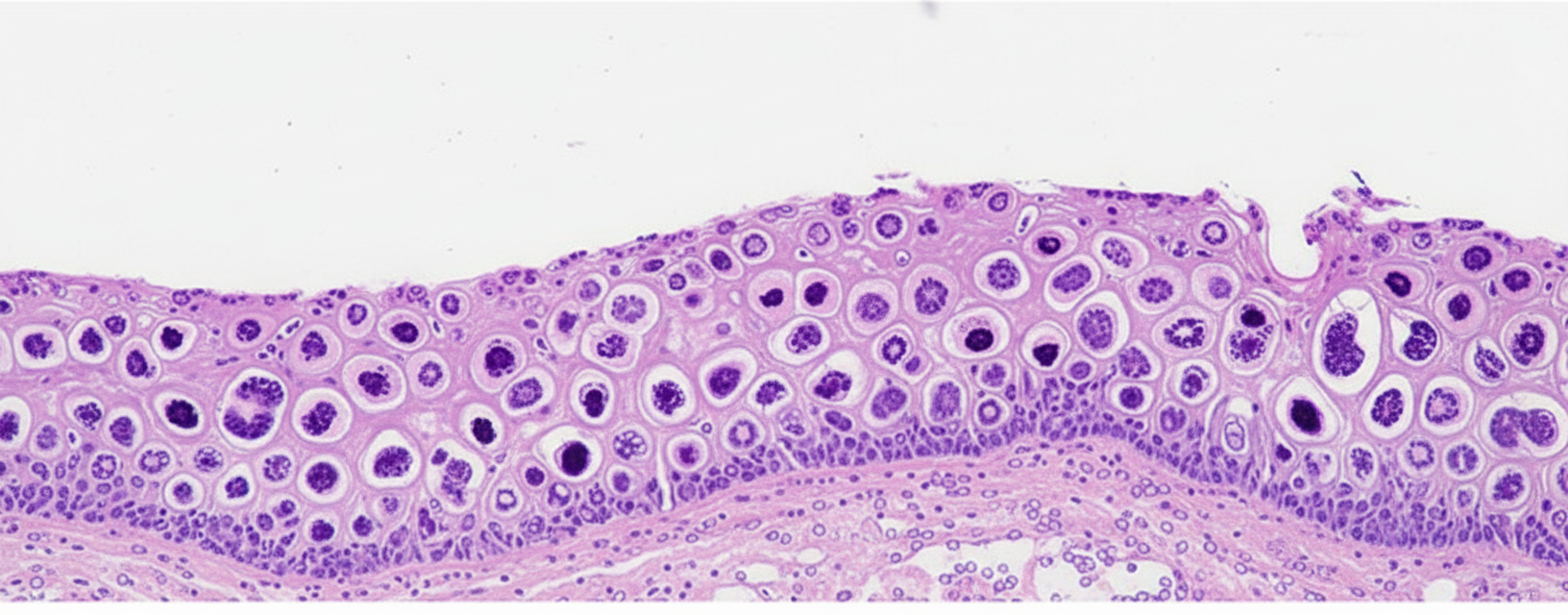
HPV causes which change in the cervical epithelium?
The Van Nuys grading system is used for the assessment of which of the following conditions?
Which of the following histologic types of invasive breast cancer has the best prognosis?
What is the most common malignant testicular neoplasm?
What is a partial mole?
A 46-year-old woman undergoes an abdominal hysterectomy for a fibroid uterus. The surgeon requests a frozen section on the tumor, which is deferred due to the lesion's degree of cellularity. Which of the following criteria will be used by the pathologist in determining benignancy versus malignancy in permanent sections?
Which carcinoma of the breast is not invasive?
A 75-year-old female presents with vaginal spotting. She has been postmenopausal for 25 years and is not taking hormones. Ultrasound reveals a mass in the uterine fundus. Pathologic examination of the removed uterus after hysterectomy shows a malignant tumor of the endometrial glands and stroma. What is the most likely diagnosis?
Explanation: Explanation: The presence of **atypical cytologic changes** (Atypical Lobular Hyperplasia - ALH) is the most significant predictor of future breast cancer risk among the options provided. [1] 1. **Why the Correct Answer is Right:** Atypical Lobular Hyperplasia (ALH) and Atypical Ductal Hyperplasia (ADH) are considered **proliferative lesions with atypia**. Histologically, ALH consists of a proliferation of small, monomorphic cells that do not fill or distend more than 50% of the acini within a lobule. [1] The presence of these atypical cytologic features confers a **4 to 5-fold increased relative risk** of developing invasive carcinoma (either ductal or lobular) in either breast. This risk is significantly higher than the baseline risk associated with age or lifestyle factors alone. 2. **Why the Incorrect Options are Wrong:** * **History of Smoking:** While smoking is a major risk factor for many cancers (lung, bladder), its association with breast cancer is relatively weak compared to hormonal and genetic factors. * **Hormone Replacement Therapy (HRT):** Long-term HRT (estrogen-progesterone) does increase the risk of breast cancer (Relative Risk ~1.2 to 1.5), but this risk is substantially lower than the 4-5x risk conferred by atypical hyperplasia. [3] * **Postmenopausal Age:** While the incidence of breast cancer increases with age, the specific finding of ALH represents a biological precursor/marker that elevates the risk far beyond the age-matched general population. **NEET-PG High-Yield Pearls:** * **Relative Risk (RR) of Breast Lesions:** * Non-proliferative (e.g., Fibrocystic changes): **RR 1.0** (No increased risk). [2] * Proliferative without atypia (e.g., Sclerosing adenosis, Papilloma): **RR 1.5–2.0**. [2] * Proliferative with atypia (ADH/ALH): **RR 4.0–5.0**. [1] * Carcinoma in situ (LCIS/DCIS): **RR 8.0–10.0**. * **ALH/LCIS** are often incidental findings on biopsy and are frequently **bilateral and multicentric**. * Loss of **E-cadherin** expression is the hallmark molecular feature of lobular lesions (ALH and LCIS). **References:** [1] Kumar V, Abbas AK, et al.. Robbins and Cotran Pathologic Basis of Disease. 9th ed. The Breast, pp. 1054-1056. [2] Kumar V, Abbas AK, et al.. Robbins and Cotran Pathologic Basis of Disease. 9th ed. The Breast, pp. 1052-1054. [3] Cross SS. Underwood's Pathology: A Clinical Approach. 6th ed. Common Clinical Problems From Liver And Biliary System Disease, pp. 451-452.
Explanation: ### Explanation The correct answer is **D. Endometrial cancer and breast cancer**. #### 1. Underlying Medical Concept: The "Unopposed Estrogen" Theory The primary risk factor linking nulliparity and late menopause to these specific cancers is **prolonged, cumulative exposure to estrogen** without the balancing effect of progesterone [2]. * **Nulliparity:** Pregnancy provides a long break from the ovulatory cycle, during which high levels of progesterone dominate. A woman who has never been pregnant (nulliparous) experiences more lifetime ovulatory cycles [1]. * **Late Menopause:** Extending the menstrual lifespan increases the total duration of estrogen exposure [3]. * **Mechanism:** Estrogen promotes the proliferation of the endometrial lining and the ductal epithelium of the breast. Chronic stimulation without adequate progesterone "opposition" leads to hyperplasia and increases the risk of malignant transformation [2]. #### 2. Analysis of Incorrect Options * **Options A & B (Cervical Cancer):** The primary risk factor for cervical cancer is **Human Papillomavirus (HPV)** infection (Types 16 and 18). Unlike endometrial cancer, cervical cancer is associated with **early** age of first intercourse and **multiparity** (due to cervical trauma and hormonal changes during multiple pregnancies). * **Option C (Vulvar Cancer):** There are two pathways for vulvar cancer: one is related to **HPV** (in younger women) and the other to **Lichen Sclerosus** (in older women). It is not primarily driven by the "unopposed estrogen" mechanism. #### 3. NEET-PG High-Yield Pearls * **Protective Factors:** Combined Oral Contraceptive Pills (OCPs) and multiparity **decrease** the risk of endometrial and ovarian cancers because they suppress ovulation and reduce estrogen exposure. * **Lynch Syndrome (HNPCC):** Always remember that the most common extra-colonic manifestation of Lynch Syndrome is **Endometrial Cancer** [1]. * **Obesity:** Adipose tissue contains the enzyme **aromatase**, which converts androstenedione to estrone (estrogen), making obesity a major risk factor for both breast and endometrial cancers [2], [4]. **References:** [1] Cross SS. Underwood's Pathology: A Clinical Approach. 6th ed. (Basic Pathology) introduces the student to key general principles of pathology, both as a medical science and as a clinical activity with a vital role in patient care. Part 2 (Disease Mechanisms) provides fundamental knowledge about the cellular and molecular processes involved in diseases, providing the rationale for their treatment. Part 3 (Systematic Pathology) deals in detail with specific diseases, with emphasis on the clinically important aspects., pp. 222-223. [2] Cross SS. Underwood's Pathology: A Clinical Approach. 6th ed. Common Clinical Problems From Liver And Biliary System Disease, pp. 450-452. [3] Cross SS. Underwood's Pathology: A Clinical Approach. 6th ed. Common Clinical Problems From Liver And Biliary System Disease, pp. 450-451. [4] Kumar V, Abbas AK, et al.. Robbins and Cotran Pathologic Basis of Disease. 9th ed. The Breast, pp. 1057-1058.
Explanation: **Explanation:** The oncogenic potential of High-Risk Human Papillomavirus (HPV), particularly types 16 and 18, is primarily mediated by the viral oncoproteins **E6 and E7**. These proteins disrupt the host cell cycle control mechanisms, leading to the **immortalization** of cervical epithelial cells [2]. 1. **Why Option C is Correct:** * **E6 Oncoprotein:** Binds to and facilitates the degradation of the **p53** tumor suppressor protein via the ubiquitin-proteasome pathway. This prevents p53-mediated apoptosis and cell cycle arrest. * **E7 Oncoprotein:** Binds to the **Retinoblastoma (Rb) protein**, displacing the E2F transcription factor [1]. This allows the cell to bypass the G1-S checkpoint and enter the S-phase continuously [1]. * The combined action of E6 and E7 results in the loss of growth inhibition, leading to "immortalization"—the ability of cells to divide indefinitely without undergoing senescence [1]. 2. **Why Other Options are Incorrect:** * **A & B (Apoptosis/Necrosis):** HPV aims to keep the host cell alive to replicate its genome. E6 specifically *inhibits* apoptosis by degrading p53 [1]. * **D (Stimulation of telomerase):** While HPV E6 *does* eventually upregulate telomerase to maintain telomere length, the primary and most characteristic pathognomonic change described in standard pathology (Robbins) regarding HPV’s oncogenic drive is the **immortalization** of cells through the inactivation of p53 and Rb. **High-Yield Clinical Pearls for NEET-PG:** * **Koilocytes:** The hallmark of HPV infection; characterized by perinuclear halo and wrinkled "raisinoid" nuclei. * **Integration:** Malignant transformation occurs when the circular HPV genome integrates into the host DNA, typically resulting in the over-expression of E6 and E7. * **Vaccination:** The Quadrivalent vaccine (Gardasil) targets types 6, 11, 16, and 18 [1]. **References:** [1] Kumar V, Abbas AK, et al.. Robbins and Cotran Pathologic Basis of Disease. 9th ed. Neoplasia, pp. 334-335. [2] Kumar V, Abbas AK, et al.. Robbins and Cotran Pathologic Basis of Disease. 9th ed. The Female Genital Tract, pp. 1006-1008.
Explanation: The **Van Nuys Prognostic Index (VNPI)** is a specialized scoring system used specifically for the assessment and management of **Ductal Carcinoma in Situ (DCIS)** of the breast. It was developed to predict the risk of local recurrence after breast-conserving surgery and to help clinicians decide whether adjuvant radiation therapy is necessary [1]. The VNPI scores four key parameters (each from 1 to 3): 1. **Tumor Size:** Larger lesions carry a higher risk [1]. 2. **Margin Width:** Distance from the tumor to the surgical edge [1]. 3. **Pathologic Classification:** Based on nuclear grade and the presence/absence of comedo-type necrosis [1]. 4. **Age of the Patient:** Younger patients typically have higher recurrence rates. **Analysis of Incorrect Options:** * **Lobular carcinoma in situ (LCIS):** Unlike DCIS, LCIS is traditionally viewed as a risk factor for developing invasive cancer in either breast rather than a direct precursor requiring surgical margins or grading via VNPI [1]. * **Inflammatory carcinoma:** This is a clinical diagnosis characterized by "peau d'orange" appearance and dermal lymphatic invasion; it is managed with systemic chemotherapy and surgery, not the Van Nuys system [4]. * **Medullary carcinoma:** This is a subtype of invasive ductal carcinoma characterized by a lymphoplasmacytic infiltrate. It is graded using standard invasive breast cancer systems (like the Nottingham Grading System) [3]. **High-Yield Pearls for NEET-PG:** * **DCIS Hallmark:** Characterized by malignant clonal proliferation of epithelial cells limited to ducts and lobules by the basement membrane [1]. * **Comedo Necrosis:** A high-grade feature of DCIS where central necrotic debris undergoes calcification (visible on mammography) [1]. * **Paget Disease of the Nipple:** Frequently associated with underlying DCIS [2]. * **Nottingham (Scarff-Bloom-Richardson) System:** Used for **Invasive** Breast Carcinoma, whereas **Van Nuys** is for **DCIS**. **References:** [1] Kumar V, Abbas AK, et al.. Robbins and Cotran Pathologic Basis of Disease. 9th ed. The Breast, pp. 1061-1064, 1072. [2] Kumar V, Abbas AK, et al.. Robbins and Cotran Pathologic Basis of Disease. 9th ed. The Breast, pp. 1061-1062. [3] Kumar V, Abbas AK, et al.. Robbins and Cotran Pathologic Basis of Disease. 9th ed. The Breast, p. 1068. [4] Kumar V, Abbas AK, et al.. Robbins and Cotran Pathologic Basis of Disease. 9th ed. The Breast, p. 1072.
Explanation: **Explanation:** The prognosis of invasive breast cancer is determined by its histological subtype, grade, and molecular characteristics [1]. **1. Why Tubular Carcinoma is Correct:** Tubular carcinoma is a well-differentiated (Grade 1) variant of invasive ductal carcinoma [1]. It is characterized by the presence of well-formed, angulated tubules (lacking a myoepithelial layer) in more than 90% of the tumor. It has the **best prognosis** among all invasive breast cancers because it is almost always Estrogen Receptor (ER) and Progesterone Receptor (PR) positive, HER2/neu negative, and rarely metastasizes to axillary lymph nodes. The 10-year survival rate exceeds 95%. **2. Analysis of Incorrect Options:** * **Mucinous (Colloid) Carcinoma:** Also carries a favorable prognosis as it is usually slow-growing and ER/PR positive [1]. However, its prognosis is slightly less favorable than the pure tubular subtype. * **Medullary Carcinoma:** Characterized by large pleomorphic cells, a dense lymphocytic infiltrate, and a "pushing" border [2]. While it has a better prognosis than standard invasive ductal carcinoma (despite being "Triple Negative"), it is more aggressive than tubular carcinoma [2]. * **Invasive Ductal Carcinoma (NOS):** This is the most common type of breast cancer. It generally has the worst prognosis among the options listed due to its higher likelihood of lymph node metastasis and varied molecular profiles. **Clinical Pearls for NEET-PG:** * **Best Prognosis:** Tubular Carcinoma > Mucinous Carcinoma > Medullary Carcinoma. * **Worst Prognosis:** Inflammatory Breast Carcinoma (due to dermal lymphatic invasion). * **Tubular Carcinoma** is often detected as a small, irregular "radial scar-like" density on mammography. * **Medullary Carcinoma** is frequently associated with **BRCA1 mutations**. **References:** [1] Kumar V, Abbas AK, et al.. Robbins and Cotran Pathologic Basis of Disease. 9th ed. The Breast, pp. 1068-1070. [2] Cross SS. Underwood's Pathology: A Clinical Approach. 6th ed. Common Clinical Problems From Liver And Biliary System Disease, pp. 455-456.
Explanation: **Explanation:** **Seminoma** is the most common malignant testicular neoplasm, accounting for approximately 50% of all germ cell tumors (GCTs) [1]. It typically occurs in the 4th decade of life (ages 30–40). Histologically, it is characterized by large, uniform cells with clear cytoplasm (“fried-egg” appearance) and fibrous septa infiltrated by lymphocytes. It is highly radiosensitive and has an excellent prognosis. **Analysis of Incorrect Options:** * **A. Teratoma:** In adults, pure teratomas are rare and usually considered malignant (unlike in children) [4]. They are more common as components of mixed germ cell tumors. * **C. Choriocarcinoma:** This is the most aggressive but rarest pure germ cell tumor [3]. It is characterized by high levels of hCG and early hematogenous spread to the lungs and brain. * **D. Lymphoma:** While not a primary germ cell tumor, it is the most common testicular neoplasm in men **over the age of 60**. **High-Yield Clinical Pearls for NEET-PG:** * **Tumor Marker:** Seminomas may show mildly elevated **hCG** (in 10-15% of cases due to syncytiotrophoblasts) but **AFP is never elevated** [2]. If AFP is high, it indicates a non-seminomatous component (e.g., Yolk Sac Tumor). * **Risk Factor:** Cryptorchidism (undescended testis) is the most significant risk factor for developing seminoma. * **Spermatocytic Tumor:** Formerly "Spermatocytic Seminoma," this is a distinct entity occurring in older men (>50 years) and rarely metastasizes [2]. * **Spread:** Seminomas typically spread via lymphatics to the **retroperitoneal para-aortic nodes**. **References:** [1] Kumar V, Abbas AK, et al.. Robbins and Cotran Pathologic Basis of Disease. 9th ed. The Lower Urinary Tract and Male Genital System, pp. 979-980. [2] Kumar V, Abbas AK, et al.. Robbins and Cotran Pathologic Basis of Disease. 9th ed. The Lower Urinary Tract and Male Genital System, pp. 980-982. [3] Kumar V, Abbas AK, et al.. Robbins and Cotran Pathologic Basis of Disease. 9th ed. The Lower Urinary Tract and Male Genital System, p. 982. [4] Kumar V, Abbas AK, et al.. Robbins and Cotran Pathologic Basis of Disease. 9th ed. The Lower Urinary Tract and Male Genital System, pp. 982-983.
Explanation: ### Explanation **Correct Answer: C. Triploid** **Understanding the Concept:** A **Partial Hydatidiform Mole** is characterized by a **triploid** karyotype (usually **69,XXX or 69,XXY**) [1]. This occurs due to **dispermy**—the fertilization of a single normal haploid ovum (23,X) by two sperm, or by one sperm that subsequently duplicates its chromosomes [1]. Unlike a complete mole, fetal tissue is often present because maternal genetic material is retained [1]. **Analysis of Options:** * **A. Haploid (23 chromosomes):** This is the state of a normal gamete. A mole requires fertilization and abnormal chromosomal multiplication; a single haploid set cannot form a molar pregnancy. * **B. Diploid (46 chromosomes):** This is characteristic of a **Complete Hydatidiform Mole** [1]. In a complete mole, an "empty" egg (lacking maternal chromosomes) is fertilized by a single sperm that duplicates (46,XX) or by two sperm (46,XY) [1]. There is no fetal tissue [1]. * **D. Polyploid:** While triploidy is a form of polyploidy, "Triploid" is the specific and most accurate medical description for a partial mole. Polyploid is a general term for any set exceeding two (3n, 4n, etc.). **NEET-PG High-Yield Pearls:** 1. **Genetics:** Complete Mole = 46,XX (90%, Androgenetic); Partial Mole = 69,XXY (Triploid) [1]. 2. **Morphology:** Partial moles show "focal" hydropic swelling of villi and scalloped villous margins with **trophoblastic inclusions**. Complete moles show "diffuse" swelling and circumferential hyperplasia [1]. 3. **p57KIP2 Immunostaining:** This is a maternally expressed gene. It is **absent** in complete moles (no maternal DNA) but **present (positive)** in partial moles. 4. **Malignancy Risk:** The risk of progression to Choriocarcinoma is much higher in complete moles (~2.5%) compared to partial moles (rare/negligible) [1]. 5. **hCG Levels:** Markedly elevated in complete moles; only mildly elevated in partial moles [1]. **References:** [1] Kumar V, Abbas AK, et al.. Robbins and Cotran Pathologic Basis of Disease. 9th ed. The Female Genital Tract, pp. 1043-1046.
Explanation: In uterine smooth muscle tumors, the distinction between a **Leiomyoma** (benign) and a **Leiomyosarcoma** (malignant) is based on the **Stanford Criteria**. [1] ### 1. Why Mitotic Rate is the Correct Answer The most critical and objective parameter for diagnosing malignancy in uterine smooth muscle tumors is the **mitotic index**. According to the Stanford criteria, a tumor is classified as a Leiomyosarcoma if it exhibits: * **High mitotic count:** Usually $>10$ mitoses per 10 High Power Fields (HPF). [1] * **Coagulative tumor cell necrosis.** * **Significant cytologic atypia.** [1] While all three factors are assessed, the mitotic rate is the primary quantitative driver for differentiating cellular leiomyomas or mitotically active leiomyomas from sarcomas. [3] ### 2. Why Other Options are Incorrect * **B. Cell Pleomorphism:** While present in malignancy, pleomorphism alone is not diagnostic. "Symplastic leiomyomas" show significant atypia/pleomorphism but follow a benign clinical course. [1] * **C. Cell Necrosis:** Only **Coagulative Tumor Cell Necrosis** (abrupt change from live to dead cells) is a feature of malignancy. Hyaline or infarct-type necrosis is common in benign fibroids due to rapid growth or torsion. [1] * **D. Nucleus-to-cytoplasm (N/C) ratio:** This is a general feature of many neoplasms but is not a specific diagnostic criterion for uterine smooth muscle tumors compared to the mitotic rate. [2] ### 3. High-Yield Clinical Pearls for NEET-PG * **Frozen Section Limitation:** Pathologists often defer frozen sections for uterine tumors because counting mitoses and distinguishing types of necrosis requires permanent, high-quality H&E sections. * **STUMP:** "Smooth Muscle Tumor of Uncertain Malignant Potential" is diagnosed when a tumor has some features of malignancy but does not meet the full Stanford criteria. * **Epidemiology:** Unlike many cancers, Leiomyosarcomas typically arise **de novo** and NOT from pre-existing benign leiomyomas. [1] **References:** [1] Kumar V, Abbas AK, et al.. Robbins and Cotran Pathologic Basis of Disease. 9th ed. The Female Genital Tract, pp. 1024-1025. [2] Cross SS. Underwood's Pathology: A Clinical Approach. 6th ed. (Basic Pathology) introduces the student to key general principles of pathology, both as a medical science and as a clinical activity with a vital role in patient care. Part 2 (Disease Mechanisms) provides fundamental knowledge about the cellular and molecular processes involved in diseases, providing the rationale for their treatment. Part 3 (Systematic Pathology) deals in detail with specific diseases, with emphasis on the clinically important aspects., pp. 204-206. [3] Kumar V, Abbas AK, et al.. Robbins and Cotran Pathologic Basis of Disease. 9th ed. Neoplasia, pp. 276-278.
Explanation: ### Explanation **Correct Option: A. Comedo carcinoma** Comedo carcinoma is a high-grade subtype of **Ductal Carcinoma In Situ (DCIS)** [2]. By definition, "in situ" means the malignant cells are confined within the basement membrane of the breast ducts and have not invaded the surrounding stroma [1]. It is characterized histologically by solid sheets of pleomorphic cells with central "comedo-like" necrosis and frequent calcifications [3]. Since it lacks stromal invasion, it is classified as a non-invasive carcinoma [4]. **Analysis of Incorrect Options:** * **B. Scirrhous carcinoma:** This is an older term for **Invasive Carcinoma of No Special Type (NST)**. It is characterized by a dense, fibrous (desmoplastic) stromal reaction, making the tumor hard and fixed. It is the most common type of invasive breast cancer. * **C. Lobular carcinoma:** While there is an "in situ" version (LCIS), the term "Lobular Carcinoma" without the suffix "in situ" generally refers to **Invasive Lobular Carcinoma (ILC)**, which is characterized by the loss of E-cadherin and a "single-file" pattern of stromal invasion. * **D. Paget's disease of the nipple:** Although Paget cells themselves are often confined to the epidermis, the condition is almost always (95-100%) associated with an **underlying malignancy**, which is frequently an invasive ductal carcinoma or a DCIS that has already breached the basement membrane elsewhere. **NEET-PG High-Yield Pearls:** * **DCIS vs. LCIS:** DCIS is more likely to be unilateral and often presents as microcalcifications on mammography. LCIS is frequently bilateral, multifocal, and often an incidental finding. * **E-cadherin:** This is the most important marker to differentiate Ductal (E-cadherin positive) from Lobular (E-cadherin negative) carcinomas. * **Most common site:** The Upper Outer Quadrant is the most common site for both benign and malignant breast masses. **References:** [1] Cross SS. Underwood's Pathology: A Clinical Approach. 6th ed. (Basic Pathology) introduces the student to key general principles of pathology, both as a medical science and as a clinical activity with a vital role in patient care. Part 2 (Disease Mechanisms) provides fundamental knowledge about the cellular and molecular processes involved in diseases, providing the rationale for their treatment. Part 3 (Systematic Pathology) deals in detail with specific diseases, with emphasis on the clinically important aspects., pp. 209-210. [2] Kumar V, Abbas AK, et al.. Robbins and Cotran Pathologic Basis of Disease. 9th ed. The Breast, p. 1062. [3] Cross SS. Underwood's Pathology: A Clinical Approach. 6th ed. Common Clinical Problems From Liver And Biliary System Disease, pp. 452-453. [4] Kumar V, Abbas AK, et al.. Robbins and Cotran Pathologic Basis of Disease. 9th ed. The Breast, pp. 1060-1061.
Explanation: ### Explanation **Correct Answer: D. Malignant mixed mullerian tumor (MMMT)** **1. Why the Correct Answer is Right:** Malignant Mixed Mullerian Tumor (MMMT), also known as **Carcinosarcoma**, is a high-grade neoplasm characterized by a **biphasic** appearance—it contains both malignant epithelial elements (carcinoma) and malignant mesenchymal elements (sarcoma). [1] * **Clinical Presentation:** It typically affects postmenopausal women (mean age 70–80 years) presenting with vaginal bleeding. [2] * **Pathology:** The question specifies a tumor of both **endometrial glands** (epithelial) and **stroma** (mesenchymal). In MMMT, the "sarcomatous" component can be homologous (native to the uterus, like stromal sarcoma) or heterologous (foreign to the uterus, like rhabdomyosarcoma or chondrosarcoma). [1] Modern research classifies MMMT as a metaplastic form of endometrial carcinoma. [1] **2. Why the Other Options are Wrong:** * **A. Endolymphatic stromal myosis:** This is an older term for Low-grade Endometrial Stromal Sarcoma. It involves only the stroma and is characterized by worm-like invasion into lymphatic vessels, lacking the malignant glandular component. * **B. Endometrial carcinoma:** This is a purely epithelial malignancy. [2] While it is the most common cause of postmenopausal bleeding, it does not account for the malignant stromal component described. * **C. Endometrial stromal sarcoma (ESS):** This is a pure mesenchymal tumor. While it involves the stroma, it lacks the malignant epithelial (glandular) component. **3. NEET-PG High-Yield Pearls:** * **Gross Appearance:** MMMTs often present as large, bulky, polypoid masses that may prolapse through the cervical os. [1] * **Risk Factors:** Similar to endometrial carcinoma (obesity, nulliparity), but also strongly associated with **prior pelvic radiation**. * **Prognosis:** Highly aggressive with a poor prognosis; it tends to spread like a high-grade carcinoma. [2] * **Marker:** Cytokeratin is positive in the epithelial component, while the stromal component may express Vimentin or specific markers like Desmin (if rhabdomyoblastic). **References:** [1] Cross SS. Underwood's Pathology: A Clinical Approach. 6th ed. Common Clinical Problems From Female Genital Tract Disease, pp. 475-476. [2] Kumar V, Abbas AK, et al.. Robbins and Cotran Pathologic Basis of Disease. 9th ed. The Female Genital Tract, pp. 1022-1024.
Diseases of Male Genital Tract
Practice Questions
Testicular Tumors
Practice Questions
Prostate Pathology
Practice Questions
Diseases of Female Genital Tract
Practice Questions
Cervical Pathology and Neoplasia
Practice Questions
Endometrial Pathology
Practice Questions
Ovarian Diseases and Tumors
Practice Questions
Gestational Trophoblastic Disease
Practice Questions
Placental Pathology
Practice Questions
Sexually Transmitted Infections
Practice Questions
Get full access to all questions, explanations, and performance tracking.
Start For Free