A 70-year-old man presents with urinary retention and back pain. Which investigation should be performed?
Placental alkaline phosphatase is a marker of which of the following?
What is true about Paget's disease of the nipple?
Bilateral ovarian masses are identified on pelvic examination of a 40-year-old woman. Ultrasound examination reveals multiloculated cystic masses involving both ovaries. The patient is treated with total abdominal hysterectomy with removal of both adnexa. Pathologic examination demonstrates papillary carcinoma producing serous fluid. Which of the following tumor markers would be most useful in monitoring for recurrence?
Intratubular germ cell neoplasia (ITGCN) is most commonly seen in association with which of the following conditions?
A 3-year-old boy presents with an abnormal mass in his scrotum. Workup demonstrates elevated levels of serum alpha-fetoprotein. What is the most likely diagnosis?
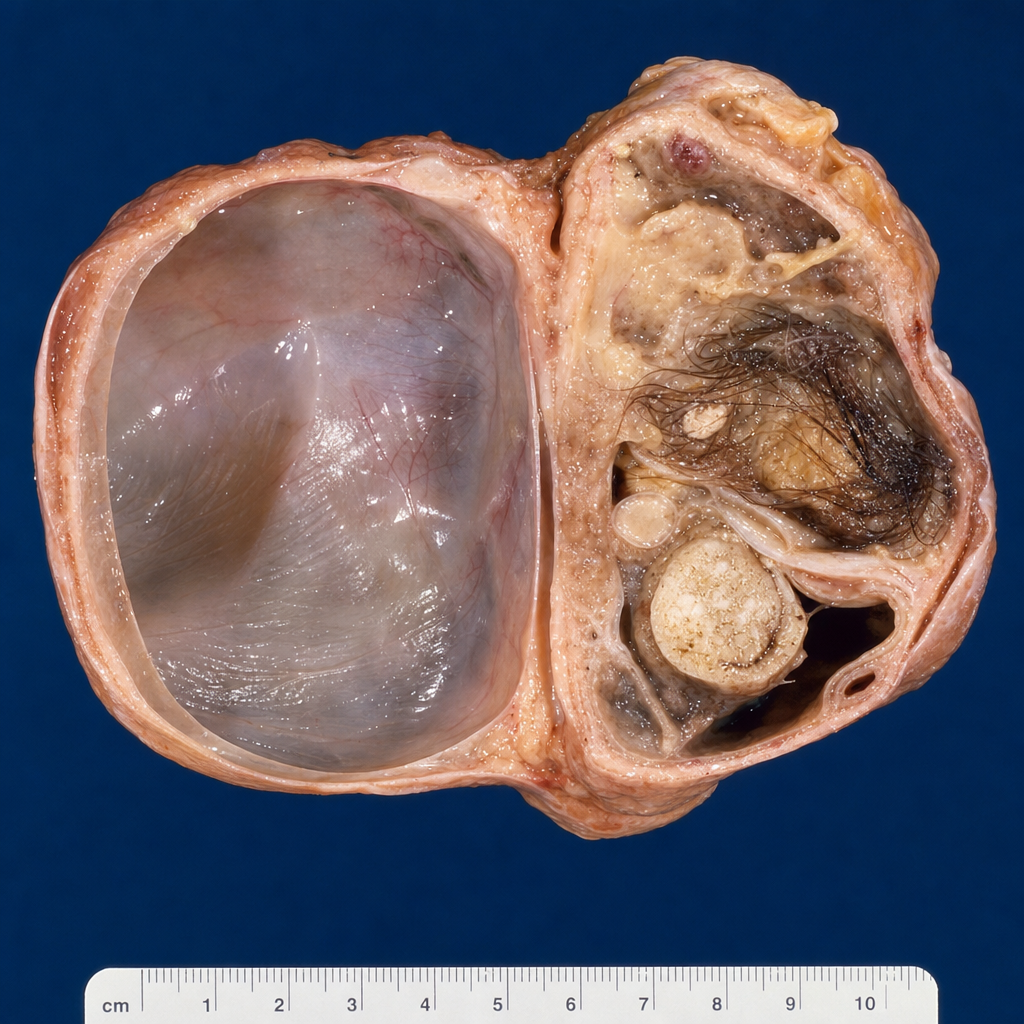
Histopathological examination of a testicular mass from a 30-year-old man shows a heterogeneous collection of differentiated cells, including neural tissue, muscle bundles, islands of cartilage, clusters of squamous epithelium, structures resembling the thyroid gland, bronchial epithelium, and bits of intestinal wall or brain substance. All of the following are true about this tumor except?
A Pap smear of a 23-year-old woman demonstrates squamous cells with enlarged, hyperchromatic nuclei and prominent perinuclear halos. The Pap smear is graded as cervical intraepithelial neoplasia, grade II (CIN II). Which of the following viruses is most likely to be etiologically related to this neoplastic growth?
A 26-year-old man has occasionally felt pain in the scrotum for the past 3 months. On physical examination, the right testis is more tender than the left but does not appear to be enlarged. An ultrasound scan shows a 1.5-cm mass within the right testis. A right orchiectomy is performed, and gross examination shows the mass to be hemorrhagic and soft. A retroperitoneal lymph node dissection is done. In sections of the lymph nodes, a neoplasm is found with extensive necrosis and hemorrhage. Microscopic examination shows that areas of viable tumors are composed of cuboidal cells intermingled with large eosinophilic syncytial cells containing multiple dark, pleomorphic nuclei. Immunohistochemical staining of syncytial cells is most likely to be positive for which of the following?
What is the hallmark of Arias-Stella reaction?
Explanation: **Explanation:** The clinical presentation of an elderly male (70 years) with **urinary retention** (suggestive of Prostatic Hyperplasia or Carcinoma) and **back pain** (suggestive of vertebral metastasis) is a classic scenario for **Metastatic Prostate Cancer** [1]. **1. Why Serum Acid Phosphatase (SAP) is correct:** Historically, **Prostatic Acid Phosphatase (PAP)**, a subset of SAP, was the primary biochemical marker for prostate cancer. While Prostate-Specific Antigen (PSA) is now the preferred screening tool, SAP remains a highly specific marker for **extracapsular extension** and **bony metastasis** in prostatic carcinoma. In the context of this question, elevated SAP levels correlate strongly with osteoblastic metastases to the spine, explaining the patient's back pain. **2. Analysis of Incorrect Options:** * **B. Serum Calcium:** While bone metastasis can affect calcium levels, it is non-specific. Prostate cancer typically causes *osteoblastic* (bone-forming) lesions, which are less likely to cause hypercalcemia compared to osteolytic lesions [1]. * **C. Serum Alkaline Phosphatase (ALP):** ALP is elevated in states of increased osteoblastic activity (like prostate cancer metastasis) [1]. However, it is also elevated in liver diseases, making it less specific than SAP for prostatic origin in this clinical context. * **D. Serum Electrophoresis:** This is the investigation of choice for **Multiple Myeloma** (characterized by an M-spike). While myeloma also causes back pain in the elderly, it typically presents with *osteolytic* "punched-out" lesions and would not explain the urinary retention. **Clinical Pearls for NEET-PG:** * **Prostate Cancer:** Most common site of metastasis is the **axial skeleton** (lumbar spine) via the **Batson venous plexus** [1]. * **Osteoblastic Metastasis:** Prostate cancer is the most common cause of radioblastic (white) bone lesions in elderly males [1]. * **PSA vs. PAP:** PSA is used for screening and monitoring; PAP/SAP is a marker of metastatic progression. **References:** [1] Cross SS. Underwood's Pathology: A Clinical Approach. 6th ed. Common Clinical Problems From Diseases Of The Urinary And Male Genital Tracts, pp. 501-502.
Explanation: **Explanation:** **Placental Alkaline Phosphatase (PLAP)** is a high-yield biochemical marker in germ cell tumors. It is a membrane-bound enzyme normally expressed by syncytiotrophoblasts in the placenta [1]. In pathology, it is the most sensitive marker for **Seminoma** [1] (and its ovarian counterpart, Dysgerminoma [2]). 1. **Why Seminoma is correct:** Seminomas are germ cell tumors that characteristically express PLAP on their cell membranes [1]. While not entirely specific, it is positive in approximately 95-100% of cases. It is also used to identify **Intratubular Germ Cell Neoplasia (ITGCN)** [3], the precursor lesion for most testicular germ cell tumors. 2. **Why other options are incorrect:** * **Theca cell tumor:** These are sex cord-stromal tumors, not germ cell tumors. They typically produce estrogens and are marked by Inhibin or Calretinin. * **Teratoma:** These are composed of mature or immature tissues from multiple germ layers. They are generally negative for PLAP unless they contain a seminomatous component. * **Choriocarcinoma:** While this tumor secretes **hCG** (Human Chorionic Gonadotropin) [4], PLAP is not its primary diagnostic marker. **High-Yield Clinical Pearls for NEET-PG:** * **Seminoma Markers:** PLAP (+), **c-KIT (CD117)** (+), OCT4 (+), and SALL4 (+) [1]. * **Dysgerminoma:** The female equivalent of seminoma; it is also characteristically **PLAP positive** [2]. * **Yolk Sac Tumor:** Marker is **Alpha-fetoprotein (AFP)**; look for Schiller-Duval bodies. * **Choriocarcinoma:** Marker is **beta-hCG**; look for syncytiotrophoblasts and cytotrophoblasts without villi [4]. * **Rule of Thumb:** Seminomas never produce AFP. If AFP is elevated in a "pure" seminoma, it is likely a mixed germ cell tumor. **References:** [1] Kumar V, Abbas AK, et al.. Robbins and Cotran Pathologic Basis of Disease. 9th ed. The Lower Urinary Tract and Male Genital System, pp. 980-982. [2] Kumar V, Abbas AK, et al.. Robbins and Cotran Pathologic Basis of Disease. 9th ed. The Female Genital Tract, pp. 1034-1035. [3] Kumar V, Abbas AK, et al.. Robbins and Cotran Pathologic Basis of Disease. 9th ed. The Lower Urinary Tract and Male Genital System, pp. 979-980. [4] Kumar V, Abbas AK, et al.. Robbins and Cotran Pathologic Basis of Disease. 9th ed. The Lower Urinary Tract and Male Genital System, p. 982.
Explanation: **Explanation:** **Paget’s Disease of the Nipple** is a rare manifestation of breast cancer where malignant cells (Paget cells) migrate from an underlying carcinoma through the lactiferous ducts into the epidermis of the nipple and areola [1]. 1. **Why Option A is correct:** Paget’s disease is virtually **always associated with an underlying breast carcinoma** [1], [2]. In approximately 50% of cases, there is a palpable mass (usually Invasive Ductal Carcinoma), while the remaining 50% show underlying Ductal Carcinoma in Situ (DCIS) without a palpable mass [1]. 2. **Why Option B is incorrect:** It typically presents as **unilateral** crusting, scaling, or eczematous changes. Bilateral involvement is rare and more suggestive of benign inflammatory eczema. 3. **Why Option C is incorrect:** Histology reveals **Paget cells**, which are large, pale, vacuolated cells with prominent nucleoli located within the squamous epithelium [1], [2]. They are **not giant cells**. These cells are PAS-positive (mucin-secreting) and express Her2/neu [1]. 4. **Why Option D is incorrect:** The prognosis of Paget’s disease itself is generally good; the overall survival depends entirely on the stage and grade of the **underlying** invasive or in-situ carcinoma [1]. **High-Yield Clinical Pearls for NEET-PG:** * **Pathogenesis:** The "Epidermotropic Theory" states that cells migrate from the ducts to the nipple surface [1]. * **Markers:** Paget cells are typically **Her2/neu positive**, Cytokeratin 7 (CK7) positive, and S100 negative (distinguishing it from Melanoma) [1]. * **Clinical Tip:** Any "eczema" of the nipple that does not respond to topical steroids must be biopsied to rule out Paget’s disease. * **Extramammary Paget’s:** Occurs on the vulva or perianal region; unlike the mammary type, it is *not* always associated with an underlying internal malignancy. **References:** [1] Kumar V, Abbas AK, et al.. Robbins and Cotran Pathologic Basis of Disease. 9th ed. The Breast, pp. 1061-1062. [2] Cross SS. Underwood's Pathology: A Clinical Approach. 6th ed. Common Clinical Problems From Liver And Biliary System Disease, pp. 456-457.
Explanation: **Explanation:** **Correct Answer: C. CA-125** The clinical presentation describes a **Serous Cystadenocarcinoma**, the most common malignant ovarian tumor. These tumors are frequently bilateral, multiloculated, and characterized by papillary projections and the production of serous fluid. **CA-125 (Cancer Antigen 125)** is a high-molecular-weight glycoprotein expressed by epithelial ovarian tumors (especially serous types). While it lacks the specificity required for initial screening, it is the "gold standard" marker for **monitoring treatment response** and **detecting recurrence** in patients with epithelial ovarian cancer [1]. **Analysis of Incorrect Options:** * **A. Alpha-fetoprotein (AFP):** This is a marker for **Yolk Sac Tumors** (Endodermal Sinus Tumors) and Hepatocellular Carcinoma. It is not associated with epithelial ovarian tumors [3]. * **B. Bombesin:** This is a marker associated with **Small Cell Carcinoma of the Lung**, neuroblastoma, and gastric cancer. It has no role in ovarian pathology. * **D. PSA (Prostate-Specific Antigen):** This is used for screening and monitoring **Prostate Adenocarcinoma** in men. **High-Yield Clinical Pearls for NEET-PG:** * **Psammoma bodies:** These are concentric calcifications frequently seen on histopathology of Serous Cystadenocarcinoma. * **Risk Factors:** BRCA1 and BRCA2 mutations significantly increase the risk of serous ovarian carcinoma. * **Other Ovarian Markers:** * **Inhibin:** Marker for Granulosa Cell Tumors [2]. * **LDH:** Marker for Dysgerminoma. * **hCG:** Marker for Choriocarcinoma [3]. * **CA 19-9:** Often elevated in Mucinous Ovarian Tumors. **References:** [1] Kumar V, Abbas AK, et al.. Robbins and Cotran Pathologic Basis of Disease. 9th ed. The Female Genital Tract, pp. 1032-1033. [2] Kumar V, Abbas AK, et al.. Robbins and Cotran Pathologic Basis of Disease. 9th ed. The Female Genital Tract, pp. 1036-1037. [3] Kumar V, Abbas AK, et al.. Robbins and Cotran Pathologic Basis of Disease. 9th ed. The Female Genital Tract, pp. 1035-1036.
Explanation: **Explanation:** **Intratubular Germ Cell Neoplasia (ITGCN)**, now officially termed **Germ Cell Neoplasia In Situ (GCNIS)**, is the precursor lesion for the majority of testicular germ cell tumors (TGCTs) in adults [1]. **1. Why Seminoma is correct:** GCNIS arises from primordial germ cells that fail to differentiate and instead remain in a dormant, fetal-like state within the seminiferous tubules [1]. It is found in the adjacent parenchyma of approximately **95-100% of Seminomas** and non-seminomatous germ cell tumors (NSGCTs) in adults [1]. These tumors share the same genetic hallmark as GCNIS: **isochromosome 12p [i(12p)]**. **2. Why the other options are incorrect:** * **Pediatric Yolk Sac Tumor & Pediatric Teratoma:** These are "Type I" germ cell tumors. Unlike adult tumors, they are **not** derived from GCNIS and do not show i(12p) abnormalities [1]. They are typically benign (teratomas) or have a distinct pathogenesis in children. * **Spermatocytic Seminoma:** Now called **Spermatocytic Tumor**, this is a clinically distinct entity occurring in older men (age >50). It does **not** arise from GCNIS, is not associated with cryptorchidism, and lacks i(12p) [1]. It has an excellent prognosis and rarely metastasizes. **Clinical Pearls for NEET-PG:** * **Markers for GCNIS:** Positive for **OCT3/4, PLAP, and c-KIT (CD117)** [2]. * **Risk Factors:** Cryptorchidism (undescended testis) and Dysgenetic gonads (e.g., Swyer Syndrome) [1]. * **Exceptions:** The only germ cell tumors **NOT** associated with GCNIS are Pediatric Yolk Sac Tumors, Pediatric Teratomas, and Spermatocytic Tumors [1]. **References:** [1] Kumar V, Abbas AK, et al.. Robbins and Cotran Pathologic Basis of Disease. 9th ed. The Lower Urinary Tract and Male Genital System, pp. 979-980. [2] Kumar V, Abbas AK, et al.. Robbins and Cotran Pathologic Basis of Disease. 9th ed. The Lower Urinary Tract and Male Genital System, pp. 980-982.
Explanation: ### Explanation **Correct Answer: B. Endodermal sinus (yolk sac) tumor** The diagnosis is based on the patient's age and the specific tumor marker. The **Endodermal sinus tumor (Yolk Sac Tumor)** is the most common testicular tumor in infants and children (up to 3 years of age) [1]. It is characterized by the production of **Alpha-Fetoprotein (AFP)**, which serves as a highly specific serum marker for diagnosis and monitoring treatment response. Histologically, these tumors often show **Schiller-Duval bodies**, which are pathognomonic structures resembling primitive glomeruli. **Analysis of Incorrect Options:** * **A. Choriocarcinoma:** This is a highly aggressive germ cell tumor characterized by the secretion of **beta-hCG**, not AFP [2]. It typically presents in young adults (20–30 years) and is rare in toddlers [2]. * **C. Hepatocellular carcinoma (HCC):** While HCC also produces elevated AFP, it is a primary liver malignancy. In a 3-year-old presenting specifically with a **scrotal mass**, a primary testicular germ cell tumor is the definitive diagnosis. * **D. Teratoma:** In children, mature teratomas are usually benign, but they do not typically cause a significant elevation in serum AFP unless they contain yolk sac elements (mixed germ cell tumor) [1]. **High-Yield NEET-PG Pearls:** * **Most common testicular tumor in children:** Yolk Sac Tumor (AFP positive). * **Most common testicular tumor in adults:** Seminoma (hCG may be mildly elevated, but AFP is **never** elevated). * **Schiller-Duval bodies:** Classic histological finding in Yolk Sac Tumors (central capillary surrounded by visceral and parietal layers of cells). * **Reinke Crystals:** Pathognomonic for Leydig cell tumors [3]. * **Call-Exner Bodies:** Pathognomonic for Granulosa cell tumors. **References:** [1] Kumar V, Abbas AK, et al.. Robbins and Cotran Pathologic Basis of Disease. 9th ed. The Lower Urinary Tract and Male Genital System, pp. 979-980. [2] Kumar V, Abbas AK, et al.. Robbins and Cotran Pathologic Basis of Disease. 9th ed. The Lower Urinary Tract and Male Genital System, p. 982. [3] Cross SS. Underwood's Pathology: A Clinical Approach. 6th ed. Common Clinical Problems From Diseases Of The Urinary And Male Genital Tracts, pp. 513-514.
Explanation: ### **Explanation** The clinical description of a heterogeneous collection of tissues derived from all three germ layers (ectoderm, mesoderm, and endoderm) is diagnostic of a **Teratoma** [1]. **1. Why Option D is the Correct Answer (The "Except" statement):** In **post-pubertal males**, all testicular teratomas are considered **malignant**, regardless of how "mature" or differentiated the tissues appear histologically [1]. They have the potential to metastasize, usually to retroperitoneal lymph nodes. This contrasts with teratomas in females (ovarian dermoid cysts) or pre-pubertal boys, which are typically benign [1]. **2. Analysis of Other Options:** * **Option A (Tumor markers):** While pure teratomas do not secrete markers, they are frequently part of **mixed germ cell tumors** (MGCT) [2]. Elevated AFP suggests a Yolk Sac component, and elevated beta-hCG suggests a Choriocarcinoma component. In clinical practice, these markers are crucial for monitoring. * **Option B (Immature components):** In the testis (unlike the ovary), the presence of immature (embryonic) tissue is **not** required to classify the tumor as malignant [1]. Even a "mature" teratoma in an adult male is biologically aggressive. * **Option C (Totipotent cells):** Teratomas originate from **totipotent germ cells** capable of differentiating into any cell type found in the human body (neural tissue, cartilage, intestinal epithelium, etc.) [2]. ### **High-Yield Clinical Pearls for NEET-PG** * **Pre-pubertal vs. Post-pubertal:** Teratomas in infants/children are benign; in adults, they are malignant [1]. * **"Teratoma with Somatic-type Malignancy":** This refers to a rare phenomenon where a component of the teratoma (e.g., squamous cells or muscle) undergoes a malignant transformation into a non-germ cell cancer like Squamous Cell Carcinoma or Rhabdomyosarcoma [1]. * **Scrotal Ultrasound:** Usually the first-line investigation for a testicular mass. * **Management Rule:** Never perform a transscrotal biopsy for a suspected testicular tumor (risk of lymphatic seeding); the standard is **Radical Inguinal Orchidectomy**. **References:** [1] Kumar V, Abbas AK, et al.. Robbins and Cotran Pathologic Basis of Disease. 9th ed. The Lower Urinary Tract and Male Genital System, pp. 982-983. [2] Kumar V, Abbas AK, et al.. Robbins and Cotran Pathologic Basis of Disease. 9th ed. The Lower Urinary Tract and Male Genital System, pp. 979-980.
Explanation: ### Explanation **Correct Answer: D. Human papillomavirus (HPV)** The clinical presentation describes **koilocytosis** [5], the pathognomonic cytological feature of HPV infection. Koilocytes are squamous cells characterized by enlarged, hyperchromatic "raisinoid" nuclei surrounded by a distinct, clear **perinuclear halo** [1]. HPV is the primary etiological agent for cervical intraepithelial neoplasia (CIN) and cervical carcinoma [3]. High-risk strains (primarily **HPV 16 and 18**) integrate their DNA into the host genome, leading to the overexpression of oncoproteins **E6** (which degrades p53) and **E7** (which inhibits Rb), resulting in uncontrolled cell cycle progression [2]. **Incorrect Options:** * **A. Epstein-Barr virus (EBV):** Associated with Burkitt lymphoma, Nasopharyngeal carcinoma, and Infectious Mononucleosis, but not cervical neoplasia. * **B. Hepatitis B virus (HBV):** A DNA virus primarily associated with chronic hepatitis and Hepatocellular carcinoma (HCC). * **C. Human herpesvirus 8 (HHV 8):** Also known as Kaposi Sarcoma-associated Herpesvirus (KSHV); it causes Kaposi sarcoma, Primary effusion lymphoma, and Multicentric Castleman disease. **High-Yield NEET-PG Pearls:** * **Koilocytes:** Defined by nuclear enlargement (3x normal), irregular nuclear membrane, and perinuclear cytoplasmic clearing [5]. * **CIN Grading:** CIN I (Low-grade SIL), CIN II/III (High-grade SIL). CIN II involves dysplasia in the lower 2/3rds of the epithelium [3][4]. * **Vaccination:** The quadrivalent vaccine (Gardasil) targets HPV 6, 11 (warts) and 16, 18 (cancer). * **Screening:** The transformation zone (squamocolumnar junction) is the most common site for cervical cancer and the area sampled during a Pap smear [4]. **References:** [1] Kumar V, Abbas AK, et al.. Robbins and Cotran Pathologic Basis of Disease. 9th ed. The Female Genital Tract, p. 1010. [2] Kumar V, Abbas AK, et al.. Robbins and Cotran Pathologic Basis of Disease. 9th ed. The Female Genital Tract, pp. 1007-1008. [3] Kumar V, Abbas AK, et al.. Robbins and Cotran Pathologic Basis of Disease. 9th ed. The Female Genital Tract, pp. 1008-1010. [4] Cross SS. Underwood's Pathology: A Clinical Approach. 6th ed. Common Clinical Problems From Female Genital Tract Disease, pp. 467-468. [5] Cross SS. Underwood's Pathology: A Clinical Approach. 6th ed. Common Clinical Problems From Female Genital Tract Disease, pp. 466-467.
Explanation: The clinical presentation and histopathology point toward a diagnosis of **Choriocarcinoma**, a highly aggressive non-seminomatous germ cell tumor (NSGCT) [1]. ### **Why the Correct Answer is Right** The key diagnostic features in this case are: * **Gross Appearance:** Choriocarcinomas are typically small, highly **hemorrhagic, and necrotic** masses [1]. * **Microscopy:** The classic "biphasic" pattern is described—**cytotrophoblasts** (cuboidal cells) intermingled with **syncytiotrophoblasts** (large, multinucleated eosinophilic cells with pleomorphic nuclei) [1]. * **Immunohistochemistry:** Syncytiotrophoblasts are the functional units that produce **Human Chorionic Gonadotropin (hCG)**. Therefore, IHC staining will be strongly positive for hCG in these cells [1]. ### **Why Other Options are Wrong** * **A. Alpha-fetoprotein (AFP):** This is the marker for **Yolk Sac Tumors** (Schiller-Duval bodies). Pure choriocarcinomas do not produce AFP. * **B. Carcinoembryonic antigen (CEA):** This is a marker for colorectal, pancreatic, and certain lung carcinomas, but it is not a specific marker for testicular germ cell tumors. * **C. CD20:** This is a B-cell marker used to diagnose **Lymphomas**. While primary testicular lymphoma occurs in older men (>60 years), it does not present with the trophoblastic morphology described. ### **NEET-PG High-Yield Pearls** * **Hematogenous Spread:** Unlike most testicular tumors that spread via lymphatics first, Choriocarcinoma is notorious for early **hematogenous spread** (especially to the lungs and brain) [3]. * **Small Primary, Big Metastasis:** It often presents as a tiny, non-palpable testicular nodule despite widespread metastatic disease [1]. * **Gynecomastia:** High levels of hCG can cross-react with LH/FSH receptors, sometimes leading to paraneoplastic gynecomastia or hyperthyroidism (due to similarity with TSH). * **Seminoma Marker:** Remember that **Placental Alkaline Phosphatase (PLAP)** is the classic marker for Seminomas [2]. **References:** [1] Kumar V, Abbas AK, et al.. Robbins and Cotran Pathologic Basis of Disease. 9th ed. The Lower Urinary Tract and Male Genital System, p. 982. [2] Kumar V, Abbas AK, et al.. Robbins and Cotran Pathologic Basis of Disease. 9th ed. The Lower Urinary Tract and Male Genital System, pp. 980-982. [3] Kumar V, Abbas AK, et al.. Robbins and Cotran Pathologic Basis of Disease. 9th ed. The Lower Urinary Tract and Male Genital System, pp. 983-984.
Explanation: **Explanation:** The **Arias-Stella reaction** is a benign, hormone-induced change in the endometrial glands, typically associated with the presence of chorionic tissue (pregnancy). It is a physiological response to high levels of progesterone [1] and is most commonly seen in intrauterine pregnancy, ectopic pregnancy, or gestational trophoblastic disease. **Why the correct answer is right:** The hallmark of the Arias-Stella reaction is **Nuclear enlargement** (hyperchromasia and pleomorphism). Under the influence of pregnancy hormones, the endometrial glandular cells undergo significant changes: the nuclei become enlarged, irregular, and darkly stained (hyperchromatic), often with a "smudged" appearance. This is frequently accompanied by a "hobnail" appearance, where the nuclei bulge into the glandular lumen. **Why the incorrect options are wrong:** * **Pinopods:** These are small, finger-like protrusions on the apical surface of endometrial epithelial cells that appear during the "implantation window" (Secretory phase). They are not a feature of Arias-Stella. * **Vacuoles in cytoplasm:** While the cytoplasm in Arias-Stella can be vacuolated or clear, it is the **nuclear changes** that are the diagnostic hallmark. Cytoplasmic vacuolation is more characteristic of the normal secretory phase [1]. * **Nuclear pyknosis:** Pyknosis refers to nuclear shrinkage and condensation (often seen in necrosis/apoptosis). In contrast, Arias-Stella is characterized by nuclear **enlargement**. **High-Yield Clinical Pearls for NEET-PG:** * **Clinical Significance:** Its primary importance lies in **not misdiagnosing it as Clear Cell Carcinoma** or adenocarcinoma. Despite the nuclear atypia, there is a lack of mitotic figures. * **Association:** It is a classic finding in **Ectopic Pregnancy**; if a curettage shows Arias-Stella reaction but no chorionic villi, an ectopic pregnancy must be ruled out. * **Key Histology Triad:** Hyperchromatic enlarged nuclei, Hobnail cells, and Scant/Absent mitoses. **References:** [1] Kumar V, Abbas AK, et al.. Robbins and Cotran Pathologic Basis of Disease. 9th ed. The Female Genital Tract, pp. 1011-1013.
Diseases of Male Genital Tract
Practice Questions
Testicular Tumors
Practice Questions
Prostate Pathology
Practice Questions
Diseases of Female Genital Tract
Practice Questions
Cervical Pathology and Neoplasia
Practice Questions
Endometrial Pathology
Practice Questions
Ovarian Diseases and Tumors
Practice Questions
Gestational Trophoblastic Disease
Practice Questions
Placental Pathology
Practice Questions
Sexually Transmitted Infections
Practice Questions
Get full access to all questions, explanations, and performance tracking.
Start For Free