A characteristic feature of nephritic syndrome in children is:
Which of the following is the LEAST common characteristic of nephrotic syndrome?
A kidney biopsy under electron microscopy shows subepithelial 'spike' formation. Which immunofluorescence pattern would confirm membranous nephropathy?
Child with proteinuria, generalized edema, hypoproteinemia, and hyperlipidemia - most common cause is?
Which of the following is NOT a feature of nephrotic syndrome?
In glomerulus subendothelial deposits are seen in?
Which of these conditions is classified as a nephritic syndrome?
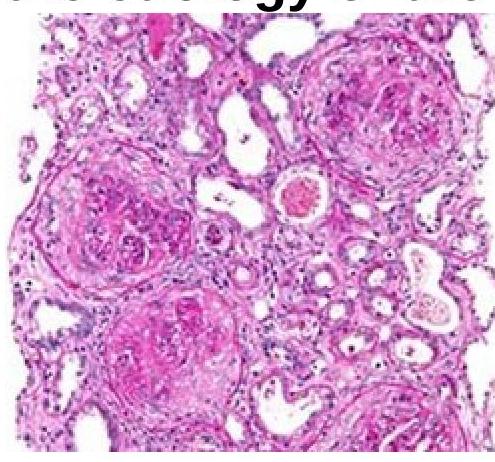
A 51-year-old person came with a complaint of hematuria. On examination, he was normotensive and had pedal edema. Investigations revealed the patient had no glucosuria and had a creatinine value of 9mg%. Renal biopsy is as shown below. Which of the following investigations should be done to identify the etiology of the disease?
A young adult presents with hematuria following a sore throat. Diagnosis?
Loss of foot processes seen on electron microscopy of renal biopsy is a classical feature in which of the following?
Explanation: ***RBC casts in urine*** - The presence of **red blood cell (RBC) casts** in urine is a **pathognomonic sign** of **glomerulonephritis**, which is the underlying pathology in nephritic syndrome. - This indicates **glomerular inflammation** and bleeding, where RBCs leak through damaged glomeruli and are molded into casts within the renal tubules. *WBC casts in urine* - **White blood cell (WBC) casts** are characteristic of **pyelonephritis** (kidney infection) or other severe interstitial nephritis, indicating inflammation within the renal tubules. - While infection can sometimes accompany nephritic syndrome, WBC casts are not a primary diagnostic feature of the syndrome itself. *Lipid casts in urine* - **Lipid casts** and **fatty oval bodies** are typically associated with **nephrotic syndrome**, resulting from significant proteinuria and hyperlipidemia. - They signify severe disruption of glomerular filtration leading to lipid excretion, which is not the defining feature of nephritic syndrome. *Albumin in urine* - While **proteinuria (albumin in urine)** is present in nephritic syndrome, it is a non-specific finding and is also a hallmark of **nephrotic syndrome**, where it is much more severe. - The *quality* of the proteinuria (e.g., whether it contains RBCs) is more indicative for differentiating nephritic from nephrotic syndrome.
Explanation: ***Lipiduria*** - While lipiduria can occur in nephrotic syndrome, particularly with **severe proteinuria**, it is not a universally present clinical diagnostic criterion. - Its presence is a consequence of lipoprotein filtration rather than a direct defining feature of the syndrome itself. *Hypoalbuminemia* - This is a cardinal feature, defined as **serum albumin < 3.0 g/dL**, resulting from significant urinary protein loss. - It drives the generalized edema characteristic of nephrotic syndrome by reducing plasma oncotic pressure [1]. *Hyperlipidemia* - This is a very common characteristic due to increased hepatic synthesis of lipoproteins and decreased catabolism, often presenting as elevated **cholesterol and triglycerides**. - It is a risk factor for cardiovascular complications in nephrotic patients [1]. *Proteinuria > 3.5 gm per 1.73 m2 per 24 hours* - This is the **defining feature** of nephrotic syndrome, indicating significant damage to the glomerular filtration barrier [1]. - Massive proteinuria leads to the other key clinical manifestations of the syndrome.
Explanation: ***Granular IgG along GBM*** - **Membranous nephropathy** is characterized by the immune complexes forming **subepithelial deposits** along the glomerular basement membrane (GBM) [1], [2]. - These deposits appear as **granular IgG** (and often C3) on immunofluorescence, corresponding to the "spike" formation seen on electron microscopy [1]. *Linear IgG along GBM* - This pattern is characteristic of **Goodpasture syndrome** (anti-GBM disease), where antibodies directly bind to the GBM in a uniform, linear fashion [3], [4]. - The electron microscopy findings in Goodpasture syndrome do not show subepithelial "spike" formation but rather a normal or thickened GBM. *Mesangial IgA deposits* - This is the hallmark of **IgA nephropathy** (Berger's disease), where IgA immune complexes accumulate predominantly in the mesangium [2]. - IgA nephropathy would not typically present with subepithelial "spike" formation on electron microscopy. *C3 deposits only* - While C3 can be present in membranous nephropathy, finding "C3 deposits only" without significant IgG or other immunoglobulins suggests conditions like **C3 glomerulopathy** or dense deposit disease. - These conditions have distinct electron microscopy findings and a different pathogenesis compared to membranous nephropathy. **References:** [1] Kumar V, Abbas AK, et al.. Robbins and Cotran Pathologic Basis of Disease. 9th ed. The Kidney, p. 921. [2] Kumar V, Abbas AK, et al.. Robbins and Cotran Pathologic Basis of Disease. 9th ed. The Kidney, p. 911. [3] Kumar V, Abbas AK, et al.. Robbins and Cotran Pathologic Basis of Disease. 9th ed. The Kidney, p. 909. [4] Cross SS. Underwood's Pathology: A Clinical Approach. 6th ed. Common Clinical Problems From Diseases Of The Urinary And Male Genital Tracts, pp. 526-527.
Explanation: **Minimal change nephrotic syndrome** - This is the most common cause of **nephrotic syndrome** in children, characterized by the classic tetrad of **proteinuria**, **hypoalbuminemia**, **edema**, and **hyperlipidemia**. - The disease involves **effacement of podocyte foot processes**, visible on electron microscopy, but the glomeruli appear normal on light microscopy. *Mesangial glomerulonephritis* - This condition involves immune complex deposition in the **mesangium**, often presenting with **hematuria** and proteinuria, but not typically the full nephrotic picture in children. - It's a form of **glomerulonephritis**, distinct from the podocytopathy seen in minimal change disease. *FSGN* - **Focal segmental glomerulosclerosis (FSGS)** is a common cause of nephrotic syndrome, but it's less common than minimal change disease as the initial presentation in young children. - It is characterized by **segmental scarring of glomeruli**, which can be seen on light microscopy. *IgA nephropathy* - This is a common cause of **glomerular hematuria**, often presenting after an upper respiratory infection. - While proteinuria can occur, it's typically not severe enough to cause the full-blown **nephrotic syndrome** with generalized edema, hypoproteinemia, and hyperlipidemia in children.
Explanation: ### Original Explanation ***Hematuria*** - **Hematuria** is a characteristic feature of **nephritic syndrome**, which involves glomerular inflammation and damage leading to blood in the urine [1]. - In contrast, **nephrotic syndrome** is primarily characterized by increased glomerular permeability to protein, not red blood cells, resulting in significant **proteinuria** [1]. *Edema* - **Edema** is a hallmark of nephrotic syndrome, resulting from severe **hypoalbuminemia** that reduces plasma oncotic pressure [2]. - This leads to fluid extravasation into the interstitial spaces, causing generalized swelling. *Hypoalbuminemia* - **Hypoalbuminemia** is a defining feature of nephrotic syndrome, caused by excessive urinary loss of albumin due to widespread glomerular damage [2]. - Reduced serum albumin levels contribute to the characteristic edema and increased lipid synthesis by the liver. *Proteinuria* - **Proteinuria**, specifically *massive proteinuria* (>3.5 g/day in adults), is the cardinal feature of nephrotic syndrome [1], [2]. - It signifies significant damage to the glomerular filtration barrier, allowing large amounts of protein to leak into the urine.
Explanation: ***MPGN type I*** - **Subendothelial deposits** are a hallmark of MPGN type I, often associated with **immune complex deposition** [1]. - This condition can present with **hematuria**, **proteinuria**, and can be triggered by infections or autoimmune diseases [1]. *Good pasture syndrome* - Primarily involves **anti-GBM antibodies** leading to **glomerulonephritis** and pulmonary hemorrhage, not subendothelial deposits. - Typically, it presents with **crescent formation** in the glomeruli rather than deposits. *MPGN type II* - Characterized by **dense deposit disease**, it features **intramembranous** rather than subendothelial deposits [1]. - It is often associated with **C3 nephritic factor** and does not show classic subendothelial pathology. *IgA nephropathy* - Characterized by **IgA deposits** primarily in the **mesangium**, not subendothelially. - It presents with **hematuria** and recurrent episodes of **macrohematuria**, especially after infections. **References:** [1] Kumar V, Abbas AK, et al.. Robbins and Cotran Pathologic Basis of Disease. 9th ed. The Kidney, pp. 925-927.
Explanation: ***Post infectious Glomerulonephritis*** - Characterized by **hematuria, hypertension, and edema**, typically following an infection, such as streptococcal pharyngitis [2]. - Immune-mediated response leads to **decreased GFR** and signs of nephritic syndrome [1][2]. *Focal segmental glomerulosclerosis* - Primarily causes **nephrotic syndrome**, characterized by proteinuria and edema rather than hematuria [2]. - Often associated with **secondary causes** like obesity or HIV, not typically post-infectious. *Membranous Glomerulopathy* - Results in significant **proteinuria** and is classified as a **nephrotic syndrome** rather than a nephritic one [2][3]. - It presents with **edema and hypoalbuminemia**, lacking the hallmark features of hematuria. *Minimal change disease* - Predominantly causes **nephrotic syndrome** with heavy proteinuria and little to no hematuria [2]. - Young children are commonly affected, and it responds well to **corticosteroid therapy** [1].
Explanation: ***ANTI GBM antibodies*** - The presence of hematuria and renal failure suggests a possible **glomerulonephritis**, where **anti-GBM (Glomerular Basement Membrane) antibodies** would help confirm conditions like Goodpasture syndrome [2]. - This test specifically identifies **anti-GBM disease** [1,2], which is crucial in guiding management for this patient with suspected renal pathology [3]. *ANA* - **Antinuclear antibody (ANA)** testing is typically used for autoimmune diseases like **Systemic Lupus Erythematosus** but is less specific for glomerular diseases. - In this context, ANA would not specifically help in identifying the **etiology of renal failure** associated with hematuria. *Urine immunoelectrophoresis* - This test is primarily useful for detecting **light chains** in conditions like **multiple myeloma** and may not be relevant to general hematuria or renal failure. - It is not a direct test for **glomerular disease etiology** related to hematuria and edema. *HIV RNA* - While **HIV** can lead to renal complications, including **HIV-associated nephropathy**, this test is not the first line for etiological determination in this specific presentation. - Negative **HIV serology** doesn't rule out renal disease caused by other factors, making this test less relevant here. **References:** [1] Cross SS. Underwood's Pathology: A Clinical Approach. 6th ed. Common Clinical Problems From Diseases Of The Urinary And Male Genital Tracts, pp. 526-527. [2] Cross SS. Underwood's Pathology: A Clinical Approach. 6th ed. Common Clinical Problems From Diseases Of The Urinary And Male Genital Tracts, pp. 537-538. [3] Kumar V, Abbas AK, et al.. Robbins and Cotran Pathologic Basis of Disease. 9th ed. The Kidney, pp. 918-919.
Explanation: ***IgA nephropathy*** - Presents with **hematuria** (often macroscopic) within **1-2 days** of an upper respiratory tract infection or **sore throat**, indicating its rapid onset after mucosal infection. - This condition is caused by the deposition of **IgA immune complexes** in the glomeruli. *Henoch-Schönlein purpura* - Characterized by a **palpable purpuric rash**, abdominal pain, and arthritis, in addition to hematuria. - While it also involves IgA deposition and can follow an infection, the constellation of symptoms is broader and distinct from isolated hematuria after a sore throat. *Goodpasture syndrome* - Involves **anti-glomerular basement membrane (anti-GBM) antibodies** that attack the kidneys and often the lungs, leading to hemoptysis and rapidly progressive glomerulonephritis. - It does not typically follow a sore throat with such a short latency to hematuria. *Post-streptococcal glomerulonephritis* - Typically presents with hematuria **1-3 weeks** (latent period) following a **streptococcal throat or skin infection**. - The latency period is longer than described in the scenario, and it is usually associated with a low C3 complement level.
Explanation: ***Minimal change disease*** - **Loss of foot processes** (podocyte effacement) is the hallmark ultrastructural finding in **minimal change disease** on electron microscopy [1]. - This effacement of podocyte foot processes leads to increased permeability of the **glomerular filtration barrier** to albumin, causing **nephrotic syndrome** [1], [2]. *IgA nephropathy* - Characterized by **IgA immune complex deposition** in the **mesangium** on immunofluorescence. - Electron microscopy typically shows **mesangial immune deposits**, not primarily foot process effacement. *Membranous nephropathy* - Identified by the presence of **subepithelial immune deposits** and **thickening of the glomerular basement membrane** (GBM) [3]. - On electron microscopy, these deposits are visible, often with overlying **spikes** of GBM material separating them. *Rapidly progressive glomerulonephritis* - Defined by the rapid loss of renal function and the presence of **crescents** in more than 50% of glomeruli on light microscopy [2]. - While there may be secondary podocyte changes due to severe inflammation, **foot process effacement** is not its primary diagnostic feature. **References:** [1] Kumar V, Abbas AK, et al.. Robbins and Cotran Pathologic Basis of Disease. 9th ed. The Kidney, pp. 927-928. [2] Cross SS. Underwood's Pathology: A Clinical Approach. 6th ed. Common Clinical Problems From Diseases Of The Urinary And Male Genital Tracts, pp. 527-528. [3] Cross SS. Underwood's Pathology: A Clinical Approach. 6th ed. Common Clinical Problems From Diseases Of The Urinary And Male Genital Tracts, pp. 532-533.
Get full access to all questions, explanations, and performance tracking.
Start For Free