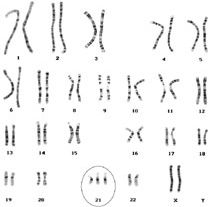
Which banding technique is most commonly used for karyotyping?
Which of the following is a channelopathy?
What is the genotype of Klinefelter syndrome?
The expression of which gene is most strongly associated with a high incidence of medullary carcinomas of the thyroid?
Explanation: ***G banding*** - This method is the **most widely used** technique for karyotyping, allowing clear visualization of chromosome bands under light microscopy [1][2]. - G banding helps in identifying **chromosomal abnormalities** and is routinely utilized in clinical genetics [2]. *C banding* - Primarily highlights the **centromeric regions** of chromosomes, but is less common than G banding for overall karyotyping. - Does not provide a full **karyotype view**, making it less suitable for routine analysis. *R banding* - Useful for providing **reverse staining**, which shows the bands in a different manner but is not as commonly employed in clinical settings. - Typically used to analyze specific **chromosomal translocations**, rather than routine karyotyping. *Q banding* - This technique involves **fluorescent microscopy** to visualize chromosomes but is not as prevalent for basic karyotyping. - Mainly used for detecting **specific chromosomal anomalies**, not the standard karyotype assessment. **References:** [1] Cross SS. Underwood's Pathology: A Clinical Approach. 6th ed. (Basic Pathology) introduces the student to key general principles of pathology, both as a medical science and as a clinical activity with a vital role in patient care. Part 2 (Disease Mechanisms) provides fundamental knowledge about the cellular and molecular processes involved in diseases, providing the rationale for their treatment. Part 3 (Systematic Pathology) deals in detail with specific diseases, with emphasis on the clinically important aspects., pp. 54-55. [2] Kumar V, Abbas AK, et al.. Robbins and Cotran Pathologic Basis of Disease. 9th ed. Genetic Disorders, pp. 167-168.
Explanation: ***Anderson Tawil Syndrome*** - This syndrome is a **channelopathy** specifically linked to mutations in the **KCNJ2 gene**, which encodes a subunit of a potassium channel. [1] - It presents with a triad of symptoms: **paroxysmal periodic paralysis**, **cardiac arrhythmias (long QT syndrome)**, and **dysmorphic facial features**. *Ataxia Telangiectasia* - This is an **autosomal recessive disorder** characterized by **progressive cerebellar ataxia**, oculocutaneous telangiectasias, and immunodeficiency. - It is caused by mutations in the **ATM gene**, which is involved in DNA repair, not ion channel function. *Spinocerebellar Ataxia* - This is a broad group of **hereditary ataxias** primarily affecting the cerebellum and spinal cord. - Most forms involve **trinucleotide repeat expansions** or other gene mutations that lead to neuronal degeneration, not directly affecting ion channels. *Friedreich Ataxia* - This is an **autosomal recessive neurodegenerative disorder** caused by a **GAA triplet repeat expansion** in the **FXN gene**, which encodes the protein frataxin. - The disease involves **progressive ataxia**, dysarthria, and loss of proprioception, but it is not classified as a channelopathy. **References:** [1] Cross SS. Underwood's Pathology: A Clinical Approach. 6th ed. (Basic Pathology) introduces the student to key general principles of pathology, both as a medical science and as a clinical activity with a vital role in patient care. Part 2 (Disease Mechanisms) provides fundamental knowledge about the cellular and molecular processes involved in diseases, providing the rationale for their treatment. Part 3 (Systematic Pathology) deals in detail with specific diseases, with emphasis on the clinically important aspects., pp. 120-122.
Explanation: ***47,XXY*** - This genotype represents the presence of an **extra X chromosome** in males, which is the defining characteristic of Klinefelter syndrome. - Individuals with this syndrome typically have **47 chromosomes** instead of the usual 46. *45,X* - This genotype describes **Turner syndrome**, which is characterized by the absence of one X chromosome in females [1]. - Individuals with Turner syndrome are typically female and present with a distinct set of physical features and health issues. *47,XXX* - This genotype is known as **Triple X syndrome** or **Trisomy X**, which affects females who have an extra X chromosome. - While it involves an extra sex chromosome, it is distinct from Klinefelter syndrome both in terms of affected sex and clinical presentation. *Trisomy 13* - This refers to **Patau syndrome**, a severe chromosomal disorder caused by an extra copy of chromosome 13. - It is an **autosomal trisomy** and is not related to sex chromosome abnormalities like Klinefelter syndrome. **References:** [1] Kumar V, Abbas AK, et al.. Robbins and Cotran Pathologic Basis of Disease. 9th ed. Genetic Disorders, pp. 191-192.
Explanation: ***Ret proto-oncogene (Correct Answer)*** - **Mutations** in the **RET proto-oncogene** are central to the development of **medullary thyroid carcinoma (MTC)**, especially in hereditary forms like **Multiple Endocrine Neoplasia type 2 (MEN 2)** [1], [2]. - Activating mutations in *RET* lead to constitutive activation of its tyrosine kinase domain, promoting uncontrolled cell growth and survival in **parafollicular C cells** [1], [3]. - Found in ~98% of hereditary MTC and ~40-50% of sporadic cases. *p53 (Incorrect)* - The **p53 tumor suppressor gene** is frequently mutated in a wide variety of human cancers, but it is not the primary driver in **medullary thyroid carcinoma**. - Its role is often seen in later-stage or more aggressive cancers, typically losing normal cell cycle control. *Her2/neu (Incorrect)* - The **HER2/neu (ERBB2) gene** encodes a receptor tyrosine kinase primarily associated with **breast cancer** and some **gastric cancers**, where its overexpression is a therapeutic target [1]. - Its overexpression is not a characteristic feature or driver mutation for **medullary thyroid carcinoma**. *Rb gene (Incorrect)* - The **retinoblastoma (Rb) gene** is a **tumor suppressor gene** crucial for regulating the cell cycle, and mutations are associated with retinoblastoma and other cancers like **osteosarcoma** and **small cell lung cancer**. - While it's a significant tumor suppressor, mutations in the *Rb gene* are not directly linked to the pathogenesis of **medullary thyroid carcinoma**. **References:** [1] Kumar V, Abbas AK, et al.. Robbins and Cotran Pathologic Basis of Disease. 9th ed. Neoplasia, p. 292. [2] Kumar V, Abbas AK, et al.. Robbins and Cotran Pathologic Basis of Disease. 9th ed. The Endocrine System, pp. 1139-1140. [3] Cross SS. Underwood's Pathology: A Clinical Approach. 6th ed. Common Clinical Problems From Liver And Biliary System Disease, pp. 428-429.
Principles of Molecular Pathology
Practice Questions
DNA and RNA Analysis Techniques
Practice Questions
Cytogenetics
Practice Questions
Polymerase Chain Reaction Applications
Practice Questions
Next-Generation Sequencing
Practice Questions
Molecular Diagnosis of Infectious Diseases
Practice Questions
Molecular Oncology
Practice Questions
Pharmacogenomics
Practice Questions
Genetic Counseling and Risk Assessment
Practice Questions
Molecular Diagnostics Quality Control
Practice Questions
Get full access to all questions, explanations, and performance tracking.
Start For Free