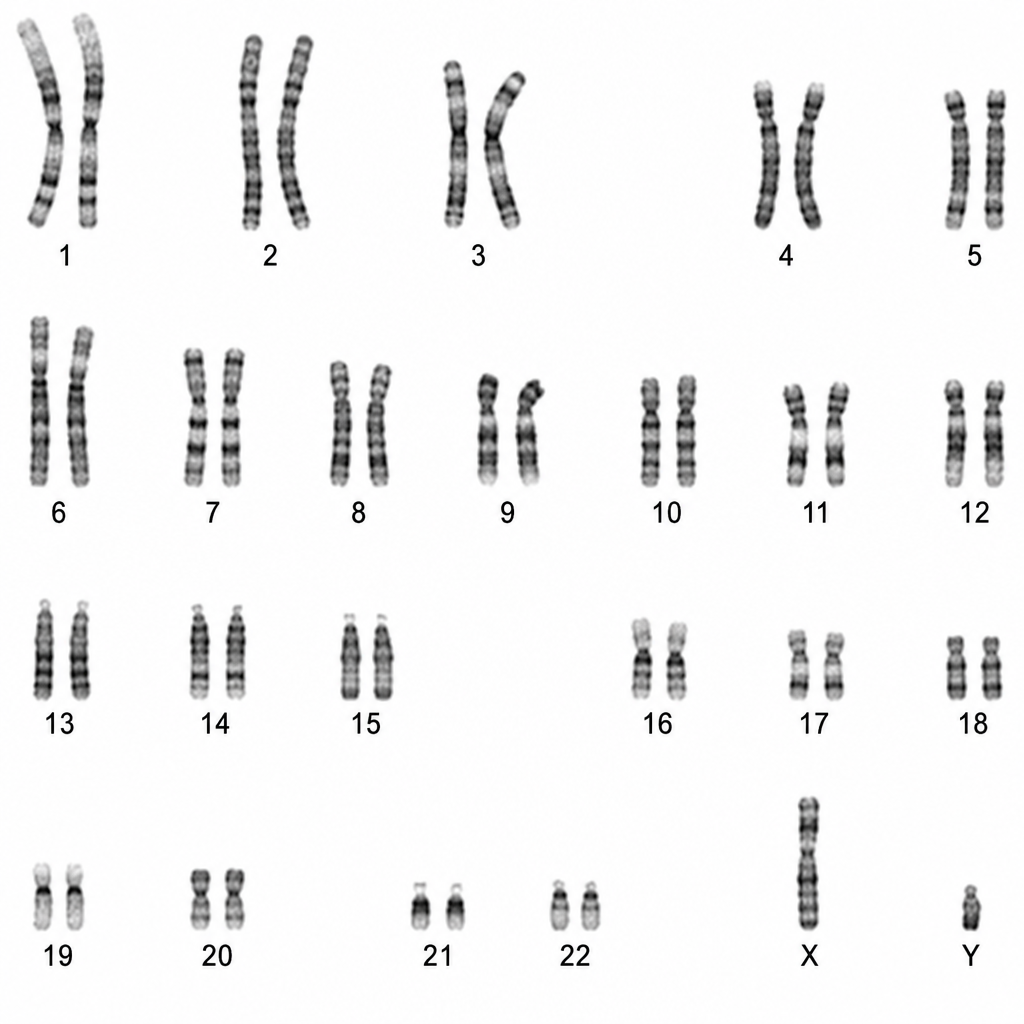
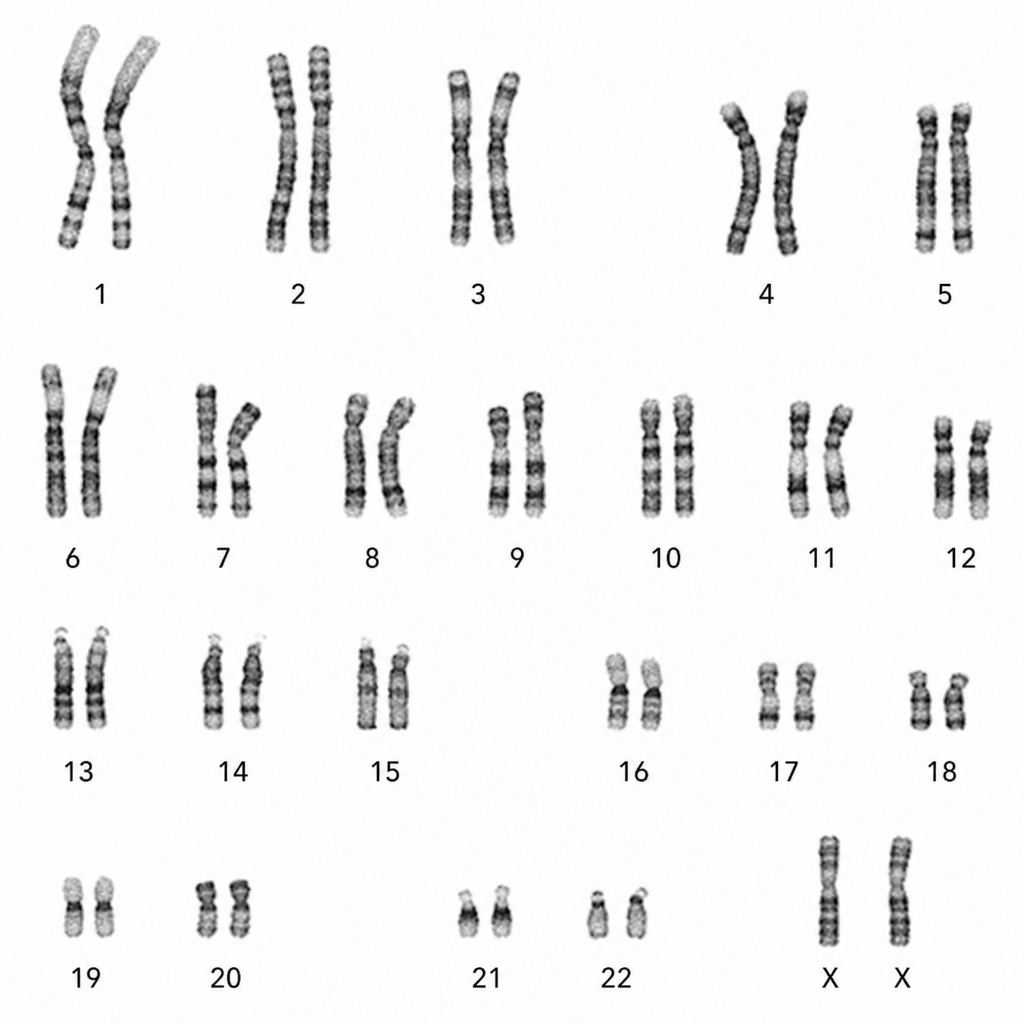
What is the total number of somatic chromosomes in a normal human diploid cell?
What does GWAS stand for?
A 32-year-old woman develops an Addisonian crisis (acute adrenal insufficiency) 3 months after suffering massive hemorrhage during the delivery of her baby. A CT scan of the abdomen shows small adrenal glands. Which of the following mechanisms of disease best accounts for adrenal atrophy in this patient?
Which stain is used to highlight the ocular basement membrane?
Karyotyping can be used to diagnose which of the following diseases?
Which antinuclear antibody is specific for Systemic Lupus Erythematosus (SLE)?
Which of the following statements is true regarding ataxia telangiectasia?
22q11 deletion leading to Di George syndrome is associated with which of the following?
What is the name of this chromosomal abnormality?

A one-year-old boy presented with hepatosplenomegaly and delayed milestones. Liver biopsy and bone marrow biopsy revealed the presence of histiocytes with PAS-positive diastase-resistant material in the cytoplasm. Electron-microscopic examination of these histiocytes is most likely to reveal the presence of?
Explanation: **Explanation:** The human genome consists of a total of **46 chromosomes**, which are organized into 23 pairs [1]. These are categorized into two types: **Autosomes (Somatic Chromosomes)** and **Allosomes (Sex Chromosomes).** 1. **The Correct Answer (D):** In a normal human diploid cell, there are **22 pairs of autosomes**, totaling **44 somatic chromosomes** [1]. These chromosomes carry genes for general body characteristics and are identical in both males and females. 2. **The Remaining 2:** The final pair (the 23rd pair) consists of sex chromosomes (XX in females or XY in males), which determine the biological sex of the individual [1]. Therefore, the formula is: **44 Autosomes + 2 Sex Chromosomes = 46 Total Chromosomes.** **Analysis of Incorrect Options:** * **Options A (42) & B (41):** These numbers do not correspond to any standard physiological or common pathological chromosomal count in humans. * **Option C (46):** This represents the **total** number of chromosomes (diploid number/2n). The question specifically asks for "somatic chromosomes" (autosomes), excluding the sex chromosomes. **Clinical Pearls for NEET-PG:** * **Euploidy:** A state where the chromosome number is an exact multiple of the haploid set (e.g., 46, 69, 92). * **Aneuploidy:** An abnormal number of chromosomes that is not a multiple of 23 (e.g., Trisomy 21/Down Syndrome has 47 chromosomes) [2]. * **Barr Body:** In females, one of the two X chromosomes is inactivated and stays as condensed heterochromatin (Barr body). The number of Barr bodies is always **(Total X chromosomes - 1)**. * **Karyotyping:** Usually performed during **Metaphase** of mitosis when chromosomes are most condensed [1]. **References:** [1] Kumar V, Abbas AK, et al.. Robbins and Cotran Pathologic Basis of Disease. 9th ed. Genetic Disorders, pp. 167-168. [2] Kumar V, Abbas AK, et al.. Robbins and Cotran Pathologic Basis of Disease. 9th ed. Genetic Disorders, pp. 170-171.
Explanation: **Explanation:** **Genome-wide Association Studies (GWAS)** is a powerful research approach used to identify genetic variations associated with specific diseases or traits [1]. **1. Why Option B is Correct:** GWAS involves scanning the entire genome of a large group of people (cases with a disease vs. healthy controls) to find **Single Nucleotide Polymorphisms (SNPs)** that occur more frequently in those with the disease [1]. Unlike linkage analysis, which looks for inheritance patterns in families, GWAS is "hypothesis-free" and identifies common genetic variants across a population [1]. This is crucial in understanding **polygenic (complex) diseases** like Type 2 Diabetes, Hypertension, and Alzheimer’s disease [1]. **2. Why Other Options are Incorrect:** * **Option A (Syndrome):** GWAS is a research methodology or tool, not a clinical syndrome or a collection of symptoms. * **Option C (Array):** While GWAS often utilizes "microarrays" (SNP chips) to process data, the formal name of the study design is "Association Studies." * **Option D (Amplification):** Amplification (like PCR) is a laboratory technique, but GWAS focuses on the statistical association between existing variants and disease phenotypes. **High-Yield Clinical Pearls for NEET-PG:** * **Primary Target:** GWAS specifically looks for **SNPs** (Single Nucleotide Polymorphisms) [1]. * **Odds Ratio:** Results are often plotted on a **Manhattan Plot**, where the highest "peaks" represent the most significant genetic associations. * **Clinical Utility:** GWAS helps identify "risk alleles" and has led to the discovery of novel pathways in diseases like Crohn’s disease (e.g., identifying the *NOD2* gene) [2]. * **Limitation:** It identifies *associations*, not necessarily *causation* [1]. Further functional studies are required to prove a gene causes a disease. **References:** [1] Kumar V, Abbas AK, et al.. Robbins and Cotran Pathologic Basis of Disease. 9th ed. Genetic Disorders, pp. 188-189. [2] Kumar V, Abbas AK, et al.. Robbins and Cotran Pathologic Basis of Disease. 9th ed. Diseases of the Immune System, pp. 223-224.
Explanation: **Explanation:** The patient is presenting with **Sheehan Syndrome** (Postpartum Pituitary Necrosis). During pregnancy, the pituitary gland enlarges significantly due to lactotroph hyperplasia, making it highly susceptible to ischemia. Massive obstetric hemorrhage causes systemic hypotension, leading to ischemic necrosis of the anterior pituitary [2]. **1. Why "Lack of trophic signals" is correct:** The anterior pituitary produces **Adrenocorticotropic Hormone (ACTH)**, which is the essential trophic signal for the adrenal cortex (specifically the zona fasciculata and reticularis). Necrosis of the pituitary leads to a deficiency of ACTH [1]. Without this constant hormonal stimulation, the adrenal cortex undergoes **disuse atrophy**, resulting in small adrenal glands and secondary adrenal insufficiency (Addisonian crisis) [2]. **2. Why other options are incorrect:** * **Chronic inflammation:** This would typically present with enlarged or irregular glands (e.g., in tuberculosis or fungal infections) rather than simple atrophy following a postpartum event. * **Chronic ischemia:** While the *pituitary* suffered ischemia, the *adrenal glands* did not. Their atrophy is a secondary functional response, not a primary vascular event. * **Hemorrhagic necrosis:** This describes **Waterhouse-Friderichsen Syndrome** (usually due to *Neisseria meningitidis*), which causes acute adrenal destruction and enlargement due to hemorrhage, not atrophy [3]. **Clinical Pearls for NEET-PG:** * **Sheehan Syndrome:** Look for a history of postpartum hemorrhage followed by failure to lactate (prolactin deficiency) and loss of pubic/axillary hair (gonadotropin deficiency) [2]. * **Adrenal Atrophy:** In secondary adrenal insufficiency (Pituitary origin), the **Zona Glomerulosa remains intact** because it is regulated by the Renin-Angiotensin system, not ACTH [1]. Therefore, mineralocorticoid levels are usually normal. * **CT Finding:** Small, symmetrical adrenal glands are a hallmark of secondary (ACTH-deficient) atrophy. **References:** [1] Kumar V, Abbas AK, et al.. Robbins and Cotran Pathologic Basis of Disease. 9th ed. The Endocrine System, pp. 1134-1135. [2] Cross SS. Underwood's Pathology: A Clinical Approach. 6th ed. Common Clinical Problems From Liver And Biliary System Disease, pp. 416-417. [3] Kumar V, Abbas AK, et al.. Robbins and Cotran Pathologic Basis of Disease. 9th ed. The Endocrine System, p. 1133.
Explanation: **Explanation:** The **Periodic acid–Schiff (PAS)** stain is the gold standard for highlighting basement membranes throughout the body, including the ocular structures [1]. **Why PAS is the correct answer:** The PAS reaction works by oxidizing glucose residues (hexoses and hexosamines) in tissue into aldehydes using periodic acid. These aldehydes then react with the Schiff reagent to produce a brilliant **magenta/purplish-red color**. Basement membranes are rich in neutral mucopolysaccharides and Type IV collagen, making them strongly PAS-positive [2]. In the eye, PAS is specifically used to visualize the **Descemet’s membrane**, the lens capsule, and the basement membranes of the retinal vasculature (crucial for diagnosing diabetic retinopathy) [1]. **Analysis of Incorrect Options:** * **Alcian Blue:** This stain is used to detect **acidic mucopolysaccharides** (like hyaluronic acid). In ophthalmology, it is used to identify macular corneal dystrophy but does not highlight the basement membrane. * **Methylene Blue:** A simple basic dye used primarily as a counterstain or for vital staining to identify corneal epithelial defects; it lacks specificity for carbohydrates. * **Giemsa Stain:** Primarily used for hematological smears and identifying infectious agents like *Chlamydia trachomatis* (inclusion conjunctivitis) or Acanthamoeba. **High-Yield Clinical Pearls for NEET-PG:** * **Thickest basement membrane in the body:** The **Lens Capsule** (strongly PAS positive). * **Kimmelstiel-Wilson (KW) nodules:** PAS-positive nodules in the kidney, pathognomonic for diabetic nephropathy. * **PAS with Diastase:** Used to differentiate glycogen (which is digested by diastase) from other PAS-positive substances like mucin or fungi. * **Fungal morphology:** PAS is excellent for highlighting fungal cell walls (e.g., *Candida*, *Aspergillus*). **References:** [1] Kumar V, Abbas AK, et al.. Robbins and Cotran Pathologic Basis of Disease. 9th ed. The Eye, p. 1328. [2] Kumar V, Abbas AK, et al.. Robbins and Cotran Pathologic Basis of Disease. 9th ed. The Endocrine System, p. 1121.
Explanation: **Explanation:** **1. Why Option A is Correct:** Karyotyping is a cytogenetic technique used to examine the number and structure of chromosomes in a cell [1]. **Klinefelter’s syndrome** is a chromosomal aneuploidy characterized by the presence of at least one extra X chromosome in a male (most commonly **47, XXY**). Since karyotyping visualizes the entire set of chromosomes (the karyogram), it is the gold standard for diagnosing numerical abnormalities like trisomies and sex chromosome disorders [2]. **2. Why the Other Options are Incorrect:** * **Multiple Myeloma (B):** This is a plasma cell dyscrasia. While specific chromosomal translocations (e.g., t(11;14)) are prognostic, the diagnosis is primarily based on bone marrow biopsy (plasma cells >10%), M-protein spike on electrophoresis, and CRAB features. * **Niemann-Pick Disease (C):** This is an autosomal recessive lysosomal storage disorder caused by a deficiency of the enzyme acid sphingomyelinase. Diagnosis is made via enzyme assays or genetic testing for specific mutations (SMPD1 gene), not by looking at chromosome structure. * **Pemphigus (D):** This is an autoimmune blistering skin disease. Diagnosis relies on clinical presentation, histopathology (acantholysis), and direct immunofluorescence (DIF) showing IgG/C3 in a "fishnet" pattern against desmogleins. **3. NEET-PG High-Yield Pearls:** * **Resolution:** Standard karyotyping can only detect abnormalities larger than **5–10 Mb**. For smaller microdeletions (e.g., DiGeorge Syndrome), **FISH** (Fluorescence In Situ Hybridization) is required. * **Sample Collection:** For a postnatal karyotype, peripheral blood T-lymphocytes are stimulated with a mitogen (e.g., **Phytohemagglutinin**) to arrest them in **metaphase** using colchicine [2]. * **Barr Body:** In Klinefelter’s (47, XXY), one Barr body is present (Total X chromosomes minus one) [3]. **References:** [1] Kumar V, Abbas AK, et al.. Robbins and Cotran Pathologic Basis of Disease. 9th ed. Genetic Disorders, pp. 167-168. [2] Cross SS. Underwood's Pathology: A Clinical Approach. 6th ed. (Basic Pathology) introduces the student to key general principles of pathology, both as a medical science and as a clinical activity with a vital role in patient care. Part 2 (Disease Mechanisms) provides fundamental knowledge about the cellular and molecular processes involved in diseases, providing the rationale for their treatment. Part 3 (Systematic Pathology) deals in detail with specific diseases, with emphasis on the clinically important aspects., pp. 54-55. [3] Kumar V, Abbas AK, et al.. Robbins and Cotran Pathologic Basis of Disease. 9th ed. Genetic Disorders, pp. 191-192.
Explanation: **Explanation:** In Systemic Lupus Erythematosus (SLE), the production of autoantibodies against nuclear antigens is the hallmark of the disease [1]. **Why Anti-dsDNA is correct:** While many antibodies appear in SLE, **Anti-dsDNA** and **Anti-Smith (Sm)** antibodies are considered **highly specific** for the diagnosis [1]. Anti-dsDNA levels often correlate with disease activity, particularly the development of lupus nephritis, making it useful for both diagnosis and monitoring. **Analysis of Incorrect Options:** * **Anti-nuclear antibodies (ANA):** This is the **best screening test** for SLE due to its very high sensitivity (95-99%) [1]. However, it lacks specificity as it is positive in many other autoimmune conditions (Scleroderma, RA, Sjögren’s) and even in healthy individuals [1]. * **Anti-centromere antibody:** This is highly specific for **Limited Cutaneous Systemic Sclerosis** (formerly CREST syndrome), not SLE [1]. * **Anti-histone antibody:** This is the characteristic marker for **Drug-Induced Lupus (DILE)** [1]. While it can be present in systemic SLE, its presence in the absence of other SLE-specific markers strongly suggests a drug-induced etiology (e.g., Hydralazine, Procainamide). **NEET-PG High-Yield Pearls:** * **Most Sensitive Test for SLE:** ANA (Indirect Immunofluorescence is the gold standard). * **Most Specific Tests for SLE:** Anti-dsDNA and Anti-Smith. * **Antibody for Neonatal Lupus/Congenital Heart Block:** Anti-Ro (SSA) and Anti-La (SSB). * **Antibody for Libman-Sacks Endocarditis/Thrombosis:** Anti-phospholipid antibodies (APLA). * **Drug-Induced Lupus:** Anti-histone positive; Anti-dsDNA usually negative; CNS and Renal involvement are rare. **References:** [1] Kumar V, Abbas AK, et al.. Robbins and Cotran Pathologic Basis of Disease. 9th ed. Diseases of the Immune System, pp. 226-230.
Explanation: **Explanation:** **Ataxia Telangiectasia (AT)** is an autosomal recessive multisystem disorder caused by a mutation in the **ATM gene** (located on chromosome 11q22-23). The ATM protein is a protein kinase responsible for sensing double-stranded DNA breaks and activating cell cycle checkpoints (like p53). **1. Why Option A is Correct:** An elevated level of **Alpha-fetoprotein (AFP)** is a highly sensitive diagnostic marker for Ataxia Telangiectasia (found in >95% of patients after the age of 2). While the exact mechanism is not fully understood, it is believed to reflect a failure of liver cell maturation or genomic instability in hepatic lineages. **2. Why Other Options are Incorrect:** * **Option B:** While AT patients have a significantly increased risk of malignancies [2], they are specifically predisposed to **lymphomas and leukemias** (due to defective V(D)J recombination) and breast cancer [2]. Squamous cell carcinoma is more characteristically associated with *Xeroderma Pigmentosum* [3]. * **Option C:** AT is inherited in an **Autosomal Recessive** pattern, not dominant [1]. **3. NEET-PG High-Yield Pearls:** * **Clinical Triad:** Progressive cerebellar ataxia (early childhood), oculocutaneous telangiectasias (spider veins in eyes/skin), and recurrent sinopulmonary infections [2]. * **Immunodeficiency:** Characterized by low levels of **IgA, IgE, and IgG2**. * **Radiosensitivity:** Patients are hypersensitive to ionizing radiation (X-rays/CT scans) because they cannot repair double-stranded DNA breaks [3]. * **Microscopy:** Cells show enlarged, pleomorphic nuclei (cytomegaly). **References:** [1] Kumar V, Abbas AK, et al.. Robbins and Cotran Pathologic Basis of Disease. 9th ed. The Central Nervous System, pp. 1300-1301. [2] Kumar V, Abbas AK, et al.. Robbins and Cotran Pathologic Basis of Disease. 9th ed. Diseases of the Immune System, pp. 250-251. [3] Kumar V, Abbas AK, et al.. Robbins and Cotran Pathologic Basis of Disease. 9th ed. Neoplasia, pp. 322-323.
Explanation: **Explanation:** **DiGeorge Syndrome (DGS)** is caused by a microdeletion on chromosome **22q11.2** [1]. This deletion results in the maldevelopment of the **3rd and 4th pharyngeal pouches** during embryogenesis. **Why Hypocalcemia is correct:** The 3rd and 4th pharyngeal pouches are responsible for the development of the **parathyroid glands** (inferior and superior, respectively). In DGS, parathyroid hypoplasia or aplasia leads to a deficiency in Parathyroid Hormone (PTH) [2]. Since PTH is essential for maintaining serum calcium levels (by increasing bone resorption and renal calcium reabsorption), its absence results in **hypocalcemia** [2]. This can manifest clinically as tetany or seizures in the neonatal period [2]. **Why the other options are incorrect:** * **Hypercalcemia:** This would be seen in conditions of PTH excess (Hyperparathyroidism), which is the opposite of the pathology in DGS. * **Hypokalemia & Hyperkalemia:** Potassium imbalances are typically related to renal tubular defects, adrenal issues (like Conn’s or Addison’s), or medications. DGS does not primarily affect potassium homeostasis. **High-Yield Clinical Pearls for NEET-PG:** To remember the features of 22q11 deletion, use the mnemonic **CATCH-22**: * **C:** **C**ardiac defects (specifically Conotruncal anomalies like Tetralogy of Fallot, Truncus Arteriosus, or Interrupted Aortic Arch). * **A:** **A**bnormal facies (low-set ears, hypertelorism) [1]. * **T:** **T**hymic hypoplasia (leading to T-cell deficiency and recurrent fungal/viral infections) [2]. * **C:** **C**left palate. * **H:** **H**ypocalcemia (due to parathyroid hypoplasia) [2]. * **22:** **22**q11 deletion [1]. *Note:* If the patient has the 22q11 deletion but lacks the thymic/parathyroid issues and presents primarily with facial and cardiac defects, it is referred to as **Velocardiofacial Syndrome** [1]. **References:** [1] Kumar V, Abbas AK, et al.. Robbins and Cotran Pathologic Basis of Disease. 9th ed. Genetic Disorders, pp. 172-173. [2] Kumar V, Abbas AK, et al.. Robbins and Cotran Pathologic Basis of Disease. 9th ed. The Endocrine System, pp. 1107-1108.
Explanation: ***Ring chromosome*** - A **ring chromosome** forms when both **telomeric ends** of a chromosome break and fuse together, creating a **circular structure** that appears ring-shaped on karyotype. - Often associated with **loss of genetic material** at the breakpoints, leading to various developmental abnormalities and **growth retardation**. *Translocation* - Involves the **transfer of a chromosome segment** from one chromosome to another, not forming a circular structure. - Appears as **abnormal banding patterns** between two different chromosomes on karyotype, not a ring shape. *Telomeric fusion* - Refers to the **fusion of telomeres** from different chromosomes, typically resulting in **dicentric chromosomes** or chromosome bridges. - Does not create a **ring-shaped structure** but rather abnormal linear chromosome configurations. *Isochromosome* - Forms when a chromosome divides **transversely through the centromere** instead of longitudinally, creating two identical arms. - Results in a **symmetrical chromosome** with duplicated arms (e.g., i(17q)), not a circular ring structure.
Explanation: The clinical presentation of hepatosplenomegaly and delayed milestones in a one-year-old, combined with the presence of PAS-positive, diastase-resistant material in histiocytes, is characteristic of **Gaucher Disease**. Gaucher disease is an autosomal recessive lysosomal storage disorder caused by a deficiency of the enzyme **glucocerebrosidase** [1]. This leads to the accumulation of glucosylceramide (glucocerebroside) within the lysosomes of macrophages (Gaucher cells). On light microscopy, these cells have a "wrinkled tissue paper" appearance [2]. Under **electron microscopy**, the accumulated glucocerebrosides aggregate into characteristic **parallel arrays of tubular structures** (also described as elongated, twisted bilayers) within the distended lysosomes [1]. **Analysis of Incorrect Options:** * **Option A:** **Birbeck granules** (tennis-racket shaped) are the hallmark of **Langerhans Cell Histiocytosis**, not lysosomal storage disorders [3]. * **Option B:** **Myelin figures** (concentric whorls of membranes) are seen in **Niemann-Pick Disease** (deficiency of sphingomyelinase) or as a general sign of reversible cell injury. * **Option C:** **Option D:** **Electron-dense deposits** in mitochondria are typically seen in irreversible cell injury (flocculent densities) or specific mitochondrial myopathies, but not in Gaucher disease. **NEET-PG High-Yield Pearls:** * **Gaucher Disease** is the most common lysosomal storage disorder. * **Gaucher Cells:** Large macrophages with fibrillary cytoplasm (wrinkled paper appearance); they are PAS-positive and show high levels of **Tartrate-Resistant Acid Phosphatase (TRAP)** [2]. * **Type 1 (Non-neuronopathic):** Most common; involves bone (Erlenmeyer flask deformity) and spleen. * **Type 2 & 3 (Neuronopathic):** Involve the CNS, explaining the "delayed milestones" mentioned in the vignette [1]. **References:** [1] Kumar V, Abbas AK, et al.. Robbins and Cotran Pathologic Basis of Disease. 9th ed. Genetic Disorders, pp. 162-163. [2] Kumar V, Abbas AK, et al.. Robbins and Cotran Pathologic Basis of Disease. 9th ed. Genetic Disorders, p. 163. [3] Kumar V, Abbas AK, et al.. Robbins and Cotran Pathologic Basis of Disease. 9th ed. Diseases of White Blood Cells, Lymph Nodes, Spleen, and Thymus, p. 630.
Principles of Molecular Pathology
Practice Questions
DNA and RNA Analysis Techniques
Practice Questions
Cytogenetics
Practice Questions
Polymerase Chain Reaction Applications
Practice Questions
Next-Generation Sequencing
Practice Questions
Molecular Diagnosis of Infectious Diseases
Practice Questions
Molecular Oncology
Practice Questions
Pharmacogenomics
Practice Questions
Genetic Counseling and Risk Assessment
Practice Questions
Molecular Diagnostics Quality Control
Practice Questions
Get full access to all questions, explanations, and performance tracking.
Start For Free