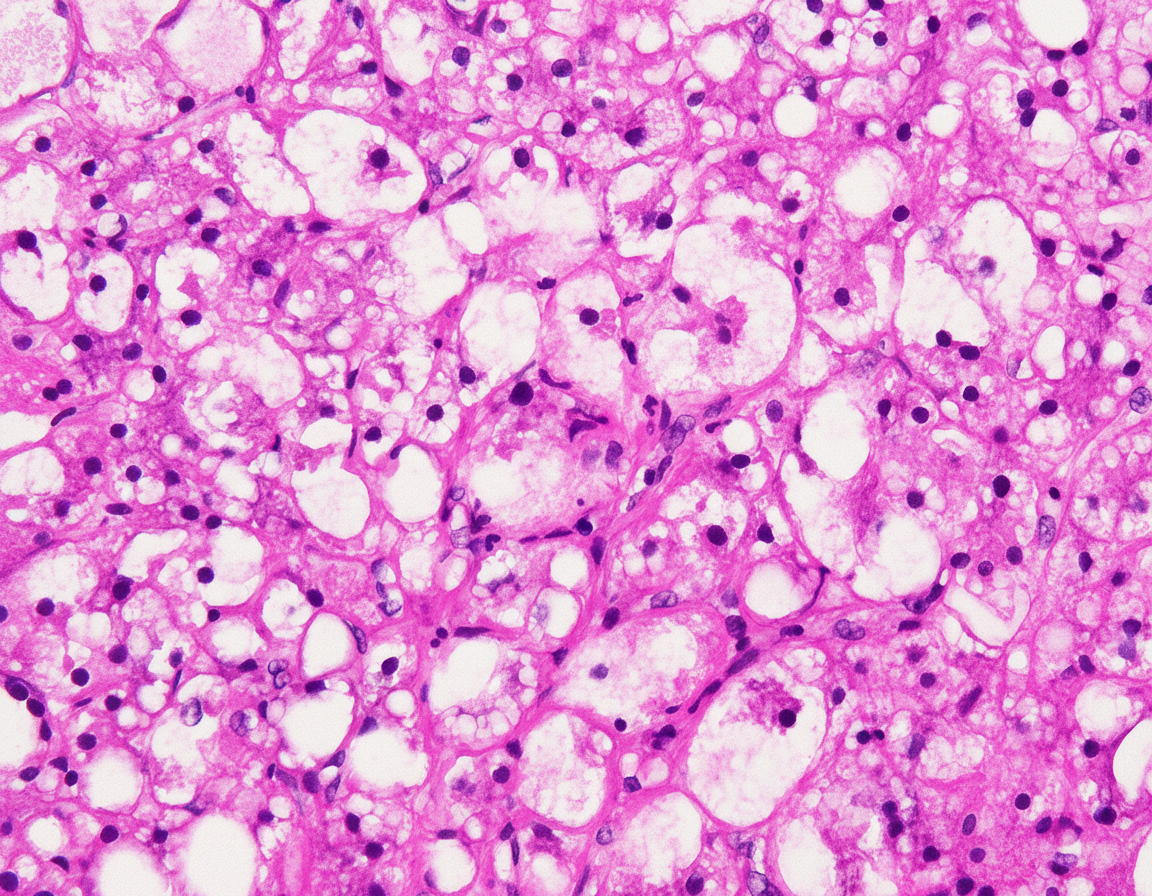
Defects in the enterohepatic circulation of bile acids due to altered canalicular function are seen in which of the following conditions?
A 22-year-old female has a congenital anemia that required multiple transfusions of red blood cells for many years. She now has no significant findings on physical examination, but her liver function test results are abnormal. Which of the following findings would most likely appear in a liver biopsy?
All of the following increase the risk for cholangiocarcinoma except?
Grossly pigmented liver is seen in which syndrome?
Nutmeg liver is the gross appearance of the liver in which of the following conditions?
Macronodular cirrhosis is considered once nodule diameter is greater than -
On stopping alcohol, all the following changes in the liver are reversible EXCEPT?
A 50-year-old male presents with chronic right heart failure and succumbs to his illness. On autopsy, what characteristic changes are seen in the liver?
A 54-year-old woman with a history of chronic hepatitis B infection presents with increased malaise over the past year. She was hospitalized 1 year ago for upper gastrointestinal hemorrhage. Physical examination reveals a firm, nodular liver. Laboratory findings include a serum albumin level of 2.5 g/dL and a prothrombin time of 28 seconds. Which of the following additional physical examination findings is most likely to be present in this woman?
What is a characteristic finding in alcoholic liver disease?
Explanation: **Explanation:** The core concept here is the site of pathology within the hepatobiliary system. **Primary Biliary Cholangitis (formerly Cirrhosis)** is an autoimmune destruction of the **intrahepatic small bile ducts and canaliculi** [2]. Because the canalicular function and the integrity of the bile ducts are compromised, the transport of bile acids from the hepatocytes into the biliary tree is disrupted [1]. This leads to a defect in the enterohepatic circulation, resulting in cholestasis and the accumulation of bile acids in the liver and blood. **Analysis of Incorrect Options:** * **Cirrhosis (Option A):** While cirrhosis involves global liver dysfunction, it is a late-stage architectural distortion (fibrosis and regenerative nodules) [4]. It is not primarily defined by a specific canalicular defect in bile acid circulation until very advanced stages. * **Gilbert’s Syndrome (Option B):** This is a disorder of **bilirubin conjugation** due to decreased activity of the enzyme UGT1A1. It does not involve bile acid transport or canalicular structural defects. * **Dubin-Johnson Syndrome (Option D):** This involves a defect in the **MRP2 protein**, which transports *conjugated bilirubin* into the bile canaliculi. While it is a canalicular transport defect, it specifically affects bilirubin excretion (causing black liver), not the primary enterohepatic circulation of bile acids. **NEET-PG High-Yield Pearls:** * **PBC Hallmark:** Anti-Mitochondrial Antibodies (AMA) are present in >95% of cases. * **Histology:** Look for "Florid duct lesions" (granulomatous destruction of bile ducts) [2]. * **Clinical Presentation:** Pruritus (due to bile acid deposition) is often the earliest symptom, preceding jaundice [1]. * **Treatment:** Ursodeoxycholic acid (UDCA) is the first-line therapy to improve bile flow [3]. **References:** [1] Cross SS. Underwood's Pathology: A Clinical Approach. 6th ed. Common Clinical Problems From Liver And Biliary System Disease, pp. 392-393. [2] Kumar V, Abbas AK, et al.. Robbins and Cotran Pathologic Basis of Disease. 9th ed. Liver and Gallbladder, pp. 864-865. [3] Kumar V, Abbas AK, et al.. Robbins and Cotran Pathologic Basis of Disease. 9th ed. Liver and Gallbladder, pp. 865-866. [4] Kumar V, Abbas AK, et al.. Robbins and Cotran Pathologic Basis of Disease. 9th ed. Liver and Gallbladder, p. 862.
Explanation: **Explanation:** **Correct Answer: D. Hemosiderin in hepatocytes** The patient has **Secondary Hemochromatosis (Hemosiderosis)**. Each unit of transfused blood contains approximately 200–250 mg of iron. Since the human body lacks an active mechanism to excrete excess iron, chronic blood transfusions lead to systemic iron overload [1], [3]. Excess iron is stored in the form of **hemosiderin** within the mononuclear phagocytic system (Kupffer cells) and eventually within parenchymal cells like **hepatocytes** [1], [2]. On histology, this appears as golden-yellow, granular pigment. To confirm, a **Prussian Blue stain** (Perl’s reaction) is used, which stains the iron granules blue [2]. Over time, this iron deposition causes free radical damage (Fenton reaction), leading to hepatocyte injury, fibrosis, and abnormal liver function tests [5]. **Why other options are incorrect:** * **A. Steatosis:** This refers to fatty change (lipid accumulation), typically associated with alcohol use, obesity, or diabetes, not iron overload. * **B. Bilirubin in canaliculi:** This indicates **cholestasis** (impaired bile flow). While advanced cirrhosis from iron overload could cause jaundice, the primary and most direct pathological finding of multiple transfusions is iron deposition. * **C. Glycogen:** Excessive glycogen accumulation is seen in Glycogen Storage Diseases (GSDs), not transfusion-related injury. **NEET-PG High-Yield Pearls:** * **Hereditary Hemochromatosis:** Most commonly due to a mutation in the **HFE gene** (C282Y) [4]. * **Classic Triad:** "Bronze Diabetes" (Cirrhosis, Diabetes Mellitus, and Skin Hyperpigmentation). * **Stain of Choice:** Prussian Blue stain [2]. * **Cardiac Involvement:** Can lead to restrictive or dilated cardiomyopathy. * **Primary vs. Secondary:** In primary (hereditary) hemochromatosis, iron deposits in hepatocytes first; in secondary (transfusional), it deposits in Kupffer cells first before involving hepatocytes. **References:** [1] Cross SS. Underwood's Pathology: A Clinical Approach. 6th ed. Common Clinical Problems From Liver And Biliary System Disease, pp. 394-395. [2] Kumar V, Abbas AK, et al.. Robbins and Cotran Pathologic Basis of Disease. 9th ed. Liver and Gallbladder, pp. 854-855. [3] Kumar V, Abbas AK, et al.. Robbins and Cotran Pathologic Basis of Disease. 9th ed. Red Blood Cell and Bleeding Disorders, p. 648. [4] Kumar V, Abbas AK, et al.. Robbins and Cotran Pathologic Basis of Disease. 9th ed. Liver and Gallbladder, p. 858. [5] Kumar V, Abbas AK, et al.. Robbins and Cotran Pathologic Basis of Disease. 9th ed. Liver and Gallbladder, p. 854.
Explanation: Explanation: Cholangiocarcinoma is a malignancy arising from the epithelial lining of the biliary tree [1]. The primary pathophysiology involves **chronic inflammation and cholestasis**, which lead to cellular dysplasia and malignant transformation. **Why Option B is the correct answer:** While **gallstones (cholelithiasis)** and stones in the common bile duct (**choledocholithiasis**) are common causes of biliary obstruction and inflammation, they are **not** significantly associated with an increased risk of cholangiocarcinoma [1]. In contrast, stones within the intrahepatic bile ducts (hepatolithiasis) are a known risk factor [3]. **Analysis of Incorrect Options:** * **Ulcerative Colitis (A) & Sclerosing Cholangitis (C):** Primary Sclerosing Cholangitis (PSC) is the most common predisposing factor for cholangiocarcinoma in the West [1]. Since roughly 70% of PSC patients also have Ulcerative Colitis, both are high-risk conditions [2]. * **Clonorchis sinensis (D):** This liver fluke (along with *Opisthorchis viverrini*) is a major risk factor in Southeast Asia [1]. Chronic infection causes chronic biliary inflammation and hyperplasia, leading to malignancy. **NEET-PG High-Yield Pearls:** * **Thorotrast:** A formerly used radiocontrast agent strongly linked to both cholangiocarcinoma and hepatic angiosarcoma [1]. * **Choledochal Cysts:** Congenital cystic dilations of the bile duct carry a high risk of malignancy (up to 15%) [1]. * **Tumor Marker:** **CA 19-9** is often elevated in cholangiocarcinoma (though not specific). * **Morphology:** Most are well-to-moderately differentiated **adenocarcinomas** characterized by a dense fibrous stroma (desmoplasia) [1]. **References:** [1] Kumar V, Abbas AK, et al.. Robbins and Cotran Pathologic Basis of Disease. 9th ed. Liver and Gallbladder, pp. 880-881. [2] Kumar V, Abbas AK, et al.. Robbins and Cotran Pathologic Basis of Disease. 9th ed. Liver and Gallbladder, pp. 865-866. [3] Kumar V, Abbas AK, et al.. Robbins and Cotran Pathologic Basis of Disease. 9th ed. Liver and Gallbladder, p. 862.
Explanation: **Explanation:** The hallmark of **Dubin-Johnson Syndrome (DJS)** is a **grossly black or darkly pigmented liver** [1]. This occurs due to a mutation in the **MRP2 gene**, which encodes a canalicular multidrug resistance-associated protein responsible for the transport of conjugated bilirubin and other organic anions into the bile [1]. The failure of this transporter leads to the accumulation of epinephrine metabolites (melanin-like polymers) within lysosomes of hepatocytes, giving the liver its characteristic dark appearance. **Analysis of Options:** * **Dubin-Johnson Syndrome (Correct):** Characterized by conjugated hyperbilirubinemia, normal total bile acid levels, and a dark/black liver [1]. A key diagnostic feature is the altered urinary coproporphyrin excretion pattern (80% is Coproporphyrin I). * **Rotor Syndrome:** Similar to DJS (conjugated hyperbilirubinemia) but lacks liver pigmentation [1]. It is caused by defects in OATP1B1 and OATP1B3 transporters. The liver appears grossly normal. * **Gilbert Syndrome:** The most common hereditary hyperbilirubinemia, caused by reduced activity of **UGT1A1** [1]. It results in mild **unconjugated** hyperbilirubinemia; the liver is structurally and grossly normal. * **Crigler-Najjar Syndrome:** Caused by a total (Type I) or near-total (Type II) absence of UGT1A1 [1]. It leads to severe **unconjugated** hyperbilirubinemia. The liver is not pigmented. **High-Yield NEET-PG Pearls:** * **DJS vs. Rotor:** DJS has a black liver and gallbladder is usually not visualized on oral cholecystography. Rotor has a normal liver and the gallbladder is visualized. * **Biopsy:** In DJS, biopsy shows coarse, iron-negative, dark brown granules in hepatocytes [1]. * **Trigger:** Jaundice in Gilbert syndrome is typically triggered by stress, fasting, or infection. **References:** [1] Kumar V, Abbas AK, et al.. Robbins and Cotran Pathologic Basis of Disease. 9th ed. Liver and Gallbladder, p. 860.
Explanation: **Explanation:** **Nutmeg liver** is the classic gross pathological description for **Chronic Passive Congestion (CPC) of the liver**, typically resulting from right-sided heart failure [1], [2]. **Why the correct answer is right:** In right heart failure, there is a backup of blood into the inferior vena cava and hepatic veins. This leads to persistent congestion of the **centrilobular regions (Zone 3)** of the liver acinus [3]. * **Pathogenesis:** The increased venous pressure causes congestion and atrophy of hepatocytes around the central vein [2]. Macroscopically, these areas appear dark/reddish-brown. In contrast, the periportal areas (Zone 1) are better oxygenated and may undergo fatty change, appearing pale/yellow. * **Appearance:** The alternating pattern of dark (congested/hemorrhagic) and light (fatty) areas resembles the cut surface of a **nutmeg** [1], [3]. **Why the incorrect options are wrong:** * **Cirrhosis of liver:** Characterized by diffuse fibrosis and regenerating nodules. While "Cardiac Cirrhosis" can occur as a late stage of CPC, the term "nutmeg liver" specifically refers to the congestive phase [3]. * **Hepatoma (HCC):** Usually presents as a large solitary mass or multiple discrete nodules with vascular invasion, not a diffuse speckled pattern. * **Secondary carcinomatous deposits:** Appear as multiple, variable-sized, firm, pale nodules, often showing **umbilication** (central necrosis), which is distinct from the uniform mottled appearance of CPC. **High-Yield Facts for NEET-PG:** * **Microscopy:** Shows "Centrilobular necrosis" and congestion of sinusoids [1]. * **Zone 3 Vulnerability:** Zone 3 is most susceptible to hypoxia and congestion because it is furthest from the hepatic artery [3]. * **Clinical Link:** Most commonly associated with **Congestive Heart Failure (CHF)** and **Constrictive Pericarditis** [4]. **References:** [1] Kumar V, Abbas AK, et al.. Robbins and Cotran Pathologic Basis of Disease. 9th ed. Hemodynamic Disorders, Thromboembolic Disease, and Shock, p. 126. [2] Cross SS. Underwood's Pathology: A Clinical Approach. 6th ed. Common Clinical Problems From Liver And Biliary System Disease, pp. 401-402. [3] Kumar V, Abbas AK, et al.. Robbins and Cotran Pathologic Basis of Disease. 9th ed. Liver and Gallbladder, pp. 870-872. [4] Kumar V, Abbas AK, et al.. Robbins and Cotran Pathologic Basis of Disease. 9th ed. Liver and Gallbladder, pp. 834-835.
Explanation: **Explanation:** Cirrhosis is pathologically defined by the presence of regenerating nodules surrounded by fibrous septa [1]. The classification into micronodular and macronodular types is based strictly on the **diameter of these nodules**. * **Correct Answer (C):** In **Macronodular Cirrhosis**, the nodules are of varying sizes and have a diameter **greater than 3 mm**. These nodules often contain intact portal tracts and are typically associated with chronic viral hepatitis (HBV, HCV) or Wilson’s disease. * **Micronodular Cirrhosis:** This is defined by uniform nodules **less than or equal to 3 mm** in diameter [1]. This pattern is classically seen in Alcoholic Liver Disease (Laennec’s cirrhosis), primary biliary cholangitis, and hemochromatosis. **Why other options are incorrect:** * **A & B (1 mm and 2 mm):** These measurements fall within the range of micronodular cirrhosis. While nodules can be this small (e.g., 2 mm), they do not represent the threshold for "macronodular" classification [1]. * **D (4 mm):** While a 4 mm nodule is technically macronodular, the standardized diagnostic cutoff used in pathology textbooks (like Robbins) and medical examinations is specifically **3 mm**. **High-Yield Clinical Pearls for NEET-PG:** * **Mixed Cirrhosis:** A pattern where both micro and macronodules are present; often seen as micronodular cirrhosis progresses over time. * **Reversibility:** While fibrosis was traditionally considered irreversible, modern hepatology recognizes that early-stage fibrosis can regress if the underlying cause (e.g., HBV/HCV) is treated. * **Gold Standard Diagnosis:** Liver biopsy remains the definitive method to assess the architectural changes of cirrhosis. * **Key Histological Stain:** **Masson’s Trichrome** is used to highlight the blue-staining (or green-staining depending on variant) collagen fibers in the fibrous septa [1]. **References:** [1] Cross SS. Underwood's Pathology: A Clinical Approach. 6th ed. Common Clinical Problems From Liver And Biliary System Disease, pp. 395-396.
Explanation: The progression of Alcoholic Liver Disease (ALD) follows a spectrum: Steatosis → Alcoholic Hepatitis → Cirrhosis [1]. The key to this question lies in understanding the threshold of **irreversible structural damage.** **1. Why Cirrhosis is the Correct Answer:** Cirrhosis represents the end-stage of chronic liver injury. It is characterized by **bridging fibrosis** and the replacement of normal parenchyma with **regenerative nodules** [1]. Once the extracellular matrix is extensively cross-linked and the native vascular architecture is destroyed, the damage becomes permanent [1]. While stopping alcohol can prevent further deterioration and complications, the established fibrotic scarring does not revert to normal liver tissue [1]. **2. Why the Other Options are Wrong:** * **Steatosis (Macro/Microvesicular fatty change):** This is the earliest response to alcohol [1]. It involves the accumulation of lipid droplets in hepatocytes due to altered NAD+/NADH ratios. It is **completely reversible** within 2–4 weeks of abstinence [1]. * **Alcoholic Hepatitis:** This involves hepatocyte swelling (ballooning), Mallory-Denk bodies, and neutrophil infiltration [1]. While more severe than steatosis, the inflammatory changes and acute necrosis can resolve with cessation of alcohol and supportive care, provided it hasn't yet progressed to cirrhosis [1]. **Clinical Pearls for NEET-PG:** * **Mallory-Denk Bodies:** These are eosinophilic cytoplasmic inclusions made of **cytokeratin intermediate filaments** (High-yield). * **First change in ALD:** Fatty change (Steatosis) [1]. * **AST:ALT Ratio:** In ALD, the ratio is typically **>2:1** (Alcoholic "S"tatistics "T"end to be higher). * **Centrilobular (Zone 3) Fibrosis:** This is the earliest site of fibrosis in alcoholic liver disease, often showing a "chicken-wire" pattern [1]. **References:** [1] Kumar V, Abbas AK, et al.. Robbins and Cotran Pathologic Basis of Disease. 9th ed. Liver and Gallbladder, pp. 848-850.
Explanation: ### Explanation **Correct Option: A. Nutmeg Liver** Chronic right-sided heart failure leads to **chronic passive congestion (CPC)** of the liver [1]. The mechanism involves back-pressure from the right atrium to the inferior vena cava and hepatic veins. This results in: 1. **Centrilobular Congestion:** The central veins and sinusoids become distended with blood, leading to atrophy and necrosis of hepatocytes in Zone 3 (the area furthest from arterial supply) [2], [3]. 2. **Peripheral Fatty Change:** The periportal hepatocytes (Zone 1) receive better oxygenation but may undergo fatty change due to hypoxia. The alternating pattern of dark red (congested/necrotic central zones) and tan-yellow (fatty peripheral zones) creates a mottled appearance resembling the cut surface of a **nutmeg** [1], [2]. **Why other options are incorrect:** * **B. Normal liver:** Chronic heart failure invariably leads to structural changes due to persistent venous hypertension and hypoxia [3]. * **C. Hemosiderosis liver:** While chronic congestion can lead to some iron deposition from broken-down RBCs, it is not the *characteristic* gross morphological description. Hemosiderosis is more typical of iron overload syndromes. * **D. Liver failure:** While "cardiac cirrhosis" can occur in prolonged cases, the question asks for the characteristic autopsy finding, which is the specific "nutmeg" appearance [3]. **NEET-PG High-Yield Pearls:** * **Zone 3 (Centrilobular):** Most susceptible to ischemic injury and congestion because it is the least oxygenated zone [3]. * **Cardiac Cirrhosis:** Long-term untreated CPC can lead to centrilobular fibrosis, eventually resulting in cirrhosis [3]. * **Microscopy:** Look for "centrilobular hemorrhagic necrosis" [1]. * **Clinical Sign:** A "pulsatile liver" on palpation is a classic clinical sign of tricuspid regurgitation leading to hepatic congestion. **References:** [1] Kumar V, Abbas AK, et al.. Robbins and Cotran Pathologic Basis of Disease. 9th ed. Hemodynamic Disorders, Thromboembolic Disease, and Shock, p. 126. [2] Cross SS. Underwood's Pathology: A Clinical Approach. 6th ed. Common Clinical Problems From Liver And Biliary System Disease, pp. 401-402. [3] Kumar V, Abbas AK, et al.. Robbins and Cotran Pathologic Basis of Disease. 9th ed. Liver and Gallbladder, pp. 870-872.
Explanation: **Explanation:** The clinical presentation—chronic Hepatitis B, nodular liver, hypoalbuminemia (2.5 g/dL), prolonged prothrombin time (28s), and a history of variceal bleeding—points to **Cirrhosis with Portal Hypertension** [1], [2]. **1. Why Caput Medusae is Correct:** Portal hypertension leads to the opening of portosystemic shunts [1]. **Caput medusae** occurs when the umbilical vein (a remnant of the fetal circulation) undergoes recanalization. This allows blood from the portal system to bypass the liver and flow into the superficial epigastric veins of the abdominal wall, appearing as dilated, radiating periumbilical veins [1]. **2. Analysis of Incorrect Options:** * **B. Diminished deep tendon reflexes:** Not typically associated with cirrhosis. However, *hyperreflexia* may be seen in hepatic encephalopathy (Stage II/III) [2]. * **C. Distended jugular veins:** This is a sign of right-sided heart failure or fluid overload. In cirrhosis, JVP is usually normal or low due to peripheral vasodilation and splanchnic pooling, despite the presence of ascites [1]. * **D. Papilledema:** This indicates increased intracranial pressure. While hepatic encephalopathy causes cerebral edema in acute liver failure, it is rarely associated with papilledema in chronic cirrhosis [2]. **3. NEET-PG High-Yield Pearls:** * **Portosystemic Shunts to Remember:** * *Lower Esophagus:* Left gastric vein ↔ Azygos vein (Esophageal varices) [3]. * *Rectum:* Superior rectal vein ↔ Middle/Inferior rectal veins (Anorectal varices). * *Umbilicus:* Paraumbilical veins ↔ Superficial epigastric veins (Caput medusae). * **Child-Pugh Score:** Uses Albumin, Bilirubin, PT/INR, Ascites, and Encephalopathy to assess cirrhosis severity [2]. * **Stellate Cells (Ito cells):** Located in the Space of Disse; they are the primary cells responsible for collagen production and fibrosis in cirrhosis. **References:** [1] Kumar V, Abbas AK, et al.. Robbins and Cotran Pathologic Basis of Disease. 9th ed. Liver and Gallbladder, pp. 835-836. [2] Cross SK. Underwood's Pathology: A Clinical Approach. 6th ed. Common Clinical Problems From Liver And Biliary System Disease, pp. 396-398. [3] Cross SS. Underwood's Pathology: A Clinical Approach. 6th ed. Common Clinical Problems From Liver And Biliary System Disease, pp. 383-384.
Explanation: Alcoholic liver disease (ALD) encompasses a spectrum of histopathological changes ranging from steatosis to cirrhosis [2]. The correct answer is **All of the above** because ALD involves a combination of degenerative, inflammatory, and fibrotic processes [2]. ### **Explanation of Findings:** 1. **Perivenular Fibrosis:** This is one of the earliest signs of irreversible damage in ALD. Fibrosis typically begins in the **centrilobular region (Zone 3)** around the central vein (perivenular) [1]. It often presents as a "chicken-wire" pattern of scarring, which eventually leads to cirrhosis [1]. 2. **Mallory Hyaline (Mallory-Denk Bodies):** These are eosinophilic, intracytoplasmic inclusions made of tangled **intermediate filaments (keratin 8 and 18)** [1]. While characteristic of alcoholic hepatitis, they are not pathognomonic and can be seen in Wilson’s disease or NASH [1]. 3. **Spotty Necrosis:** This refers to the focal death of individual hepatocytes accompanied by a mild inflammatory infiltrate. In ALD, this occurs alongside more prominent features like ballooning degeneration and neutrophilic infiltration [1]. ### **Clinical Pearls for NEET-PG:** * **AST:ALT Ratio:** In ALD, the ratio is typically **>2:1**. This is because alcohol induces mitochondrial damage (releasing AST) and causes a deficiency in Pyridoxal-5-phosphate (required for ALT synthesis). * **Neutrophilic Infiltration:** Unlike viral hepatitis (lymphocytic), alcoholic hepatitis is characterized by a **neutrophilic** response around degenerating hepatocytes [1]. * **Reversibility:** Fatty change (steatosis) is completely reversible with abstinence, but perivenular fibrosis marks the progression toward irreversible injury [1]. * **Zone 3 Vulnerability:** Zone 3 is most susceptible to alcoholic injury due to the highest concentration of CYP2E1 and the lowest oxygen tension [1]. **References:** [1] Kumar V, Abbas AK, et al.. Robbins and Cotran Pathologic Basis of Disease. 9th ed. Liver and Gallbladder, pp. 848-850. [2] Cross SS. Underwood's Pathology: A Clinical Approach. 6th ed. Common Clinical Problems From Liver And Biliary System Disease, pp. 388-390.
Jaundice and Cholestasis
Practice Questions
Viral Hepatitis
Practice Questions
Alcoholic and Non-alcoholic Fatty Liver Disease
Practice Questions
Drug and Toxin Induced Liver Injury
Practice Questions
Cirrhosis and Its Complications
Practice Questions
Metabolic Liver Diseases
Practice Questions
Liver Tumors
Practice Questions
Gallbladder and Biliary Tract Diseases
Practice Questions
Congenital Liver Diseases
Practice Questions
Liver Transplantation Pathology
Practice Questions
Get full access to all questions, explanations, and performance tracking.
Start For Free