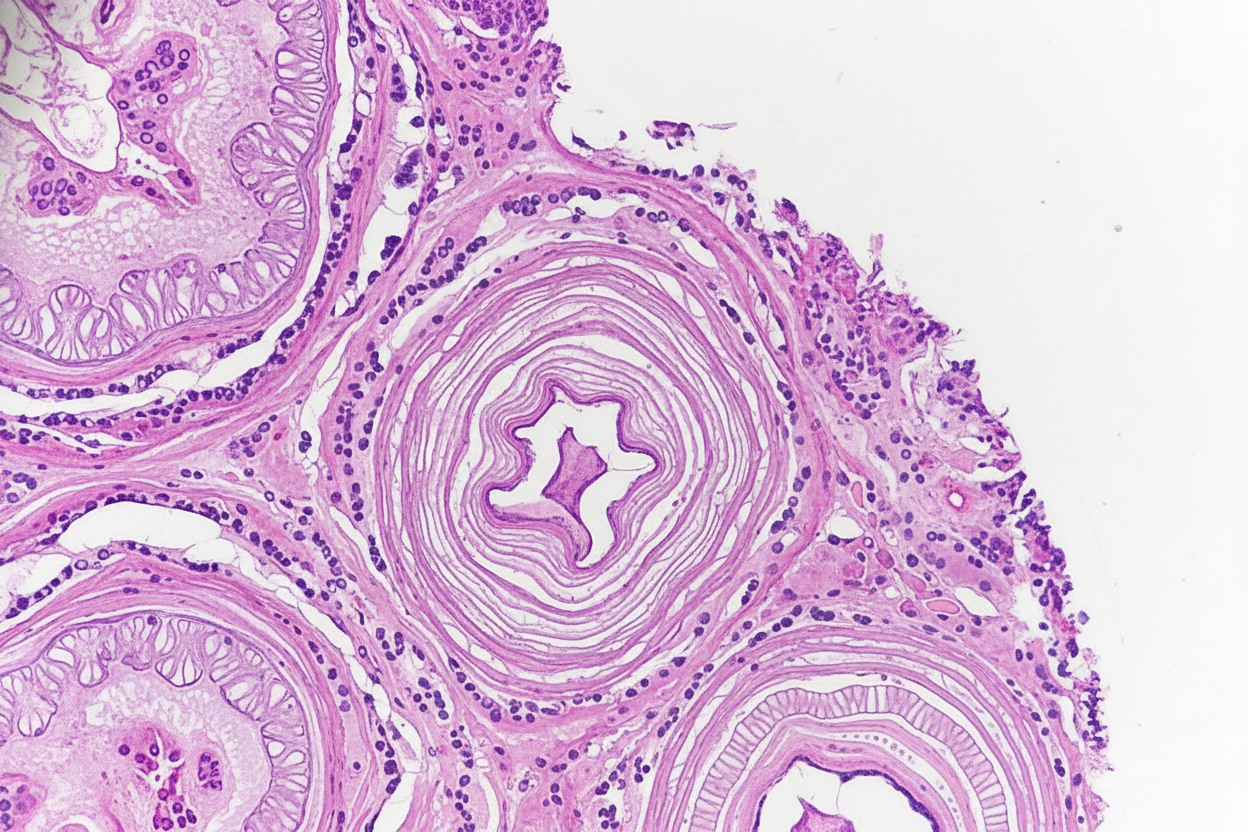
Budd-Chiari syndrome is due to thrombosis of which of the following structures?
Which of the following statements about hepatic adenoma is false?
Ingestion of arsenic causes which of the following?
Hepar lobatum is due to:
What is the major source of collagen in cirrhosis?
Alpha-1 antitrypsin deficiency is characterized by the deposition of cytoplasmic inclusions that are:
Which of the following is NOT a predisposing factor for cholangiocarcinoma?
What is the most common malignancy of the gallbladder?
A liver biopsy in a patient with malaria will show which of the following histological findings?
Hemosiderosis of the liver is characterized by the deposition of which pigment?
Explanation: **Explanation:** **Budd-Chiari Syndrome (BCS)** is a clinical condition characterized by the obstruction of hepatic venous outflow [1]. This occurs due to thrombosis or compression of the **hepatic veins** (at any level from the small hepatic venules to the junction with the IVC) or the **intrahepatic/suprahepatic portion of the Inferior Vena Cava (IVC)** [4]. 1. **Why Hepatic Veins are correct:** The hallmark of BCS is the inability of blood to exit the liver. This leads to increased intrahepatic pressure, centrilobular congestion, and necrosis (Nutmeg liver) [1]. Clinically, this manifests as the classic triad of **abdominal pain, ascites, and hepatomegaly**. 2. **Why other options are incorrect:** * **Infrarenal IVC:** Obstruction here causes lower limb edema and venous stasis but does not directly cause the hepatic congestion seen in BCS. * **Renal Veins:** Thrombosis here leads to Nephrotic syndrome or acute kidney injury, not hepatic outflow obstruction. * **Superior Mesenteric Vein:** Thrombosis of this vessel leads to mesenteric ischemia and bowel infarction; it is a component of portal vein thrombosis, not BCS [3]. **High-Yield Clinical Pearls for NEET-PG:** * **Most common cause:** Polycythemia Vera (and other myeloproliferative neoplasms). * **Morphology:** The **Caudate Lobe** is often spared and undergoes compensatory hypertrophy because it has independent venous drainage directly into the IVC. * **Imaging:** "Spider-web" network of collateral vessels on angiography. * **Nutmeg Liver:** While also seen in congestive heart failure, in BCS, it occurs without signs of right-sided heart failure (e.g., no JVP elevation) [2]. **References:** [1] Kumar V, Abbas AK, et al.. Robbins and Cotran Pathologic Basis of Disease. 9th ed. Liver and Gallbladder, pp. 869-870. [2] Cross SS. Underwood's Pathology: A Clinical Approach. 6th ed. Common Clinical Problems From Liver And Biliary System Disease, pp. 401-402. [3] Kumar V, Abbas AK, et al.. Robbins and Cotran Pathologic Basis of Disease. 9th ed. Liver and Gallbladder, pp. 868-869. [4] Kumar V, Abbas AK, et al.. Robbins and Cotran Pathologic Basis of Disease. 9th ed. Liver and Gallbladder, pp. 834-835.
Explanation: Hepatic Adenoma (HA) is a benign liver tumor primarily associated with oral contraceptive pill (OCP) use [1]. Understanding its clinical presentation and risks is crucial for NEET-PG. **Why Option B is the correct answer (False statement):** Contrary to many benign liver lesions (like hemangiomas), hepatic adenomas are **frequently symptomatic**. Patients often present with right upper quadrant pain due to rapid growth or intratumoral hemorrhage. Because these tumors are highly vascular and lack a stable connective tissue framework, they have a high propensity for spontaneous rupture, leading to life-threatening intraperitoneal hemorrhage (hemoperitoneum). **Analysis of other options:** * **Option A (True):** There is a strong female predilection (9:1 ratio), directly linked to estrogen exposure from OCPs [1]. * **Option C (True):** The risk of rupture and hemorrhage significantly increases during pregnancy due to hormonal stimulation and increased vascularity. * **Option D (True):** While malignant transformation to Hepatocellular Carcinoma (HCC) can occur, the overall risk is considered **low** (approx. 4-5%), though it is notably higher in the **̢-catenin mutated subtype** [2] and in male patients. **High-Yield Clinical Pearls for NEET-PG:** 1. **Subtypes:** * *HNF-1̑ inactivated:* Lowest risk of malignancy; associated with fatty change [2]. * *̢-catenin activated:* **Highest risk** of malignant transformation; often seen in males or those using anabolic steroids [1]. * *Inflammatory:* Associated with obesity and NAFLD; high risk of bleeding [2]. 2. **Management:** Lesions >5 cm or those with ̢-catenin mutations usually require surgical resection due to the risk of rupture or HCC. 3. **Imaging:** Classically shows "cold" spots on Sulfur Colloid scans because they lack Kupffer cells. **References:** [1] Kumar V, Abbas AK, et al.. Robbins and Cotran Pathologic Basis of Disease. 9th ed. Liver and Gallbladder, p. 874. [2] Kumar V, Abbas AK, et al.. Robbins and Cotran Pathologic Basis of Disease. 9th ed. Liver and Gallbladder, pp. 874-875.
Explanation: **Explanation:** The correct answer is **Noncirrhotic portal fibrosis (NCPF)**. Chronic arsenic exposure, often through contaminated groundwater, is a well-documented cause of NCPF (also known as Idiopathic Portal Hypertension). **1. Why NCPF is correct:** Arsenic is a potent endothelial toxin. Chronic ingestion leads to damage of the small intrahepatic portal vein branches and perisinusoidal fibrosis. This results in increased resistance to portal blood flow and portal hypertension, but crucially, the liver parenchyma remains non-cirrhotic (no regenerative nodules). Clinically, patients present with massive splenomegaly and variceal bleeding despite preserved liver function. **2. Why other options are incorrect:** * **Hepatic carcinoma:** While arsenic is a known carcinogen, its primary hepatic malignancy association is **Angiosarcoma** (a vascular tumor), not Hepatocellular Carcinoma (HCC). * **Hepatic adenoma:** These are typically associated with oral contraceptive pills (OCPs) or anabolic steroids, not heavy metal toxicity. * **Hepatic cirrhosis:** Arsenic causes portal hypertension through "pre-sinusoidal" mechanisms. While it causes fibrosis, it does not typically progress to the diffuse architectural reorganization and nodularity required for a diagnosis of cirrhosis. **High-Yield Clinical Pearls for NEET-PG:** * **Arsenic & Liver:** The most specific association is **Angiosarcoma** (along with Vinyl Chloride and Thorotrast). NCPF is the most common presentation of chronic arsenicosis in the Indian subcontinent (especially West Bengal). * **Arsenic & Skin:** Look for "raindrop" pigmentation (hyperpigmentation) and palmoplantar hyperkeratosis [1]. * **Arsenic & Other Organs:** Associated with Squamous Cell Carcinoma (SCC) of the skin and lung cancer [1]. * **NCPF Triad:** Portal hypertension + Splenomegaly + Patent portal vein in the absence of cirrhosis. **References:** [1] Kumar V, Abbas AK, et al.. Robbins and Cotran Pathologic Basis of Disease. 9th ed. Infectious Diseases, pp. 420-421.
Explanation: **Explanation:** **Hepar lobatum** is a classic morphological manifestation of **Tertiary Syphilis** [1]. It occurs due to the formation and subsequent healing of multiple **gummas** (granulomatous lesions) within the liver. As these gummas heal, they undergo extensive fibrosis and scarring. The resulting deep, radiating fibrous scars contract, dividing the liver into irregular, prominent lobes, giving it a characteristic "botryoid" (cluster of grapes) or coarsely lobulated appearance. **Analysis of Options:** * **Option B (Syphilis):** Correct. The cicatrization (scarring) of hepatic gummas in late-stage syphilis is the specific cause of the lobulated "Hepar lobatum" deformity. * **Option A & C (Hepatitis A & B):** Incorrect. Viral hepatitis typically causes diffuse inflammation. While chronic Hepatitis B can lead to cirrhosis (characterized by regenerative nodules and diffuse fibrosis), it does not produce the deep, coarse, lobulated scars seen in Hepar lobatum. * **Option D (Biliary atresia):** Incorrect. This is a neonatal condition characterized by the obstruction of the extrahepatic biliary tree, leading to secondary biliary cirrhosis and cholestasis, not gummatous lobulation. **High-Yield Pearls for NEET-PG:** * **Gumma:** The hallmark of tertiary syphilis [1]; a form of coagulative necrosis with a rubbery consistency. * **Microscopy:** Gummas show a central zone of necrosis surrounded by mononuclear cells (plasma cells, lymphocytes) and a peripheral rim of fibroblasts. * **Arterial involvement:** Syphilis is often associated with **endarteritis obliterans** (narrowing of small arteries due to intimal proliferation) [1]. * **Other Hepatic Syphilis:** Congenital syphilis presents differently, often showing diffuse interstitial fibrosis (pericellular fibrosis) known as **"Flint liver."** **References:** [1] Kumar V, Abbas AK, et al.. Robbins and Cotran Pathologic Basis of Disease. 9th ed. Infectious Diseases, pp. 388-389.
Explanation: ### Explanation **1. Why Ito cells (Hepatic Stellate Cells) are correct:** In a healthy liver, **Ito cells** (located in the Space of Disse) function primarily as storage sites for Vitamin A (quiescent state). However, in response to chronic liver injury, they undergo **"activation"** triggered by cytokines like **TGF-̢** (the most potent fibrogenic cytokine), PDGF, and TNF. Activated stellate cells transform into **myofibroblast-like cells**, which are the primary source of excess extracellular matrix and **Type I and III collagen**, leading to the fibrosis characteristic of cirrhosis [1], [2]. **2. Why the other options are incorrect:** * **Kupffer cells (A):** These are specialized macrophages of the liver [1]. While they play a crucial role in initiating fibrosis by secreting pro-inflammatory cytokines (like TGF-̢) that activate Ito cells, they do not produce collagen themselves. * **Hepatocytes (C):** These are the functional parenchymal cells responsible for metabolism and detoxification. In cirrhosis, they undergo necrosis or apoptosis but do not transform into collagen-producing cells. * **Canalicular cells (D):** These refer to the specialized surfaces of hepatocytes that form bile canaliculi. They are involved in bile transport, not structural protein synthesis. **3. NEET-PG High-Yield Pearls:** * **Space of Disse:** The anatomical location where Ito cells reside and where collagen deposition occurs in early fibrosis. * **Vitamin A Storage:** Ito cells store 80% of the body's retinoids in lipid droplets. * **TGF-̢:** The single most important cytokine involved in the activation of stellate cells and subsequent fibrogenesis. * **Reversibility:** Early-stage fibrosis is potentially reversible, but established cirrhosis with dense scars is generally considered irreversible [2]. **References:** [1] Cross SS. Underwood's Pathology: A Clinical Approach. 6th ed. Common Clinical Problems From Liver And Biliary System Disease, pp. 381-382. [2] Kumar V, Abbas AK, et al.. Robbins and Cotran Pathologic Basis of Disease. 9th ed. Liver and Gallbladder, pp. 830-832.
Explanation: **Explanation:** Alpha-1 antitrypsin (A1AT) deficiency is a genetic disorder characterized by the misfolding of the A1AT protein (most commonly the **PiZ variant**). This misfolded protein cannot be secreted by hepatocytes, leading to its accumulation within the endoplasmic reticulum [1]. **Why "All of the above" is correct:** * **Eosinophilic:** On standard H&E staining, these accumulated proteins appear as distinct, round-to-oval **eosinophilic (pinkish)** hyaline globules within the cytoplasm of hepatocytes, particularly in the periportal regions [1]. * **PAS Positive:** These inclusions are composed of glycoproteins. The Periodic Acid-Schiff (PAS) stain reacts with the carbohydrate moieties of the misfolded protein, staining the globules a deep magenta/purple. * **Diastase Resistant:** This is the most characteristic feature. While glycogen is also PAS-positive, it is digested by the enzyme diastase. Since A1AT globules are proteins and not glycogen, they remain visible after diastase treatment (**PAS-D positive**). **Clinical Pearls for NEET-PG:** * **Genetics:** Autosomal codominant inheritance; the **PiZZ phenotype** carries the highest risk for both panacinar emphysema (lungs) and cirrhosis (liver) [1], [2]. * **Morphology:** The globules are most prominent in **periportal hepatocytes** (Zone 1). * **Diagnosis:** Gold standard is isoelectric focusing for phenotype identification. * **Associated Pathology:** It is the most common genetic cause of liver disease in children and is associated with an increased risk of **Hepatocellular Carcinoma (HCC)** even in the absence of cirrhosis. **References:** [1] Kumar V, Abbas AK, et al.. Robbins and Cotran Pathologic Basis of Disease. 9th ed. Liver and Gallbladder, pp. 856-858. [2] Kumar V, Abbas AK, et al.. Robbins and Cotran Pathologic Basis of Disease. 9th ed. The Lung, pp. 684-685.
Explanation: **Explanation:** Cholangiocarcinoma is a malignancy arising from the epithelial lining of the biliary tree [1]. The primary underlying mechanism for its development is **chronic inflammation and cholestasis**, which leads to cellular proliferation and DNA damage. **Why Cholelithiasis is the correct answer:** While **Cholelithiasis** (gallstones) is a major risk factor for **Gallbladder Carcinoma**, it is **not** significantly associated with Cholangiocarcinoma. In contrast, **Hepatolithiasis** (intrahepatic stones) is a well-known risk factor because it causes chronic irritation and recurrent pyogenic cholangitis within the bile ducts themselves [2]. **Analysis of Incorrect Options:** * **Asiatic Cholangiohepatitis (Recurrent Pyogenic Cholangitis):** This condition, often associated with *Clonorchis sinensis* or *Opisthorchis viverrini* infections, causes chronic biliary inflammation and stone formation, significantly increasing the risk [2]. * **Ulcerative Colitis:** This is strongly associated with **Primary Sclerosing Cholangitis (PSC)**. PSC is the most common predisposing factor for cholangiocarcinoma in Western countries due to the chronic fibro-obliterative destruction of bile ducts. * **Choledochal Cyst:** These congenital cystic dilatations of the bile duct lead to bile stasis and activation of pancreatic enzymes within the duct, causing chronic mucosal injury and a high risk of malignant transformation. **NEET-PG High-Yield Pearls:** * **Most common site:** Perihilar (Klatskin tumor), located at the junction of the right and left hepatic ducts. * **Tumor Marker:** CA 19-9 is often elevated (though non-specific). * **Risk Factors Mnemonic:** "The 4 C's" – **C**lonorchis, **C**holedochal cyst, **C**irrhosis (HCV/HBV), and **C**olitis (via PSC). * **Thorotrast:** Historical exposure to this contrast agent is a classic, high-yield risk factor for both cholangiocarcinoma and angiosarcoma of the liver. **References:** [1] Kumar V, Abbas AK, et al.. Robbins and Cotran Pathologic Basis of Disease. 9th ed. Liver and Gallbladder, pp. 880-881. [2] Kumar V, Abbas AK, et al.. Robbins and Cotran Pathologic Basis of Disease. 9th ed. Liver and Gallbladder, p. 862.
Explanation: **Explanation:** **Adenocarcinoma** is the most common primary malignancy of the gallbladder, accounting for approximately **90–95%** of all cases [1]. This malignancy typically arises from the glandular epithelium lining the gallbladder wall. It is frequently associated with chronic inflammation, most commonly due to **cholelithiasis (gallstones)**, which is present in about 70–90% of cases [2]. Morphologically, these tumors can be infiltrating (diffuse thickening of the wall) or exophytic (cauliflower-like mass) [1]. **Analysis of Incorrect Options:** * **Squamous cell carcinoma:** This is a rare primary malignancy of the gallbladder (approx. 2–5%) [1]. It usually occurs due to squamous metaplasia of the gallbladder epithelium triggered by chronic irritation from stones. * **Mucinous cystadenoma:** This is a benign cystic neoplasm. While it has malignant potential (can progress to cystadenocarcinoma), it is far less common than primary adenocarcinoma. * **Serous cystadenoma:** These are almost always benign, thin-walled cystic lesions more commonly associated with the pancreas than the gallbladder. **High-Yield Clinical Pearls for NEET-PG:** * **Risk Factors:** The most significant risk factor is **gallstones**, particularly "porcelain gallbladder" (intramural calcification), which carries a high risk of malignancy [2]. * **Demographics:** It is more common in females (2:1 to 3:1 ratio) and shows a high prevalence in North India (specifically the Gangetic belt) [2]. * **Molecular Pathogenesis:** Mutations in the **TP53** gene are common in the early stages, while **KRAS** mutations are seen in later stages. * **Prognosis:** Generally poor, as it is often asymptomatic until it reaches an advanced stage or incidentally discovered during a cholecystectomy. **References:** [1] Kumar V, Abbas AK, et al.. Robbins and Cotran Pathologic Basis of Disease. 9th ed. Liver and Gallbladder, p. 886. [2] Kumar V, Abbas AK, et al.. Robbins and Cotran Pathologic Basis of Disease. 9th ed. Liver and Gallbladder, pp. 883-884.
Explanation: **Explanation:** In malaria, the liver is a primary site of involvement during the exo-erythrocytic phase. The characteristic histological finding is **Kupffer cell hyperplasia** [1]. As the malaria parasite (Plasmodium) infects and ruptures red blood cells, it releases hemoglobin breakdown products and **hemozoin pigment** (malarial pigment). The Kupffer cells, which are the resident macrophages of the liver, proliferate and become heavily engorged as they phagocytose these pigments and cellular debris [1]. This often gives the liver a slate-gray or "dusky" macroscopic appearance [1]. **Analysis of Incorrect Options:** * **A. Microabscesses:** These are typically seen in pyogenic liver abscesses or systemic bacterial infections (e.g., *Staphylococcus aureus* or *E. coli*), not protozoal infections like malaria. * **C. Piecemeal necrosis (Interface Hepatitis):** This is the hallmark of Chronic Active Hepatitis (especially Hepatitis B and C), where inflammation spills over from the portal tracts into the adjacent parenchyma. * **D. Non-caseating granuloma:** These are characteristic of Sarcoidosis, Tuberculosis (though TB is usually caseating), or drug-induced liver injury. **High-Yield NEET-PG Pearls:** * **Malarial Pigment:** Hemozoin is an iron-containing pigment but is **Prussian Blue negative** (unlike hemosiderin), as the iron is sequestered in a crystalline form. * **Liver Involvement:** While the liver is enlarged (hepatomegaly), true "hepatitis" with significant transaminase elevation is rare in malaria; the pathology is primarily reticuloendothelial [1]. * **Other Organs:** Similar pigment deposition and macrophage hyperplasia are seen in the **spleen** (leading to "Big Spleen Disease" or Tropical Splenomegaly Syndrome) and bone marrow [1]. **References:** [1] Kumar V, Abbas AK, et al.. Robbins and Cotran Pathologic Basis of Disease. 9th ed. Infectious Diseases, p. 400.
Explanation: **Explanation:** **Hemosiderosis** refers to the systemic or localized deposition of **Iron** in the form of hemosiderin within tissues [3]. In the liver, this occurs when the body’s iron stores are overloaded, leading to the accumulation of golden-yellow, granular pigment primarily within the Kupffer cells and hepatocytes [1], [2]. Unlike hemochromatosis, hemosiderosis typically does not involve initial tissue damage or fibrosis, though chronic overload can progress to cellular injury [1], [2]. **Why other options are incorrect:** * **Copper:** Accumulation of copper in the liver is the hallmark of **Wilson Disease** (Hepatolenticular degeneration), caused by a mutation in the *ATP7B* gene [2], [4]. * **Zinc:** While zinc is an essential trace element, its toxicity does not manifest as a specific pigmentary deposition in the liver like iron. * **Manganese:** Manganese toxicity (Manganism) primarily affects the central nervous system (specifically the basal ganglia), leading to Parkinsonian-like symptoms, rather than hepatic pigment deposition. **High-Yield NEET-PG Pearls:** 1. **Staining:** The gold standard for identifying iron (hemosiderin) is the **Prussian Blue (Perls') stain**, which colors the granules royal blue [1]. 2. **Hemochromatosis vs. Hemosiderosis:** Hemochromatosis is a clinical syndrome of iron overload with associated organ damage (cirrhosis, diabetes, skin pigmentation—"Bronze Diabetes") [4]. 3. **Morphology:** In early stages of systemic overload, iron appears first in **Kupffer cells**; in hereditary hemochromatosis, it appears first in **periportal hepatocytes** [1]. **References:** [1] Kumar V, Abbas AK, et al.. Robbins and Cotran Pathologic Basis of Disease. 9th ed. Liver and Gallbladder, pp. 854-855. [2] Cross SS. Underwood's Pathology: A Clinical Approach. 6th ed. Common Clinical Problems From Liver And Biliary System Disease, pp. 394-395. [3] Kumar V, Abbas AK, et al.. Robbins and Cotran Pathologic Basis of Disease. 9th ed. Cellular Responses to Stress and Toxic Insults: Adaptation, Injury, and Death, pp. 75-76. [4] Kumar V, Abbas AK, et al.. Robbins and Cotran Pathologic Basis of Disease. 9th ed. Liver and Gallbladder, p. 858.
Jaundice and Cholestasis
Practice Questions
Viral Hepatitis
Practice Questions
Alcoholic and Non-alcoholic Fatty Liver Disease
Practice Questions
Drug and Toxin Induced Liver Injury
Practice Questions
Cirrhosis and Its Complications
Practice Questions
Metabolic Liver Diseases
Practice Questions
Liver Tumors
Practice Questions
Gallbladder and Biliary Tract Diseases
Practice Questions
Congenital Liver Diseases
Practice Questions
Liver Transplantation Pathology
Practice Questions
Get full access to all questions, explanations, and performance tracking.
Start For Free