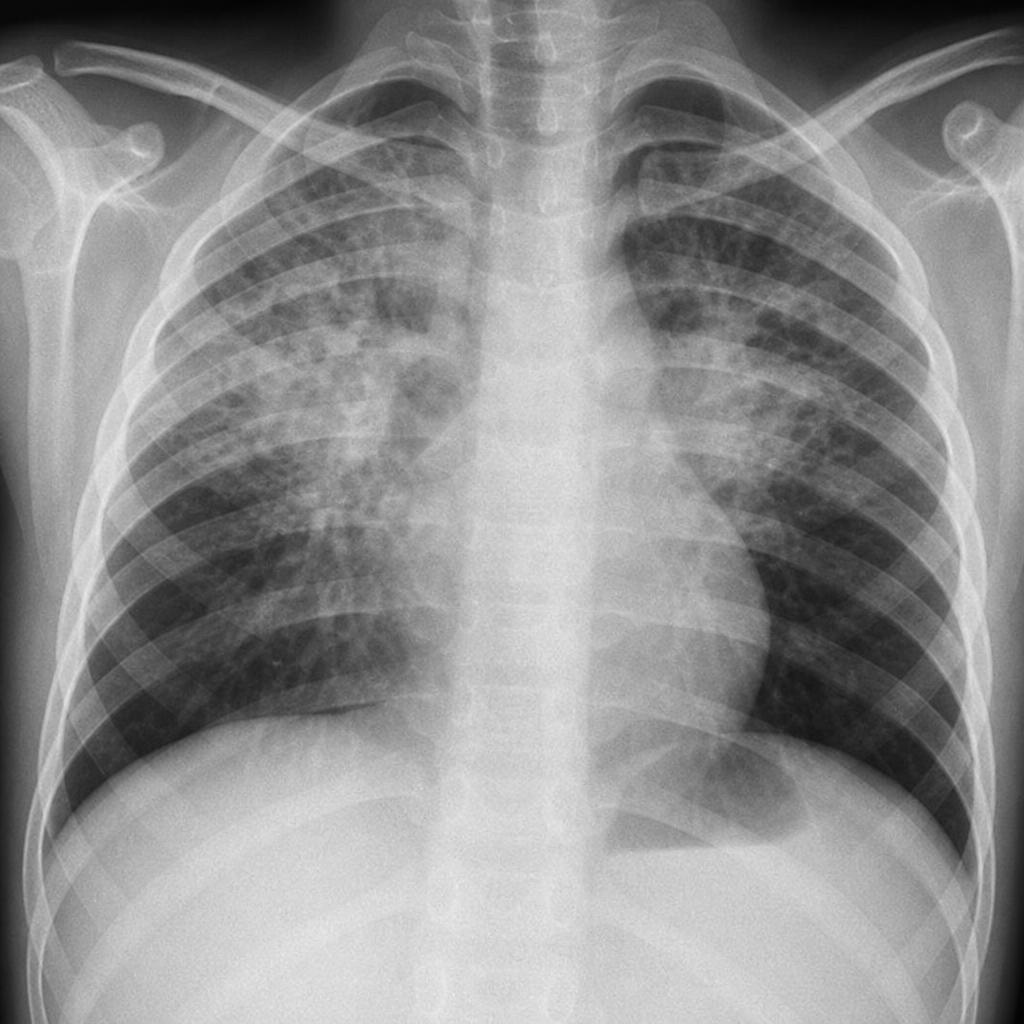
What is the most common malignancy in patients with AIDS?
Glomus cells are found in which of the following?
A 45-year-old man presents with chest pain, fever, productive cough, and rust-colored sputum. He had a history of tuberculosis in his early 20s. A chest X-ray shows multiple, nodular infiltrates and cavitary lesions. A lung biopsy reveals necrotizing inflammation and vascular thrombi with branching fungal hyphae. Which of the following is the most likely diagnosis?
Cold abscess formation is due to?
Caseating granuloma is commonly seen in which of the following conditions?
A 6-year-old girl presents with intense perianal itching, especially at night. Physical examination reveals perianal excoriation. An adhesive tape test is positive for worms. Which of the following is the most likely parasite in this patient?
Necrotizing granulomatous inguinal lymphadenopathy is caused by which of the following?
"Torres bodies" are seen in which condition?
Which of the following viruses appears to be involved in the pathogenesis of Kaposi's sarcoma?
In primary tuberculosis, all of the following may be seen except?
Explanation: **Explanation:** **Correct Answer: A. Kaposi sarcoma** Kaposi sarcoma (KS) is the most common malignancy associated with HIV/AIDS [1]. It is a vascular neoplasm caused by **Human Herpesvirus 8 (HHV-8)**, also known as Kaposi Sarcoma-associated Herpesvirus (KSHV) [4]. In the context of AIDS, it typically presents as multifocal, purplish-red cutaneous nodules or plaques but can also involve the gastrointestinal tract and lungs [1]. Its high prevalence in the AIDS population (particularly among men who have sex with men) makes it the "defining" malignancy of the epidemic. **Analysis of Incorrect Options:** * **B. B-cell lymphoma:** This is the **second most common** malignancy in AIDS patients [1]. These are typically aggressive, high-grade Non-Hodgkin Lymphomas (NHL), often occurring in extranodal sites like the CNS [2]. * **C. Leukemia of myeloid origin:** While HIV patients have a slightly increased risk of various hematological malignancies due to bone marrow suppression and immune dysregulation, myeloid leukemias are not classically associated with or characteristic of AIDS [3]. * **D. Burkitt’s lymphoma:** This is a specific subtype of B-cell lymphoma highly associated with HIV and Epstein-Barr Virus (EBV) [4]. While it is a common AIDS-defining illness, it is less frequent than Kaposi sarcoma. **High-Yield Clinical Pearls for NEET-PG:** * **AIDS-Defining Malignancies:** Kaposi Sarcoma (HHV-8), Non-Hodgkin Lymphoma (EBV), and Invasive Cervical Carcinoma (HPV). * **Most common site for KS:** Skin (most common), followed by the GI tract and lymph nodes. * **Histology of KS:** Characterized by "slit-like" vascular spaces containing red blood cells, lined by spindle-shaped endothelial cells. * **Primary CNS Lymphoma:** Almost 100% associated with EBV in AIDS patients; it is a critical differential for ring-enhancing lesions on MRI. **References:** [1] Kumar V, Abbas AK, et al.. Robbins and Cotran Pathologic Basis of Disease. 9th ed. Diseases of the Immune System, pp. 261-262. [2] Kumar V, Abbas AK, et al.. Robbins and Cotran Pathologic Basis of Disease. 9th ed. Diseases of the Immune System, pp. 262-263. [3] Kumar V, Abbas AK, et al.. Robbins and Cotran Pathologic Basis of Disease. 9th ed. Diseases of White Blood Cells, Lymph Nodes, Spleen, and Thymus, pp. 595-596. [4] Cross SS. Underwood's Pathology: A Clinical Approach. 6th ed. (Basic Pathology) introduces the student to key general principles of pathology, both as a medical science and as a clinical activity with a vital role in patient care. Part 2 (Disease Mechanisms) provides fundamental knowledge about the cellular and molecular processes involved in diseases, providing the rationale for their treatment. Part 3 (Systematic Pathology) deals in detail with specific diseases, with emphasis on the clinically important aspects., pp. 219-220.
Explanation: **Explanation:** **1. Why the Correct Answer is Right:** Glomus cells (also known as **Type I chief cells**) are the primary neuroendocrine cells found in the **paraganglia**, such as the carotid body [1]. A **Carotid Body Tumor** (also called a Chemodectoma) is a type of paraganglioma [1]. Histologically, these tumors are characterized by a classic **"Zellballen" pattern**, where nests of round-to-oval glomus cells are surrounded by a delicate vascular stroma and peripheral spindle-shaped **sustentacular cells** (Type II cells). These cells act as chemoreceptors sensitive to changes in arterial pH, oxygen, and carbon dioxide levels. **2. Why the Incorrect Options are Wrong:** * **B. Thyroid Carcinoma:** The functional units of the thyroid are follicular cells (producing T3/T4) and parafollicular C-cells (producing calcitonin). Glomus cells are not a component of thyroid tissue. * **C. Liver Carcinoma:** Hepatocellular carcinoma arises from hepatocytes, while cholangiocarcinoma arises from bile duct epithelium [2]. Neither involves neuroendocrine glomus cells. **3. High-Yield Clinical Pearls for NEET-PG:** * **Location:** The carotid body is located at the **bifurcation** of the common carotid artery [1]. * **Radiology:** On angiography, it presents as a highly vascular mass splaying the internal and external carotid arteries (the **Lyre sign**). * **Staining:** Glomus cells (Type I) are positive for neuroendocrine markers like **Synaptophysin** and **Chromogranin**, while sustentacular cells (Type II) are positive for **S-100**. * **Rule of 10s:** Like pheochromocytomas (which are also paragangliomas), about 10% are familial, 10% are bilateral, and 10% are malignant. **References:** [1] Kumar V, Abbas AK, et al.. Robbins and Cotran Pathologic Basis of Disease. 9th ed. Head and Neck, pp. 748-749. [2] Cross SS. Underwood's Pathology: A Clinical Approach. 6th ed. Common Clinical Problems From Liver And Biliary System Disease, pp. 419-420.
Explanation: ### Explanation **Correct Answer: B. Aspergillosis** The clinical presentation and histopathology are classic for **Invasive Pulmonary Aspergillosis (IPA)**. The key diagnostic features in this case are: 1. **Vascular Invasion:** *Aspergillus* is an angioinvasive fungus. It invades blood vessel walls, leading to **vascular thrombi**, infarction, and subsequent **necrotizing inflammation** (cavitation) [1], [2]. 2. **Morphology:** *Aspergillus* species are characterized by septate hyphae that exhibit **dichotomous branching at acute angles (approximately 45°)**. 3. **Clinical Context:** The history of tuberculosis often leaves behind "cavitary lesions" (pre-existing lung cavities) which can be colonized by *Aspergillus* (forming an Aspergilloma or "fungus ball") or serve as a site for invasive disease in immunocompromised states [1]. --- ### Why Other Options are Incorrect: * **A. Actinomycosis:** Caused by *Actinomyces israelii* (a filamentous bacterium, not a fungus). It typically presents with sulfur granules and "lumpy jaw" or thoracic fistulas, showing Gram-positive branching filaments but not angioinvasion. * **C. Candidiasis:** *Candida* typically shows yeast cells and **pseudohyphae** (sausage-like constrictions). While it can cause pneumonia in severely neutropenic patients, it does not typically present with the acute-angle branching hyphae or the specific cavitary necrotizing pattern seen here [2]. * **D. Cryptococcosis:** Caused by *Cryptococcus neoformans*, which is a **budding yeast with a thick polysaccharide capsule** (visualized by India Ink). It does not form hyphae or cause angioinvasive infarction. --- ### NEET-PG High-Yield Pearls: * **Aspergillus vs. Mucormycosis:** *Aspergillus* has **septate** hyphae with **acute-angle (45°)** branching. *Mucor* has **aseptate** hyphae with **right-angle (90°)** branching. * **Silver Stains:** GMS (Gomori Methenamine Silver) and PAS (Periodic Acid-Schiff) are the best stains to visualize fungal morphology [2]. * **Halo Sign:** On a CT scan, a nodule surrounded by a ground-glass opacity (representing hemorrhage) is a classic early sign of Invasive Aspergillosis. **References:** [1] Kumar V, Abbas AK, et al.. Robbins and Cotran Pathologic Basis of Disease. 9th ed. Infectious Diseases, pp. 396-397. [2] Cross SS. Underwood's Pathology: A Clinical Approach. 6th ed. Common Clinical Problems From Respiratory Tract Disease, pp. 318-319.
Explanation: ### Explanation **Concept Overview:** A **Cold Abscess** is a collection of pus that develops slowly and lacks the classic signs of acute inflammation (heat, redness, and pain). It is most characteristically associated with **Tuberculosis (TB)** [1], specifically involving the lymph nodes or the spine (Pott’s disease) [2]. **Why the Correct Answer is Right:** * **Option C:** The "cold" nature of the abscess refers to the absence of the typical inflammatory response. In TB, the central area of a granuloma undergoes **caseous necrosis** [1]. When this necrotic material liquefies, it forms a thick, creamy fluid resembling pus. Because the body’s immune response is a chronic granulomatous reaction rather than an acute neutrophilic one, there is no increased vascularity or local heat, leading to "caseous pus without signs of acute inflammation," unlike the acute lymphadenitis where nodes are enlarged and painful [4]. **Why Other Options are Wrong:** * **Option A & B:** Acute inflammation is characterized by the "Cardinal Signs" (Rubor, Calor, Tumor, Dolor) [4]. These are present in **pyogenic abscesses** (caused by *Staph. aureus*), which are "hot" abscesses. * **Option D:** An infected cyst (like an infected sebaceous cyst) typically presents with acute secondary bacterial infection, leading to a "hot" abscess. **High-Yield Facts for NEET-PG:** * **Most Common Cause:** *Mycobacterium tuberculosis*. * **Common Sites:** Cervical lymph nodes (Scrofula) and the lumbar spine (Pott’s disease) [2]. * **Pott’s Disease:** In the spine, the pus can track down the psoas muscle sheath to present as a swelling in the inguinal region (**Psoas Abscess**) [2]. * **Histology:** Look for epithelioid granulomas, Langhans giant cells, and central caseous necrosis [3]. * **Differential Diagnosis:** Fungal infections (like Actinomycosis) can also occasionally present as cold abscesses. **References:** [1] Kumar V, Abbas AK, et al.. Robbins and Cotran Pathologic Basis of Disease. 9th ed. Infectious Diseases, pp. 383-384. [2] Kumar V, Abbas AK, et al.. Robbins and Cotran Pathologic Basis of Disease. 9th ed. Bones, Joints, and Soft Tissue Tumors, pp. 1197-1198. [3] Kumar V, Abbas AK, et al.. Robbins and Cotran Pathologic Basis of Disease. 9th ed. Inflammation and Repair, p. 109. [4] Kumar V, Abbas AK, et al.. Robbins and Cotran Pathologic Basis of Disease. 9th ed. Diseases of White Blood Cells, Lymph Nodes, Spleen, and Thymus, pp. 592-593.
Explanation: **Explanation:** **Tuberculosis (Option B)** is the correct answer because it is the classic example of **caseating granulomatous inflammation** [1]. A granuloma is a specialized form of chronic inflammation characterized by a collection of activated macrophages (epithelioid cells), Langhans giant cells, and a peripheral rim of lymphocytes [3]. In Tuberculosis, the cell-mediated immune response (Type IV Hypersensitivity) leads to central **caseous necrosis**—a cheese-like, friable, yellowish-white appearance caused by the high lipid content of the *Mycobacterium tuberculosis* cell wall [1]. **Why other options are incorrect:** * **Viral infections (Option A):** These typically elicit a lymphocytic or mononuclear response rather than granuloma formation [2]. * **Typhoid (Option C):** Caused by *Salmonella typhi*, it is characterized by "Typhoid nodules" (collections of macrophages called **Ehrlich cells**) in the liver, bone marrow, and spleen, and longitudinal ulcers in the Peyer's patches, but not caseating granulomas. * **Amoebiasis (Option D):** Caused by *Entamoeba histolytica*, it results in **"flask-shaped ulcers"** in the colon and liquefactive necrosis (anchovy sauce pus) in liver abscesses, not granulomatous inflammation. **High-Yield Pearls for NEET-PG:** * **Non-caseating granulomas:** Seen in Sarcoidosis, Crohn’s disease, Leprosy (Tuberculoid), and Berylliosis [4]. * **Stain for TB:** Ziehl-Neelsen (ZN) stain is used to identify Acid-Fast Bacilli (AFB) [1]. * **Granuloma components:** The hallmark cell is the **Epithelioid cell** (modified macrophage with "slipper-shaped" nuclei) [3]. * **Schistosomal granuloma:** Associated with a prominent eosinophilic response. **References:** [1] Kumar V, Abbas AK, et al.. Robbins and Cotran Pathologic Basis of Disease. 9th ed. Infectious Diseases, pp. 383-384. [2] Kumar V, Abbas AK, et al.. Robbins and Cotran Pathologic Basis of Disease. 9th ed. Infectious Diseases, p. 360. [3] Kumar V, Abbas AK, et al.. Robbins and Cotran Pathologic Basis of Disease. 9th ed. Inflammation and Repair, p. 109. [4] Cross SS. Underwood's Pathology: A Clinical Approach. 6th ed. (Basic Pathology) introduces the student to key general principles of pathology, both as a medical science and as a clinical activity with a vital role in patient care. Part 2 (Disease Mechanisms) provides fundamental knowledge about the cellular and molecular processes involved in diseases, providing the rationale for their treatment. Part 3 (Systematic Pathology) deals in detail with specific diseases, with emphasis on the clinically important aspects., pp. 198-200.
Explanation: **Explanation** The clinical presentation described is a classic case of **Enterobiasis**, caused by **Enterobius vermicularis** (Pinworm or Seatworm). **Why Option C is Correct:** * **Nocturnal Pruritus Ani:** The hallmark symptom is intense perianal itching at night. This occurs because the gravid female worm migrates out of the anus to deposit eggs on the perianal skin folds. * **Adhesive Tape Test (Scotch Tape Test):** This is the gold standard for diagnosis. Since eggs are rarely found in feces, a transparent adhesive tape is applied to the perianal area in the morning to collect and visualize the characteristic **planoconvex (D-shaped)** eggs under a microscope. * **Transmission:** It is common in children due to the feco-oral route and autoinoculation (finger-to-mouth after scratching). **Why Other Options are Incorrect:** * **Options A & D (Hookworms):** *Ancylostoma duodenale* and *Necator americanus* primarily cause iron-deficiency anemia and ground itch at the site of larval penetration (usually the feet). They do not cause perianal itching. * **Option B (Ascaris lumbricoides):** The giant roundworm typically presents with intestinal obstruction, Loeffler’s syndrome (pulmonary phase), or biliary colic. Diagnosis is made by finding eggs in the stool, not via the tape test. **High-Yield Clinical Pearls for NEET-PG:** * **Morphology:** Eggs are non-bile stained and D-shaped. * **Treatment:** **Albendazole** or Mebendazole (single dose, repeated after 2 weeks). It is crucial to **treat the entire family** to prevent reinfection. * **Ectopic Migration:** In females, the worm can migrate into the vagina, leading to vulvovaginitis or pelvic inflammatory disease (PID).
Explanation: **Explanation:** The correct answer is **Syphilis**. While syphilis is classically associated with a painless chancre (primary stage), the histopathology of the associated inguinal lymphadenopathy (buboes) often reveals **necrotizing granulomatous inflammation** [2]. This is characterized by a central area of necrosis surrounded by epithelioid histiocytes, lymphocytes, and a prominent proliferation of plasma cells (a hallmark of syphilitic lesions). Endarteritis obliterans is also frequently observed in the surrounding vasculature [1]. **Analysis of Options:** * **Granuloma inguinale (Donovanosis):** Caused by *Klebsiella granulomatis*. It presents with painless, beefy-red ulcers. Histologically, it shows pseudoepitheliomatous hyperplasia and **Donovan bodies** (intracytoplasmic organisms in macrophages) within a dense inflammatory infiltrate, but it does *not* typically form granulomas or involve lymph nodes (pseudobuboes occur due to subcutaneous granulation tissue). * **Sarcoidosis:** Characterized by **non-caseating** (non-necrotizing) granulomas. While it involves lymph nodes, it usually affects hilar or mediastinal nodes rather than presenting as primary inguinal lymphadenopathy. * **Tuberculosis:** While TB causes necrotizing (caseating) granulomatous lymphadenitis, it is a systemic infection. In the context of sexually transmitted inguinal lymphadenopathy, syphilis is the more specific association for this pathological description in standard medical exams. **High-Yield Clinical Pearls for NEET-PG:** * **Lymphogranuloma Venereum (LGV):** Caused by *Chlamydia trachomatis* (L1-L3), it also shows necrotizing granulomas but is specifically known for **"Stellate abscesses"** (star-shaped areas of necrosis) within the lymph nodes [2]. * **Silver Stains:** *Treponema pallidum* can be visualized in these nodes using **Warthin-Starry** or Steiner stains [1]. * **Plasma Cells:** Whenever you see a dense infiltrate of plasma cells in a biopsy related to an STD, think Syphilis [1]. **References:** [1] Kumar V, Abbas AK, et al.. Robbins and Cotran Pathologic Basis of Disease. 9th ed. Infectious Diseases, pp. 386-389. [2] Cross SS. Underwood's Pathology: A Clinical Approach. 6th ed. Common Clinical Problems From Diseases Of The Urinary And Male Genital Tracts, pp. 504-505.
Explanation: **Explanation:** **Yellow Fever** is the correct answer. It is a viral hemorrhagic fever caused by a Flavivirus, characterized by significant hepatic involvement. The hallmark histopathological finding in the liver is **Councilman bodies** (apoptotic hepatocytes) [1]. When these eosinophilic, acidophilic inclusion bodies are specifically found within the nuclei of hepatocytes in Yellow Fever, they are referred to as **Torres bodies**. These represent areas of focal hyaline necrosis and are a classic high-yield morphologic marker for this disease. **Analysis of Incorrect Options:** * **Kala Azar (Visceral Leishmaniasis):** Characterized by **LD bodies** (Leishman-Donovan bodies), which are amastigote forms of the parasite found within macrophages of the reticuloendothelial system. * **Q-fever:** Caused by *Coxiella burnetii*. The characteristic histopathological finding is the **"Doughnut granuloma"** (a fibrin-ring granuloma with a central lipid vacuole), typically seen in the liver or bone marrow. * **Lymphogranuloma venereum (LGV):** Caused by *Chlamydia trachomatis* (serotypes L1-L3). It is associated with **"Stellate abscesses"** (star-shaped areas of necrosis) within the inguinal lymph nodes. **NEET-PG Clinical Pearls:** * **Councilman bodies** are seen in Yellow Fever and other forms of viral hepatitis, but **Torres bodies** are specific to Yellow Fever [1]. * Yellow Fever liver pathology typically shows **mid-zonal necrosis** (Zone 2 of the hepatic acinus), sparing the cells around the central vein and portal tract. * Other important bodies to remember: **Negri bodies** (Rabies), **Guarnieri bodies** (Smallpox), and **Henderson-Peterson bodies** (Molluscum contagiosum). **References:** [1] Cross SS. Underwood's Pathology: A Clinical Approach. 6th ed. Common Clinical Problems From Liver And Biliary System Disease, pp. 386-387.
Explanation: ### Explanation **Correct Answer: C. Human Herpes Virus 8 (HHV-8)** **Pathogenesis:** Kaposi’s Sarcoma (KS) is a vascular neoplasm caused by **Human Herpes Virus 8 (HHV-8)**, also known as **Kaposi Sarcoma-associated Herpesvirus (KSHV)** [1]. HHV-8 infects vascular and lymphatic endothelial cells. The virus carries genes that mimic host cellular genes (like v-cyclin and v-IL6), which promote cell proliferation, inhibit apoptosis, and induce angiogenesis (via VEGF). It is most commonly seen in the context of HIV/AIDS (Epidemic KS), but also occurs in elderly Mediterranean men (Classic KS), organ transplant recipients (Iatrogenic KS), and endemic regions of Africa [1]. **Analysis of Incorrect Options:** * **A. Human Herpes Virus 3 (Varicella-Zoster Virus):** Causes chickenpox (primary infection) and shingles (reactivation). It is not oncogenic. * **B. Human Herpes Virus 1 (Herpes Simplex Virus-1):** Primarily causes orolabial herpes (cold sores) and sporadic encephalitis. * **D. Human Herpes Virus 4 (Epstein-Barr Virus):** While EBV is oncogenic, it is associated with Burkitt lymphoma, Nasopharyngeal carcinoma, and Hodgkin lymphoma, but not Kaposi’s sarcoma [1]. **High-Yield NEET-PG Pearls:** * **Histology:** Look for **spindle-shaped cells**, slit-like vascular spaces, and extravasated RBCs with hemosiderin-laden macrophages. * **Marker:** **LANA-1** (Latency-Associated Nuclear Antigen) is a highly specific immunohistochemical marker for HHV-8 in tissue sections. * **Clinical Presentation:** Characterized by purple, red, or brown skin plaques or nodules, often involving the lower extremities, mucous membranes, or viscera [1]. * **Association:** HHV-8 is also implicated in **Primary Effusion Lymphoma (PEL)** and **Multicentric Castleman Disease**. **References:** [1] Kumar V, Abbas AK, et al.. Robbins and Cotran Pathologic Basis of Disease. 9th ed. Diseases of the Immune System, pp. 261-262.
Explanation: **Explanation:** The hallmark of **Primary Tuberculosis (TB)** is the formation of the **Ghon Complex**, which consists of a subpleural parenchymal lesion (Ghon focus) and involved draining hilar lymph nodes. **Why Cavitation is the correct answer:** **Cavitation** is a characteristic feature of **Secondary (Reactivation) Tuberculosis**, not primary TB. It occurs due to a brisk secondary immune response (Type IV Hypersensitivity) where extensive tissue necrosis leads to the erosion of the lesion into a bronchus [1]. This process requires prior sensitization, which is absent in primary infection. In primary TB, the lesions typically undergo fibrosis or calcification rather than liquefaction and cavitation [1]. **Analysis of incorrect options:** * **Caseation:** This is the central "cheese-like" necrosis found within a tubercle [1]. It is a defining pathological feature of both primary and secondary TB [1]. * **Calcification:** As a primary lesion heals, it often undergoes dystrophic calcification [2]. A calcified Ghon complex is known as a **Ranke Complex**, a common finding in primary TB [2]. * **Langhans giant cells:** These are multinucleated giant cells formed by the fusion of epithelioid macrophages [1]. They are a standard component of the granulomatous inflammation seen in any stage of TB [1]. **High-Yield Clinical Pearls for NEET-PG:** * **Ghon Focus:** Usually located in the lower part of the upper lobe or upper part of the lower lobe. * **Secondary TB:** Most commonly involves the **apex** of the lungs due to high oxygen tension. * **Miliary TB:** Occurs when the bacilli disseminate hematogenously, resulting in tiny, millet-seed-sized lesions throughout organs [2]. * **Progressive Primary TB:** Can occur in immunocompromised individuals where the primary infection fails to resolve and mimics secondary TB (including cavitation). **References:** [1] Kumar V, Abbas AK, et al.. Robbins and Cotran Pathologic Basis of Disease. 9th ed. Infectious Diseases, pp. 380-384. [2] Cross SS. Underwood's Pathology: A Clinical Approach. 6th ed. Common Clinical Problems From Respiratory Tract Disease, pp. 320-321.
Host-Pathogen Interactions
Practice Questions
Bacterial Infections
Practice Questions
Viral Infections
Practice Questions
Fungal Infections
Practice Questions
Parasitic Diseases
Practice Questions
Emerging Infections
Practice Questions
Healthcare-Associated Infections
Practice Questions
Infectious Disease Pathology in Immunocompromised Hosts
Practice Questions
Laboratory Diagnosis of Infections
Practice Questions
Antimicrobial Resistance
Practice Questions
Get full access to all questions, explanations, and performance tracking.
Start For Free