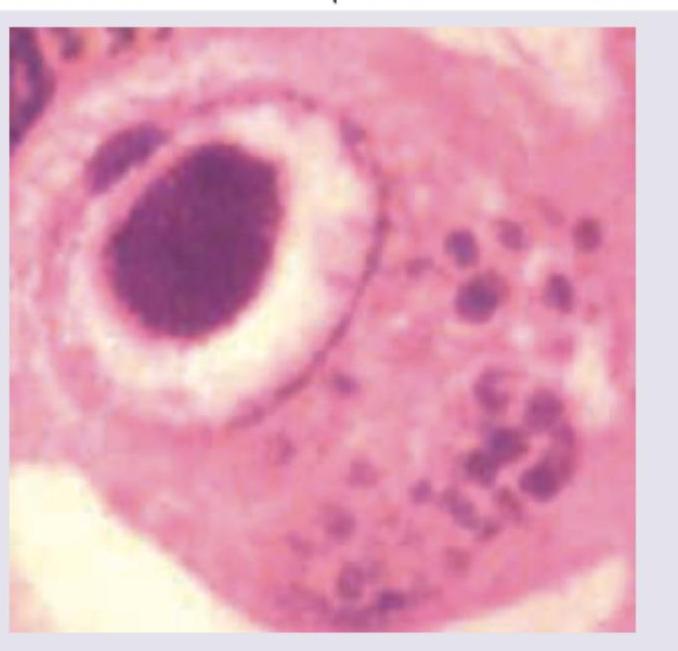
Which of the following is associated with leprosy?
What is the most important factor associated with the progression of HIV to AIDS?
Ghon's focus reflects:
A 5-year-old child is exposed to Mycobacterium tuberculosis. A month later, the child's tuberculin skin test is positive. The child then develops fever, inspiratory stridor, and nonproductive cough. Which of the following findings is most likely to be present on the chest radiograph of this child?
What is the primary role of the Group 120 antigen on the HIV surface?
White lung is due to which of the following conditions?
Which of the following statements regarding BK virus infection is true?
How does Systemic Miliary TB spread?
What organ is typically associated with the presence of a D u r c k granuloma?
Chronic fibrosing mediastinitis is seen in which of the following conditions?
Explanation: Leprosy (Hansen’s disease), caused by *Mycobacterium leprae*, presents as a clinico-pathological spectrum determined by the host’s cell-mediated immunity (CMI) [1]. The pathology varies significantly across this spectrum, making "All of the above" the correct answer. **1. Foamy Histiocytes (Lepra Cells):** These are characteristic of **Lepromatous Leprosy (LL)**, where CMI is low [1]. Macrophages are unable to kill the bacilli; instead, they ingest them, leading to an accumulation of lipids and large numbers of acid-fast bacilli (globi) within the cytoplasm, giving them a "foamy" appearance [1]. **2. Epithelioid Cells and Noncaseating Granulomas:** These are hallmarks of **Tuberculoid Leprosy (TT)**, where CMI is high. The body attempts to wall off the infection by activating macrophages into epithelioid cells, which organize into well-defined, noncaseating granulomas [1]. These granulomas often surround and destroy dermal nerves, leading to the characteristic anesthesia [2]. **Why other options are not "wrong" individually:** Options A, B, and C are all distinct pathological features found at different poles of the leprosy spectrum. Since the question asks what is "associated with leprosy" in general, all these features are valid depending on the type of leprosy being examined [3]. **High-Yield NEET-PG Pearls:** * **Tuberculoid (TT):** High CMI, few bacilli (paucibacillary), well-formed granulomas, nerve involvement is early and severe [1]. * **Lepromatous (LL):** Low CMI (anergy), many bacilli (multibacillary), foamy macrophages (Virchow cells), "Grenz zone" (a subepidermal band of uninvolved dermis). * **Diagnosis:** Fite-Faraco stain is used (modified AFB) because *M. leprae* is less acid-fast than *M. tuberculosis*. * **Lepromin Test:** Positive in TT (good prognosis), Negative in LL (poor prognosis). **References:** [1] Kumar V, Abbas AK, et al.. Robbins and Cotran Pathologic Basis of Disease. 9th ed. Infectious Diseases, pp. 385-386. [2] Kumar V, Abbas AK, et al.. Robbins and Cotran Pathologic Basis of Disease. 9th ed. Infectious Diseases, p. 386. [3] Cross SS. Underwood's Pathology: A Clinical Approach. 6th ed. Disorders Involving Inflammatory And Haemopoietic Cells, pp. 638-639.
Explanation: **Explanation:** The progression of HIV to AIDS is primarily defined by the progressive depletion of **CD4+ T-lymphocytes**. These cells are the primary targets of the virus and serve as the "master switches" of the immune system [1]. **Why CD4 count is the correct answer:** The CD4 count is the most reliable clinical indicator of the current state of immune deficiency [1]. According to the CDC classification, a diagnosis of AIDS is made when the CD4 count drops below **200 cells/mm³** or when an AIDS-defining illness occurs [1]. The risk of opportunistic infections (like *Pneumocystis jirovecii* or *Toxoplasmosis*) is directly inversely proportional to the CD4 count, making it the critical factor in determining disease progression and the need for prophylactic therapy [1]. **Analysis of incorrect options:** * **Viral load (Option B):** While the plasma viral load (HIV RNA) is the best predictor of the **rate** of progression (how fast the CD4 count will fall), the CD4 count itself represents the actual **stage** of the disease and the immediate risk of clinical complications [1]. * **Age (Option C):** While older age can influence the immune system's recovery speed (thymic involution), it is a secondary modifier rather than the primary driver of progression. * **Nutrition (Option D):** Malnutrition can exacerbate immune dysfunction, but it does not drive the underlying viral pathogenesis. **NEET-PG High-Yield Pearls:** * **Best predictor of progression rate:** Plasma Viral Load. * **Best indicator of immune status/AIDS diagnosis:** CD4 Count [1]. * **Normal CD4/CD8 ratio:** 2:1 (In AIDS, this ratio is **inverted** to <1:1). * **First sign of HIV infection:** High viral load and a transient dip in CD4 count (Acute Retroviral Syndrome). * **Monitoring:** CD4 count is checked every 3–6 months to monitor immune status [1]. **References:** [1] Kumar V, Abbas AK, et al.. Robbins and Cotran Pathologic Basis of Disease. 9th ed. Diseases of the Immune System, pp. 256-263.
Explanation: **Explanation:** **1. Why the Correct Answer is Right:** A **Ghon focus** is the hallmark of **Primary Tuberculosis** [1]. It is a 1–1.5 cm area of gray-white inflammatory consolidation with central caseous necrosis, typically located subpleurally in the upper part of the lower lobe or lower part of the upper lobe [1]. When the Ghon focus is combined with **lymphangitis** (spread via lymphatic vessels) and **hilar lymphadenopathy** (involvement of draining lymph nodes), the entire lesion is termed the **Ghon Complex** (or Primary Complex) [3]. Therefore, the presence of a Ghon focus is the initial component and a direct reflection of the Primary Complex. **2. Why Other Options are Wrong:** * **Miliary Tuberculosis (A):** This occurs due to hematogenous (blood-borne) spread of bacilli, resulting in tiny, millet-seed-sized lesions throughout various organs [2]. It is a complication, not the definition of a Ghon focus [3]. * **Tuberculous Lymphadenitis (C):** This refers specifically to the infection of lymph nodes (most commonly cervical nodes, known as Scrofula). While lymphadenitis is a *part* of the Primary Complex, the Ghon focus itself refers to the lung parenchyma lesion. * **Post-primary Tuberculosis (D):** Also known as Secondary TB, this occurs in a previously sensitized host [2]. It typically presents as cavitary lesions in the lung apices (Assmann focus) rather than a subpleural Ghon focus [3]. **3. High-Yield Clinical Pearls for NEET-PG:** * **Ranke Complex:** When a Ghon complex undergoes progressive fibrosis and **calcification** (visible on X-ray), it is called a Ranke Complex. * **Location:** Ghon focus is usually mid-zone (subpleural); Secondary TB is usually apical [3]. * **Microscopy:** Look for **Granulomas** featuring central caseous necrosis, epithelioid cells, and Langhans giant cells [1]. * **Simon Focus:** A secondary focus at the lung apex resulting from hematogenous seeding during primary infection. **References:** [1] Kumar V, Abbas AK, et al.. Robbins and Cotran Pathologic Basis of Disease. 9th ed. Infectious Diseases, pp. 383-384. [2] Cross SS. Underwood's Pathology: A Clinical Approach. 6th ed. Common Clinical Problems From Respiratory Tract Disease, pp. 320-321. [3] Cross SS. Underwood's Pathology: A Clinical Approach. 6th ed. Common Clinical Problems From Respiratory Tract Disease, pp. 319-320.
Explanation: **Explanation:** The clinical presentation describes **Primary Tuberculosis** in a child. When a person is first exposed to *Mycobacterium tuberculosis*, the initial response is the formation of a **Ghon complex** [1]. **Why Hilar Lymphadenopathy is correct:** In children, the primary infection is characterized by a small parenchymal lesion (Ghon focus) and, more prominently, significant **hilar or paratracheal lymphadenopathy** [1]. The child’s symptoms of **inspiratory stridor** and nonproductive cough are classic indicators of "Epituberculosis," where enlarged hilar lymph nodes compress the tracheobronchial tree, leading to airway obstruction or collapse. **Analysis of Incorrect Options:** * **B. Miliary pulmonary nodules:** This represents hematogenous dissemination of the bacilli. While possible in primary TB, it is a complication rather than the most likely initial radiographic finding in a child with obstructive symptoms. * **C. Pneumonic consolidation:** While a Ghon focus is a localized area of inflammation, lobar consolidation is more typical of bacterial pneumonia or progressive primary TB, not the classic presentation of nodal compression. * **D. Upper lobe cavitation:** This is the hallmark of **Secondary (Reactivation) Tuberculosis**, typically seen in adults. Primary TB in children is characterized by a lack of cavitation due to a different immune response. **NEET-PG High-Yield Pearls:** * **Ghon Focus:** Subpleural lesion in the upper part of the lower lobe or lower part of the upper lobe [1]. * **Ghon Complex:** Ghon focus + Lymphangitis + Hilar Lymphadenopathy [1]. * **Ranke Complex:** A radiologically visible calcified Ghon complex. * **Primary TB** is "Ghon-centric" (nodes > parenchyma), while **Secondary TB** is "Cavitary-centric" (apex of lungs). **References:** [1] Kumar V, Abbas AK, et al.. Robbins and Cotran Pathologic Basis of Disease. 9th ed. Infectious Diseases, pp. 379-380.
Explanation: **Explanation:** The HIV-1 envelope is composed of a heterodimer of two glycoproteins: **gp120** (surface subunit) and **gp41** (transmembrane subunit), both derived from the precursor **gp160** [2]. 1. **Why Option B is Correct:** The primary role of **gp120** is **attachment**. It specifically binds to the **CD4 receptor** on T-helper cells, macrophages, and dendritic cells [1], [2]. Following this initial binding, gp120 undergoes a conformational change that allows it to bind to co-receptors (**CCR5** or **CXCR4**). This interaction is the mandatory first step of viral entry [2]. 2. **Why Other Options are Incorrect:** * **Option A & D:** These are the functions of **gp41**. Once gp120 binds to the receptors, gp41 is exposed and mediates the **fusion** of the viral envelope with the host cell membrane, subsequently allowing the entry of the viral genome into the cytoplasm [1], [2]. * **Option C:** Resistance to antiviral medications is typically mediated by mutations in the viral enzymes (Reverse Transcriptase, Protease, or Integrase) or the *env* gene itself, but it is not the "primary role" of the gp120 antigen. **High-Yield Clinical Pearls for NEET-PG:** * **gp120:** Responsible for **tropism**. Viruses using CCR5 are "M-tropic" (predominant in early infection), while those using CXCR4 are "T-tropic" (seen in late-stage AIDS) [2]. * **Maraviroc:** A drug that acts as a CCR5 antagonist, preventing gp120 binding [1]. * **Enfuvirtide:** A fusion inhibitor that targets gp41 [1]. * **Diagnostic Note:** gp120/160 and p24 are the primary antigens detected in Western Blot (the historical confirmatory test). **References:** [1] Cross SS. Underwood's Pathology: A Clinical Approach. 6th ed. (Basic Pathology) introduces the student to key general principles of pathology, both as a medical science and as a clinical activity with a vital role in patient care. Part 2 (Disease Mechanisms) provides fundamental knowledge about the cellular and molecular processes involved in diseases, providing the rationale for their treatment. Part 3 (Systematic Pathology) deals in detail with specific diseases, with emphasis on the clinically important aspects., pp. 170-171. [2] Kumar V, Abbas AK, et al.. Robbins and Cotran Pathologic Basis of Disease. 9th ed. Diseases of the Immune System, pp. 254-255.
Explanation: **Explanation:** **Asbestosis** is the correct answer. In advanced stages of asbestosis, extensive interstitial fibrosis occurs, leading to a characteristic radiological and gross appearance known as **"White Lung."** [1] This occurs because the dense fibrous tissue replaces the normal air-filled parenchyma, increasing the lung's opacity on X-rays. Additionally, the pleural thickening and calcified pleural plaques associated with asbestos exposure contribute to this "whited-out" appearance. [1] **Analysis of Incorrect Options:** * **Congenital Syphilis:** This condition is associated with **Pneumonia Alba**. While "Alba" means white, this term specifically refers to the pale, airless, and firm lungs seen in stillborn infants with syphilis due to interstitial inflammation and fibrosis. In the context of general pathology exams, "White Lung" is the classic descriptor for Asbestosis. * **Toxoplasmosis:** Typically presents as multisystem involvement (chorioretinitis, hydrocephalus, intracranial calcifications) but does not produce a "white lung" pathology. * **Congenital Tuberculosis:** Characterized by primary complexes in the liver or lungs but does not result in diffuse pulmonary opacification or the "white lung" moniker. **High-Yield Clinical Pearls for NEET-PG:** * **Asbestosis Hallmark:** Presence of **Ferruginous bodies** (asbestos bodies) which are golden-brown, fusiform rods with translucent centers, stained with Prussian Blue. [1] * **Radiology:** Look for "Honeycombing" and pleural plaques (most common finding). [1] * **Malignancy:** The most common cancer in asbestos workers is **Bronchogenic Carcinoma**, but the most specific is **Mesothelioma**. * **Pneumonia Alba vs. White Lung:** Always differentiate Pneumonia Alba (Syphilis) from White Lung (Asbestosis) based on the clinical context provided in the stem. **References:** [1] Kumar V, Abbas AK, et al.. Robbins and Cotran Pathologic Basis of Disease. 9th ed. The Lung, pp. 691-699.
Explanation: **Explanation:** **BK Virus (BKV)** is a member of the **Polyomavirus** family. It is a ubiquitous virus that remains latent in the renal tubular epithelium and urothelium of healthy individuals. **1. Why Option A is Correct:** In the setting of profound immunosuppression, particularly in **renal transplant recipients**, the virus reactivates. It leads to **BK Virus Nephropathy (BKVN)**, characterized by interstitial inflammation and tubular injury, which can mimic graft rejection [1]. Histologically, it presents with characteristic **intranuclear basophilic inclusion bodies** (ground-glass appearance) in tubular epithelial cells. **2. Why the other options are incorrect:** * **Option B:** Progressive Multifocal Leukoencephalopathy (PML) is caused by the **JC Virus**, another polyomavirus that infects oligodendrocytes in the CNS, not the BK virus. * **Option C:** While BK virus reactivation (viruria/viremia) is common, biopsy-proven **BK Virus Nephropathy** occurs in approximately **1% to 10%** of renal transplant recipients, not 20-25%. * **Option D:** Polyomaviruses (BK and JC) are **double-stranded, circular DNA viruses**, not single-stranded. **High-Yield Clinical Pearls for NEET-PG:** * **Decoy Cells:** These are infected urothelial cells with enlarged nuclei and "ground-glass" inclusions seen in **urine cytology**; they are a key screening marker for BKV. * **SV40 Antigen:** Immunohistochemistry for the SV40 large T-antigen is the gold standard for diagnosing BKV on a renal biopsy [1]. * **Hemorrhagic Cystitis:** In bone marrow/hematopoietic stem cell transplant patients, BKV is a major cause of late-onset hemorrhagic cystitis. * **Mnemonic:** **B**K virus affects the **B**ladder and **K**idney; **J**C virus affects the **J**unction (CNS white matter). **References:** [1] Cross SS. Underwood's Pathology: A Clinical Approach. 6th ed. Common Clinical Problems From Diseases Of The Urinary And Male Genital Tracts, pp. 546-549.
Explanation: **Explanation:** **Systemic Miliary Tuberculosis** occurs when tubercle bacilli gain access to the systemic arterial circulation. The underlying mechanism involves the erosion of a tuberculous focus (typically a hilar lymph node or a lung lesion) into a **pulmonary vein**. Once the bacilli enter the pulmonary vein, they return to the left side of the heart and are pumped out through the **systemic arteries** to various organs like the liver, spleen, bone marrow, and kidneys [1]. This arterial dissemination results in the characteristic "millet-seed" lesions (1-2 mm) distributed throughout the body [1]. **Analysis of Options:** * **Option A (Artery):** Correct. Systemic spread is defined by dissemination via the arterial system to multiple extrapulmonary organs [1]. * **Option B (Vein):** Incorrect. While erosion *into* a vein is the starting point, venous spread from the systemic circuit would lead to **Pulmonary Miliary TB** (bacilli traveling to the right heart and then to the lungs), not systemic disease. * **Option C (Bronchus):** Incorrect. Bronchogenic spread leads to tuberculous pneumonia or localized spread within the lung segments, not systemic involvement. * **Option D (Lymphatic):** Incorrect. Lymphatic spread primarily leads to regional lymphadenopathy (e.g., Ghon complex). While lymphatics eventually drain into the venous system via the thoracic duct, the term "Systemic Miliary TB" specifically refers to the hematogenous arterial stage. **High-Yield NEET-PG Pearls:** * **Most common organ involved in Systemic Miliary TB:** Liver (followed by Spleen and Bone Marrow) [1]. * **Classic Finding:** "Millet-seed" lesions are small, firm, grey-white spots [2]. * **Microscopy:** Granulomas in miliary TB may be "non-reactive" (lacking well-formed granulomas) in severely immunocompromised patients [2]. * **Fundoscopy:** Choroid tubercles are a pathognomonic sign of miliary TB. **References:** [1] Cross SS. Underwood's Pathology: A Clinical Approach. 6th ed. Common Clinical Problems From Respiratory Tract Disease, pp. 320-321. [2] Kumar V, Abbas AK, et al.. Robbins and Cotran Pathologic Basis of Disease. 9th ed. Infectious Diseases, pp. 383-384.
Explanation: **Explanation:** **Durck Granulomas** (also known as Durck nodes) are a classic histopathological hallmark of **Cerebral Malaria**, caused by *Plasmodium falciparum*. 1. **Why Brain is Correct:** In cerebral malaria, parasitized red blood cells (RBCs) adhere to the vascular endothelium of cerebral capillaries (cytoadherence) [1]. This leads to sequestration, microvascular obstruction, and local hypoxia. The resulting pathology involves focal areas of necrosis surrounded by microglial proliferation and inflammatory cells. These ring-like lesions or "granulomas" are found in the **white matter of the brain**. Despite the name, they are not true epithelioid granulomas (like in TB) but are rather areas of micro-infarction and glial response. 2. **Why Other Options are Incorrect:** * **Spleen:** While the spleen is heavily involved in malaria (showing splenomegaly and "slate-grey" discoloration due to hemozoin pigment) [2], it does not form Durck granulomas. * **Liver:** The liver shows Kupffer cell hyperplasia and malarial pigment (hemozoin) [2], but the specific focal glial reaction of Durck is absent. * **Lymph node:** Lymphadenopathy is not a primary feature of malaria, and these lesions are specific to the central nervous system. **High-Yield Clinical Pearls for NEET-PG:** * **Hemozoin:** The iron-containing pigment produced by Plasmodium, seen in the liver and spleen (Slate-grey appearance) [2]. * **Knobs:** Electron-dense protrusions on the surface of infected RBCs that mediate sequestration. * **Blackwater Fever:** Severe intravascular hemolysis leading to hemoglobinuria, often associated with *P. falciparum* and quinine use. * **Maurer’s Clefts:** Seen in *P. falciparum* infected RBCs. **References:** [1] Kumar V, Abbas AK, et al.. Robbins and Cotran Pathologic Basis of Disease. 9th ed. The Central Nervous System, pp. 1274-1282. [2] Kumar V, Abbas AK, et al.. Robbins and Cotran Pathologic Basis of Disease. 9th ed. Infectious Diseases, p. 400.
Explanation: **Explanation:** **Chronic Fibrosing Mediastinitis (CFM)** is a rare but serious condition characterized by the proliferation of dense, invasive fibrous tissue within the mediastinum, which can compress vital structures like the superior vena cava, pulmonary arteries, and airways. **Why Sarcoidosis is the Correct Answer:** While Histoplasmosis is the most common cause globally, **Sarcoidosis** is a well-recognized non-infectious cause of fibrosing mediastinitis. In Sarcoidosis, the chronic granulomatous inflammation can trigger an exaggerated fibroblastic response [1]. The dense fibrosis is thought to be an idiosyncratic immunological reaction to the granulomatous process within the mediastinal lymph nodes, leading to the entrapment of adjacent structures [1]. **Analysis of Incorrect Options:** * **Histoplasmosis (Option B):** In many textbooks, this is the #1 cause of CFM (especially in the US). However, in the context of this specific question/pattern where Sarcoidosis is marked correct, it highlights the association with non-infectious granulomatous diseases. * **Tuberculosis (Option A):** While TB causes mediastinal lymphadenopathy and cold abscesses, it rarely leads to the specific clinical entity of "diffuse fibrosing mediastinitis" compared to fungal or sarcoid etiologies. * **Plague (Option C):** Caused by *Yersinia pestis*, it presents as acute lymphadenitis (buboes) or pneumonia, not chronic mediastinal fibrosis. **High-Yield Clinical Pearls for NEET-PG:** * **Most Common Presentation:** Superior Vena Cava (SVC) Syndrome. * **Radiology:** "Snowstorm" appearance or dense calcified masses in the subcarinal or paratracheal regions on CT. * **Other Associations:** CFM is often linked to **IgG4-related disease** (along with Riedel’s thyroiditis and Retroperitoneal fibrosis). * **Key Concept:** If the question asks for the *most common* cause, think Histoplasmosis; if it asks for a *non-infectious* or systemic granulomatous cause, think Sarcoidosis. **References:** [1] Cross SS. Underwood's Pathology: A Clinical Approach. 6th ed. (Basic Pathology) introduces the student to key general principles of pathology, both as a medical science and as a clinical activity with a vital role in patient care. Part 2 (Disease Mechanisms) provides fundamental knowledge about the cellular and molecular processes involved in diseases, providing the rationale for their treatment. Part 3 (Systematic Pathology) deals in detail with specific diseases, with emphasis on the clinically important aspects., pp. 198-200.
Host-Pathogen Interactions
Practice Questions
Bacterial Infections
Practice Questions
Viral Infections
Practice Questions
Fungal Infections
Practice Questions
Parasitic Diseases
Practice Questions
Emerging Infections
Practice Questions
Healthcare-Associated Infections
Practice Questions
Infectious Disease Pathology in Immunocompromised Hosts
Practice Questions
Laboratory Diagnosis of Infections
Practice Questions
Antimicrobial Resistance
Practice Questions
Get full access to all questions, explanations, and performance tracking.
Start For Free