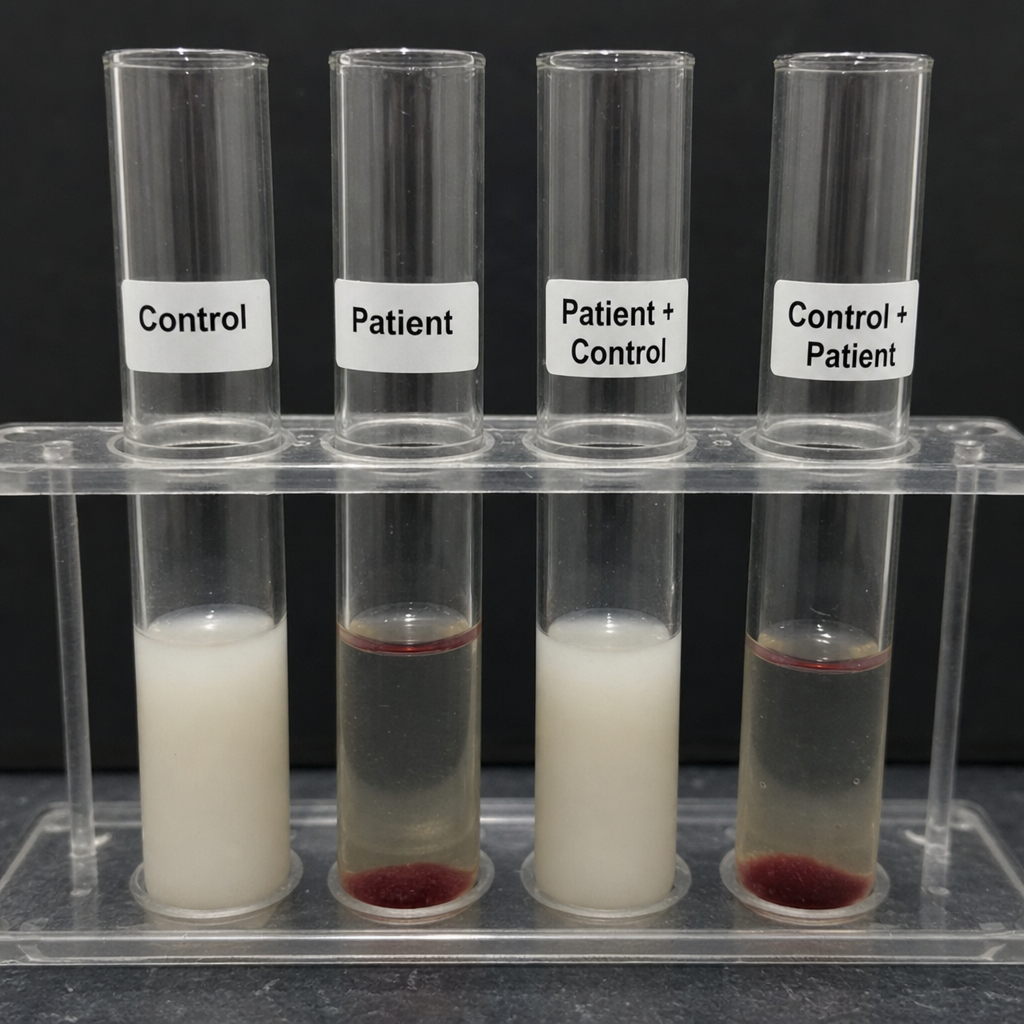
Absent parathyroid, thymic aplasia with immunodeficiency, and heart defects are features of which condition?
A 12-year-old boy presents with a history of recurrent infections over 10 years, including Pneumocystis jiroveci pneumonia, Streptococcus pneumoniae otitis media, and Pseudomonas aeruginosa urinary tract infection. His current examination reveals a temperature of 38.5°C and pharyngeal erythema with exudate. Laboratory findings include hemoglobin of 9.1 g/dL, hematocrit of 27.6%, platelet count of 130,900/mm³, and a WBC count of 3440/mm³ with 47% segmented neutrophils, 3% bands, 40% lymphocytes, and 10% monocytes. Serum immunoglobulin levels show very low IgG, very high IgM, and undetectable IgA. A peripheral blood smear reveals nucleated RBCs. Which of the following immunologic defects is most likely to produce this clinical presentation?
Necrotising arteritis with fibrinoid necrosis is characteristic of which immunological mechanism?
Band test is done in which of the following conditions?
Which of the following can be seen in Severe Combined Immunodeficiency (SCID)?
Anti-fibrillarin antibodies are associated with which condition?
Which of the following statements regarding bone marrow transplantation is true?
Within 5 minutes after a bee sting, a 15-year-old girl suddenly has difficulty breathing, with marked inspiratory stridor from laryngeal edema. She experiences marked urticaria and notes swelling of the hand that was stung. Which of the following is the best pharmacologic agent to treat her signs and symptoms?
Hyperacute rejection is due to which of the following mechanisms?
A 28-year-old man presents with a 2-day history of hemoptysis and hematuria. His vital signs are: temperature 36.8°C, pulse 87/min, respirations 19/min, and blood pressure 150/90 mm Hg. Laboratory findings include creatinine 3.8 mg/dL and urea nitrogen 35 mg/dL. Urinalysis reveals 4+ hematuria, 2+ proteinuria, and no glucose. A renal biopsy shows glomerular damage with linear immunofluorescence for C3 and anti-IgG antibody. Which of the following autoantibodies has the greatest specificity for this patient's condition?
Explanation: **DiGeorge Syndrome** (also known as 22q11.2 deletion syndrome) is the correct answer [1]. This condition results from a developmental failure of the **3rd and 4th pharyngeal pouches** during embryogenesis [2]. ### Why DiGeorge Syndrome is Correct: The 3rd and 4th pouches are responsible for forming the thymus, parathyroid glands, and parts of the heart/great vessels. The classic triad includes: 1. **Thymic Aplasia/Hypoplasia:** Leads to T-cell deficiency and recurrent viral/fungal infections. 2. **Hypocalcemia:** Due to absent parathyroid glands (hypoparathyroidism), often presenting as tetany in neonates [1]. 3. **Conotruncal Heart Defects:** Such as Tetralogy of Fallot or Interrupted Aortic Arch [2]. 4. **Facial Dysmorphism:** Low-set ears, cleft palate, and bifid uvula (CATCH-22 mnemonic) [2]. ### Why Other Options are Incorrect: * **Autoimmune Polyglandular Syndrome (APS):** A group of disorders characterized by autoimmune destruction of endocrine glands (e.g., Addison’s disease, Type 1 DM). It is an acquired autoimmune process, not a developmental pouch defect. * **Pendred Syndrome:** An autosomal recessive disorder characterized by sensorineural hearing loss and goiter (thyroid dysfunction). It does not involve the thymus or parathyroids. * **Lesch-Nyhan Syndrome:** An X-linked recessive disorder caused by **HGPRT deficiency**, leading to hyperuricemia, gout, and self-mutilating behavior. ### High-Yield Clinical Pearls for NEET-PG: * **Mnemonic (CATCH-22):** **C**ardiac defects, **A**bnormal facies, **T**hymic hypoplasia, **C**left palate, **H**ypocalcemia, **22**q11 deletion [2]. * **Immunology:** Patients have low T-cell counts but normal B-cell counts (though antibody production may be impaired due to lack of T-cell help). * **Diagnosis:** Confirmed via **FISH** (Fluorescence In Situ Hybridization) for the 22q11.2 microdeletion [3]. * **Radiology:** Look for the **absence of a thymic shadow** on a neonatal chest X-ray. **References:** [1] Kumar V, Abbas AK, et al.. Robbins and Cotran Pathologic Basis of Disease. 9th ed. The Endocrine System, pp. 1107-1108. [2] Cross SS. Underwood's Pathology: A Clinical Approach. 6th ed. (Basic Pathology) introduces the student to key general principles of pathology, both as a medical science and as a clinical activity with a vital role in patient care. Part 2 (Disease Mechanisms) provides fundamental knowledge about the cellular and molecular processes involved in diseases, providing the rationale for their treatment. Part 3 (Systematic Pathology) deals in detail with specific diseases, with emphasis on the clinically important aspects., pp. 167-168. [3] Kumar V, Abbas AK, et al.. Robbins and Cotran Pathologic Basis of Disease. 9th ed. Genetic Disorders, p. 173.
Explanation: ### **Explanation** The clinical presentation of recurrent infections (both pyogenic and opportunistic like *Pneumocystis jiroveci*), combined with the classic triad of **low IgG, low IgA, and markedly elevated IgM**, is diagnostic of **Hyper-IgM Syndrome (HIGM)**. **1. Why Option B is Correct:** The most common form (Type 1 HIGM) is X-linked and caused by a mutation in the **CD40 Ligand (CD40L/CD154)** on T-cells. * **Mechanism:** B-cells require a "second signal" via the interaction between CD40 (on B-cells) and CD40L (on activated T-cells) to undergo **heavy-chain class switching** [1]. * **Result:** Without this interaction, B-cells can only produce IgM, leading to a deficiency of IgG, IgA, and IgE. * **Opportunistic Infections:** CD40L is also essential for T-cell-mediated activation of macrophages. Its absence explains the susceptibility to *Pneumocystis jiroveci*. **2. Why Other Options are Incorrect:** * **A. Adenosine Deaminase (ADA) Deficiency:** Causes **SCID** [3]. This would present with profound lymphopenia (both T and B cells) and very low levels of *all* immunoglobulin classes, including IgM. * **C. Deletion of 22q11 (DiGeorge Syndrome):** Characterized by thymic hypoplasia leading to T-cell deficiency, hypocalcemia, and cardiac defects [3]. It does not typically present with isolated hyper-IgM. * **D. HIV Infection:** While it causes opportunistic infections, it typically presents with a decrease in CD4+ counts and polyclonal **hypergammaglobulinemia** (elevated IgG), not a selective elevation of IgM with absent IgA. **3. NEET-PG High-Yield Pearls:** * **Inheritance:** Most common form is **X-linked Recessive** (affects males). * **Clinical Clue:** Look for a male child with *Pneumocystis* pneumonia and "Normal to High" IgM. * **Hematologic finding:** Patients often have **cyclic neutropenia** (explaining the low WBC count in this case). * **Lymphoid tissue:** Characterized by a lack of **germinal centers** in lymph nodes [2]. **References:** [1] Kumar V, Abbas AK, et al.. Robbins and Cotran Pathologic Basis of Disease. 9th ed. Diseases of the Immune System, pp. 249-250. [2] Kumar V, Abbas AK, et al.. Robbins and Cotran Pathologic Basis of Disease. 9th ed. Diseases of the Immune System, pp. 248-249. [3] Cross SS. Underwood's Pathology: A Clinical Approach. 6th ed. (Basic Pathology) introduces the student to key general principles of pathology, both as a medical science and as a clinical activity with a vital role in patient care. Part 2 (Disease Mechanisms) provides fundamental knowledge about the cellular and molecular processes involved in diseases, providing the rationale for their treatment. Part 3 (Systematic Pathology) deals in detail with specific diseases, with emphasis on the clinically important aspects., pp. 167-168.
Explanation: **Explanation:** **1. Why Option B is Correct:** Necrotizing arteritis with **fibrinoid necrosis** is the hallmark of **Type III Hypersensitivity (Antigen-Antibody Complex Mediated)** [1]. In this mechanism, circulating immune complexes deposit in the walls of blood vessels [1]. These complexes activate the **classical complement pathway**, leading to the generation of C5a (chemotactic for neutrophils). Neutrophils release lysosomal enzymes and reactive oxygen species that damage the vessel wall. Plasma proteins, including fibrin, leak into the damaged wall, creating a bright pink, amorphous appearance under H&E stain known as "fibrinoid necrosis." **2. Why Other Options are Incorrect:** * **Option A (Immediate Hypersensitivity):** Type I reactions are mediated by IgE and mast cell degranulation (e.g., anaphylaxis, asthma) [4]. They do not cause vascular necrosis. * **Option C (Cell-mediated Immunity):** Type IV reactions involve T-lymphocytes and macrophages. They typically lead to **granuloma formation** (e.g., TB) or contact dermatitis, not acute necrotizing arteritis. * **Option D (Cytotoxic Mediated):** Type II reactions involve antibodies (IgG/IgM) binding to fixed antigens on cell surfaces or tissues (e.g., Goodpasture syndrome) [4]. While they cause inflammation, they are not the classic cause of systemic necrotizing vasculitis. **3. NEET-PG High-Yield Pearls:** * **Classic Examples:** Polyarteritis Nodosa (PAN), Systemic Lupus Erythematosus (SLE), and Arthus Reaction [3]. * **Microscopic Appearance:** The vessel wall shows a "smudgy" eosinophilic (pink) appearance due to fibrin deposition [5]. * **Complement:** Type III reactions are associated with **low serum complement levels** (C3, C4) because they are consumed during the inflammatory process. * **Arthus Reaction:** A localized form of Type III hypersensitivity characterized by tissue necrosis following antigen injection in a previously sensitized individual [2]. **References:** [1] Kumar V, Abbas AK, et al.. Robbins and Cotran Pathologic Basis of Disease. 9th ed. Diseases of the Immune System, pp. 214-215. [2] Cross SS. Underwood's Pathology: A Clinical Approach. 6th ed. (Basic Pathology) introduces the student to key general principles of pathology, both as a medical science and as a clinical activity with a vital role in patient care. Part 2 (Disease Mechanisms) provides fundamental knowledge about the cellular and molecular processes involved in diseases, providing the rationale for their treatment. Part 3 (Systematic Pathology) deals in detail with specific diseases, with emphasis on the clinically important aspects., pp. 172-173. [3] Kumar V, Abbas AK, et al.. Robbins and Cotran Pathologic Basis of Disease. 9th ed. Diseases of the Immune System, pp. 215-216. [4] Kumar V, Abbas AK, et al.. Robbins and Cotran Pathologic Basis of Disease. 9th ed. Diseases of the Immune System, pp. 208-210. [5] Kumar V, Abbas AK, et al.. Robbins and Cotran Pathologic Basis of Disease. 9th ed. Diseases of Infancy and Childhood, pp. 514-515.
Explanation: The **Lupus Band Test (LBT)** is a diagnostic direct immunofluorescence (DIF) technique used to detect the deposition of immunoglobulins (IgG, IgM) and complement components (C3) at the **dermo-epidermal junction (DEJ)**. [2] ### **Why Systemic Lupus Erythematosus (SLE) is Correct** In SLE, immune complexes circulate and deposit in various tissues. In the skin, these deposits appear as a characteristic **continuous granular band** of fluorescence along the DEJ. [4] * **Positive LBT in involved skin:** Seen in both Discoid Lupus (DLE) and SLE. [4] * **Positive LBT in uninvolved (normal) skin:** Highly specific for **Systemic Lupus Erythematosus (SLE)**. [4] This helps differentiate systemic involvement from localized cutaneous lupus. ### **Why Other Options are Incorrect** * **A. Rheumatoid Arthritis:** This is primarily a joint-focused inflammatory disease. While skin nodules occur, they do not show a linear/granular band of immune deposits at the DEJ. * **C. Scleroderma:** Characterized by excessive collagen deposition and fibrosis. Diagnosis relies on clinical features and specific antibodies (Anti-Scl70, Anti-centromere), not the Band Test. [1] * **D. Polyarteritis Nodosa:** A systemic necrotizing vasculitis affecting medium and small-sized arteries. Diagnosis is made via biopsy showing transmural inflammation or angiography, not DEJ immunofluorescence. ### **High-Yield Clinical Pearls for NEET-PG** * **Diagnostic Significance:** A positive Band Test on **sun-protected, uninvolved skin** is a strong indicator of SLE and often correlates with renal involvement. [3] * **Most common Ig:** **IgM** is the most frequently detected immunoglobulin in the Lupus Band Test. [4] * **False Positives:** Can occur in sun-exposed skin of healthy individuals or other bullous diseases, which is why testing "normal" skin is crucial for SLE diagnosis. * **Staining Pattern:** Granular (not linear, which is seen in Goodpasture syndrome or Bullous Pemphigoid). [2] **References:** [1] Kumar V, Abbas AK, et al.. Robbins and Cotran Pathologic Basis of Disease. 9th ed. Diseases of the Immune System, pp. 226-227. [2] Cross SS. Underwood's Pathology: A Clinical Approach. 6th ed. Common Clinical Problems From Diseases Of The Urinary And Male Genital Tracts, pp. 526-527. [3] Cross SS. Underwood's Pathology: A Clinical Approach. 6th ed. Disorders Involving Inflammatory And Haemopoietic Cells, pp. 639-640. [4] Kumar V, Abbas AK, et al.. Robbins and Cotran Pathologic Basis of Disease. 9th ed. Diseases of the Immune System, pp. 233-234.
Explanation: ### **Explanation** **Severe Combined Immunodeficiency (SCID)** is a pediatric emergency characterized by a profound defect in both **T-cell and B-cell immunity** [1]. #### **Why "Graft-versus-host disease (GVHD)" is Correct:** In SCID, the patient’s immune system is virtually non-existent (specifically lacking functional T-cells). If the patient receives a blood transfusion containing viable donor lymphocytes, or if maternal T-cells cross the placenta during pregnancy, the patient’s body cannot reject these foreign cells. Consequently, the **donor T-cells** recognize the host (the SCID infant) as foreign and mount an immune attack against the host's tissues. This results in **Graft-versus-host disease (GVHD)**, which typically presents with rash, diarrhea, and liver dysfunction. #### **Why Other Options are Incorrect:** * **A. Autoimmune diseases:** These require a functioning, albeit dysregulated, immune system to attack self-antigens. In SCID, the immune machinery is too deficient to mount such responses. * **B. Granuloma formation:** Granulomas are a product of **Type IV Hypersensitivity**, requiring functional **T-helper (Th1) cells** and macrophages. Since SCID patients lack functional T-cells, they cannot form organized granulomas. * **D. Graft rejection:** Rejection of a graft (Host-versus-Graft) requires the host’s T-cells to attack the donor tissue. Because SCID patients are severely T-cell deficient, they are **incapable of rejecting grafts**, which is precisely why they are susceptible to GVHD. --- ### **High-Yield Clinical Pearls for NEET-PG:** * **Most Common Cause:** X-linked SCID (mutation in the **IL-2 receptor gamma chain**) [1]. * **Autosomal Recessive Cause:** **ADA (Adenosine Deaminase) deficiency**, leading to the accumulation of toxic metabolites in lymphocytes [1]. * **Radiology/Pathology:** Look for a **"missing thymic shadow"** on X-ray and **thymic hypoplasia** (vestigial thymus) on biopsy. * **Management:** SCID is a "medical emergency"; the definitive treatment is **Hematopoietic Stem Cell Transplant (HSCT)**. All blood products must be **irradiated** to prevent GVHD. **References:** [1] Kumar V, Abbas AK, et al.. Robbins and Cotran Pathologic Basis of Disease. 9th ed. Diseases of the Immune System, pp. 247-248.
Explanation: **Anti-fibrillarin antibodies** (also known as **anti-U3 RNP**) are highly specific markers for **Systemic Sclerosis (SSc)**, particularly the **diffuse cutaneous subtype**. Fibrillarin is a major component of the nucleolus involved in pre-rRNA processing. On indirect immunofluorescence, these antibodies typically produce a **clumpy nucleolar pattern**. Clinically, anti-fibrillarin antibodies are associated with younger age of onset, frequent internal organ involvement (especially pulmonary hypertension and skeletal muscle involvement), and a generally poorer prognosis [1]. **Analysis of Incorrect Options:** * **A. Rheumatoid Arthritis:** Characterized by **Anti-CCP** (most specific) and Rheumatoid Factor (RF). It does not involve nucleolar antigens like fibrillarin [1]. * **B. Systemic Lupus Erythematosus (SLE):** Associated with **Anti-dsDNA** (specific/prognostic) and **Anti-Smith** (most specific). While ANA is positive, the patterns are usually homogeneous or speckled, not clumpy nucleolar [1]. * **C. Mixed Connective Tissue Disease (MCTD):** Defined by high titers of **Anti-U1 RNP** antibodies [1]. While it shares features of SSc, anti-fibrillarin is not a diagnostic marker for MCTD. **High-Yield Clinical Pearls for NEET-PG:** * **Anti-Scl-70 (Anti-topoisomerase I):** Specific for Diffuse Systemic Sclerosis; associated with pulmonary fibrosis [1]. * **Anti-Centromere:** Specific for **Limited** Systemic Sclerosis (**CREST syndrome**); associated with digital ischemia and pulmonary hypertension [1]. * **Anti-RNA Polymerase III:** Associated with diffuse skin involvement and increased risk of **Scleroderma Renal Crisis**. * **Nucleolar ANA Pattern:** Always think of Systemic Sclerosis (Anti-fibrillarin, Anti-Th/To, or Anti-PM-Scl). **References:** [1] Kumar V, Abbas AK, et al.. Robbins and Cotran Pathologic Basis of Disease. 9th ed. Diseases of the Immune System, pp. 236-239.
Explanation: ### Explanation **Correct Answer: A. Marrow is highly immunogenic and easily rejected by the non-immunosuppressed host.** Bone marrow is considered one of the most immunologically active tissues. It contains a high density of **antigen-presenting cells (APCs)**, such as dendritic cells and macrophages, along with mature T-lymphocytes. These cells express high levels of **MHC (HLA) antigens**. In a non-immunosuppressed host, the recipient’s immune system rapidly recognizes these foreign HLA markers, leading to vigorous graft rejection [1]. Therefore, "conditioning" the recipient with high-dose chemotherapy or total body irradiation is mandatory to suppress the host's immune system and create space for the new cells. **Analysis of Incorrect Options:** * **Option B & C:** These are incorrect because Hematopoietic Stem Cell Transplantation (HSCT) is the **definitive treatment** for severe aplastic anemia and various primary immunodeficiency diseases (e.g., SCID, Wiskott-Aldrich syndrome). It replaces the defective or absent stem cell lines with healthy ones. * **Option D:** While high-dose chemotherapy followed by autologous stem cell rescue was once researched for advanced breast cancer, large clinical trials have shown **no significant survival benefit** over standard therapy. It is not a standard or successful therapy for Stage IV breast cancer. **High-Yield Clinical Pearls for NEET-PG:** * **Graft-versus-Host Disease (GVHD):** Unique to marrow/stem cell transplants; here, the *graft's* T-cells attack the *host's* tissues (skin, liver, GI tract) [2]. * **HLA Matching:** The most critical factor for success is matching at the **HLA-A, B, and DR** loci [1]. * **Source of Stem Cells:** Can be Bone Marrow, Peripheral Blood (after mobilization with G-CSF), or Umbilical Cord Blood. **References:** [1] Kumar V, Abbas AK, et al.. Robbins and Cotran Pathologic Basis of Disease. 9th ed. Diseases of the Immune System, pp. 239-241. [2] Cross SS. Underwood's Pathology: A Clinical Approach. 6th ed. (Basic Pathology) introduces the student to key general principles of pathology, both as a medical science and as a clinical activity with a vital role in patient care. Part 2 (Disease Mechanisms) provides fundamental knowledge about the cellular and molecular processes involved in diseases, providing the rationale for their treatment. Part 3 (Systematic Pathology) deals in detail with specific diseases, with emphasis on the clinically important aspects., pp. 182-183.
Explanation: ### Explanation **Concept: Type I Hypersensitivity (Anaphylaxis)** The clinical presentation—rapid onset (within 5 minutes) of respiratory distress (laryngeal edema), stridor, and urticaria following an allergen exposure (bee sting)—is a classic description of **Anaphylaxis** [1]. This is a life-threatening **Type I Hypersensitivity reaction** mediated by IgE antibodies bound to mast cells and basophils, leading to the systemic release of histamine, leukotrienes, and prostaglandins [1]. **Why Epinephrine is the Correct Choice:** Epinephrine is the first-line treatment for anaphylaxis because of its rapid-acting sympathomimetic effects: * **α-1 agonist:** Causes vasoconstriction, which reduces laryngeal edema and increases peripheral vascular resistance (treating hypotension). * **β-2 agonist:** Causes bronchodilation, relieving the respiratory distress and stridor. * **Mast Cell Stabilization:** It inhibits the further release of inflammatory mediators. **Why Other Options are Incorrect:** * **Cyclosporine (A):** An immunosuppressant that inhibits calcineurin and T-cell activation. It is used for transplant rejection and chronic autoimmune conditions; it has no role in acute emergency management. * **Glucocorticoids (C):** While used in anaphylaxis, they have a **slow onset of action** (hours). They are used to prevent "biphasic reactions" (late-phase responses) but cannot treat acute airway obstruction or shock [1]. * **Methotrexate (D):** A folate antagonist used for chemotherapy and chronic inflammatory diseases (e.g., Rheumatoid Arthritis). It is irrelevant in an acute allergic emergency. **NEET-PG High-Yield Pearls:** * **Mechanism:** Type I Hypersensitivity involves **IgE cross-linking** on mast cells [1]. * **Drug of Choice:** Epinephrine (Adrenaline) is given **Intramuscularly (IM)** in the anterolateral thigh (1:1000 concentration). * **Pathology:** Look for **Curschmann spirals** or **Charcot-Leyden crystals** in sputum if the reaction involves the lower airways (asthma) [2]. * **Biomarker:** Serum **Tryptase** levels are elevated shortly after an anaphylactic event and can be used for retrospective diagnosis. **References:** [1] Kumar V, Abbas AK, et al.. Robbins and Cotran Pathologic Basis of Disease. 9th ed. Diseases of the Immune System, pp. 210-213. [2] Kumar V, Abbas AK, et al.. Robbins and Cotran Pathologic Basis of Disease. 9th ed. The Lung, pp. 688-689.
Explanation: **Explanation:** **Hyperacute rejection** is a Type II hypersensitivity reaction that occurs within minutes to hours after transplantation. 1. **Why Option A is Correct:** The primary mechanism is the presence of **preformed antibodies** (humoral immunity) in the recipient's circulation. These antibodies are directed against antigens on the donor vascular endothelium (usually ABO blood group antigens or HLA Class I antigens). Once the graft is vascularized, these antibodies bind to the endothelium, activating the **complement system**. This leads to endothelial injury, fibrin-platelet thrombi formation, and neutrophilic infiltration, resulting in rapid ischemic necrosis of the graft (classically described as a "cyanotic, mottled, and flaccid" organ) [1]. 2. **Why Other Options are Incorrect:** * **Option B:** Cytotoxic T-lymphocyte (CD8+) mediated injury is the hallmark of **Acute Cellular Rejection**, which typically occurs days to weeks after transplant [1]. * **Option C:** Macrophages play a role in chronic inflammation and delayed-type hypersensitivity, but they are not the primary mediators of hyperacute rejection. * **Option D:** While endothelial injury occurs, "Endothelitis" (lymphocytes under the endothelium) is a characteristic histological feature of **Acute Cellular Rejection**, not hyperacute [1]. **High-Yield Clinical Pearls for NEET-PG:** * **Prevention:** Hyperacute rejection is now rare due to mandatory **pre-transplant cross-matching** (testing recipient serum against donor lymphocytes). * **Risk Factors:** Previous blood transfusions, multiple pregnancies, or prior organ transplants (all of which sensitize the recipient). * **Histology:** Look for widespread **microvascular thrombosis** and fibrinoid necrosis of arterial walls [1]. * **Timeline Summary:** * **Hyperacute:** Minutes/Hours (Preformed Antibodies). * **Acute:** Days/Weeks (T-cells or Antibodies) [1]. * **Chronic:** Months/Years (Fibrosis and Intimal thickening/Arteriosclerosis). **References:** [1] Kumar V, Abbas AK, et al.. Robbins and Cotran Pathologic Basis of Disease. 9th ed. Diseases of the Immune System, pp. 241-242.
Explanation: ### Explanation The patient presents with the classic triad of **Goodpasture Syndrome**: hemoptysis (pulmonary hemorrhage), hematuria (rapidly progressive glomerulonephritis), and acute renal failure (elevated creatinine) [1]. **1. Why the Correct Answer is Right:** The definitive diagnostic finding in this case is the **linear immunofluorescence** for IgG and C3 [1]. This pattern is pathognomonic for **Type II Hypersensitivity**, where autoantibodies are directed against the **α3 chain of Type IV collagen** found in the glomerular and alveolar basement membranes [1]. Therefore, **Anti-basement membrane (Anti-GBM) antibodies** are highly specific for this condition. **2. Why the Other Options are Wrong:** * **Anticardiolipin antibody:** Associated with Antiphospholipid Syndrome (APS), characterized by arterial/venous thrombosis and pregnancy loss, not linear glomerular deposits. * **Anti-double-stranded DNA (dsDNA) antibody:** Highly specific for Systemic Lupus Erythematosus (SLE). While SLE can cause nephritis, it typically shows a "lumpy-bumpy" (granular) immunofluorescence pattern due to immune complex deposition (Type III Hypersensitivity) [1]. * **Anti-histone antibody:** Primarily associated with Drug-Induced Lupus. **3. NEET-PG High-Yield Pearls:** * **Immunofluorescence Pattern:** Linear = Goodpasture Syndrome (Anti-GBM); Granular = Post-streptococcal GN or SLE; Pauci-immune = ANCA-associated vasculitis (Wegener’s) [1]. * **Morphology:** On light microscopy, Goodpasture Syndrome often presents as **Crescentic Glomerulonephritis** (RPGN Type I) [1]. * **Treatment:** Urgent plasmapheresis is required to remove the circulating anti-GBM antibodies, combined with corticosteroids and cyclophosphamide [1]. **References:** [1] Cross SS. Underwood's Pathology: A Clinical Approach. 6th ed. Common Clinical Problems From Diseases Of The Urinary And Male Genital Tracts, pp. 526-538.
Cells and Tissues of the Immune System
Practice Questions
Innate Immunity
Practice Questions
Adaptive Immunity
Practice Questions
Hypersensitivity Reactions
Practice Questions
Autoimmune Diseases
Practice Questions
Immunodeficiency Disorders
Practice Questions
Transplantation Immunopathology
Practice Questions
Immune Response to Infections
Practice Questions
Immunologic Laboratory Techniques
Practice Questions
Tumor Immunology
Practice Questions
Get full access to all questions, explanations, and performance tracking.
Start For Free