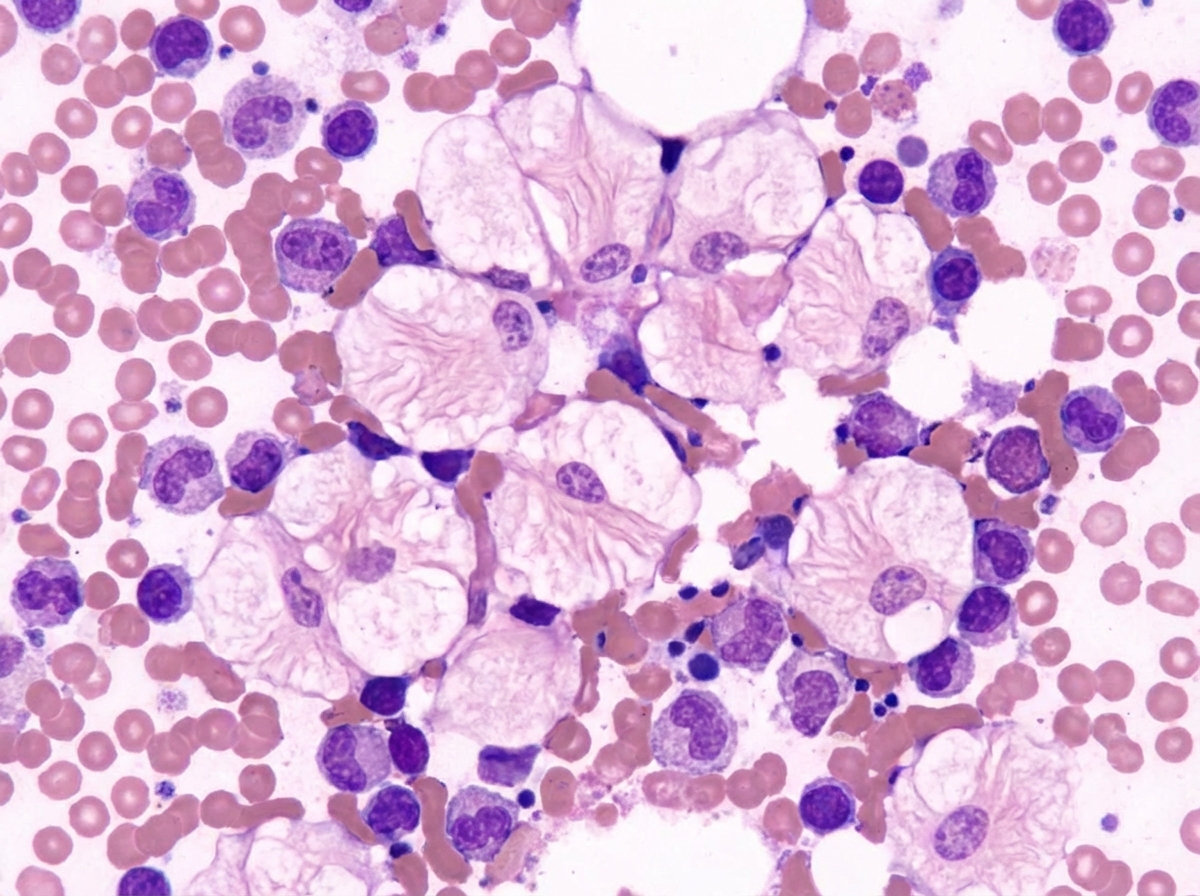
Acid phosphatase is specific to which of the following cells?
All the following diseases contain abnormal immunoglobulin except:
Which substance precipitates at 50 to 60 degrees Celsius but disappears on further heating?
Which of the following statements is FALSE regarding the cytochemistry of Acute Myeloid Leukemia (AML)?
Which of the following human malignancies is highly malignant, rapidly progressive, and where a delay in treatment of even 1-2 days can lead to death?
What is the CD marker of MALT lymphoma?
Richter's transformation is associated with which of the following conditions?
Incompatible blood transfusion leads to all except?
What is the most common type of Non-Hodgkin lymphoma?
Which of the following statements about Sickle cell anemia is INCORRECT?
Explanation: **Explanation:** In the context of cytochemical staining in hematopathology, **Acid Phosphatase (AP)** is a lysosomal enzyme used to differentiate various lineages of hematopoietic cells. **Why Monocytes are correct:** Monocytes and their mature forms (macrophages) are rich in lysosomes. Consequently, they show **strong, diffuse positivity** for Acid Phosphatase. While other cells may show focal positivity, the intensity and consistency in the monocytic lineage make it a characteristic marker for identifying these cells and their neoplastic counterparts (e.g., Acute Monocytic Leukemia - AML M5). **Analysis of Incorrect Options:** * **T lymphocytes:** These cells typically show **focal, polar (punctate)** positivity for Acid Phosphatase. While useful for diagnosing T-cell Acute Lymphoblastic Leukemia (T-ALL), it is not as "specific" or diffuse as in monocytes. * **B lymphocytes:** These cells are generally **Acid Phosphatase negative** or show only weak, inconsistent staining. * **Myelocytes:** The granulocytic series (myeloblasts to neutrophils) is primarily identified by **Myeloperoxidase (MPO)** and Sudan Black B (SBB). While they contain some acid phosphatase, it is not the defining or specific cytochemical feature for this lineage [1]. **High-Yield Clinical Pearls for NEET-PG:** 1. **TRAP Stain:** A special subtype of acid phosphatase, **Tartrate-Resistant Acid Phosphatase (TRAP)**, is the pathognomonic marker for **Hairy Cell Leukemia** [2]. 2. **MPO vs. NSE:** For AML differentiation, Myeloperoxidase (MPO) marks the myeloid line (M1-M3), while **Non-Specific Esterase (NSE)** is the gold standard for the monocytic line (M4-M5). 3. **T-ALL Key Marker:** Focal "block-like" acid phosphatase positivity in a lymphoblast is a classic exam trigger for **T-cell ALL**. **References:** [1] Cross SS. Underwood's Pathology: A Clinical Approach. 6th ed. Common Clinical Problems From Blood And Bone Marrow Disease, pp. 579-580. [2] Kumar V, Abbas AK, et al.. Robbins and Cotran Pathologic Basis of Disease. 9th ed. Diseases of White Blood Cells, Lymph Nodes, Spleen, and Thymus, p. 612.
Explanation: **Explanation:** The core concept of this question lies in distinguishing between **Plasma Cell Dyscrasias** (which involve the production of monoclonal abnormal immunoglobulins) and **Inflammatory/Autoimmune conditions**. [1] **Why Reactive Arthritis is the correct answer:** Reactive arthritis (formerly Reiter’s syndrome) is an **autoimmune spondyloarthropathy** that typically follows a gastrointestinal or genitourinary infection (e.g., *Chlamydia* or *Salmonella*). It is associated with the **HLA-B27** gene. While it involves an overactive immune system, it does **not** involve the production of paraproteins or abnormal immunoglobulins (M-proteins). **Why the other options are incorrect:** * **Multiple Myeloma:** This is a malignant proliferation of plasma cells that produces a monoclonal (M) protein, which is an abnormal immunoglobulin or its fragments (like Bence-Jones proteins). [1], [2] * **Franklin’s Disease (Gamma Heavy Chain Disease):** A type of Plasma Cell Dyscrasia characterized by the production of abnormal, truncated **IgG heavy chains** without associated light chains. [1] * **Seligman’s Disease (Alpha Heavy Chain Disease):** The most common heavy chain disease, involving the production of truncated **IgA heavy chains**. It often manifests as immunoproliferative small intestinal disease (IPSID). [1] **High-Yield NEET-PG Pearls:** 1. **Heavy Chain Diseases:** Remember them by their Greek letters: Franklin’s (Gamma/$\gamma$), Seligman’s (Alpha/$\alpha$), and Mu-chain disease (associated with CLL). [1] 2. **M-Spike:** On serum protein electrophoresis (SPEP), abnormal immunoglobulins appear as a sharp "M-spike" in the gamma globulin region. [2] 3. **Reactive Arthritis Triad:** "Can't see (Uveitis), can't pee (Urethritis), can't climb a tree (Arthritis)." **References:** [1] Kumar V, Abbas AK, et al.. Robbins and Cotran Pathologic Basis of Disease. 9th ed. Diseases of White Blood Cells, Lymph Nodes, Spleen, and Thymus, pp. 606-607. [2] Kumar V, Abbas AK, et al.. Robbins and Cotran Pathologic Basis of Disease. 9th ed. Diseases of the Immune System, pp. 266-267.
Explanation: ### Explanation The question describes the classic thermal property of **Bence-Jones Proteins (BJP)**, which are free monoclonal **immunoglobulin light chains** (either kappa or lambda). **1. Why Light Chains are Correct:** Bence-Jones proteins are unique because of their peculiar solubility characteristics. When a urine sample containing these light chains is heated, they begin to precipitate (forming a cloudy white precipitate) at **40–60°C**. Crucially, as the temperature reaches boiling point (**100°C**), the precipitate **redissolves**. Upon cooling, the proteins reprecipitate at 60°C and disappear again below 40°C. This occurs because the light chains undergo reversible thermal denaturation and aggregation. **2. Why Other Options are Incorrect:** * **Heavy Chains (Option A & C):** Free heavy chains do not exhibit this specific reversible precipitation-dissolution property. In conditions like Heavy Chain Disease, the proteins do not behave like BJP. * **Neither (Option D):** This is incorrect as the phenomenon is a pathognomonic laboratory finding for free light chains. **3. Clinical Pearls for NEET-PG:** * **Clinical Association:** BJP is most commonly associated with **Multiple Myeloma** (found in ~50–80% of cases) and Waldenström Macroglobulinemia [2]. * **Diagnostic Trap:** Standard urine dipsticks primarily detect **albumin** and often give a **false negative** for Bence-Jones proteins. Therefore, **Sulphosalicylic Acid (SSA) test** or **Urine Protein Electrophoresis (UPEP)** is required for detection. * **Renal Impact:** These light chains are filtered by the glomerulus and are toxic to renal tubular epithelial cells, leading to "Myeloma Kidney" (Cast Nephropathy) [1], [3]. **References:** [1] Kumar V, Abbas AK, et al.. Robbins and Cotran Pathologic Basis of Disease. 9th ed. The Kidney, pp. 942-943. [2] Kumar V, Abbas AK, et al.. Robbins and Cotran Pathologic Basis of Disease. 9th ed. Diseases of White Blood Cells, Lymph Nodes, Spleen, and Thymus, pp. 607-608. [3] Cross SS. Underwood's Pathology: A Clinical Approach. 6th ed. Common Clinical Problems From Blood And Bone Marrow Disease, pp. 618-619.
Explanation: ### Explanation: Cytochemistry in Acute Myeloid Leukemia (AML) Cytochemical stains are essential tools in differentiating AML subtypes and distinguishing them from Acute Lymphoblastic Leukemia (ALL). **1. Why Option B is the Correct (False) Statement:** In **Erythroleukemia (FAB M6)**, the neoplastic erythroid precursors characteristically show **strong, coarse, granular, or block-like positivity for Periodic Acid-Schiff (PAS)**. This is a crucial diagnostic marker because normal erythroid precursors are PAS-negative. Therefore, the statement that PAS is negative in erythroleukemia is incorrect. **2. Analysis of Other Options:** * **Option A (True):** **Myeloperoxidase (MPO)** is the most specific stain for myeloid differentiation [1]. **Sudan Black B (SBB)** stains lipids in the membranes of primary and secondary granules. Both are positive in AML (M1, M2, M3, M4) and negative in ALL. * **Option C (True):** **Non-specific esterase (NSE)**, such as alpha-naphthyl acetate esterase, is a marker for monocytic differentiation [1]. It is strongly positive in **Acute Myelomonocytic Leukemia (M4)** and **Acute Monocytic Leukemia (M5)** [1]. This positivity is typically inhibited by sodium fluoride. **3. NEET-PG High-Yield Clinical Pearls:** * **Auer Rods:** These are clumps of azurophilic granules that are strongly **MPO positive** [1]. They are pathognomonic for AML (especially M2 and M3). * **M3 (APML):** Shows the most intense MPO positivity ("faggot cells") [1]. * **M7 (Megakaryoblastic):** Characterized by **Platelet Peroxidase** (seen on electron microscopy) and is usually PAS positive. * **PAS Pattern:** Block-like positivity is seen in both **ALL** (L1/L2) and **AML M6**, but M6 is distinguished by its erythroid morphology. **References:** [1] Kumar V, Abbas AK, et al.. Robbins and Cotran Pathologic Basis of Disease. 9th ed. Diseases of White Blood Cells, Lymph Nodes, Spleen, and Thymus, pp. 620-622.
Explanation: **Explanation:** **Burkitt’s Lymphoma (BL)** is the correct answer because it is one of the fastest-growing human tumors [1], [2], characterized by a **doubling time of approximately 24 to 48 hours**. This extreme proliferation rate is driven by the translocation **t(8;14)**, which leads to the overexpression of the **c-MYC oncogene**, a potent regulator of the cell cycle. Due to this rapid growth, BL is considered a medical emergency; a delay in diagnosis or treatment for even a few days can lead to fatal complications like multi-organ failure or spontaneous **Tumor Lysis Syndrome (TLS)**. **Why other options are incorrect:** * **Hodgkin’s Lymphoma:** Generally follows a predictable, nodal spread and is relatively slow-growing compared to high-grade B-cell lymphomas. * **Neuroblastoma:** While it is a common childhood malignancy that can be aggressive, its doubling time does not match the explosive growth seen in Burkitt's. * **Mycosis Fungoides:** This is a cutaneous T-cell lymphoma that typically follows a very indolent (slow) course, often progressing over many years. **NEET-PG High-Yield Pearls:** * **Morphology:** Characterized by a **"Starry Sky" appearance** (tingible body macrophages acting as "stars" against a dark background of neoplastic B-cells) [2]. * **Genetics:** Most common translocation is **t(8;14)** involving *MYC* and *IgH* genes. * **Variants:** Endemic (African, associated with EBV, involves the jaw), Sporadic (involves ileocecum/abdomen), and Immunodeficiency-associated (HIV) [1]. * **Management:** Highly sensitive to chemotherapy, but clinicians must aggressively monitor for **Tumor Lysis Syndrome** (Hyperkalemia, Hyperuricemia, Hyperphosphatemia, and Hypocalcemia) during treatment initiation [1]. **References:** [1] Kumar V, Abbas AK, et al.. Robbins and Cotran Pathologic Basis of Disease. 9th ed. Diseases of White Blood Cells, Lymph Nodes, Spleen, and Thymus, pp. 605-606. [2] Kumar V, Abbas AK, et al.. Robbins and Cotran Pathologic Basis of Disease. 9th ed. Diseases of White Blood Cells, Lymph Nodes, Spleen, and Thymus, p. 606.
Explanation: **MALT Lymphoma (Extranodal Marginal Zone B-cell Lymphoma)** is a low-grade B-cell neoplasm that typically arises in the setting of chronic inflammation (e.g., *H. pylori* gastritis or Sjögren syndrome) [2], [3]. 1. **Why CD 20 is correct:** MALT lymphoma is a malignancy of **B-lymphocytes**. CD 20 is a definitive pan-B-cell marker expressed on the surface of nearly all mature B-cells and their neoplastic counterparts [1]. Therefore, MALT lymphoma cells characteristically express **CD 19, CD 20, and CD 79a**. 2. **Analysis of Incorrect Options:** * **CD 3:** This is a pan-T-cell marker. Its presence would indicate a T-cell lineage, which is inconsistent with MALT lymphoma. * **CD 5:** This is normally a T-cell marker. While it is aberrantly expressed in certain B-cell lymphomas (specifically **CLL/SLL** and **Mantle Cell Lymphoma**), MALT lymphoma is characteristically **CD 5 negative**. * **CD 40:** While CD 40 is expressed on B-cells and involved in costimulation, it is not used as a diagnostic or primary identifying marker for MALT lymphoma in clinical pathology. **High-Yield Clinical Pearls for NEET-PG:** * **Immunophenotype:** MALToma is CD 20+, CD 19+, CD 5–, CD 10–, and CD 23–. * **Cytogenetics:** The most common translocation is **t(11;18)(q21;q21)** involving the *API2-MLT* gene fusion. This translocation is associated with a lack of response to *H. pylori* eradication therapy. * **Hallmark Histology:** Presence of **lymphoepithelial lesions** (invasion of glandular epithelium by neoplastic B-cells) [4]. * **Association:** Gastric MALToma is most frequently associated with ***Helicobacter pylori*** infection; treatment often begins with antibiotic eradication [2], [4]. **References:** [1] Kumar V, Abbas AK, et al.. Robbins and Cotran Pathologic Basis of Disease. 9th ed. Diseases of White Blood Cells, Lymph Nodes, Spleen, and Thymus, pp. 609-610. [2] Cross SS. Underwood's Pathology: A Clinical Approach. 6th ed. Common Clinical Problems From Alimentary System Disease, pp. 356-357. [3] Kumar V, Abbas AK, et al.. Robbins and Cotran Pathologic Basis of Disease. 9th ed. Diseases of the Immune System, pp. 235-236. [4] Cross SS. Underwood's Pathology: A Clinical Approach. 6th ed. Common Clinical Problems From Alimentary System Disease, pp. 357-358.
Explanation: **Explanation:** **Richter’s Transformation** refers to the sudden clinical deterioration of a patient with **Chronic Lymphocytic Leukemia (CLL)** [1] or Small Lymphocytic Lymphoma (SLL) [2] into a much more aggressive form of lymphoma. 1. **Why the Correct Answer is Right:** In approximately 2–8% of CLL cases, the low-grade B-cell neoplasm transforms into a high-grade lymphoma, most commonly **Diffuse Large B-Cell Lymphoma (DLBCL)** (90% of cases) or, less frequently, Hodgkin Lymphoma. This transformation is driven by acquired genetic mutations (e.g., TP53 or NOTCH1) and is clinically characterized by rapid lymphadenopathy, worsening systemic symptoms (fever, weight loss), and a poor prognosis. 2. **Why the Incorrect Options are Wrong:** * **Chronic Myeloid Leukemia (CML):** CML undergoes a "Blast Crisis," where it transforms into Acute Myeloid Leukemia (70%) or Acute Lymphoblastic Leukemia (30%), but this is not termed Richter’s transformation. * **AML and ALL:** These are already acute, high-grade leukemias. While they can relapse or change lineage (lineage switch), the specific term "Richter’s" is reserved for the CLL-to-DLBCL transition. 3. **High-Yield Clinical Pearls for NEET-PG:** * **Clinical Presentation:** Suspect Richter’s if a stable CLL patient develops sudden-onset LDH elevation, rapid increase in lymph node size, or new-onset "B symptoms." * **Diagnosis:** Requires an excisional lymph node biopsy. * **Prognosis:** Generally poor, with a median survival of less than one year. * **Morphology:** Look for "Prolymphocytes" or "Paraimmunoblasts" in the background of CLL as early indicators of transformation. **References:** [1] Cross SS. Underwood's Pathology: A Clinical Approach. 6th ed. Common Clinical Problems From Blood And Bone Marrow Disease, pp. 612-613. [2] Kumar V, Abbas AK, et al.. Robbins and Cotran Pathologic Basis of Disease. 9th ed. Diseases of White Blood Cells, Lymph Nodes, Spleen, and Thymus, p. 602.
Explanation: Incompatible blood transfusion (typically ABO incompatibility) triggers **Acute Hemolytic Transfusion Reaction (AHTR)**, characterized by Type II hypersensitivity where host antibodies destroy donor RBCs [3]. ### Why "Increased Plasma Prothrombin" is the Correct Answer Incompatible transfusion leads to **Disseminated Intravascular Coagulation (DIC)** [1]. The release of tissue factor from damaged RBCs and the activation of the complement system trigger widespread clotting. This process **consumes** clotting factors, including Prothrombin (Factor II) [1]. Therefore, plasma prothrombin levels **decrease**, not increase. Prothrombin time (PT) would be prolonged [1]. ### Explanation of Incorrect Options * **Increased Plasma Bilirubin:** Intravascular hemolysis releases free hemoglobin into the plasma. This is metabolized by the heme oxygenase system into unconjugated bilirubin, leading to hyperbilirubinemia [2]. * **Jaundice:** As a direct consequence of increased unconjugated bilirubin (from rapid RBC destruction), the patient develops clinical jaundice [2]. * **Renal Failure:** Hemoglobinuria occurs when haptoglobin is saturated [2]. Free hemoglobin is nephrotoxic; it causes Acute Tubular Necrosis (ATN) due to the formation of obstructing casts and renal vasoconstriction, leading to acute renal failure [2]. ### High-Yield Clinical Pearls for NEET-PG * **Most common cause:** Clerical/Administrative error (wrong blood to wrong patient) [3]. * **Key Laboratory Findings:** Hemoglobinemia, Hemoglobinuria, Low Haptoglobin, and a **Positive Direct Coombs Test** [2]. * **First Sign in Anesthetized Patients:** Uncontrolled bleeding at the surgical site (due to DIC) or dark-colored urine (hemoglobinuria). * **Management:** Immediate cessation of transfusion and aggressive IV hydration to protect the kidneys. **References:** [1] Cross SS. Underwood's Pathology: A Clinical Approach. 6th ed. Common Clinical Problems From Blood And Bone Marrow Disease, pp. 625-626. [2] Kumar V, Abbas AK, et al.. Robbins and Cotran Pathologic Basis of Disease. 9th ed. Red Blood Cell and Bleeding Disorders, pp. 639-640. [3] Kumar V, Abbas AK, et al.. Robbins and Cotran Pathologic Basis of Disease. 9th ed. Red Blood Cell and Bleeding Disorders, pp. 673-674.
Explanation: **Explanation:** **Diffuse Large B-cell Lymphoma (DLBCL)** is the most common type of Non-Hodgkin Lymphoma (NHL) worldwide, accounting for approximately **30–40%** of all adult cases. It is characterized by a diffuse growth pattern of large, atypical B-cells (at least twice the size of a normal lymphocyte) that express pan-B-cell markers like CD19, CD20, and CD79a [1]. Clinically, it is an aggressive (high-grade) lymphoma that presents as a rapidly enlarging mass, often involving extranodal sites [1]. **Analysis of Incorrect Options:** * **B. Follicular Lymphoma:** This is the second most common NHL overall (approx. 20%) and the most common **indolent** (low-grade) lymphoma [2]. It is characterized by the t(14;18) translocation involving the *BCL2* gene [2]. * **C. Anaplastic Large-Cell Lymphoma (ALCL):** This is a rare T-cell lymphoma characterized by "hallmark cells" (kidney-shaped nuclei) and CD30 positivity. It represents only a small fraction of NHL cases. * **D. Large T-cell Leukemia/Lymphoma:** T-cell lymphomas are significantly less common than B-cell lymphomas, making up only about 10–15% of all NHL cases. **High-Yield Clinical Pearls for NEET-PG:** * **Most common NHL in children:** Burkitt Lymphoma or Lymphoblastic Lymphoma (DLBCL is rare in children). * **Most common site for extranodal NHL:** Stomach (often MALToma or DLBCL) [1]. * **IHC Profile of DLBCL:** Positive for CD20, CD45, and often BCL6 [2]. * **Prognosis:** While aggressive, DLBCL is potentially curable with the R-CHOP chemotherapy regimen [2]. **References:** [1] Kumar V, Abbas AK, et al.. Robbins and Cotran Pathologic Basis of Disease. 9th ed. Diseases of White Blood Cells, Lymph Nodes, Spleen, and Thymus, pp. 604-605. [2] Cross SS. Underwood's Pathology: A Clinical Approach. 6th ed. Common Clinical Problems From Diseases Of The Urinary And Male Genital Tracts, pp. 563-564.
Explanation: ### Explanation **1. Why Option D is the Correct (Incorrect Statement):** Sickle cell anemia is caused by a **point mutation** (specifically a missense mutation), not a gene deletion [1]. It involves a single nucleotide substitution (GAG → GTG) in the 6th codon of the $\beta$-globin gene on chromosome 11. Gene deletions are characteristic of **Thalassemias** (e.g., $\alpha$-thalassemia is typically a deletion, while $\beta$-thalassemia is usually a mutation) [3]. **2. Analysis of Other Options:** * **Option A:** It is highly prevalent in populations from **Sub-Saharan Africa**, the Mediterranean, and parts of India. This is due to the "heterozygote advantage," where the sickle cell trait provides protection against *Plasmodium falciparum* malaria. * **Option B:** In sickle cell anemia, the RBCs are typically **normocytic and normochromic** (MCV is normal). However, the "size" and shape are dramatically altered during deoxygenation as HbS polymerizes, causing the cell to transform from a biconcave disc into a rigid **sickle shape** [1]. * **Option C:** This is the classic biochemical hallmark. There is a substitution of **Valine** (non-polar) for **Glutamic acid** (polar/negative charge) at the 6th position of the $\beta$-globin chain [1]. **3. NEET-PG High-Yield Pearls:** * **Metabisulfite Test:** Used for screening; induces sickling by deoxygenating the hemoglobin. * **Electrophoresis:** HbS moves **slower** than HbA toward the anode because valine is neutral, making the molecule less negatively charged. * **Autosplenectomy:** Repeated splenic infarctions lead to a shrunken, fibrotic spleen by adulthood, characterized by **Howell-Jolly bodies** on peripheral smear [2]. * **Vaso-occlusive Crisis:** The most common clinical presentation (e.g., Dactylitis in infants) [2]. **References:** [1] Cross SS. Underwood's Pathology: A Clinical Approach. 6th ed. Common Clinical Problems From Blood And Bone Marrow Disease, pp. 598-599. [2] Kumar V, Abbas AK, et al.. Robbins and Cotran Pathologic Basis of Disease. 9th ed. Red Blood Cell and Bleeding Disorders, pp. 644-645. [3] Kumar V, Abbas AK, et al.. Robbins and Cotran Pathologic Basis of Disease. 9th ed. Red Blood Cell and Bleeding Disorders, p. 648.
Anemias: Classification and Approach
Practice Questions
Hemolytic Anemias
Practice Questions
Myeloproliferative Neoplasms
Practice Questions
Myelodysplastic Syndromes
Practice Questions
Acute Leukemias
Practice Questions
Chronic Leukemias
Practice Questions
Lymphomas and Lymphoid Neoplasms
Practice Questions
Plasma Cell Disorders
Practice Questions
Bleeding Disorders
Practice Questions
Thrombotic Disorders
Practice Questions
Get full access to all questions, explanations, and performance tracking.
Start For Free