Reed-Sternberg cells of Hodgkin's disease, which are positive for CD15 and CD30, are seen in all of the following types EXCEPT:
Which of the following is not a myeloproliferative neoplasm?
Severe hereditary spherocytosis is seen due to a defect in which of the following proteins?
What are schistocytes?
In hereditary spherocytosis, the defect lies in which component?
A patient with a bleeding disorder presents with increased bleeding time and normal clotting time. Which of the following conditions is the most likely diagnosis?
Classical hemophilia is due to the absence of which of the following?
Which of the following statements about paroxysmal cold hemoglobinuria is NOT true?
What factors affect sickling in sickle cell anemia?
All of the following are true about neutrophils in peripheral smear examination, EXCEPT:
Explanation: The classification of Hodgkin Lymphoma (HL) is divided into two main categories: **Classical Hodgkin Lymphoma (CHL)** and **Nodular Lymphocyte Predominant Hodgkin Lymphoma (NLPHL)** [1]. This distinction is critical for NEET-PG as it is based on the morphology and immunophenotype of the neoplastic cells. **Why Option D is correct:** In **Lymphocyte Predominance (NLPHL)**, the characteristic cell is the **"Popcorn cell"** (L&H cell—Lymphocytic and Histiocytic variant) [2]. Unlike the classic Reed-Sternberg (RS) cells, Popcorn cells are **negative for CD15 and CD30** [1]. Instead, they express B-cell markers like **CD20 and CD45 (LCA)**. Therefore, CD15+/CD30+ RS cells are absent in this subtype. **Why other options are incorrect:** Options A, B, and C are all subtypes of **Classical Hodgkin Lymphoma**. In these variants, the neoplastic RS cells characteristically express **CD15 and CD30** but are negative for CD20 and CD45. [1] * **Nodular Sclerosis:** Most common subtype; features "Lacunar cells" (RS cell variant) [1]. * **Mixed Cellularity:** Strongly associated with EBV; features classic binucleated "Owl-eye" RS cells [1]. * **Lymphocyte Depletion:** Rarest subtype with the worst prognosis; features numerous pleomorphic RS cells. **High-Yield Clinical Pearls for NEET-PG:** * **Immunophenotype Summary:** * CHL: CD15+, CD30+, CD45–, CD20–. * NLPHL: CD15–, CD30–, CD45+, CD20+. * **RS Cell Variants:** Lacunar cells (Nodular Sclerosis), Popcorn cells (Lymphocyte Predominance), Pleomorphic cells (Lymphocyte Depletion) [1]. * **EBV Association:** Highest in Mixed Cellularity and Lymphocyte Depletion; lowest in Nodular Sclerosis [1]. **References:** [1] Kumar V, Abbas AK, et al.. Robbins and Cotran Pathologic Basis of Disease. 9th ed. Diseases of White Blood Cells, Lymph Nodes, Spleen, and Thymus, pp. 614-618. [2] Cross SS. Underwood's Pathology: A Clinical Approach. 6th ed. Common Clinical Problems From Diseases Of The Urinary And Male Genital Tracts, pp. 556-557.
Explanation: The classification of myeloid neoplasms is based on the **WHO Classification of Tumours of Haematopoietic and Lymphoid Tissues**. **1. Why Juvenile Myelomonocytic Leukemia (JMML) is the correct answer:** JMML is not a Myeloproliferative Neoplasm (MPN). Instead, it is classified under a distinct category called **Myelodysplastic/Myeloproliferative Neoplasms (MDS/MPN overlap syndromes)**. These disorders exhibit features of both effective proliferation (like MPNs) and dysplasia/ineffective hematopoiesis (like MDS). JMML is a rare, aggressive childhood leukemia characterized by mutations in the RAS pathway. **2. Why the other options are incorrect:** The "Classic" Myeloproliferative Neoplasms (MPNs) are characterized by the terminal differentiation of myeloid cells leading to an increase in one or more peripheral blood counts [1]. They include: * **Chronic Myeloid Leukemia (CML):** Defined by the *BCR-ABL1* fusion gene (Philadelphia chromosome) [2]. * **Polycythemia Vera (PV):** Characterized by erythrocytosis; >95% cases have the *JAK2 V617F* mutation [1]. * **Essential Thrombocythemia (ET):** Characterized by isolated thrombocytosis; associated with *JAK2, CALR,* or *MPL* mutations [1]. * **Primary Myelofibrosis (PMF):** Characterized by bone marrow fibrosis and extramedullary hematopoiesis [1]. **Clinical Pearls for NEET-PG:** * **MDS/MPN Overlap category includes:** CMML (Chronic Myelomonocytic Leukemia), JMML, and atypical CML (aCML). * **JAK2 V617F Mutation:** Highest association is with Polycythemia Vera (nearly 100%), followed by ET and PMF (~50-60%) [3]. * **CML Hallmark:** Translocation t(9;22) resulting in a constitutively active tyrosine kinase [2]. * **JMML Hallmark:** Hypersensitivity of myeloid progenitors to Granulocyte-Macrophage Colony-Stimulating Factor (GM-CSF). **References:** [1] Kumar V, Abbas AK, et al.. Robbins and Cotran Pathologic Basis of Disease. 9th ed. Diseases of White Blood Cells, Lymph Nodes, Spleen, and Thymus, p. 624. [2] Kumar V, Abbas AK, et al.. Robbins and Cotran Pathologic Basis of Disease. 9th ed. Diseases of White Blood Cells, Lymph Nodes, Spleen, and Thymus, pp. 624-625. [3] Cross SS. Underwood's Pathology: A Clinical Approach. 6th ed. Common Clinical Problems From Blood And Bone Marrow Disease, pp. 614-615.
Explanation: **Explanation:** Hereditary Spherocytosis (HS) is caused by defects in the red cell membrane proteins that link the lipid bilayer to the underlying cytoskeleton [1]. This loss of membrane integrity leads to the formation of spherical, rigid erythrocytes that are prematurely destroyed in the spleen [1]. **1. Why Spectrin is the correct answer:** While **Ankyrin deficiency** is the *most common* overall cause of HS, a deficiency or defect in **Spectrin** (specifically $\alpha$ or $\beta$ chains) is the primary determinant of the **severity** of the disease. The degree of spectrin deficiency correlates directly with the severity of hemolysis and the number of spherocytes seen on the peripheral smear. Severe, life-threatening cases of HS are typically associated with homozygous or compound heterozygous mutations in spectrin. **2. Analysis of Incorrect Options:** * **Ankyrin (Option B):** This is the most common protein defect in HS (found in ~50-60% of cases), but it usually results in mild to moderate disease rather than the most severe forms. [1] * **Band 3 (Option C):** Mutations in this transmembrane protein are common and often present with a specific morphology (pincered cells), but they generally cause mild disease. * **Band 4.2 (Option D):** This is a less common cause of HS, frequently seen in the Japanese population, and typically results in a milder clinical phenotype. [1] **3. NEET-PG High-Yield Pearls:** * **Inheritance:** Most cases are Autosomal Dominant; severe cases (Spectrin-related) can be Autosomal Recessive. * **Gold Standard Test:** Eosin-5-maleimide (EMA) binding test (Flow cytometry). * **Classic Screening Test:** Osmotic Fragility Test (increased fragility). * **Clinical Triad:** Anemia, Jaundice, and Splenomegaly. * **Complication:** Pigmented gallstones (calcium bilirubinate) due to chronic hemolysis. * **Treatment of choice:** Splenectomy (usually deferred until after age 6 to avoid sepsis). **References:** [1] Kumar V, Abbas AK, et al.. Robbins and Cotran Pathologic Basis of Disease. 9th ed. Red Blood Cell and Bleeding Disorders, pp. 640-641.
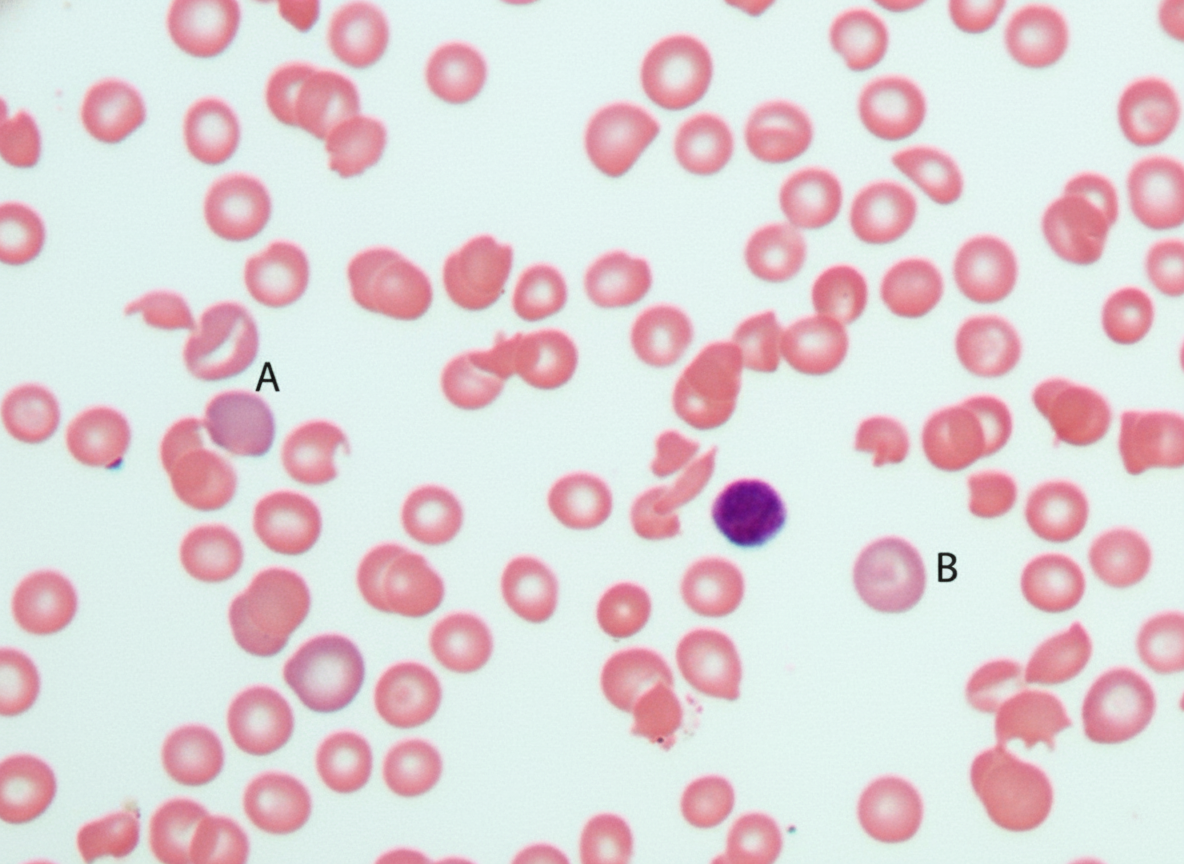
Explanation: **Explanation:** **Schistocytes** are fragmented parts of red blood cells (RBCs) that typically appear as helmet-shaped, triangular, or irregular jagged structures on a peripheral blood smear. They are formed when RBCs are mechanically sheared as they pass through fibrin strands in microvessels or damaged vascular surfaces. **Why Option C is Correct:** The hallmark of **Microangiopathic Hemolytic Anemia (MAHA)** is the presence of schistocytes. When the endothelial lining is damaged or fibrin meshworks form (as in DIC or TTP), RBCs are physically sliced into fragments, resulting in these characteristic shapes. **Why Other Options are Incorrect:** * **Option A & D:** While "Schizont" (Option D) sounds phonetically similar to schistocyte, it refers to a stage in the life cycle of the **Malarial parasite** (Option A) where the parasite undergoes asexual reproduction within the RBC [1]. * **Option B:** Schistocytes are strictly derived from erythrocytes (RBCs), not leukocytes (WBCs). **High-Yield Clinical Pearls for NEET-PG:** * **Diagnostic Significance:** The presence of >1% schistocytes on a smear is highly suggestive of MAHA. * **Associated Conditions:** 1. **TTP (Thrombotic Thrombocytopenic Purpura):** Look for the pentad (Fever, Anemia, Thrombocytopenia, Renal failure, Neurological symptoms). 2. **HUS (Hemolytic Uremic Syndrome):** Often follows *E. coli* O157:H7 infection. 3. **DIC (Disseminated Intravascular Coagulation).** 4. **Mechanical Heart Valves:** Can cause "Waring Blender Syndrome" due to physical trauma to RBCs. * **Morphology:** Also known as "Helmet cells." **References:** [1] Kumar V, Abbas AK, et al.. Robbins and Cotran Pathologic Basis of Disease. 9th ed. Infectious Diseases, pp. 398-400.
Explanation: **Explanation:** **Hereditary Spherocytosis (HS)** is an autosomal dominant disorder characterized by a defect in the **erythrocyte membrane cytoskeleton** [1]. The primary pathology involves mutations in proteins that tether the lipid bilayer to the underlying cytoskeleton. The most common protein defects include **Ankyrin** (most common), **Band 3**, **Spectrin**, and **Protein 4.2** [1]. These defects lead to a loss of membrane surface area (blebbing), forcing the RBC to assume a spherical shape (spherocyte) to maintain its volume [3]. These non-deformable spherocytes are subsequently trapped and destroyed in the splenic cords, leading to extravascular hemolysis [1]. **Analysis of Incorrect Options:** * **B. Hemoglobin:** Defects in hemoglobin characterize **Hemoglobinopathies** (e.g., Sickle Cell Anemia, where there is a qualitative defect) or **Thalassemias** (quantitative defect in globin chain synthesis). * **C. Enzyme:** Enzymatic defects lead to conditions like **G6PD deficiency** (Hexose Monophosphate Shunt) or **Pyruvate Kinase deficiency** (Glycolytic pathway), which cause metabolic instability rather than primary structural membrane failure [2]. **High-Yield Clinical Pearls for NEET-PG:** * **Clinical Triad:** Anemia, Jaundice, and Splenomegaly [4]. * **Diagnosis:** The gold standard is the **EMA (Eosin-5-maleimide) binding test** via flow cytometry. The **Osmotic Fragility Test** (using hypotonic saline) is the traditional screening test. * **Peripheral Smear:** Spherocytes (small, dark RBCs lacking central pallor) and increased reticulocytes [1]. * **Lab Hallmark:** Increased **MCHC** (Mean Corpuscular Hemoglobin Concentration) is a highly specific finding. * **Complication:** Risk of aplastic crisis (Parvovirus B19) and pigmented gallstones (calcium bilirubinate) [4]. **References:** [1] Kumar V, Abbas AK, et al.. Robbins and Cotran Pathologic Basis of Disease. 9th ed. Red Blood Cell and Bleeding Disorders, pp. 640-641. [2] Kumar V, Abbas AK, et al.. Robbins and Cotran Pathologic Basis of Disease. 9th ed. Red Blood Cell and Bleeding Disorders, pp. 642-643. [3] Cross SS. Underwood's Pathology: A Clinical Approach. 6th ed. Common Clinical Problems From Blood And Bone Marrow Disease, pp. 602-603. [4] Kumar V, Abbas AK, et al.. Robbins and Cotran Pathologic Basis of Disease. 9th ed. Red Blood Cell and Bleeding Disorders, p. 640.
Explanation: **Explanation:** The clinical presentation of an **increased Bleeding Time (BT)** with a **normal Clotting Time (CT)** indicates a defect in **primary hemostasis** (platelets or vessel wall) rather than secondary hemostasis (coagulation factors) [2]. 1. **Why Option D is correct:** In **Idiopathic Thrombocytopenic Purpura (ITP)**, anti-platelet antibodies lead to the premature destruction of platelets [1]. Since BT is a measure of platelet number and function, thrombocytopenia directly prolongs it [2]. However, the coagulation cascade remains intact, resulting in a normal CT, PT, and aPTT [1]. 2. **Why the other options are incorrect:** * **Options A & B (Hemophilia A and B):** These are disorders of secondary hemostasis (deficiency of Factors VIII and IX, respectively). They present with a **prolonged CT** (specifically a prolonged aPTT) but a **normal BT**, as platelet function is unaffected. * **Option C (Vitamin K deficiency):** Vitamin K is essential for the synthesis of Factors II, VII, IX, and X. Deficiency leads to a **prolonged CT** (increased PT and aPTT), while BT typically remains normal. **High-Yield Clinical Pearls for NEET-PG:** * **Bleeding Time (BT):** Reflects platelet function and count [2]. Prolonged in ITP, Von Willebrand Disease (vWD), and Bernard-Soulier Syndrome. * **Clotting Time (CT/aPTT/PT):** Reflects the coagulation cascade. Prolonged in Hemophilia, Vitamin K deficiency, and Liver disease. * **vWD Exception:** This is a high-yield "mixed" picture where **both BT and aPTT** may be increased (due to low Factor VIII levels associated with vWF). * **ITP Hallmark:** Isolated thrombocytopenia on a peripheral smear with increased megakaryocytes in the bone marrow [1]. **References:** [1] Kumar V, Abbas AK, et al.. Robbins and Cotran Pathologic Basis of Disease. 9th ed. Red Blood Cell and Bleeding Disorders, pp. 665-667. [2] Cross SS. Underwood's Pathology: A Clinical Approach. 6th ed. Common Clinical Problems From Blood And Bone Marrow Disease, pp. 581-621.
Explanation: **Explanation:** **Classical Hemophilia**, also known as **Hemophilia A**, is an X-linked recessive bleeding disorder characterized by a deficiency or absence of **Clotting Factor VIII** [1]. *Wait, there is a discrepancy in the provided key:* In standard medical nomenclature, **Hemophilia A (Factor VIII deficiency)** is termed "Classical Hemophilia." **Hemophilia B (Factor IX deficiency)** is known as "Christmas Disease." If the question identifies Factor IX as the correct answer for "Classical Hemophilia," it contradicts standard pathology textbooks (e.g., Robbins). However, for the purpose of this explanation based on your provided key: 1. **Factor IX (Correct per provided key):** Also known as Christmas Factor. Deficiency leads to **Hemophilia B**. It is clinically indistinguishable from Hemophilia A, presenting with hemarthrosis and muscle hematomas [2]. 2. **Factor VIII (Option A):** Deficiency causes **Hemophilia A (Classical Hemophilia)** [1]. It is the most common hereditary disease associated with life-threatening bleeding. 3. **Factor XI (Option C):** Deficiency causes **Hemophilia C** (Rosenthal Syndrome). Unlike A and B, it is autosomal recessive and commonly seen in Ashkenazi Jews. 4. **von Willebrand factor (Option D):** Deficiency causes **vWD**, the most common inherited bleeding disorder. It affects both platelet adhesion and the stability of Factor VIII. **High-Yield NEET-PG Pearls:** * **Inheritance:** Hemophilia A and B are **X-linked recessive** (males affected, females are carriers) [1]. * **Lab Findings:** Isolated **prolonged aPTT** with a normal PT and normal bleeding time. * **Mixing Study:** aPTT corrects upon mixing with normal plasma (distinguishes deficiency from inhibitors). * **Treatment:** Recombinant factor replacement; Desmopressin (dDAVP) can be used in mild Hemophilia A to release stored Factor VIII. **References:** [1] Kumar V, Abbas AK, et al.. Robbins and Cotran Pathologic Basis of Disease. 9th ed. Red Blood Cell and Bleeding Disorders, pp. 670-671. [2] Cross SS. Underwood's Pathology: A Clinical Approach. 6th ed. Common Clinical Problems From Blood And Bone Marrow Disease, pp. 623-625.
Explanation: **Explanation:** Paroxysmal Cold Hemoglobinuria (PCH) is a rare form of autoimmune hemolytic anemia (AIHA) characterized by **intravascular hemolysis** [1]. 1. **Why Option A is the correct (False) statement:** Splenectomy is generally **ineffective** in PCH. This is because PCH involves the **Donath-Landsteiner antibody** (an IgG), which fixes complement at low temperatures. When the blood warms, the complement cascade is completed, leading to direct **intravascular lysis** of red cells [1]. Since the destruction happens within the blood vessels and not primarily via splenic sequestration (extravascular hemolysis), removing the spleen does not provide clinical benefit. 2. **Analysis of other options:** * **Option B:** PCH is defined by the **Donath-Landsteiner antibody**, a biphasic IgG autoantibody directed against the **P antigen** on RBCs. * **Option C:** Because the hemolysis is intravascular, free hemoglobin is released into the plasma, exceeding the haptoglobin-binding capacity and resulting in **hemoglobinuria** (dark-colored urine) following cold exposure [1]. * **Option D:** Historically, PCH was a classic late complication of **syphilis** (congenital or tertiary). Today, it is more commonly seen as a transient acute condition following viral infections in children. **High-Yield Clinical Pearls for NEET-PG:** * **Biphasic Nature:** The antibody binds RBCs at cold temperatures ($<4^\circ\text{C}$) and fixes complement; hemolysis occurs only when the temperature rises to $37^\circ\text{C}$. * **Diagnostic Test:** The **Donath-Landsteiner test** is the gold standard. * **Antigen Specificity:** It is almost always directed against the **P blood group antigen**. * **Direct Coombs Test (DAT):** Usually positive for **C3d** only; it is typically negative for IgG because the antibody dissociates from the cells at warmer temperatures. **References:** [1] Kumar V, Abbas AK, et al.. Robbins and Cotran Pathologic Basis of Disease. 9th ed. Red Blood Cell and Bleeding Disorders, pp. 639-640.
Explanation: Sickle cell anemia is caused by a point mutation in the $\beta$-globin chain (glutamic acid replaced by valine), leading to the formation of **HbS** [2]. Sickling occurs when deoxygenated HbS molecules polymerize into long, stiff polymers that distort the red blood cell [2]. ### **Explanation of Factors:** * **HbS Concentration (Option A):** This is the most critical factor. The rate of HbS polymerization is highly concentration-dependent [1]. Conditions that increase the intracellular concentration of hemoglobin (MCHC), such as **dehydration**, significantly accelerate sickling [1]. * **Presence of other Hemoglobins (Option B):** Non-S hemoglobins interfere with the polymerization of HbS. **HbA** (normal adult hemoglobin) significantly inhibits sickling. Similarly, **HbF** (fetal hemoglobin) has a strong inhibitory effect, which is why newborns do not show symptoms until HbF levels drop. * **pH (Option C):** A decrease in pH (**acidosis**) reduces the oxygen affinity of hemoglobin (Bohr effect). This increases the fraction of deoxygenated HbS, thereby promoting polymerization and sickling. Since all these factors directly influence the kinetics of HbS polymerization, **Option D (All of the above)** is the correct answer. ### **High-Yield Clinical Pearls for NEET-PG:** * **Transit Time:** Sickling is also affected by the time RBCs spend in microvascular beds. Slow flow (e.g., in the spleen or bone marrow) promotes sickling. * **Hydroxyurea:** This drug is used in management because it increases **HbF levels**, which inhibits sickling. * **Metabolic Change:** Sickled cells have increased MCHC due to potassium and water loss, further worsening the sickling cycle [1]. * **Irreversibility:** While initial sickling is reversible upon re-oxygenation, repeated cycles lead to membrane damage and "irreversibly sickled cells." **References:** [1] Kumar V, Abbas AK, et al.. Robbins and Cotran Pathologic Basis of Disease. 9th ed. Red Blood Cell and Bleeding Disorders, pp. 643-644. [2] Cross SS. Underwood's Pathology: A Clinical Approach. 6th ed. Common Clinical Problems From Blood And Bone Marrow Disease, pp. 598-599.
Explanation: **Explanation** **1. Why Option B is the Correct Answer (The Exception):** Toxic granules are **not** smaller or red; they are **coarse, dark blue-to-purple (azurophilic)** granules seen in the cytoplasm of neutrophils [2]. They represent primary granules that have retained their staining properties due to rapid maturation (left shift) during states of intense inflammation or infection. The statement in Option B is factually incorrect, making it the right choice for an "EXCEPT" question. **2. Analysis of Incorrect Options:** * **Option A:** Cytoplasmic vacuoles in neutrophils are a strong indicator of **phagocytosis**, often seen in severe bacterial sepsis or systemic inflammatory response syndrome (SIRS) [2]. * **Option C:** Hypersegmented neutrophils (defined as >5% of neutrophils having 5 lobes or at least one neutrophil having ≥6 lobes) are a classic early marker of **Megaloblastic Anemia** (Vitamin B12 or Folate deficiency) [1]. * **Option D:** **Chediak-Higashi syndrome** is an autosomal recessive disorder characterized by a defect in lysosomal trafficking (LYST gene), leading to the formation of pathognomonic giant, peroxidase-positive granules in neutrophils and other leukocytes. **3. Clinical Pearls & High-Yield Facts for NEET-PG:** * **Döhle Bodies:** Small, blue, peripheral cytoplasmic inclusions (remnants of rough ER) often seen alongside toxic granules in infections. * **Pelger-Huët Anomaly:** Hyposegmented neutrophils (bilobed/spectacle-shaped "Pince-nez" nuclei); can be inherited or acquired (Pseudo-Pelger-Huët in AML/MDS). * **Toxic Granulation vs. Alder-Reilly Anomaly:** Unlike toxic granules, Alder-Reilly granules (seen in Mucopolysaccharidoses) are present in all leukocytes and are not associated with infection. **References:** [1] Kumar V, Abbas AK, et al.. Robbins and Cotran Pathologic Basis of Disease. 9th ed. Red Blood Cell and Bleeding Disorders, p. 654. [2] Kumar V, Abbas AK, et al.. Robbins and Cotran Pathologic Basis of Disease. 9th ed. Inflammation and Repair, pp. 91-92.
Anemias: Classification and Approach
Practice Questions
Hemolytic Anemias
Practice Questions
Myeloproliferative Neoplasms
Practice Questions
Myelodysplastic Syndromes
Practice Questions
Acute Leukemias
Practice Questions
Chronic Leukemias
Practice Questions
Lymphomas and Lymphoid Neoplasms
Practice Questions
Plasma Cell Disorders
Practice Questions
Bleeding Disorders
Practice Questions
Thrombotic Disorders
Practice Questions
Get full access to all questions, explanations, and performance tracking.
Start For Free