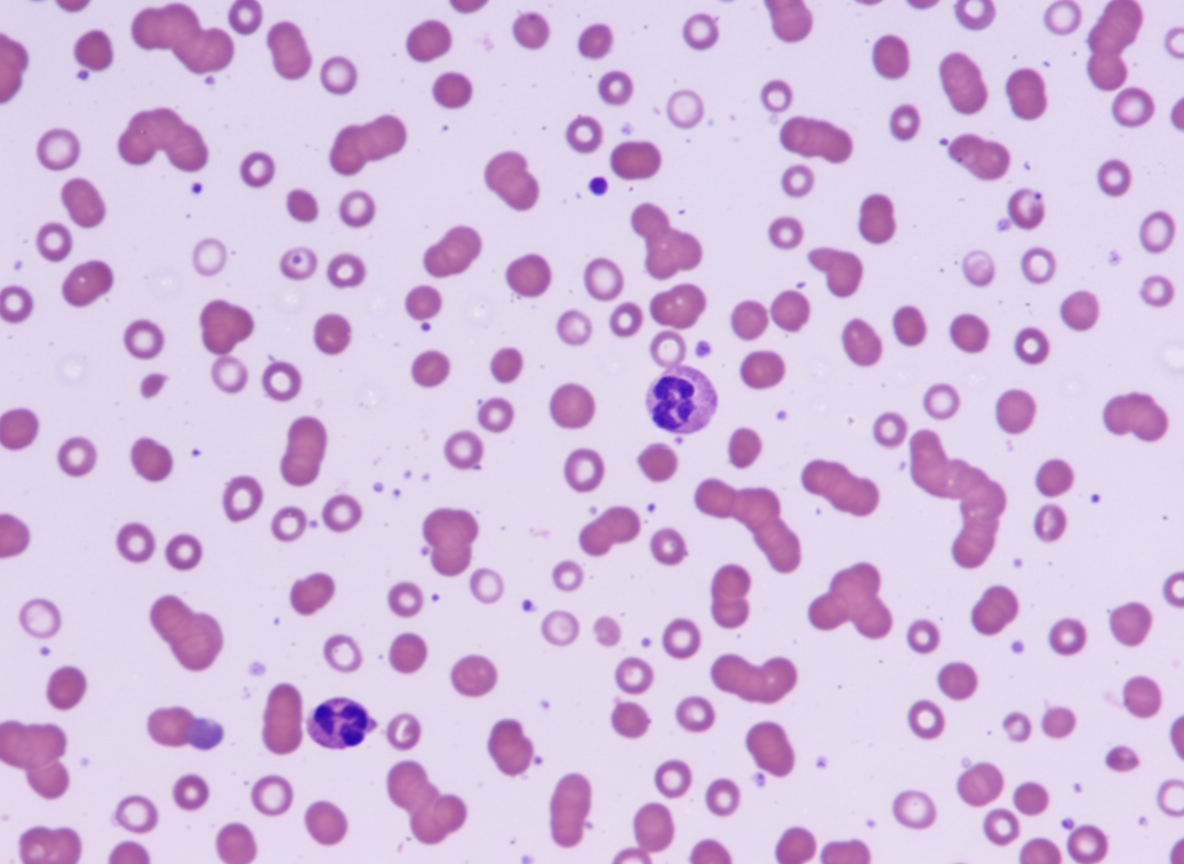
JAK-2 mutation is seen in which of the following conditions?
In multiple myeloma, there is a proliferation of which cell type?
Juvenile myelomonocytic leukemia (JMML) is characterized by all EXCEPT:
Anemia of chronic disorder is characterized by which of the following laboratory findings?
Failure of clot retraction indicates which of the following?
The "Owl's eye" nucleus is a characteristic finding in which type of lymphoma?
A deficiency of intrinsic factor can result in anemia. What type of anemia would occur if intrinsic factor were deficient?
Flame cells are characteristic of which of the following conditions?
Find the false statement regarding megaloblastic anemia.
Hemolytic anemia is a feature of deficiency of all RBC enzymes EXCEPT?
Explanation: **Explanation:** The **JAK2 (Janus Kinase 2)** mutation is a hallmark of **BCR-ABL1 negative Myeloproliferative Neoplasms (MPNs)**. The most common mutation is a point mutation (V617F) in exon 14, which leads to constitutive activation of the JAK-STAT signaling pathway. This results in hypersensitivity of hematopoietic stem cells to growth factors (like erythropoietin), leading to autonomous cell proliferation [1]. * **Polycythemia Vera (PV):** This is the correct answer. The JAK2 V617F mutation is present in **>95% of PV cases** [1]. It is a major diagnostic criterion according to the WHO classification. * **Idiopathic Thrombocytopenic Purpura (ITP):** This is an immune-mediated destruction of platelets (Type II hypersensitivity). It is not a clonal stem cell disorder and does not involve JAK2 mutations. * **Chronic Myeloid Leukemia (CML):** CML is characterized by the **Philadelphia chromosome [t(9;22)]**, which creates the **BCR-ABL1** fusion gene [1]. While it is an MPN, it is "BCR-ABL1 positive" and typically does not harbor the JAK2 mutation. * **Chronic Myelomonocytic Leukemia (CMML):** This is a Myelodysplastic/Myeloproliferative overlap syndrome. While mutations like TET2 or SRSF2 are common, JAK2 is rare (<10%) and not a defining feature. **High-Yield Clinical Pearls for NEET-PG:** * **JAK2 V617F Frequency:** PV (>95%) > Essential Thrombocythemia (~50-60%) = Primary Myelofibrosis (~50-60%) [1]. * **PV Diagnostic Clue:** Low serum Erythropoietin (EPO) levels combined with JAK2 positivity. * **Clinical Sign:** Aquagenic pruritus (itching after a hot bath) is a classic symptom of PV. * **Treatment:** Ruxolitinib is a JAK1/2 inhibitor used in refractory cases. **References:** [1] Kumar V, Abbas AK, et al.. Robbins and Cotran Pathologic Basis of Disease. 9th ed. Diseases of White Blood Cells, Lymph Nodes, Spleen, and Thymus, p. 624.
Explanation: **Explanation:** **Multiple Myeloma (MM)** is a neoplastic proliferation of a single clone of **plasma cells** (mature B-cells) derived from the bone marrow [1]. These malignant plasma cells produce an excess of monoclonal (M) proteins, typically IgG or IgA, which can be detected via serum protein electrophoresis (M-spike) [3]. **Why the correct answer is right:** * **Plasma Cells:** In MM, the bone marrow is typically infiltrated by >10% clonal plasma cells [2]. These cells are characterized morphologically by an eccentric nucleus, "cartwheel" chromatin, and a prominent perinuclear halo (Golgi zone). **Why the incorrect options are wrong:** * **Basophils, Eosinophils, and Neutrophils:** These are all myeloid lineage cells (granulocytes). Proliferation of these cells is associated with Chronic Myeloid Leukemia (CML) or reactive leukocytosis, not Multiple Myeloma. Specifically, basophilia is a hallmark of CML, while eosinophilia is seen in parasitic infections or allergic reactions. **High-Yield Clinical Pearls for NEET-PG:** * **CRAB Criteria:** The classic presentation includes **C**alcium elevation, **R**enal insufficiency, **A**nemia, and **B**one lesions (punched-out lytic lesions) [1]. * **Diagnosis:** Look for **Bence-Jones proteins** (free light chains) in urine and **Rouleaux formation** on peripheral blood smears due to decreased zeta potential between RBCs [4]. * **Markers:** CD138 and CD38 are the primary immunohistochemical markers for plasma cells [4]. * **Prognosis:** Serum beta-2 microglobulin is the most important prognostic marker. **References:** [1] Cross SS. Underwood's Pathology: A Clinical Approach. 6th ed. Common Clinical Problems From Blood And Bone Marrow Disease, pp. 616-617. [2] Cross SS. Underwood's Pathology: A Clinical Approach. 6th ed. Common Clinical Problems From Blood And Bone Marrow Disease, pp. 617-618. [3] Kumar V, Abbas AK, et al.. Robbins and Cotran Pathologic Basis of Disease. 9th ed. Diseases of the Immune System, pp. 266-267. [4] Kumar V, Abbas AK, et al.. Robbins and Cotran Pathologic Basis of Disease. 9th ed. Diseases of White Blood Cells, Lymph Nodes, Spleen, and Thymus, pp. 607-608.
Explanation: **Explanation:** Juvenile Myelomonocytic Leukemia (JMML) is a rare, aggressive clonal hematopoietic stem cell disorder of childhood that overlaps features of both myelodysplastic syndrome (MDS) and myeloproliferative neoplasm (MPN). **Why Option B is the Correct Answer (The Exception):** The **Philadelphia chromosome [t(9;22)]** is the hallmark of Chronic Myeloid Leukemia (CML) [1]. By definition, JMML is **BCR-ABL1 negative** [2]. The pathogenesis of JMML involves mutations in the **RAS signaling pathway** (e.g., *PTPN11, NF1, NRAS, KRAS,* or *CBL*), leading to hypersensitivity of myeloid progenitors to Granulocyte-Macrophage Colony-Stimulating Factor (GM-CSF). **Analysis of Other Options:** * **Option A (Increased HbF):** This is a classic diagnostic marker for JMML. Elevated fetal hemoglobin (HbF) for the patient's age is seen in approximately 75% of cases due to erythropoiesis reverting to a fetal-like state. * **Option C (Immature Granulocytes):** The peripheral blood in JMML typically shows a high monocyte count (>1x10⁹/L) along with immature myeloid cells (promyelocytes, myelocytes), reflecting the myeloproliferative nature of the disease. * **Option D (Nucleated RBCs):** The presence of nucleated red blood cells (nRBCs) and a leucoerythroblastic blood picture are common findings in the peripheral smear of JMML patients. **High-Yield Clinical Pearls for NEET-PG:** * **Age Group:** Usually occurs in children <2 years of age. * **Clinical Features:** Hepatosplenomegaly, lymphadenopathy, and skin rashes (xanthomas or café-au-lait spots, especially in NF1-associated cases). * **Diagnostic Hallmark:** Hypersensitivity of hematopoietic progenitors to **GM-CSF** in *in vitro* colony assays. * **Association:** Strongly associated with **Noonan Syndrome** and **Neurofibromatosis type 1 (NF1)**. **References:** [1] Kumar V, Abbas AK, et al.. Robbins and Cotran Pathologic Basis of Disease. 9th ed. Diseases of White Blood Cells, Lymph Nodes, Spleen, and Thymus, p. 624. [2] Cross SS. Underwood's Pathology: A Clinical Approach. 6th ed. Common Clinical Problems From Blood And Bone Marrow Disease, pp. 611-612.
Explanation: **Anemia of Chronic Disease (ACD)** is a common normocytic/microcytic anemia driven by chronic inflammation (e.g., infections, malignancies, autoimmune disorders). ### **Why Option C is Correct** The pathophysiology of ACD is centered on **Hepcidin**, an acute-phase reactant produced by the liver in response to IL-6 [1]. Hepcidin degrades **ferroportin** channels on macrophages and enterocytes [1]. This prevents iron from being released into the plasma, effectively "locking" it within the reticuloendothelial system. Consequently, **bone marrow iron stores (hemosiderin in macrophages)** are increased, which is the gold standard diagnostic finding on Prussian blue staining [1]. ### **Analysis of Incorrect Options** * **A. Increased serum ferritin:** While ferritin is often elevated in ACD (as it is an acute-phase reactant), the question asks for the most characteristic laboratory finding among the choices. While A is technically true in many cases, **C** is the definitive pathological hallmark of the sequestration mechanism. * **B. Increased TIBC:** In ACD, TIBC (a measure of transferrin) is **decreased**. The body downregulates transferrin to limit iron availability to potential pathogens. (Increased TIBC is characteristic of Iron Deficiency Anemia). * **D. Increased erythrocyte protoporphyrin:** While this can occur when iron is unavailable for heme synthesis, it is a non-specific finding also seen in lead poisoning and iron deficiency. ### **NEET-PG High-Yield Pearls** * **Hepcidin:** The "Master Regulator" of iron; elevated in ACD, decreased in Iron Deficiency Anemia (IDA) and Hemochromatosis. * **Differentiation:** * **ACD:** Low Serum Iron, **Low TIBC**, **High Ferritin**, High Marrow Iron. * **IDA:** Low Serum Iron, **High TIBC**, **Low Ferritin**, Absent Marrow Iron. * **Treatment:** Treat the underlying cause; recombinant erythropoietin may be used in specific cases (e.g., CKD). **References:** [1] Kumar V, Abbas AK, et al.. Robbins and Cotran Pathologic Basis of Disease. 9th ed. Red Blood Cell and Bleeding Disorders, pp. 660-662.
Explanation: **Explanation:** **1. Why Low Platelet Count is Correct:** Clot retraction is the process by which a blood clot shrinks and expresses serum. This process is actively mediated by **platelets** [1][3]. Platelets contain contractile proteins, specifically **thrombosthenin** (an actin-myosin complex). Once a clot forms, these proteins contract, pulling the fibrin strands together and squeezing out the serum. Therefore, a low platelet count (**thrombocytopenia**) [3][4] or defective platelet function (e.g., Glanzmann thrombasthenia) [2] directly leads to poor or absent clot retraction. **2. Why the Other Options are Incorrect:** * **Factor VIII Deficiency (Hemophilia A):** This affects the intrinsic pathway of coagulation, leading to a delay in the *formation* of the fibrin clot. However, once the clot is formed, the retraction mechanism (which is platelet-dependent) remains intact. * **Factor XIII Deficiency:** Factor XIII is the "Fibrin Stabilizing Factor." While its deficiency leads to an unstable clot that may dissolve prematurely (excessive fibrinolysis), it does not prevent the initial contraction of the fibrin mesh by platelets. * **Fibrinogen Deficiency:** While fibrinogen is necessary to form the clot itself, "failure of clot retraction" as a clinical test finding is classically used to identify platelet-related pathologies rather than substrate deficiencies. **3. NEET-PG High-Yield Pearls:** * **Glanzmann Thrombasthenia:** A qualitative platelet disorder (deficiency of GpIIb/IIIa) where the platelet count is normal, but **clot retraction is absent** [2]. * **Thrombosthenin:** The specific contractile protein in platelets responsible for clot retraction. * **Clot Retraction Time (CRT):** Normally begins within 30–60 minutes and is complete within 24 hours. It is a crude but classic bedside test for platelet function. **References:** [1] Cross SS. Underwood's Pathology: A Clinical Approach. 6th ed. Common Clinical Problems From Blood And Bone Marrow Disease, pp. 581-582. [2] Kumar V, Abbas AK, et al.. Robbins and Cotran Pathologic Basis of Disease. 9th ed. Red Blood Cell and Bleeding Disorders, pp. 668-669. [3] Cross SS. Underwood's Pathology: A Clinical Approach. 6th ed. Common Clinical Problems From Blood And Bone Marrow Disease, pp. 619-620. [4] Kumar V, Abbas AK, et al.. Robbins and Cotran Pathologic Basis of Disease. 9th ed. Red Blood Cell and Bleeding Disorders, pp. 666-667.
Explanation: **Explanation:** The "Owl’s eye" appearance is the hallmark morphological feature of the **classic Reed-Sternberg (RS) cell**, which is diagnostic for **Hodgkin’s Lymphoma** [1]. These are large, multinucleated or bilobed cells where each lobe contains a prominent, eosinophilic, inclusion-like nucleolus surrounded by a clear halo, mimicking the eyes of an owl [1]. **Why the other options are incorrect:** * **Non-Hodgkin’s Lymphoma (NHL):** This is a diverse group of malignancies (e.g., Follicular, DLBCL) that typically lack RS cells [1]. They are characterized by a diffuse or nodular proliferation of lymphoid cells without the specific "Owl's eye" morphology. * **Burkitt’s Lymphoma:** This is characterized by a **"Starry sky" appearance** on low power, created by tingible body macrophages (the "stars") consuming apoptotic debris against a background of dark neoplastic B-cells (the "sky"). * **Cutaneous T-cell Lymphoma (Mycosis Fungoides):** This is characterized by **Pautrier’s microabscesses** in the epidermis and "Cerebriform" nuclei (Sezary cells) in the peripheral blood. **High-Yield Clinical Pearls for NEET-PG:** * **Immunophenotype:** Classic RS cells are typically **CD15+ and CD30+**, but negative for CD45 and CD20 (except in the Nodular Lymphocyte Predominant subtype, which is CD20+ and CD45+). * **Variants:** The "Lacunar variant" is specifically associated with the **Nodular Sclerosis** subtype of Hodgkin's Lymphoma [1]. * **Bimodal Age Distribution:** Hodgkin’s Lymphoma typically shows two peaks of incidence (20s and 50s) [1]. * **EBV Association:** The Mixed Cellularity subtype has the strongest association with the Epstein-Barr Virus [1]. **References:** [1] Kumar V, Abbas AK, et al.. Robbins and Cotran Pathologic Basis of Disease. 9th ed. Diseases of White Blood Cells, Lymph Nodes, Spleen, and Thymus, pp. 614-618.
Explanation: **Explanation:** **1. Why Megaloblastic Anemia is Correct:** Intrinsic Factor (IF) is a glycoprotein secreted by the **gastric parietal cells** [3]. It is essential for the absorption of **Vitamin B12 (Cobalamin)** in the terminal ileum [2]. A deficiency of IF (commonly due to autoimmune destruction of parietal cells in Pernicious Anemia or gastrectomy) leads to Vitamin B12 deficiency [1]. Vitamin B12 is a crucial cofactor for DNA synthesis. Its absence causes "nuclear-cytoplasmic asynchrony," where the cell nucleus matures slower than the cytoplasm, resulting in large, immature red blood cells known as **megaloblasts** [4]. **2. Why Other Options are Incorrect:** * **Hypochromic, microcytic anemia:** This is characteristic of impaired hemoglobin synthesis, most commonly seen in **Iron Deficiency Anemia** or Thalassemia. * **Hemolytic anemia:** This occurs due to the premature destruction of RBCs (e.g., Hereditary Spherocytosis or G6PD deficiency), not a DNA maturation defect. * **Sickle cell anemia:** This is a qualitative hemoglobinopathy caused by a specific point mutation in the β-globin gene, leading to the formation of HbS. **3. NEET-PG High-Yield Pearls:** * **Pernicious Anemia:** The most common cause of Vitamin B12 deficiency globally; associated with anti-parietal cell and anti-intrinsic factor antibodies [1]. * **Peripheral Smear Findings:** Look for **macro-ovalocytes** and **hypersegmented neutrophils** (more than 5 lobes) [3][4]. * **Neurological Symptoms:** Unlike folate deficiency, Vitamin B12 deficiency causes **Subacute Combined Degeneration (SCD)** of the spinal cord due to methylmalonic acid (MMA) accumulation [2]. * **Schilling Test:** Historically used to differentiate the cause of B12 deficiency (though now largely replaced by antibody testing). **References:** [1] Cross SS. Underwood's Pathology: A Clinical Approach. 6th ed. Common Clinical Problems From Blood And Bone Marrow Disease, pp. 592-593. [2] Cross SS. Underwood's Pathology: A Clinical Approach. 6th ed. (Basic Pathology) introduces the student to key general principles of pathology, both as a medical science and as a clinical activity with a vital role in patient care. Part 2 (Disease Mechanisms) provides fundamental knowledge about the cellular and molecular processes involved in diseases, providing the rationale for their treatment. Part 3 (Systematic Pathology) deals in detail with specific diseases, with emphasis on the clinically important aspects., pp. 130-131. [3] Kumar V, Abbas AK, et al.. Robbins and Cotran Pathologic Basis of Disease. 9th ed. Red Blood Cell and Bleeding Disorders, p. 654. [4] Cross SS. Underwood's Pathology: A Clinical Approach. 6th ed. Common Clinical Problems From Blood And Bone Marrow Disease, pp. 593-594.
Explanation: **Explanation:** **Flame cells** are atypical plasma cells characterized by a vibrant, fiery-red or pink cytoplasm [1]. This distinct appearance is due to the accumulation of **Immunoglobulin A (IgA)** within the cisternae of the endoplasmic reticulum [5]. While most commonly associated with **Multiple Myeloma** (specifically the IgA subtype), they can also be seen in reactive plasmacytosis [3]. The red staining is attributed to the high carbohydrate content of the IgA molecule. **Analysis of Options:** * **Multiple Myeloma (Correct):** This is a plasma cell dyscrasia [2]. Flame cells are a classic morphological variant seen on bone marrow aspiration in these patients, alongside other features like Mott cells (Grape cells) and Russell bodies [5]. * **Ewing’s Sarcoma:** This is a small round blue cell tumor of the bone. Histology typically shows uniform small cells with scanty cytoplasm and "Homer-Wright rosettes," not plasma cell variants. * **Leukemia:** While plasma cell leukemia exists, "Flame cells" are a specific morphological descriptor for IgA-producing plasma cells, making Multiple Myeloma the most definitive answer in a general context. * **Osteosarcoma:** This is a malignant osteoid-producing tumor. Characteristic findings include pleomorphic cells producing "lace-like" osteoid [4]. **High-Yield NEET-PG Pearls:** * **Mott Cells:** Plasma cells containing multiple globular cytoplasmic inclusions (Russell bodies) resembling a bunch of grapes. * **Russell Bodies:** Eosinophilic, PAS-positive cytoplasmic inclusions (accumulated Ig). * **Dutcher Bodies:** Periodic Acid-Schiff (PAS) positive intranuclear inclusions (actually cytoplasm invaginating into the nucleus). * **Bence-Jones Proteins:** Free light chains (Kappa/Lambda) found in urine that precipitate at 40-60°C and redissolve at 100°C [1]. **References:** [1] Cross SS. Underwood's Pathology: A Clinical Approach. 6th ed. Common Clinical Problems From Blood And Bone Marrow Disease, pp. 616-617. [2] Kumar V, Abbas AK, et al.. Robbins and Cotran Pathologic Basis of Disease. 9th ed. Diseases of White Blood Cells, Lymph Nodes, Spleen, and Thymus, pp. 606-607. [3] Kumar V, Abbas AK, et al.. Robbins and Cotran Pathologic Basis of Disease. 9th ed. Diseases of White Blood Cells, Lymph Nodes, Spleen, and Thymus, pp. 608-609. [4] Kumar V, Abbas AK, et al.. Robbins and Cotran Pathologic Basis of Disease. 9th ed. Diseases of White Blood Cells, Lymph Nodes, Spleen, and Thymus, p. 608. [5] Cross SS. Underwood's Pathology: A Clinical Approach. 6th ed. Common Clinical Problems From Blood And Bone Marrow Disease, pp. 617-618.
Explanation: **Explanation:** Megaloblastic anemia is a macrocytic anemia characterized by impaired DNA synthesis, most commonly due to Vitamin B12 or Folate deficiency [1]. **Why Option D is the correct (false) statement:** In megaloblastic anemia, while the Mean Corpuscular Volume (MCV) is increased (>100 fL), the **Mean Corpuscular Hemoglobin Concentration (MCHC) remains normal**. Hemoglobin synthesis is independent of DNA synthesis; therefore, hemoglobin production keeps pace with the enlarging cell volume [2]. An increased MCHC is rare in clinical practice and is classically associated with **Hereditary Spherocytosis**, not megaloblastic anemia. **Analysis of other options:** * **A. Macro-polycytes:** These are large, hypersegmented neutrophils (typically defined as >5% of neutrophils having 5 lobes or at least one having 6 lobes). They are one of the earliest peripheral blood findings [1]. * **B. Reduced reticulocyte count:** Due to "ineffective erythropoiesis," many RBC precursors die within the bone marrow. This leads to a low reticulocyte count despite the anemia. * **C. Hypercellular bone marrow:** The marrow is paradoxically hyperactive as it attempts to compensate for the anemia, showing a "blue marrow" appearance due to an abundance of megaloblasts with open, lacy chromatin [2]. **High-Yield NEET-PG Pearls:** * **Pancytopenia:** Severe megaloblastic anemia can present with low WBC and platelet counts. * **Biochemical markers:** Increased Serum LDH and Indirect Bilirubin (due to intramedullary hemolysis/ineffective erythropoiesis). * **Neurological symptoms:** Subacute Combined Degeneration (SCD) of the spinal cord is specific to **Vitamin B12 deficiency**, not folate deficiency. * **Howell-Jolly bodies:** May be seen on the peripheral smear due to nuclear remnants. **References:** [1] Kumar V, Abbas AK, et al.. Robbins and Cotran Pathologic Basis of Disease. 9th ed. Red Blood Cell and Bleeding Disorders, pp. 654-657. [2] Cross SS. Underwood's Pathology: A Clinical Approach. 6th ed. Common Clinical Problems From Blood And Bone Marrow Disease, pp. 593-595.
Explanation: The mature red blood cell (RBC) lacks mitochondria and is entirely dependent on **anaerobic glycolysis (Embden-Meyerhof pathway)** for ATP production. ATP is essential for maintaining the structural integrity of the RBC membrane and the function of ion pumps. Any enzyme deficiency that disrupts this pathway leads to ATP depletion, resulting in rigid cells, premature destruction, and **nonspherocytic hemolytic anemia.** * **Why Lactate Dehydrogenase (LDH) is the correct answer:** LDH catalyzes the reversible conversion of pyruvate to lactate. While LDH is a marker of hemolysis (released from ruptured RBCs), its deficiency does **not** cause hemolytic anemia. In LDH deficiency, cells can still generate ATP via glycolysis, and alternative pathways prevent metabolic failure. * **Why other options are incorrect:** * **Glucose-6-Phosphate Dehydrogenase (G6PD):** The most common RBC enzyme deficiency [1]. It is part of the Hexose Monophosphate (HMP) shunt. Deficiency leads to decreased NADPH, making RBCs vulnerable to oxidative stress, causing acute hemolysis and **Heinz bodies**. * **Pyruvate Kinase (PK):** The most common enzyme deficiency of the **glycolytic pathway** causing hemolytic anemia [1]. Lack of PK leads to severe ATP depletion, causing membrane failure and "echinocytes" (spiculated cells). * **Aldolase A:** An integral enzyme in the glycolytic pathway. Its deficiency is rare but leads to hereditary nonspherocytic hemolytic anemia and may be associated with myopathy. **High-Yield Clinical Pearls for NEET-PG:** * **Most common RBC enzyme deficiency:** G6PD deficiency (X-linked) [1]. * **Most common glycolytic pathway deficiency:** Pyruvate Kinase deficiency (Autosomal Recessive) [1]. * **Key finding in PK deficiency:** Increased 2,3-BPG levels (shifts oxygen dissociation curve to the right, helping tissue oxygenation despite anemia). * **LDH in Hemolysis:** Serum LDH is a sensitive marker of **intravascular hemolysis**, but its deficiency is clinically silent regarding RBC survival. **References:** [1] Kumar V, Abbas AK, et al.. Robbins and Cotran Pathologic Basis of Disease. 9th ed. Red Blood Cell and Bleeding Disorders, p. 638.
Anemias: Classification and Approach
Practice Questions
Hemolytic Anemias
Practice Questions
Myeloproliferative Neoplasms
Practice Questions
Myelodysplastic Syndromes
Practice Questions
Acute Leukemias
Practice Questions
Chronic Leukemias
Practice Questions
Lymphomas and Lymphoid Neoplasms
Practice Questions
Plasma Cell Disorders
Practice Questions
Bleeding Disorders
Practice Questions
Thrombotic Disorders
Practice Questions
Get full access to all questions, explanations, and performance tracking.
Start For Free