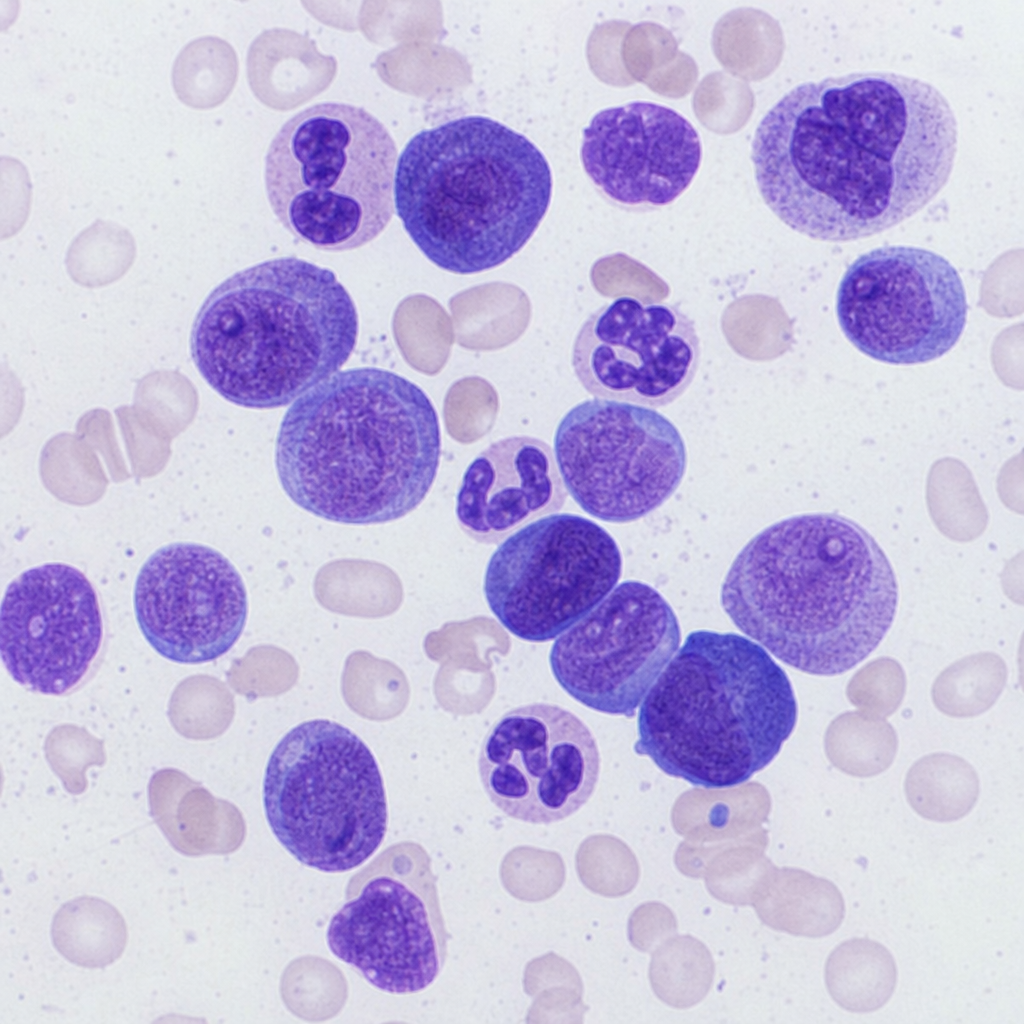
Which of the following is NOT a laboratory finding in thalassemia major?
Low serum haptoglobin in hemolysis is masked by which of the following conditions?
Which of the following is a laboratory finding of Multiple myeloma?
Which of the following is a marker for Langerhans cell histiocytosis?
Auto-splenectomy is associated with which of the following conditions?
Leukocyte alkaline phosphatase is increased in all conditions except?
A 59-year-old male patient presents with multiple neck swellings, fever, and weight loss. General examination reveals painless lymph node enlargement in the neck, and blood investigations show anemia. Serum albumin is 32 gm/l. Lymph node biopsy shows Reed-Sternberg cells. What is the 5-year rate of overall survival (in %) for this patient, according to the Hasenclever prognostic index for advanced Hodgkin lymphoma?
As compared to iron deficiency anemia, which of the following is decreased in anemia of chronic disease?
Which of the following is not a feature of multiple myeloma?
Deficiency of GpIIb-IIIa results in which of the following conditions?
Explanation: Explanation: In **Thalassemia Major**, the primary defect is a quantitative deficiency in beta-globin chain synthesis [4], leading to ineffective erythropoiesis and hemolysis [3]. The laboratory profile is characterized by **iron overload**, not normal iron levels. **1. Why "Normal ferritin level" is the correct answer (the finding NOT seen):** Patients with Thalassemia Major develop significant iron overload due to two main reasons: repeated blood transfusions and increased intestinal iron absorption [2]. Consequently, **Serum Ferritin is characteristically elevated**, and a normal level would be highly unusual in a diagnosed case. **2. Analysis of incorrect options:** * **Normal TIBC (Option B):** In states of iron overload, Total Iron Binding Capacity (TIBC) remains normal or becomes decreased as transferrin becomes saturated. It is never elevated (unlike in Iron Deficiency Anemia). * **Microcytic hypochromic anemia (Option C):** This is the hallmark morphological finding. Reduced hemoglobin synthesis leads to small (low MCV) and pale (low MCHC) red blood cells [1]. * **High saturation percentage (Option D):** Due to the excess circulating iron and normal/low transferrin levels, the Transferrin Saturation (TfSat) is typically very high, often exceeding 70-80%. **NEET-PG High-Yield Pearls:** * **Mentzer Index:** (MCV/RBC count) < 13 suggests Thalassemia; > 13 suggests Iron Deficiency Anemia. * **Peripheral Smear:** Look for **Target cells**, nucleated RBCs (normoblasts), and Howell-Jolly bodies. * **Gold Standard Diagnosis:** Hb Electrophoresis (shows increased HbF and absent/low HbA) [2]. * **Iron Studies:** Thalassemia is a "Microcytic anemia with High Serum Iron," which distinguishes it from Iron Deficiency Anemia. **References:** [1] Cross SS. Underwood's Pathology: A Clinical Approach. 6th ed. Common Clinical Problems From Blood And Bone Marrow Disease, pp. 590-591. [2] Kumar V, Abbas AK, et al.. Robbins and Cotran Pathologic Basis of Disease. 9th ed. Red Blood Cell and Bleeding Disorders, p. 648. [3] Cross SS. Underwood's Pathology: A Clinical Approach. 6th ed. Common Clinical Problems From Blood And Bone Marrow Disease, pp. 588-589. [4] Kumar V, Abbas AK, et al.. Robbins and Cotran Pathologic Basis of Disease. 9th ed. Red Blood Cell and Bleeding Disorders, pp. 646-647.
Explanation: **Explanation:** **Haptoglobin** is an acute-phase reactant synthesized by the liver. Its primary function is to bind free hemoglobin released during intravascular hemolysis, forming a complex that is rapidly cleared by the reticuloendothelial system [1]. Consequently, **low serum haptoglobin** is a classic marker for hemolytic anemia [1]. **Why Bile Duct Obstruction is Correct:** Haptoglobin levels are significantly influenced by the rate of hepatic synthesis. In conditions of **biliary obstruction (obstructive jaundice)**, there is a compensatory increase in the hepatic synthesis of acute-phase proteins, including haptoglobin. This elevation can counteract the depletion caused by hemolysis, resulting in a "normal" haptoglobin level that masks the underlying hemolytic process. **Analysis of Incorrect Options:** * **Pregnancy:** Generally associated with a slight decrease in haptoglobin levels due to hemodilution, which would exacerbate a low reading rather than mask it. * **Liver Disease:** Since the liver is the site of haptoglobin production, end-stage liver disease or cirrhosis leads to **decreased** synthesis. This would result in low haptoglobin levels, mimicking or worsening the findings of hemolysis. * **Malnutrition:** Leads to a global decrease in protein synthesis (hypoalbuminemia/hypoproteinemia), which results in **low** haptoglobin levels. **NEET-PG High-Yield Pearls:** * **Most sensitive marker for hemolysis:** Low serum haptoglobin (specifically intravascular) [1]. * **Acute Phase Reactant:** Haptoglobin levels **increase** in infection, inflammation, and malignancy, which can also lead to false-normal results in hemolytic patients. * **Estrogen effect:** Oral contraceptives or estrogen therapy can **lower** haptoglobin levels. * **Neonate Fact:** Haptoglobin is naturally low/absent in newborns (physiological ahaptoglobinemia) until about 6 months of age. **References:** [1] Kumar V, Abbas AK, et al.. Robbins and Cotran Pathologic Basis of Disease. 9th ed. Red Blood Cell and Bleeding Disorders, pp. 639-640.
Explanation: Multiple Myeloma is a plasma cell dyscrasia characterized by the neoplastic proliferation of a single clone of plasma cells, which secrete a monoclonal (M) protein [1], [2]. 1. **Hyperglobulinemia:** The malignant plasma cells produce excessive amounts of monoclonal immunoglobulins (usually IgG or IgA) [2]. This leads to a significant increase in total serum protein levels, specifically the globulin fraction, resulting in a reversed Albumin-Globulin (A:G) ratio. On Serum Protein Electrophoresis (SPEP), this appears as a sharp **"M-spike."** [2] 2. **Bence Jones Proteins (BJP):** In many cases, there is an overproduction of monoclonal **free light chains** (kappa or lambda) [2]. Due to their small molecular weight, these light chains are filtered by the glomerulus and excreted in the urine [1]. These are known as Bence Jones proteins. A classic diagnostic feature is that they precipitate when heated to 40–60°C and redissolve upon boiling (100°C). **Why Option C is correct:** Since both hyperglobulinemia (due to M-protein) and Bence Jones proteinuria (due to light chains) are hallmark laboratory findings of the disease, "Both" is the correct choice. **High-Yield Clinical Pearls for NEET-PG:** * **CRAB Criteria:** Remember the diagnostic features: **C**alcium elevation, **R**enal insufficiency, **A**nemia, and **B**one lesions (lytic "punched-out" lesions). * **Blood Film:** Look for **Rouleaux formation** due to high globulin levels neutralizing the negative charge on RBCs [1]. * **Bone Marrow:** Presence of >10% clonal plasma cells; look for **Mott cells**, Flame cells, or Russell bodies. * **Urine Dipstick:** Often **negative** for protein because dipsticks primarily detect albumin, not Bence Jones proteins (requires Sulfosalicylic acid test or Urine Electrophoresis). **References:** [1] Kumar V, Abbas AK, et al.. Robbins and Cotran Pathologic Basis of Disease. 9th ed. Diseases of White Blood Cells, Lymph Nodes, Spleen, and Thymus, pp. 607-608. [2] Kumar V, Abbas AK, et al.. Robbins and Cotran Pathologic Basis of Disease. 9th ed. Diseases of White Blood Cells, Lymph Nodes, Spleen, and Thymus, pp. 608-609.
Explanation: **Explanation:** **Langerhans Cell Histiocytosis (LCH)** is a clonal proliferation of Langerhans cells, which are specialized dendritic cells normally found in the skin. The diagnosis relies on identifying these cells through specific immunophenotypic markers and ultrastructural findings [1]. **Why CD1a is correct:** Langerhans cells are characterized by the expression of **CD1a** and **Langerin (CD207)**. CD1a is a glycoprotein structurally related to MHC molecules and is highly specific for Langerhans cells when found in the context of histiocytic lesions. Another gold-standard marker is **S100** (though it is less specific). **Analysis of Incorrect Options:** * **CD10:** Also known as CALLA (Common Acute Lymphoblastic Leukemia Antigen), it is a marker for pre-B cells and germinal center B-cells. It is used to diagnose **B-ALL** and Follicular Lymphoma. * **CD30:** A marker for activated T and B cells. It is the hallmark of **Hodgkin Lymphoma** (Reed-Sternberg cells) and **Anaplastic Large Cell Lymphoma (ALCL)**. * **CD56:** An adhesion molecule used as a marker for **Natural Killer (NK) cells** and certain neuroendocrine tumors. **High-Yield Clinical Pearls for NEET-PG:** * **Electron Microscopy:** The pathognomonic finding in LCH is the **Birbeck Granule**, which has a characteristic "tennis-racket" appearance [1]. * **Langerin (CD207):** This is the most specific marker for LCH as it is directly associated with the formation of Birbeck granules [1]. * **Clinical Triad (Hand-Schüller-Christian disease):** Calvarial bone defects, exophthalmos, and diabetes insipidus. * **BRAF V600E Mutation:** Seen in approximately 50% of LCH cases [1]. **References:** [1] Kumar V, Abbas AK, et al.. Robbins and Cotran Pathologic Basis of Disease. 9th ed. Diseases of White Blood Cells, Lymph Nodes, Spleen, and Thymus, pp. 629-630.
Explanation: **Explanation:** **Auto-splenectomy** refers to the progressive fibrosis and atrophy of the spleen due to repeated vascular insults, eventually leading to a non-functional, shrunken organ. **Why A is correct:** While **Sickle Cell Anemia** is the most common cause of auto-splenectomy (due to repeated micro-infarctions) [1], **Systemic Lupus Erythematosus (SLE)** is a well-recognized cause in adults. In SLE, the mechanism involves vasculitis of the splenic vessels and the deposition of immune complexes, leading to infarction and subsequent atrophy. A characteristic histological finding in SLE is **"onion-skin" thickening** of the splenic penicilliary arteries due to concentric perivascular fibrosis. **Why the other options are incorrect:** * **B. Trauma:** Splenic trauma typically leads to surgical splenectomy (splenectomy due to rupture) or the formation of accessory splenic tissue (splenosis), but not the gradual physiological atrophy known as auto-splenectomy. * **C. Sarcoidosis:** This condition typically causes **splenomegaly** (enlargement) due to the infiltration of non-caseating granulomas. * **D. ITP:** In ITP, the spleen is the site of platelet destruction, but it usually remains **normal in size** or shows only mild enlargement. It does not undergo atrophy. **High-Yield Clinical Pearls for NEET-PG:** * **Most common cause of auto-splenectomy:** Sickle Cell Anemia (usually complete by childhood) [1]. * **Howell-Jolly bodies:** These nuclear remnants in RBCs are a hallmark of a non-functional spleen (seen after auto-splenectomy) [1]. * **Onion-skin lesion:** Pathognomonic splenic finding in SLE. * **Other causes of small spleen:** Celiac disease and Essential Thrombocythemia. **References:** [1] Kumar V, Abbas AK, et al.. Robbins and Cotran Pathologic Basis of Disease. 9th ed. Diseases of White Blood Cells, Lymph Nodes, Spleen, and Thymus, pp. 631-632.
Explanation: **Explanation:** The **Leukocyte Alkaline Phosphatase (LAP) score** (also known as the Neutrophil Alkaline Phosphatase or NAP score) measures the activity of the enzyme alkaline phosphatase within the secondary granules of mature neutrophils. **Why CML is the correct answer:** In **Chronic Myeloid Leukemia (CML)**, the LAP score is characteristically **decreased or absent**. This occurs because the neoplastic neutrophils produced in CML are biochemically abnormal and lack the enzyme, despite appearing morphologically mature [1]. This is a crucial diagnostic feature used to differentiate CML from a "Leukemoid Reaction" (where the LAP score is high). **Analysis of Incorrect Options:** * **Polycythemia Vera (PV):** As a myeloproliferative neoplasm (MPN) involving mature myeloid cells, PV typically presents with an **elevated** LAP score. * **Myelofibrosis & Myeloid Metaplasia:** These terms often refer to Primary Myelofibrosis (PMF). In the early or proliferative stages of PMF and during extramedullary hematopoiesis (myeloid metaplasia), the LAP score is generally **increased or normal**, unlike in CML [2]. **High-Yield Clinical Pearls for NEET-PG:** 1. **LAP Score in CML:** It is low in the chronic phase but may **increase** during a Blast Crisis or if there is a concurrent infection. 2. **PNH Connection:** Besides CML, the LAP score is also **decreased** in Paroxysmal Nocturnal Hemoglobinuria (PNH) and Hypophosphatasia. 3. **Leukemoid Reaction vs. CML:** This is a classic exam favorite. * *Leukemoid Reaction:* High LAP score, presence of toxic granulations/Dohle bodies. * *CML:* Low LAP score, presence of Basophilia, and Philadelphia chromosome $t(9;22)$ [2]. 4. **Pregnancy/Stress:** LAP scores naturally increase during pregnancy, oral contraceptive use, and acute stress/inflammation. **References:** [1] Cross SS. Underwood's Pathology: A Clinical Approach. 6th ed. Common Clinical Problems From Blood And Bone Marrow Disease, pp. 611-612. [2] Kumar V, Abbas AK, et al.. Robbins and Cotran Pathologic Basis of Disease. 9th ed. Diseases of White Blood Cells, Lymph Nodes, Spleen, and Thymus, pp. 624-629.
Explanation: The question assesses the application of the **Hasenclever Index (International Prognostic Score - IPS)** for advanced Hodgkin Lymphoma (HL). This index uses seven clinical parameters to predict the 5-year overall survival (OS) rate. [1] ### **1. Analysis of the Correct Answer (B: 74%)** To determine the survival rate, we must calculate the IPS score for this patient. Each of the following criteria counts as **1 point**: 1. **Age ≥ 45 years:** Patient is 59 (+1) 2. **Male gender:** (+1) [1] 3. **Serum Albumin < 40 g/L:** Patient has 32 g/L (+1) 4. **Stage IV disease:** (Not explicitly mentioned, but B-symptoms are present) 5. **Hemoglobin < 10.5 g/dL:** Patient has anemia (assumed +1 based on clinical context of advanced presentation) 6. **Leukocytosis (WBC ≥ 15,000/mm³)** 7. **Lymphocytopenia (< 600/mm³ or < 8% of WBC)** Based on the provided data, the patient has at least **3 points** (Age, Male, Low Albumin). According to the Hasenclever Index: * **Score 0-1:** ~90% 5-year OS * **Score 2:** ~81% 5-year OS * **Score 3:** **74% 5-year OS** * **Score 4:** ~67% 5-year OS * **Score 5 or more:** ~59% 5-year OS ### **2. Analysis of Incorrect Options** * **Option A (90%):** Corresponds to an IPS score of 0 or 1 (Low risk). * **Option C (70%):** This value lies between the survival rates for scores 3 and 4 but is not the standard percentage defined by the index. * **Option D (59%):** Corresponds to an IPS score of 5 or more (High risk). ### **3. Clinical Pearls for NEET-PG** * **Reed-Sternberg (RS) Cells:** The hallmark of HL; they are CD15+ and CD30+ (except in Lymphocyte Predominant type, which is CD20+). [1] * **B-Symptoms:** Fever, night sweats, and weight loss (>10% in 6 months) signify a worse prognosis. [1] * **Most Common Type:** Nodular Sclerosis is the most common subtype of HL. * **Best Prognosis:** Lymphocyte Rich; **Worst Prognosis:** Lymphocyte Depleted. [1] **References:** [1] Kumar V, Abbas AK, et al.. Robbins and Cotran Pathologic Basis of Disease. 9th ed. Diseases of White Blood Cells, Lymph Nodes, Spleen, and Thymus, pp. 614-618.
Explanation: In **Anemia of Chronic Disease (ACD)**, the primary driver is chronic inflammation, which leads to the overproduction of **Hepcidin** by the liver [1]. Hepcidin degrades ferroportin, causing iron to be "trapped" inside macrophages and hepatocytes [1]. ### Why TIBC is the Correct Answer **Total Iron-Binding Capacity (TIBC)** is an indirect measure of serum transferrin levels [2]. In the state of inflammation (ACD), the body perceives a "pseudo-iron overload" because iron is sequestered in stores. Consequently, the liver decreases the synthesis of transferrin to prevent further iron transport. * **In ACD:** TIBC is **decreased** (or low-normal). * **In Iron Deficiency Anemia (IDA):** TIBC is **increased** as the body attempts to maximize iron transport. Therefore, TIBC is the key parameter that is lower in ACD compared to IDA. ### Why Other Options are Incorrect * **A. Endogenous bone marrow iron stores:** These are **increased** in ACD (due to sequestration) but **absent/decreased** in IDA [1]. * **B. Serum ferritin:** Ferritin is an acute-phase reactant and a marker of stores [2]. It is **increased** in ACD but **decreased** in IDA. * **C. Transferrin saturation:** This is **decreased in both** ACD and IDA (though usually more severely low in IDA), so it does not serve as a point of decrease for ACD relative to IDA [2]. ### NEET-PG High-Yield Pearls * **Gold Standard for differentiating ACD from IDA:** Bone marrow aspiration with **Prussian Blue staining** (shows increased iron in ACD macrophages; absent in IDA). * **Soluble Transferrin Receptor (sTfR):** This is **normal** in ACD but **elevated** in IDA. It is a highly specific marker to differentiate the two. * **Hepcidin Mechanism:** It inhibits **Ferroportin**, preventing iron release from macrophages and iron absorption in the duodenum [1]. **References:** [1] Kumar V, Abbas AK, et al.. Robbins and Cotran Pathologic Basis of Disease. 9th ed. Red Blood Cell and Bleeding Disorders, pp. 658-662. [2] Kumar V, Abbas AK, et al.. Robbins and Cotran Pathologic Basis of Disease. 9th ed. Red Blood Cell and Bleeding Disorders, pp. 657-658.
Explanation: **Explanation:** The correct answer is **C. t(8;14) translocation**. This translocation involves the *c-MYC* gene on chromosome 8 and the *IgH* gene on chromosome 14; it is the hallmark cytogenetic abnormality of **Burkitt Lymphoma**, not Multiple Myeloma (MM). In MM, the most common translocations involve chromosome 14 (IgH locus) with partners such as t(11;14), t(4;14), or t(14;16). **Why the other options are features of Multiple Myeloma:** * **A. Recurrent infection:** MM is characterized by the proliferation of monoclonal plasma cells, leading to a deficiency in normal functional immunoglobulins (hypogammaglobulinemia) [1]. This makes patients highly susceptible to encapsulated organisms like *S. pneumoniae* [1]. * **B. Neurological manifestation:** These occur due to hyperviscosity syndrome (causing headache or visual disturbances) [2], spinal cord compression by plasmacytomas, or peripheral neuropathy (often associated with AL amyloidosis). * **C. Hypercalcemia:** Myeloma cells produce RANK-L and other Osteoclast Activating Factors (OAFs), leading to increased bone resorption [2]. This results in the classic "punched-out" lytic lesions and elevated serum calcium levels [1]. **High-Yield Clinical Pearls (CRAB Criteria):** To remember the core features of Multiple Myeloma, use the mnemonic **CRAB**: * **C:** Calcium elevation [1] * **R:** Renal insufficiency (Bence-Jones proteinuria/Myeloma kidney) [1] * **A:** Anemia (Normocytic normochromic) [3] * **B:** Bone lesions (Lytic lesions/Back pain) [1] **Note:** The most common initial symptom of MM is bone pain, and the most common cause of death is infection [1]. **References:** [1] Kumar V, Abbas AK, et al.. Robbins and Cotran Pathologic Basis of Disease. 9th ed. Diseases of White Blood Cells, Lymph Nodes, Spleen, and Thymus, pp. 607-609. [2] Kumar V, Abbas AK, et al.. Robbins and Cotran Pathologic Basis of Disease. 9th ed. Diseases of White Blood Cells, Lymph Nodes, Spleen, and Thymus, p. 608. [3] Cross SS. Underwood's Pathology: A Clinical Approach. 6th ed. Common Clinical Problems From Blood And Bone Marrow Disease, pp. 616-618.
Explanation: **Explanation:** The correct answer is **Glanzmann thrombasthenia (GT)**. This condition is an autosomal recessive bleeding disorder caused by a deficiency or dysfunction of the **Glycoprotein IIb/IIIa (GpIIb-IIIa)** complex, also known as integrin αIIbβ3 [1]. **1. Why Glanzmann thrombasthenia is correct:** The GpIIb-IIIa complex is the most abundant receptor on the platelet surface [2]. Its primary role is to act as a receptor for **fibrinogen**. When platelets are activated, this receptor undergoes a conformational change, allowing fibrinogen to form "bridges" between adjacent platelets [2]. This process is essential for **platelet aggregation** [1]. In GT, the absence of this receptor prevents platelets from sticking to each other, leading to mucosal bleeding and a prolonged bleeding time, despite a normal platelet count. **2. Why other options are incorrect:** * **Bernard-Soulier syndrome:** This is caused by a deficiency of the **GpIb-IX-V** complex [1]. This receptor is responsible for platelet **adhesion** to the subendothelial collagen via von Willebrand factor (vWF) [2]. It is characterized by "Giant Platelets" and thrombocytopenia. * **Wiskott-Aldrich syndrome:** This is an X-linked recessive disorder characterized by the triad of eczema, immunodeficiency, and thrombocytopenia with **micro-platelets** (small platelets). It is caused by a mutation in the WASP gene, not a glycoprotein deficiency. **3. NEET-PG High-Yield Pearls:** * **Platelet Aggregation Study:** In GT, aggregation is **absent** with all agonists (ADP, Epinephrine, Collagen) **except Ristocetin** [1]. * **Bernard-Soulier vs. GT:** In Bernard-Soulier, aggregation is absent with Ristocetin but normal with other agonists. * **Peripheral Smear:** GT shows isolated platelets (no clumping), whereas Bernard-Soulier shows abnormally large platelets. **References:** [1] Kumar V, Abbas AK, et al.. Robbins and Cotran Pathologic Basis of Disease. 9th ed. Red Blood Cell and Bleeding Disorders, pp. 668-669. [2] Kumar V, Abbas AK, et al.. Robbins and Cotran Pathologic Basis of Disease. 9th ed. Hemodynamic Disorders, Thromboembolic Disease, and Shock, p. 128.
Anemias: Classification and Approach
Practice Questions
Hemolytic Anemias
Practice Questions
Myeloproliferative Neoplasms
Practice Questions
Myelodysplastic Syndromes
Practice Questions
Acute Leukemias
Practice Questions
Chronic Leukemias
Practice Questions
Lymphomas and Lymphoid Neoplasms
Practice Questions
Plasma Cell Disorders
Practice Questions
Bleeding Disorders
Practice Questions
Thrombotic Disorders
Practice Questions
Get full access to all questions, explanations, and performance tracking.
Start For Free