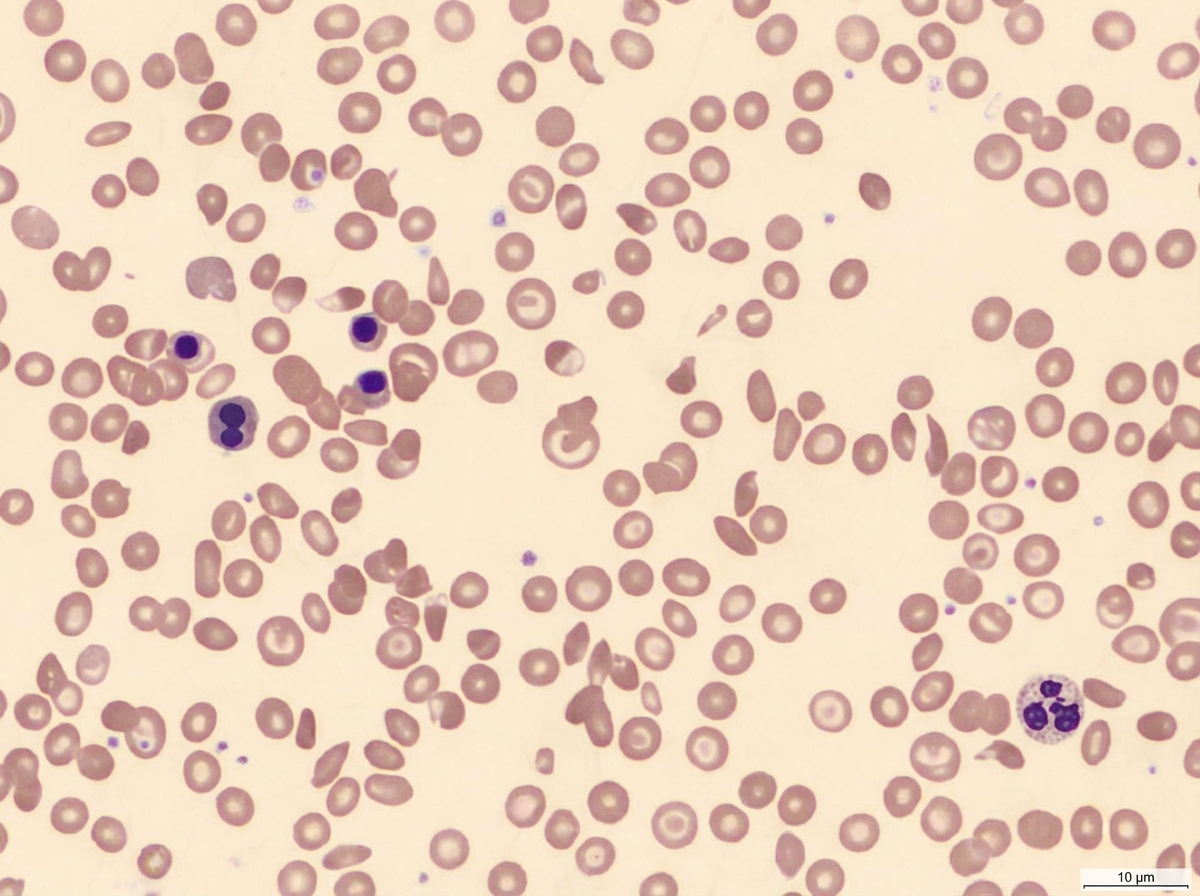
Which of the following conditions is associated with Coombs-positive hemolysis?
NESTROFT test is used for screening of:
Which subtype of Hodgkin lymphoma is negative for CD15 and CD30 markers?
What is the cause of severe hemorrhage in Acute Promyelocytic Leukemia?
Macrocytosis is seen in all of the following disorders, except?
All of the following features are true regarding multiple myeloma except?
A man living in southern Japan contracts HTLV-1 infection through sexual contact. Twenty-five years later he develops generalized lymphadenopathy with hepatosplenomegaly, a skin rash, hypercalcemia, and an elevated white blood count. This man has most likely developed which of the following?
Which of the following statements regarding Hodgkin's lymphoma is incorrect?
Blood when stored at 4°C can be kept for how long?
Platelet function is assessed by which of the following methods?
Explanation: **Explanation:** The **Coombs test** (Antiglobulin test) is the hallmark for diagnosing **Immune Hemolytic Anemias**. A positive result indicates that antibodies or complement proteins are attached to the surface of Red Blood Cells (RBCs). **Why SLE is the correct answer:** Systemic Lupus Erythematosus (SLE) is a multisystem autoimmune disorder characterized by the production of various autoantibodies [1]. Approximately 10% of SLE patients develop **Warm Autoimmune Hemolytic Anemia (WAIHA)**, where IgG autoantibodies are directed against RBC antigens [2]. This results in a **Direct Coombs-positive** hemolytic anemia [2]. **Analysis of Incorrect Options:** * **A. TTP:** This is a **Microangiopathic Hemolytic Anemia (MAHA)**. Hemolysis occurs due to mechanical shearing of RBCs (schistocytes) as they pass through fibrin thrombi in small vessels. It is a non-immune process; hence, the Coombs test is **negative**. * **C. ITP:** While ITP is an immune-mediated destruction of **platelets**, it does not inherently involve RBC destruction. (Note: If ITP and AIHA occur together, it is known as *Evans Syndrome*). * **D. PNH:** This is an acquired stem cell defect involving a deficiency of GPI-anchored proteins (CD55/CD59), making RBCs susceptible to **complement-mediated lysis**. It is not antibody-mediated; therefore, the Coombs test is **negative**. **High-Yield Clinical Pearls for NEET-PG:** * **Direct Coombs Test:** Detects antibodies/complement already bound to RBCs *in vivo*. * **Indirect Coombs Test:** Detects unbound antibodies in the *serum*. * **Drug-induced positive Coombs:** Classically associated with **Methyldopa** (true autoantibodies) and **Penicillin** (hapten mechanism). * **Evans Syndrome:** Triad of AIHA, ITP, and occasionally neutropenia. Often associated with SLE. **References:** [1] Kumar V, Abbas AK, et al.. Robbins and Cotran Pathologic Basis of Disease. 9th ed. Diseases of the Immune System, p. 230. [2] Cross SS. Underwood's Pathology: A Clinical Approach. 6th ed. Common Clinical Problems From Blood And Bone Marrow Disease, pp. 602-603.
Explanation: ### Explanation **NESTROFT** stands for **N**aked **E**ye **S**ingle **T**ube **R**ed Cell **O**smotic **F**ragility **T**est. It is a rapid, cost-effective, and highly sensitive screening tool used primarily for **Beta-Thalassemia Trait (BTT)** in large-scale population screenings. #### Why Thalassemia is Correct: In Thalassemia, red blood cells are microcytic and hypochromic [1]. These cells have a **decreased osmotic fragility** (or increased osmotic resistance) compared to normal RBCs. When placed in a buffered saline solution of 0.36%, normal RBCs undergo lysis, making the solution clear. However, Thalassemic cells resist lysis; the solution remains turbid, and a black line held behind the tube cannot be seen clearly. A positive NESTROFT (turbidity) indicates the need for further confirmatory testing like Hb Electrophoresis or HPLC [1]. #### Why Other Options are Incorrect: * **Sickle cell anemia:** Screening is typically done via the **Sickle Solubility Test** (using sodium dithionite) or Sodium Metabisulfite slide test. * **PNH:** This is an acquired stem cell disorder diagnosed via **Flow Cytometry** (CD55/CD59 deficiency). Historically, the Ham’s test and Sucrose Lysis test were used. * **PCH:** This is an autoimmune hemolytic anemia diagnosed using the **Donath-Landsteiner test** to detect biphasic IgG antibodies. #### NEET-PG High-Yield Pearls: * **Sensitivity:** NESTROFT has a high sensitivity (approx. 95-98%) but low specificity, making it an ideal "rule-out" screening tool. * **Confirmatory Gold Standard:** For Thalassemia, the gold standard for diagnosis is **HPLC (High-Performance Liquid Chromatography)**, where HbA2 > 3.5% is diagnostic for Beta-Thalassemia Trait [1]. * **Mentzer Index:** Another bedside screening tool; (MCV/RBC count) < 13 suggests Thalassemia, while > 13 suggests Iron Deficiency Anemia. **References:** [1] Kumar V, Abbas AK, et al.. Robbins and Cotran Pathologic Basis of Disease. 9th ed. Red Blood Cell and Bleeding Disorders, pp. 647-650.
Explanation: ### Explanation **1. Understanding the Correct Answer: Lymphocyte Predominance (NLPHL)** Nodular Lymphocyte Predominant Hodgkin Lymphoma (NLPHL) is biologically distinct from "Classical" Hodgkin Lymphoma (CHL). In NLPHL, the characteristic cells are **L&H cells (Lymphocytic and Histiocytic)**, also known as **"Popcorn cells."** [1] Unlike the Reed-Sternberg (RS) cells of classical types, these cells retain their B-cell phenotype. Therefore, they are **negative for CD15 and CD30** but **positive for B-cell markers like CD20 and CD45 (LCA).** [1] **2. Analysis of Incorrect Options** Options A, B, and C represent the subtypes of **Classical Hodgkin Lymphoma (CHL)**. * **A. Nodular Sclerosis:** The most common subtype; characterized by lacunar cells and collagen bands. [1] * **B. Mixed Cellularity:** Associated with EBV infection and a polymorphic inflammatory background. [1] * **C. Lymphocyte Depletion:** The rarest subtype with the worst prognosis; seen often in HIV patients. [2] * **Why they are wrong:** All CHL subtypes (A, B, C, and Lymphocyte-rich) share a common immunophenotype: they are **CD15+ and CD30+**, but usually negative for CD20 and CD45. [1] **3. High-Yield Clinical Pearls for NEET-PG** * **Immunophenotype Summary:** * **CHL:** CD15+, CD30+, CD45–, CD20–. * **NLPHL:** CD15–, CD30–, CD45+, CA20+, BCL6+. * **Popcorn Cells:** Pathognomonic for NLPHL; they have multi-lobed nuclei resembling exploded corn kernels. [1] * **Prognosis:** NLPHL generally has an excellent prognosis and often presents as localized peripheral lymphadenopathy (cervical or axillary) in young males. [1] * **Transformation:** NLPHL has a small risk (approx. 3-5%) of transforming into Diffuse Large B-cell Lymphoma (DLBCL). [1] **References:** [1] Kumar V, Abbas AK, et al.. Robbins and Cotran Pathologic Basis of Disease. 9th ed. Diseases of White Blood Cells, Lymph Nodes, Spleen, and Thymus, pp. 616-618. [2] Cross SS. Underwood's Pathology: A Clinical Approach. 6th ed. Common Clinical Problems From Diseases Of The Urinary And Male Genital Tracts, pp. 559-560.
Explanation: **Explanation:** **Acute Promyelocytic Leukemia (APL)**, classified as AML-M3, is a medical emergency primarily due to its association with a life-threatening coagulopathy. **Why A is correct:** The hallmark of APL is the **t(15;17)** translocation, which leads to the accumulation of abnormal promyelocytes [1]. These cells contain numerous **Auer rods** and primary granules rich in **tissue factor-like procoagulants** and **fibrinolytic enzymes**. When these cells die (either spontaneously or due to chemotherapy), they release these substances into the circulation, triggering **Disseminated Intravascular Coagulation (DIC)** and primary fibrinolysis [2]. This results in the rapid consumption of clotting factors and platelets, leading to severe, often fatal, hemorrhage. **Why the other options are incorrect:** * **B. Immune complex deposits:** This is a mechanism for Type III hypersensitivity reactions (e.g., Vasculitis or SLE), not the primary cause of bleeding in acute leukemia. * **C. Thrombocytopenia:** While patients with APL do have low platelet counts due to bone marrow infiltration, the *severity* and *rapidity* of the hemorrhage are specifically driven by the DIC process, which is the unique defining feature of M3. * **D. Thrombocytosis:** This refers to an increased platelet count, which would typically predispose a patient to thrombosis rather than hemorrhage. **High-Yield Clinical Pearls for NEET-PG:** * **Morphology:** Look for "Faggot cells" (cells with bundles of Auer rods). * **Cytogenetics:** **t(15;17)** involving the **PML-RARA** fusion gene [1]. * **Treatment:** **ATRA (All-trans retinoic acid)** and Arsenic Trioxide. ATRA induces the maturation of promyelocytes, which rapidly resolves the DIC. * **Warning:** Starting chemotherapy without ATRA can worsen DIC by causing massive release of procoagulants (Tumor Lysis). **References:** [1] Kumar V, Abbas AK, et al.. Robbins and Cotran Pathologic Basis of Disease. 9th ed. Diseases of White Blood Cells, Lymph Nodes, Spleen, and Thymus, pp. 620-621. [2] Kumar V, Abbas AK, et al.. Robbins and Cotran Pathologic Basis of Disease. 9th ed. Red Blood Cell and Bleeding Disorders, pp. 671-672.
Explanation: **Explanation:** The correct answer is **Thalassemia major** because it is a disorder characterized by **microcytic hypochromic anemia**, not macrocytosis. [1] **1. Why Thalassemia Major is the correct answer:** In Thalassemia, there is a genetic defect in the synthesis of globin chains (alpha or beta). This leads to deficient hemoglobin production. To compensate for the lack of hemoglobin, the red blood cell undergoes extra divisions in the bone marrow, resulting in smaller cells (**Microcytosis**, MCV < 80 fL). [1] **2. Why the other options are incorrect (Causes of Macrocytosis):** * **Vitamin B12 and Folic Acid Deficiency:** These are the classic causes of **Megaloblastic Anemia**. Both are essential for DNA synthesis (specifically thymidine production). Deficiency leads to "nuclear-cytoplasmic asynchrony," where the nucleus matures slowly while the cytoplasm grows normally, resulting in large, oval red cells (**Macro-ovalocytes**, MCV > 100 fL). * **Hypothyroidism:** This is a common cause of **Non-megaloblastic macrocytosis**. The exact mechanism is multifactorial, involving altered lipid metabolism in the RBC membrane and a direct effect of thyroid hormone deficiency on erythropoiesis. **High-Yield NEET-PG Pearls:** * **MCV Ranges:** Microcytic (<80 fL), Normocytic (80–100 fL), Macrocytic (>100 fL). * **Megaloblastic vs. Non-megaloblastic:** Megaloblastic macrocytosis features **hypersegmented neutrophils** (5+ lobes), whereas non-megaloblastic (Alcoholism, Liver disease, Hypothyroidism) does not. * **Thalassemia Hallmark:** Look for **Target cells** and a Mentzer Index (MCV/RBC count) **< 13**, which helps differentiate it from Iron Deficiency Anemia. **References:** [1] Cross SS. Underwood's Pathology: A Clinical Approach. 6th ed. Common Clinical Problems From Blood And Bone Marrow Disease, pp. 590-591, 600-601.
Explanation: **Explanation:** The correct answer is **D (Dystrophic calcification)** because Multiple Myeloma is characterized by **Metastatic calcification**, not dystrophic. 1. **Why D is correct:** * **Metastatic Calcification:** In Multiple Myeloma, neoplastic plasma cells secrete **RANKL**, which activates osteoclasts, leading to extensive bone resorption [4]. This results in **Hypercalcemia** (high serum calcium levels). When calcium deposits in normal tissues due to high serum levels, it is termed metastatic calcification [1], [2]. * **Dystrophic Calcification:** This occurs in **dead or dying tissues** (e.g., areas of necrosis or atherosclerosis) while serum calcium levels remain **normal** [2]. 2. **Why other options are incorrect:** * **A. Proteinuria:** Patients exhibit **Bence-Jones proteinuria** (monoclonal light chains in urine) [3], [5]. Additionally, AL-amyloidosis and light chain cast nephropathy ("Myeloma Kidney") contribute to protein excretion [1]. * **B. Bleeding tendency:** Myeloma causes bleeding via multiple mechanisms: interference with clotting factors by M-proteins, thrombocytopenia due to marrow infiltration, and platelet dysfunction. * **C. Visual disturbances:** High levels of monoclonal proteins (IgG/IgA) increase blood viscosity [5]. This **Hyperviscosity Syndrome** leads to retinal hemorrhages and "sausage-link" appearance of retinal veins, causing blurred vision [1]. **NEET-PG High-Yield Pearls:** * **CRAB Criteria:** **C**alcium (elevated), **R**enal insufficiency, **A**nemia, **B**one lesions (punched-out lytic lesions) [4]. * **Diagnosis:** Bone marrow plasma cells **≥10%** or biopsy-proven plasmacytoma [4], [5]. * **Blood Film:** **Rouleaux formation** (due to decreased zeta potential between RBCs) [4]. * **Urine:** Bence-Jones proteins precipitate at 40-60°C and redissolve on boiling (100°C). They are **not** detected by standard dipsticks (which detect albumin). **References:** [1] Cross SS. Underwood's Pathology: A Clinical Approach. 6th ed. Common Clinical Problems From Blood And Bone Marrow Disease, pp. 618-619. [2] Cross SS. Underwood's Pathology: A Clinical Approach. 6th ed. (Basic Pathology) introduces the student to key general principles of pathology, both as a medical science and as a clinical activity with a vital role in patient care. Part 2 (Disease Mechanisms) provides fundamental knowledge about the cellular and molecular processes involved in diseases, providing the rationale for their treatment. Part 3 (Systematic Pathology) deals in detail with specific diseases, with emphasis on the clinically important aspects., pp. 134-135. [3] Cross SS. Underwood's Pathology: A Clinical Approach. 6th ed. Common Clinical Problems From Blood And Bone Marrow Disease, pp. 616-617. [4] Cross SS. Underwood's Pathology: A Clinical Approach. 6th ed. Common Clinical Problems From Blood And Bone Marrow Disease, pp. 617-618. [5] Kumar V, Abbas AK, et al.. Robbins and Cotran Pathologic Basis of Disease. 9th ed. Diseases of White Blood Cells, Lymph Nodes, Spleen, and Thymus, pp. 608-609.
Explanation: ### Explanation **Correct Option: D. Leukemia (Adult T-Cell Leukemia/Lymphoma - ATLL)** The clinical presentation described is a classic case of **Adult T-Cell Leukemia/Lymphoma (ATLL)**, caused by the **HTLV-1** (Human T-cell Lymphotropic Virus type 1) retrovirus [1]. **Why it is correct:** HTLV-1 is endemic in parts of **Japan**, the Caribbean, and Africa [1]. It is transmitted via sexual contact, blood, or breastfeeding. The virus has a long latency period (20–30 years). It encodes the **Tax protein**, which activates host cell transcription, inhibits tumor suppressor genes (like p53), and leads to the polyclonal expansion of CD4+ T-cells. Eventually, a monoclonal neoplastic transformation occurs. * **Clinical Hallmarks:** Generalized lymphadenopathy, hepatosplenomegaly, **skin lesions** (rash/nodules), and significant **hypercalcemia** (due to osteoclast activation). * **Morphology:** Peripheral blood smears typically show "Flower cells" (lymphocytes with multilobulated nuclei). **Why incorrect options are wrong:** * **A. AIDS:** Caused by HIV, not HTLV-1 [2]. While both are retroviruses, HIV leads to CD4+ T-cell depletion and immunosuppression, whereas HTLV-1 leads to T-cell proliferation/malignancy [2]. * **B. Autoimmunity:** While HTLV-1 is associated with *HAM/TSP* (HTLV-1-associated myelopathy), the acute presentation of hypercalcemia and high WBC points specifically to malignancy. * **C. Delayed hypersensitivity:** This is a Type IV immune response. While T-cells are involved, it does not explain the systemic neoplastic features like organomegaly and hypercalcemia. **NEET-PG High-Yield Pearls:** 1. **Virus:** HTLV-1 (a retrovirus) [1]. 2. **Key Protein:** **Tax protein** (essential for leukemogenesis). 3. **Pathognomonic Cell:** **Flower cells** (Clover-leaf nuclei) on peripheral smear. 4. **Classic Triad:** Lytic bone lesions/Hypercalcemia + Skin rash + HTLV-1 positivity. 5. **Differential:** Unlike Multiple Myeloma, ATLL presents with significant lymphadenopathy and hepatosplenomegaly. **References:** [1] Cross SS. Underwood's Pathology: A Clinical Approach. 6th ed. (Basic Pathology) introduces the student to key general principles of pathology, both as a medical science and as a clinical activity with a vital role in patient care. Part 2 (Disease Mechanisms) provides fundamental knowledge about the cellular and molecular processes involved in diseases, providing the rationale for their treatment. Part 3 (Systematic Pathology) deals in detail with specific diseases, with emphasis on the clinically important aspects., pp. 219-220. [2] Kumar V, Abbas AK, et al.. Robbins and Cotran Pathologic Basis of Disease. 9th ed. Diseases of the Immune System, pp. 261-262.
Explanation: ### Explanation **1. Why Option A is the correct (incorrect statement):** In Hodgkin’s Lymphoma (HL), **Central Nervous System (CNS) involvement is extremely rare** (occurring in <1% of cases). HL typically spreads in a predictable, contiguous fashion via the lymphatic system [1], [2]. The most common site of involvement is the **cervical lymph nodes** (60-80% of cases), followed by mediastinal, axillary, and para-aortic nodes [4]. If a lymphoma involves the CNS, it is much more likely to be a Non-Hodgkin Lymphoma (NHL), particularly Diffuse Large B-Cell Lymphoma (DLBCL). **2. Analysis of other options:** * **Option B:** The **Reed-Sternberg (RS) cell** is the diagnostic hallmark of HL [3]. These are large, multinucleated cells (or have a bilobed nucleus) with prominent "owl-eye" nucleoli [1]. * **Option C:** **Nodular Sclerosis** is the most common subtype of HL [4]. It characteristically presents with a mediastinal mass and typically affects young females [2]. * **Option D:** HL is unique because the neoplastic RS cells make up only 1–5% of the tumor mass. The bulk of the tumor consists of a **reactive inflammatory background** (eosinophils, plasma cells, lymphocytes, and neutrophils) recruited by cytokines (like IL-5) secreted by the RS cells [1]. **3. High-Yield Pearls for NEET-PG:** * **CD Markers:** Classic HL is **CD15+ and CD30+**, but **CD45-**. * **Popcorn Cells:** Seen in Lymphocyte Predominant HL (LPHL); these are **CD20+** and CD45+, but CD15- and CD30-. * **Bimodal Age Distribution:** HL shows peaks in the 20s and again after age 50 [1]. * **EBV Association:** Most strongly associated with the Mixed Cellularity subtype [4]. **References:** [1] Kumar V, Abbas AK, et al.. Robbins and Cotran Pathologic Basis of Disease. 9th ed. Diseases of White Blood Cells, lymph Nodes, Spleen, and Thymus, pp. 614-616. [2] Cross SS. Underwood's Pathology: A Clinical Approach. 6th ed. Common Clinical Problems From Diseases Of The Urinary And Male Genital Tracts, pp. 557-558. [3] Kumar V, Abbas AK, et al.. Robbins and Cotran Pathologic Basis of Disease. 9th ed. Diseases of White Blood Cells, lymph Nodes, Spleen, and Thymus, p. 616. [4] Kumar V, Abbas AK, et al.. Robbins and Cotran Pathologic Basis of Disease. 9th ed. Diseases of White Blood Cells, lymph Nodes, Spleen, and Thymus, pp. 616-618.
Explanation: **Explanation:** The storage life (shelf life) of whole blood is primarily determined by the **anticoagulant-preservative solution** used in the blood bag. The standard duration for blood stored at **4°C (± 2°C)** using **CPD (Citrate Phosphate Dextrose)** or **CPDA-1 (Citrate Phosphate Dextrose Adenine)** is based on the viability of Red Blood Cells (RBCs). 1. **Why 21 days is correct:** When blood is collected in **CPD**, the shelf life is **21 days**. The citrate prevents clotting by chelating calcium, while dextrose provides a substrate for glycolysis to maintain ATP levels. For a unit to be considered viable, at least **70% of the transfused RBCs must survive in the recipient's circulation for 24 hours** post-transfusion. 2. **Why other options are incorrect:** * **7 and 14 days:** These durations are too short. While metabolic changes (the "storage lesion") begin immediately, the cells remain clinically viable for much longer. * **28 days:** This is an intermediate value. While newer additive solutions extend life beyond 21 days, 28 is not the standard cutoff for CPD. **High-Yield Clinical Pearls for NEET-PG:** * **CPDA-1:** If Adenine is added (CPDA-1), the shelf life extends to **35 days** because adenine enhances ATP synthesis. * **SAGM (Saline-Adenine-Glucose-Mannitol):** If additive solutions are used after removing plasma, the shelf life extends to **42 days**. * **Storage Lesion:** During storage at 4°C, certain changes occur: **↓ pH, ↓ 2,3-DPG (shifting the O2 dissociation curve to the left), ↓ Sodium, and ↑ Potassium.** * **Temperature:** Blood must be stored at **2°C to 6°C**. Platelets, conversely, are stored at **20°C to 24°C** with constant agitation for only 5 days.
Explanation: **Explanation:** Platelet function assessment is crucial for diagnosing qualitative platelet disorders (like Glanzmann thrombasthenia or Bernard-Soulier syndrome) and monitoring antiplatelet therapy [1]. 1. **Bleeding Time (BT):** This is a traditional *in vivo* test of platelet function. It measures the time taken for a standardized skin incision to stop bleeding. It evaluates the formation of the temporary platelet plug (primary hemostasis), which depends on both platelet number and function. 2. **Platelet Adhesion:** This is a fundamental step in platelet plug formation where platelets attach to the subendothelial collagen via von Willebrand factor (vWF) [1][2]. Tests like the glass bead column retention test (though largely historical) measure the ability of platelets to adhere to surfaces. 3. **PFA-100 (Platelet Function Analyzer):** This is a modern *in vitro* "high-shear" flow system that has largely replaced the Bleeding Time in clinical practice. It simulates a damaged blood vessel by passing whole blood through a membrane coated with collagen and epinephrine/ADP. It measures the "Closure Time" (CT) and is highly sensitive to von Willebrand Disease and aspirin effects. Since all three methods evaluate different aspects of how platelets contribute to primary hemostasis, **Option D** is the correct answer. **High-Yield Clinical Pearls for NEET-PG:** * **Gold Standard:** Platelet Aggregometry (using Born’s aggregometer) is the gold standard for specific qualitative defects. * **BT vs. PFA-100:** PFA-100 is more sensitive and reproducible than the manual Bleeding Time. * **Bernard-Soulier Syndrome:** Characterized by defective **adhesion** (GpIb-IX-V deficiency) [3]. * **Glanzmann Thrombasthenia:** Characterized by defective **aggregation** (GpIIb/IIIa deficiency) [3]. **References:** [1] Kumar V, Abbas AK, et al.. Robbins and Cotran Pathologic Basis of Disease. 9th ed. Hemodynamic Disorders, Thromboembolic Disease, and Shock, pp. 126-128. [2] Cross SS. Underwood's Pathology: A Clinical Approach. 6th ed. Common Clinical Problems From Blood And Bone Marrow Disease, pp. 581-582. [3] Kumar V, Abbas AK, et al.. Robbins and Cotran Pathologic Basis of Disease. 9th ed. Red Blood Cell and Bleeding Disorders, pp. 668-669.
Anemias: Classification and Approach
Practice Questions
Hemolytic Anemias
Practice Questions
Myeloproliferative Neoplasms
Practice Questions
Myelodysplastic Syndromes
Practice Questions
Acute Leukemias
Practice Questions
Chronic Leukemias
Practice Questions
Lymphomas and Lymphoid Neoplasms
Practice Questions
Plasma Cell Disorders
Practice Questions
Bleeding Disorders
Practice Questions
Thrombotic Disorders
Practice Questions
Get full access to all questions, explanations, and performance tracking.
Start For Free