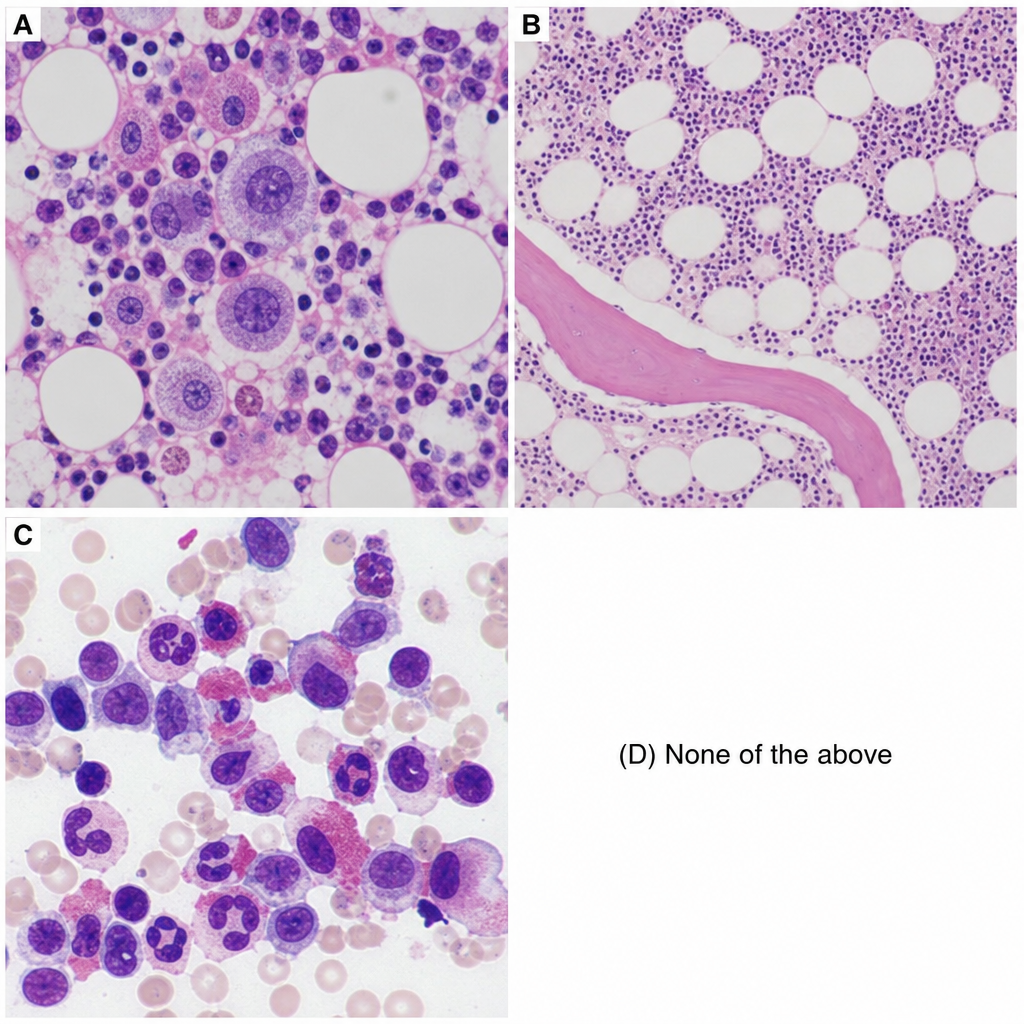
Which test is most sensitive for disseminated intravascular coagulation (DIC)?
Which of the following laboratory determinants is abnormally prolonged in ITP?
What is true regarding prothrombin time measurement?
Heinz bodies are seen in:
Which of the following is NOT a feature of intravascular hemolysis?
All of the following are true about anticoagulants except?
The Philadelphia chromosome is consistently found in which of the following hematologic malignancies?
Which of the following CD markers is NOT used for diagnostic criteria for systemic mastocytosis?
Which of the following surface glycoproteins is most often expressed in human hematopoietic stem cells?
Which of the following is considered the most malignant form of Non-Hodgkin Lymphoma (NHL)?
Explanation: **Explanation:** Disseminated Intravascular Coagulation (DIC) is a complex thrombo-hemorrhagic disorder characterized by systemic activation of the coagulation cascade, leading to widespread microvascular thrombosis and subsequent consumption of clotting factors and platelets [1], [2]. **Why Option B is Correct:** The hallmark of DIC is the simultaneous activation of coagulation and **secondary fibrinolysis**. As the body attempts to break down widespread fibrin clots, plasmin cleaves fibrin and fibrinogen, resulting in a significant rise in **Fibrin Degradation Products (FDPs)** and **D-dimers** [2]. FDPs are considered the most sensitive indicator because they reflect the active breakdown of fibrin/fibrinogen that occurs early and consistently in the DIC process [1]. While D-dimer is more specific for cross-linked fibrin, elevated FDP remains a classic high-yield answer for sensitivity in DIC. **Analysis of Incorrect Options:** * **A. Serum Fibrinogen:** Fibrinogen is an acute-phase reactant. In early DIC, levels may appear "normal" despite consumption. Low fibrinogen is specific but lacks sensitivity as it only occurs in late, decompensated stages [2]. * **C. Prolonged PT and PTT:** While common in DIC due to the consumption of clotting factors, these are non-specific and can be seen in liver disease or vitamin K deficiency [2]. * **D. Thrombocytopenia:** Platelet consumption is a key feature, but isolated thrombocytopenia is seen in numerous other conditions (e.g., ITP, HUS), making it less sensitive for the specific diagnosis of DIC compared to FDPs [2]. **NEET-PG High-Yield Pearls:** * **Best Screening Test:** Platelet count (usually low) [2]. * **Most Specific Test:** D-dimer (indicates breakdown of cross-linked fibrin). * **Peripheral Smear:** Look for **Schistocytes** (fragmented RBCs) indicating microangiopathic hemolytic anaemia (MAHA) [2]. * **Common Trigger:** Obstetric complications (Abruptio placentae) and Sepsis (Gram-negative). **References:** [1] Cross SS. Underwood's Pathology: A Clinical Approach. 6th ed. (Basic Pathology) introduces the student to key general principles of pathology, both as a medical science and as a clinical activity with a vital role in patient care. Part 2 (Disease Mechanisms) provides fundamental knowledge about the cellular and molecular processes involved in diseases, providing the rationale for their treatment. Part 3 (Systematic Pathology) deals in detail with specific diseases, with emphasis on the clinically important aspects., pp. 151-152. [2] Cross SS. Underwood's Pathology: A Clinical Approach. 6th ed. Common Clinical Problems From Blood And Bone Marrow Disease, pp. 625-626.
Explanation: **Explanation:** **Immune Thrombocytopenic Purpura (ITP)** is an acquired autoimmune disorder characterized by the immune-mediated destruction of platelets (via anti-GP IIb/IIIa antibodies) and impaired platelet production. 1. **Why Bleeding Time (BT) is prolonged:** Bleeding time is a functional assessment of the **primary hemostatic pathway**, which depends on two factors: adequate platelet count and normal platelet function [1]. In ITP, the hallmark is significant **thrombocytopenia** (low platelet count). Since there are fewer platelets available to form the initial platelet plug at the site of vascular injury, the bleeding time is characteristically increased. 2. **Why other options are incorrect:** * **APTT (Activated Partial Thromboplastin Time):** This measures the **intrinsic and common pathways** of the coagulation cascade (Factors XII, XI, IX, VIII, X, V, II, and I). These plasma proteins are unaffected in ITP [2]. * **Prothrombin Time (PT):** This measures the **extrinsic and common pathways** (Factor VII, X, V, II, and I). Like APTT, PT remains normal because ITP is a platelet disorder, not a coagulation factor deficiency [2]. * **Clotting Time (CT):** This is an older, less sensitive measure of the intrinsic coagulation pathway. It remains normal in isolated platelet disorders. **High-Yield Clinical Pearls for NEET-PG:** * **Bone Marrow Finding:** Characterized by **increased megakaryocytes** (compensatory hyperplasia) with many immature forms [2]. * **Peripheral Smear:** Shows thrombocytopenia with **large platelets (Megathrombocytes)** [2]. * **Treatment of Choice:** Corticosteroids (First-line) [2]; IVIG is used for rapid platelet elevation; Splenectomy is considered for refractory cases. * **Rule of Thumb:** In pure platelet disorders (ITP, Bernard-Soulier, Glanzmann), BT is high while PT/APTT are normal. In pure coagulation disorders (Hemophilia), PT/APTT are high while BT is normal. **References:** [1] Cross SS. Underwood's Pathology: A Clinical Approach. 6th ed. Common Clinical Problems From Blood And Bone Marrow Disease, pp. 619-620. [2] Kumar V, Abbas AK, et al.. Robbins and Cotran Pathologic Basis of Disease. 9th ed. Red Blood Cell and Bleeding Disorders, pp. 666-667.
Explanation: **Explanation:** Prothrombin Time (PT) measures the integrity of the **extrinsic and common pathways** of the coagulation cascade (Factors VII, X, V, II, and I). **1. Why Option C is Correct:** PT testing requires **Platelet-Poor Plasma (PPP)**. To maintain the stability of coagulation factors, especially Factor VII (which has the shortest half-life) and Factor V (which is labile), the sample should ideally be tested within **2 hours** if kept at room temperature. While some guidelines allow up to 24 hours for un-fractionated samples, for NEET-PG purposes, the "2-hour rule" is the standard clinical benchmark for ensuring the highest viability of labile factors. [1] **2. Why the other options are incorrect:** * **Option A:** PT requires **Platelet-Poor Plasma** (centrifuged at high speeds). Platelets contain phospholipids and Platelet Factor 4, which can neutralize heparin or interfere with the standardized thromboplastin reagent. * **Option B:** Kaolin is used in the **Activated Partial Thromboplastin Time (aPTT)** to provide a surface for the activation of Factor XII (intrinsic pathway). PT is activated using **Tissue Thromboplastin** and Calcium. [1] * **Option D:** Immediate refrigeration is **not** recommended for PT samples. Cold temperatures can cause "cold activation" of Factor VII, leading to falsely shortened PT results. Samples should be kept at room temperature (18-24°C). **High-Yield Clinical Pearls for NEET-PG:** * **Anticoagulant used:** 3.2% Sodium Citrate (Light blue top) in a **9:1 ratio** of blood to anticoagulant. * **INR (International Normalized Ratio):** Used to standardize PT results for patients on Warfarin. Formula: $INR = (Patient PT / Control PT)^{ISI}$. * **Most sensitive factor:** Factor VII is the first to decrease in Vitamin K deficiency or liver disease due to its short half-life (approx. 6 hours). **References:** [1] Cross SS. Underwood's Pathology: A Clinical Approach. 6th ed. Common Clinical Problems From Blood And Bone Marrow Disease, pp. 625-626.
Explanation: **Explanation:** **1. Why G-6-PD Deficiency is Correct:** Glucose-6-Phosphate Dehydrogenase (G-6-PD) is a critical enzyme in the Hexose Monophosphate (HMP) shunt, responsible for maintaining levels of **reduced glutathione**. This antioxidant protects hemoglobin from oxidative stress. In G-6-PD deficiency, oxidative stress (triggered by fava beans, infections, or drugs like Primaquine) causes hemoglobin to denature and precipitate into insoluble inclusions called **Heinz bodies** [2]. When these cells pass through the splenic sinusoids, splenic macrophages pluck out these inclusions, resulting in **"Bite cells"** (Degmacytes) [2]. **2. Why Incorrect Options are Wrong:** * **Sickle Cell Disease:** Characterized by **HbS polymerization** under deoxygenated conditions [4], leading to sickle-shaped RBCs and **Howell-Jolly bodies** (nuclear remnants due to functional asplenia), not Heinz bodies. * **Hereditary Spherocytosis:** Caused by defects in RBC membrane proteins (Spectrin/Ankyrin). The hallmark finding is **Spherocytes** (small, dark RBCs lacking central pallor) [1]. * **PNH (Paroxysmal Nocturnal Hemoglobinuria):** An acquired stem cell defect (PIGA gene) leading to a deficiency of GPI-anchored proteins (CD55/CD59) [3]. It presents with intravascular hemolysis but does not involve hemoglobin precipitation. **3. High-Yield Clinical Pearls for NEET-PG:** * **Staining:** Heinz bodies are **not visible on routine Leishman or Romanowsky stains**. They require **Supravital stains** (e.g., Crystal Violet, Brilliant Cresyl Blue, or Methyl Violet). * **Differential Diagnosis:** Heinz bodies are also seen in **Alpha-Thalassemia** (HbH disease) and **Unstable Hemoglobin variants**. * **Bite Cells vs. Blister Cells:** Both are characteristic of G-6-PD deficiency; "Blister cells" have a vacuole where the hemoglobin has pulled away from the membrane. **References:** [1] Kumar V, Abbas AK, et al.. Robbins and Cotran Pathologic Basis of Disease. 9th ed. Red Blood Cell and Bleeding Disorders, pp. 641-642. [2] Kumar V, Abbas AK, et al.. Robbins and Cotran Pathologic Basis of Disease. 9th ed. Red Blood Cell and Bleeding Disorders, pp. 642-643. [3] Cross SS. Underwood's Pathology: A Clinical Approach. 6th ed. Common Clinical Problems From Blood And Bone Marrow Disease, pp. 601-602. [4] Cross SS. Underwood's Pathology: A Clinical Approach. 6th ed. Common Clinical Problems From Blood And Bone Marrow Disease, pp. 598-599.
Explanation: **Explanation:** In **intravascular hemolysis**, Red Blood Cells (RBCs) are destroyed directly within the circulation. This process releases free hemoglobin into the plasma, leading to a specific cascade of biochemical changes [1]. **Why Thrombocytopenia is the correct answer:** Thrombocytopenia (low platelet count) is **not** a characteristic feature of intravascular hemolysis itself. While certain conditions like Microangiopathic Hemolytic Anemia (MAHA) or DIC can present with both hemolysis and low platelets, thrombocytopenia is a feature of the underlying systemic disease process rather than the hemolytic mechanism [2]. Pure intravascular hemolysis (e.g., G6PD deficiency or mismatched transfusion) typically leaves platelet counts unaffected. **Why the other options are incorrect:** * **Decreased Haptoglobin:** Free hemoglobin released into the blood binds to haptoglobin. This complex is rapidly cleared by the liver, leading to a marked decrease or total absence of serum haptoglobin [1]. * **Raised Indirect Bilirubin:** Heme from the released hemoglobin is metabolized into unconjugated (indirect) bilirubin [3]. When the rate of hemolysis exceeds the liver's conjugating capacity, indirect bilirubin levels rise [3]. * **Hemosiderinuria:** When haptoglobin is saturated, free hemoglobin is filtered by the renal glomeruli (hemoglobinuria). Some is reabsorbed by renal tubular cells, where it is converted to hemosiderin. When these cells eventually slough off into the urine, it results in hemosiderinuria (a classic sign of chronic intravascular hemolysis) [1]. **High-Yield Clinical Pearls for NEET-PG:** * **Hallmark Triad:** Low Haptoglobin + Hemoglobinuria + Hemosiderinuria = Intravascular Hemolysis [1]. * **Schistocytes:** Their presence on a peripheral smear strongly suggests intravascular destruction (e.g., mechanical heart valves or MAHA). * **LDH:** Serum Lactate Dehydrogenase is significantly elevated in intravascular hemolysis as it is released directly from the RBC cytoplasm. **References:** [1] Kumar V, Abbas AK, et al.. Robbins and Cotran Pathologic Basis of Disease. 9th ed. Red Blood Cell and Bleeding Disorders, pp. 639-640. [2] Kumar V, Abbas AK, et al.. Robbins and Cotran Pathologic Basis of Disease. 9th ed. Red Blood Cell and Bleeding Disorders, pp. 667-668. [3] Kumar V, Abbas AK, et al.. Robbins and Cotran Pathologic Basis of Disease. 9th ed. Red Blood Cell and Bleeding Disorders, p. 640.
Explanation: This question tests the knowledge of blood preservation and the specific roles of additives in anticoagulant solutions. ### **Explanation of the Correct Option** **Option C is the incorrect statement (and thus the correct answer).** In blood preservation solutions like CPD (Citrate Phosphate Dextrose), **Sodium Acid Phosphate (NaH₂PO₄)** is added primarily as a **buffer** to maintain the pH of the stored blood. It prevents the excessive drop in pH caused by the accumulation of lactic acid (a byproduct of glycolysis). While ATP is vital for red cell survival, its synthesis is primarily supported by **Dextrose** (which provides the energy source) and **Adenine** (which provides the substrate for ATP synthesis). ### **Analysis of Other Options** * **Option A (CPDA-1):** Citrate Phosphate Dextrose Adenine-1 allows for a storage life of **35 days**. The addition of Adenine to the standard CPD solution improves ATP regeneration, extending the shelf life from 21 to 35 days. * **Option B (SAGM):** Saline-Adenine-Glucose-Mannitol is an additive solution used after removing plasma. It provides optimal nutrients and membrane stabilization (via Mannitol), extending the shelf life to **42 days**. * **Option D (Citrate):** Citrate (Sodium Citrate) is the primary anticoagulant in all standard blood bags. It works by **chelating (binding) ionized calcium**, which is Factor IV in the coagulation cascade, thereby preventing clot formation. ### **High-Yield Clinical Pearls for NEET-PG** * **Citrate:** Anticoagulant (Calcium chelator). * **Dextrose:** Energy source for glycolysis. * **Phosphate:** Buffer (maintains pH). * **Adenine:** Maintains high ATP levels (extends life to 35 days). * **2,3-DPG:** Levels decrease during storage, leading to an increased affinity of hemoglobin for oxygen (Left shift of the Oxygen Dissociation Curve). * **Storage Temperature:** Whole blood/PRBCs must be stored at **2–6°C**.
Explanation: ### Explanation **Correct Option: C. Chronic Myeloid Leukemia (CML)** The **Philadelphia chromosome (Ph)** is the hallmark cytogenetic abnormality of Chronic Myeloid Leukemia, present in **>95% of cases** [1]. It results from a reciprocal translocation between chromosomes 9 and 22, denoted as **t(9;22)(q34;q11)** [2]. * **Mechanism:** This translocation fuses the *ABL1* gene (from chromosome 9) with the *BCR* gene (on chromosome 22), creating the **BCR-ABL1 fusion gene** [4]. * **Pathophysiology:** This fusion gene encodes a chimeric protein with constitutive **tyrosine kinase activity**, which drives uncontrolled proliferation of the myeloid lineage and inhibits apoptosis [1]. **Why other options are incorrect:** * **A. Acute Myeloid Leukemia (AML):** While the Ph chromosome can rarely be seen in *de novo* AML (approx. 1%), it is not a consistent or defining feature. Common translocations in AML include t(8;21) or t(15;17). * **B. Chronic Lymphocytic Leukemia (CLL):** CLL is typically associated with deletions (13q, 11q, 17p) or trisomy 12. The Ph chromosome is not a feature of CLL. * **D. All of the above:** Incorrect because the Ph chromosome is specifically diagnostic for CML among the options provided. **High-Yield Clinical Pearls for NEET-PG:** 1. **Treatment:** The discovery of the Ph chromosome led to the development of **Imatinib (Gleevec)**, a targeted tyrosine kinase inhibitor (TKI) that revolutionized CML prognosis [3]. 2. **Molecular Variants:** In CML, the fusion protein is typically **p210**. In Ph+ Acute Lymphoblastic Leukemia (ALL), it is often **p190**, which carries a poorer prognosis. 3. **Leukocyte Alkaline Phosphatase (LAP) Score:** In CML, the LAP score is characteristically **decreased**, helping to differentiate it from a Leukemoid reaction (where LAP is increased). **References:** [1] Kumar V, Abbas AK, et al.. Robbins and Cotran Pathologic Basis of Disease. 9th ed. Diseases of White Blood Cells, Lymph Nodes, Spleen, and Thymus, p. 624. [2] Cross SS. Underwood's Pathology: A Clinical Approach. 6th ed. (Basic Pathology) introduces the student to key general principles of pathology, both as a medical science and as a clinical activity with a vital role in patient care. Part 2 (Disease Mechanisms) provides fundamental knowledge about the cellular and molecular processes involved in diseases, providing the rationale for their treatment. Part 3 (Systematic Pathology) deals in detail with specific diseases, with emphasis on the clinically important aspects., pp. 225-226. [3] Cross SS. Underwood's Pathology: A Clinical Approach. 6th ed. Common Clinical Problems From Blood And Bone Marrow Disease, pp. 611-612. [4] Kumar V, Abbas AK, et al.. Robbins and Cotran Pathologic Basis of Disease. 9th ed. Diseases of White Blood Cells, Lymph Nodes, Spleen, and Thymus, pp. 624-625.
Explanation: **Explanation:** Systemic Mastocytosis (SM) is a clonal disorder characterized by the proliferation and accumulation of neoplastic mast cells in one or more extra-cutaneous organs (most commonly the bone marrow). **Why CD 20 is the correct answer:** CD 20 is a classic marker for **B-lymphocytes** [2]. It is not expressed by mast cells and is not part of the WHO diagnostic criteria for systemic mastocytosis. **Analysis of other options:** * **CD 117 (c-kit):** This is the most important marker for identifying mast cells, as it is the receptor for stem cell factor. While normal mast cells express CD 117, its presence is essential for identifying the lineage in biopsy specimens. Pathogenesis of mastocytosis often involves acquired activating point mutations in the KIT receptor tyrosine kinase [1]. * **CD 2 and CD 25:** These are **aberrant markers**. Normal mast cells do *not* express CD 2 or CD 25. The expression of CD 25 (with or without CD 2) on mast cells is a **Minor Criterion** for the diagnosis of Systemic Mastocytosis. **High-Yield Clinical Pearls for NEET-PG:** * **WHO Diagnostic Criteria:** Diagnosis requires either **1 Major + 1 Minor** criterion OR **3 Minor** criteria. * *Major:* Multifocal, dense infiltrates of mast cells (≥15) in bone marrow or extra-cutaneous organs. * *Minor:* 1) Spindled/atypical morphology (>25%); 2) *KIT* mutation at codon 816 (D816V); 3) Expression of **CD2 and/or CD25**; 4) Persistent serum total tryptase >20 ng/mL. * **Genetics:** The **KIT D816V mutation** is present in >90% of adult SM cases [1]. * **Staining:** Mast cells are best visualized using **Toluidine blue** (metachromatic staining) or **Leder stain** (Chloroacetate esterase). **References:** [1] Kumar V, Abbas AK, et al.. Robbins and Cotran Pathologic Basis of Disease. 9th ed. The Skin, pp. 1162-1164. [2] Kumar V, Abbas AK, et al.. Robbins and Cotran Pathologic Basis of Disease. 9th ed. Diseases of White Blood Cells, Lymph Nodes, Spleen, and Thymus, pp. 609-610.
Explanation: **Explanation:** **CD34** is a transmembrane phosphoglycoprotein and the hallmark surface marker for **human hematopoietic stem cells (HSCs)** and progenitor cells. It plays a critical role in cell-cell adhesion and mediates the attachment of stem cells to the bone marrow extracellular matrix. As HSCs differentiate into mature lineages, the expression of CD34 is lost; therefore, it is used clinically to identify, quantify, and isolate stem cells for peripheral blood stem cell transplantation [1]. **Analysis of Incorrect Options:** * **CD22:** This is a specific marker for **B-lineage cells**. It is expressed during the late pre-B cell stage and persists on mature B cells, but it is absent on hematopoietic stem cells. * **CD4:** This is a marker for **T-helper cells**, monocytes, and macrophages. It is a co-receptor for the T-cell receptor (TCR) and is not expressed on early undifferentiated stem cells. (Note: CD4D is likely a typo for CD4). * **CD15:** Also known as Lewis X, this is a carbohydrate adhesion molecule primarily expressed on **mature granulocytes** (neutrophils) and Reed-Sternberg cells in Hodgkin Lymphoma. **High-Yield Clinical Pearls for NEET-PG:** * **Stem Cell Harvest:** A minimum dose of **$2 \times 10^6$ CD34+ cells/kg** is generally required for successful engraftment in autologous transplants [1]. * **Flow Cytometry:** CD34 is essential for diagnosing **Acute Leukemias** (to identify the "blast" population), though it may be negative in Acute Promyelocytic Leukemia (M3). * **Other HSC Markers:** Along with CD34, HSCs are typically **CD38-negative** and **Lin-negative**. * **Vascular Marker:** CD34 is also expressed on **vascular endothelial cells** and is used as a marker for vascular tumors (e.g., Angiosarcoma, Kaposi Sarcoma). **References:** [1] Cross SS. Underwood's Pathology: A Clinical Approach. 6th ed. Common Clinical Problems From Blood And Bone Marrow Disease, pp. 584-586.
Explanation: **Explanation:** The classification of Non-Hodgkin Lymphomas (NHL) is primarily based on their clinical behavior, categorized into **Indolent** (low-grade) and **Aggressive** (high-grade) types. **Diffuse Large B-Cell Lymphoma (DLBCL)** is the most common subtype of NHL and is characterized by a highly aggressive clinical course [1]. It consists of large, atypical B-cells that rapidly efface the lymph node architecture [2]. Without treatment, it is rapidly fatal; however, because the cells are rapidly dividing, it is often sensitive to intensive chemotherapy (like R-CHOP), making it potentially curable [1]. **Analysis of Incorrect Options:** * **Small Cell Lymphocytic Lymphoma (SLL):** This is an indolent (low-grade) B-cell lymphoma, the tissue equivalent of Chronic Lymphocytic Leukemia (CLL). It progresses very slowly over many years. * **Mantle Cell Lymphoma (MCL):** While MCL is aggressive and often has a poor prognosis due to its lack of curability, it is generally considered less "acutely malignant" in its initial growth velocity compared to the rapid proliferation seen in DLBCL. * **Follicular Lymphoma (FL), Large Cell Type:** While Grade 3 FL (large cell) is more aggressive than Grades 1 or 2, it is often considered a transitional phase. If it completely loses its follicular pattern, it is reclassified as DLBCL. **High-Yield NEET-PG Pearls:** * **Most common NHL overall:** DLBCL. * **Most common indolent NHL:** Follicular Lymphoma. * **Starry sky appearance:** Burkitt Lymphoma (the most rapidly dividing/highly malignant, but often categorized separately due to its unique doubling time) [3]. * **Richter Transformation:** The progression of an indolent lymphoma (like SLL/CLL) into an aggressive DLBCL. **References:** [1] Cross SS. Underwood's Pathology: A Clinical Approach. 6th ed. Common Clinical Problems From Diseases Of The Urinary And Male Genital Tracts, pp. 563-564. [2] Kumar V, Abbas AK, et al.. Robbins and Cotran Pathologic Basis of Disease. 9th ed. Diseases of White Blood Cells, Lymph Nodes, Spleen, and Thymus, pp. 604-605. [3] Kumar V, Abbas AK, et al.. Robbins and Cotran Pathologic Basis of Disease. 9th ed. Diseases of White Blood Cells, Lymph Nodes, Spleen, and Thymus, p. 606.
Anemias: Classification and Approach
Practice Questions
Hemolytic Anemias
Practice Questions
Myeloproliferative Neoplasms
Practice Questions
Myelodysplastic Syndromes
Practice Questions
Acute Leukemias
Practice Questions
Chronic Leukemias
Practice Questions
Lymphomas and Lymphoid Neoplasms
Practice Questions
Plasma Cell Disorders
Practice Questions
Bleeding Disorders
Practice Questions
Thrombotic Disorders
Practice Questions
Get full access to all questions, explanations, and performance tracking.
Start For Free