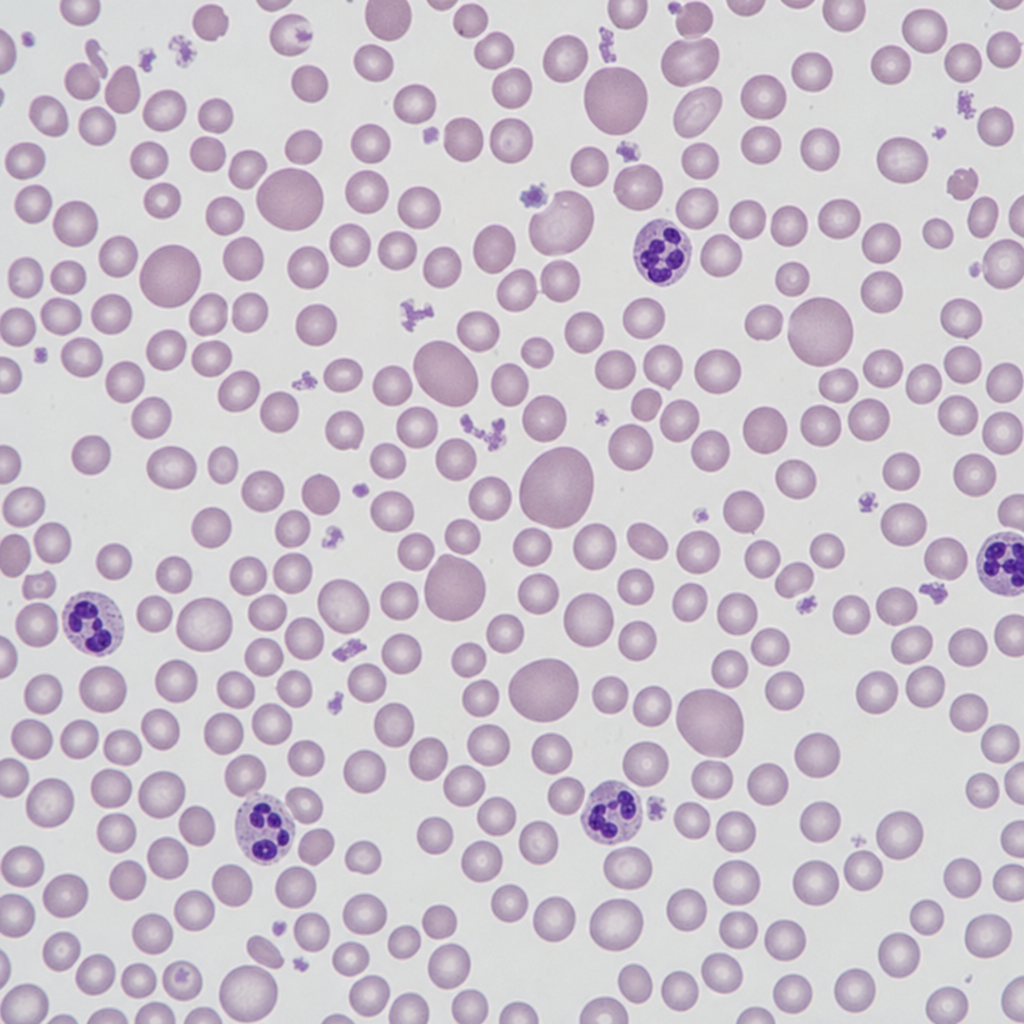
What are the main components of cryoprecipitate?
Which of the following is NOT true about BCR-ABL variants?
Di Guglielmo's disease refers to which of the following conditions?
Acid Citrate Dextrose (ACD) is used to store blood and preserves Red Blood Cells (RBCs) for 21 days. What are the respective storage periods when phosphate alone is added to ACD, and when adenine and phosphate are added together to ACD?
A patient with Myeloproliferative Neoplasm presents with decreased white cell count and decreased platelets. What is the most likely diagnosis?
A 40-year-old female presented with acute painful swelling of the left leg. Ultrasound of the left leg showed deep venous thrombosis. Which of the following abnormalities is least likely to be involved in this condition?
Transfusing blood after prolonged storage could lead to which of the following complications?
Macrophage activation syndrome is characterized by all of the following except?
Richter transformation is the conversion of?
A thrombotic event is seen in all of the following conditions except?
Explanation: **Explanation:** Cryoprecipitate is a concentrated blood product prepared by thawing one unit of Fresh Frozen Plasma (FFP) at 1°C–6°C and collecting the insoluble precipitate. It is primarily used to manage hypofibrinogenemia and certain bleeding disorders. **Why Option A is Correct:** Cryoprecipitate is rich in specific clotting factors that "precipitate" out in the cold. Its main components include: 1. **Fibrinogen (Factor I):** Approximately 150–250 mg per unit [2]. 2. **Factor VIII:** Approximately 80–120 units [2]. 3. **von Willebrand Factor (vWF) [2].** 4. **Factor XIII.** 5. **Fibronectin.** **Analysis of Incorrect Options:** * **Options B, C, and D:** These options include **Factor VII** and **Factor V**. Factor VII is a stable factor found in FFP but is not concentrated in cryoprecipitate. Factor V is a labile factor that remains in the supernatant (cryo-poor plasma) rather than the precipitate [1]. **High-Yield NEET-PG Pearls:** * **Indications:** The primary indication today is **Hypofibrinogenemia** (e.g., in DIC or massive transfusion) [1]. It was historically used for Hemophilia A and von Willebrand Disease, but recombinant factors or Desmopressin are now preferred. * **Storage:** It is stored at **-18°C or colder** and has a shelf life of 1 year. Once thawed, it must be used within 6 hours (or 4 hours if pooled). * **Dosage:** One unit of cryoprecipitate typically raises the fibrinogen level by **5–10 mg/dL** in an average adult. * **Compatibility:** ABO compatibility is preferred but not mandatory because cryoprecipitate contains minimal plasma/antibodies. Rh compatibility is not required as it contains no RBCs. **References:** [1] Cross SS. Underwood's Pathology: A Clinical Approach. 6th ed. Common Clinical Problems From Blood And Bone Marrow Disease, pp. 625-626. [2] Kumar V, Abbas AK, et al.. Robbins and Cotran Pathologic Basis of Disease. 9th ed. Red Blood Cell and Bleeding Disorders, pp. 669-670.
Explanation: The **BCR-ABL1** fusion gene results from the reciprocal translocation **t(9;22)**, known as the Philadelphia chromosome [1]. The location of the breakpoint on the BCR gene determines the size of the protein produced, which directly correlates with the clinical phenotype. ### **Explanation of the Correct Answer** * **Option A (P190 is associated with an indolent clinical course):** This is **NOT true**. The **p190** variant (minor breakpoint) is primarily associated with **Acute Lymphoblastic Leukemia (Ph+ ALL)** and occasionally AML. Unlike Chronic Myeloid Leukemia (CML), Ph+ ALL is a highly aggressive malignancy with a poor prognosis, not an indolent one [2]. ### **Analysis of Other Options** * **Option B (P190 is a poor prognostic factor):** This is true. In the context of ALL, the presence of the p190 BCR-ABL transcript signifies a high-risk disease category requiring intensive therapy and often stem cell transplantation [2]. * **Option C & D (P230 variants):** These are true. The **p230** variant (micro breakpoint) is characteristically associated with **Chronic Neutrophilic Leukemia (CNL)** or a "neutrophilic-CML." This variant typically follows an **indolent clinical course** with slow progression compared to other forms. ### **High-Yield Clinical Pearls for NEET-PG** * **p210 (Major breakpoint):** The classic variant found in **95% of CML** cases [1]. * **p190 (Minor breakpoint):** Most common in **Ph+ ALL** (found in ~25% of adult ALL and ~3% of pediatric ALL) [2]. * **p230 (Micro breakpoint):** Associated with **CNL**; represents the most mature differentiation. * **Mechanism:** The BCR-ABL fusion protein functions as a **constitutively active Tyrosine Kinase**, leading to uncontrolled cell proliferation and inhibition of apoptosis [1]. * **Treatment:** All variants are targeted by Tyrosine Kinase Inhibitors (TKIs) like **Imatinib**, though sensitivity varies by transcript type [3]. **References:** [1] Cross SS. Underwood's Pathology: A Clinical Approach. 6th ed. (Basic Pathology) introduces the student to key general principles of pathology, both as a medical science and as a clinical activity with a vital role in patient care. Part 2 (Disease Mechanisms) provides fundamental knowledge about the cellular and molecular processes involved in diseases, providing the rationale for their treatment. Part 3 (Systematic Pathology) deals in detail with specific diseases, with emphasis on the clinically important aspects., pp. 225-226. [2] Kumar V, Abbas AK, et al.. Robbins and Cotran Pathologic Basis of Disease. 9th ed. Diseases of White Blood Cells, Lymph Nodes, Spleen, and Thymus, pp. 598-602. [3] Cross SS. Underwood's Pathology: A Clinical Approach. 6th ed. Common Clinical Problems From Blood And Bone Marrow Disease, pp. 611-612.
Explanation: **Explanation:** **Di Guglielmo’s disease** is a historical eponym for **Acute Erythroid Leukemia (AEL)**, specifically categorized under the FAB classification as **AML-M6**. The disease is characterized by the malignant proliferation of erythroid precursors. In the original description by Giovanni Di Guglielmo, it referred to a pure erythroid proliferation (now known as **Pure Erythroid Leukemia**), though the term is often used interchangeably with Erythroleukemia (AML-M6). According to the WHO classification, these cases are defined by having >80% erythroid precursors in the bone marrow, with at least 30% being proerythroblasts. **Analysis of Incorrect Options:** * **A. Megakaryoblastic leukemia (AML-M7):** This involves the proliferation of primitive megakaryoblasts. It is often associated with Down Syndrome (in children <5 years) and extensive marrow fibrosis. * **C. Monocytic leukemia (AML-M5):** Characterized by >80% cells of the monocytic lineage [2]. Clinically, it is high-yield for causing **gingival hypertrophy** and skin involvement (leukemia cutis). * **D. Myelomonocytic leukemia (AML-M4):** This involves a mix of both myeloid and monocytic lineages [1]. A specific subtype (M4eo) is associated with inversion of chromosome 16 [1]. **High-Yield Clinical Pearls for NEET-PG:** * **PAS Stain:** Erythroblasts in Di Guglielmo’s disease show a characteristic **chunky or globular PAS positivity**, unlike normal erythroid cells which are PAS negative. * **Ring Sideroblasts:** These are frequently seen in the erythroid lineage of these patients. * **Eponyms:** Remember **Di Guglielmo Syndrome** refers to the erythroleukemic phase, while **Di Guglielmo Disease** specifically refers to the acute erythroid proliferation. **References:** [1] Kumar V, Abbas AK, et al.. Robbins and Cotran Pathologic Basis of Disease. 9th ed. Diseases of White Blood Cells, Lymph Nodes, Spleen, and Thymus, p. 620. [2] Kumar V, Abbas AK, et al.. Robbins and Cotran Pathologic Basis of Disease. 9th ed. Diseases of White Blood Cells, Lymph Nodes, Spleen, and Thymus, pp. 621-622.
Explanation: ### Explanation The storage life of Red Blood Cells (RBCs) in a blood bank depends on the composition of the anticoagulant-preservative solution, which maintains cell viability by providing nutrients and preventing metabolic decay. **1. Understanding the Correct Answer (Option B):** * **ACD (Acid Citrate Dextrose):** The baseline storage period is **21 days**. Citrate acts as an anticoagulant, while Dextrose provides a substrate for ATP production via glycolysis. * **CPD (Citrate Phosphate Dextrose):** When **Phosphate** is added to ACD, the storage period remains **21 days**. However, Phosphate acts as a buffer to maintain pH and maintains higher levels of 2,3-DPG, ensuring better oxygen delivery post-transfusion. * **CPDA-1 (Citrate Phosphate Dextrose Adenine):** When **Adenine** is added along with Phosphate, the storage period increases to **35 days**. Adenine provides a substrate for the synthesis of ATP, which is essential for maintaining the RBC membrane integrity and the sodium-potassium pump. **2. Why Other Options are Incorrect:** * **Option A & D:** 42 days is the storage life for **Additive Solutions** (like SAGM: Saline-Adenine-Glucose-Mannitol), not CPDA-1. 35 days refers to CPDA-1, not CPD alone. * **Option C:** 28 days and 45 days are not standard storage durations for the primary anticoagulant solutions used in clinical practice. **3. Clinical Pearls for NEET-PG:** * **Storage Temperature:** Blood is stored at **2°C to 6°C**. * **The "Storage Lesion":** During storage, there is a decrease in pH, 2,3-DPG, and Sodium, while there is an **increase in Potassium** and Lactate. * **SAGM (Additive Solution):** Extends shelf life to **42 days** by providing optimal nutrients after the plasma is removed. * **Frozen RBCs:** Can be stored for up to **10 years** using Glycerol as a cryoprotectant.
Explanation: **Explanation:** The correct answer is **Myelofibrosis (Primary Myelofibrosis)**. **Why it is correct:** While most Myeloproliferative Neoplasms (MPNs) initially present with an increase in cell counts, Primary Myelofibrosis (PMF) is unique due to its progression into a **"spent phase."** In PMF, neoplastic megakaryocytes release cytokines like TGF-β, which stimulate fibroblasts to deposit collagen in the bone marrow [1]. This progressive **fibrosis** replaces the hematopoietic space, leading to bone marrow failure. Consequently, patients develop **cytopenias** (decreased WBCs and platelets) and extramedullary hematopoiesis (massive splenomegaly) [1]. **Why other options are incorrect:** * **Chronic Myeloid Leukemia (CML):** Characterized by marked leukocytosis (predominantly neutrophils and myelocytes) and often thrombocytosis. Cytopenia is rare unless the patient enters a Blast Crisis. * **Polycythemia Vera (PV):** Defined by an absolute increase in red cell mass, often accompanied by leukocytosis and thrombocytosis (panmyelosis). * **Essential Thrombocytosis (ET):** Primarily presents with a significantly elevated platelet count; WBC and RBC counts are usually normal or slightly increased. **High-Yield Clinical Pearls for NEET-PG:** * **Peripheral Smear:** Look for **Dacrocytes (Tear-drop RBCs)** and a **Leukoerythroblastic picture** (immature WBCs and nucleated RBCs). * **Bone Marrow:** Characterized by a **"Dry Tap"** on aspiration due to extensive fibrosis (Silver stain/Reticulin stain is used for diagnosis). * **Genetics:** Associated with **JAK2 V617F** (approx. 50%), CALR, or MPL mutations. * **Splenomegaly:** PMF causes some of the largest spleens in clinical practice due to compensatory extramedullary hematopoiesis [1]. **References:** [1] Cross SS. Underwood's Pathology: A Clinical Approach. 6th ed. Common Clinical Problems From Blood And Bone Marrow Disease, pp. 615-616.
Explanation: The clinical presentation of acute painful leg swelling and ultrasound findings confirms **Deep Venous Thrombosis (DVT)**. This condition is driven by **Virchow’s Triad**: endothelial injury, stasis, and hypercoagulability (thrombophilia) [1]. **Why Hypohomocysteinemia is the Correct Answer:** **Hyper**homocysteinemia (elevated levels), not **hypo**homocysteinemia, is a recognized risk factor for venous and arterial thrombosis. High levels of homocysteine cause endothelial damage and interfere with the antithrombotic properties of the vessel wall. Therefore, low levels (hypohomocysteinemia) are not associated with a prothrombotic state and are "least likely" to be involved. **Analysis of Incorrect Options:** * **Factor V Leiden Mutation (Option A):** This is the **most common** inherited cause of hypercoagulability [1]. It involves a mutation that makes Factor V resistant to inactivation by Protein C, leading to a prothrombotic state. * **Prothrombin Gene Mutation (Option B):** Specifically the G20210A mutation, it leads to increased levels of prothrombin (Factor II), significantly increasing the risk of DVT [1]. * **Protein C Deficiency (Option C):** Protein C is a natural anticoagulant. Its deficiency leads to unchecked coagulation and is a classic cause of hereditary thrombophilia. **High-Yield Clinical Pearls for NEET-PG:** * **Most common inherited thrombophilia:** Factor V Leiden (G1691A mutation) [1]. * **Hyperhomocysteinemia causes:** Often due to deficiencies in **Vitamin B12, B6, or Folate**, or mutations in the **MTHFR gene**. * **Warfarin-induced skin necrosis:** Classically seen in patients with **Protein C or S deficiency** when starting Warfarin without heparin bridging. * **Antithrombin III deficiency:** Suspect this if a patient does not respond to Heparin (Heparin resistance). **References:** [1] Kumar V, Abbas AK, et al.. Robbins and Cotran Pathologic Basis of Disease. 9th ed. Hemodynamic Disorders, Thromboembolic Disease, and Shock, pp. 132-134.
Explanation: **Explanation:** The correct answer is **Potassium intoxication (Hyperkalemia)**. **Underlying Medical Concept:** During the storage of whole blood or packed red blood cells (PRBCs), the "storage lesion" occurs. As blood ages, the efficiency of the ATP-dependent Na+/K+ ATPase pump on the red cell membrane decreases. This leads to a leakage of potassium ions out of the intracellular compartment into the plasma. In a standard unit of blood, potassium levels can rise from ~4 mEq/L to over 25–30 mEq/L after 21 days of storage. Rapid transfusion of such units, especially in neonates or patients with renal failure, can lead to life-threatening hyperkalemia and cardiac arrhythmias. **Analysis of Incorrect Options:** * **Citrate intoxication:** While citrate is used as an anticoagulant in blood bags, it is rapidly metabolized by the liver. Intoxication (leading to hypocalcemia) typically occurs during **massive transfusion** (e.g., 1 blood volume in <24 hours) rather than simply due to the *duration* of storage. * **Circulatory overload (TACO):** This is a complication related to the **volume and rate** of transfusion, particularly in elderly patients or those with heart failure, regardless of how long the blood was stored [1]. * **Hemorrhagic diathesis:** This refers to a bleeding tendency. While stored blood is deficient in labile factors (V and VIII) and functional platelets, a bleeding tendency is usually a consequence of **dilutional coagulopathy** following massive transfusion, not a direct result of storage duration alone. **NEET-PG High-Yield Pearls:** * **Storage Lesion:** Includes decreased pH, decreased 2,3-DPG (shifting the oxygen dissociation curve to the **left**), increased potassium, and decreased glucose. * **Shelf Life:** CPDA-1 (Citrate Phosphate Dextrose Adenine) allows storage for **35 days**, while SAGM (Saline Adenine Glucose Mannitol) extends it to **42 days**. * **Fresh Blood:** Defined as blood stored for <7 days; it is preferred in neonatal exchange transfusions to avoid hyperkalemia and ensure adequate 2,3-DPG levels. **References:** [1] Cross SS. Underwood's Pathology: A Clinical Approach. 6th ed. Common Clinical Problems From Blood And Bone Marrow Disease, pp. 628-631.
Explanation: **Explanation:** **Macrophage Activation Syndrome (MAS)** is a life-threatening hyperinflammatory condition. It is currently considered a form of **secondary Hemophagocytic Lymphohistiocytosis (HLH)**, typically occurring in the context of systemic inflammatory diseases like Systemic Juvenile Idiopathic Arthritis (sJIA) or SLE [1]. **Why Option D is correct:** In MAS/HLH, there is an extreme elevation of **plasma ferritin** (often >10,000 ng/mL). Ferritin is not just a storage form of iron but also an acute-phase reactant [2]. High levels are a hallmark of the "cytokine storm" and are used as a key diagnostic marker. Therefore, "low levels of plasma ferritin" is factually incorrect and the right answer for this "except" question. **Analysis of Incorrect Options:** * **Option A:** The pathogenesis involves the uncontrolled activation and proliferation of **CD8+ T cells** and macrophages due to defective natural killer (NK) cell cytotoxicity [1]. * **Option B:** The activated cells release massive amounts of pro-inflammatory cytokines (IFN-̳, TNF-̑, IL-1, IL-6), leading to a **cytokine storm** that causes multi-organ failure [1]. * **Option C:** MAS is clinically and pathologically indistinguishable from **secondary HLH**, and the terms are often used interchangeably in rheumatological contexts [1]. **NEET-PG High-Yield Pearls:** * **Diagnostic Triad:** Cytopenia (usually involving ≥2 lineages), high ferritin, and splenomegaly [1]. * **Bone Marrow Finding:** Presence of **hemophagocytosis** (macrophages ingesting RBCs, WBCs, or platelets), though its absence does not rule out the diagnosis [1]. * **Biochemical Markers:** High Triglycerides, low Fibrinogen, and high soluble CD25 (IL-2 receptor). * **Treatment:** High-dose corticosteroids, Cyclosporine, or Etoposide. **References:** [1] Kumar V, Abbas AK, et al.. Robbins and Cotran Pathologic Basis of Disease. 9th ed. Diseases of White Blood Cells, Lymph Nodes, Spleen, and Thymus, pp. 593-594. [2] Kumar V, Abbas AK, et al.. Robbins and Cotran Pathologic Basis of Disease. 9th ed. Inflammation and Repair, p. 111.
Explanation: **Explanation:** **Richter Transformation (RT)** refers to the sudden clinical deterioration of a patient with Chronic Lymphocytic Leukemia (CLL) or Small Lymphocytic Lymphoma (SLL) due to its transformation into a more aggressive form of lymphoma [1]. 1. **Why Option A is Correct:** In approximately 2–8% of CLL cases, the disease transforms into an aggressive high-grade lymphoma. The most common manifestation (about 90% of cases) is the conversion of **CLL into Diffuse Large B-Cell Lymphoma (DLBCL)**. Less commonly, it can transform into Hodgkin Lymphoma. This transformation is characterized by a rapid increase in lymph node size, worsening systemic symptoms (B-symptoms), and a very poor prognosis. 2. **Why Other Options are Incorrect:** * **Option B:** DLBCL is already a high-grade, aggressive lymphoma; it does not "de-escalate" into the indolent CLL. * **Options C & D:** CLL and SLL are essentially the same disease entity (CLL/SLL) according to the WHO classification [1]. The only difference is the primary site of involvement (CLL involves blood/bone marrow; SLL involves lymph nodes). One does not "transform" into the other in the clinical sense of disease progression. **High-Yield Clinical Pearls for NEET-PG:** * **Clinical Presentation:** Suspect Richter Transformation if a stable CLL patient develops sudden fever, weight loss, rapidly enlarging lymphadenopathy, or a sharp rise in Serum LDH levels. * **Genetics:** Often associated with mutations in **TP53** or **NOTCH1** and the loss of CDKN2A. * **Morphology:** On a lymph node biopsy, you will see large, atypical lymphoid cells with prominent nucleoli, replacing the previous small, mature lymphocyte pattern. * **Prognosis:** The median survival after transformation is typically less than 1 year. **References:** [1] Kumar V, Abbas AK, et al.. Robbins and Cotran Pathologic Basis of Disease. 9th ed. Diseases of White Blood Cells, Lymph Nodes, Spleen, and Thymus, p. 602.
Explanation: **Explanation:** The core concept tested here is the distinction between **consumptive/prothrombotic thrombocytopenias** and **isolated destructive thrombocytopenias**. **Why ITP is the correct answer:** Immune Thrombocytopenic Purpura (ITP) is characterized by the immune-mediated destruction of platelets by anti-platelet antibodies (usually IgG against GpIIb/IIIa). This leads to an isolated low platelet count, resulting in a **bleeding diathesis** (petechiae, purpura, mucosal bleeding) rather than thrombosis. There is no systemic activation of the coagulation cascade. **Why the other options are incorrect:** * **PNH:** This is a stem cell defect (PIGA gene) leading to a deficiency of GPI-anchored proteins (CD55/CD59). Venous thrombosis (especially in the hepatic, portal, or cerebral veins) is the **leading cause of death** in PNH due to complement-mediated platelet activation and hemolysis. * **DIC:** This involves systemic activation of coagulation, leading to widespread microvascular thrombi [1]. It is a "consumptive coagulopathy" where both thrombosis and bleeding occur simultaneously [2]. * **HIT (Type II):** This is a paradoxical prothrombotic state. Antibodies against the Heparin-Platelet Factor 4 (PF4) complex activate platelets, leading to both thrombocytopenia and **life-threatening arterial and venous thrombosis**. **NEET-PG High-Yield Pearls:** * **PNH Triad:** Hemolytic anemia, Pancytopenia, and Venous Thrombosis (Budd-Chiari syndrome is common). * **HIT:** Always suspect if the platelet count drops by >50% after starting Heparin; switch to Argatroban or Fondaparinux. * **ITP:** Bone marrow shows **increased megakaryocytes** (compensatory) and is a diagnosis of exclusion. **References:** [1] Kumar V, Abbas AK, et al.. Robbins and Cotran Pathologic Basis of Disease. 9th ed. Red Blood Cell and Bleeding Disorders, pp. 667-668. [2] Cross SS. Underwood's Pathology: A Clinical Approach. 6th ed. Common Clinical Problems From Blood And Bone Marrow Disease, pp. 625-626.
Anemias: Classification and Approach
Practice Questions
Hemolytic Anemias
Practice Questions
Myeloproliferative Neoplasms
Practice Questions
Myelodysplastic Syndromes
Practice Questions
Acute Leukemias
Practice Questions
Chronic Leukemias
Practice Questions
Lymphomas and Lymphoid Neoplasms
Practice Questions
Plasma Cell Disorders
Practice Questions
Bleeding Disorders
Practice Questions
Thrombotic Disorders
Practice Questions
Get full access to all questions, explanations, and performance tracking.
Start For Free