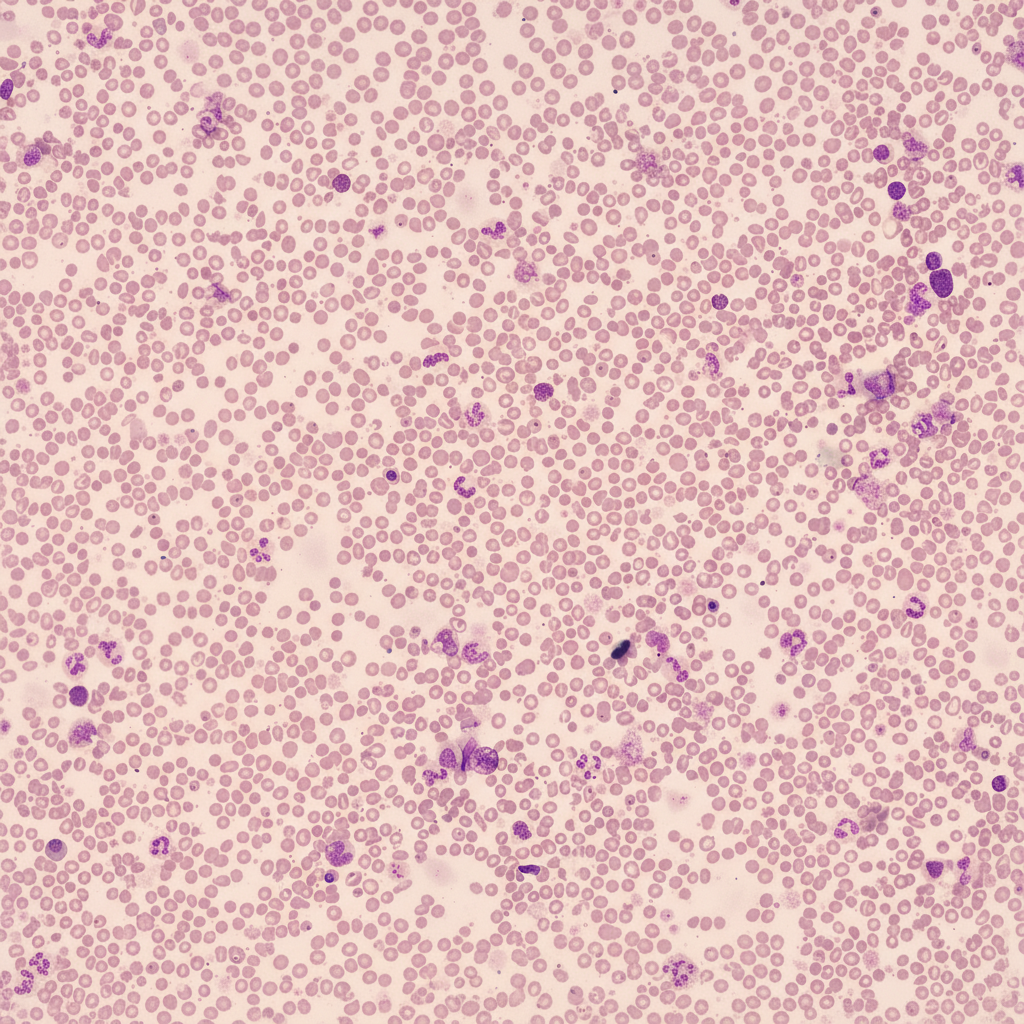
Fanconi's anemia is classified as which of the following types of anemia?
Which of the following are characteristic markers for Hodgkin's Lymphoma?
Pancytopenia with a cellular bone marrow is seen in which of the following conditions?
The classification proposed by the International Lymphoma Study Group for non-Hodgkin's lymphoma is known as?
What is the most common cytogenetic abnormality in Multiple myeloma?
Prominent reticulocytosis is a feature of which type of anemia?
A 59-year-old male presents with multiple neck swellings, fever, and weight loss. He has a history of hypertension. Examination reveals painless lymphadenopathy in the neck, and blood investigations show anemia. Lymph node biopsy shows characteristic 'owl eye' shaped cells. What is the most probable diagnosis for this patient?
Which of the following immunohistochemical stains is used for the diagnosis of lymphomas?
Massive transfusion in a previously healthy adult male can cause hemorrhage due to which of the following mechanisms?
Paroxysmal nocturnal hemoglobinuria (PNH) is associated with a deficiency of which of the following?
Explanation: **Explanation:** **Fanconi’s Anemia (FA)** is the most common cause of **inherited (constitutional) aplastic anemia** [1]. It is an autosomal recessive (rarely X-linked) DNA repair defect characterized by hypersensitivity to DNA cross-linking agents. 1. **Why Option A is correct:** The term "Constitutional" refers to conditions that are congenital or genomic in origin. FA is classified as a constitutional anemia because it is a genetic syndrome leading to progressive bone marrow failure [1]. It typically presents in the first decade of life with pancytopenia and macrocytosis [2]. 2. **Why other options are incorrect:** * **B. Hemolytic Anemia:** FA involves a production defect (hypoplasia), not the premature destruction of red cells. [3] * **C. Iron Deficiency Anemia:** This is a microcytic nutritional anemia caused by blood loss or poor intake, whereas FA is a normocytic to macrocytic marrow failure syndrome [2]. * **D. Autoimmune Anemia:** While acquired aplastic anemia is often T-cell mediated (autoimmune), FA is strictly a genetic defect in the FANC protein complex [1]. **Clinical Pearls for NEET-PG:** * **Physical Findings:** Short stature, **absent/hypoplastic thumbs**, radius malformations, and **café-au-lait spots**. * **Gold Standard Diagnosis:** **Chromosomal Breakage Analysis** (using Diepoxybutane or Mitomycin C). * **Malignancy Risk:** Patients have a significantly high risk of developing **AML** (Acute Myeloid Leukemia) and squamous cell carcinomas (head, neck, and anogenital). * **Pathogenesis:** Defect in the **FA pathway**, which is responsible for repairing interstrand DNA cross-links. **References:** [1] Cross SS. Underwood's Pathology: A Clinical Approach. 6th ed. Common Clinical Problems From Blood And Bone Marrow Disease, pp. 595-596. [2] Kumar V, Abbas AK, et al.. Robbins and Cotran Pathologic Basis of Disease. 9th ed. Red Blood Cell and Bleeding Disorders, pp. 662-663. [3] Kumar V, Abbas AK, et al.. Robbins and Cotran Pathologic Basis of Disease. 9th ed. Red Blood Cell and Bleeding Disorders, p. 638.
Explanation: **Explanation:** Classical Hodgkin Lymphoma (cHL) is characterized by the presence of **Reed-Sternberg (RS) cells** in a background of reactive inflammatory cells [1]. The diagnosis relies heavily on the specific immunophenotype of these RS cells. **1. Why Option A is Correct:** In Classical Hodgkin Lymphoma (which accounts for 95% of cases), the neoplastic RS cells characteristically express **CD15** and **CD30**. * **CD30** is a marker of activation (Ki-1 antigen) and shows a membrane and Golgi pattern of staining. * **CD15** is a granulocytic marker that is typically positive in RS cells. Crucially, these cells are usually **negative for CD45** (Leukocyte Common Antigen), which helps distinguish them from most non-Hodgkin lymphomas. **2. Why Other Options are Incorrect:** * **Option B (CD15 and CD45):** While RS cells are CD15+, they are characteristically **CD45 negative**. If a large cell is CD45+, it points toward Non-Hodgkin Lymphoma (NHL) or the rare Nodular Lymphocyte Predominant Hodgkin Lymphoma (NLPHL) [1]. * **Option C (CD30 and CD68):** CD68 is a **macrophage/histiocyte marker**. While macrophages are present in the inflammatory background of HL, they are not the diagnostic neoplastic cells [1]. * **Option D (CD15 and CD3):** CD3 is a **T-cell marker**. RS cells in classical HL do not express T-cell markers; their presence would suggest a T-cell NHL. **High-Yield Clinical Pearls for NEET-PG:** * **Mnemonic:** "Owl's Eye" appearance of RS cells. * **NLPHL Exception:** In Nodular Lymphocyte Predominant HL (the "non-classical" type), the "Popcorn cells" are **CD20+ and CD45+**, but **CD15- and CD30-** [2]. * **PAX-5:** This is a B-cell transcription factor that shows weak nuclear expression in RS cells and is a very reliable marker for cHL. * **EBV Association:** Most commonly associated with the Mixed Cellularity subtype [1]. **References:** [1] Kumar V, Abbas AK, et al.. Robbins and Cotran Pathologic Basis of Disease. 9th ed. Diseases of White Blood Cells, Lymph Nodes, Spleen, and Thymus, pp. 614-618. [2] Kumar V, Abbas AK, et al.. Robbins and Cotran Pathologic Basis of Disease. 9th ed. Diseases of White Blood Cells, Lymph Nodes, Spleen, and Thymus, p. 618.
Explanation: **Explanation:** The hallmark of this question lies in distinguishing between "hypocellular" and "hypercellular/cellular" causes of pancytopenia. **1. Why Paroxysmal Nocturnal Hemoglobinuria (PNH) is correct:** PNH is a unique stem cell disorder characterized by a mutation in the **PIGA gene**, leading to a deficiency of GPI-anchored proteins (CD55 and CD59) [1]. While PNH is closely associated with aplastic anemia, it frequently presents with **pancytopenia in the setting of a cellular or even hypercellular bone marrow** due to compensatory erythropoiesis responding to chronic intravascular hemolysis [1]. Over time, it may evolve into aplastic anemia (hypocellular), but the "cellular marrow with pancytopenia" phase is a classic diagnostic trap [2]. **2. Why the other options are incorrect:** * **Acquired Aplastic Anemia:** By definition, this condition presents with pancytopenia and a **hypocellular** (fatty) bone marrow [2]. * **G6PD Deficiency:** This is an episodic hemolytic anemia [3]. It typically presents with isolated anemia (not pancytopenia) and a hypercellular marrow. * **Thalassemia:** This is a microcytic hypochromic anemia [4]. While the marrow is hypercellular due to ineffective erythropoiesis, it does not typically cause pancytopenia unless complicated by massive splenomegaly (hypersplenism). **3. High-Yield Clinical Pearls for NEET-PG:** * **Pancytopenia with Cellular Marrow (Mnemonic: "M-M-A-P"):** 1. **M**yelodysplastic Syndrome (MDS) 2. **M**egaloblastic Anemia (Most common cause in India) 3. **A**leukemic Leukemia (e.g., Hairy Cell Leukemia) 4. **P**NH / **P**aroxysmal Nocturnal Hemoglobinuria * **Gold Standard Test for PNH:** Flow cytometry for CD55/CD59. * **Classic Triad of PNH:** Hemolytic anemia, pancytopenia, and venous thrombosis (e.g., Budd-Chiari syndrome). **References:** [1] Cross SS. Underwood's Pathology: A Clinical Approach. 6th ed. Common Clinical Problems From Blood And Bone Marrow Disease, pp. 601-602. [2] Cross SS. Underwood's Pathology: A Clinical Approach. 6th ed. Common Clinical Problems From Blood And Bone Marrow Disease, pp. 595-596. [3] Kumar V, Abbas AK, et al.. Robbins and Cotran Pathologic Basis of Disease. 9th ed. Red Blood Cell and Bleeding Disorders, pp. 652-654. [4] Cross SS. Underwood's Pathology: A Clinical Approach. 6th ed. Common Clinical Problems From Blood And Bone Marrow Disease, pp. 590-591.
Explanation: **Explanation:** The correct answer is **B. REAL classification**. The **REAL (Revised European-American Lymphoma) classification** was proposed in **1994** by the International Lymphoma Study Group (ILSG). It revolutionized the approach to Non-Hodgkin’s Lymphoma (NHL) by shifting from purely morphological descriptions to a multiparametric approach. It categorizes lymphomas based on a combination of **morphology, immunophenotype, genetic features, and clinical presentation**, ensuring that each entity represents a distinct disease process [1]. **Analysis of Incorrect Options:** * **A. Kiel classification:** Developed by Gerard Lennert in Europe, this system focused primarily on the cytology (cell size and shape) of the malignant cells, dividing them into "low-grade" and "high-grade." * **C. WHO classification:** While the current gold standard, the WHO classification (first published in 2001) is actually an **extension and refinement** of the REAL classification [1]. It was not the original proposal of the ILSG but rather a global consensus based on the REAL principles. * **D. Rappaport classification:** One of the earliest systems (1956), it was based strictly on architectural patterns (nodular vs. diffuse) and cell morphology. It is now considered obsolete as it predates our understanding of B-cell and T-cell immunology. **High-Yield Pearls for NEET-PG:** * The REAL classification was the first to recognize **MALT lymphoma** and **Mantel Cell Lymphoma** as distinct entities. * The **Working Formulation** (1982) was another historical system used primarily for clinical prognosis but lacked immunophenotypic data. * **Current Practice:** We currently use the **5th Edition of the WHO Classification (2022)** and the **International Consensus Classification (ICC)**, both of which evolved from the original REAL framework [1]. **References:** [1] Kumar V, Abbas AK, et al.. Robbins and Cotran Pathologic Basis of Disease. 9th ed. Diseases of White Blood Cells, Lymph Nodes, Spleen, and Thymus, pp. 596-598.
Explanation: **Explanation:** Multiple Myeloma (MM) is characterized by a complex landscape of genetic alterations. Understanding the distinction between the "most common" and "prognostically significant" abnormalities is crucial for NEET-PG. **1. Why Deletion 13q is correct:** **Deletion 13q** is the most frequent cytogenetic abnormality in Multiple Myeloma, detected in approximately **50% of cases** by conventional cytogenetics and up to **80-90%** using Fluorescence In Situ Hybridization (FISH). It often involves the loss of the *RB1* (Retinoblastoma) gene and is considered an early event in the pathogenesis of the disease. **2. Analysis of Incorrect Options:** * **Trisomy 12:** This is the most common chromosomal abnormality in **Chronic Lymphocytic Leukemia (CLL)**, not Multiple Myeloma. MM is more commonly associated with odd-numbered trisomies (Hyperdiploidy), such as trisomies of chromosomes 3, 5, 7, 9, 11, and 15. * **t(11;14):** This translocation involves the *CCND1* (Cyclin D1) gene. While it is the most common **translocation** in MM (occurring in ~15% of cases), its overall frequency is lower than Deletion 13q. It is also the hallmark of Mantle Cell Lymphoma. * **t(4;14):** This involves the *FGFR3* and *MMSET* genes. It occurs in about 15% of patients and is significant because it indicates a **poor prognosis**, but it is not the most common. **Clinical Pearls for NEET-PG:** * **Most common overall abnormality:** Deletion 13q. * **Most common translocation:** t(11;14). * **Poor Prognostic Markers (High Yield):** del(17p) [loss of TP53], t(4;14), and t(14;16). * **Good Prognostic Markers:** Hyperdiploidy and t(11;14). * **CRAB Criteria:** Remember **C**alcium (high) [1], **R**enal insufficiency [1], **A**nemia [1], and **B**one lesions [1] for clinical diagnosis. **References:** [1] Kumar V, Abbas AK, et al.. Robbins and Cotran Pathologic Basis of Disease. 9th ed. Diseases of White Blood Cells, Lymph Nodes, Spleen, and Thymus, pp. 608-609.
Explanation: **Explanation:** The core concept behind reticulocytosis is the **bone marrow's compensatory response** to a decrease in red blood cell (RBC) mass. Reticulocytes are immature, non-nucleated RBCs that contain residual ribosomal RNA. **Why Hemolytic Anemia is Correct:** In hemolytic anemia, RBCs are destroyed prematurely in the peripheral circulation (extravascular or intravascular) [2]. Since the bone marrow itself is healthy and functional, it responds to the increased erythropoietin levels (triggered by hypoxia) by accelerating erythropoiesis [1]. This results in the premature release of reticulocytes into the blood, leading to a high **Reticulocyte Production Index (RPI) > 2-3%** [1]. **Why the other options are incorrect:** * **Aplastic Anemia:** This is characterized by bone marrow failure (pancytopenia). The marrow cannot produce cells, leading to a characteristically low reticulocyte count. * **Nutritional Anemia (e.g., Iron, B12, Folate deficiency):** These are "cytoplasmic" or "nuclear" maturation defects. The marrow lacks the building blocks to create new cells, resulting in ineffective erythropoiesis and a low reticulocyte count [2]. * **Anemia of Chronic Disease:** This involves iron sequestration and suppressed erythropoietin response due to inflammation (hepcidin-mediated). The marrow's proliferative capacity is blunted, leading to a low or normal reticulocyte count. **NEET-PG High-Yield Pearls:** * **Corrected Reticulocyte Count (CRC):** Always calculate this in anemic patients to assess true marrow response. Formula: *Reticulocyte % × (Patient Hct / Normal Hct).* * **Supravital Stains:** Reticulocytes are visualized using **New Methylene Blue** or **Brilliant Cresyl Blue**, which precipitate the ribosomal RNA (precipitated organelles). * **Polychromasia:** On a standard Leishman or Wright stain, reticulocytes appear as larger, bluish-grey cells [3]. **References:** [1] Kumar V, Abbas AK, et al.. Robbins and Cotran Pathologic Basis of Disease. 9th ed. Red Blood Cell and Bleeding Disorders, p. 640. [2] Cross SS. Underwood's Pathology: A Clinical Approach. 6th ed. Common Clinical Problems From Blood And Bone Marrow Disease, pp. 596-597. [3] Cross SS. Underwood's Pathology: A Clinical Approach. 6th ed. Common Clinical Problems From Blood And Bone Marrow Disease, pp. 603-604.
Explanation: ### Explanation The correct diagnosis is **Hodgkin’s Lymphoma (HL)**. **1. Why Hodgkin’s Lymphoma is correct:** The clinical presentation of painless lymphadenopathy associated with "B-symptoms" (fever and weight loss) in an older male is highly suggestive of lymphoma [1]. The pathognomonic finding in this case is the presence of **'owl eye' shaped cells** on lymph node biopsy [1]. These are **Reed-Sternberg (RS) cells**, which are large, multinucleated (or bilobed) B-cells with prominent, eosinophilic, inclusion-like nucleoli surrounded by a clear halo [1]. Their presence in a background of reactive inflammatory cells is the hallmark of Hodgkin’s Lymphoma [1]. **2. Why the other options are incorrect:** * **Multiple Myeloma:** This is a plasma cell dyscrasia characterized by bone pain, hypercalcemia, renal failure, and "punched-out" lytic lesions on X-ray. Biopsy would show sheets of malignant plasma cells, not RS cells. * **Non-Hodgkin’s Lymphoma (NHL):** While NHL also presents with lymphadenopathy, it lacks the characteristic RS cells and often involves extranodal sites more frequently than HL [1]. * **Burkitt’s Lymphoma:** This is a high-grade B-cell NHL characterized histologically by a **"starry sky" appearance** (tingible body macrophages against a sea of dark malignant B-cells), not owl-eye cells. **3. High-Yield Clinical Pearls for NEET-PG:** * **RS Cell Markers:** Classic HL cells are typically **CD15+ and CD30+**, but **CD45 negative**. * **Bimodal Age Distribution:** HL often shows two peaks (20s and 50s) [1]. * **Most Common Subtype:** Nodular Sclerosis is the most common subtype of HL [2]. * **Prognosis:** Lymphocyte Predominance has the best prognosis, while Lymphocyte Depletion has the worst [2]. **References:** [1] Kumar V, Abbas AK, et al.. Robbins and Cotran Pathologic Basis of Disease. 9th ed. Diseases of White Blood Cells, Lymph Nodes, Spleen, and Thymus, pp. 614-616. [2] Cross SS. Underwood's Pathology: A Clinical Approach. 6th ed. Common Clinical Problems From Diseases Of The Urinary And Male Genital Tracts, pp. 559-560.
Explanation: **Explanation:** The diagnosis of lymphomas relies heavily on Immunohistochemistry (IHC) to differentiate lymphoid malignancies from other poorly differentiated neoplasms [2]. **1. Why Leukocyte Common Antigen (LCA) is correct:** LCA, also known as **CD45**, is a surface glycoprotein expressed on almost all hematolymphoid cells and their precursors. It is the "gold standard" screening marker for lymphomas. If a tumor is LCA-positive, it confirms a lymphoid origin, after which specific markers (like CD20 for B-cells or CD3 for T-cells) are used for subtyping [1]. **2. Why the other options are incorrect:** * **S-100:** This is a marker for cells derived from the neural crest. It is primarily used to diagnose **Melanomas**, Schwannomas, and Langerhans Cell Histiocytosis (LCH). * **HMB-45:** This stands for "Human Melanoma Black." It is a highly specific marker for **Melanoma** (specifically melanocytic differentiation). * **Cytokeratin (CK):** This is an intermediate filament found in epithelial cells. It is the primary marker used to diagnose **Carcinomas** [2]. **Clinical Pearls for NEET-PG:** * **The "Big Four" IHC Screening Panel:** When faced with an undifferentiated round cell tumor, pathologists use: **LCA** (Lymphoma), **Cytokeratin** (Carcinoma), **S-100/HMB-45** (Melanoma), and **Vimentin** (Sarcoma) [2]. * **Exception:** Important to remember that **Reed-Sternberg cells** in Classical Hodgkin Lymphoma are typically **LCA negative** (but CD15 and CD30 positive) [1]. * **Plasma Cell Myeloma** may also be LCA negative; CD138 is the preferred marker there [1]. **References:** [1] Kumar V, Abbas AK, et al.. Robbins and Cotran Pathologic Basis of Disease. 9th ed. Diseases of White Blood Cells, Lymph Nodes, Spleen, and Thymus, pp. 596-598. [2] Cross SS. Underwood's Pathology: A Clinical Approach. 6th ed. (Basic Pathology) introduces the student to key general principles of pathology, both as a medical science and as a clinical activity with a vital role in patient care. Part 2 (Disease Mechanisms) provides fundamental knowledge about the cellular and molecular processes involved in diseases, providing the rationale for their treatment. Part 3 (Systematic Pathology) deals in detail with specific diseases, with emphasis on the clinically important aspects., pp. 208-209.
Explanation: **Explanation:** **Massive transfusion** is defined as the replacement of one total blood volume (approx. 10 units of PRBCs) within 24 hours. The most common cause of bleeding in patients receiving massive transfusions is **Dilutional Thrombocytopenia** [1]. **Why Option B is Correct:** Stored whole blood or Packed Red Blood Cells (PRBCs) are deficient in viable platelets and labile coagulation factors (Factors V and VIII). When large volumes of PRBCs are infused without proportional replacement of platelets, the patient’s endogenous platelet count is "diluted" by the fluid volume, leading to a qualitative and quantitative deficiency. This results in a failure of primary hemostasis and subsequent hemorrhage [1], [2]. **Why Other Options are Incorrect:** * **A. Increased tPA activity:** While trauma can trigger fibrinolysis, massive transfusion itself does not primarily cause hemorrhage via tPA-mediated pathways. * **C. Vitamin K deficiency:** This is a chronic nutritional or absorption issue [3]. While it affects Factors II, VII, IX, and X, it does not occur acutely due to transfusion. * **D. Decreased fibrinogen levels:** While dilutional coagulopathy affects all factors, thrombocytopenia typically occurs earlier and is the more significant clinical driver of bleeding compared to isolated fibrinogen depletion in this specific context. **NEET-PG High-Yield Pearls:** 1. **Triad of Death:** Massive transfusion in trauma can lead to the lethal triad: **Coagulopathy, Acidosis, and Hypothermia.** 2. **Citrate Toxicity:** Citrate used as an anticoagulant in blood bags chelates calcium, leading to **Hypocalcemia** (manifesting as tetany or arrhythmias). 3. **Hyperkalemia:** Stored RBCs leak potassium over time; massive transfusion can lead to acute potassium spikes. 4. **Management:** To prevent dilutional coagulopathy, modern protocols recommend a **1:1:1 ratio** (PRBCs: FFP: Platelets). **References:** [1] Cross SS. Underwood's Pathology: A Clinical Approach. 6th ed. Common Clinical Problems From Blood And Bone Marrow Disease, pp. 619-620. [2] Kumar V, Abbas AK, et al.. Robbins and Cotran Pathologic Basis of Disease. 9th ed. Hemodynamic Disorders, Thromboembolic Disease, and Shock, p. 132. [3] Cross SS. Underwood's Pathology: A Clinical Approach. 6th ed. Common Clinical Problems From Blood And Bone Marrow Disease, pp. 624-625.
Explanation: **Explanation:** **Paroxysmal Nocturnal Hemoglobinuria (PNH)** is an acquired clonal hematopoietic stem cell disorder caused by a somatic mutation in the **PIGA gene** (Phosphatidylinositol Glycan class A) [2]. This gene is essential for the synthesis of the **Glycosylphosphatidylinositol (GPI) anchor**, which tethers various proteins to the cell membrane. 1. **Why Option D is correct:** The fundamental defect is a deficiency of **GPI-anchored proteins (Option C)**. Because the anchor itself is missing, all proteins that rely on it for membrane attachment are absent. The two most clinically significant missing proteins are: * **CD55 (Decay-accelerating factor/DAF - Option A):** It inhibits C3 convertase, preventing the amplification of the complement cascade. * **CD59 (Membrane inhibitor of reactive lysis/MIRL - Option B):** It inhibits the formation of the Membrane Attack Complex (MAC). Since both DAF and MIRL are GPI-anchored proteins, all three options describe the molecular deficiency in PNH. 2. **Pathophysiology:** In the absence of CD55 and CD59, red blood cells become exquisitely sensitive to **complement-mediated lysis**, leading to intravascular hemolysis [1]. **High-Yield Clinical Pearls for NEET-PG:** * **Gold Standard Diagnosis:** Flow cytometry (shows absence of CD55 and CD59 on RBCs and WBCs) [1]. * **Classic Triad:** Hemolytic anemia, pancytopenia, and venous thrombosis (often in unusual sites like the Budd-Chiari syndrome) [1]. * **Ham’s Test & Sucrose Lysis Test:** Historical tests; now replaced by flow cytometry. * **Treatment:** **Eculizumab** (a monoclonal antibody against Complement C5) is the drug of choice. * **Complications:** PNH is a "pro-thrombotic" state and carries a risk of transformation into Acute Myeloid Leukemia (AML) or Aplastic Anemia. **References:** [1] Kumar V, Abbas AK, et al.. Robbins and Cotran Pathologic Basis of Disease. 9th ed. Red Blood Cell and Bleeding Disorders, pp. 650-651. [2] Cross SS. Underwood's Pathology: A Clinical Approach. 6th ed. Common Clinical Problems From Blood And Bone Marrow Disease, pp. 601-602.
Anemias: Classification and Approach
Practice Questions
Hemolytic Anemias
Practice Questions
Myeloproliferative Neoplasms
Practice Questions
Myelodysplastic Syndromes
Practice Questions
Acute Leukemias
Practice Questions
Chronic Leukemias
Practice Questions
Lymphomas and Lymphoid Neoplasms
Practice Questions
Plasma Cell Disorders
Practice Questions
Bleeding Disorders
Practice Questions
Thrombotic Disorders
Practice Questions
Get full access to all questions, explanations, and performance tracking.
Start For Free