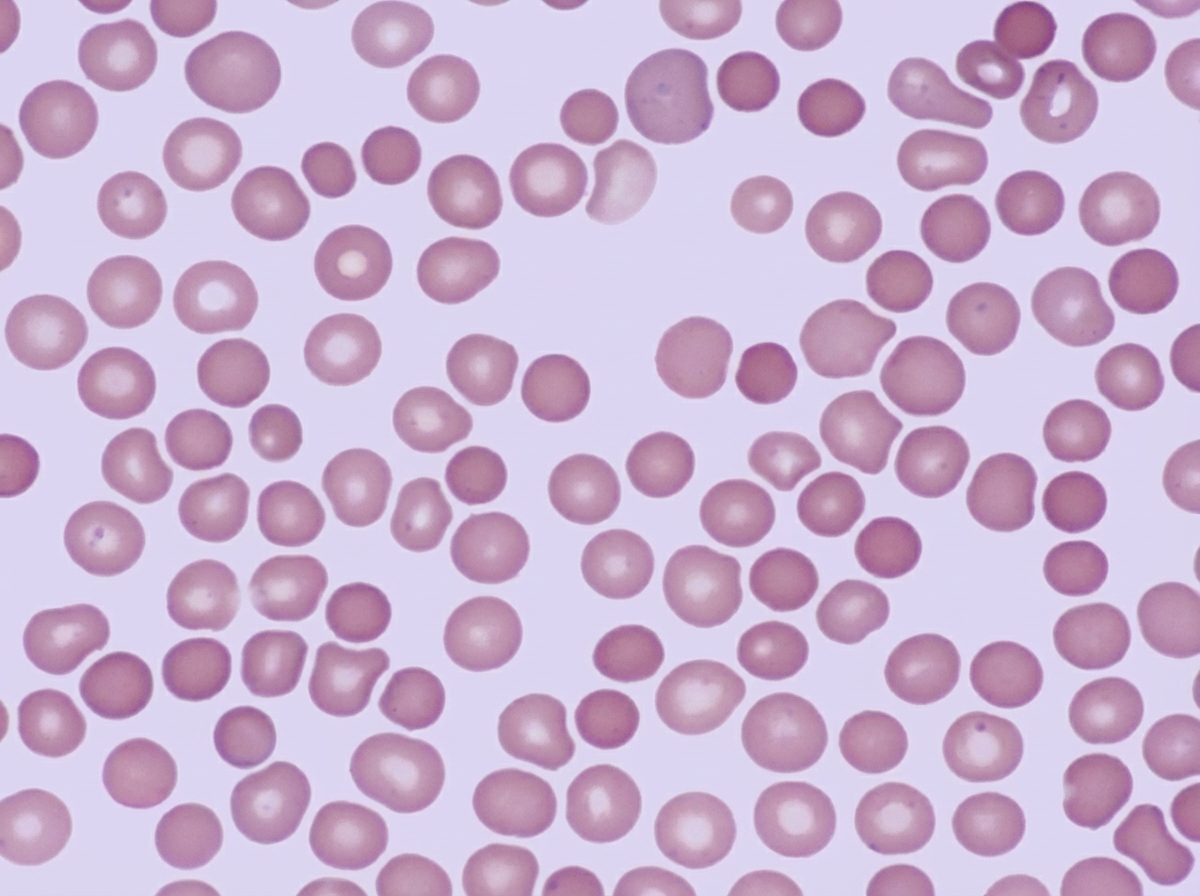
In sickle cell anemia, the sickle shape of red blood cells occurs due to the polymerization of which of the following?
The Ham test is primarily used to diagnose which of the following conditions?
Thalassemia is inherited as an?
Which of the following blood components is expected to increase in disseminated intravascular coagulation?
One of the following leukemias almost never develops after radiation?
What is the best prognostic type of Hodgkin's lymphoma?
Hereditary spherocytosis is due to which of the following?
Which of the following conditions can cause fragmented red blood cells in peripheral blood?
Disseminated intravascular coagulation (DIC) in association with giant hemangiomas is seen in which of the following conditions?
Multiple punched-out lesions in the skull are characteristically seen in which of the following conditions?
Explanation: ### Explanation **Concept Overview** Sickle cell anemia is caused by a point mutation in the $\beta$-globin gene (glutamic acid replaced by valine at position 6) [1][2]. This results in the formation of **Hemoglobin S (HbS)**. The fundamental pathophysiology of "sickling" depends on the oxygenation state of the hemoglobin molecule [1]. **Why Deoxyhemoglobin is Correct** When HbS is in its **deoxygenated state** (T-state/Tense form), the hydrophobic valine at position 6 is exposed on the surface of the $\beta$-chain [1][2]. This creates a "sticky patch" that allows HbS molecules to aggregate and polymerize into long, stiff, insoluble fibers [1][2]. These fibers distort the red blood cell into the characteristic crescent or sickle shape [1][2]. Upon re-oxygenation, these polymers initially dissolve, but repeated cycles of sickling lead to permanent membrane damage and "irreversibly sickled cells" [1]. **Why Other Options are Incorrect** * **Oxyhemoglobin:** In the oxygenated state (R-state), the conformational change of the hemoglobin molecule hides the hydrophobic valine residue, preventing polymerization. Therefore, sickling does not occur in well-oxygenated arterial blood. * **Methemoglobin (Methoxyglobin):** This refers to hemoglobin where iron is in the ferric ($Fe^{3+}$) state. While it affects oxygen binding, it is not the primary driver of the polymerization process in sickle cell disease. * **Carboxyhemoglobin:** This is formed when carbon monoxide binds to hemoglobin. It actually increases oxygen affinity (shifting the curve to the left), which would theoretically inhibit, rather than promote, sickling. **NEET-PG High-Yield Pearls** * **Rate-limiting factor:** The most important factor determining sickling is the **concentration of HbS** and the **time** the RBCs spend in the microcirculation (deoxygenated state). * **Protective Factors:** **HbF (Fetal Hemoglobin)** inhibits polymerization; this is why symptoms don't appear until 6 months of age and why **Hydroxyurea** (which increases HbF) is used in treatment. * **Acidosis and Dehydration:** Both promote sickling by shifting the oxygen dissociation curve to the right (increasing deoxy-Hb) and increasing intracellular hemoglobin concentration, respectively. **References:** [1] Kumar V, Abbas AK, et al.. Robbins and Cotran Pathologic Basis of Disease. 9th ed. Red Blood Cell and Bleeding Disorders, pp. 652-654. [2] Cross SS. Underwood's Pathology: A Clinical Approach. 6th ed. Common Clinical Problems From Blood And Bone Marrow Disease, pp. 598-599.
Explanation: ### Explanation **Correct Answer: A. Paroxysmal Nocturnal Hemoglobinuria (PNH)** **Mechanism and Concept:** The Ham test, also known as the **Acidified Serum Lysis Test**, is a classic diagnostic tool for PNH. PNH is an acquired clonal stem cell disorder [2] characterized by a deficiency of GPI-anchored proteins, specifically **CD55 (DAF)** and **CD59 (MIRL)**. These proteins normally protect red blood cells (RBCs) from complement-mediated destruction [1]. In the Ham test, the patient's RBCs are incubated with acidified normal serum. The acid activates the alternative complement pathway; because PNH cells lack protective proteins, they undergo significant hemolysis, confirming the diagnosis [1]. **Why Other Options are Incorrect:** * **B. Megaloblastic Anemia:** Diagnosed via peripheral smear (macro-ovalocytes, hypersegmented neutrophils) and low Vitamin B12/Folate levels. The Schilling test (historical) was used here, not the Ham test. * **C. Sickle Cell Anemia:** Diagnosed using **Sickling tests** (Sodium metabisulfite) and confirmed by **Hb Electrophoresis** or HPLC, which identifies HbS. * **D. Thalassemia:** Diagnosed via **Hb Electrophoresis** (showing increased HbA2 or HbF) and Mentzer index calculation [2]. **Clinical Pearls for NEET-PG:** * **Gold Standard:** While the Ham test is a classic exam favorite, **Flow Cytometry** is now the gold standard for PNH diagnosis (detecting the absence of CD55/CD59 on RBCs and WBCs) [1]. * **Sucrose Hemolysis Test:** Another screening test for PNH; it is more sensitive but less specific than the Ham test. * **PNH Triad:** Hemolytic anemia, pancytopenia, and venous thrombosis (often in unusual sites like the Budd-Chiari syndrome) [1]. * **PIGA Gene:** PNH results from a somatic mutation in the *PIGA* gene [2]. **References:** [1] Kumar V, Abbas AK, et al.. Robbins and Cotran Pathologic Basis of Disease. 9th ed. Red Blood Cell and Bleeding Disorders, pp. 650-651. [2] Cross SS. Underwood's Pathology: A Clinical Approach. 6th ed. Common Clinical Problems From Blood And Bone Marrow Disease, pp. 601-602.
Explanation: **Explanation:** **1. Why Autosomal Recessive is Correct:** Thalassemia is a quantitative hemoglobinopathy characterized by a reduction or total absence of synthesis of one or more globin chains ($\alpha$ or $\beta$). It follows an **autosomal recessive** pattern of inheritance [1]. This means a child must inherit one mutated allele from each parent (homozygous or compound heterozygous state) to manifest the severe clinical form of the disease (e.g., Thalassemia Major) [2]. Individuals with only one mutated allele are "carriers" (Thalassemia Minor/Trait) and are typically asymptomatic or mildly symptomatic [2]. **2. Why the Other Options are Incorrect:** * **Autosomal Dominant:** In dominant disorders, a single mutated allele is sufficient to cause the full disease phenotype. While some rare "Dominant $\beta$-thalassemia" variants exist, they are exceptions and not the standard inheritance pattern. * **X-linked Recessive/Dominant:** These involve mutations on the X chromosome. Thalassemia involves the $\alpha$-globin gene cluster on **Chromosome 16** and the $\beta$-globin gene cluster on **Chromosome 11**. Since these are autosomes, the disease affects males and females equally and is not sex-linked. **3. NEET-PG High-Yield Clinical Pearls:** * **Molecular Basis:** $\alpha$-thalassemia is most commonly due to **gene deletions**, whereas $\beta$-thalassemia is most commonly due to **point mutations** (splice-site or promoter sequences) [2]. * **Screening:** The **NESTROFT** (Naked Eye Single Tube Red Cell Osmotic Fragility Test) is a common screening tool, but **Hb Electrophoresis** or HPLC (showing increased HbA2 >3.5% in $\beta$-thalassemia trait) is the gold standard for diagnosis. * **Blood Picture:** Characterized by microcytic hypochromic anemia with **target cells** and basophilic stippling on peripheral smear [3]. Mentzer Index (MCV/RBC count) <13 suggests Thalassemia. **References:** [1] Cross SS. Underwood's Pathology: A Clinical Approach. 6th ed. (Basic Pathology) introduces the student to key general principles of pathology, both as a medical science and as a clinical activity with a vital role in patient care. Part 2 (Disease Mechanisms) provides fundamental knowledge about the cellular and molecular processes involved in diseases, providing the rationale for their treatment. Part 3 (Systematic Pathology) deals in detail with specific diseases, with emphasis on the clinically important aspects., pp. 53-54. [2] Kumar V, Abbas AK, et al.. Robbins and Cotran Pathologic Basis of Disease. 9th ed. Red Blood Cell and Bleeding Disorders, p. 650. [3] Kumar V, Abbas AK, et al.. Robbins and Cotran Pathologic Basis of Disease. 9th ed. Red Blood Cell and Bleeding Disorders, pp. 649-650.
Explanation: ### Explanation **Disseminated Intravascular Coagulation (DIC)** is a complex thrombohemorrhagic disorder characterized by the systemic activation of the coagulation cascade. **Why Fibrin Degradation Products (FDPs) Increase:** In DIC, widespread formation of microthrombi leads to the consumption of clotting factors. Simultaneously, the body activates the secondary fibrinolytic system to break down these clots. **Plasmin** cleaves both fibrinogen and cross-linked fibrin, resulting in the release of **Fibrin Degradation Products (FDPs)** and **D-dimers** into the circulation [1], [2]. Therefore, elevated FDPs are a hallmark laboratory finding in DIC [2]. **Why Other Options are Incorrect:** * **Factor V and Fibrinogen (Options A & C):** These are "consumed" during the massive, uncontrolled formation of systemic clots. Their levels **decrease** in DIC, contributing to the bleeding diathesis [2]. * **Plasminogen (Option D):** Plasminogen is the inactive precursor converted into active **plasmin** to dissolve clots. Due to the massive activation of the fibrinolytic system in DIC, plasminogen stores are exhausted, leading to **decreased** levels. **NEET-PG High-Yield Pearls:** * **Best Screening Test:** Platelet count (usually decreased/Thrombocytopenia) [1], [2]. * **Most Sensitive/Specific Test:** D-dimer (indicates breakdown of cross-linked fibrin). * **Peripheral Smear:** Characterized by **Schistocytes** (fragmented RBCs) due to microangiopathic hemolytic anemia (MAHA) [2]. * **Coagulation Profile:** Prolonged PT, aPTT, and Thrombin Time (TT) due to consumption of factors [2]. * **Common Triggers:** Sepsis (Gram-negative), Obstetric complications (Abruptio placentae), and Malignancy (APML - M3) [3]. **References:** [1] Cross SS. Underwood's Pathology: A Clinical Approach. 6th ed. (Basic Pathology) introduces the student to key general principles of pathology, both as a medical science and as a clinical activity with a vital role in patient care. Part 2 (Disease Mechanisms) provides fundamental knowledge about the cellular and molecular processes involved in diseases, providing the rationale for their treatment. Part 3 (Systematic Pathology) deals in detail with specific diseases, with emphasis on the clinically important aspects., pp. 151-152. [2] Cross SS. Underwood's Pathology: A Clinical Approach. 6th ed. Common Clinical Problems From Blood And Bone Marrow Disease, pp. 625-626. [3] Kumar V, Abbas AK, et al.. Robbins and Cotran Pathologic Basis of Disease. 9th ed. Red Blood Cell and Bleeding Disorders, pp. 671-672.
Explanation: The relationship between ionizing radiation and leukemogenesis is well-established; however, **Chronic Lymphocytic Leukemia (CLL)** is the notable exception. **1. Why CLL is the Correct Answer:** Extensive epidemiological studies (including data from Hiroshima and Nagasaki survivors and patients receiving therapeutic radiation) have consistently shown no significant increase in the incidence of CLL following radiation exposure. The underlying pathophysiology of CLL involves the accumulation of mature B-cells due to defective apoptosis [1] rather than the specific DNA-breakage patterns typically induced by ionizing radiation. Therefore, CLL is considered **non-radiogenic**. **2. Why Other Options are Incorrect:** * **Acute Myeloblastic Leukemia (AML) & Acute Lymphoblastic Leukemia (ALL):** These are the most common acute leukemias associated with radiation. There is a dose-dependent increase in risk, typically peaking 5–10 years after exposure. * **Chronic Myeloid Leukemia (CML):** CML was the first leukemia linked to radiation. The ionizing radiation can induce the reciprocal translocation $t(9;22)$, leading to the formation of the Philadelphia chromosome. **3. High-Yield NEET-PG Pearls:** * **Most common leukemia after radiation:** AML (specifically types related to MDS). * **Leukemia with NO association with radiation:** CLL (and Hairy Cell Leukemia). * **Other factors NOT associated with CLL:** It is also not linked to specific chemicals (like benzene) or viruses (unlike HTLV-1 and ATLL). * **Genetic predisposition:** While radiation doesn't cause CLL, it has the strongest **familial/genetic predisposition** among all leukemias. **References:** [1] Cross SS. Underwood's Pathology: A Clinical Approach. 6th ed. Common Clinical Problems From Blood And Bone Marrow Disease, pp. 612-613.
Explanation: **Explanation:** The prognosis of Hodgkin’s Lymphoma (HL) is primarily determined by the ratio of reactive lymphocytes to Reed-Sternberg (RS) cells. A higher number of lymphocytes and a lower number of RS cells correlate with a better prognosis [1]. **1. Why Lymphocytic Predominant (LP) is correct:** This subtype is characterized by an abundance of mature B-lymphocytes and very few RS cells (specifically the "Popcorn cell" or L&H variant) [1]. Because the host’s immune response (lymphocytes) is robust and the malignant cell burden is low, it carries the **best overall prognosis**, often presenting in early stages (Stage I or II) with a slow clinical course [1]. **2. Why the other options are incorrect:** * **Nodular Sclerosis (D):** This is the **most common** subtype overall. While it has a very good prognosis, it is statistically ranked second to the LP subtype [1]. It is characterized by lacunar cells and collagen bands [2]. * **Mixed Cellularity (C):** This subtype has a moderate prognosis [3]. It features a diverse background of eosinophils, plasma cells, and histiocytes, and is frequently associated with EBV infection [1]. * **Lymphocytic Depletion (B):** This is the **rerest and most aggressive** subtype. It is characterized by a high number of pleomorphic RS cells and a scarcity of lymphocytes [3]. It carries the **worst prognosis** and is often seen in HIV-positive patients. **High-Yield Clinical Pearls for NEET-PG:** * **Best Prognosis:** Lymphocyte Predominant. * **Worst Prognosis:** Lymphocyte Depletion. * **Most Common Subtype:** Nodular Sclerosis (especially in young females). * **EBV Association:** Highest in Mixed Cellularity and Lymphocyte Depletion. * **CD Markers:** Classical HL (NS, MC, LD) is **CD15+, CD30+, CD45-**. Nodular Lymphocyte Predominant HL is **CD20+, CD45+, CD15-, CD30-** [1]. **References:** [1] Kumar V, Abbas AK, et al.. Robbins and Cotran Pathologic Basis of Disease. 9th ed. Diseases of White Blood Cells, Lymph Nodes, Spleen, and Thymus, pp. 616-618. [2] Cross SS. Underwood's Pathology: A Clinical Approach. 6th ed. Common Clinical Problems From Diseases Of The Urinary And Male Genital Tracts, pp. 558-559. [3] Cross SS. Underwood's Pathology: A Clinical Approach. 6th ed. Common Clinical Problems From Diseases Of The Urinary And Male Genital Tracts, pp. 559-560.
Explanation: **Hereditary Spherocytosis (HS)** is an autosomal dominant disorder characterized by a defect in the red blood cell (RBC) membrane skeleton. [1] 1. **Why Spectrin deficiency is correct:** The primary pathology in HS involves a deficiency or dysfunction of membrane proteins that tether the lipid bilayer to the cytoskeleton. [1] The most common molecular defects involve **Ankyrin** (most common overall), **Spectrin** (α or β), Band 3, or Protein 4.2. [1] A deficiency in **Spectrin** leads to a loss of membrane surface area relative to volume. This forces the RBC to assume a **spherical shape** (spherocyte), which is less deformable and gets trapped and destroyed in the splenic cords (extravascular hemolysis). [1] 2. **Why other options are incorrect:** * **Integrin defect:** Integrins are transmembrane receptors involved in cell-extracellular matrix adhesion (e.g., Leukocyte Adhesion Deficiency); they are not structural components of the RBC cytoskeleton. * **Collagen defect:** Collagen is a structural protein of connective tissue (e.g., Ehlers-Danlos or Osteogenesis Imperfecta), not the RBC membrane. * **Glycoprotein defect:** While RBCs have surface glycoproteins (like Glycophorin), the classic mechanical instability in HS is due to the underlying skeletal proteins (Spectrin/Ankyrin), not a primary glycoprotein defect. [1] **High-Yield Clinical Pearls for NEET-PG:** * **Clinical Triad:** Anemia, Splenomegaly, and Jaundice. [1] * **Diagnosis:** Increased **MCHC** (>36 g/dL) is a highly specific marker. The gold standard screening test is the **Osmotic Fragility Test** (increased fragility), though the **EMA Binding test** (flow cytometry) is now preferred. * **Complication:** Risk of aplastic crisis triggered by **Parvovirus B19** and pigment gallstones (calcium bilirubinate). [1] * **Treatment:** Splenectomy is curative for the anemia, but spherocytes will persist on the peripheral smear. [1] **References:** [1] Kumar V, Abbas AK, et al.. Robbins and Cotran Pathologic Basis of Disease. 9th ed. Red Blood Cell and Bleeding Disorders, pp. 640-642.
Explanation: **Explanation:** Fragmented red blood cells, known as **Schistocytes** (or helmet cells), are the hallmark of **Microangiopathic Hemolytic Anemia (MAHA)**. **1. Why Option A is Correct:** The underlying mechanism in MAHA involves the formation of microthrombi (fibrin strands) within small blood vessels [1]. As RBCs are forced through these narrowed lumens under high pressure, they are mechanically "sliced" by the fibrin mesh, resulting in fragmented cells [3]. MAHA is an umbrella term encompassing conditions like TTP, HUS, and DIC [1]. **2. Analysis of Other Options:** * **Option B (Disseminated Intravascular Coagulation):** While DIC *does* cause schistocytes (it is a subtype of MAHA), the question asks for the primary condition/category [1]. In many standardized exams, if both a specific cause (DIC) and the overarching pathological process (MAHA) are listed, the broader clinical category is often prioritized unless the question specifies a clinical scenario. * **Option C (Hemophilia A):** This is a secondary deficiency of Factor VIII. It leads to coagulation failure and bleeding into joints (hemarthrosis) but does not involve microvascular thrombi or RBC fragmentation. * **Option D (Malignant Hypertension):** While severe hypertension can cause mechanical damage to endothelium and lead to MAHA, it is a secondary cause. MAHA remains the direct hematological diagnosis for the presence of schistocytes. **High-Yield Clinical Pearls for NEET-PG:** * **Schistocyte Triad:** Look for Schistocytes + Low Platelets (Thrombocytopenia) + Elevated LDH [1], [2]. * **Common Causes of Schistocytes:** TTP (ADAMTS13 deficiency), HUS (Shiga toxin), DIC, and prosthetic heart valves (Macroangiopathic) [1], [2], [4]. * **Morphology:** Schistocytes lack central pallor and often appear as "helmet" or "triangle" shapes on a peripheral smear. **References:** [1] Kumar V, Abbas AK, et al.. Robbins and Cotran Pathologic Basis of Disease. 9th ed. Red Blood Cell and Bleeding Disorders, pp. 667-668. [2] Kumar V, Abbas AK, et al.. Robbins and Cotran Pathologic Basis of Disease. 9th ed. The Kidney, pp. 947-948. [3] Cross SS. Underwood's Pathology: A Clinical Approach. 6th ed. Common Clinical Problems From Diseases Of The Urinary And Male Genital Tracts, pp. 540-541. [4] Kumar V, Abbas AK, et al.. Robbins and Cotran Pathologic Basis of Disease. 9th ed. The Kidney, pp. 946-947.
Explanation: **Explanation:** **Kasabach-Merritt Syndrome (KMS)** is the correct answer. It is a rare, life-threatening condition characterized by the association of a rapidly growing vascular tumor (typically a **tufted angioma** or **kaposiform hemangioendothelioma**) with profound thrombocytopenia and consumptive coagulopathy (DIC) [1]. 1. **Pathophysiology:** The "giant" vascular tumor acts as a trap for platelets and clotting factors. As blood flows through the abnormal, convoluted vessels of the hemangioma, platelets are activated and sequestered, leading to their consumption [1]. This triggers the coagulation cascade, resulting in secondary fibrinolysis and clinical DIC [1]. 2. **Why other options are incorrect:** * **Waterhouse-Friderichsen Syndrome:** This is adrenal gland failure due to massive hemorrhage into the adrenal glands, typically caused by severe bacterial infection (usually *Neisseria meningitidis*) [1]. While it involves DIC, it is not associated with giant hemangiomas. * **Hemolytic Uremic Syndrome (HUS):** Characterized by the triad of microangiopathic hemolytic anemia, thrombocytopenia, and acute kidney injury [3]. It is usually triggered by Shiga toxin-producing *E. coli* (O157:H7) and does not involve vascular tumors. * **Type 2 von Willebrand Disease:** A qualitative defect in von Willebrand factor (vWF) leading to bleeding diathesis. It does not cause DIC or giant hemangiomas. **High-Yield Pearls for NEET-PG:** * **KMS Hallmark:** Consumptive coagulopathy + Giant vascular tumor [1]. * **Lab Findings:** Low platelets, low fibrinogen, elevated D-dimer, and prolonged PT/aPTT (typical DIC profile) [1], [2]. * **Tumor Types:** Classically associated with Kaposiform hemangioendothelioma, not simple "strawberry" hemangiomas of infancy. **References:** [1] Kumar V, Abbas AK, et al.. Robbins and Cotran Pathologic Basis of Disease. 9th ed. Red Blood Cell and Bleeding Disorders, pp. 671-673. [2] Cross SS. Underwood's Pathology: A Clinical Approach. 6th ed. Common Clinical Problems From Blood And Bone Marrow Disease, pp. 625-626. [3] Kumar V, Abbas AK, et al.. Robbins and Cotran Pathologic Basis of Disease. 9th ed. Red Blood Cell and Bleeding Disorders, pp. 667-668.
Explanation: **Explanation:** **Multiple Myeloma** is a plasma cell neoplasm characterized by the clonal proliferation of malignant plasma cells in the bone marrow [1]. The "punched-out" lesions seen on a skeletal survey (especially the skull) are the radiographic hallmark of this disease [1], [3]. **Pathophysiology:** The malignant plasma cells secrete cytokines, most notably **RANK-L** and **IL-6**, which activate osteoclasts and inhibit osteoblasts. This leads to localized areas of bone resorption without new bone formation, resulting in sharply demarcated, non-sclerotic radiolucent lesions [1], [3]. **Analysis of Incorrect Options:** * **Thalassemia:** Characteristically shows a **"Hair-on-end"** appearance (crew-cut sign) due to compensatory extramedullary hematopoiesis expanding the marrow space, not focal lytic lesions. * **Rickets:** Presents with widening of the epiphyseal plates, **cupping and fraying** of metaphyses, and "Rachitic rosary" at the costochondral junctions. * **Osteoporosis:** Characterized by a generalized decrease in bone mineral density (diffuse osteopenia) rather than focal, punched-out defects [3]. **High-Yield Clinical Pearls for NEET-PG:** * **CRAB Criteria:** **C**alcium elevation, **R**enal insufficiency, **A**nemia, and **B**one lesions [1]. * **M-Spike:** Seen on Serum Protein Electrophoresis (usually IgG or IgA) [2], [4]. * **Bence-Jones Proteins:** Free light chains (kappa/lambda) found in urine [2]. * **Bone Scan:** Often **negative** in Multiple Myeloma because it detects osteoblastic activity, which is absent here. X-rays or MRI are preferred. * **Histology:** "Clock-face" chromatin in plasma cells and **Russell bodies** (intracytoplasmic Ig inclusions). **References:** [1] Kumar V, Abbas AK, et al.. Robbins and Cotran Pathologic Basis of Disease. 9th ed. Diseases of White Blood Cells, Lymph Nodes, Spleen, and Thymus, p. 608. [2] Cross SS. Underwood's Pathology: A Clinical Approach. 6th ed. Common Clinical Problems From Blood And Bone Marrow Disease, pp. 616-617. [3] Cross SS. Underwood's Pathology: A Clinical Approach. 6th ed. Common Clinical Problems From Blood And Bone Marrow Disease, pp. 617-618. [4] Kumar V, Abbas AK, et al.. Robbins and Cotran Pathologic Basis of Disease. 9th ed. Diseases of White Blood Cells, Lymph Nodes, Spleen, and Thymus, pp. 608-609.
Anemias: Classification and Approach
Practice Questions
Hemolytic Anemias
Practice Questions
Myeloproliferative Neoplasms
Practice Questions
Myelodysplastic Syndromes
Practice Questions
Acute Leukemias
Practice Questions
Chronic Leukemias
Practice Questions
Lymphomas and Lymphoid Neoplasms
Practice Questions
Plasma Cell Disorders
Practice Questions
Bleeding Disorders
Practice Questions
Thrombotic Disorders
Practice Questions
Get full access to all questions, explanations, and performance tracking.
Start For Free