Which of the following is the most common chromosomal abnormality associated with acute myeloid leukemia (AML) with a favorable prognosis?
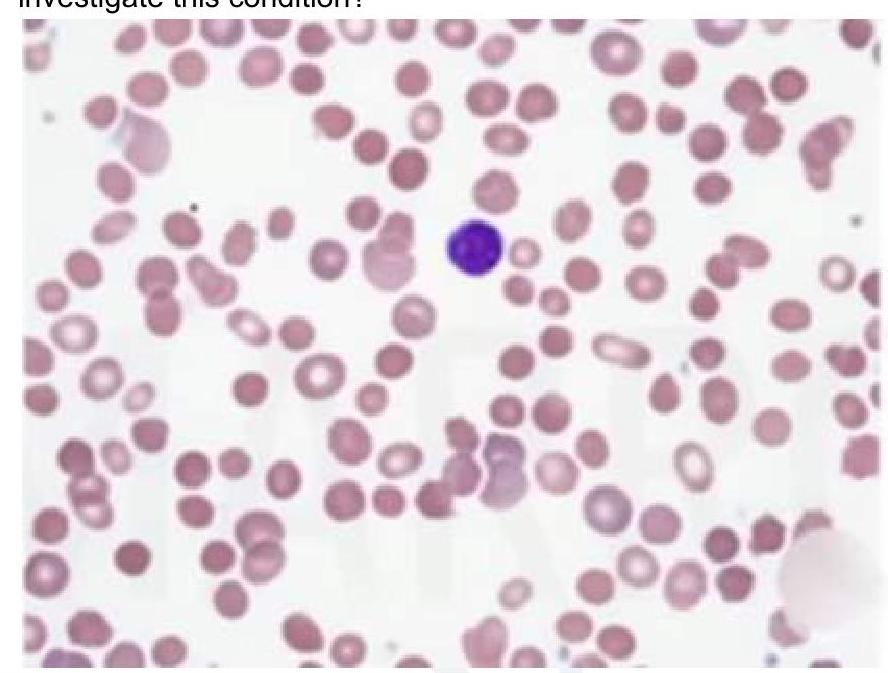
A 68-year-old man presents with bleeding manifestations. Peripheral smear shows the presence of cells shown below. Which of the following is the most common chromosomal abnormality seen in this condition?
Which of the following laboratory techniques is most commonly used to compare and quantify CD markers on cells?
A lymphoma characterized by the presence of centrocytes and centroblasts, along with BCL2 positivity and CD10 expression, is most commonly associated with which chromosomal translocation?
Which of the following hematological findings are seen in pregnant women with thalassemia trait?
Folic acid deficiency is characterized by the following features except
Basophilic stippling of the RBCs is a sensitive index of
Which of the following blood components has the shortest shelf life?
An elderly male patient presented with clinical symptoms and signs consistent with possible multiple myeloma. Electrophoresis shows an M spike, and immunofixation findings are shown below. Which of the following statements best corresponds to the findings?

Identify the image and the disease it is associated with: 

Explanation: ***t(15;17)*** - This translocation defines **Acute Promyelocytic Leukemia (APL)**, a distinct and highly curable subtype of AML, making its prognosis the most favorable [1]. - It results in the expression of the chimeric **PML/RARA fusion gene**, which is highly sensitive to differentiation agents like **all-trans retinoic acid (ATRA)**, leading to high cure rates [1]. *t(8;21) and inv(16) are also associated with a favorable prognosis, but t(15;17) often has the best outcome* - The **t(8;21)** and **inv(16)**/t(16;16) are classified as favorable or core-binding factor (CBF) AMLs, indicating good responsiveness to chemotherapy [1]. - Prognosis for CBF AML is superior to intermediate-risk AML, but generally not as excellent as APL treated with ATRA and arsenic. *Monosomy 7 (-7)* - The loss of chromosome 7 is a hallmark chromosomal abnormality associated with the **adverse risk** group in AML, indicating a significantly poor prognosis. - It is frequently observed in patients with pre-existing **Myelodysplastic Syndrome (MDS)** or **therapy-related AML (t-AML)**. *t(9;22)* - While this translocation is famous for defining **Chronic Myeloid Leukemia (CML)** (leading to the **BCR-ABL1** fusion gene), its presence in AML is generally associated with a complex karyotype or mixed-phenotype acute leukemia. - Its presence in AML usually confers a less favorable or **adverse prognosis**, unlike the highly favorable t(15;17). **References:** [1] Kumar V, Abbas AK, et al.. Robbins and Cotran Pathologic Basis of Disease. 9th ed. Diseases of White Blood Cells, Lymph Nodes, Spleen, and Thymus, pp. 620-621.
Explanation: The image displays a large blast cell containing numerous needle-like pink/red inclusions known as **Auer rods** (sometimes referred to as a "faggot cell") [2]. This morphology is pathognomonic for **Acute Promyelocytic Leukemia (APL)**, which is categorized as **AML M3** [3]. APL is frequently associated with severe **Disseminated Intravascular Coagulation (DIC)**, explaining the patient's bleeding manifestations [3]. ***t(15 ; 17)*** - This specific reciprocal translocation fuses the **PML** (Promyelocytic Leukemia) gene on chromosome 15 with the **RARA** (Retinoic Acid Receptor Alpha) gene on chromosome 17, defining APL [1]. - The resulting **PML-RARA fusion protein** blocks myeloid differentiation, and its presence guides therapeutic management, making APL highly responsive to **All-trans Retinoic Acid (ATRA)** [1]. *t(8 ; 21)* - This translocation is the most common cytogenetic abnormality seen in **AML M2** (AML with maturation), fusing the *RUNX1* and *RUNX1T1* genes [3]. - Although classified as core-binding factor leukemia, it lacks the characteristic morphology (multiple Auer rods/faggot cells) of APL. *t(14 ; 18)* - This is the defining translocation for **Follicular Lymphoma**, leading to the overexpression of the anti-apoptotic protein **BCL2**. - It is not associated with Acute Myeloid Leukemia (AML) subtypes. *inv(16)* - This chromosomal inversion is highly characteristic of **AML M4eo** (Acute Myelomonocytic Leukemia with marrow eosinophilia) [3]. - This aberration fuses the *CBFB* gene with *MYH11*, another type of core-binding factor leukemia with a largely favorable prognosis [3]. **References:** [1] Kumar V, Abbas AK, et al.. Robbins and Cotran Pathologic Basis of Disease. 9th ed. Diseases of White Blood Cells, Lymph Nodes, Spleen, and Thymus, pp. 620-621. [2] Kumar V, Abbas AK, et al.. Robbins and Cotran Pathologic Basis of Disease. 9th ed. Diseases of White Blood Cells, Lymph Nodes, Spleen, and Thymus, pp. 621-622. [3] Kumar V, Abbas AK, et al.. Robbins and Cotran Pathologic Basis of Disease. 9th ed. Diseases of White Blood Cells, Lymph Nodes, Spleen, and Thymus, p. 620.
Explanation: ***Flow cytometry*** - It is the standard technique used to analyze and count cells based on their expression of **surface** and **intracellular** markers like CD markers [1]. - Cells are labeled with **fluorescent antibodies** specific to CD markers and passed through a laser beam to quantify fluorescence, which corresponds to marker expression [1]. *ELISA (Enzyme-linked immunosorbent assay)* - It is primarily used to detect and quantify the concentration of **soluble molecules** (e.g., antibodies, cytokines, antigens) in biological fluids [2]. - It is not designed for the simultaneous comparison and quantification of **membrane markers** on individual cells. *Western blot* - This technique separates **proteins** based on size (electrophoresis) and uses specific antibodies to detect their presence from a cell lysate. - It provides information about the protein's presence and size but does not assess the **cellular localization** or allow for single-cell quantification of surface markers. *Immunohistochemistry (IHC)* - IHC uses antibodies to detect antigens (including CD markers) within **tissue sections** (or immunocytochemistry for cell smears) [1]. - While it can demonstrate the presence of CD markers, it is used for **qualitative visualization** and anatomical localization, not for the high-throughput, quantitative comparison of markers on suspended single cells [1]. **References:** [1] Kumar V, Abbas AK, et al.. Robbins and Cotran Pathologic Basis of Disease. 9th ed. Neoplasia, pp. 341-342. [2] Cross SS. Underwood's Pathology: A Clinical Approach. 6th ed. (Basic Pathology) introduces the student to key general principles of pathology, both as a medical science and as a clinical activity with a vital role in patient care. Part 2 (Disease Mechanisms) provides fundamental knowledge about the cellular and molecular processes involved in diseases, providing the rationale for their treatment. Part 3 (Systematic Pathology) deals in detail with specific diseases, with emphasis on the clinically important aspects., pp. 259-260.
Explanation: ***t(14 ; 18)*** [1], [2] - This translocation is the genetic hallmark of **Follicular Lymphoma (FL)**, characterized by the presence of **centrocytes** and **centroblasts**, **BCL2 positivity**, and **CD10 expression** [1], [2]. - It results in the juxtaposition of the **BCL2 gene** (on chromosome 18) with the **IgH locus** (on chromosome 14), leading to constitutive overexpression of the anti-apoptotic BCL2 protein [1], [2]. *t(2 ; 5)* - This translocation is characteristic of **Anaplastic Large Cell Lymphoma (ALCL)**, leading to the activation of the **ALK gene**. - ALCL is typically **CD30 positive** and lacks the centrocytes/centroblasts morphology and germinal center markers (like CD10) seen in the described B-cell lymphoma. *t(11 ; 14)* - This translocation is associated with **Mantle Cell Lymphoma (MCL)**, causing the overexpression of **Cyclin D1**. - While MCL cells are often BCL2 positive, they typically lack **CD10 expression**, which is a key feature of the described germinal center lymphoma. *t(8 ; 14)* - This translocation is the hallmark of **Burkitt Lymphoma**, resulting in **MYC gene** overexpression. - Burkitt Lymphoma is typically **CD10 positive** but shows a high proliferation index (Ki-67 ~100%) and lacks BCL2 expression [3], unlike the described follicular lymphoma. **References:** [1] Kumar V, Abbas AK, et al.. Robbins and Cotran Pathologic Basis of Disease. 9th ed. Diseases of White Blood Cells, Lymph Nodes, Spleen, and Thymus, pp. 602-604. [2] Cross SS. Underwood's Pathology: A Clinical Approach. 6th ed. Common Clinical Problems From Diseases Of The Urinary And Male Genital Tracts, pp. 561-562. [3] Kumar V, Abbas AK, et al.. Robbins and Cotran Pathologic Basis of Disease. 9th ed. Diseases of White Blood Cells, Lymph Nodes, Spleen, and Thymus, p. 606.
Explanation: ***Raised HbA₂ and low MCV*** - Beta-thalassemia trait is characterized by a **compensatory increase in HbA₂** (alpha2-delta2 globin chains) synthesis and **microcytic (low MCV)** red blood cells [1]. - This combination is a classic finding that helps differentiate thalassemia trait from iron deficiency anemia in pregnant women. *Low serum total iron binding capacity* - **Low total iron binding capacity (TIBC)** is typically seen in **anemia of chronic disease**, where iron stores are often adequate or high. - In thalassemia trait, iron stores are usually normal or increased, and TIBC is usually normal or slightly increased. *Low HbA₂ and raised MCV* - **Low HbA₂** is seen in alpha-thalassemia trait or iron deficiency anemia, not beta-thalassemia trait [2]. - **Raised MCV (macrocytosis)** is characteristic of conditions like **folate or B12 deficiency** or megaloblastic anemia, which is not associated with uncomplicated thalassemia trait [1]. *Low MCHC* - **Low MCHC (mean corpuscular hemoglobin concentration)** indicates hypochromic red blood cells and is found in various microcytic anemias, including **iron deficiency anemia** [1]. - While it can be present in thalassemia trait, it is not as specific as the combination of **raised HbA₂** and **low MCV** for distinguishing beta-thalassemia trait from other microcytic conditions [2]. **References:** [1] Cross SS. Underwood's Pathology: A Clinical Approach. 6th ed. Common Clinical Problems From Blood And Bone Marrow Disease, pp. 588-591. [2] Kumar V, Abbas AK, et al.. Robbins and Cotran Pathologic Basis of Disease. 9th ed. Red Blood Cell and Bleeding Disorders, pp. 649-650.
Explanation: ***Microcytes*** - **Folic acid deficiency** causes **macrocytic anemia** [1][2], meaning red blood cells are larger than normal, not microcytic (smaller than normal). - **Microcytes** are characteristic of **iron deficiency anemia** or thalassemia. *Macrocytes* - **Folic acid deficiency** leads to defective DNA synthesis, resulting in larger, immature red blood cells known as **macrocytes** [2]. - This is a hallmark of **megaloblastic anemia**, which includes both folic acid and vitamin B12 deficiencies [4]. *Howell-Jolly bodies* - These are **nuclear remnants** found in red blood cells that indicate impaired splenic function or accelerated red blood cell production. - While not exclusive to folic acid deficiency, they can be seen due to the **dyserythropoiesis** (abnormal red blood cell development) associated with it. *Hypersegmented neutrophils* - **Hypersegmented neutrophils** are a classic morphological finding in peripheral blood smears of patients with **folic acid deficiency** (and vitamin B12 deficiency) [2][3]. - This occurs due to abnormal maturation of neutrophils in the bone marrow, where the nucleus divides into a higher number of lobes (typically 5 or more) [3]. **References:** [1] Cross SS. Underwood's Pathology: A Clinical Approach. 6th ed. Common Clinical Problems From Blood And Bone Marrow Disease, pp. 594-595. [2] Cross SS. Underwood's Pathology: A Clinical Approach. 6th ed. Common Clinical Problems From Blood And Bone Marrow Disease, pp. 593-594. [3] Kumar V, Abbas AK, et al.. Robbins and Cotran Pathologic Basis of Disease. 9th ed. Red Blood Cell and Bleeding Disorders, p. 654. [4] Cross SS. Underwood's Pathology: A Clinical Approach. 6th ed. (Basic Pathology) introduces the student to key general principles of pathology, both as a medical science and as a clinical activity with a vital role in patient care. Part 2 (Disease Mechanisms) provides fundamental knowledge about the cellular and molecular processes involved in diseases, providing the rationale for their treatment. Part 3 (Systematic Pathology) deals in detail with specific diseases, with emphasis on the clinically important aspects., pp. 130-131.
Explanation: ***Correct: Lead poisoning*** - **Basophilic stippling** is a classic and sensitive hematologic finding in lead poisoning [1] - Results from inhibition of **pyrimidine 5'-nucleotidase**, which impairs RNA degradation in red blood cells - The presence of these **ribonucleoprotein granules** indicates defective heme synthesis and red cell maturation due to lead toxicity [1] - Other findings in lead poisoning include microcytic anemia and increased zinc protoporphyrin [1] *Incorrect: Silicosis* - A **lung disease** caused by inhaling **silica dust**, leading to pulmonary fibrosis and nodular lesions [2] - Does not primarily affect red blood cell morphology or cause basophilic stippling - Findings are limited to the respiratory system *Incorrect: Asbestosis* - A chronic **lung disease** caused by inhaling **asbestos fibers**, resulting in pulmonary fibrosis [2] - Does not directly cause changes in red blood cell morphology such as basophilic stippling - Associated with pleural plaques and increased risk of mesothelioma [2] *Incorrect: Arsenic poisoning* - Can cause various hematologic abnormalities including **anemia** and **pancytopenia** - **Not typically associated** with prominent basophilic stippling as a key diagnostic feature - Neurological symptoms (peripheral neuropathy), gastrointestinal symptoms, and dermatological findings (Mees' lines, hyperpigmentation) are more characteristic **References:** [1] Kumar V, Abbas AK, et al.. Robbins and Cotran Pathologic Basis of Disease. 9th ed. Infectious Diseases, pp. 418-420. [2] Kumar V, Abbas AK, et al.. Robbins and Cotran Pathologic Basis of Disease. 9th ed. The Lung, pp. 695-699.
Explanation: ***Platelets*** - **Platelets** have the shortest shelf life among the listed blood components, typically stored for **5 days** at room temperature with continuous agitation. - Their short shelf life is due to the risk of **bacterial contamination** and reduced therapeutic efficacy over time. *Fresh frozen plasma* - **Fresh frozen plasma (FFP)** can be stored for up to **1 year** at temperatures of -18°C or colder. - Once thawed, it must be used within **24 hours** if stored at 1-6°C. *Cryoprecipitate* - **Cryoprecipitate**, like FFP, can be stored for up to **1 year** at -18°C or colder. - After thawing, it is stable for **6 hours** at room temperature or **24 hours** if pooled and stored at room temperature. *Red Blood Cells* - **Red blood cells (RBCs)**, when stored in additive solutions, have a shelf life of up to **42 days** at 1-6°C. - This longer shelf life is due to specialized storage conditions that minimize metabolic activity and preserve cell integrity.
Explanation: ***Multiple myeloma with increased IgG*** - The immunofixation image shows a distinct, *monoclonal band (M spike)* in the **IgG lane (G)**, corresponding to the initial electrophoresis (ELP) M spike [1]. There is also a corresponding band in the **kappa light chain (K)** lane [1]. - The presence of a dominant band in IgG, along with a matching light chain (either kappa or lambda), indicates an **IgG monoclonal gammopathy**, which is characteristic of the most common type of multiple myeloma [1]. *Multiple myeloma with increased IgM* - This option would correspond to a strong, monoclonal band in the **IgM lane (M)**, which is not the case here. The 'M' lane in the image shows a faint/normal band, not an increased M spike. - Increased IgM monoclonal protein (M spike) is characteristic of **Waldenström macroglobulinemia**, not typically multiple myeloma [2]. *Multiple myeloma with increased IgA* - If the patient had IgA multiple myeloma, there would be a prominent monoclonal band in the **IgA lane (A)**, which is not observed in this immunofixation result. The 'A' lane shows a considerably smaller band compared to IgG. - IgA multiple myeloma is a less common subtype than IgG myeloma and would present with an IgA M spike [1]. *Waldenström macroglobulinemia* - Waldenström macroglobulinemia is characterized by a monoclonal gammopathy of the **IgM type**, which would present as a distinct M spike in the IgM lane [2]. - The immunofixation clearly shows an **IgG M spike**, ruling out Waldenström macroglobulinemia based on the type of monoclonal gammopathy [2]. **References:** [1] Kumar V, Abbas AK, et al.. Robbins and Cotran Pathologic Basis of Disease. 9th ed. Diseases of White Blood Cells, Lymph Nodes, Spleen, and Thymus, pp. 608-609. [2] Kumar V, Abbas AK, et al.. Robbins and Cotran Pathologic Basis of Disease. 9th ed. Diseases of White Blood Cells, Lymph Nodes, Spleen, and Thymus, pp. 606-607.
Explanation: ***Gaucher's disease*** - The image shows **Gaucher cells** - characteristic lipid-laden macrophages with a distinctive **"crumpled tissue paper" or "wrinkled silk" cytoplasmic appearance** and eccentric nuclei [1] - These cells are pathognomonic for **Gaucher's disease**, an **autosomal recessive lysosomal storage disorder** caused by **glucocerebrosidase deficiency** [1] - Accumulation of **glucocerebroside** in macrophages creates the characteristic morphology seen in bone marrow, spleen, and liver [1] - Caused by mutations in the *GBA* gene on chromosome 1 [1] *Tay-Sachs disease* - Autosomal recessive disorder caused by **hexosaminidase A deficiency** leading to **GM2 ganglioside accumulation** [2] - Characteristic findings include **cherry-red spot on macula** and neuronal ballooning, not the macrophage changes seen in this image [2] - Does not produce Gaucher cells *Sandhoff's disease* - Caused by deficiency of both **hexosaminidase A and B** due to *HEXB* gene mutations - Similar to Tay-Sachs with GM2 ganglioside accumulation affecting neurons - Does not produce the characteristic macrophage morphology shown in the image *Fabry's disease* - **X-linked recessive** disorder caused by **alpha-galactosidase A deficiency** - Accumulation of **globotriaosylceramide** in vascular endothelial cells - Histology may show lipid deposits in vessels and kidney, not the distinctive Gaucher cells seen here **References:** [1] Kumar V, Abbas AK, et al.. Robbins and Cotran Pathologic Basis of Disease. 9th ed. Genetic Disorders, pp. 162-163. [2] Kumar V, Abbas AK, et al.. Robbins and Cotran Pathologic Basis of Disease. 9th ed. Genetic Disorders, p. 161.
Anemias: Classification and Approach
Practice Questions
Hemolytic Anemias
Practice Questions
Myeloproliferative Neoplasms
Practice Questions
Myelodysplastic Syndromes
Practice Questions
Acute Leukemias
Practice Questions
Chronic Leukemias
Practice Questions
Lymphomas and Lymphoid Neoplasms
Practice Questions
Plasma Cell Disorders
Practice Questions
Bleeding Disorders
Practice Questions
Thrombotic Disorders
Practice Questions
Get full access to all questions, explanations, and performance tracking.
Start For Free