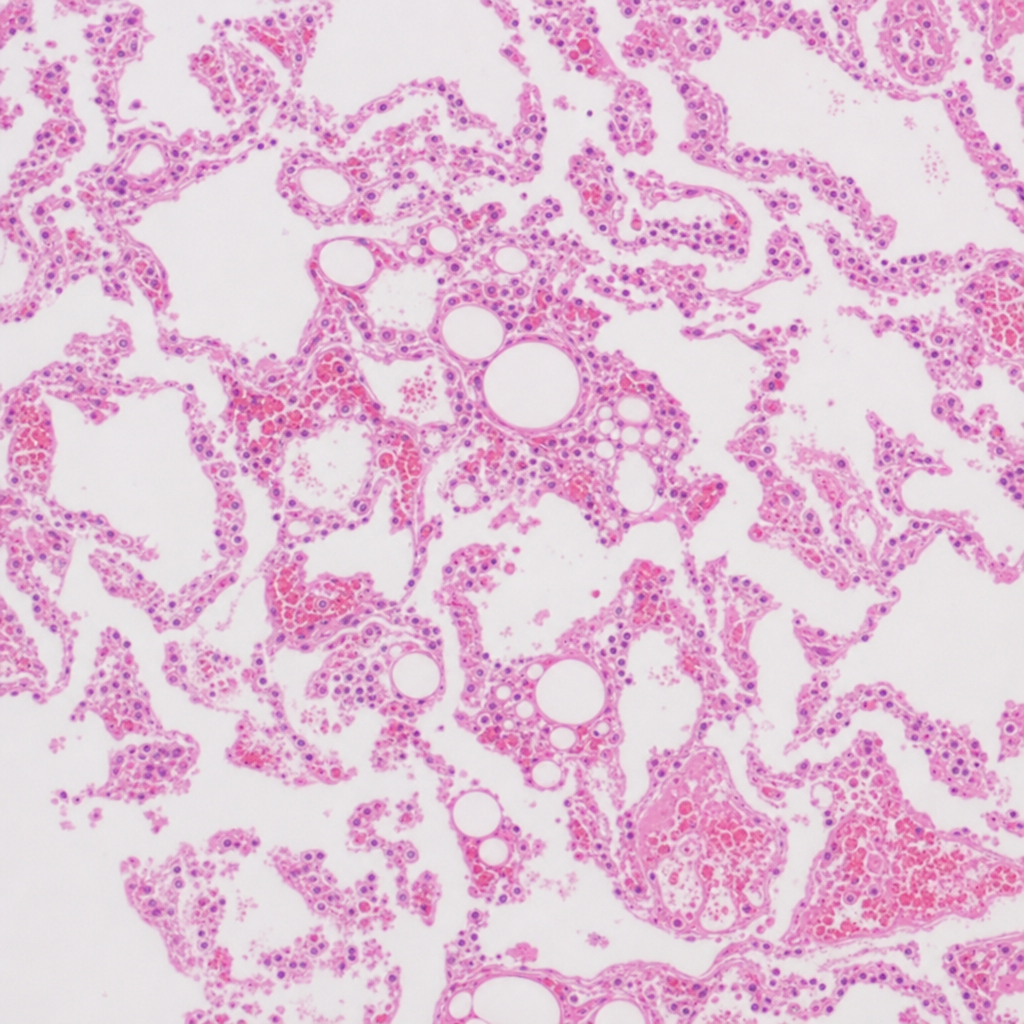
The ocular basement membrane is stained with which of the following?
Which of the following is a labile cell?
True rosettes are seen in all of the following except:
A 60-year-old diabetic female presented with a burning sensation aggravated by spicy food. Intraoral examination revealed multiple periodontal abscesses and a keratotic area in a lace pattern with occasional erosive areas within the lace pattern. What histological feature would be expected?
Major basic proteins are produced by which type of cell?
What is the most efficient bactericidal system of neutrophils?
Down syndrome is due to non-disjunction of which chromosome?
Dystrophic calcification is commonly seen in which of the following conditions?
Polycythemia is associated with all of the following cancers except?
Which of the following patterns is seen in DNA electrophoresis?
Explanation: **Explanation:** The correct answer is **Periodic acid-Schiff (PAS)**. **Why PAS is the correct answer:** Basement membranes (including those in the eye, such as Descemet’s membrane and the lens capsule) are rich in **neutral mucopolysaccharides** and **Type IV collagen**. The PAS stain works by oxidizing the carbon-carbon bonds in glucose residues to create aldehydes, which then react with the Schiff reagent to produce a deep magenta/pink color. Because the ocular basement membranes are exceptionally thick and carbohydrate-rich, PAS is the gold-standard histopathological stain for visualizing them [1]. **Analysis of Incorrect Options:** * **Alcaine blue (Alcian Blue):** This stain is used to detect **acidic mucopolysaccharides** (like hyaluronic acid or chondroitin sulfate). It is commonly used to identify goblet cells in intestinal metaplasia (Barrett’s esophagus) but does not specifically highlight the basement membrane. * **Giemsa stain:** This is a differential stain primarily used for hematology (blood smears) and detecting specific pathogens like *Chlamydia*, *Plasmodium*, and *Leishmania*. * **Methylene blue:** This is a simple basic dye used to highlight nuclei or to identify morphology in fecal leukocytes; it lacks the specificity for the complex carbohydrates of the basement membrane. **NEET-PG High-Yield Pearls:** * **PAS Positive structures:** Basement membranes, Glycogen (diastase sensitive), Fungi (cell walls), and Amoeba. * **Descemet’s Membrane:** This is the basement membrane of the corneal endothelium and is one of the thickest in the body, making it intensely PAS-positive [1]. * **Silver Stains (GMS/Jones):** These are also used for basement membranes (especially in the kidney), but PAS is the classic choice for ocular histology. **References:** [1] Kumar V, Abbas AK, et al.. Robbins and Cotran Pathologic Basis of Disease. 9th ed. The Eye, p. 1328.
Explanation: ### Explanation The classification of cells based on their proliferative capacity is a fundamental concept in General Pathology. Cells are categorized into three types: **Labile, Stable, and Permanent.** [1] **1. Why Surface Epithelium is correct:** **Labile cells** (or continuous dividers) are cells that follow the cell cycle from one mitosis to the next. They are constantly being lost and replaced by maturation from stem cells and by proliferation of mature cells [2]. **Surface epithelia** (such as the epidermis, lining of the GI tract, respiratory tract, and bone marrow hematopoietic cells) are classic examples because they undergo rapid, continuous turnover throughout life to maintain homeostasis [1], [3]. **2. Why the other options are incorrect:** * **Cardiac cells (Option A):** These are **Permanent cells**. They have left the cell cycle (in G0 phase) and cannot undergo division in postnatal life. Injury to these cells results in scarring (fibrosis) rather than regeneration. * **Liver parenchymal cells (Option B):** These are **Stable cells** (Quiescent). They normally have a low level of replication but can undergo rapid division in response to stimuli (e.g., partial hepatectomy) [1]. * **Vascular endothelial cells (Option C):** These are also **Stable cells**. Like hepatocytes and mesenchymal cells (fibroblasts, smooth muscle), they remain in the G0 phase but can be stimulated to enter the G1 phase of the cell cycle when necessary. ### High-Yield NEET-PG Pearls: * **Cell Cycle Phase:** Labile cells are always in the cell cycle; Stable cells are in **G0** but can enter **G1**; Permanent cells have permanently exited the cell cycle. * **Regenerative Capacity:** Only tissues containing Labile or Stable cells can regenerate; Permanent cells heal only by **repair (scarring)**. * **Neurons and Skeletal Muscle:** Along with cardiac myocytes, these are the primary examples of Permanent cells. **References:** [1] Kumar V, Abbas AK, et al.. Robbins and Cotran Pathologic Basis of Disease. 9th ed. Inflammation and Repair, pp. 112-113. [2] Kumar V, Abbas AK, et al.. Robbins and Cotran Pathologic Basis of Disease. 9th ed. With Illustrations By, pp. 38-39. [3] Cross SS. Underwood's Pathology: A Clinical Approach. 6th ed. (Basic Pathology) introduces the student to key general principles of pathology, both as a medical science and as a clinical activity with a vital role in patient care. Part 2 (Disease Mechanisms) provides fundamental knowledge about the cellular and molecular processes involved in diseases, providing the rationale for their treatment. Part 3 (Systematic Pathology) deals in detail with specific diseases, with emphasis on the clinically important aspects., pp. 104-105.
Explanation: **Explanation:** The term **"True Rosettes"** in pathology refers to specific circular arrangements of tumor cells around a central lumen or a fibrillar core. These are characteristic histological markers for primitive neuroectodermal and neuroepithelial tumors. **Why Thecoma is the correct answer:** A **Thecoma** is a benign sex cord-stromal tumor of the ovary [1]. Histologically, it is composed of spindle-shaped cells laden with lipid (theca cells) and does not exhibit any rosette formation [1]. Rosettes are a feature of neuroectodermal differentiation, which is absent in mesenchymal/stromal tumors like thecomas. **Analysis of Incorrect Options:** * **Neuroblastoma:** Characterized by **Homer-Wright rosettes**, which are "pseudorosettes" because they contain a central hub of neuropil (fibrillar material) rather than a true lumen. However, in the context of many exams, both true and pseudorosettes are grouped under the broad umbrella of "rosettes" seen in small round blue cell tumors. * **Retinoblastoma:** Classically shows **Flexner-Wintersteiner rosettes**, which are considered "True Rosettes" because they contain a central empty lumen. * **Medulloblastoma:** Frequently demonstrates **Homer-Wright rosettes**, similar to neuroblastoma, representing primitive neural differentiation. **NEET-PG High-Yield Pearls:** 1. **Flexner-Wintersteiner Rosettes:** True lumen; seen in Retinoblastoma, Pineoblastoma, and Ependymoma. 2. **Homer-Wright Rosettes:** No lumen (fibrillar center); seen in Neuroblastoma, Medulloblastoma, and PNET. 3. **Perivascular Pseudorosettes:** Cells arranged around a blood vessel; the hallmark of **Ependymoma**. 4. **Call-Exner Bodies:** Small fluid-filled spaces between granulosa cells; pathognomonic for **Granulosa Cell Tumor** (often confused with rosettes). **References:** [1] Cross SS. Underwood's Pathology: A Clinical Approach. 6th ed. Common Clinical Problems From Female Genital Tract Disease, pp. 481-482.
Explanation: The clinical presentation described—a lace-like keratotic pattern (Wickham striae) with erosive areas on the oral mucosa—is classic for **Oral Lichen Planus (OLP)** [1]. This is a chronic inflammatory condition mediated by T-cells that attack the basal keratinocytes [1], [3]. **Why "Saw-tooth rete ridges" is correct:** In Lichen Planus, there is intense, band-like lymphocytic infiltration at the dermo-epidermal junction. This inflammation causes "liquefactive degeneration" (necrosis) of the basal cell layer [1], [3]. As the basal cells are destroyed, the downward extensions of the epithelium (rete ridges) become pointed and angular, resembling the teeth of a saw. This **"saw-tooth" appearance** is a pathognomonic histological hallmark of the disease [3]. **Analysis of Incorrect Options:** * **A. Elongated rete ridges:** Typically seen in **Psoriasis** (regular elongation) or chronic inflammatory conditions like Lichen Simplex Chronicus. * **B. Flattened rete ridges:** Seen in **Atrophic** conditions or Lichen Sclerosus, where the epithelium thins out and the dermo-epidermal junction becomes flat [2]. * **D. Bulbous rete ridges:** Often described as "teardrop-shaped" or "club-shaped," these are characteristic of **Epithelial Dysplasia** or certain reactive hyperplasias. **NEET-PG High-Yield Pearls:** * **Wickham Striae:** The white, lace-like lines seen clinically in Lichen Planus. * **Civatte Bodies:** Also known as colloid or hyaline bodies; these are apoptotic keratinocytes found in the lower epidermis/upper dermis. * **Max-Joseph Spaces:** Small areas of artificial separation between the epidermis and dermis due to extensive basal cell damage. * **6 P’s of Cutaneous Lichen Planus:** Planar (flat-topped), Purple, Polygonal, Pruritic, Papules, and Plaques [1]. **References:** [1] Kumar V, Abbas AK, et al.. Robbins and Cotran Pathologic Basis of Disease. 9th ed. The Skin, pp. 1168-1170. [2] Kumar V, Abbas AK, et al.. Robbins and Cotran Pathologic Basis of Disease. 9th ed. The Female Genital Tract, p. 1000. [3] Cross SS. Underwood's Pathology: A Clinical Approach. 6th ed. Disorders Involving Inflammatory And Haemopoietic Cells, pp. 641-642.
Explanation: **Explanation:** **Major Basic Protein (MBP)** is the primary constituent of the crystalline core of **Eosinophil** granules. It is a highly cytotoxic polypeptide that plays a critical role in the body's defense against helminthic parasites by damaging the parasite's tegument. * **Why Eosinophil is Correct:** Eosinophils contain specialized secondary granules consisting of a crystalloid core (containing MBP) and a surrounding matrix (containing Eosinophil Cationic Protein, Eosinophil Peroxidase, and Eosinophil-Derived Neurotoxin). MBP is potent enough to cause degranulation of mast cells and basophils and can also cause epithelial damage in conditions like bronchial asthma [1]. * **Why Other Options are Incorrect:** * **Lymphocytes:** These are agranulocytes involved in adaptive immunity (T-cells and B-cells) and do not contain MBP. * **Neutrophils:** Their primary granules (azurophilic) contain myeloperoxidase and defensins, while secondary granules contain lactoferrin and collagenase. They do not produce MBP. * **Basophils:** While they share some mediators with eosinophils, their granules primarily contain histamine, heparin, and chondroitin sulfate. **High-Yield Clinical Pearls for NEET-PG:** 1. **Charcot-Leyden Crystals:** These are hexagonal, needle-like crystals found in the sputum of asthma patients (Curschmann spirals) and result from the breakdown of eosinophil membranes (specifically **Galectin-10**). 2. **Eosinophilia:** Classically seen in **PACMAN**: **P**arasitic infections, **A**sthma/Allergies, **C**hurg-Strauss syndrome, **M**yeloproliferative disorders, **A**ddison’s disease, and **N**eoplasia (Hodgkin Lymphoma). 3. MBP is a potent trigger for **histamine release** from mast cells, linking eosinophilic inflammation to immediate hypersensitivity reactions. **References:** [1] Kumar V, Abbas AK, et al.. Robbins and Cotran Pathologic Basis of Disease. 9th ed. The Lung, pp. 688-689.
Explanation: **Explanation:** The **H2O2-MPO-Halide (Myeloperoxidase) system** is the most potent and efficient bactericidal mechanism within neutrophils [2]. While neutrophils utilize several pathways to kill pathogens, this specific oxygen-dependent system is the "gold standard" for microbial killing. 1. **Why Option A is Correct:** During phagocytosis, neutrophils undergo a "respiratory burst." NADPH oxidase generates superoxide radicals, which are converted to Hydrogen Peroxide ($H_2O_2$). In the presence of the enzyme **Myeloperoxidase (MPO)**—found in the primary (azurophilic) granules—$H_2O_2$ reacts with a halide (most commonly Chloride, $Cl^-$) to form **Hypochlorous acid ($HOCl$)** [1][2]. $HOCl$ is a powerful oxidant (essentially household bleach) that destroys bacteria by lipid peroxidation and protein oxidation. 2. **Why Other Options are Incorrect:** * **B. NADPH oxidase:** This enzyme initiates the respiratory burst by producing superoxide [2]. While essential, it is the *starting point* of the pathway; the subsequent MPO system is significantly more efficient at killing. * **C. Lysozyme:** This is an oxygen-independent mechanism found in granules [1]. It works by hydrolyzing the glycopeptide coat of bacteria. It is important but far less potent than the oxidative burst. * **D. Reactive nitrogen species:** These (like Peroxynitrite) are primarily used by macrophages rather than being the *most* efficient system in neutrophils [2]. **High-Yield Clinical Pearls for NEET-PG:** * **MPO Deficiency:** Interestingly, patients with MPO deficiency are often asymptomatic because other mechanisms compensate, though they are predisposed to *Candida* infections. * **Chronic Granulomatous Disease (CGD):** Caused by a deficiency in **NADPH oxidase**. These patients cannot produce $H_2O_2$ and suffer from recurrent infections by **Catalase-positive** organisms (e.g., *S. aureus*). * **NBT Test/DHR Flow Cytometry:** Used to diagnose CGD by measuring the efficiency of the respiratory burst. **References:** [1] Kumar V, Abbas AK, et al.. Robbins and Cotran Pathologic Basis of Disease. 9th ed. Inflammation and Repair, pp. 91-92. [2] Kumar V, Abbas AK, et al.. Robbins and Cotran Pathologic Basis of Disease. 9th ed. Inflammation and Repair, p. 91.
Explanation: Explanation: **Down Syndrome (Trisomy 21)** is the most common chromosomal disorder and a frequent cause of intellectual disability [1]. It is caused by the presence of an extra copy of **Chromosome 21** [3]. In approximately 95% of cases, this is due to **meiotic non-disjunction**, where chromosomes fail to separate during meiosis (most commonly during Oogenesis in the mother). This risk increases significantly with advanced maternal age (>35 years) [1]. **Analysis of Options:** * **Chromosome 21 (Correct):** Trisomy 21 leads to Down syndrome [3]. Key features include a flat facial profile, epicanthic folds, Simian crease, and Brushfield spots. * **Chromosome 18 (Incorrect):** Trisomy 18 causes **Edwards Syndrome** [3]. Clinical features include "rocker-bottom" feet, micrognathia, clenched fists with overlapping fingers, and low-set ears. * **Chromosome 11 (Incorrect):** While not a common trisomy, deletions on 11p13 are associated with **WAGR syndrome** (Wilms tumor, Aniridia, Genitourinary anomalies, and intellectual disability). * **Chromosome 15 (Incorrect):** Abnormalities here typically involve imprinting defects rather than trisomy, leading to **Prader-Willi Syndrome** (paternal deletion) or **Angelman Syndrome** (maternal deletion). **High-Yield Clinical Pearls for NEET-PG:** * **Most common cause:** Meiotic non-disjunction (95%). Other causes include Robertsonian Translocation (4%) and Mosaicism (1%). * **Cardiac association:** Endocardial cushion defects (Atrioventricular Septal Defect) are the most common. * **GI association:** Duodenal atresia ("Double bubble" sign) and Hirschsprung disease. * **Hematological risk:** Increased risk of **ALL** (Acute Lymphoblastic Leukemia) and **AMKL** (Acute Megakaryoblastic Leukemia - M7). * **Neurological:** Early-onset Alzheimer’s disease due to the APP gene located on Chromosome 21 [2]. **References:** [1] Cross SS. Underwood's Pathology: A Clinical Approach. 6th ed. (Basic Pathology) introduces the student to key general principles of pathology, both as a medical science and as a clinical activity with a vital role in patient care. Part 2 (Disease Mechanisms) provides fundamental knowledge about the cellular and molecular processes involved in diseases, providing the rationale for their treatment. Part 3 (Systematic Pathology) deals in detail with specific diseases, with emphasis on the clinically important aspects., pp. 40-41. [2] Kumar V, Abbas AK, et al.. Robbins and Cotran Pathologic Basis of Disease. 9th ed. The Central Nervous System, pp. 1290-1292. [3] Kumar V, Abbas AK, et al.. Robbins and Cotran Pathologic Basis of Disease. 9th ed. Genetic Disorders, pp. 171-172.
Explanation: **Explanation:** Pathologic calcification is the abnormal tissue deposition of calcium salts. It is divided into two types: **Dystrophic** and **Metastatic**. **Why Atheromatous Plaque is Correct:** Dystrophic calcification occurs in **locally dying, damaged, or necrotic tissues** despite **normal serum calcium levels** [1]. In advanced atherosclerosis, the necrotic core of the atheromatous plaque undergoes dystrophic calcification [1]. The process involves the formation of crystalline calcium phosphate, often starting in membrane-bound vesicles (matrix vesicles) derived from injured cells. **Analysis of Incorrect Options:** * **A. Hyperparathyroidism:** This leads to hypercalcemia [2]. Excess calcium then deposits in **normal tissues**, which is the definition of **Metastatic Calcification** [2]. * **B. Vitamin D Deficiency:** This typically leads to hypocalcemia and metabolic bone diseases like rickets or osteomalacia, not pathologic calcification. Conversely, Vitamin D *intoxication* causes metastatic calcification. * **C. Renal Disease:** Chronic renal failure leads to secondary hyperparathyroidism and phosphate retention, resulting in **Metastatic Calcification** (often affecting the gastric mucosa, lungs, and kidneys) [3]. **High-Yield Clinical Pearls for NEET-PG:** * **Dystrophic Calcification:** Normal serum calcium; occurs in necrotic areas (e.g., Caseous necrosis in TB [1], Psammoma bodies in papillary thyroid cancer [2], damaged heart valves [1]). * **Metastatic Calcification:** Elevated serum calcium; occurs in normal tissues, primarily affecting interstitial tissues of the **gastric mucosa, kidneys, lungs, and systemic arteries** [3] (due to an internal alkaline environment). * **Psammoma Bodies:** These are classic examples of dystrophic calcification seen in Papillary carcinoma of the thyroid, Serous cystadenocarcinoma of the ovary, and Meningioma [2]. **References:** [1] Kumar V, Abbas AK, et al.. Robbins and Cotran Pathologic Basis of Disease. 9th ed. Cellular Responses to Stress and Toxic Insults: Adaptation, Injury, and Death, p. 55. [2] Cross SS. Underwood's Pathology: A Clinical Approach. 6th ed. (Basic Pathology) introduces the student to key general principles of pathology, both as a medical science and as a clinical activity with a vital role in patient care. Part 2 (Disease Mechanisms) provides fundamental knowledge about the cellular and molecular processes involved in diseases, providing the rationale for their treatment. Part 3 (Systematic Pathology) deals in detail with specific diseases, with emphasis on the clinically important aspects., pp. 134-135. [3] Kumar V, Abbas AK, et al.. Robbins and Cotran Pathologic Basis of Disease. 9th ed. Cellular Responses to Stress and Toxic Insults: Adaptation, Injury, and Death, pp. 76-77.
Explanation: **Explanation:** The association between certain cancers and polycythemia is primarily due to the **paraneoplastic production of Erythropoietin (EPO)**. This leads to secondary polycythemia (erythrocytosis), where the bone marrow is stimulated to produce excess red blood cells [4]. **Why Prostate Cancer is the Correct Answer:** Prostate cancer is **not** typically associated with the paraneoplastic production of erythropoietin. While it frequently metastasizes to the bone (osteoblastic lesions), it does not secrete hormones that trigger polycythemia [1]. In fact, advanced prostate cancer is more commonly associated with anemia of chronic disease or bone marrow infiltration [2]. **Analysis of Incorrect Options:** * **Renal Cell Carcinoma (RCC):** This is the most classic association. RCC is the most common tumor to produce ectopic EPO, occurring in about 1-5% of cases [4]. * **Liver Cancer (Hepatocellular Carcinoma):** HCC is a well-known cause of paraneoplastic polycythemia [4]. The liver is the primary site of EPO production in the fetus and retains the capacity to secrete it during neoplastic transformation. * **Stomach Cancer:** Though rarer than RCC or HCC, various gastrointestinal malignancies, including gastric carcinoma, have been documented in medical literature to cause paraneoplastic erythrocytosis. **High-Yield Clinical Pearls for NEET-PG:** * **Mnemonic for EPO-producing tumors (Potentially High-Yield):** **"He-Man Really Loves Statistics"** * **He**mangioblastoma (Cerebellum) * **Ma**ffucci Syndrome * **R**enal Cell Carcinoma * **L**iver Cancer (HCC) * **S**pacia (Uterine Fibroids/Leiomyoma) * **P**heochromocytoma * **Key Distinction:** Secondary polycythemia (due to tumors) will show **elevated EPO levels**, whereas Polycythemia Vera (a primary myeloproliferative neoplasm) will show **low/suppressed EPO levels** and the **JAK2 mutation** [3]. **References:** [1] Kumar V, Abbas AK, et al.. Robbins and Cotran Pathologic Basis of Disease. 9th ed. The Lower Urinary Tract and Male Genital System, pp. 993-994. [2] Cross SS. Underwood's Pathology: A Clinical Approach. 6th ed. Common Clinical Problems From Diseases Of The Urinary And Male Genital Tracts, pp. 501-502. [3] Cross SS. Underwood's Pathology: A Clinical Approach. 6th ed. Common Clinical Problems From Blood And Bone Marrow Disease, pp. 614-615. [4] Cross SS. Underwood's Pathology: A Clinical Approach. 6th ed. Common Clinical Problems From Blood And Bone Marrow Disease, pp. 586-587.
Explanation: **Explanation:** The correct answer is **Apoptosis**. The hallmark of apoptosis on DNA electrophoresis is a characteristic **"Step-ladder pattern."** **1. Why Apoptosis is correct:** During apoptosis, specific calcium- and magnesium-dependent endonucleases (caspase-activated DNase) cleave the DNA at internucleosomal linker regions [1]. Since DNA is wrapped around histones in regular intervals of approximately 180–200 base pairs, this enzymatic cleavage results in DNA fragments of varying lengths that are multiples of 180–200 bp. When these fragments are separated by electrophoresis, they form a distinct "step-ladder" appearance. **2. Why the other options are incorrect:** * **Necrosis:** Unlike the programmed cleavage in apoptosis, necrosis involves random, uncontrolled degradation of DNA and the nucleus (karyolysis). This results in a diffuse, continuous distribution of DNA fragments of all sizes, appearing as a **"Smear pattern"** on electrophoresis. * **Dysplasia and Metaplasia:** These are cellular adaptations or pre-neoplastic changes involving alterations in cell size, shape, organization, or phenotype. They do not involve the specific DNA fragmentation patterns seen in programmed cell death [1]. **High-Yield Clinical Pearls for NEET-PG:** * **Apoptosis:** Step-ladder pattern (Internucleosomal cleavage). * **Necrosis:** Smear pattern (Random cleavage). * **Gold Standard for Apoptosis:** The **TUNEL assay** (Terminal deoxynucleotidyl transferase dUTP nick end labeling) is used to detect these DNA fragments in situ. * **Annexin V:** A marker used to detect phosphatidylserine on the outer leaflet of the plasma membrane, another early marker of apoptosis [1]. **References:** [1] Kumar V, Abbas AK, et al.. Robbins and Cotran Pathologic Basis of Disease. 9th ed. Cellular Responses to Stress and Toxic Insults: Adaptation, Injury, and Death, pp. 63-65.
Cell Injury and Cell Death
Practice Questions
Adaptations of Cellular Growth
Practice Questions
Accumulations and Deposits
Practice Questions
Acute and Chronic Inflammation
Practice Questions
Tissue Repair and Wound Healing
Practice Questions
Hemodynamic Disorders
Practice Questions
Genetic Disorders
Practice Questions
Environmental Pathology
Practice Questions
Nutritional Diseases
Practice Questions
Molecular Basis of Disease
Practice Questions
Get full access to all questions, explanations, and performance tracking.
Start For Free