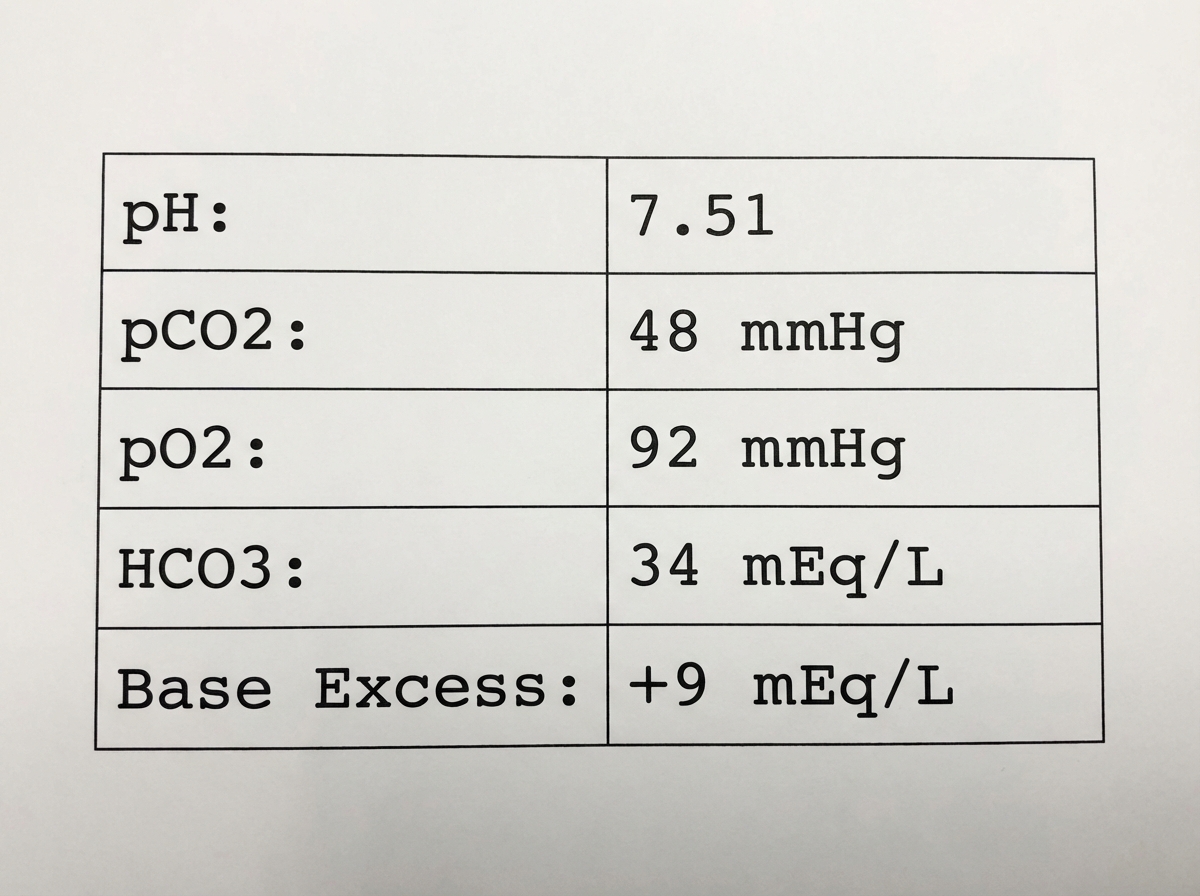
Which of the following disease processes best accounts for the arterial blood gas (ABG) abnormality shown in the image?
Autopsy of a specimen shows pale infarction. Pale infarct is seen in all of the following organs, EXCEPT:
The disease process that best accounts for this problem?
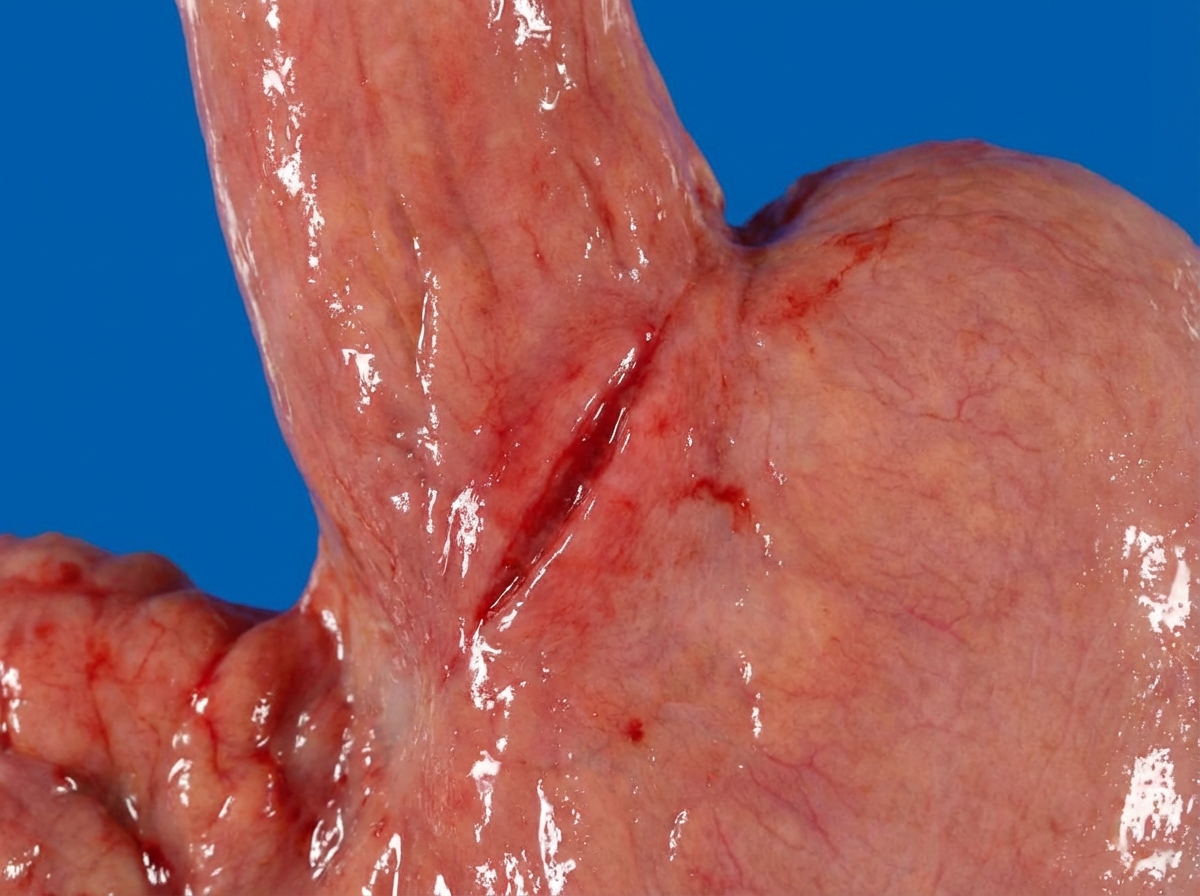
Autopsy of a specimen shows pale infarction. Pale infarct is seen in all of the following organs, EXCEPT:
Why do fetal cells continue to divide while terminally differentiated adult cells do not?
Which of the following cell types differentiates into a macrophage?
What term best describes nuclear dissolution?
All of the following are functions of CD4 helper cells, except?
A 40-year-old female patient complains of excessive bleeding and drowsiness following a road traffic accident 5 hours ago, with a lacerated wound on the lower back region. General physical examination reveals: Blood pressure - 80/60 mmHg, Jugular venous pressure - low, Pulsus paradoxus - present, Cardiac output - Increased. The patient is in which type of shock?
In amyloidosis of the tongue, where is the amyloid deposited primarily?
Explanation: ***Vomiting*** - Causes **metabolic alkalosis** due to loss of **hydrochloric acid (HCl)** from gastric secretions, leading to elevated **pH** and **bicarbonate (HCO3⁻)** levels. - Results in **hypokalemia** and **hypochloremia** as additional electrolyte abnormalities commonly seen with prolonged vomiting. *Ethylene glycol poisoning* - Produces **high-anion-gap metabolic acidosis** with decreased pH and bicarbonate due to formation of toxic metabolites like **glycolic acid** and **oxalic acid**. - Associated with **osmolar gap** elevation and potential **calcium oxalate crystals** in urine, not alkalosis. *Chronic obstructive pulmonary disease* - Causes **respiratory acidosis** with elevated **CO2** retention and compensatory rise in bicarbonate, but with **decreased pH**. - Results from **impaired ventilation** and CO2 elimination, opposite pattern from metabolic alkalosis. *Congestive heart failure* - Can present with **mixed acid-base disorders** including respiratory acidosis from pulmonary edema or metabolic acidosis from poor perfusion. - Does not typically cause isolated **metabolic alkalosis** unless complicated by diuretic use or other factors.
Explanation: **Explanation:** The classification of infarcts into **Pale (White)** or **Red (Hemorrhagic)** depends primarily on the vascular anatomy and the density of the affected tissue [2]. **Why Lung is the Correct Answer:** The **Lung** is a classic site for **Red Infarcts**. This occurs because the lung has a **dual blood supply** (Pulmonary and Bronchial arteries) and a loose, spongy parenchymal structure [1], [2]. When an obstruction occurs in the pulmonary artery, the collateral bronchial circulation continues to pump blood into the necrotic area. Because the tissue is loose, this blood extravasates and collects in the infarct zone, making it appear red and hemorrhagic. **Why the Other Options are Incorrect:** * **Heart (A), Spleen (B), and Kidney (D):** These are solid, dense organs with **end-arterial circulation** (single blood supply) [2], [3]. When the supplying artery is occluded, there is no collateral flow to "refill" the area. The density of the tissue also limits the amount of blood that can seep into the necrotic zone from adjacent capillary beds [2]. This results in an anemic or **Pale Infarct** [2]. **NEET-PG High-Yield Pearls:** * **Pale Infarcts (White):** Occur in solid organs with end-arterial circulation (Heart, Spleen, Kidney) [2]. * **Red Infarcts (Hemorrhagic):** Occur in: 1. Tissues with **dual/collateral circulation** (Lung, Small Intestine) [1], [2]. 2. **Loose tissues** where blood can collect [2]. 3. Tissues previously congested by **venous outflow obstruction** (e.g., Ovarian torsion) [2]. 4. When flow is re-established to a site of previous arterial occlusion (**Reperfusion injury**) [2]. * **Morphology:** Most infarcts are wedge-shaped, with the apex pointing toward the site of vascular occlusion [2], [3]. **References:** [1] Kumar V, Abbas AK, et al.. Robbins and Cotran Pathologic Basis of Disease. 9th ed. Hemodynamic Disorders, Thromboembolic Disease, and Shock, pp. 137-138. [2] Kumar V, Abbas AK, et al.. Robbins and Cotran Pathologic Basis of Disease. 9th ed. Hemodynamic Disorders, Thromboembolic Disease, and Shock, p. 140. [3] Cross SS. Underwood's Pathology: A Clinical Approach. 6th ed. (Basic Pathology) introduces the student to key general principles of pathology, both as a medical science and as a clinical activity with a vital role in patient care. Part 2 (Disease Mechanisms) provides fundamental knowledge about the cellular and molecular processes involved in diseases, providing the rationale for their treatment. Part 3 (Systematic Pathology) deals in detail with specific diseases, with emphasis on the clinically important aspects., pp. 148-149.
Explanation: ***Vomiting*** - Can cause **Mallory-Weiss tears** in the esophagus due to sudden increase in intragastric pressure during forceful retching. - May lead to **hypokalemic vacuolar nephropathy** from electrolyte losses, causing characteristic **vacuolar changes** in renal tubular epithelium. *Ethylene glycol poisoning* - Causes **oxalate crystal nephropathy** with pathognomonic **calcium oxalate crystals** in renal tubules and interstitium. - Results in **acute tubular necrosis** and **metabolic acidosis** with anion gap, not the pathological changes described. *Chronic obstructive pulmonary disease* - Characterized by **emphysema** (alveolar destruction) and **chronic bronchitis** (mucus gland hyperplasia). - Primarily affects the **respiratory system** with **air trapping** and **hyperinflation**, not the pathological process in question. *Congestive heart failure* - Causes **pulmonary congestion** with **hemosiderin-laden macrophages** (heart failure cells) in lungs. - Results in **cardiac cachexia** and **hepatic congestion** with **nutmeg liver** pattern, distinct from the described pathology.
Explanation: The classification of an infarct as **pale (white)** or **hemorrhagic (red)** depends primarily on the vascular anatomy and the density of the tissue in the affected organ. **1. Why Lung is the Correct Answer:** The **Lung** is the classic example of an organ that develops **Red (Hemorrhagic) Infarcts**. This occurs because the lung has a **dual blood supply** (Pulmonary and Bronchial arteries) and a loose, spongy parenchyma [1]. When an obstruction occurs in the pulmonary artery, the bronchial circulation continues to pump blood into the necrotic area. Because the tissue is loose, this blood easily extravasates into the alveolar spaces, making the infarct appear red. **2. Why the other options are incorrect:** * **Heart (A), Spleen (B), and Kidney (D):** These are solid, dense organs with **end-arterial circulation** (single blood supply) [2]. When the primary artery is occluded, there is no secondary source of blood to fill the necrotic area. The density of the tissue also limits the seepage of blood from adjacent capillary beds [2]. Consequently, the area becomes ischemic and pale. **3. NEET-PG High-Yield Pearls:** * **Red Infarcts (mnemonic: "L-S-B-T"):** Occur in **L**ungs, **S**mall Intestine (loose tissue/collaterals), **B**rain (liquefactive necrosis), and **T**estis (venous torsion). They also occur in tissues following **reperfusion** (e.g., after angioplasty) [2]. * **White Infarcts:** Occur in solid organs with end-arterial circulation (Heart, Spleen, Kidney) [2]. * **Shape:** Most infarcts (both red and white) are **wedge-shaped**, with the apex pointing toward the occluded vessel and the base at the organ surface [2, 3]. * **Morphology:** Most infarcts (except in the brain) result in **coagulative necrosis**. **References:** [1] Kumar V, Abbas AK, et al.. Robbins and Cotran Pathologic Basis of Disease. 9th ed. Hemodynamic Disorders, Thromboembolic Disease, and Shock, pp. 137-138. [2] Kumar V, Abbas AK, et al.. Robbins and Cotran Pathologic Basis of Disease. 9th ed. Hemodynamic Disorders, Thromboembolic Disease, and Shock, p. 140. [3] Cross SS. Underwood's Pathology: A Clinical Approach. 6th ed. (Basic Pathology) introduces the student to key general principles of pathology, both as a medical science and as a clinical activity with a vital role in patient care. Part 2 (Disease Mechanisms) provides fundamental knowledge about the cellular and molecular processes involved in diseases, providing the rationale for their treatment. Part 3 (Systematic Pathology) deals in detail with specific diseases, with emphasis on the clinically important aspects., pp. 148-149.
Explanation: **Explanation:** The cell cycle is governed by a delicate balance between stimulatory proteins (**Cyclins and Cyclin-Dependent Kinases/CDKs**) and inhibitory proteins (**CDK Inhibitors/CDKIs**) [2]. **1. Why Option A is Correct:** The primary reason fetal cells exhibit rapid proliferation compared to terminally differentiated adult cells is the level of **CDK inhibitors** (such as the p21, p27, and p16 families) [2]. In the fetus, these inhibitors are present in very low concentrations, allowing the Cyclin-CDK complexes to remain active. This facilitates the phosphorylation of the Retinoblastoma (Rb) protein, releasing E2F transcription factors that drive the cell into the **S phase** [1]. In contrast, adult terminally differentiated cells (like neurons or cardiac myocytes) upregulate these inhibitors, effectively locking the cell in the **G0 phase** [2]. **2. Analysis of Incorrect Options:** * **Option B:** Phosphatases (like CDC25) are actually essential for activating CDKs in *both* fetal and adult dividing cells. They are not unique to adult cells. * **Option C:** Proteinases (like Caspases or Ubiquitin ligases) are present in both; in fact, the degradation of cyclins by the ubiquitin-proteasome pathway is a universal requirement for cell cycle progression. * **Option D:** Adult cells do not lack CDKs; rather, the CDKs they possess are kept in an inactive state by the presence of inhibitors [2]. **High-Yield Clinical Pearls for NEET-PG:** * **G1 to S Transition:** This is the most critical checkpoint in the cell cycle [1]. * **Quiescent Cells (G0):** Stable cells (e.g., hepatocytes) can re-enter the cycle, while Permanent cells (e.g., neurons) cannot [2]. * **Knudson’s Two-Hit Hypothesis:** Often involves the *RB1* gene, which regulates this exact G1-S transition [3]. * **P53 Connection:** p53 acts primarily by inducing **p21** (a CDKI), which halts the cell cycle to allow for DNA repair. **References:** [1] Kumar V, Abbas AK, et al.. Robbins and Cotran Pathologic Basis of Disease. 9th ed. Neoplasia, pp. 300-301. [2] Kumar V, Abbas AK, et al.. Robbins and Cotran Pathologic Basis of Disease. 9th ed. With Illustrations By, pp. 37-38. [3] Kumar V, Abbas AK, et al.. Robbins and Cotran Pathologic Basis of Disease. 9th ed. Neoplasia, p. 300.
Explanation: **Explanation:** The correct answer is **A. Monocytes**. **Why Monocytes are correct:** Monocytes are mononuclear phagocytic cells produced in the bone marrow. They circulate in the bloodstream for approximately 1–2 days before migrating into various tissues [1]. Once they exit the circulation and enter the extravascular space, they undergo morphological and functional changes to differentiate into **macrophages** [1], [2]. This transition is part of the **Mononuclear Phagocyte System** (formerly known as the Reticuloendothelial System). **Why the other options are incorrect:** * **B. Eosinophils:** These are granulocytes primarily involved in allergic reactions and defense against parasitic infections. They do not differentiate into macrophages. * **C. Neutrophils:** These are the "first responders" of acute inflammation. While they are professional phagocytes, they are short-lived cells that undergo apoptosis after performing their function; they do not transform into other cell types. * **D. Lymphocytes:** These are the primary cells of the adaptive immune system (B-cells, T-cells, and NK cells). They differentiate into plasma cells (B-cells) or effector T-cells, but not macrophages. **High-Yield Clinical Pearls for NEET-PG:** * **Tissue-Specific Macrophages:** When monocytes differentiate in specific organs, they take on unique names [2]: * **Liver:** Kupffer cells * **CNS:** Microglia * **Lungs:** Alveolar macrophages (Dust cells) * **Bone:** Osteoclasts * **Skin:** Langerhans cells (Note: These are dendritic cells, but share a common lineage). * **Activation:** Macrophages can be activated via the **Classical pathway (M1)** (pro-inflammatory/microbicidal) or the **Alternative pathway (M2)** (tissue repair/anti-inflammatory) [2]. * **Granulomas:** In chronic inflammation, macrophages can further differentiate into **Epithelioid cells** and fuse to form **Multinucleated Giant Cells** (e.g., Langhans giant cells in Tuberculosis) [2]. **References:** [1] Kumar V, Abbas AK, et al.. Robbins and Cotran Pathologic Basis of Disease. 9th ed. Diseases of the Immune System, pp. 194-196. [2] Kumar V, Abbas AK, et al.. Robbins and Cotran Pathologic Basis of Disease. 9th ed. Inflammation and Repair, pp. 105-106.
Explanation: **Explanation:** The correct answer is **Karyolysis**. This term refers to the fading and eventual **dissolution of the nucleus** during cell death (necrosis) [1]. **1. Why Karyolysis is correct:** Karyolysis (from Greek *karyon* = kernel/nucleus and *lysis* = loosening/dissolution) occurs when the chromatin fades due to the action of DNAse and RNAse enzymes. These enzymes degrade the nuclear DNA, leading to a loss of basophilia (the nucleus loses its purple/blue staining on H&E) until it eventually disappears entirely [1]. **2. Why other options are incorrect:** * **Pyknosis:** This is the first stage of nuclear change in necrosis. It is characterized by **nuclear shrinkage** and increased basophilia (the nucleus becomes a small, dense, dark mass) [1]. * **Karyorrhexis:** This follows pyknosis. It involves **nuclear fragmentation**, where the pyknotic nucleus breaks apart into many small, dust-like granules [1]. **3. NEET-PG High-Yield Pearls:** * **Sequence of Nuclear Changes:** The typical progression in necrosis is **Pyknosis → Karyorrhexis → Karyolysis** [1]. * **Mechanism:** These changes are irreversible and signify **cell death** [1]. * **Staining:** In karyolysis, the cell becomes increasingly **eosinophilic** (pinker) because the loss of acidic DNA means there is less binding of the basic dye (Hematoxylin) [1]. * **Apoptosis vs. Necrosis:** While pyknosis and karyorrhexis occur in both, **karyolysis is characteristic of necrosis**. In apoptosis, the nucleus fragments into membrane-bound "apoptotic bodies" without total enzymatic dissolution of the DNA in the same manner. **References:** [1] Kumar V, Abbas AK, et al.. Robbins and Cotran Pathologic Basis of Disease. 9th ed. Cellular Responses to Stress and Toxic Insults: Adaptation, Injury, and Death, pp. 53-55.
Explanation: **Explanation:** The correct answer is **B (Produce immunoglobulins)**. This is a classic NEET-PG concept testing the distinction between cellular and humoral immunity. **1. Why Option B is correct:** CD4+ T-helper cells do not produce immunoglobulins (antibodies) directly [1]. Antibody production is the exclusive function of **Plasma cells**, which are differentiated **B-lymphocytes** [4]. While CD4 cells (specifically the Th2 subset) are essential for stimulating B-cells to undergo class switching and maturation [2], they do not possess the machinery to secrete antibodies themselves. **2. Why other options are incorrect:** * **Option A (Immunogenic memory):** After an initial encounter with an antigen, a subset of CD4 cells differentiates into **Memory T-cells**. these provide a rapid and more robust response upon re-exposure [2]. * **Option C (Activate macrophages):** **Th1 cells** (a subset of CD4) secrete **Interferon-gamma (IFN-γ)**, which is the most potent activator of macrophages, enhancing their microbicidal activity [3]. * **Option D (Activate cytotoxic cells):** CD4 cells secrete **Interleukin-2 (IL-2)** and other cytokines that provide the "second signal" necessary for the proliferation and differentiation of CD8+ Cytotoxic T-cells. **High-Yield Clinical Pearls for NEET-PG:** * **MHC Restriction:** CD4 cells recognize antigens presented on **MHC Class II** molecules (Rule of 8: 4 × 2 = 8). * **Th1 vs. Th2:** Th1 cells (IL-2, IFN-γ) drive **cell-mediated immunity**; Th2 cells (IL-4, IL-5, IL-13) drive **humoral immunity** and allergic responses [3]. * **HIV Pathogenesis:** The hallmark of HIV is the progressive depletion of **CD4+ T-cells**, leading to a collapse of both cellular and humoral regulatory pathways. **References:** [1] Kumar V, Abbas AK, et al.. Robbins and Cotran Pathologic Basis of Disease. 9th ed. Diseases of the Immune System, pp. 206-207. [2] Cross SS. Underwood's Pathology: A Clinical Approach. 6th ed. (Basic Pathology) introduces the student to key general principles of pathology, both as a medical science and as a clinical activity with a vital role in patient care. Part 2 (Disease Mechanisms) provides fundamental knowledge about the cellular and molecular processes involved in diseases, providing the rationale for their treatment. Part 3 (Systematic Pathology) deals in detail with specific diseases, with emphasis on the clinically important aspects., pp. 161-162. [3] Kumar V, Abbas AK, et al.. Robbins and Cotran Pathologic Basis of Disease. 9th ed. Diseases of the Immune System, p. 206. [4] Kumar V, Abbas AK, et al.. Robbins and Cotran Pathologic Basis of Disease. 9th ed. Diseases of the Immune System, pp. 207-208.
Explanation: The correct answer is **Distributive Shock**. ### **Explanation of the Correct Answer** The key to identifying the type of shock lies in the hemodynamic profile. While the patient has a history of trauma (suggesting hypovolemia), the clinical findings point elsewhere: * **Increased Cardiac Output (CO):** This is the hallmark of **Distributive Shock** (specifically early/hyperdynamic phase) [1]. In all other forms of shock (Hypovolemic, Cardiogenic, Obstructive), the CO is characteristically decreased. * **Low JVP:** Indicates decreased preload, common in distributive and hypovolemic shock. * **Pulsus Paradoxus:** While classically associated with cardiac tamponade, it can occur in distributive shock due to exaggerated respiratory swings in intrathoracic pressure affecting a "volume-depleted" heart. In this clinical scenario, the lacerated wound on the **lower back** suggests a potential spinal cord injury, leading to **Neurogenic Shock** (a subtype of Distributive Shock), where loss of sympathetic tone causes massive vasodilation. ### **Why Other Options are Incorrect** * **Hypovolemic Shock:** Although bleeding is present, hypovolemic shock is characterized by **decreased** cardiac output and increased systemic vascular resistance (cold extremities). * **Obstructive Shock:** (e.g., Cardiac Tamponade, Tension Pneumothorax) would present with **elevated** JVP and **decreased** cardiac output. * **Neurogenic Shock (as a separate option):** While neurogenic shock is the likely *cause*, it is a *category* of **Distributive Shock**. In many standardized exams, if both are present, the broader physiological category (Distributive) is tested to ensure the student understands the hemodynamic mechanism (High CO/Low SVR). ### **NEET-PG High-Yield Pearls** * **Warm Shock vs. Cold Shock:** Distributive shock is "Warm Shock" (due to vasodilation); Hypovolemic/Cardiogenic are "Cold Shock" [1]. * **Hemodynamic Rule:** If **CO is Increased**, the answer is almost always **Distributive Shock** (Sepsis, Anaphylaxis, or Neurogenic). * **Neurogenic Shock Triad:** Hypotension, **Bradycardia**, and Peripheral Vasodilation (unlike other shocks which present with tachycardia). **References:** [1] Kumar V, Abbas AK, et al.. Robbins and Cotran Pathologic Basis of Disease. 9th ed. Hemodynamic Disorders, Thromboembolic Disease, and Shock, p. 144.
Explanation: **Explanation:** **1. Why the correct answer is right:** Amyloidosis is a disorder characterized by the extracellular deposition of misfolded, insoluble fibrillar proteins [1]. By definition, amyloid is an **extracellular** substance. In the tongue (and other solid organs), these deposits occur primarily in the **stromal connective tissue** between functional cells and within the walls of small blood vessels [1]. As the amyloid accumulates in the stroma, it causes pressure atrophy of the surrounding structures, leading to the characteristic clinical presentation of macroglossia (enlarged tongue) [1]. **2. Why the incorrect options are wrong:** * **Option B:** Amyloid is never deposited within the surface epithelium. Epithelial cells are cellular components, whereas amyloid is an interstitial, extracellular deposit [1]. * **Options C & D:** Amyloid is not an intracellular protein. It does not deposit within the nuclei or the cytoplasm of striated muscle cells. While amyloidosis of the tongue causes the destruction of muscle fibers, this is due to **extrinsic compression** from the expanding stromal deposits, not internal accumulation within the myocytes [1]. **3. NEET-PG High-Yield Pearls:** * **Macroglossia:** This is a classic physical sign of **AL (Primary) Amyloidosis** [1]. It is rarely seen in AA (Secondary) Amyloidosis. * **Staining Characteristics:** Amyloid shows **Apple-green birefringence** under polarized light when stained with **Congo Red** [1]. * **Morphology:** On H&E stain, it appears as an extracellular, amorphous, eosinophilic (pink), hyaline-like material [1]. * **Common Sites:** Apart from the tongue, common sites for biopsy include the gingiva, rectal mucosa, and abdominal fat pad. **References:** [1] Kumar V, Abbas AK, et al.. Robbins and Cotran Pathologic Basis of Disease. 9th ed. Diseases of the Immune System, pp. 264-270.
Cell Injury and Cell Death
Practice Questions
Adaptations of Cellular Growth
Practice Questions
Accumulations and Deposits
Practice Questions
Acute and Chronic Inflammation
Practice Questions
Tissue Repair and Wound Healing
Practice Questions
Hemodynamic Disorders
Practice Questions
Genetic Disorders
Practice Questions
Environmental Pathology
Practice Questions
Nutritional Diseases
Practice Questions
Molecular Basis of Disease
Practice Questions
Get full access to all questions, explanations, and performance tracking.
Start For Free