Which of the following is not a branch of the inferior mesenteric artery?
What is the primary vascular abnormality associated with intestinal angiodysplasia?
Chronic radiation proctitis is associated with the treatment of all malignancies, EXCEPT:
Gangrene of the intestine is seen in all the following conditions, except:
A young girl presents with abdominal pain and a recent change in bowel habit, with passage of mucus in stool. There is no associated blood in stool and symptoms are increased with stress. The most likely diagnosis is:
All of the following are true about Crohn's disease except.
String sign is a radiological feature of:
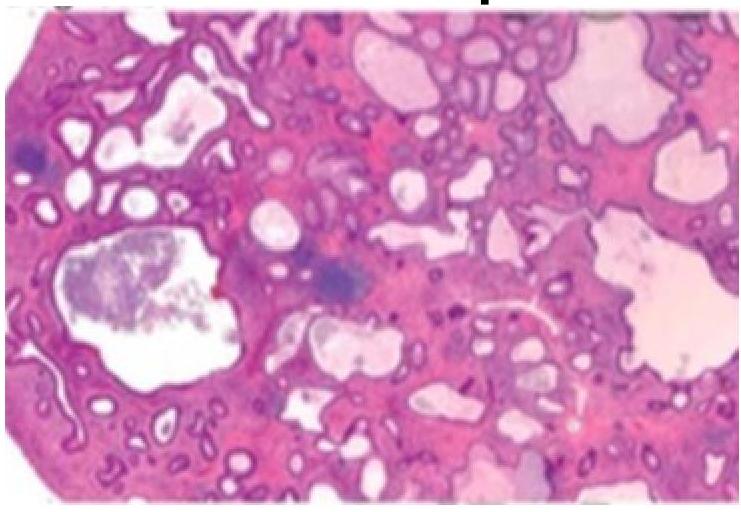
A 5-year-old child presented with a history of blood in the stools. On examination, there was a polypoid mass in the rectum, a biopsy of which showed as below. The most probable diagnosis is?
What condition is associated with a greater risk of gastric carcinoma?
Which of the following conditions is least likely to be associated with Helicobacter pylori infection?
Explanation: ***Middle rectal artery*** - The **middle rectal artery** [2] is typically a branch of the **internal iliac artery** [2], supplying the middle part of the rectum. - It is not a direct branch of the inferior mesenteric artery. *Left colic artery* - The left colic artery is a direct branch of the **inferior mesenteric artery** [1], supplying the distal transverse colon and descending colon. - It forms an important anastomosis with the middle colic artery [1]. *Superior rectal artery* - The **superior rectal artery** is the terminal branch of the **inferior mesenteric artery**, supplying the upper rectum. - This artery provides the primary arterial supply to the proximal large intestine structures. *Sigmoidal artery* - The **sigmoidal arteries** are typically 2-4 branches arising from the **inferior mesenteric artery**, supplying the sigmoid colon. - These arteries anastomose with branches of the superior rectal and left colic arteries.
Explanation: ***AV malformation*** - **Intestinal angiodysplasia** is characterized by abnormal **arteriovenous (AV) connections**, leading to vascular lesions in the gut [1]. - These malformations can cause **chronic gastrointestinal bleeding** due to fragility of the blood vessels [1]. *Capillary hemangioma* - This is a **benign vascular tumor** often found in the skin or subcutaneous tissue, not specifically associated with intestinal vascular changes. - **Capillary hemangiomas** typically do not cause significant gastrointestinal bleeding as seen in angiodysplasia. *Malignant tumor* - Intestinal angiodysplasia is a **benign condition** and not a malignant tumor, therefore it does not fit the characteristics of malignancy. - **Malignant tumors** usually present with different symptoms and underlying pathophysiology than angiodysplasia. *Cavernous hemangioma* - This type of hemangioma involves larger vascular channels and is typically more associated with the liver than the intestines. - **Cavernous hemangiomas** do not relate to the intestinal bleeding patterns seen in angiodysplasia.
Explanation: Chronic radiation proctitis is associated with the treatment of all malignancies, EXCEPT: ***Carcinoma small bowel*** - **Radiation therapy** is rarely used as a primary treatment for **small bowel carcinoma**, as surgical resection is the main modality. - Therefore, the small bowel is typically not exposed to direct radiation in a manner that would cause proctitis. *Carcinoma cervix* - **Pelvic radiation** is a common treatment for **cervical carcinoma**, which often involves the rectum within the radiation field. - This proximity makes chronic radiation proctitis a known and relatively frequent complication. *Carcinoma prostate* - **External beam radiation therapy** is a standard treatment option for **prostate cancer**, directly targeting the prostate gland which is anatomically close to the rectum. - This close proximity frequently leads to chronic radiation-induced damage to the rectal tissue, resulting in proctitis. *Carcinoma testes* - While **testicular cancer** itself is not directly adjacent to the rectum, certain stages of testicular cancer are treated with **retroperitoneal lymph node irradiation** or whole-pelvis radiation. - This can expose portions of the rectum to radiation, leading to chronic radiation proctitis as a potential side effect.
Explanation: ***Tricuspid Valve Endocarditis*** - While vegetations from **tricuspid valve endocarditis** can embolize, they typically affect the **pulmonary circulation** (e.g., pulmonary embolism, septic pulmonary infarcts) due to the venous drainage pattern. - Embolization from the right side of the heart to the systemic circulation (like the mesenteric arteries) is rare unless there's a **patent foramen ovale** or similar intracardiac shunt. - Therefore, tricuspid endocarditis does **NOT** typically cause intestinal gangrene. *Shock* - **Hypoperfusion** during shock leads to a severe reduction in blood flow to the intestines, causing **ischemia**. - Prolonged or severe ischemia can result in **intestinal gangrene** due to tissue death. - This is known as **non-occlusive mesenteric ischemia (NOMI)**. *Mesenteric artery thrombosis* - A **thrombus** in the mesenteric artery directly blocks blood supply to a segment of the intestine. - This abrupt cessation of blood flow leads rapidly to **ischemia and infarction**, resulting in gangrene. - Accounts for approximately 25-30% of acute mesenteric ischemia cases. *Volvulus* - **Volvulus** involves the twisting of a loop of intestine around its mesentery, which constricts and obstructs the mesenteric blood vessels. - This vascular compromise quickly leads to **ischemia and gangrene** of the twisted bowel segment. - Common sites include sigmoid colon and cecum.
Explanation: ***Irritable bowel syndrome*** - **Irritable bowel syndrome (IBS)** typically presents with **abdominal pain**, altered bowel habits (constipation, diarrhea, or mixed), and **mucus in stool** without blood [1]. - The symptoms are often exacerbated by **stress** and there is no evidence of structural or biochemical abnormalities [1]. *Amebiasis* - **Amebiasis** is an infection caused by *Entamoeba histolytica*, usually leading to **bloody diarrhea** (dysentery), abdominal pain, and fever. - The absence of blood in the stool and the presence of stress-related symptom exacerbation make amebiasis less likely. *Crohn's disease* - **Crohn's disease** is a type of inflammatory bowel disease characterized by **transmural inflammation** that can affect any part of the gastrointestinal tract. - Symptoms often include **abdominal pain**, diarrhea (which can be bloody), weight loss, and fatigue, and it does not typically show a direct correlation with stress as the primary exacerbating factor. *Ulcerative Colitis* - **Ulcerative colitis (UC)** is an inflammatory bowel disease characterized by **continuous inflammation** of the colon, typically starting in the rectum. - Key symptoms include recurrent **bloody diarrhea**, abdominal pain, and tenesmus, which are not described in this case, particularly the absence of blood.
Explanation: ***It is superficial inflammation involving mucosa*** - Crohn's disease is characterized by **transmural inflammation**, meaning it affects all layers of the bowel wall, not just the superficial mucosa [1]. - This **full-thickness inflammation** contributes to complications like **fistulas** and **strictures** [2]. *Cobble stone appearance* - The **cobblestone appearance** on endoscopic examination is a classic finding in Crohn's disease, resulting from deep longitudinal ulcers and intervening edematous mucosa. - This is a direct consequence of the **transmural inflammation**. *Perianal fistula is seen* - **Perianal fistulas** are common manifestations of Crohn's disease, occurring due to the transmural inflammation extending into the perianal tissues [2]. - These are formed when an inflamed crypt gland ruptures into the perianal tissue, creating a tract. *Skip lesions seen* - **Skip lesions** refer to discontinuous areas of inflammation, where segments of diseased bowel are separated by healthy, uninvolved segments [1]. - This **patchy pattern** is a hallmark feature distinguishing Crohn's disease from ulcerative colitis [1].
Explanation: ***Crohn's disease*** - The **string sign (Kantor's string sign)** is a classic and pathognomonic radiological finding in **Crohn's disease**, particularly affecting the terminal ileum. - It appears on barium studies as a **thin line of contrast** due to severe luminal narrowing caused by **transmural inflammation, spasm, edema, and fibrosis**. - Other characteristic features of Crohn's include **skip lesions, cobblestoning, fissures, fistulas**, and the ability to affect any part of the GI tract from mouth to anus. *Ileocecal tuberculosis* - While ileocecal TB can cause **strictures and narrowing** of the terminal ileum, the classic "string sign" terminology is specifically associated with Crohn's disease in standard radiology literature. - TB typically shows **circumferential thickening, shortened cecum (pulled-up cecum)**, and associated lymphadenopathy with central necrosis. *Ulcerative colitis* - Primarily affects the **colon and rectum** with continuous inflammation extending proximally, not involving the small bowel. - Radiographic features include **loss of haustra ("lead pipe" appearance)**, mucosal granularity, and pseudopolyps, not a string sign. *Ischemic colitis* - Characterized by acute inflammation due to reduced blood flow, typically affecting the **watershed areas** (splenic flexure, rectosigmoid junction). - Shows **"thumbprinting"** (submucosal edema/hemorrhage) and wall thickening, not the severe stenotic string sign.
Explanation: ***Juvenile polyp*** - The image shows **dilated, cystically appearing glands** within an inflamed lamina propria, which is characteristic of a juvenile polyp. - Juvenile polyps are the most common cause of **rectal bleeding** in children under 10 years of age and are typically benign. *Villous adenoma* - Villous adenomas are **neoplastic polyps** with a **villous (finger-like) architecture** and are more commonly seen in older adults [1]. - They typically show **dysplastic changes** and are considered premalignant [1]. *Vascular malformation* - Vascular malformations consist of **abnormally formed blood vessels** (e.g., arteriovenous malformations, hemangiomas) and would appear as dilated or aberrant vessels on histology. - While they can cause bleeding, the image does not show a predominance of vascular structures. *Serrated adenoma* - Serrated adenomas are characterized by **sawtooth-like glandular infoldings** and show varying degrees of dysplasia. - They are typically found in adults and are considered premalignant, not benign growths usually found in children. **References:** [1] Cross SS. Underwood's Pathology: A Clinical Approach. 6th ed. Common Clinical Problems From Alimentary System Disease, pp. 371-372.
Explanation: ***Intestinal metaplasia*** - Intestinal metaplasia is a known **precursor** condition associated with an increased risk of gastric carcinoma due to the transformation of gastric epithelium [1,2]. - This condition often arises from **chronic gastritis**, particularly after **H. pylori** infection, advancing the risk of malignant transformation [1,2]. *Old age* - While old age is a **risk factor** for various cancers, it is not specifically associated with gastric carcinoma without other factors. - The incidence of gastric cancer is more correlated with specific **precursor lesions** rather than just age alone. *Cardiac end ulcer* - Cardiac ulcers are typically **benign lesions** and not directly pre-cancerous. - They are often related to **chronic reflux disease**, which does not significantly increase the risk of gastric carcinoma. *Prepyloric ulcer* - Prepyloric ulcers may arise due to **peptic ulcer disease** but do not significantly predispose to gastric cancer. - The majority of ulcers can be healing or benign, lacking the malignant potential seen in precancerous lesions like intestinal metaplasia. **References:** [1] Kumar V, Abbas AK, et al.. Robbins and Cotran Pathologic Basis of Disease. 9th ed. The Gastrointestinal Tract, pp. 777-779. [2] Cross SS. Underwood's Pathology: A Clinical Approach. 6th ed. Common Clinical Problems From Alimentary System Disease, pp. 354-355.
Explanation: ***Barrett's esophagus*** - **Barrett's esophagus** is characterized by the replacement of the normal **squamous epithelium** of the esophagus with **columnar epithelium with intestinal metaplasia** (goblet cells), primarily due to chronic **gastroesophageal reflux disease (GERD)**. - While *H. pylori* can affect the stomach and duodenum, it is **not directly associated** with the pathogenesis of Barrett's esophagus. [1] - Barrett's is a complication of **chronic acid reflux**, not *H. pylori* infection. *Pyloric metaplasia of duodenum* - **Pyloric metaplasia** (gastric metaplasia) in the duodenum is often seen in the presence of an **active duodenal ulcer**, which is strongly associated with *H. pylori* infection. - *H. pylori* can colonize these metaplastic cells, perpetuating inflammation and ulcer formation in the duodenum. *Atrophic gastritis* - **Atrophic gastritis** is a common consequence of chronic *H. pylori* infection, leading to the **loss of gastric glands** and replacement by intestinal-type epithelium. [1] - This condition is a significant risk factor for the development of **gastric cancer**. *Intestinal metaplasia of stomach* - **Intestinal metaplasia** in the stomach is a precursor lesion for gastric cancer and is frequently observed in individuals with **chronic *H. pylori* gastritis**. [1] - *H. pylori* infection drives the inflammatory process that can lead to this metaplastic change in the gastric mucosa. [2] **References:** [1] Kumar V, Abbas AK, et al.. Robbins and Cotran Pathologic Basis of Disease. 9th ed. The Gastrointestinal Tract, pp. 770-771. [2] Cross SS. Underwood's Pathology: A Clinical Approach. 6th ed. Common Clinical Problems From Alimentary System Disease, pp. 356-357.
Get full access to all questions, explanations, and performance tracking.
Start For Free