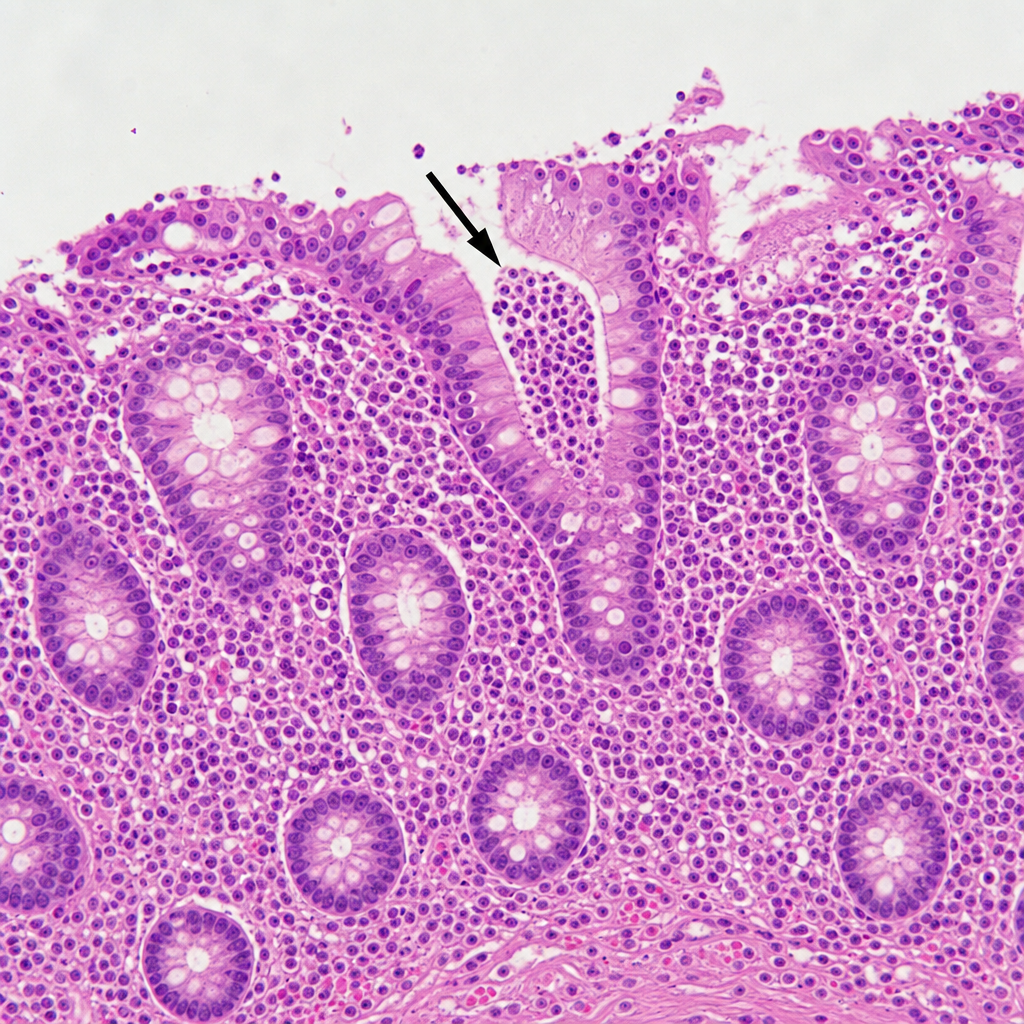
A 50-year-old male presents with severe abdominal pain and bloody diarrhea. Colonoscopy reveals continuous inflammation extending from the rectum to the splenic flexure. Which histological finding is most likely in this patient?
A 40-year-old man is diagnosed with a gastrointestinal stromal tumor (GIST). Which marker is most useful for confirming the diagnosis?
Which histological pattern is characteristic of gastric carcinoma that has a better prognosis?
A 30-year-old woman is diagnosed with Peutz-Jeghers syndrome. What type of polyps can be expected in her gastrointestinal tract?
Positive periodic acid-Schiff (PAS) macrophages are seen in which of the following conditions?
Which of the following is not a typical feature of Crohn's disease?
Which of the following morphological features is most characteristic for distinguishing ulcerative colitis from Crohn's disease?
Strawberry gallbladder is seen in which of the following conditions?
Which disease is classically diagnosed by jejunal biopsy?
Collar button ulcer is found in?
Explanation: ***Crypt abscesses*** - Crypt abscesses are typical histological findings in **Ulcerative colitis** [1], which presents with continuous inflammation affecting the colon [2]. - They result from **neutrophilic infiltration** within the crypts [1], correlating with the patient's symptoms of bloody diarrhea. *Skip lesions* - **Skip lesions** are characteristic of **Crohn's disease** [3,4], not ulcerative colitis; they appear as patches of inflammation interspersed with normal bowel. - This patient has continuous inflammation [2], making skip lesions inappropriate in this context. *Granulomas* - Granulomas are more indicative of **Crohn's disease** and are generally **non-caseating** [3,4]; they are not a feature of ulcerative colitis. - The presence of granulomas would suggest a different diagnosis than what is presented in this case. *Transmural inflammation* - **Transmural inflammation** is characteristic of **Crohn's disease** [3,4,5], contrasting with the mucosal inflammation seen in ulcerative colitis [1,2]. - The description provided specifies continuous inflammation and does not support transmural involvement. **References:** [1] Kumar V, Abbas AK, et al.. Robbins and Cotran Pathologic Basis of Disease. 9th ed. The Gastrointestinal Tract, p. 809. [2] Cross SS. Underwood's Pathology: A Clinical Approach. 6th ed. Common Clinical Problems From Alimentary System Disease, pp. 367-368. [3] Kumar V, Abbas AK, et al.. Robbins and Cotran Pathologic Basis of Disease. 9th ed. The Gastrointestinal Tract, pp. 806-807. [4] Cross SS. Underwood's Pathology: A Clinical Approach. 6th ed. Common Clinical Problems From Alimentary System Disease, pp. 366-367. [5] Cross SS. Underwood's Pathology: A Clinical Approach. 6th ed. Common Clinical Problems From Alimentary System Disease, pp. 365-366.
Explanation: ***CD117*** - **CD117** (also known as c-Kit) is a transmembrane receptor tyrosine kinase found in over 95% of **Gastrointestinal Stromal Tumors (GISTs)** [1]. - Its expression is crucial for confirming the diagnosis of GISTs and also guides targeted therapy with **tyrosine kinase inhibitors** like imatinib [1]. *CD34* - **CD34** is a marker expressed in about 70-80% of GISTs, but it is less specific than CD117. - It is also found in other tumors like **solitary fibrous tumors** and some vascular tumors, making it less definitive for GIST diagnosis on its own. *Chromogranin* - **Chromogranin** is a marker for **neuroendocrine tumors** (e.g., carcinoids, pheochromocytomas). - GISTs are mesenchymally derived and do not typically express neuroendocrine markers. *S100* - **S100 protein** is a marker for neural crest-derived tumors, particularly **melanomas** and **schwannomas**. - While some rare GISTs can show aberrant S100 positivity, it is not a primary or characteristic marker for GISTs. **References:** [1] Kumar V, Abbas AK, et al.. Robbins and Cotran Pathologic Basis of Disease. 9th ed. The Gastrointestinal Tract, pp. 782-783.
Explanation: ***Intestinal type*** - The **intestinal type** of gastric carcinoma is associated with a **better prognosis** due to its more differentiated histological features [1]. - It often grows in discrete masses and is linked to chronic **gastritis** and intestinal metaplasia, allowing for potential surgical intervention [1]. *Diffuse infiltration* - This pattern is characterized by **poorly differentiated cells** that invade the gastric wall, leading to **peritoneal spread** and a worse prognosis [1]. - It does not form distinct masses, making it harder to resect completely, thus contributing to a more aggressive course [1]. *Mucinous type* - While this type can be found in gastric cancer, it generally does not correlate with a favorable prognosis and has a tendency for **aggressive behavior**. - It is associated with a significant amount of **extracellular mucin**, complicating the histological evaluation and treatment outcomes. *Signet ring cells* - The presence of **signet ring cells** indicates a highly aggressive form of gastric carcinoma and is associated with **advanced disease** at diagnosis [1]. - This morphology typically signifies a **poor prognosis**, primarily due to its infiltrative nature and likelihood of metastasis at an early stage [1]. **References:** [1] Kumar V, Abbas AK, et al.. Robbins and Cotran Pathologic Basis of Disease. 9th ed. The Gastrointestinal Tract, pp. 779-780.
Explanation: ***Hamartomatous polyps*** - Peutz-Jeghers syndrome is characterized by the development of **hamartomatous polyps**, which arise from an abnormal proliferation of tissue elements [1]. - These polyps are often found in the **gastrointestinal tract**, particularly the small intestine, and are associated with mucocutaneous pigmentation [1]. *Villous adenomas* - Villous adenomas are **neoplastic** polyps that can lead to a higher risk of colorectal cancer, but are not characteristic of Peutz-Jeghers syndrome. - They typically present with **villous architecture** and are associated with conditions like familial adenomatous polyposis (FAP). *Sessile serrated adenomas* - Sessile serrated adenomas are part of the **serrated pathway** to colorectal cancer, different from the hamartomatous polyps seen in Peutz-Jeghers. - Their formation is linked to genetic mutations but is **not typical** in Peutz-Jeghers syndrome. *Hyperplastic polyps* - Hyperplastic polyps are generally small, **non-neoplastic** lesions found in the colon and do not carry significant cancer risk compared to other types. - They are often observed in **adenomatous polyp syndromes**, but not associated with Peutz-Jeghers syndrome. **References:** [1] Kumar V, Abbas AK, et al.. Robbins and Cotran Pathologic Basis of Disease. 9th ed. The Gastrointestinal Tract, pp. 813-814.
Explanation: ***Whipple's disease*** - **Whipple's disease** is caused by the bacterium *Tropheryma whipplei*, which is ingested by macrophages and accumulates in their lysosomes [1]. - The bacterial cell wall contains **glycoproteins** and **proteoglycans** that stain magenta (red-purple) with the **periodic acid-Schiff (PAS)** stain. - PAS-positive, diastase-resistant macrophages in the lamina propria of the small intestine are **pathognomonic** for Whipple's disease [1]. *Crohn's disease* - Crohn's disease is an **inflammatory bowel disease** characterized by transmural inflammation and non-caseating granulomas. - While it involves macrophages in the inflammatory process, they do not typically show **PAS-positive inclusions**. *HIV/AIDS* - HIV/AIDS is a **viral infection** that primarily targets CD4+ T lymphocytes and macrophages. - Although macrophages are involved in HIV infection and can be found in intestinal tissue, they do not exhibit **PAS-positive inclusions** characteristic of Whipple's disease. *Celiac disease* - Celiac disease is an **autoimmune enteropathy** triggered by gluten, causing villous atrophy and malabsorption. - The histology shows increased intraepithelial lymphocytes and crypt hyperplasia, but **macrophages are not PAS-positive**. - Both Whipple's and celiac disease can present with malabsorption, making clinical differentiation important [1]. **References:** [1] Kumar V, Abbas AK, et al.. Robbins and Cotran Pathologic Basis of Disease. 9th ed. The Gastrointestinal Tract, pp. 798-799.
Explanation: ***Lymphoid hyperplasia*** - Lymphoid hyperplasia is **not a characteristic** feature of Crohn's disease; rather, it is more common in conditions like **ulcerative colitis** [1]. - Crohn's disease typically shows **granulomatous inflammation** and segmental involvement, rather than lymphoid tissue proliferation [1]. *Crypt Abscess* - Crypt abscesses are often found in **inflammatory bowel diseases**, including Crohn's disease, indicating **active mucosal inflammation**. - They are a hallmark finding in Crohn's and indicate the presence of **neutrophils** in the crypts of the intestinal lining. *Transmural involvement* - Transmural involvement is characteristic of Crohn's disease [1][2], leading to complications like **strictures** and **fistulas**. - This distinguishes it from ulcerative colitis, which primarily affects the **mucosal layer** [1]. *Skin lesion* - While skin lesions can occur in Crohn's disease, they are **not a defining feature**; they are more associated with extra-intestinal manifestations [2]. - Common presentations may include **erythema nodosum**, but these are secondary to the main gastrointestinal pathology. **References:** [1] Cross SS. Underwood's Pathology: A Clinical Approach. 6th ed. Common Clinical Problems From Alimentary System Disease, pp. 365-367. [2] Kumar V, Abbas AK, et al.. Robbins and Cotran Pathologic Basis of Disease. 9th ed. The Gastrointestinal Tract, pp. 806-807.
Explanation: ***Diffuse distributions of pseudopolyps*** - ***Ulcerative colitis*** is characterized by the presence of **pseudopolyps**, which are formed due to mucosal regeneration and are distributed diffusely throughout the affected areas [2][3]. - The presence and distribution of **pseudopolyps** are specifically associated with **mucosal inflammation** in ulcerative colitis, helping distinguish it from Crohn's disease [2]. *Crypt abscesses* - Crypt abscesses are often seen in **both ulcerative colitis** and Crohn's disease but are more prominent in ulcerative colitis [1][2]. - They do not distinctly distinguish between the two conditions, as both can show this histological feature [2]. *Mucosal edema* - Mucosal edema can occur in both ulcerative colitis and Crohn's disease during active inflammation [2]. - It's a nonspecific sign and lacks the diagnostic specificity needed to differentiate the two diseases [2]. *Lymphoid aggregates in the mucosa* - Lymphoid aggregates may be found in Crohn's disease and, to a lesser degree, in ulcerative colitis, but are not unique to either condition [2][4]. - This feature is seen variably in both diseases and fails to serve as a distinguishing morphological trait [2]. **References:** [1] Kumar V, Abbas AK, et al.. Robbins and Cotran Pathologic Basis of Disease. 9th ed. The Gastrointestinal Tract, p. 809. [2] Cross SS. Underwood's Pathology: A Clinical Approach. 6th ed. Common Clinical Problems From Alimentary System Disease, pp. 365-366. [3] Cross SS. Underwood's Pathology: A Clinical Approach. 6th ed. Common Clinical Problems From Alimentary System Disease, pp. 367-368. [4] Kumar V, Abbas AK, et al.. Robbins and Cotran Pathologic Basis of Disease. 9th ed. The Gastrointestinal Tract, pp. 806-807.
Explanation: ***Cholesterosis*** - Strawberry gallbladder is characterized by the presence of **cholesterol polyps** and **mucosal changes** that give it a reddish appearance. - It is associated with **hyperlipidemia** and often presents as an incidental finding on ultrasound. *Primary sclerosing cholangitis* - This condition primarily affects the **bile ducts**, with symptoms like **jaundice** and **pruritus**, rather than altering the gallbladder appearance. - It is associated with **inflammatory bowel disease**, particularly **ulcerative colitis** [1], and does not show a "strawberry" appearance. *Cholestasis* - Cholestasis refers to the **reduced bile flow**, leading to jaundice and pruritus, but does not result in a strawberry gallbladder morphology. - It typically presents with **biochemical abnormalities** like elevated alkaline phosphatase rather than structural changes in the gallbladder. *Primary biliary cirrhosis* - This autoimmune disorder leads to the destruction of the bile ducts and may cause **jaundice**, but does not produce a strawberry gallbladder appearance. - Symptoms usually include fatigue and pruritus, and associated with **anti-mitochondrial antibodies (AMA)**. **References:** [1] Kumar V, Abbas AK, et al.. Robbins and Cotran Pathologic Basis of Disease. 9th ed. Liver and Gallbladder, pp. 865-866.
Explanation: ***Intestinal lymphoma*** - **Jejunal biopsy** can reveal **malignant cells** confirming intestinal lymphoma, which often presents with weight loss and abdominal pain. - Associated with **tissue infiltration** of neoplastic cells leading to diagnostic confirmation. *Argentaffinoma of intestine* - While **argyrophilic cells** can be involved, diagnosis typically requires **endoscopic biopsy** rather than jejunal biopsy. - Symptoms may include **flushing** and **diarrhea**, but it does not typically require a jejunal biopsy for diagnosis. *Tropical sprue* - Diagnosis is usually based on **clinical history** and **response to treatment**, rather than a jejunal biopsy specifically. - It is characterized by **malabsorption**, diarrhea, and nutritional deficiencies, which can be managed clinically. *Celiac disease* - Diagnosis requires **duodenal biopsy** to assess for **villous atrophy**, not jejunal biopsy [1]. - Associated with symptoms like **diarrhea** and **malabsorption**, but definitive diagnosis focuses on the duodenum. **References:** [1] Cross SS. Underwood's Pathology: A Clinical Approach. 6th ed. Common Clinical Problems From Alimentary System Disease, pp. 361-362.
Explanation: ***Ulcerative colitis*** - **Collar button ulcers** are a classic and characteristic gross pathological finding in ulcerative colitis - These ulcers have a distinctive morphology: a narrow opening at the mucosal surface with a wider base that undermines the surrounding mucosa, creating a flask-shaped or "collar button" appearance - The undermining occurs because the inflammatory infiltrate in the lamina propria causes mucosal detachment, while the surface epithelium remains relatively intact initially - This is a hallmark feature described in standard pathology texts and frequently tested in medical examinations *Crohn's disease* - Crohn's disease shows transmural inflammation with different ulcer patterns including linear/serpentine ulcers, aphthous ulcers, and deep fissuring ulcers - The characteristic appearance is "cobblestone mucosa" due to linear ulcers with intervening edematous mucosa - Does NOT characteristically show collar button ulcers - the morphology is fundamentally different *Shigella* - Shigella infection causes acute infectious colitis with superficial mucosal ulceration and pseudomembrane formation - The ulceration is typically diffuse and superficial, not showing the characteristic undermining pattern of collar button ulcers - The inflammatory process differs from the chronic undermining seen in ulcerative colitis *All of the options* - Incorrect, as collar button ulcers are specifically characteristic of ulcerative colitis - While other conditions cause colonic ulceration, they have different morphological patterns
Oral Cavity and Esophageal Pathology
Practice Questions
Gastritis and Peptic Ulcer Disease
Practice Questions
Inflammatory Bowel Disease
Practice Questions
Malabsorption Syndromes
Practice Questions
Vascular Disorders of Intestine
Practice Questions
Diverticular Disease
Practice Questions
Intestinal Obstruction
Practice Questions
Gastrointestinal Infections
Practice Questions
Polyps and Neoplasms
Practice Questions
Appendiceal Pathology
Practice Questions
Get full access to all questions, explanations, and performance tracking.
Start For Free