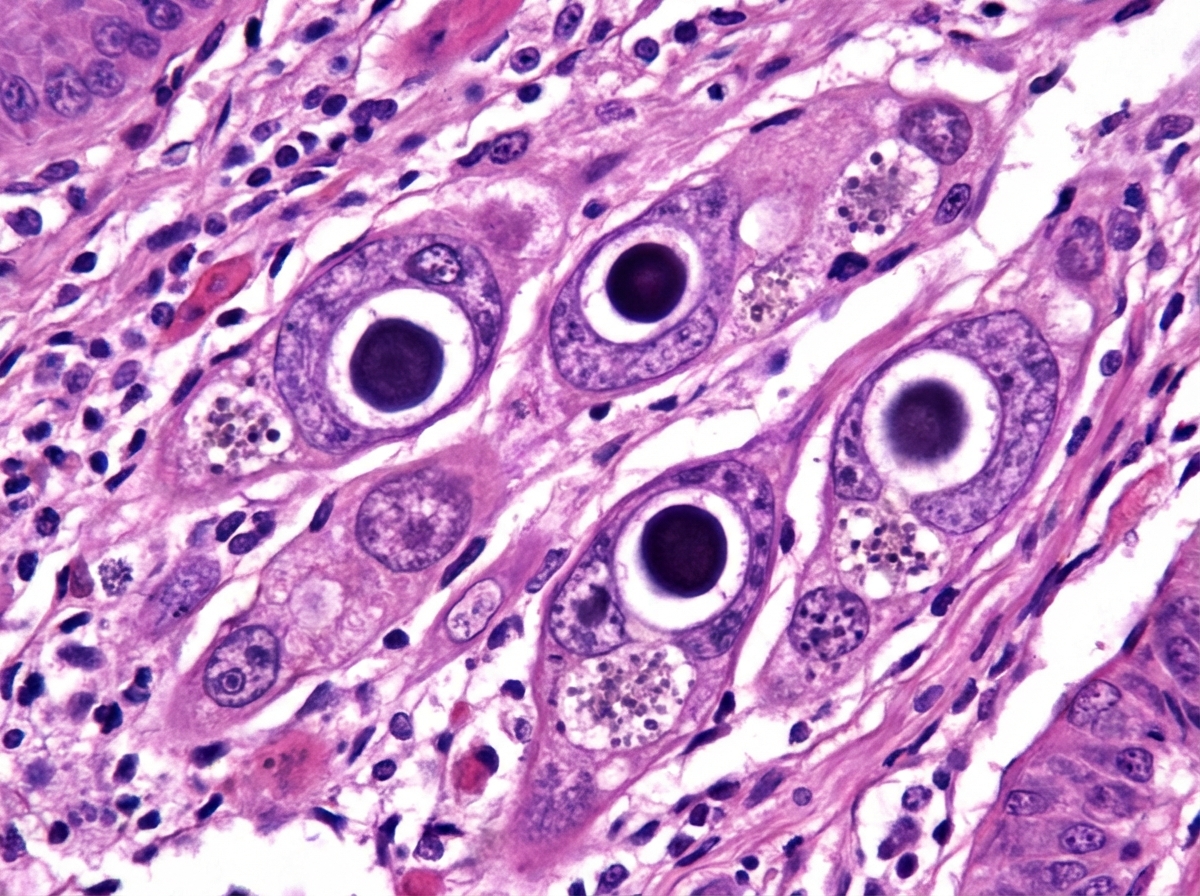
Which of the following is FALSE regarding autoimmune atrophic gastritis?
Duke's stage C2 refers to carcinoma:
Which type of carcinoid is associated with the greatest incidence of metastasis?
Which of the following is NOT considered a premalignant condition?
A peptic ulcer is associated with all of the following conditions except one?
What is the commonest site involved in ileocecal tuberculosis?
A patient with intestinal malabsorption shows marked improvement when flour products are removed from the diet. At the height of the disease, what histologic changes would be seen at which of the following sites?
Which of the following statements is NOT true about Gastrointestinal Stromal Tumors (GIST)?
Linitis plastica is seen in which of the following conditions?
Which of the following is NOT a pathologic feature of H. pylori chronic gastritis?
Explanation: Autoimmune Atrophic Gastritis (Type A Gastritis) is characterized by the immune-mediated destruction of **parietal cells** [3] located in the body and fundus of the stomach. **Why Option C is the Correct (False) Statement:** The destruction of parietal cells leads to a profound decrease in gastric acid production, resulting in **Achlorhydria** or hypochlorhydria, not hyperchlorhydria [3]. The lack of acid removes the negative feedback inhibition on gastrin secretion, leading to compensatory **Hypergastrinemia** [4]. **Analysis of Other Options:** * **Option A (Loss of parietal cells):** This is the primary pathology. CD4+ T-cells and autoantibodies (against H+/K+ ATPase) target and destroy these cells [1]. * **Option B (Hyperplasia of G cells):** Due to the lack of acid (achlorhydria), G cells in the antrum undergo hyperplasia [4] to secrete more gastrin in a futile attempt to stimulate acid production. * **Option C (Hypertrophy of enterochromaffin-like cells):** Chronic hypergastrinemia exerts a trophic effect on ECL cells, leading to their hyperplasia/hypertrophy [4], which can eventually progress to **carcinoid tumors** (neuroendocrine tumors) [3]. **NEET-PG High-Yield Pearls:** 1. **Location:** Primarily involves the **Body and Fundus** (Antrum is spared) [3]. 2. **Pernicious Anemia:** Loss of parietal cells also means loss of **Intrinsic Factor**, leading to Vitamin B12 deficiency and megaloblastic anemia [2]. 3. **Antibodies:** Anti-parietal cell antibodies (more sensitive) and Anti-intrinsic factor antibodies (more specific) [1]. 4. **Morphology:** Characterized by mucosal atrophy, intestinal metaplasia (increased risk of gastric adenocarcinoma), and ECL cell hyperplasia [3]. **References:** [1] Kumar V, Abbas AK, et al.. Robbins and Cotran Pathologic Basis of Disease. 9th ed. Red Blood Cell and Bleeding Disorders, pp. 655-656. [2] Cross SS. Underwood's Pathology: A Clinical Approach. 6th ed. Common Clinical Problems From Blood And Bone Marrow Disease, pp. 592-593. [3] Kumar V, Abbas AK, et al.. Robbins and Cotran Pathologic Basis of Disease. 9th ed. The Gastrointestinal Tract, pp. 771-772. [4] Cross SS. Underwood's Pathology: A Clinical Approach. 6th ed. Common Clinical Problems From Alimentary System Disease, pp. 351-352.
Explanation: **Explanation:** **Duke’s Staging** is a classic classification system used for colorectal carcinoma [1]. The correct answer is **D** because Duke’s Stage C specifically denotes lymph node involvement, regardless of the depth of primary tumor penetration [1][2]. * **Duke’s A:** Tumor limited to the wall (mucosa/submucosa) [1]. * **Duke’s B:** Tumor extends through the muscularis propria into the pericolic fat [1]. * **Duke’s C:** Metastasis to regional lymph nodes [1][2]. * **C1:** Involvement of regional lymph nodes near the tumor. * **C2:** Involvement of lymph nodes at the **apex of the mesentery** (e.g., inferior mesenteric lymph nodes for rectal/distal colon cancer). * **Duke’s D:** Distant metastasis (added later by Astler-Coller) [1]. **Analysis of Incorrect Options:** * **Options A & B:** These refer to the bladder. Duke’s staging is specific to **colorectal cancer**. Bladder cancer uses the TNM or Jewett-Strong systems. * **Option C:** This describes **histological grading** (Broders’ classification), which measures cell differentiation/anaplasia, not staging (which measures anatomical spread). **High-Yield Pearls for NEET-PG:** 1. **Modified Astler-Coller (MAC):** This is the modern refinement of Duke’s staging commonly tested. In MAC, Stage C2 specifically refers to a tumor extending through the wall (T3/T4) with positive nodes (N+). 2. **Prognostic Factor:** The most important prognostic factor for colorectal cancer is the **stage at presentation** (specifically lymph node status), not the histological grade [2]. 3. **CEA (Carcinoembryonic Antigen):** Not used for diagnosis, but the gold standard for monitoring **recurrence** post-surgery. **References:** [1] Cross SS. Underwood's Pathology: A Clinical Approach. 6th ed. (Basic Pathology) introduces the student to key general principles of pathology, both as a medical science and as a clinical activity with a vital role in patient care. Part 2 (Disease Mechanisms) provides fundamental knowledge about the cellular and molecular processes involved in diseases, providing the rationale for their treatment. Part 3 (Systematic Pathology) deals in detail with specific diseases, with emphasis on the clinically important aspects., pp. 236-237. [2] Cross SS. Underwood's Pathology: A Clinical Approach. 6th ed. Common Clinical Problems From Alimentary System Disease, pp. 374-375.
Explanation: **Explanation:** The metastatic potential of a carcinoid tumor (Neuroendocrine Tumor) is primarily determined by its **site of origin** and **size**. **Why Pancreatic Carcinoid is correct:** Carcinoid tumors of the **pancreas and colon** are associated with the highest rates of metastasis. Pancreatic neuroendocrine tumors (PanNETs) are often aggressive; by the time of diagnosis, approximately **70-80%** of these tumors have already metastasized, particularly to the liver. This high incidence is attributed to the rich vascular supply of the pancreas and the fact that these tumors often remain clinically silent until they reach a significant size or spread. **Analysis of Incorrect Options:** * **Appendix Carcinoid:** This is the most common site for carcinoids overall. However, they are usually discovered incidentally during appendectomy and have an extremely low metastatic potential (less than 2%), especially if they are <2 cm in size. * **Colonic Carcinoid:** While these have a high metastatic rate (up to 70%), pancreatic carcinoids statistically show a slightly higher or equal propensity for spread, often being more advanced at presentation. In many standard pathology texts (like Robbins), the pancreas and colon are highlighted as the "most aggressive" sites. * **Hepatic Carcinoid:** Primary carcinoids of the liver are exceedingly rare. Most carcinoid involvement in the liver represents metastatic spread from a primary site (usually midgut), rather than a primary origin. **High-Yield NEET-PG Pearls:** 1. **Most common site overall:** Appendix (often at the tip). 2. **Most common site for symptomatic carcinoid:** Small intestine (Ileum). 3. **Carcinoid Syndrome:** Occurs only when the tumor has metastasized to the **liver** (bypassing first-pass metabolism) [1] or arises from extra-portal sites (e.g., lungs). 4. **Diagnostic Marker:** 24-hour urinary **5-HIAA** (metabolite of serotonin). 5. **Histology:** Characteristic "Salt and Pepper" chromatin and organoid/nesting pattern [1]. **References:** [1] Kumar V, Abbas AK, et al.. Robbins and Cotran Pathologic Basis of Disease. 9th ed. The Gastrointestinal Tract, pp. 781-782.
Explanation: The potential for a colonic polyp to undergo malignant transformation (the adenoma-carcinoma sequence) depends on its histological architecture and degree of dysplasia [3]. **Why Hyperplastic Polyp is the correct answer:** Hyperplastic polyps are the most common type of non-neoplastic polyps in the colon [2]. They are typically small (<5mm), located in the rectosigmoid region, and are composed of mature goblet and absorptive cells. Histologically, they exhibit a characteristic **"saw-tooth" or serrated surface** appearance but, crucially, they **lack cellular dysplasia** [1]. Therefore, they have no significant malignant potential and are not considered premalignant. **Why the other options are incorrect:** * **Tubulovillous and Villous Adenomas:** These are neoplastic polyps. All adenomas are, by definition, dysplastic and carry a risk of progressing to adenocarcinoma [5]. The risk of malignancy increases with the **size** (>2cm), **villous component** (Villous > Tubulovillous > Tubular), and the **severity of dysplasia** [4]. Villous adenomas carry the highest risk (up to 40%) [4]. * **Familial Adenomatosis (FAP):** This is an autosomal dominant condition caused by a mutation in the *APC* gene [1]. Patients develop hundreds to thousands of adenomatous polyps. The risk of progression to colorectal cancer is **100%** by age 40 if a prophylactic colectomy is not performed [3]. **NEET-PG High-Yield Pearls:** * **Serrated Pathway:** While typical hyperplastic polyps are benign, "Sessile Serrated Adenomas" (found in the right colon) are premalignant and follow the microsatellite instability (MSI) pathway [1]. * **Size Matters:** Any polyp >2 cm has a 50% chance of containing invasive carcinoma [4]. * **Most common site:** Hyperplastic polyps are most common in the **left colon** (rectosigmoid), whereas neoplastic adenomas can occur anywhere. **References:** [1] Kumar V, Abbas AK, et al.. Robbins and Cotran Pathologic Basis of Disease. 9th ed. The Gastrointestinal Tract, pp. 821-822. [2] Kumar V, Abbas AK, et al.. Robbins and Cotran Pathologic Basis of Disease. 9th ed. The Gastrointestinal Tract, pp. 811-813. [3] Cross SS. Underwood's Pathology: A Clinical Approach. 6th ed. Common Clinical Problems From Alimentary System Disease, pp. 372-373. [4] Kumar V, Abbas AK, et al.. Robbins and Cotran Pathologic Basis of Disease. 9th ed. The Gastrointestinal Tract, pp. 815-817. [5] Cross SS. Underwood's Pathology: A Clinical Approach. 6th ed. Common Clinical Problems From Alimentary System Disease, pp. 371-372.
Explanation: The development of a peptic ulcer (PUD) fundamentally depends on an imbalance between mucosal defense mechanisms and aggressive factors, primarily **gastric acid (HCl)** [1]. **Why Pernicious Anemia is the correct answer:** Pernicious anemia is characterized by autoimmune destruction of gastric parietal cells. This leads to **achlorhydria** (absence of hydrochloric acid) [2]. Since "no acid means no ulcer," patients with pernicious anemia are protected against peptic ulcers. Instead, these patients have an increased risk of gastric adenocarcinoma and carcinoid tumors due to chronic atrophic gastritis [2]. **Analysis of Incorrect Options:** * **Cirrhosis:** Patients with cirrhosis have an increased incidence of PUD. Proposed mechanisms include reduced mucosal defense, impaired prostaglandin synthesis, and hypergastrinemia due to reduced hepatic clearance of gastrin [3]. * **Zollinger-Ellison Syndrome (ZES):** This is a classic cause of severe PUD. A gastrinoma (usually in the pancreas or duodenum) secretes excessive gastrin, leading to massive acid hypersecretion and multiple, refractory ulcers [3]. * **Primary Hyperparathyroidism:** High calcium levels (hypercalcemia) directly stimulate parietal cells to secrete more acid and also trigger gastrin release. This "calcium-gastrin-acid" axis increases the risk of PUD. **NEET-PG High-Yield Pearls:** 1. **Most common site for PUD:** First part of the duodenum (anterior wall) [1]. 2. **H. pylori:** The most common cause of PUD worldwide; it primarily causes antral gastritis. 3. **Cushing Ulcer:** Associated with CNS injury (increased vagal tone → increased acid). 4. **Curling Ulcer:** Associated with severe burns (reduced plasma volume → mucosal ischemia) [3]. 5. **Blood Group O:** Associated with a higher risk of duodenal ulcers. **References:** [1] Kumar V, Abbas AK, et al.. Robbins and Cotran Pathologic Basis of Disease. 9th ed. The Gastrointestinal Tract, pp. 773-774. [2] Kumar V, Abbas AK, et al.. Robbins and Cotran Pathologic Basis of Disease. 9th ed. The Gastrointestinal Tract, pp. 771-772. [3] Kumar V, Abbas AK, et al.. Robbins and Cotran Pathologic Basis of Disease. 9th ed. The Gastrointestinal Tract, pp. 767-768.
Explanation: **Explanation:** The **intestinal mucosa** is the commonest site involved in ileocecal tuberculosis because the primary route of infection is the ingestion of *Mycobacterium tuberculosis* (either through infected milk or swallowed sputum in patients with active pulmonary TB) [1]. The bacilli are trapped in the abundant lymphoid tissue (Peyer’s patches) of the terminal ileum. The organism penetrates the **mucosa**, leading to the formation of characteristic transverse ulcers and granulomatous inflammation [1]. In the ileocecal region, the physiological stasis of content and the high density of lymphoid tissue make the mucosa the initial and most frequent site of pathological involvement. **Analysis of Incorrect Options:** * **Lymph nodes (Option B):** While mesenteric lymph nodes are almost always involved (often becoming matted or caseating), they are considered a secondary spread from the primary mucosal focus. * **Mesentery (Option C):** The mesentery is involved via lymphatic spread, leading to thickening and "shortening" (which causes the characteristic pulled-up cecum), but it is not the primary or most common site of origin. * **Intestinal wall (Option A):** This is a general term. While the entire wall (transmural involvement) is affected in chronic stages leading to strictures, the disease process initiates specifically at the mucosal/submucosal lymphoid interface. **High-Yield Clinical Pearls for NEET-PG:** * **Gross Morphology:** Ulcers in Intestinal TB are **transverse** (perpendicular to the long axis), unlike Typhoid ulcers which are longitudinal. * **Commonest Site:** Ileocecal region (due to increased stasis and lymphoid tissue). * **Radiological Sign:** **Stierlin’s sign** (rapid emptying of the inflamed cecum) and **Sterling sign** (narrowed terminal ileum). * **Complication:** Intestinal obstruction due to hyperplastic growth or strictures is the most common complication [1]. **References:** [1] Kumar V, Abbas AK, et al.. Robbins and Cotran Pathologic Basis of Disease. 9th ed. Infectious Diseases, pp. 384-385.
Explanation: **Explanation:** The clinical presentation describes **Celiac Disease** (Gluten-sensitive enteropathy), an immune-mediated inflammatory disorder triggered by the ingestion of gluten (found in wheat, rye, and barley). **Why Proximal Small Bowel is Correct:** In Celiac disease, the mucosal damage is most severe in the **proximal small bowel (duodenum and proximal jejunum)** [1]. This is because these segments are exposed to the highest concentration of dietary gluten (specifically the **gliadin** fraction) immediately after gastric emptying [2]. The characteristic histologic triad seen here includes: 1. **Villous atrophy** (blunting/flattening of villi) [1], [2]. 2. **Crypt hyperplasia** (increased mitotic activity) [2]. 3. **Increased Intraepithelial Lymphocytes (IELs)**, specifically CD8+ T cells [2]. **Analysis of Incorrect Options:** * **Options A & C (Large Bowel):** Celiac disease is strictly a disease of the small intestine. The large bowel lacks the villous structure required for the specific malabsorptive pathology of this condition. * **Option B (Distal Small Bowel):** While the ileum can be involved in extensive cases, the lesions are always more prominent proximally [1]. In contrast, conditions like Tropical Sprue tend to involve the entire small bowel, including the distal ileum (often leading to Vitamin B12 deficiency). **High-Yield Clinical Pearls for NEET-PG:** * **Serology:** Anti-tissue Transglutaminase (tTG) IgA is the screening test of choice; Anti-endomysial antibody (EMA) is highly specific. * **Genetics:** Strongly associated with **HLA-DQ2** and **HLA-DQ8**. * **Dermatologic Association:** **Dermatitis herpetiformis** (IgA deposits at the tips of dermal papillae). * **Complications:** Increased risk of **Enteropathy-associated T-cell lymphoma (EATL)** and small bowel adenocarcinoma. **References:** [1] Cross SS. Underwood's Pathology: A Clinical Approach. 6th ed. Common Clinical Problems From Alimentary System Disease, pp. 361-362. [2] Kumar V, Abbas AK, et al.. Robbins and Cotran Pathologic Basis of Disease. 9th ed. The Gastrointestinal Tract, pp. 789-790.
Explanation: ### Explanation **Gastrointestinal Stromal Tumors (GIST)** are the most common mesenchymal neoplasms of the gastrointestinal tract. **1. Why Option B is the correct answer (The "NOT true" statement):** While GISTs have malignant potential, they do **not** have a "high propensity" for malignant change in the majority of cases [1]. Instead, their clinical behavior is a spectrum ranging from benign to highly aggressive [2]. The risk of malignancy is determined by a combination of **tumor size**, **mitotic count** (per 5 mm²), and **anatomical location** (small bowel GISTs are generally more aggressive than gastric ones) [1]. Many small GISTs remain indolent for years. **2. Analysis of Incorrect Options:** * **Option A:** True. The **stomach** is the most common site (60%), followed by the small intestine (30%). * **Option C:** True. Approximately 75–80% of GISTs harbor a gain-of-function mutation in the **c-KIT (CD117)** proto-oncogene, which encodes a tyrosine kinase receptor [1]. Another 10% involve **PDGFRA** mutations [1]. * **Option D:** True. Histologically, about 70% of GISTs are composed of **spindle cells**, while 20% are epithelioid and 10% are mixed. **3. NEET-PG High-Yield Pearls:** * **Origin:** Derived from the **Interstitial Cells of Cajal (ICC)**, the "pacemaker" cells of the gut [1]. * **Immunohistochemistry (IHC):** **CD117 (c-KIT)** is the most sensitive and specific marker. **DOG1** (Discovered On GIST 1) is a highly useful marker for c-KIT negative cases. * **Treatment:** The primary treatment is surgical resection. For metastatic or unresectable cases, **Imatinib mesylate** (a tyrosine kinase inhibitor) is the drug of choice [1]. * **Carney Triad:** GIST, Pulmonary Chondroma, and Paraganglioma. **References:** [1] Kumar V, Abbas AK, et al.. Robbins and Cotran Pathologic Basis of Disease. 9th ed. The Gastrointestinal Tract, pp. 783-784. [2] Cross SS. Underwood's Pathology: A Clinical Approach. 6th ed. Common Clinical Problems From Alimentary System Disease, pp. 354-355.
Explanation: **Explanation:** **Linitis plastica** (also known as "leather bottle stomach") is a classic morphological presentation of **diffuse-type gastric adenocarcinoma** [1]. 1. **Why Option B is Correct:** In the diffuse variant of gastric carcinoma (Lauren classification), malignant cells—often **signet ring cells**—infiltrate the submucosa and muscularis propria extensively [2]. This triggers a massive **desmoplastic reaction** (fibrosis). The result is a diffuse thickening and hardening of the stomach wall, which loses its distensibility and resembles a rigid leather bottle [1]. Unlike the intestinal type, it does not typically present as a discrete mass or polyp [1]. 2. **Why Other Options are Incorrect:** * **Option A (Liver):** Hepatocellular carcinoma typically presents as a focal mass, multifocal nodules, or a massive infiltrative growth, but it does not cause the "leather bottle" rigid hollow-organ morphology. * **Option C (Lung):** Lung cancers (like Squamous or Small cell) present as hilar or peripheral masses. While they can cause pleural thickening, the term Linitis plastica is organ-specific to the stomach. * **Option D (Esophagus):** Esophageal cancer usually presents as an obstructive growth (fungating or ulcerative), leading to dysphagia, rather than diffuse transmural fibrosis of the entire organ [3]. **High-Yield Clinical Pearls for NEET-PG:** * **Histology:** Look for **Signet ring cells** (nucleus pushed to the periphery by a large mucin vacuole) [2]. * **Lauren Classification:** Linitis plastica is associated with the **Diffuse type**, which is NOT associated with *H. pylori*, occurs in younger patients, and has a poorer prognosis compared to the Intestinal type [1]. * **Genetics:** Often associated with mutations in the **CDH1 gene**, which encodes for **E-cadherin** (loss of cell adhesion) [2]. * **Metastasis:** Can spread to ovaries, known as a **Krukenberg tumor** (classically showing signet ring cells). **References:** [1] Kumar V, Abbas AK, et al.. Robbins and Cotran Pathologic Basis of Disease. 9th ed. The Gastrointestinal Tract, pp. 779-780. [2] Kumar V, Abbas AK, et al.. Robbins and Cotran Pathologic Basis of Disease. 9th ed. The Gastrointestinal Tract, p. 779. [3] Kumar V, Abbas AK, et al.. Robbins and Cotran Pathologic Basis of Disease. 9th ed. The Gastrointestinal Tract, pp. 765-766.
Explanation: **Explanation:** *Helicobacter pylori* is the most common cause of chronic gastritis worldwide. Its pathology is characterized by a specific inflammatory pattern that helps distinguish it from other types of gastritis. **1. Why "Eosinophilic infiltrates" is the correct answer:** While *H. pylori* triggers a robust immune response, the hallmark is a **lymphoplasmacytic infiltrate** in the lamina propria and **neutrophilic activity** in the epithelium [1]. Significant **eosinophilic infiltration** is not a characteristic feature of *H. pylori* gastritis; rather, it suggests **Eosinophilic Gastritis** (often associated with allergies or parasitic infections) or Crohn’s disease. **2. Analysis of Incorrect Options:** * **Intraepithelial neutrophil deposits:** This is a classic feature known as **"Activity."** Neutrophils crossing the basement membrane into the epithelial layer or forming "crypt abscesses" indicate active inflammation triggered by the bacteria [1], [2]. * **Affects intestinal gland formation:** Chronic *H. pylori* infection leads to **Intestinal Metaplasia**, where the normal gastric mucosa is replaced by goblet cells and intestinal-type epithelium. This is a significant risk factor for gastric adenocarcinoma. * **Subepithelial plasma cell deposits:** The chronic component of the infection is defined by an increase in plasma cells and lymphocytes within the superficial lamina propria [1]. **NEET-PG High-Yield Pearls:** * **Gold Standard Diagnosis:** Endoscopic biopsy with **Warthin-Starry silver stain** [1] or Giemsa stain to visualize the S-shaped bacilli. * **Location:** Primarily affects the **Antrum** (Antral-predominant gastritis) [3]. * **Virulence Factors:** **CagA** (associated with cancer) and **VacA** (cytotoxin). * **Complications:** Peptic ulcer disease, Gastric Adenocarcinoma, and **MALT Lymphoma** (which can regress with *H. pylori* eradication) [2], [3]. **References:** [1] Kumar V, Abbas AK, et al.. Robbins and Cotran Pathologic Basis of Disease. 9th ed. The Gastrointestinal Tract, p. 771. [2] Cross SS. Underwood's Pathology: A Clinical Approach. 6th ed. Common Clinical Problems From Alimentary System Disease, pp. 356-357. [3] Kumar V, Abbas AK, et al.. Robbins and Cotran Pathologic Basis of Disease. 9th ed. The Gastrointestinal Tract, pp. 771-772.
Oral Cavity and Esophageal Pathology
Practice Questions
Gastritis and Peptic Ulcer Disease
Practice Questions
Inflammatory Bowel Disease
Practice Questions
Malabsorption Syndromes
Practice Questions
Vascular Disorders of Intestine
Practice Questions
Diverticular Disease
Practice Questions
Intestinal Obstruction
Practice Questions
Gastrointestinal Infections
Practice Questions
Polyps and Neoplasms
Practice Questions
Appendiceal Pathology
Practice Questions
Get full access to all questions, explanations, and performance tracking.
Start For Free