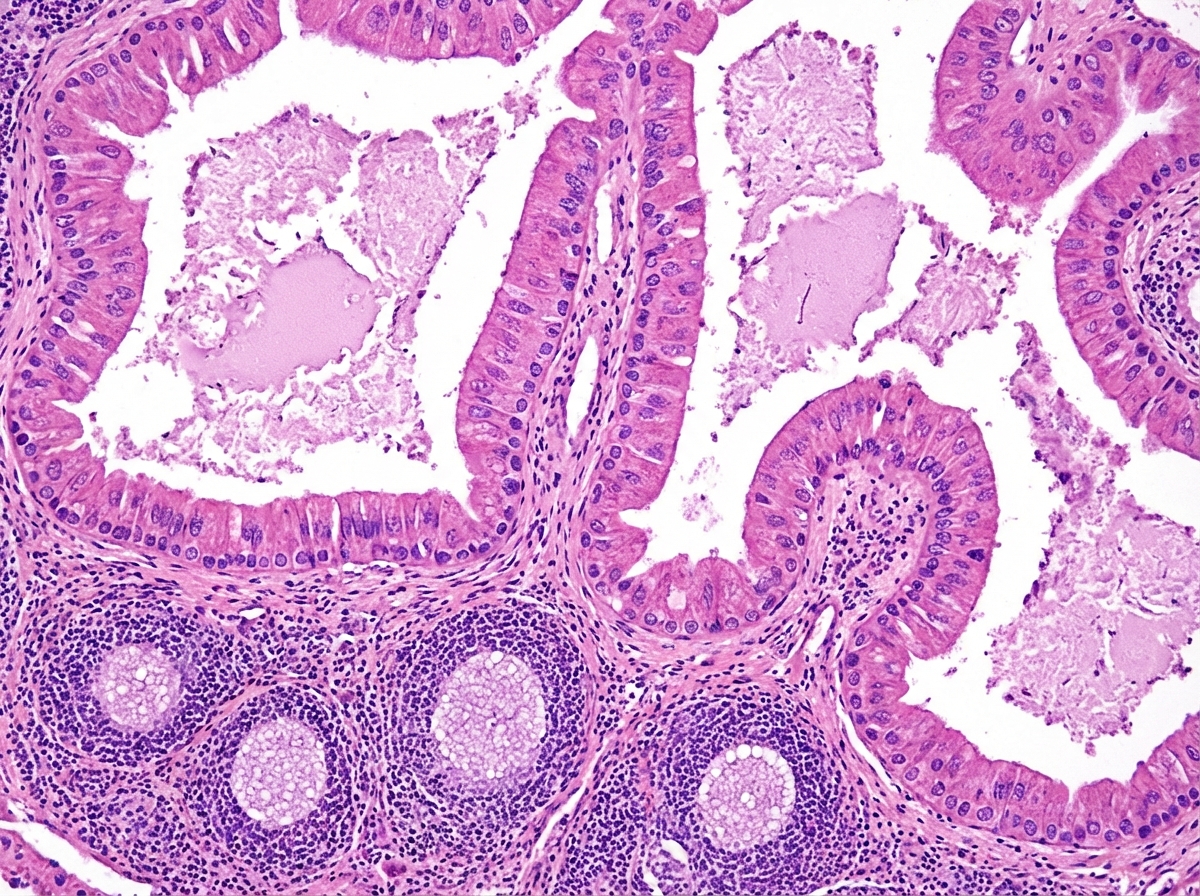
What is the most common type of cancer affecting the anus?
Diarrhea with acanthocytosis is seen in which of the following conditions?
What is the pathology in achalasia cardiae?
Which site is invariably involved in ulcerative colitis?
A 25-year-old male presents with a history of chronic diarrhea. Pathological examination reveals cryptitis and crypt abscesses. What is the likely diagnosis?
A 61-year-old man presents with 5 months of increasing fatigue, early satiety, and nausea, and vomited dark granular material yesterday. Endoscopy reveals a large ulcerated mass in the gastric fundus. Biopsies show a mass composed of spindle cells positive for c-Kit by immunohistochemistry with frequent mitoses. A 10-cm circumscribed mass is resected from the gastric wall. Which of the following therapies is most likely to be a useful adjunct in the treatment of his disease?
Which of the following conditions is characterized by a cobblestone appearance of the oral mucosa?
Which conditions are characterized by the presence of macrophages, granulomas, and erythrophagocytosis?
A jejunal biopsy is diagnostic in which of the following conditions?
Which of the following statements about Familial Polyposis Coli is false?
Explanation: **Explanation:** The anal canal is lined by different types of epithelium depending on the anatomical level. The area below the pectinate (dentate) line is lined by **stratified squamous epithelium**, which continues as the perianal skin. Consequently, **Squamous Cell Carcinoma (SCC)** is the most common histological type of anal cancer, accounting for approximately 80–85% of cases. It is strongly associated with high-risk **Human Papillomavirus (HPV)** infection, particularly types 16 and 18. **Analysis of Options:** * **A. Squamous cell carcinoma (Correct):** As the anal canal distal to the transformation zone is squamous, this is the predominant malignancy. * **B. Basaloid carcinoma:** This is a histological variant of SCC that arises from the transitional (cloacogenic) zone. While characteristic of the anal canal, it is less common than pure SCC. * **C. Cuboidal cell carcinoma:** This is not a standard primary malignancy of the anus. The upper anal canal is columnar/glandular, leading to adenocarcinomas, not cuboidal cell carcinomas. * **D. Cloacogenic carcinoma:** This term refers to tumors arising from the transitional zone (the "cloacogenic" membrane remnant). Modern WHO classifications now categorize these as a subtype of squamous cell carcinoma rather than a distinct entity. **High-Yield Clinical Pearls for NEET-PG:** * **Risk Factors:** HPV infection (most common), multiple sexual partners, receptive anal intercourse, and HIV infection. * **Precursor Lesion:** Anal Intraepithelial Neoplasia (AIN). * **Lymphatic Spread:** Above the pectinate line, drainage is to internal iliac nodes; below the line, it is to **superficial inguinal nodes** (frequently tested). * **Treatment:** Unlike rectal cancer (surgery), the primary treatment for anal SCC is the **Nigro Protocol** (Chemoradiotherapy).
Explanation: **Explanation:** The correct answer is **Wolman’s disease**. **1. Why Wolman’s Disease is Correct:** Wolman’s disease is a rare, autosomal recessive lysosomal storage disorder caused by a deficiency of **Lysosomal Acid Lipase (LAL)**. This leads to the massive accumulation of cholesteryl esters and triglycerides in various tissues. In the intestine, lipids accumulate within the lamina propria and enterocytes, causing severe malabsorption and **steatorrhea (diarrhea)**. The associated **acanthocytosis** (thorny red blood cells) occurs because the systemic defect in lipid metabolism alters the lipid composition of the RBC membrane, leading to structural deformation [1]. A classic radiological sign is **bilateral adrenal calcification**. **2. Why Other Options are Incorrect:** * **Whipple’s Disease:** Caused by *Tropheryma whipplei*. It presents with diarrhea, weight loss, and arthritis [2]. Histology shows PAS-positive macrophages in the lamina propria, but it is not typically associated with acanthocytosis. * **Celiac Sprue:** An immune-mediated enteropathy triggered by gluten [3]. While it causes malabsorptive diarrhea and characteristic villous atrophy, it does not feature acanthocytosis. * **Agammaglobulinemia:** This immunodeficiency leads to recurrent infections (including *Giardia* causing diarrhea) due to lack of B-cells/plasma cells, but it has no direct link to RBC membrane defects like acanthocytosis. **3. High-Yield Clinical Pearls for NEET-PG:** * **Acanthocytosis + Diarrhea/Malabsorption:** Think of **Abetalipoproteinemia** (MTP gene mutation) or **Wolman’s Disease** [1]. * **Abetalipoproteinemia:** Characterized by lack of ApoB-48 and ApoB-100, resulting in zero VLDL/LDL, fat-soluble vitamin deficiency, and retinitis pigmentosa [1]. * **Wolman’s Disease Hallmark:** Hepatosplenomegaly + Steatorrhea + **Adrenal Calcification** (seen in 50% of cases). * **Histology Tip:** In both Abetalipoproteinemia and Wolman’s, enterocytes appear "clear" or "vacuolated" due to lipid accumulation. **References:** [1] Kumar V, Abbas AK, et al.. Robbins and Cotran Pathologic Basis of Disease. 9th ed. The Gastrointestinal Tract, pp. 791-792. [2] Kumar V, Abbas AK, et al.. Robbins and Cotran Pathologic Basis of Disease. 9th ed. The Gastrointestinal Tract, pp. 798-799. [3] Kumar V, Abbas AK, et al.. Robbins and Cotran Pathologic Basis of Disease. 9th ed. The Gastrointestinal Tract, pp. 789-790.
Explanation: **Achalasia Cardiae** is a primary esophageal motility disorder characterized by the failure of the Lower Esophageal Sphincter (LES) to relax and the absence of esophageal peristalsis [2]. 1. **Why Option A is Correct:** The fundamental pathology is the **degeneration of the myenteric (Auerbach’s) plexus** within the esophageal wall [2]. This involves a selective loss of inhibitory nitrergic neurons (which release Nitric Oxide and VIP), leading to an inability of the LES to relax [2]. In many cases, this is an inflammatory process, often autoimmune or triggered by a viral infection, resulting in ganglion cell loss and subsequent fibrosis [1]. 2. **Why Other Options are Incorrect:** * **B. Muscular atrophy:** The muscle does not waste away; rather, the esophageal body often becomes dilated (megaesophagus) due to food stasis [1]. * **C. Hypertrophy of nerves:** There is a loss/destruction of nerve cells, not an increase in size or number [2]. * **D. Hypertrophy of muscles:** While some compensatory thickening of the circular muscle layer may occur due to increased pressure, it is a *secondary* change. The primary pathological event is the neural degeneration. **High-Yield Clinical Pearls for NEET-PG:** * **Gold Standard Investigation:** Esophageal Manometry (shows incomplete LES relaxation and aperistalsis) [2]. * **Barium Swallow Finding:** "Bird-beak" or "Rat-tail" appearance. * **Chagas Disease:** Caused by *Trypanosoma cruzi*, it is a common cause of secondary achalasia due to destruction of the myenteric plexus [1]. * **Histopathology:** Shows a lack of ganglion cells between the inner circular and outer longitudinal muscle layers [2]. * **Increased Risk:** Patients have a significantly higher risk of developing **Squamous Cell Carcinoma** of the esophagus [2]. **References:** [1] Kumar V, Abbas AK, et al.. Robbins and Cotran Pathologic Basis of Disease. 9th ed. The Gastrointestinal Tract, p. 761. [2] Kumar V, Abbas AK, et al.. Robbins and Cotran Pathologic Basis of Disease. 9th ed. The Gastrointestinal Tract, pp. 760-761.
Explanation: **Explanation:** **Ulcerative Colitis (UC)** is a chronic inflammatory bowel disease characterized by continuous mucosal inflammation that starts in the distal colon and spreads proximally [1]. **Why Rectum is the Correct Answer:** The hallmark of Ulcerative Colitis is its **invariable involvement of the rectum** [1]. The disease process begins at the anal verge and extends proximally in a continuous, symmetrical fashion without "skip lesions." In approximately 95% of cases, the rectum is involved at the time of diagnosis. If the rectum is completely spared in an untreated patient, the diagnosis of Crohn’s disease should be strongly considered instead. **Analysis of Incorrect Options:** * **A & B (Sigmoid and Transverse Colon):** While these sites are frequently involved as the disease progresses proximally (proctosigmoiditis or extensive colitis), they are not involved in every single case. UC can be limited to the rectum alone (ulcerative proctitis) [1]. * **C (Ileum):** UC primarily affects the colon. The ileum is generally spared, except in cases of **"backwash ileitis,"** where the terminal ileum shows mild inflammation due to an incompetent ileocecal valve in patients with pancolitis [1]. **NEET-PG High-Yield Pearls:** * **Distribution:** Continuous involvement (No skip lesions) [1]. * **Depth:** Limited to **Mucosa and Submucosa** (unlike Crohn’s, which is transmural) [1]. * **Microscopy:** Crypt abscesses and crypt distortion are characteristic. * **Gross Feature:** **Pseudopolyps** (regenerating islands of mucosa) and "Lead-pipe" appearance on barium enema due to loss of haustrations. * **Smoking:** Paradoxically, smoking is protective in UC (but a risk factor for Crohn’s). * **Marker:** p-ANCA is frequently positive. **References:** [1] Cross SS. Underwood's Pathology: A Clinical Approach. 6th ed. Common Clinical Problems From Alimentary System Disease, pp. 367-368.
Explanation: **Explanation:** The presence of **cryptitis** (neutrophilic infiltration of the crypt epithelium) and **crypt abscesses** (neutrophils within the crypt lumen) are hallmark histological features of **active Inflammatory Bowel Disease (IBD)** [1]. While these can be seen in both types of IBD, they are classically associated with and more prominent in **Ulcerative Colitis (UC)** [1]. * **Why Ulcerative Colitis is correct:** UC is characterized by diffuse, continuous mucosal inflammation limited to the colon [2]. The inflammatory process primarily involves the mucosa and submucosa, leading to the formation of crypt abscesses and crypt distortion [1]. * **Why other options are incorrect:** * **Crohn’s disease:** While it can show crypt abscesses, its hallmark is **non-caseating granulomas**, transmural inflammation, and "skip lesions." * **Giardiasis:** This typically presents with malabsorption and trophozoites (pear-shaped) on the brush border; it does not cause significant crypt architectural distortion or abscesses. * **Microscopic colitis:** This includes collagenous and lymphocytic colitis. It is characterized by a thickened subepithelial collagen band or increased intraepithelial lymphocytes, but the crypt architecture remains preserved. **NEET-PG High-Yield Pearls:** * **UC Hallmark:** Continuous lesions starting from the rectum, mucosal involvement only, and **pseudopolyps** [2]. * **Microscopic feature of UC:** Crypt abscesses are the most characteristic finding of *active* disease [1]. * **Serology:** UC is associated with **p-ANCA**, whereas Crohn’s is associated with **ASCA**. * **Complication:** UC carries a higher risk of **Toxic Megacolon** and **Cholangiocarcinoma** (via Primary Sclerosing Cholangitis). **References:** [1] Kumar V, Abbas AK, et al.. Robbins and Cotran Pathologic Basis of Disease. 9th ed. The Gastrointestinal Tract, p. 809. [2] Cross SS. Underwood's Pathology: A Clinical Approach. 6th ed. Common Clinical Problems From Alimentary System Disease, pp. 367-368.
Explanation: **Explanation:** The clinical presentation and histopathology point to a **Gastrointestinal Stromal Tumor (GIST)**. GIST is the most common mesenchymal tumor of the abdomen, typically arising from the **Interstitial Cells of Cajal** (the pacemaker cells of the gut). **Why Imatinib is correct:** The hallmark of GIST (95% of cases) is a gain-of-function mutation in the **c-KIT proto-oncogene** (CD117), which encodes a receptor tyrosine kinase [1]. This leads to constitutive activation of signaling pathways for cell proliferation. **Imatinib mesylate** is a selective tyrosine kinase inhibitor that specifically targets the ATP-binding site of the c-KIT and PDGFRA receptors [2]. In cases of large tumors (>5 cm), high mitotic rates, or metastatic disease, Imatinib is the standard-of-care adjuvant therapy to prevent recurrence [2]. **Why other options are incorrect:** * **Amoxicillin:** Used in triple therapy for *H. pylori* eradication, relevant for gastric MALT lymphoma or peptic ulcers, but has no role in mesenchymal tumors. * **Azathioprine:** An immunosuppressant used in Inflammatory Bowel Disease (IBD) or autoimmune conditions. * **Cyclophosphamide:** An alkylating agent used for various carcinomas and lymphomas, but GISTs are notoriously resistant to conventional chemotherapy. **High-Yield Pearls for NEET-PG:** 1. **Most common site:** Stomach (60%), followed by the small intestine. 2. **IHC Markers:** **CD117 (c-KIT)** is the most specific; **DOG1** (Discovered On GIST 1) is highly sensitive for c-KIT negative cases. 3. **Histology:** Can be spindle cell type (70%) or epithelioid type. 4. **Genetics:** Most have *c-KIT* mutations; a subset has *PDGFRA* mutations [1]. 5. **Carney Triad:** Gastric GIST, Paraganglioma, and Pulmonary Chondroma. **References:** [1] Kumar V, Abbas AK, et al.. Robbins and Cotran Pathologic Basis of Disease. 9th ed. The Gastrointestinal Tract, pp. 782-783. [2] Kumar V, Abbas AK, et al.. Robbins and Cotran Pathologic Basis of Disease. 9th ed. The Gastrointestinal Tract, pp. 783-784.
Explanation: **Explanation:** **Crohn Disease (Option A)** is the correct answer. It is a chronic inflammatory bowel disease (IBD) characterized by **transmural inflammation** and **skip lesions** that can affect any part of the gastrointestinal tract, from the mouth to the anus [1]. The "cobblestone appearance" is a classic morphological hallmark caused by deep, linear (fissuring) ulcerations interspersed with islands of edematous, intact mucosa [1]. While most commonly seen in the terminal ileum and colon, these changes can manifest in the **oral mucosa** as firm, linear nodules or hyperplastic folds, often preceding intestinal symptoms. **Why other options are incorrect:** * **Ulcerative Colitis (Option B):** Unlike Crohn disease, UC is limited to the colon and rectum. It involves only the mucosa and submucosa (not transmural) and presents with continuous lesions rather than skip lesions [1]. Oral manifestations are rare and typically present as "pyostomatitis vegetans" (snail-track ulcers), not cobblestoning. * **Whipple Disease (Option C):** This is a systemic infection caused by *Tropheryma whipplei*. It primarily affects the small intestine, causing malabsorption, and is characterized by PAS-positive macrophages in the lamina propria. It does not cause a cobblestone appearance of the oral or intestinal mucosa. **High-Yield Clinical Pearls for NEET-PG:** * **Microscopy:** Non-caseating granulomas are pathognomonic for Crohn disease (seen in ~40-60% of cases) [1], [2]. * **Radiology:** "String sign of Kantor" (due to terminal ileum narrowing) and "Creeping fat" (mesenteric fat wrapping) [1]. * **Complications:** Crohn disease is prone to fistulas, strictures, and perianal disease, whereas UC is more strongly associated with Primary Sclerosing Cholangitis (PSC) and Toxic Megacolon [1]. **References:** [1] Cross SS. Underwood's Pathology: A Clinical Approach. 6th ed. Common Clinical Problems From Alimentary System Disease, pp. 365-367. [2] Kumar V, Abbas AK, et al.. Robbins and Cotran Pathologic Basis of Disease. 9th ed. The Gastrointestinal Tract, pp. 806-807.
Explanation: **Explanation:** The correct answer is **Regional ileitis**, also known as **Crohn’s Disease**. **1. Why Regional Ileitis is Correct:** Regional ileitis is a chronic inflammatory bowel disease (IBD) characterized by transmural inflammation [1]. The hallmark histological features include: * **Granulomas:** Non-caseating granulomas are found in approximately 40-60% of cases, occurring in any layer of the bowel wall or regional lymph nodes [1], [2]. * **Macrophages:** These are the primary cells forming the granulomas and are scattered throughout the lamina propria [1], [2]. * **Erythrophagocytosis:** While more commonly associated with hemophagocytic syndromes, erythrophagocytosis by macrophages can be seen in the active inflammatory lesions and mesenteric lymph nodes of Crohn’s disease due to localized hemorrhage and intense macrophage activation. **2. Why Other Options are Incorrect:** * **Ulcerative Colitis:** This is a mucosal-limited disease. It is characterized by crypt abscesses and pseudopolyps but **lacks granulomas** [3]. * **Necrotising Enterocolitis (NEC):** Primarily seen in premature infants, it is characterized by coagulative necrosis, pneumatosis intestinalis (gas in the bowel wall), and inflammation, but not granuloma formation. * **Typhoid (Enteric Fever):** While Typhoid involves "Typhoid nodules" (clusters of macrophages called **Ehrlich cells**), it typically presents with longitudinal ulcers over Peyer’s patches and splenomegaly. While erythrophagocytosis is a classic feature of Typhoid, the term "Regional Ileitis" is the more specific pathological descriptor for the triad mentioned in standard pathology texts. **Clinical Pearls for NEET-PG:** * **Crohn’s Disease:** "Skip lesions," "String sign of Kantor" (on X-ray), and "Cobblestone appearance" [1]. * **Granuloma Type:** Always remember that Crohn’s has **non-caseating** granulomas, whereas Intestinal TB has **caseating** granulomas [2]. * **Transmurality:** Crohn’s is transmural (full thickness), leading to fistulas and strictures, unlike Ulcerative Colitis [3]. **References:** [1] Cross SS. Underwood's Pathology: A Clinical Approach. 6th ed. Common Clinical Problems From Alimentary System Disease, pp. 366-367. [2] Kumar V, Abbas AK, et al.. Robbins and Cotran Pathologic Basis of Disease. 9th ed. The Gastrointestinal Tract, pp. 806-807. [3] Cross SS. Underwood's Pathology: A Clinical Approach. 6th ed. Common Clinical Problems From Alimentary System Disease, pp. 365-366.
Explanation: Explanation: In Abetalipoproteinemia, a jejunal biopsy is considered diagnostic because it reveals pathognomonic histological findings [1]. The condition is caused by a mutation in the microsomal triglyceride transfer protein (MTP), leading to an inability to assemble apolipoprotein B-containing lipoproteins (VLDL and Chylomicrons). On biopsy, enterocytes appear vacuolated and "clear" due to the massive accumulation of dietary lipids that cannot be exported. This "lipid-laden enterocyte" appearance is specific and diagnostic. Why other options are incorrect: * Giardiasis: While a biopsy may show the pear-shaped trophozoites, it is not the diagnostic gold standard. Diagnosis is typically made via stool microscopy (cysts/trophozoites) or stool antigen tests (ELISA). * Celiac Sprue: Biopsy shows characteristic features like villous atrophy, crypt hyperplasia, and increased intraepithelial lymphocytes [2]. However, these findings are suggestive, not diagnostic [3], as they can be seen in other conditions (e.g., Tropical sprue, viral enteritis). Diagnosis requires a combination of serology (Anti-ttG) and clinical response to a gluten-free diet [3]. * Tropical Sprue: Similar to Celiac disease, it presents with non-specific subtotal villous atrophy in the jejunum [4]. It is a diagnosis of exclusion based on travel history and response to antibiotics/folate. High-Yield Clinical Pearls for NEET-PG: * Abetalipoproteinemia: Look for the triad of steatorrhea, acanthocytosis (spur cells on blood smear) [1], and neurological symptoms (ataxia, retinitis pigmentosa) due to Vitamin E deficiency. * Biopsy Site: The jejunum is the preferred site for diagnosing malabsorption syndromes because it has the highest surface area for absorption and shows the most pronounced pathological changes. * Differentiating Celiac vs. Tropical Sprue: Celiac primarily affects the proximal small bowel (duodenum/jejunum), whereas Tropical sprue affects the entire small bowel (including the ileum, leading to Vitamin B12 deficiency). **References:** [1] Kumar V, Abbas AK, et al.. Robbins and Cotran Pathologic Basis of Disease. 9th ed. The Gastrointestinal Tract, pp. 791-792. [2] Kumar V, Abbas AK, et al.. Robbins and Cotran Pathologic Basis of Disease. 9th ed. The Gastrointestinal Tract, pp. 789-790. [3] Cross SS. Underwood's Pathology: A Clinical Approach. 6th ed. Common Clinical Problems From Alimentary System Disease, pp. 360-361. [4] Cross SS. Underwood's Pathology: A Clinical Approach. 6th ed. Common Clinical Problems From Alimentary System Disease, pp. 361-362.
Explanation: ### Explanation **1. Why Option C is the Correct (False) Statement:** Familial Adenomatous Polyposis (FAP) is characterized by **adenomatous polyps** (neoplastic), not hamartomatous polyps [1], [2]. Hamartomatous polyps are characteristic of syndromes like Peutz-Jeghers or Juvenile Polyposis. Furthermore, the classic diagnostic criterion for FAP is the presence of at least **100 polyps**, not 80 [1]. **2. Analysis of Incorrect Options (True Statements):** * **Option A:** FAP is indeed an **Autosomal Dominant** condition caused by a germline mutation in the **APC (Adenomatous Polyposis Coli) gene** on chromosome **5q21** [1]. * **Option B:** Without prophylactic colectomy, the risk of progression to colorectal carcinoma is virtually **100%**, usually by the age of 40–50 years [1]. * **Option D:** **Gardner Syndrome** is a well-recognized phenotypic variant of FAP. It presents with the same colonic polyposis plus extra-colonic manifestations: osteomas (commonly of the mandible/skull), epidermal cysts, and desmoid tumors (fibromatosis). **3. High-Yield Clinical Pearls for NEET-PG:** * **Turcot Syndrome:** FAP (or HNPCC) associated with Central Nervous System tumors (Medulloblastoma is most common in FAP-associated Turcot). * **Genetics:** The APC gene is a "gatekeeper" tumor suppressor gene; its loss leads to the accumulation of $\beta$-catenin. * **Screening:** Screening for family members should begin at age 10–12 years with annual sigmoidoscopy. * **CHRPE:** Congenital Hypertrophy of Retinal Pigment Epithelium is a highly specific extra-colonic sign of FAP. **References:** [1] Kumar V, Abbas AK, et al.. Robbins and Cotran Pathologic Basis of Disease. 9th ed. The Gastrointestinal Tract, pp. 821-822. [2] Cross SS. Underwood's Pathology: A Clinical Approach. 6th ed. Common Clinical Problems From Alimentary System Disease, pp. 372-373.
Oral Cavity and Esophageal Pathology
Practice Questions
Gastritis and Peptic Ulcer Disease
Practice Questions
Inflammatory Bowel Disease
Practice Questions
Malabsorption Syndromes
Practice Questions
Vascular Disorders of Intestine
Practice Questions
Diverticular Disease
Practice Questions
Intestinal Obstruction
Practice Questions
Gastrointestinal Infections
Practice Questions
Polyps and Neoplasms
Practice Questions
Appendiceal Pathology
Practice Questions
Get full access to all questions, explanations, and performance tracking.
Start For Free