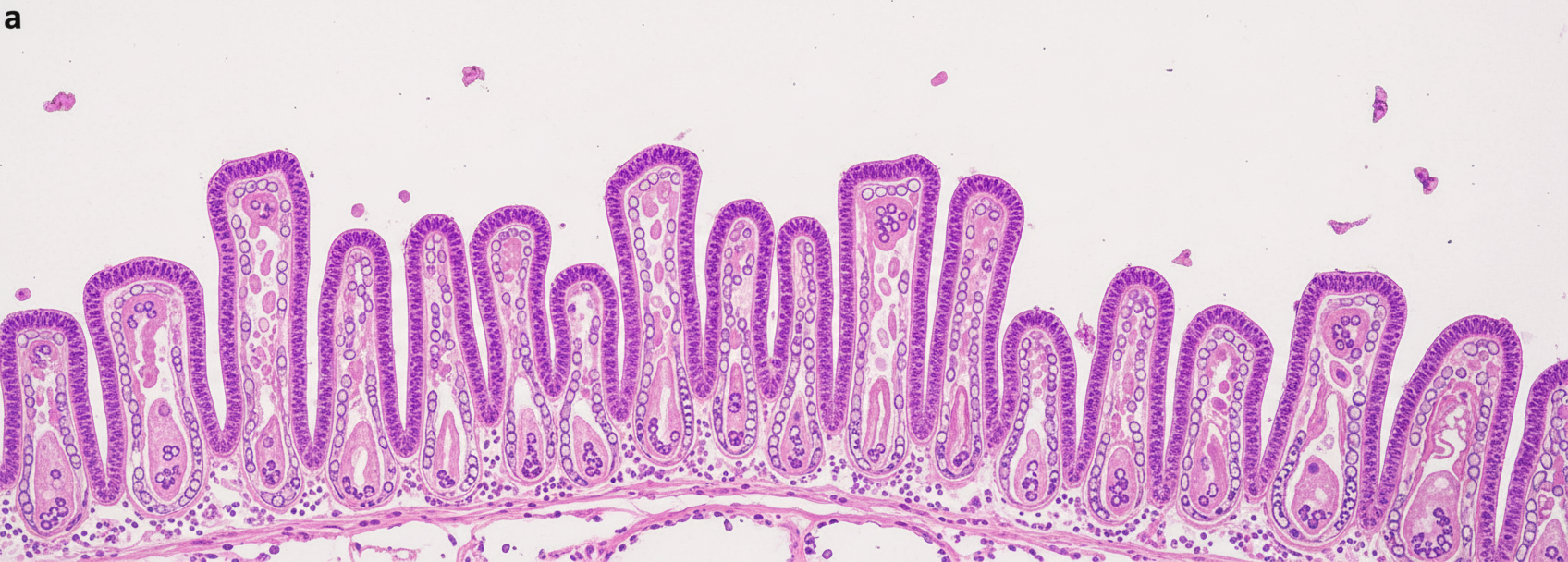
Carcinoid tumors develop from which type of cell?
What is the most common odontogenic cyst?
Adenocarcinoma of the esophagus is associated with which of the following conditions?
Which of the following are types of Inflammatory Bowel Disease?
All of the following are significant risk factors for colonic carcinoma in an adenomatous polyp except?
A 50-year-old obese man (BMI =32 kg/m2) presents with indigestion after meals, bloating, and heartburn. Vital signs are normal. A CT scan of the abdomen reveals a hiatal hernia of the esophagus. Endoscopic biopsy shows thickening of the basal layer of the squamous epithelium, upward extension of the papillae of the lamina propria, and an increased number of neutrophils and lymphocytes. Which of the following is the most likely diagnosis?
A 20-year-old woman was diagnosed 8 years earlier with precocious pseudo-puberty secondary to an ovarian tumor. Physical examination reveals oral and lingual dark pigmentation. The patient also has multiple polyps throughout the gastrointestinal tract. Histopathological findings show polyps with arborization and pseudo-invasion. What is the most common site for these polyps?
Which of the following colonic pathologies is thought to have no malignant potential?
Transmural inflammation with skip lesions in the colon are characteristic of which condition?
A patient with a history of familial polyposis undergoes a diagnostic polypectomy. Which of the following types of polyps is most likely to be found?
Explanation: **Explanation:** **Carcinoid tumors** are well-differentiated neuroendocrine neoplasms that arise from the **Enterochromaffin (EC) cells** (also known as Kulchitsky cells) [1]. These cells are part of the Diffuse Neuroendocrine System (DNES) and are distributed throughout the gastrointestinal mucosa [1]. They are characterized by their ability to produce, store, and secrete bioactive amines and peptides, most notably **Serotonin (5-HT)** [3]. **Analysis of Options:** * **A. Enterochromaffin cells (Correct):** These are the progenitor cells for carcinoids [2]. On histology, these tumors show a characteristic "salt and pepper" chromatin pattern and stain positive for markers like **Chromogranin A** and **Synaptophysin** [1]. * **B. Neuroectoderm:** While neuroendocrine cells share some functional similarities with neurons, carcinoid tumors arise from endoderm-derived epithelial cells that have acquired neuroendocrine differentiation, not directly from the neuroectoderm (which gives rise to the CNS and melanocytes). * **C. J cells:** These are specific cells in the small intestine that produce Cholecystokinin (CCK). They are not the primary origin of classic carcinoid tumors. * **D. Goblet cells:** These are mucus-secreting cells. While a rare variant called "Goblet cell carcinoid" exists (primarily in the appendix), it is a hybrid tumor; the standard carcinoid arises from EC cells. **High-Yield Clinical Pearls for NEET-PG:** * **Most common site:** The **Appendix** is the most common site for incidental carcinoids, but the **Small Intestine (Ileum)** is the most common site for symptomatic/metastatic ones [2]. * **Carcinoid Syndrome:** Occurs only when the tumor metastasizes to the **liver** (bypassing first-pass metabolism) [1]. Symptoms include flushing, diarrhea, and wheezing. * **Diagnosis:** Elevated urinary **5-HIAA** (a metabolite of serotonin). * **Cardiac Involvement:** Right-sided heart failure (Tricuspid regurgitation/Pulmonary stenosis) due to endocardial fibrosis. Left-sided lesions are rare as serotonin is inactivated in the lungs. **References:** [1] Kumar V, Abbas AK, et al.. Robbins and Cotran Pathologic Basis of Disease. 9th ed. The Gastrointestinal Tract, pp. 781-782. [2] Kumar V, Abbas AK, et al.. Robbins and Cotran Pathologic Basis of Disease. 9th ed. The Gastrointestinal Tract, pp. 780-781. [3] Kumar V, Abbas AK, et al.. Robbins and Cotran Pathologic Basis of Disease. 9th ed. The Lung, p. 727.
Explanation: **Explanation:** The **Radicular cyst** (also known as a periapical cyst) is the most common odontogenic cyst, accounting for approximately 60–75% of all jaw cysts. It is an **inflammatory cyst** that arises from the epithelial rests of Malassez in the periodontal ligament [1]. It typically develops at the apex of a non-vital (necrotic) tooth due to dental caries or trauma [1]. **Analysis of Options:** * **Radicular Cyst (Correct):** Its high prevalence is due to the commonality of dental pulp infection and subsequent periapical inflammation [1]. Histologically, it is lined by stratified squamous epithelium and often contains **Rushton bodies** (eosinophilic, linear, or curved structures). * **Dentigerous Cyst (Incorrect):** This is the second most common odontogenic cyst. It is a **developmental cyst** that originates from the reduced enamel epithelium and characteristically surrounds the crown of an **unerupted tooth** (most commonly the mandibular third molar). * **Primordial Cyst (Incorrect):** This is a rare developmental cyst that develops in place of a tooth rather than associated with one. Most lesions previously diagnosed as primordial cysts are now classified as Odontogenic Keratocysts (OKCs). * **Mucocele (Incorrect):** A mucocele is a common lesion of the oral mucosa caused by the rupture of a salivary gland duct (mucus extravasation), typically in the lower lip. It is **not** an odontogenic cyst as it does not arise from tooth-forming epithelium. **NEET-PG High-Yield Pearls:** * **Most common developmental odontogenic cyst:** Dentigerous cyst. * **Odontogenic Keratocyst (OKC):** Known for its high recurrence rate and association with **Gorlin-Goltz Syndrome** (PTCH gene mutation). * **Pindborg Tumor:** Calcifying Epithelial Odontogenic Tumor (CEOT), characterized by "Liesegang rings" and amyloid-like material. **References:** [1] Kumar V, Abbas AK, et al.. Robbins and Cotran Pathologic Basis of Disease. 9th ed. Head and Neck, pp. 741-742.
Explanation: **Explanation:** **Correct Answer: D. Barrett's esophagus** Adenocarcinoma of the esophagus primarily arises from **Barrett’s esophagus**, which is a complication of chronic Gastroesophageal Reflux Disease (GERD) [1]. The underlying mechanism involves **intestinal metaplasia**, where the normal stratified squamous epithelium of the lower esophagus is replaced by non-ciliated columnar epithelium with goblet cells [1]. This metaplastic tissue is unstable and can progress through a sequence of low-grade dysplasia to high-grade dysplasia, and finally to invasive **Adenocarcinoma** [2]. It typically involves the distal third of the esophagus [3]. **Incorrect Options:** * **A, B, and C (Achalasia, Stricture, Corrosive burns):** These conditions are all established risk factors for **Squamous Cell Carcinoma (SCC)** of the esophagus, not adenocarcinoma. * **Achalasia** leads to food stasis and chronic inflammation. * **Corrosive burns** (lye ingestion) cause chronic scarring and a 1000-fold increase in SCC risk. * **Strictures** (especially those following caustic injury) predispose to SCC. **High-Yield Clinical Pearls for NEET-PG:** * **Location:** Adenocarcinoma occurs in the **distal 1/3rd** [3]; Squamous Cell Carcinoma occurs most commonly in the **middle 1/3rd**. * **Risk Factors for Adenocarcinoma:** GERD, Barrett’s, Obesity, Smoking, and Male gender. * **Protective Factor:** Interestingly, *H. pylori* infection is associated with a *decreased* risk of esophageal adenocarcinoma (due to gastric atrophy reducing acid reflux). * **Molecular Marker:** Overexpression of **p53** and **HER2/neu** is often seen in esophageal adenocarcinoma. **References:** [1] Cross SS. Underwood's Pathology: A Clinical Approach. 6th ed. Common Clinical Problems From Alimentary System Disease, pp. 348-349. [2] Kumar V, Abbas AK, et al.. Robbins and Cotran Pathologic Basis of Disease. 9th ed. The Gastrointestinal Tract, pp. 764-765. [3] Kumar V, Abbas AK, et al.. Robbins and Cotran Pathologic Basis of Disease. 9th ed. The Gastrointestinal Tract, pp. 765-766.
Explanation: **Explanation:** Inflammatory Bowel Disease (IBD) refers to a group of chronic, idiopathic, and relapsing inflammatory disorders of the gastrointestinal tract resulting from an inappropriate mucosal immune response [1]. **Why Crohn's Disease is Correct:** **Crohn's disease (Option A)** and **Ulcerative colitis (Option B)** are the two primary subtypes of IBD [1]. Crohn’s disease is characterized by transmural inflammation that can affect any part of the GI tract (from mouth to anus) in a "skip lesion" pattern [2]. *Note: While both A and B are types of IBD, in single-best-answer formats, Crohn's is a classic representative.* **Why Other Options are Incorrect:** * **Toxic colitis (Option C):** This is a severe, life-threatening complication of various types of colitis (including IBD or infectious causes) characterized by total or segmental colonic dilatation (toxic megacolon) and systemic toxicity. It is a clinical state, not a primary disease category of IBD. * **Amoebic colitis (Option D):** This is an infectious colitis caused by the protozoan *Entamoeba histolytica*. It is characterized by "flask-shaped ulcers" and is distinct from the idiopathic autoimmune nature of IBD. **High-Yield Clinical Pearls for NEET-PG:** * **Crohn’s Disease:** Transmural involvement, non-caseating granulomas (pathognomonic), "cobblestone" appearance, and "string sign of Kantor" on imaging [2]. * **Ulcerative Colitis:** Limited to the mucosa/submucosa, starts in the rectum (proctitis) and extends proximally, presence of pseudopolyps and "lead pipe" appearance on imaging. * **Serology:** ASCA (Anti-Saccharomyces cerevisiae antibodies) is associated with Crohn’s; p-ANCA is more common in Ulcerative Colitis. **References:** [1] Kumar V, Abbas AK, et al.. Robbins and Cotran Pathologic Basis of Disease. 9th ed. The Gastrointestinal Tract, pp. 803-805. [2] Cross SS. Underwood's Pathology: A Clinical Approach. 6th ed. Common Clinical Problems From Alimentary System Disease, pp. 365-366.
Explanation: The risk of malignancy in an adenomatous polyp (the adenoma-carcinoma sequence) is determined by its size, architectural pattern, and degree of dysplasia [1]. **Why "Pedunculated polyp" is the correct answer:** The gross morphology of a polyp—whether it is **pedunculated** (having a stalk) or **sessile** (flat/broad-based)—is not an independent risk factor for malignant transformation [1]. While sessile polyps are often more difficult to resect completely, the presence of a stalk does not increase the risk of cancer; in fact, sessile polyps are statistically more likely to harbor occult malignancy than pedunculated ones of the same size [1]. **Explanation of Incorrect Options:** * **Size > 2 cm:** This is the single most important predictor of malignancy [2]. Polyps <1 cm have a <1% risk, while those >2 cm have a nearly 40-50% risk of containing invasive carcinoma [2]. * **Villous histology:** Adenomas are classified as tubular, tubulovillous, or villous [1]. Villous architecture (long, finger-like projections) is associated with a much higher risk of malignancy compared to tubular architecture [1]. * **Atypia (Dysplasia):** By definition, all adenomas are dysplastic [1]. However, the **grade** of dysplasia (high-grade vs. low-grade) is a critical risk factor [2]. High-grade atypia/dysplasia is a direct precursor to invasive carcinoma [1]. **High-Yield Clinical Pearls for NEET-PG:** * **The "Rule of 2s":** Risk of malignancy increases significantly if the polyp is **>2 cm**, has **Villous** histology, and shows **High-grade** dysplasia [1], [2]. * **Most common site:** Sigmoid colon is the most common site for adenomatous polyps. * **Screening:** Colonoscopy is the gold standard; the goal is to identify and remove polyps before they progress to adenocarcinoma. * **Non-neoplastic polyps:** Hyperplastic, Inflammatory, and Hamartomatous polyps generally have no malignant potential (unless part of a specific syndrome like Peutz-Jeghers). **References:** [1] Cross SS. Underwood's Pathology: A Clinical Approach. 6th ed. Common Clinical Problems From Alimentary System Disease, pp. 371-373. [2] Kumar V, Abbas AK, et al.. Robbins and Cotran Pathologic Basis of Disease. 9th ed. The Gastrointestinal Tract, pp. 815-817.
Explanation: ### **Explanation** **Correct Option: C. Reflux esophagitis** The clinical presentation and histopathological findings are classic for **Gastroesophageal Reflux Disease (GERD)**. [1] * **Clinical Correlation:** Obesity (BMI 32) and hiatal hernia are major risk factors that decrease lower esophageal sphincter (LES) tone, leading to heartburn and indigestion. * **Histopathology:** The biopsy findings described are the "hallmark" triad of reflux esophagitis: [1] 1. **Basal zone hyperplasia:** Thickening of the basal layer (exceeding 20% of total epithelial thickness). [1] 2. **Elongation of lamina propria papillae:** Extension into the upper third of the epithelium. [1] 3. **Inflammatory infiltrate:** Presence of intraepithelial eosinophils (most sensitive), neutrophils, and lymphocytes. [1] --- ### **Why Other Options are Incorrect:** * **A. Esophageal varices:** These are dilated submucosal veins typically seen in portal hypertension (cirrhosis). [2] They present with painless hematemesis, not chronic heartburn, and would show dilated vascular channels on biopsy. * **B. Mallory-Weiss syndrome:** This refers to longitudinal mucosal tears at the gastroesophageal junction caused by severe retching or vomiting. [3] It presents as acute upper GI bleeding. * **D. Schatzki mucosal ring:** This is a structural narrowing (ring) at the squamocolumnar junction. While it causes dysphagia, it does not explain the specific inflammatory histopathological changes described. --- ### **High-Yield NEET-PG Pearls:** * **Most common cause of GERD:** Transient Lower Esophageal Sphincter (LES) relaxation. * **Eosinophils in Esophagus:** If eosinophils are numerous (>15/hpf) and found in the absence of acid reflux, consider **Eosinophilic Esophagitis** (associated with atopy). [1] * **Complication:** Long-standing GERD leads to **Barrett’s Esophagus**, characterized by intestinal metaplasia (replacement of squamous epithelium by columnar epithelium with **Goblet cells**). * **Cancer Risk:** Barrett’s esophagus is a precursor to **Adenocarcinoma**, whereas smoking/alcohol are linked to **Squamous Cell Carcinoma**. **References:** [1] Kumar V, Abbas AK, et al.. Robbins and Cotran Pathologic Basis of Disease. 9th ed. The Gastrointestinal Tract, pp. 762-763. [2] Kumar V, Abbas AK, et al.. Robbins and Cotran Pathologic Basis of Disease. 9th ed. The Gastrointestinal Tract, pp. 763-764. [3] Kumar V, Abbas AK, et al.. Robbins and Cotran Pathologic Basis of Disease. 9th ed. The Gastrointestinal Tract, pp. 761-762.
Explanation: ### Explanation **Diagnosis: Peutz-Jeghers Syndrome (PJS)** The clinical triad of **mucocutaneous hyperpigmentation** (lips, oral mucosa), **multiple gastrointestinal hamartomatous polyps**, [1] and a history of a sex cord-stromal tumor (Sertoli cell tumor causing precocious puberty) is classic for Peutz-Jeghers Syndrome. This is an autosomal dominant condition caused by a mutation in the **STK11 (LKB1)** gene [1]. **1. Why the Small Intestine is Correct:** While polyps in PJS can occur anywhere in the GI tract, the **small intestine** (specifically the jejunum) is the **most common site** of involvement [1]. Histologically, these are hamartomatous polyps characterized by a "Christmas tree" **arborizing** pattern of smooth muscle extending into the lamina propria [1]. The presence of "pseudo-invasion" (epithelial entrapment in the muscle layer) is a known diagnostic pitfall that can mimic adenocarcinoma. **2. Why Other Options are Incorrect:** * **Colon:** This is the second most common site [1]. While PJS polyps do occur here, they are less frequent than in the small intestine. (Note: Colon is the primary site for Familial Adenomatous Polyposis, not PJS). * **Stomach:** Gastric involvement occurs in about 25% of cases, making it less common than the small intestine or colon [1]. * **Esophagus:** This is the least common site for polyps in PJS; the squamous lining of the esophagus is rarely involved in hamartomatous polyposis syndromes. **3. High-Yield Clinical Pearls for NEET-PG:** * **Inheritance:** Autosomal Dominant; **STK11** gene on Chromosome 19p [1]. * **Complications:** The most common complication is **intussusception** (due to polyps acting as lead points). * **Cancer Risk:** Patients have a significantly increased risk of GI cancers (colorectal, pancreatic) and extra-GI cancers (breast, lung, pancreatic, and thyroid cancer) [1]. * **Histology Keyword:** "Arborizing" smooth muscle framework [1]. **References:** [1] Kumar V, Abbas AK, et al.. Robbins and Cotran Pathologic Basis of Disease. 9th ed. The Gastrointestinal Tract, p. 813.
Explanation: **Explanation:** The correct answer is **Peutz-Jeghers syndrome (D)**. **Why Peutz-Jeghers syndrome is the correct answer:** Peutz-Jeghers syndrome (PJS) is characterized by multiple **hamartomatous polyps** throughout the gastrointestinal tract. Hamartomas are non-neoplastic malformations consisting of indigenous tissue elements (smooth muscle, connective tissue, and epithelium) arranged in a disorganized "Christmas tree" branching pattern. Because these polyps are not dysplastic by nature, the **polyps themselves have no inherent malignant potential** [1]. However, it is a high-yield distinction that while the polyps are benign, patients with PJS have a significantly increased risk of developing extra-intestinal malignancies (e.g., breast, pancreas, ovary, and lung) [1]. **Why the other options are incorrect:** * **Ulcerative Colitis (A):** Chronic inflammation leads to mucosal dysplasia. The risk of colorectal carcinoma increases significantly with the duration of the disease (usually after 8–10 years) and the extent of colonic involvement. * **Villous Adenomas (B):** These are neoplastic polyps. Among all adenomas, villous architecture carries the highest risk of harboring occult invasive carcinoma due to its large size and high degree of dysplasia. * **Familial Polyposis (FAP) (C):** Caused by a mutation in the *APC* gene, this syndrome leads to thousands of adenomatous polyps [2]. Without a prophylactic colectomy, the risk of progression to colorectal cancer is nearly **100%** by age 40 [2]. **High-Yield Clinical Pearls for NEET-PG:** * **PJS Triad:** Hamartomatous polyps + Mucocutaneous hyperpigmentation (melanotic macules on lips/buccal mucosa) + *STK11/LKB1* gene mutation [1]. * **Most common site for PJS polyps:** Small intestine (jejunum) [1]. * **Hyperplastic polyps:** Generally considered non-neoplastic (no malignant potential) unless they are "Serrated" and located in the right colon. **References:** [1] Kumar V, Abbas AK, et al.. Robbins and Cotran Pathologic Basis of Disease. 9th ed. The Gastrointestinal Tract, pp. 813-814. [2] Kumar V, Abbas AK, et al.. Robbins and Cotran Pathologic Basis of Disease. 9th ed. The Gastrointestinal Tract, pp. 821-822.
Explanation: **Explanation:** The question describes the classic pathological hallmarks of **Crohn’s Disease (Regional Ileitis)**. Crohn’s disease is an idiopathic inflammatory bowel disease (IBD) characterized by **transmural inflammation** (involving all layers of the bowel wall from mucosa to serosa) [1] and **skip lesions** (areas of active disease interspersed with healthy "skipped" segments) [2]. * **Why Option A is correct:** Crohn’s disease can affect any part of the GIT from mouth to anus [1]. The transmural nature leads to complications like fistulae, strictures, and "creeping fat." Histologically, it often shows non-caseating granulomas (in 40-60% of cases) [2]. * **Why Option C is incorrect:** **Ulcerative Colitis (UC)** is characterized by **continuous** involvement (no skip lesions) starting from the rectum and moving proximally [1]. Crucially, the inflammation in UC is limited to the **mucosa and submucosa**, not transmural. * **Why Option B is incorrect:** Ischemic colitis typically presents with sudden onset pain and "ghost cells" (coagulative necrosis) on biopsy. While it can be segmental, it lacks the chronic transmural granulomatous features of Crohn's. * **Why Option D is incorrect:** Nonspecific colitis is a descriptive term for inflammation that lacks the diagnostic features of IBD or specific infections. **High-Yield NEET-PG Pearls:** * **Cobblestone appearance:** Seen in Crohn’s due to fissuring ulcers and submucosal edema. * **String sign of Kantor:** Radiological finding in Crohn’s due to terminal ileum strictures [2]. * **Smoking:** A risk factor for Crohn’s but protective against Ulcerative Colitis. * **ASCA (Anti-Saccharomyces cerevisiae antibodies):** Positive in Crohn’s [1]; **p-ANCA** is more common in UC. **References:** [1] Cross SS. Underwood's Pathology: A Clinical Approach. 6th ed. Common Clinical Problems From Alimentary System Disease, pp. 365-366. [2] Kumar v, Abbas AK, et al.. Robbins and Cotran Pathologic Basis of Disease. 9th ed. The Gastrointestinal Tract, pp. 806-807.
Explanation: ### Explanation **Correct Answer: C. Adenomatous polyp** **1. Why it is correct:** Familial Adenomatous Polyposis (FAP) is an autosomal dominant disorder caused by a germline mutation in the **APC (Adenomatous Polyposis Coli) gene** on chromosome 5q21 [2]. The hallmark of this condition is the development of hundreds to thousands of **adenomatous polyps** (neoplastic polyps) throughout the colon, starting in adolescence [1]. By definition, these polyps are dysplastic and carry a 100% risk of progressing to colorectal carcinoma if the colon is not prophylactically removed [2]. **2. Why the other options are incorrect:** * **A. Villous adenoma:** While villous adenomas are a subtype of adenomatous polyps, they are less common in the initial presentation of FAP [3]. Most polyps in FAP are small, tubular adenomas [1]. Villous adenomas are generally larger, sessile, and carry a higher risk of malignancy compared to tubular ones [3]. * **B. Hyperplastic polyp:** These are non-neoplastic polyps resulting from decreased cell turnover. They are the most common type of polyp in the general population (usually found in the rectosigmoid) but are not the characteristic lesion of FAP [2]. * **C. Retention polyp:** Also known as a juvenile polyp, this is a type of hamartomatous polyp. These are typically seen in children (Juvenile Polyposis Syndrome) and are not the primary feature of FAP. **3. NEET-PG High-Yield Pearls:** * **Rule of 100:** A diagnosis of FAP requires at least 100 polyps [2]. * **Gardner Syndrome:** FAP + Osteomas (mandible), epidermal cysts, and desmoid tumors. * **Turcot Syndrome:** FAP + CNS tumors (Medulloblastoma is most common). * **Genetics:** APC gene is a "gatekeeper" tumor suppressor gene; its loss leads to the accumulation of $\beta$-catenin. **References:** [1] Kumar V, Abbas AK, et al.. Robbins and Cotran Pathologic Basis of Disease. 9th ed. The Gastrointestinal Tract, pp. 815-817. [2] Kumar V, Abbas AK, et al.. Robbins and Cotran Pathologic Basis of Disease. 9th ed. The Gastrointestinal Tract, pp. 821-822. [3] Cross SS. Underwood's Pathology: A Clinical Approach. 6th ed. Common Clinical Problems From Alimentary System Disease, pp. 371-373.
Oral Cavity and Esophageal Pathology
Practice Questions
Gastritis and Peptic Ulcer Disease
Practice Questions
Inflammatory Bowel Disease
Practice Questions
Malabsorption Syndromes
Practice Questions
Vascular Disorders of Intestine
Practice Questions
Diverticular Disease
Practice Questions
Intestinal Obstruction
Practice Questions
Gastrointestinal Infections
Practice Questions
Polyps and Neoplasms
Practice Questions
Appendiceal Pathology
Practice Questions
Get full access to all questions, explanations, and performance tracking.
Start For Free