Metastases from follicular carcinoma should be treated by:
Radiation exposure can lead to which type of thyroid carcinoma?
A female presents with a 1 × 1 cm thyroid swelling. What is the next best step in management?
A 26-year-old male presents to the outpatient department with a discrete thyroid swelling. On neck ultrasound, an isolated cystic swelling of the gland is seen. What is the risk of malignancy associated with this finding?
A 40F presents with double vision, headaches, and a progressively enlarging thyroid mass. She has proptosis and limited eye movement. TSH is suppressed. Likely cause of her symptoms?
A 30-year-old woman presents with thyroid swelling. On investigations, her TSH levels are found to be elevated. Postoperative reports showed lymphocytic infiltration and Hurthle cells. A most probable diagnosis is?
A 30-year-old female complaints of fatigue and is unable to gain weight. On examination, her body felt warm. Which of the following investigation can be helpful in reaching the diagnosis?
A 30-year-old came with complaints of thyroid swelling. On investigations her TSH levels were found to be elevated. Post-operative histopathological examination reports show lymphocytic infiltration and Hürthle cells. Which of the following is the most likely diagnosis?
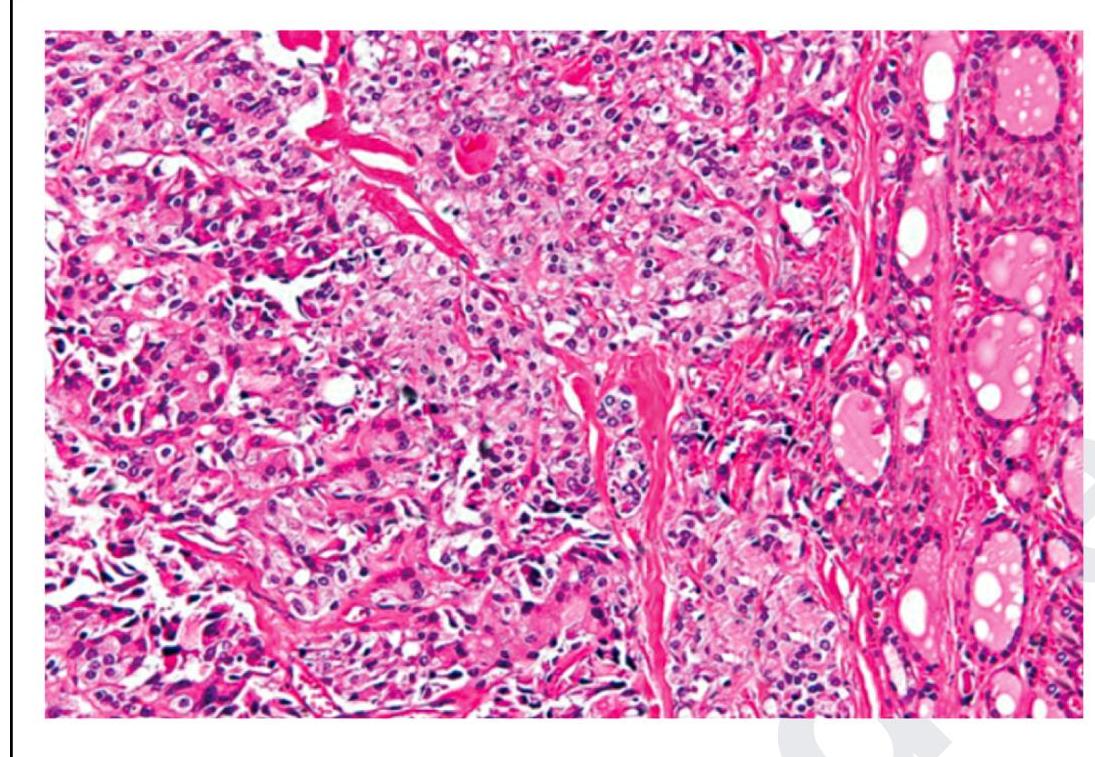
The following is a histopathological image of thyroid pathology. What is the diagnosis?

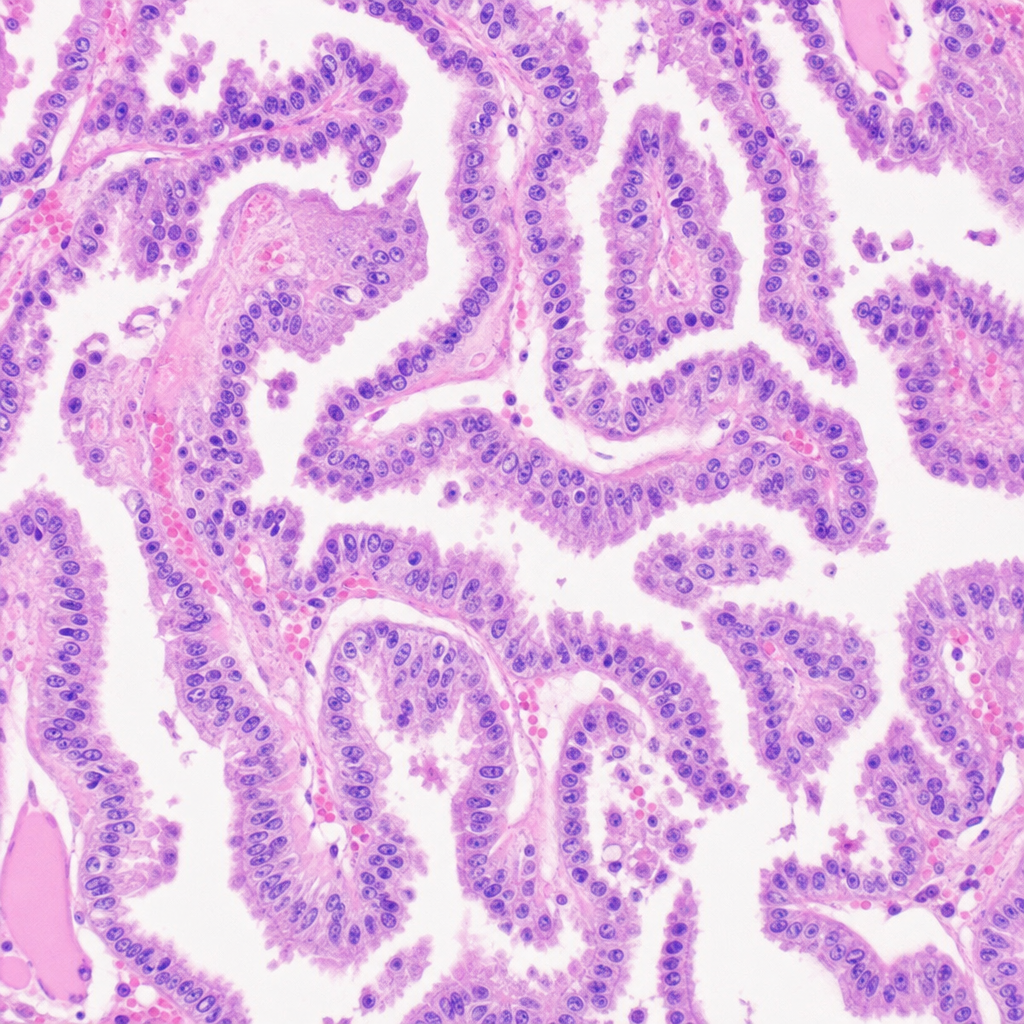
A 25-Year-old male presented with a 2cm thyroid nodule. A thyroidectomy was done. The histology picture is given below. What could be the diagnosis?
Explanation: ***Radioiodine*** - **Differentiated thyroid cancers**, including **follicular carcinoma**, retain the ability to uptake iodine, making **radioiodine (I-131) therapy** highly effective for treating metastases [1]. - This therapy targets and destroys thyroid cancer cells wherever they are located in the body, including distant metastatic sites. *Surgery* - While surgery (e.g., **thyroidectomy**) is the primary treatment for localized thyroid cancer and can be used to resect some metastases, it is **not always feasible** for all metastatic sites, especially widely disseminated disease. - Surgery for widespread metastases carries significant risks and may not be curative if all tumor burden cannot be removed. *Thyroxine* - **Thyroxine (T4)** replacement therapy is crucial after thyroidectomy to replace missing hormones and to **suppress TSH** production, which can stimulate residual cancer growth [1]. - However, thyroxine itself does **not directly destroy** existing metastases; it's a supportive and suppressive therapy, not a primary treatment for metastases. *Observation* - **Observation** is generally not appropriate for treating metastases from **follicular carcinoma**, as these metastases have the potential to grow and lead to significant morbidity and mortality if left untreated. - Active treatment is usually indicated to improve prognosis and quality of life.
Explanation: ***Papillary carcinoma*** - Papillary thyroid carcinoma is strongly associated with **radiation exposure**, particularly during childhood [1]. - It is the most prevalent type of thyroid cancer and typically has a **good prognosis** [1]. *Lymphoma* - Thyroid lymphoma is rare and generally not linked to **radiation exposure**; it often presents as a **rapidly enlarging goiter**. - It is more commonly associated with **autoimmune thyroiditis**, not primary radiation effects. *Follicular carcinoma* - Follicular carcinoma shows a correlation with **iodine deficiency** rather than radiation exposure [1]. - Its presentation is more subtle, compared to the classical association of **radiation with papillary carcinoma**. *Medullary carcinoma* - Medullary thyroid carcinoma is primarily linked to **familial syndromes** like MEN 2 and not radiation exposure. - It arises from **parafollicular C cells**, making it clinically distinct from radiation-related types. **References:** [1] Kumar V, Abbas AK, et al.. Robbins and Cotran Pathologic Basis of Disease. 9th ed. The Endocrine System, pp. 1098-1099.
Explanation: ***Correct Option: TSH*** - **Thyroid-stimulating hormone (TSH)** is the most sensitive initial test to assess thyroid function when a thyroid nodule is discovered. - An abnormal TSH level (either high or low) can guide further investigation into whether the nodule is associated with a functional thyroid disorder. - **TSH should be the first test** according to American Thyroid Association guidelines for thyroid nodule evaluation. *Incorrect Option: I-131* - **I-131 (radioactive iodine therapy)** is a treatment modality for hyperthyroidism or thyroid cancer, not a diagnostic step for initial thyroid swelling evaluation. - Administering I-131 before assessing thyroid function would be inappropriate and could lead to unnecessary or harmful intervention. *Incorrect Option: TSH & T4* - While TSH is crucial, adding **T4 (thyroxine)** as an initial step is often not necessary if TSH is normal, as TSH alone effectively screens for primary thyroid dysfunction. - Measuring both TSH and T4 is typically reserved for situations where TSH is abnormal or when central hypothyroidism is suspected. *Incorrect Option: T3 & T4* - Measuring **T3 (triiodothyronine)** along with T4 as an initial screening for a thyroid nodule is generally not recommended. - T3 levels are primarily used to diagnose **hyperthyroidism** or to evaluate the severity of thyrotoxicosis after an abnormal TSH and T4 have been identified. *Incorrect Option: FNAC* - While **Fine Needle Aspiration Cytology (FNAC)** is an essential diagnostic tool for thyroid nodules, it is typically performed after TSH assessment. - FNAC is indicated for nodules >1 cm with suspicious ultrasound features, but **functional assessment with TSH comes first** to rule out hyperfunctioning nodules.
Explanation: ***3%*** - **Purely cystic thyroid nodules** (as described in this case with "isolated cystic swelling") have a **very low risk of malignancy**, typically **2-3%** or less. - According to **ATA guidelines** and **TIRADS classification**, purely cystic nodules are considered **low suspicion** lesions. - The cystic nature suggests a **benign process** such as a degenerated adenoma, colloid cyst, or simple cyst. - **Fine needle aspiration (FNA)** may still be considered if the nodule is >2 cm or has any suspicious solid components, but is often not required for purely cystic lesions. *48%* - This percentage is **significantly higher** than the actual malignancy risk for a purely cystic thyroid swelling. - Such a **high risk** would typically be associated with **solid nodules** exhibiting highly suspicious ultrasound features such as: - Microcalcifications - Irregular or spiculated margins - Taller-than-wide shape - Marked hypoechogenicity - Extrathyroidal extension *24%* - This percentage represents a **moderate to high risk** of malignancy, which is **not characteristic** of an isolated purely cystic thyroid swelling. - A risk in this range might be seen with: - **Mixed solid-cystic nodules** with predominantly solid components - Solid nodules with **intermediate suspicious features** on ultrasound *12%* - While lower than 24% or 48%, 12% is still **considerably higher** than the generally accepted malignancy risk for purely cystic thyroid nodules. - This risk level could be plausible for: - **Predominantly cystic nodules** with some eccentric solid components - Solid nodules with **mildly suspicious** features on ultrasound
Explanation: Graves' orbitopathy - The combination of **proptosis**, **limited eye movement (ophthalmoplegia)** causing double vision, and a suppressed TSH (indicating hyperthyroidism) is highly characteristic of **Graves' disease** with orbital involvement [1]. - An **enlarging thyroid mass** further supports Graves' disease, as it often presents with goiter and hyperthyroidism, leading to the autoimmune sequelae in the orbit [1]. *Pituitary adenoma* - While it can cause **headaches** and **double vision** due to oculomotor nerve compression, a pituitary adenoma would not typically cause a progressively **enlarging thyroid mass** or **proptosis** with suppressed TSH. - Hypersecreting pituitary adenomas (e.g., ACTH, GH) affect other endocrine axes, and non-secreting ones primarily cause mass effect. *Orbital cellulitis* - This is an **acute infection** of the orbital tissues, usually presenting with **pain, fever, rapidly progressing proptosis**, and erythema, which is not suggested by the chronic and progressive nature of this patient's symptoms. - It would not be associated with a suppressed TSH or an enlarged thyroid gland. *Thyroid carcinoma* - A thyroid carcinoma can present as an **enlarging thyroid mass** and may cause local symptoms like dysphagia or hoarseness if advanced, but it does not directly cause **proptosis**, **double vision**, or suppressed TSH. - Although some rare thyroid cancers can metastasize to the orbit, primary presentation with bilateral proptosis and ophthalmoplegia is not typical.
Explanation: ***Hashimoto's thyroiditis*** - The presence of **lymphocytic infiltration** and **Hurthle cells** on postoperative pathology is characteristic of Hashimoto's thyroiditis [1,2]. - Elevated **TSH levels** indicate hypothyroidism, which aligns with the autoimmune nature of Hashimoto's affecting thyroid hormone production [1]. *Graves disease* - Typically presents with **hyperthyroidism**, leading to suppressed TSH levels rather than elevation. - Characterized by **thyroid enlargement** and the presence of **autoantibodies** like TSI, not lymphocytic infiltration. *Follicular carcinoma* - While it can cause **thyroid swelling**, it is usually associated with **malignant characteristics** rather than Hurthle cells and lymphocytic infiltration. - TSH levels can be normal, as it does not principally engage in autoimmune thyroid destruction like Hashimoto's. *Medullary carcinoma thyroid* - Originates from **C cells** producing calcitonin, and typically presents with elevated calcitonin levels, not TSH. - Characteristic findings include **C-cell hyperplasia** or **neoplastic changes**, which do not match the presented lymphocytic infiltration. **References:** [1] Kumar V, Abbas AK, et al.. Robbins and Cotran Pathologic Basis of Disease. 9th ed. The Endocrine System, pp. 1090-1092. [2] Cross SS. Underwood's Pathology: A Clinical Approach. 6th ed. Common Clinical Problems From Liver And Biliary System Disease, pp. 427-428.
Explanation: Suppressed TSH with elevated thyroid hormone levels - The patient's symptoms of **fatigue** (despite being warm) and **difficulty gaining weight**, coupled with her body feeling **warm**, are classic signs of **hyperthyroidism**. [1] - In hyperthyroidism, the thyroid gland produces **excessive thyroid hormones (T3 and T4)**, which in turn **suppresses TSH** production from the pituitary gland through negative feedback. [2] *Elevated TSH with normal thyroid hormone levels* - This pattern is characteristic of **subclinical hypothyroidism**, where the thyroid gland is beginning to fail, leading to increased TSH to maintain normal thyroid hormone levels. [3] - The patient's symptoms of feeling warm and difficulty gaining weight are inconsistent with hypothyroidism. [1] *Elevated TSH with low thyroid hormone levels* - This indicates **primary hypothyroidism**, where the thyroid gland is underactive and produces insufficient thyroid hormones, leading to a compensatory rise in TSH. [2] - Hypothyroidism typically presents with **weight gain**, **cold intolerance**, and fatigue, which contradict the patient's presentation. [1] *Normal TSH with abnormal thyroid hormone levels* - This scenario usually suggests **central hypothyroidism** (pituitary or hypothalamic dysfunction affecting TSH production) or **thyroid hormone resistance**. [3] - While possible in some rare cases, it does not fit the typical clinical picture of hyperthyroidism presented by the patient's symptoms.
Explanation: ***Hashimoto thyroiditis*** - The classic triad of **elevated TSH** (hypothyroidism), **lymphocytic infiltration**, and **Hürthle cells** (oncocytic metaplasia) on histopathology is pathognomonic for Hashimoto thyroiditis [1]. - This autoimmune thyroiditis is characterized by immune-mediated destruction of the thyroid gland, leading to reduced thyroid hormone production and compensatory TSH elevation [1]. - It is the most common cause of hypothyroidism in iodine-sufficient areas. *Graves disease* - Graves disease is an autoimmune condition causing **hyperthyroidism**, characterized by **low TSH** and elevated thyroid hormones (T3/T4), which contradicts the elevated TSH in this case [2]. - Histologically, it typically shows **diffuse hyperplasia** with papillary infoldings and colloidal reabsorption, without significant lymphocytic infiltration or Hürthle cells [2]. *Medullary carcinoma thyroid* - Medullary carcinoma is a neuroendocrine tumor arising from **parafollicular C cells**, producing **calcitonin**, and is not associated with elevated TSH or Hürthle cells [3]. - Histopathology reveals **amyloid deposits** (Congo red positive) and sheets of neoplastic C cells, distinctly different from the lymphocytic infiltration described. *Follicular carcinoma* - Follicular carcinoma is a well-differentiated thyroid cancer where TSH levels are usually normal; elevation may occur with significant tissue destruction but is not a diagnostic feature. - Histopathologically, diagnosis requires demonstration of **capsular or vascular invasion** by follicular cells, and does not feature extensive lymphocytic infiltration or Hürthle cells as primary findings. **References:** [1] Kumar V, Abbas AK, et al.. Robbins and Cotran Pathologic Basis of Disease. 9th ed. The Endocrine System, pp. 1089-1091. [2] Kumar V, Abbas AK, et al.. Robbins and Cotran Pathologic Basis of Disease. 9th ed. The Endocrine System, pp. 1092-1093. [3] Cross SS. Underwood's Pathology: A Clinical Approach. 6th ed. Common Clinical Problems From Liver And Biliary System Disease, pp. 424-426.
Explanation: ***Medullary carcinoma of thyroid*** - This image shows sheets and nests of **polygonal to spindle-shaped cells**, which are characteristic of medullary thyroid carcinoma, especially when mixed with an **amyloid stroma** (seen as amorphous eosinophilic material) [2]. - The presence of **neuroendocrine features** and the production of **calcitonin** are hallmarks of these C-cell tumors [1], [2]. *Papillary carcinoma of thyroid* - Characterized by **papillary architecture**, **ground-glass (Orphan Annie eye) nuclei**, nuclear grooves, and intranuclear cytoplasmic inclusions. - These features are not prominently seen in the provided image. *Follicular carcinoma of thyroid* - Defined by an invasive growth pattern of **well-differentiated follicular cells** forming follicles, with either capsular or vascular invasion [2]. - The image does not show classic follicular architectural patterns or clear evidence of invasion in the absence of a capsule. *Anaplastic carcinoma of thyroid* - This is a highly aggressive and undifferentiated tumor with **marked pleomorphism**, bizarre giant cells, and high mitotic activity [2]. - While there is some pleomorphism, the overall pattern and cellular morphology in the image are more consistent with medullary carcinoma than the extreme anaplasia. **References:** [1] Kumar V, Abbas AK, et al.. Robbins and Cotran Pathologic Basis of Disease. 9th ed. The Endocrine System, pp. 1102-1103. [2] Cross SS. Underwood's Pathology: A Clinical Approach. 6th ed. Common Clinical Problems From Liver And Biliary System Disease, pp. 428-431.
Explanation: ***Papillary carcinoma thyroid*** - Characterized by **papillary structures** and **nuclear features** such as nuclear grooves and overlapping nuclei on histology [1]. - Often presents in young adults and can show **psammoma bodies**, which are indicative of malignancy. *Follicular adenoma* - Generally shows well-circumscribed **follicular structures** without nuclear atypia [2,3]. - Lacks the typical **papillary architecture** and associated aggressive features found in carcinoma. *Graves disease* - Primarily presents with **hyperthyroidism** and diffuse goiter rather than a solitary nodule. - Histologically, it is characterized by **hyperplastic follicles** and does not display features of malignancy. *Adenomatous goitre* - Refers to **nodular enlargement** of the thyroid with benign hyperplastic nodules. - Lacks the **malignant features** present in papillary carcinoma, such as nuclear atypia and invasion. **References:** [1] Kumar V, Abbas AK, et al.. Robbins and Cotran Pathologic Basis of Disease. 9th ed. The Endocrine System, p. 1099. [2] Kumar V, Abbas AK, et al.. Robbins and Cotran Pathologic Basis of Disease. 9th ed. The Endocrine System, pp. 1096-1097. [3] Cross SS. Underwood's Pathology: A Clinical Approach. 6th ed. Common Clinical Problems From Liver And Biliary System Disease, pp. 428-429.
Get full access to all questions, explanations, and performance tracking.
Start For Free