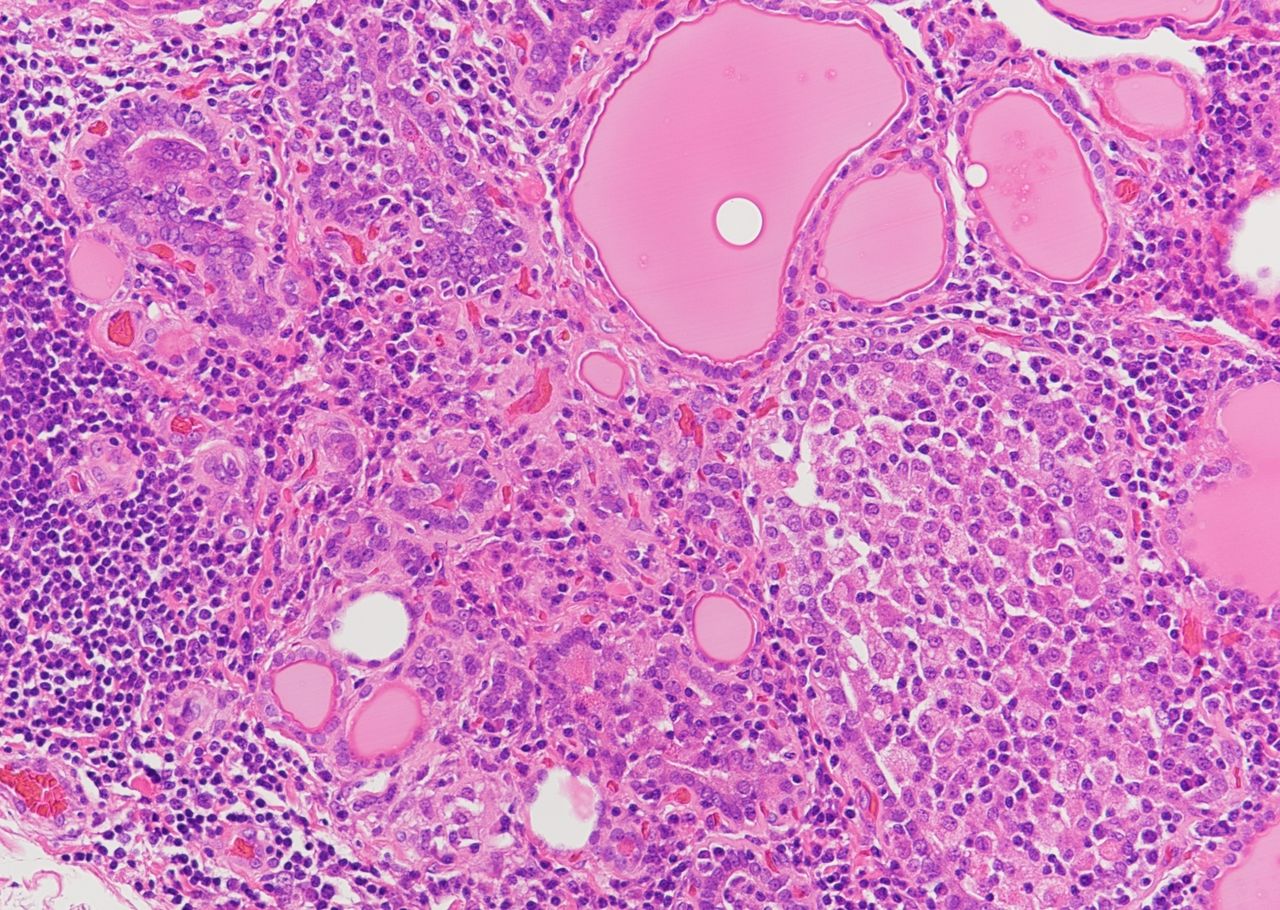
A 65-year-old female patient presented with a neck swelling that moved with deglutition, along with multiple episodes of diarrhea, hoarseness, mild dysphagia, and mild shortness of breath. Lab findings revealed raised serum calcitonin levels and hypercalcemia. From which embryonic structure is the gland responsible for this condition derived?
Which of the following is a fibrosing type of thyroiditis?
Which of the following findings is not seen in hyperparathyroidism?
Amyloid stroma is seen with which of the following conditions?
Calcitonin is a marker of which condition?
What endocrine disorder is characterized by a "brown tumor"?
Subperiosteal bone resorption is seen in which of the following conditions?
Pheochromocytoma does not arise from which of the following?
Which of the following is not included in Sipple's syndrome?
Which of the following is a common cause of hyperparathyroidism?
Explanation: ### Explanation **1. Why the Correct Answer is Right:** The clinical presentation—a neck swelling moving with deglutition, hoarseness (recurrent laryngeal nerve involvement), and diarrhea—strongly suggests **Medullary Thyroid Carcinoma (MTC)** [1]. The definitive diagnostic clue is the **raised serum calcitonin**, which is the biochemical marker for MTC [2]. MTC arises from the **Parafollicular C cells** of the thyroid gland [2]. These cells are neuroendocrine in origin and are derived from the **ultimobranchial body** (which originates from the 4th-5th branchial pouches). The presence of hypercalcemia in this context suggests **Multiple Endocrine Neoplasia (MEN) 2A**, where MTC is associated with Primary Hyperparathyroidism and Pheochromocytoma [1]. **2. Why Incorrect Options are Wrong:** * **B. Parathyroid glands:** While hypercalcemia is present, parathyroid glands secrete PTH, not calcitonin. They are involved in MEN 2A, but the primary neck mass and diarrhea (due to calcitonin/VIP secretion) are characteristic of the thyroid pathology [1]. * **C. Thymus:** Derived from the 3rd pharyngeal pouch, the thymus is not associated with calcitonin production or the clinical triad described. * **D. Adrenal medulla:** While Pheochromocytoma (adrenal medulla) occurs in MEN 2A, it would present with hypertension and palpitations, not a neck mass moving with deglutition [1]. **3. NEET-PG High-Yield Pearls:** * **Histology of MTC:** Characterized by nests of polygonal cells in an **amyloid stroma** (amyloid is formed by pro-calcitonin) [2]. * **Staining:** Amyloid shows **Apple-green birefringence** under polarized light with Congo Red stain. * **Genetics:** Strongly associated with **RET proto-oncogene** mutations. * **Calcitonin:** Used for both diagnosis and monitoring post-operative recurrence. * **Diarrhea in MTC:** Caused by the secretion of calcitonin, prostaglandins, or VIP by the tumor cells [1]. **References:** [1] Kumar V, Abbas AK, et al.. Robbins and Cotran Pathologic Basis of Disease. 9th ed. The Endocrine System, pp. 1102-1103. [2] Cross SS. Underwood's Pathology: A Clinical Approach. 6th ed. Common Clinical Problems From Liver And Biliary System Disease, pp. 428-431.
Explanation: **Explanation:** **Riedel’s Thyroiditis** is the correct answer because it is characterized by extensive **dense fibrous tissue replacement** of the thyroid parenchyma [1]. This fibrosis often extends beyond the thyroid capsule into adjacent neck structures (trachea, esophagus, recurrent laryngeal nerve), mimicking a malignancy [1]. It is now considered a manifestation of **IgG4-related systemic disease** [1]. On palpation, the thyroid is classically described as "stony hard" and fixed [1]. **Why other options are incorrect:** * **Hashimoto’s Thyroiditis:** While late-stage Hashimoto’s can show some fibrosis, its hallmark is **lymphocytic infiltration** with germinal center formation and the presence of **Hürthle cells** (oxyphilic metaplasia). It is the most common cause of hypothyroidism in iodine-sufficient areas. * **De Quervain’s Thyroiditis (Subacute Granulomatous):** This is typically a post-viral inflammatory condition. Histologically, it is characterized by **granulomatous inflammation** with multinucleated giant cells surrounding fragments of colloid, rather than extensive fibrosis. It is clinically associated with a painful, tender thyroid. **NEET-PG High-Yield Pearls:** * **Riedel’s Thyroiditis:** Look for the "Hard as wood/iron" thyroid. It is associated with other fibrosing conditions like retroperitoneal fibrosis, sclerosing cholangitis, and mediastinal fibrosis [1]. * **Microscopy:** Riedel's shows a dense collagenous stroma with a sparse inflammatory infiltrate (lymphocytes, plasma cells, and eosinophils). * **Differential:** Must be differentiated from the **fibrosing variant of Hashimoto’s** and **Anaplastic Carcinoma**; however, Riedel’s lacks the cellular atypia seen in malignancy. **References:** [1] Kumar V, Abbas AK, et al.. Robbins and Cotran Pathologic Basis of Disease. 9th ed. The Endocrine System, pp. 1091-1092.
Explanation: **Explanation:** The correct answer is **Punched-out lesions of the skull**, as this is a classic radiological hallmark of **Multiple Myeloma**, not hyperparathyroidism. **1. Why "Punched-out lesions" is the correct choice:** In hyperparathyroidism, excess Parathyroid Hormone (PTH) increases osteoclast activity [1]. This leads to a generalized decrease in bone density known as **"Salt and Pepper" skull** (granular decalcification), rather than the discrete, well-circumscribed "punched-out" lytic lesions seen in plasma cell dyscrasias like Multiple Myeloma [3]. **2. Analysis of incorrect options:** * **Osteopenia (A):** PTH stimulates osteoclasts to resorb bone to increase serum calcium [1]. This results in generalized bone loss (osteopenia) and, in severe cases, **Osteitis Fibrosa Cystica** [2]. * **Renal Stones (B):** Hypercalcemia leads to hypercalciuria. The increased concentration of calcium in the urine promotes the formation of calcium oxalate or calcium phosphate stones (Nephrolithiasis) [1]. * **Brown Tumors (D):** These are non-neoplastic reactive lesions caused by rapid bone resorption. The "brown" color is due to vascularity, hemorrhage, and hemosiderin deposition within the cystic spaces of the bone [1]. **Clinical Pearls for NEET-PG:** * **Classic Mnemonic:** Hyperparathyroidism is remembered by the phrase: *"Stones (renal), Bones (osteitis fibrosa cystica), Groans (abdominal pain/peptic ulcers), and Psychic Moans (depression/lethargy)."* * **Subperiosteal Resorption:** The most specific radiological sign of hyperparathyroidism is subperiosteal resorption, most commonly seen on the **radial aspect of the middle phalanges** [2]. * **Biochemical Triad:** High Serum Calcium, Low Serum Phosphate, and High PTH (in primary hyperparathyroidism). **References:** [1] Kumar V, Abbas AK, et al.. Robbins and Cotran Pathologic Basis of Disease. 9th ed. The Endocrine System, pp. 1105-1106. [2] Kumar V, Abbas AK, et al.. Robbins and Cotran Pathologic Basis of Disease. 9th ed. Bones, Joints, and Soft Tissue Tumors, p. 1194. [3] Cross SS. Underwood's Pathology: A Clinical Approach. 6th ed. Common Clinical Problems From Osteoarticular And Connective Tissue Disease, pp. 667-668.
Explanation: **Explanation:** **Medullary Carcinoma of the Thyroid (MTC)** is the correct answer because it is a neuroendocrine tumor derived from the **parafollicular C-cells** [2]. These cells secrete excessive amounts of **calcitonin**. The characteristic amyloid stroma seen in MTC is formed by the deposition of procalcitonin molecules that undergo misfolding into insoluble β-pleated sheets [1]. On histopathology, this amyloid appears as an extracellular eosinophilic material that shows **apple-green birefringence** under polarized light when stained with **Congo Red** [1]. **Why other options are incorrect:** * **Papillary Carcinoma (PTC):** The hallmark features are nuclear changes (Orphan Annie eye nuclei, nuclear grooves, pseudo-inclusions) and **Psammoma bodies** (laminated calcifications), not amyloid. * **Follicular Carcinoma:** This is characterized by capsular or vascular invasion [1]. It lacks both amyloid stroma and the specific nuclear features of PTC. * **Anaplastic Carcinoma:** This is a highly aggressive, undifferentiated tumor showing pleomorphic giant cells or spindle cells [1]. It does not produce calcitonin or amyloid. **High-Yield Pearls for NEET-PG:** 1. **Genetic Association:** MTC is associated with **RET proto-oncogene** mutations. It occurs sporadically (75%) or as part of **MEN 2A and 2B** syndromes [2]. 2. **Tumor Marker:** Serum **Calcitonin** is used for diagnosis and monitoring recurrence; **CEA** is also a useful marker [2]. 3. **IHC Marker:** MTC stains positive for **Calcitonin, Chromogranin, and Synaptophysin**. 4. **Precursor Lesion:** C-cell hyperplasia is the precursor in familial cases. **References:** [1] Cross SS. Underwood's Pathology: A Clinical Approach. 6th ed. Common Clinical Problems From Liver And Biliary System Disease, pp. 430-431. [2] Kumar V, Abbas AK, et al.. Robbins and Cotran Pathologic Basis of Disease. 9th ed. The Endocrine System, pp. 1102-1103.
Explanation: **Explanation:** **Correct Answer: B. Medullary carcinoma of the thyroid** **Medical Concept:** Calcitonin is a hormone primarily secreted by the **Parafollicular cells (C-cells)** of the thyroid gland [2]. Its physiological role is to lower blood calcium levels by inhibiting osteoclast activity [3]. **Medullary Thyroid Carcinoma (MTC)** is a neuroendocrine tumor arising directly from these C-cells [2]. Consequently, serum calcitonin levels are significantly elevated in patients with MTC, making it a highly specific **tumor marker** for diagnosis, screening (especially in familial cases), and monitoring post-operative recurrence [1]. **Analysis of Incorrect Options:** * **A. Prostate cancer:** The primary markers are **Prostate-Specific Antigen (PSA)** and Acid Phosphatase. * **C. Pheochromocytoma:** This tumor of the adrenal medulla secretes catecholamines. The diagnostic markers are urinary and plasma **Metanephrines** and Vanillylmandelic acid (VMA). * **D. Pancreatic cancer:** The most common marker used is **CA 19-9**. **High-Yield Clinical Pearls for NEET-PG:** * **Amyloid Stroma:** Histologically, MTC is characterized by nests of polygonal cells with **amyloid deposits** (derived from pro-calcitonin) that stain with Congo Red (showing apple-green birefringence) [4]. * **Genetic Association:** Approximately 25% of MTC cases are familial, associated with **MEN 2A and 2B** syndromes due to mutations in the **RET proto-oncogene** [1]. * **Carcinoembryonic Antigen (CEA):** This is also frequently elevated in MTC and is used alongside calcitonin for prognosis [1]. * **Hypocalcemia:** Despite high calcitonin, patients with MTC rarely present with hypocalcemia due to down-regulation of receptors [1],[3]. **References:** [1] Kumar V, Abbas AK, et al.. Robbins and Cotran Pathologic Basis of Disease. 9th ed. The Endocrine System, pp. 1102-1103. [2] Cross SS. Underwood's Pathology: A Clinical Approach. 6th ed. Common Clinical Problems From Liver And Biliary System Disease, pp. 428-429. [3] Cross SS. Underwood's Pathology: A Clinical Approach. 6th ed. (Basic Pathology) introduces the student to key general principles of pathology, both as a medical science and as a clinical activity with a vital role in patient care. Part 2 (Disease Mechanisms) provides fundamental knowledge about the cellular and molecular processes involved in diseases, providing the rationale for their treatment. Part 3 (Systematic Pathology) deals in detail with specific diseases, with emphasis on the clinically important aspects., pp. 127-128. [4] Cross SS. Underwood's Pathology: A Clinical Approach. 6th ed. Common Clinical Problems From Liver And Biliary System Disease, pp. 430-431.
Explanation: ### Explanation **Correct Answer: B. Hyperparathyroidism** **Underlying Medical Concept:** A "brown tumor" (also known as **Osteitis Fibrosa Cystica**) is a classic skeletal manifestation of **primary hyperparathyroidism** [1]. Excess Parathyroid Hormone (PTH) leads to overstimulation of osteoclasts, resulting in rapid bone resorption. As bone is destroyed, it is replaced by vascularized fibrous tissue and organized hemorrhage [1]. The characteristic "brown" color is due to the extensive deposition of **hemosiderin** (a breakdown product of hemoglobin) within these fibrovascular lesions [1]. It is important to note that despite the name, it is a non-neoplastic reactive lesion, not a true tumor. **Why Incorrect Options are Wrong:** * **A. Hypothyroidism:** This condition is characterized by a decreased metabolic rate and systemic symptoms like myxedema and bradycardia. It does not involve PTH-mediated bone resorption or the formation of hemorrhagic bone cysts. * **C & D:** These are incorrect as the association between brown tumors and hyperparathyroidism is specific and well-documented in endocrine pathology. **NEET-PG High-Yield Pearls:** * **Radiological Sign:** On X-ray, hyperparathyroidism often shows a **"Salt and Pepper" skull** (granular decalcification) and subperiosteal bone resorption (most common in the phalanges) [2]. * **Von Recklinghausen’s Disease of Bone:** This is the eponym for the constellation of bone changes (including brown tumors) seen in severe hyperparathyroidism [1]. * **Biochemical Triad:** Primary hyperparathyroidism typically presents with **Hypercalcemia**, **Hypophosphatemia**, and **elevated PTH** [3]. * **Histology:** Look for giant cells, fibrous tissue, and hemosiderin-laden macrophages (can mimic a Giant Cell Tumor of the bone) [2]. **References:** [1] Kumar V, Abbas AK, et al.. Robbins and Cotran Pathologic Basis of Disease. 9th ed. The Endocrine System, pp. 1105-1106. [2] Kumar V, Abbas AK, et al.. Robbins and Cotran Pathologic Basis of Disease. 9th ed. Bones, Joints, and Soft Tissue Tumors, p. 1194. [3] Cross SS. Underwood's Pathology: A Clinical Approach. 6th ed. Common Clinical Problems From Osteoarticular And Connective Tissue Disease, pp. 667-668.
Explanation: **Explanation:** **Hyperparathyroidism** (specifically Primary and Tertiary) is characterized by an excess of Parathyroid Hormone (PTH). PTH directly stimulates osteoblasts to release RANK-ligand, which activates **osteoclasts**, leading to increased bone resorption [2]. **Why Hyperparathyroidism is correct:** The hallmark skeletal manifestation of hyperparathyroidism is **subperiosteal bone resorption** [1]. This occurs most classically along the radial aspect of the middle phalanges of the 2nd and 3rd fingers. If chronic and severe, this process leads to **Osteitis Fibrosa Cystica**, characterized by the replacement of bone marrow with fibrous tissue and the formation of "Brown tumors" (hemosiderin-laden cystic lesions) [1][3]. **Why other options are incorrect:** * **Hypothyroidism:** Associated with delayed bone age and epiphyseal dysgenesis in children, but does not cause active bone resorption. * **Hyperthyroidism:** While it can increase bone turnover and lead to osteoporosis, it does not typically present with the pathognomonic subperiosteal resorption seen in PTH excess. * **Hypoparathyroidism:** Results in low PTH levels, leading to increased bone density (osteosclerosis) rather than resorption. **High-Yield NEET-PG Pearls:** * **Radiological Sign:** "Salt and pepper" appearance of the skull is another classic sign of hyperparathyroidism. * **Rugger-Jersey Spine:** Seen in secondary hyperparathyroidism (Renal Osteodystrophy), characterized by bands of sclerosis at the vertebral endplates. * **Biochemical Triad:** Hypercalcemia, Hypophosphatemia, and elevated PTH (in Primary Hyperparathyroidism). **References:** [1] Kumar V, Abbas AK, et al.. Robbins and Cotran Pathologic Basis of Disease. 9th ed. Bones, Joints, and Soft Tissue Tumors, p. 1194. [2] Cross SS. Underwood's Pathology: A Clinical Approach. 6th ed. Common Clinical Problems From Osteoarticular And Connective Tissue Disease, pp. 667-668. [3] Kumar V, Abbas AK, et al.. Robbins and Cotran Pathologic Basis of Disease. 9th ed. The Endocrine System, pp. 1105-1106.
Explanation: **Explanation:** **1. Why Adrenal Cortex is the Correct Answer:** Pheochromocytoma is a tumor derived from **chromaffin cells**, which are neuroendocrine cells originating from the **neural crest**. In the adrenal gland, these cells are exclusively located in the **Adrenal Medulla** [1]. The **Adrenal Cortex**, conversely, is derived from the mesoderm and produces steroid hormones (cortisol, aldosterone, androgens) [1]. Therefore, a tumor of the adrenal cortex would be an adenoma or carcinoma, not a pheochromocytoma. **2. Analysis of Incorrect Options:** * **Adrenal Medulla (Option A):** This is the most common site for pheochromocytoma (approximately 85-90% of cases). * **Extra-adrenal sites & Sympathetic chain (Options C & D):** About 10-15% of these tumors arise from extra-adrenal chromaffin tissue [2]. These are technically referred to as **Paragangliomas**. Common sites include the Organ of Zuckerkandl (near the aortic bifurcation) and the sympathetic chains in the abdomen, thorax, or pelvis [2]. **3. High-Yield Clinical Pearls for NEET-PG:** * **The Rule of 10s:** Traditionally, Pheochromocytoma is known as the "10% tumor": 10% are bilateral, 10% are malignant, 10% occur in children, and 10% are extra-adrenal (though modern genetics suggest up to 25-30% may be familial). * **Zellballen Pattern:** On histology, cells are arranged in small nests or alveolar patterns surrounded by a rich vascular network [2]. * **Diagnosis:** The best initial screening test is measuring **urinary or plasma metanephrines** (metabolites of catecholamines). * **Genetic Associations:** Frequently associated with **MEN 2A and 2B**, VHL syndrome, and NF-1. * **Staining:** Positive for neuroendocrine markers like **Chromogranin A** and **Synaptophysin**. **References:** [1] Kumar V, Abbas AK, et al.. Robbins and Cotran Pathologic Basis of Disease. 9th ed. The Endocrine System, pp. 1125-1126. [2] Cross SS. Underwood's Pathology: A Clinical Approach. 6th ed. Common Clinical Problems From Liver And Biliary System Disease, pp. 419-420.
Explanation: **Explanation:** Sipple’s Syndrome, also known as **Multiple Endocrine Neoplasia Type 2A (MEN 2A)**, is an autosomal dominant disorder caused by a germline mutation in the **RET proto-oncogene** on chromosome 10 [1]. It is characterized by a specific triad of endocrine tumors. **Why Hyperthyroidism is the correct answer:** Hyperthyroidism is not a component of MEN 2A [2]. While patients with Sipple’s syndrome develop thyroid pathology, it is specifically **Medullary Thyroid Carcinoma (MTC)**, which arises from the parafollicular C-cells [3]. These cells secrete calcitonin, not thyroid hormone (T3/T4). Therefore, patients do not typically present with clinical hyperthyroidism. **Analysis of Incorrect Options:** * **Medullary Carcinoma Thyroid (MTC):** This is the most common feature (seen in >90% of cases) and often the first clinical manifestation [1]. It is usually multifocal and bilateral in MEN syndromes [3]. * **Pheochromocytoma:** Occurs in approximately 50% of patients [1]. These are often bilateral and arise in the adrenal medulla. * **Hyperparathyroidism:** Seen in 20–30% of cases, typically due to parathyroid hyperplasia rather than a single adenoma [1]. **High-Yield Clinical Pearls for NEET-PG:** * **MEN 2A (Sipple’s):** MTC + Pheochromocytoma + Parathyroid Hyperplasia [1]. * **MEN 2B (Williams-Pollock):** MTC + Pheochromocytoma + Mucosal Neuromas + Marfanoid habitus [1]. (Note: Parathyroid involvement is rare in 2B). * **Screening:** Prophylactic thyroidectomy is often recommended in RET mutation carriers. * **Rule of 10s:** Pheochromocytoma is traditionally associated with the "Rule of 10s," but in MEN syndromes, the incidence of bilaterality is much higher (up to 50%). **References:** [1] Kumar V, Abbas AK, et al.. Robbins and Cotran Pathologic Basis of Disease. 9th ed. The Endocrine System, p. 1137. [2] Cross SS. Underwood's Pathology: A Clinical Approach. 6th ed. Common Clinical Problems From Liver And Biliary System Disease, pp. 424-426. [3] Cross SS. Underwood's Pathology: A Clinical Approach. 6th ed. Common Clinical Problems From Liver And Biliary System Disease, pp. 428-429.
Explanation: ### Explanation Hyperparathyroidism is characterized by the excessive secretion of parathyroid hormone (PTH), leading to hypercalcemia. It is classified into primary, secondary, and tertiary types [2]. Primary hyperparathyroidism (PHPT) is the most common cause of asymptomatic hypercalcemia, and it results from intrinsic pathology of the parathyroid glands [4]. **Why "All of the above" is correct:** Primary hyperparathyroidism is caused by three distinct pathological entities, all of which are represented in the options: 1. **Adenoma (Option C):** This is the **most common cause**, accounting for approximately **85-95%** of cases [4]. It usually involves a single gland. 2. **Hyperplasia (Option B):** This accounts for about **5-10%** of cases. It typically involves all four glands (multiglandular disease) and is often associated with familial syndromes like MEN 1 and MEN 2A [3]. 3. **Carcinoma (Option A):** This is a rare cause, occurring in **<1%** of cases. It is diagnosed by local invasion or distant metastasis rather than cytological features alone. Since all three conditions lead to the autonomous overproduction of PTH, they are all recognized causes of hyperparathyroidism. **High-Yield NEET-PG Pearls:** * **Most Common Cause:** Solitary Parathyroid Adenoma (usually the inferior parathyroid gland). * **Clinical Presentation:** Classically described as "Bones, Stones, Abdominal Groans, and Psychic Overtones" (Osteitis fibrosa cystica, nephrolithiasis, peptic ulcers, and depression) [1]. * **Genetic Association:** Mutations in the *MEN1* gene or *CCND1* (Cyclin D1) are frequently implicated [3]. * **Biochemical Marker:** Elevated Serum Calcium + Elevated/Inappropriately Normal PTH + Low Serum Phosphate [2]. **References:** [1] Kumar V, Abbas AK, et al.. Robbins and Cotran Pathologic Basis of Disease. 9th ed. The Endocrine System, pp. 1105-1106. [2] Kumar V, Abbas AK, et al.. Robbins and Cotran Pathologic Basis of Disease. 9th ed. The Endocrine System, pp. 1106-1107. [3] Kumar V, Abbas AK, et al.. Robbins and Cotran Pathologic Basis of Disease. 9th ed. The Endocrine System, pp. 1104-1105. [4] Cross SS. Underwood's Pathology: A Clinical Approach. 6th ed. Common Clinical Problems From Osteoarticular And Connective Tissue Disease, pp. 667-668.
Pituitary Gland Disorders
Practice Questions
Thyroid Gland Diseases
Practice Questions
Parathyroid Gland Pathology
Practice Questions
Adrenal Cortical Disorders
Practice Questions
Adrenal Medullary Disorders
Practice Questions
Pancreatic Endocrine Disorders
Practice Questions
Multiple Endocrine Neoplasia Syndromes
Practice Questions
Diffuse Neuroendocrine System
Practice Questions
Pineal Gland Pathology
Practice Questions
Laboratory Diagnosis of Endocrine Diseases
Practice Questions
Get full access to all questions, explanations, and performance tracking.
Start For Free