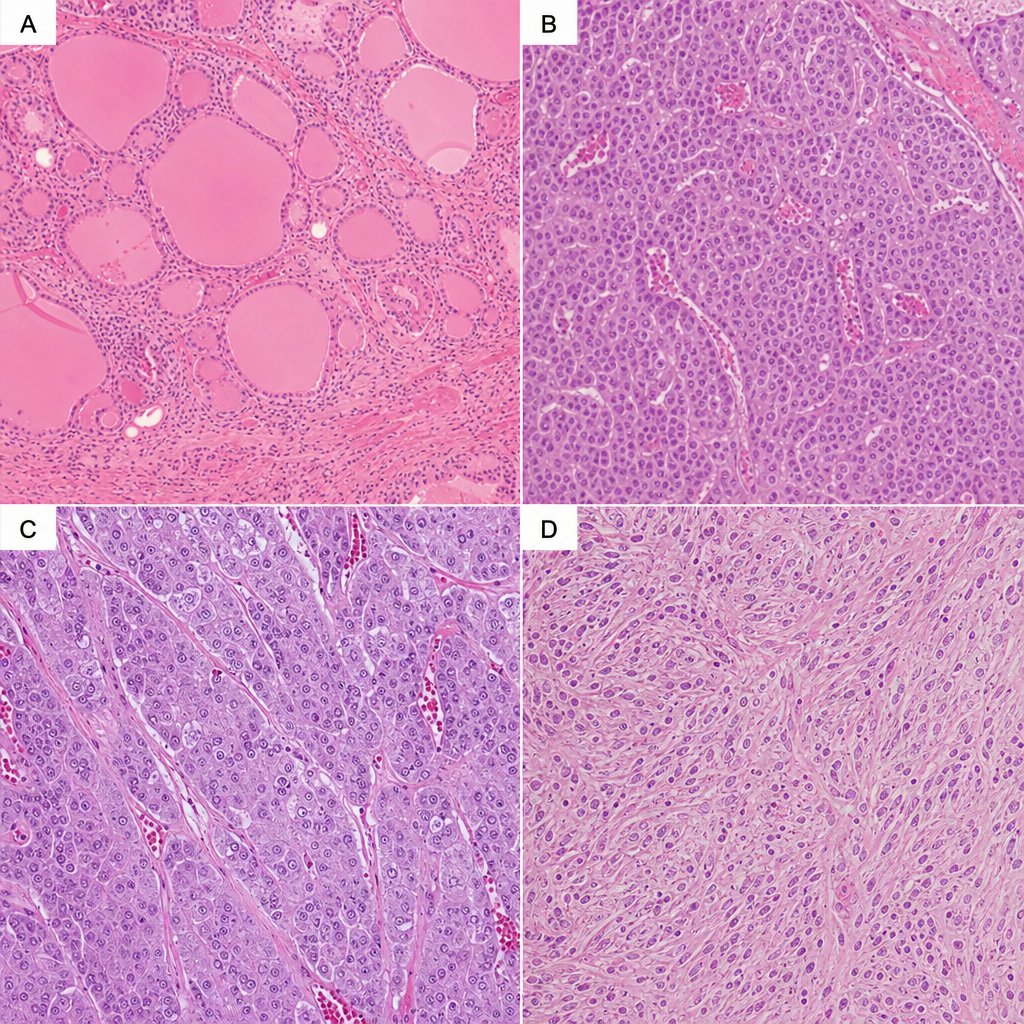
A 30-year-old woman presents with a neck mass and elevated calcitonin levels. A biopsy reveals amyloid deposits within the tumor. Which type of thyroid carcinoma is most consistent with these findings?
A 50-year-old male with a thyroid nodule undergoes fine-needle aspiration. The cytology shows nuclear grooves and optically clear nuclei. Which genetic mutation should be tested to confirm the diagnosis?
Which of the following statements is MOST accurate regarding the development of thyroid tumors in nodular goiter?
A 35-year-old woman presents with an enlarging neck mass. Fine needle aspiration reveals spindle cells and amyloid deposits. What is the most likely diagnosis?
A 50-year-old woman with Hashimoto's thyroiditis presents with a rapidly growing thyroid mass. A biopsy reveals pleomorphic cells and extensive necrosis. Which neoplasm is most likely associated with these findings?
A 35-year-old woman presents with a thyroid nodule and hoarseness. Laboratory results show normal TSH and T4 levels. Fine needle aspiration reveals orphan Annie eye nuclei and psammoma bodies. What is the likely diagnosis?
A patient with a thyroid nodule undergoes fine-needle aspiration. The aspirate shows cells with clear nuclei and nuclear grooves. What type of thyroid cancer does this indicate?
A patient presents with a painless, 'cold' thyroid nodule. Histopathology is likely to show which of the following features in a benign lesion?
A 67-year-old woman with hypertension and diabetes presents with a painless neck mass. Fine-needle aspiration biopsy reveals spindle-shaped cells. What is the most likely diagnosis?
A thyroid nodule biopsy reveals cells with nuclear overlapping and a papillary architecture. Which molecular alteration is most commonly associated with this condition?
Explanation: ***Medullary thyroid carcinoma*** - Characterized by elevated **calcitonin levels** due to C-cell hyperplasia, which is a hallmark of this tumor type [1][3]. - The presence of **amyloid deposits** within the tumor supports the diagnosis, as medullary carcinoma is associated with amyloidogenesis [2]. *Anaplastic thyroid carcinoma* - Typically presents as a **rapidly enlarging neck mass** without significant hormonal elevation or amyloid deposits. - It is known for its **aggressive behavior** and poor prognosis, rather than the specific findings of calcitonin elevation. *Follicular thyroid carcinoma* - This type does not typically produce calcitonin and is characterized by **thyroid hormone metabolism** issues, not amyloid deposits. - Tumors usually present as a **solitary nodule** without the specific features seen in this case. *Papillary thyroid carcinoma* - Primarily associated with **thyroid hormone elevation** and shows characteristic **nuclear features** rather than calcitonin production. - Also does not generally display the presence of **amyloid deposits**, distinguishing it from medullary carcinoma. **References:** [1] Cross SS. Underwood's Pathology: A Clinical Approach. 6th ed. Common Clinical Problems From Liver And Biliary System Disease, pp. 428-429. [2] Cross SS. Underwood's Pathology: A Clinical Approach. 6th ed. Common Clinical Problems From Liver And Biliary System Disease, pp. 430-431. [3] Kumar V, Abbas AK, et al.. Robbins and Cotran Pathologic Basis of Disease. 9th ed. The Endocrine System, pp. 1102-1103.
Explanation: ***BRAF mutation; schedule for thyroidectomy*** - The presence of **nuclear grooves** and **optically clear nuclei** suggests a diagnosis of **papillary thyroid carcinoma** [1], for which **BRAF** mutations are frequently associated. - Management often includes **surgical intervention**, typically a **thyroidectomy**, to prevent progression or metastasis. *TP53 mutation; observe with regular follow-up* - **TP53** mutations are typically associated with **follicular thyroid carcinoma** or other malignancies, not specifically with papillary thyroid carcinoma. - The recommendation to **observe** is not appropriate for confirmed malignancy; surgical management is required. *RET mutation; initiate chemotherapy* - **RET mutations** are linked to **medullary thyroid carcinoma** and are not relevant for papillary thyroid carcinoma. - Chemotherapy is not a standard treatment for thyroid cancers; **surgical excision is preferred**. *RAS mutation; consider lobectomy* - **RAS mutations** are associated with **follicular thyroid carcinoma** and benign follicular adenomas, not specifically with the findings described. - While **lobectomy** may be considered for some thyroid nodules, the cytological findings indicate a necessity for **more aggressive surgical management**. **References:** [1] Kumar V, Abbas AK, et al.. Robbins and Cotran Pathologic Basis of Disease. 9th ed. The Endocrine System, p. 1099.
Explanation: ***Thyroid carcinoma is found in 5-15% of multinodular goiters*** - This range accurately reflects the **established risk of malignancy** found in surgical series and diagnostic evaluations of multinodular goiters, providing the most specific and quantifiable information about thyroid tumor development in this condition. [1] - While the majority of thyroid nodules are benign, this **5-15% prevalence** makes careful evaluation crucial and represents the most direct answer to the question about tumor development in nodular goiter. [1] - This statement provides **epidemiologic data** that is most relevant for clinical risk assessment and patient counseling. *Both benign and malignant neoplasms can occur* - While medically correct, this statement is a **general truth** about nodular pathology and does not provide specific, quantifiable information about the **prevalence or risk of malignancy** in multinodular goiter. [1] - The presence of both types of neoplasms is a given in nodular disease but does not convey the **likelihood** or specific risk that characterizes tumor development. *Carcinoma risk is positively correlated with TSH level* - A **high TSH level** is indeed associated with an increased risk of thyroid cancer because TSH is a growth-stimulating hormone for thyroid cells. - However, this statement describes a **risk factor** for cancer development rather than the actual prevalence or characteristic pattern of tumor development in existing multinodular goiter, making it less direct for the specific question asked. *Papillary carcinoma is the most common type of thyroid carcinoma in multinodular goiter* - **Papillary carcinoma** is indeed the most common type of thyroid cancer overall, accounting for approximately 80% of all thyroid malignancies. [2] - While true, this statement describes the **histologic type** of cancer when present, not the **prevalence of malignancy** within multinodular goiter or the overall development pattern, which is the primary focus of the question. **References:** [1] Kumar V, Abbas AK, et al.. Robbins and Cotran Pathologic Basis of Disease. 9th ed. The Endocrine System, pp. 1094-1095. [2] Kumar V, Abbas AK, et al.. Robbins and Cotran Pathologic Basis of Disease. 9th ed. The Endocrine System, pp. 1098-1099.
Explanation: ***Medullary thyroid carcinoma*** - Characterized by the presence of **spindle cells** and **amyloid deposits** on fine needle aspiration, which are diagnostic features of this tumor type. - Arises from **C-cells** of the thyroid, resulting in elevated levels of **calcitonin** and often associated with **MEN 2 syndrome** [1]. *Anaplastic thyroid carcinoma* - Presents as a **rapidly enlarging neck mass**, often in older patients [2], but typically lacks the specific **amyloid deposits** found in medullary thyroid carcinoma. - Features **undifferentiated cells** and a more aggressive behavior with frequent local invasion and metastasis [2]. *Follicular thyroid carcinoma* - Usually presents with a **well-circumscribed mass** and is associated with **vascular invasion**, but would not display the presence of **amyloid deposits**. - Characterized by **follicular patterns** in histology and a tendency to metastasize hematogenously rather than via lymphatics [3]. *Papillary thyroid carcinoma* - Most commonly presents with **nuclear features** like **orphan Annie nuclei** and **psammoma bodies** [4], with no **amyloid** seen upon aspiration. - Often resultant in a slower-growing mass compared to the more aggressive types and typically has a good prognosis [3]. **References:** [1] Kumar V, Abbas AK, et al.. Robbins and Cotran Pathologic Basis of Disease. 9th ed. The Endocrine System, pp. 1102-1103. [2] Kumar V, Abbas AK, et al.. Robbins and Cotran Pathologic Basis of Disease. 9th ed. The Endocrine System, pp. 1101-1102. [3] Cross SS. Underwood's Pathology: A Clinical Approach. 6th ed. Common Clinical Problems From Liver And Biliary System Disease, pp. 429-430. [4] Kumar V, Abbas AK, et al.. Robbins and Cotran Pathologic Basis of Disease. 9th ed. The Endocrine System, p. 1099.
Explanation: ***Anaplastic thyroid carcinoma*** - This highly aggressive tumor is characterized by **rapid growth**, **pleomorphic cells** [1], and **extensive necrosis**, often arising in the context of long-standing thyroid disease like Hashimoto's [3]. - It is typically seen in **older patients** and has a very poor prognosis due to its undifferentiated nature and propensity for early local invasion and metastasis [1], [4]. *Papillary thyroid carcinoma* - This is the **most common** type of thyroid cancer, usually presenting as a slow-growing mass [4]. - Histologically, it is characterized by **"orphan Annie eye" nuclei**, **nuclear grooves**, and **intranuclear inclusions**, which are distinct from the pleomorphism seen in anaplastic carcinoma [4]. *Follicular thyroid carcinoma* - This type of carcinoma is characterized by its **follicular architecture** and a tendency for **vascular invasion**, requiring surgical resection for diagnosis [2]. - It generally has a better prognosis than anaplastic carcinoma and is not typically associated with the rapid growth and extensive necrosis described [4]. *Medullary thyroid carcinoma* - This neuroendocrine tumor arises from the **parafollicular C cells** of the thyroid and secretes **calcitonin** [2]. - It can be sporadic or familial (**MEN 2 syndrome**) and usually presents as a thyroid nodule, but not with the aggressive, undifferentiated features of anaplastic carcinoma [4]. **References:** [1] Kumar V, Abbas AK, et al.. Robbins and Cotran Pathologic Basis of Disease. 9th ed. The Endocrine System, pp. 1101-1102. [2] Cross SS. Underwood's Pathology: A Clinical Approach. 6th ed. Common Clinical Problems From Liver And Biliary System Disease, pp. 428-429. [3] Cross SS. Underwood's Pathology: A Clinical Approach. 6th ed. Common Clinical Problems From Liver And Biliary System Disease, pp. 427-428. [4] Cross SS. Underwood's Pathology: A Clinical Approach. 6th ed. Common Clinical Problems From Liver And Biliary System Disease, pp. 429-430.
Explanation: ***Papillary thyroid carcinoma*** [1,2] - The presence of **orphan Annie eye nuclei** and **psammoma bodies** on fine needle aspiration is characteristic of papillary thyroid carcinoma [1,2]. - Often presents with local symptoms like **hoarseness** and typically features normal serum TSH and T4 levels [1]. *Follicular thyroid carcinoma* - Generally presents with **invasion of the capsule** or vascular invasion, which is not indicated here [1]. - Lacks **psammoma bodies** and does not feature the distinctive orphan Annie eye nuclei [1]. *Anaplastic thyroid carcinoma* - Characterized by aggressive behavior and often presents in older patients with rapid growth; usually lacks typical features like orphan Annie eye nuclei [1]. - Tends to show high levels of **anaplasia** and poor prognosis compared to other thyroid carcinomas [1]. *Medullary thyroid carcinoma* - Derived from **C-cells**, and associated with elevated calcitonin levels; does not usually present with the specific nuclear features observed here [3]. - Typically does not show **psammoma bodies** and lacks the histological features of papillary thyroid carcinoma [1]. **References:** [1] Cross SS. Underwood's Pathology: A Clinical Approach. 6th ed. Common Clinical Problems From Liver And Biliary System Disease, pp. 429-430. [2] Kumar V, Abbas AK, et al.. Robbins and Cotran Pathologic Basis of Disease. 9th ed. The Endocrine System, p. 1099. [3] Kumar V, Abbas AK, et al.. Robbins and Cotran Pathologic Basis of Disease. 9th ed. The Endocrine System, pp. 1102-1103.
Explanation: ***Papillary thyroid carcinoma*** - The presence of **clear nuclei** and **nuclear grooves** strongly indicates papillary thyroid carcinoma, which is known for these characteristic cytological features [1]. - This type of thyroid cancer often has a favorable prognosis and commonly presents in younger patients [2]. *Medullary thyroid carcinoma* - This type is characterized by **calcitonin** production and the presence of **C-cells**, which do not relate to clear nuclei seen here [2]. - Typically shows **spindle-shaped** cells rather than the distinctive nuclear features of papillary thyroid carcinoma. *Anaplastic thyroid carcinoma* - Presents with **undifferentiated** cells and rapid growth, not the nuclear characteristics described in the question [2]. - It typically arises from a well-differentiated thyroid cancer and has a very poor prognosis, making it clinically distinct. *Follicular thyroid carcinoma* - Generally lacks the **clear nuclei** associated with papillary carcinoma and instead features **follicular patterns** on histology [2]. - More likely to present as a solid mass without the specific nuclear features noted in this aspirate. **References:** [1] Kumar V, Abbas AK, et al.. Robbins and Cotran Pathologic Basis of Disease. 9th ed. The Endocrine System, p. 1099. [2] Cross SS. Underwood's Pathology: A Clinical Approach. 6th ed. Common Clinical Problems From Liver And Biliary System Disease, pp. 429-430.
Explanation: ***Follicular adenoma*** - **Follicular adenomas** are common benign thyroid nodules, often presenting as a **painless, 'cold' nodule** on scintigraphy due to lack of iodine uptake [1]. - Histologically, they feature a well-defined **fibrous capsule** with uniform follicular cells, crucial for differentiating them from follicular carcinoma which shows capsular or vascular invasion [1]. *Papillary carcinoma* - **Papillary carcinoma** is the most common type of thyroid malignancy and typically shows characteristic nuclear features such as **'orphan Annie eye' nuclei**, nuclear grooves, and intranuclear inclusions [2]. - While it can present as a 'cold' nodule, its histopathology is distinctly malignant, not benign [3]. *Medullary carcinoma* - **Medullary carcinoma** arises from the parafollicular C cells of the thyroid and secretes calcitonin, which can be used as a marker [4]. - Histologically, it's characterized by nests or cords of polygonal cells and abundant **amyloid deposits**, which are distinct from follicular lesions [4]. *Anaplastic carcinoma* - **Anaplastic carcinoma** is a rare, highly aggressive, and undifferentiated thyroid malignancy, often presenting as a rapidly enlarging mass [3]. - Histopathology reveals highly pleomorphic, bizarre giant cells and spindle cells with extensive necrosis, lacking any evidence of benign follicular architecture [4]. **References:** [1] Kumar V, Abbas AK, et al.. Robbins and Cotran Pathologic Basis of Disease. 9th ed. The Endocrine System, pp. 1096-1097. [2] Kumar V, Abbas AK, et al.. Robbins and Cotran Pathologic Basis of Disease. 9th ed. The Endocrine System, p. 1099. [3] Cross SS. Underwood's Pathology: A Clinical Approach. 6th ed. Common Clinical Problems From Liver And Biliary System Disease, pp. 429-430. [4] Cross SS. Underwood's Pathology: A Clinical Approach. 6th ed. Common Clinical Problems From Liver And Biliary System Disease, pp. 430-431.
Explanation: ***Anaplastic thyroid cancer*** - Anaplastic thyroid cancer is characterized by its **aggressive nature** and often presents as a **rapidly enlarging (painless or painful) neck mass** in older patients (typically >60 years) [1], [3]. - The presence of **spindle-shaped cells** on fine-needle aspiration biopsy is a classic histological feature of anaplastic thyroid cancer, indicating a **highly undifferentiated malignancy** with pleomorphic cells (spindle, giant, and epithelioid cells) [1]. - The combination of **elderly age + spindle cells** strongly favors anaplastic carcinoma [1], [3]. *Medullary thyroid cancer* - While medullary thyroid cancer can present as a neck mass, it typically arises from **parafollicular C cells** [4] and secretes **calcitonin** [2]. - Histologically, it features **uniform polygonal or spindle cells** with characteristic **amyloid deposits** (Congo red positive). - The **highly pleomorphic undifferentiated spindle cells** in an elderly patient favor anaplastic over the more organized cellular pattern of medullary carcinoma. *Thyroid lymphoma* - Thyroid lymphoma usually occurs in the setting of **Hashimoto's thyroiditis** and presents as a rapidly enlarging neck mass, often with systemic B symptoms. - Biopsy would reveal **lymphoid cells**, not spindle-shaped cells, making this diagnosis less likely [4]. *Papillary thyroid cancer* - Papillary thyroid cancer is the **most common type of thyroid cancer**, typically indolent, and often presents with well-differentiated cells [3]. - Characteristic microscopic features include **Orphan Annie eye nuclei**, **intranuclear grooves**, and **psammoma bodies**, not spindle cells [5]. **References:** [1] Kumar V, Abbas AK, et al.. Robbins and Cotran Pathologic Basis of Disease. 9th ed. The Endocrine System, pp. 1101-1102. [2] Kumar V, Abbas AK, et al.. Robbins and Cotran Pathologic Basis of Disease. 9th ed. The Endocrine System, pp. 1102-1103. [3] Cross SS. Underwood's Pathology: A Clinical Approach. 6th ed. Common Clinical Problems From Liver And Biliary System Disease, pp. 429-430. [4] Cross SS. Underwood's Pathology: A Clinical Approach. 6th ed. Common Clinical Problems From Liver And Biliary System Disease, pp. 428-429. [5] Kumar V, Abbas AK, et al.. Robbins and Cotran Pathologic Basis of Disease. 9th ed. The Endocrine System, p. 1099.
Explanation: ***BRAF mutation*** - The presence of **nuclear overlapping** and **papillary architecture** is characteristic of papillary thyroid carcinoma, which is commonly associated with a **BRAF mutation** [1]. - This mutation is linked to **increased aggressiveness** and poor prognosis in thyroid cancers. *TP53 mutation* - Typically associated with **follicular carcinoma** and **anaplastic thyroid carcinoma**, not papillary carcinoma. - TP53 alterations indicate a **different oncogenic pathway**, primarily related to tumor suppressor gene function. *RET/PTC rearrangement* - More frequently linked with **papillary thyroid carcinoma** but less common than BRAF mutations in current presentations [1]. - Often seen in **radiation-related** thyroid tumors; does not explain the cases associated with BRAF mutation. *PAX8/PPARγ fusion* - Primarily associated with **thyroid follicular adenomas** and **carcinomas**, not with the papillary architecture described. - This fusion indicates a different pathophysiological mechanism and does not correlate with papillary thyroid carcinoma. **References:** [1] Kumar V, Abbas AK, et al.. Robbins and Cotran Pathologic Basis of Disease. 9th ed. The Endocrine System, pp. 1099-1100.
Pituitary Gland Disorders
Practice Questions
Thyroid Gland Diseases
Practice Questions
Parathyroid Gland Pathology
Practice Questions
Adrenal Cortical Disorders
Practice Questions
Adrenal Medullary Disorders
Practice Questions
Pancreatic Endocrine Disorders
Practice Questions
Multiple Endocrine Neoplasia Syndromes
Practice Questions
Diffuse Neuroendocrine System
Practice Questions
Pineal Gland Pathology
Practice Questions
Laboratory Diagnosis of Endocrine Diseases
Practice Questions
Get full access to all questions, explanations, and performance tracking.
Start For Free