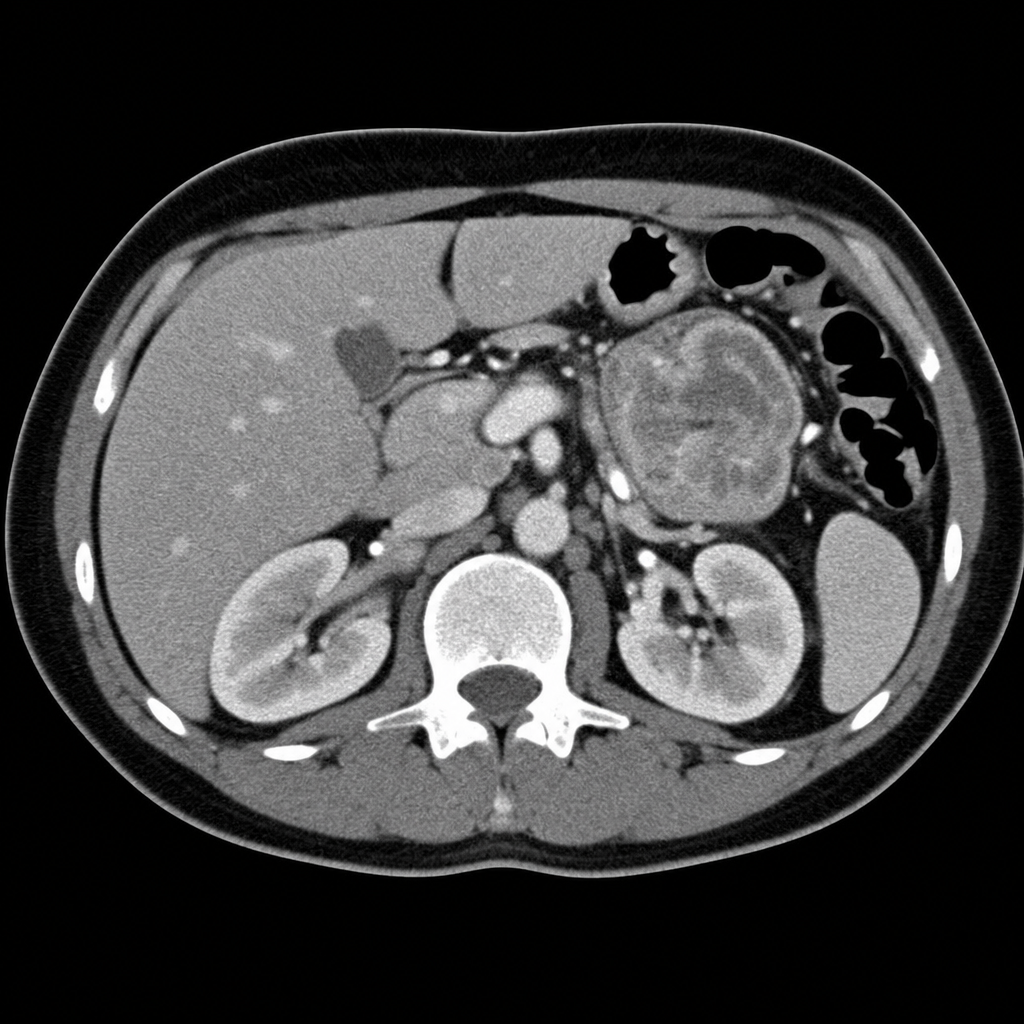
All of the following are clinical features of MEN-II EXCEPT?
Which tumor follows the rule of 10?
Which type of thyroid cancer is most commonly induced by radiation?
A patient presented with neck swelling. Cytology showed parafollicular cells along with clusters of plasmacytoid and few spindle-shaped cells. What investigation should be done to follow up the patient?
What is the typical weight range of adrenal glands in most cases of Cushing's disease?
Hypopituitarism in the adult is usually due to infarction of the pituitary. What is this condition called?
A 38-year-old male presents with paroxysmal hypertension. He is subsequently found to have medullary carcinoma of the thyroid, pheochromocytoma, and mucosal neuromas. Parathyroid involvement is not noted. What is the most likely diagnosis?
Mutation in which of the following genes is most commonly associated with medullary thyroid carcinoma?
A patient presents with weight gain, thinning of hair, and dry skin. Diagnosis is Hashimoto’s thyroiditis. Which antibody is seen in this case?
Histopathological examination showed follicular cells with abundant pink eosinophilic cytoplasm WITHOUT nuclear grooves or ground-glass nuclei. This is most characteristic of?
Explanation: **Explanation:** The Multiple Endocrine Neoplasia (MEN) syndromes are autosomal dominant conditions characterized by tumors involving two or more endocrine glands. This question tests the ability to differentiate between **MEN Type 1 (Wermer Syndrome)** and **MEN Type 2 (Sipple Syndrome/MEN 2B).** **1. Why Pituitary Tumour is the Correct Answer:** Pituitary tumors are a hallmark of **MEN Type 1**, not MEN Type 2 [2]. MEN 1 is classically defined by the "3 Ps": **P**ituitary adenomas (most commonly prolactinomas), **P**arathyroid hyperplasia, and **P**ancreatic islet cell tumors (e.g., Gastrinoma, Insulinoma) [2], [3]. **2. Analysis of Incorrect Options (Features of MEN 2):** * **Medullary Carcinoma of Thyroid (MTC):** This is the most consistent feature of both MEN 2A and 2B (occurring in >95% of cases) [1]. It arises from calcitonin-secreting parafollicular C-cells. * **Phaeochromocytoma:** This occurs in approximately 50% of patients with both MEN 2A and 2B [1]. It is often bilateral and extra-adrenal. * **Neuroma:** Mucosal neuromas (on the tongue, lips, and eyelids) are a pathognomonic clinical sign of **MEN 2B** [1]. **3. High-Yield Clinical Pearls for NEET-PG:** * **Genetic Mutation:** MEN 1 is caused by the *MEN1* gene (Menin protein); MEN 2 (both A and B) is caused by gain-of-function mutations in the **RET proto-oncogene** [1], [3]. * **MEN 2A vs. 2B:** * **MEN 2A:** MTC + Phaeochromocytoma + **Parathyroid hyperplasia** [1]. * **MEN 2B:** MTC + Phaeochromocytoma + **Mucosal Neuromas + Marfanoid habitus** [1]. * **Prophylactic Thyroidectomy:** Due to the high penetrance of MTC, prophylactic removal of the thyroid is often indicated in children carrying the RET mutation. **References:** [1] Kumar V, Abbas AK, et al.. Robbins and Cotran Pathologic Basis of Disease. 9th ed. The Endocrine System, p. 1137. [2] Kumar V, Abbas AK, et al.. Robbins and Cotran Pathologic Basis of Disease. 9th ed. The Endocrine System, pp. 1139-1140. [3] Kumar V, Abbas AK, et al.. Robbins and Cotran Pathologic Basis of Disease. 9th ed. The Endocrine System, pp. 1104-1105.
Explanation: **Explanation:** **Pheochromocytoma** is a catecholamine-secreting tumor derived from chromaffin cells of the adrenal medulla [2]. It is classically associated with the **"Rule of 10s,"** which serves as a high-yield clinical framework for understanding its diverse presentations: * **10% Extra-adrenal:** Occurring in sites like the Organ of Zuckerkandl (referred to as Paragangliomas) [5]. * **10% Bilateral:** Common in familial syndromes (MEN 2A/2B, VHL) [1]. * **10% Malignant:** More common in extra-adrenal sites [2]. * **10% Pediatric:** Usually occurs in children as part of genetic syndromes. * **10% Familial:** (Note: Modern genetics suggest this is now closer to 25-30%) [1]. * **10% Not associated with hypertension.** [4] **Analysis of Incorrect Options:** * **B. Oncocytoma:** A benign renal tumor characterized by cells with abundant mitochondria (eosinophilic cytoplasm). It does not follow a numerical rule of 10. * **C. Lymphoma:** A diverse group of hematologic malignancies. While common, they follow staging systems (Ann Arbor) rather than the rule of 10. * **D. Renal Cell Carcinoma (RCC):** Known as the "internist’s tumor" due to paraneoplastic syndromes, it is associated with the "classic triad" (hematuria, flank pain, palpable mass), but not the rule of 10. **Clinical Pearls for NEET-PG:** * **Diagnosis:** Best initial screening test is **24-hour urinary metanephrines**; the most sensitive plasma test is free metanephrines. * **Histology:** Look for the **"Zellballen" pattern** (nested clusters of cells surrounded by vascular stroma) [3]. * **Management:** Always give **Alpha-blockers (Phenoxybenzamine)** before Beta-blockers to avoid a hypertensive crisis (unopposed alpha-stimulation). **References:** [1] Kumar V, Abbas AK, et al.. Robbins and Cotran Pathologic Basis of Disease. 9th ed. The Endocrine System, p. 1137. [2] Cross SS. Underwood's Pathology: A Clinical Approach. 6th ed. Common Clinical Problems From Liver And Biliary System Disease, pp. 419-420. [3] Kumar V, Abbas AK, et al.. Robbins and Cotran Pathologic Basis of Disease. 9th ed. The Endocrine System, pp. 1137-1138. [4] Kumar V, Abbas AK, et al.. Robbins and Cotran Pathologic Basis of Disease. 9th ed. The Endocrine System, pp. 1138-1139. [5] Kumar V, Abbas AK, et al.. Robbins and Cotran Pathologic Basis of Disease. 9th ed. Head and Neck, pp. 748-749.
Explanation: **Explanation:** **1. Why Papillary Carcinoma is Correct:** Papillary Thyroid Carcinoma (PTC) is the most common thyroid malignancy overall and has the strongest association with **ionizing radiation** exposure (e.g., history of childhood neck irradiation or nuclear accidents like Chernobyl) [1]. Radiation induces specific genetic rearrangements, most notably the **RET/PTC rearrangement**, which is a hallmark of radiation-associated papillary cancer. It typically presents as a "cold" nodule and has an excellent prognosis. **2. Why the Other Options are Incorrect:** * **Follicular Carcinoma:** This is more commonly associated with **dietary iodine deficiency** rather than radiation [1]. Its primary genetic drivers are RAS mutations or the PAX8-PPARγ fusion. * **Anaplastic Carcinoma:** This is a highly aggressive, undifferentiated tumor seen in older adults [2]. While it can arise from pre-existing papillary or follicular cancers, it is not directly "induced" by radiation in the primary sense. * **Medullary Carcinoma:** This arises from parafollicular C-cells (secreting calcitonin) [2]. It is primarily associated with **RET proto-oncogene point mutations** (MEN 2A/2B syndromes) and is not linked to radiation exposure. **3. High-Yield Clinical Pearls for NEET-PG:** * **Microscopic Hallmarks:** Look for **Orphan Annie eye nuclei** (clear/ground-glass nuclei), **Psammoma bodies** (laminated calcifications), and **Nuclear grooves** [1], [2]. * **Genetic Markers:** *BRAF* mutations (most common sporadic) and *RET/PTC* rearrangements (radiation-linked). * **Spread:** Papillary cancer spreads primarily via **lymphatics** (cervical lymphadenopathy), whereas Follicular cancer spreads **hematogenously** [2]. * **Diagnosis:** Fine Needle Aspiration Cytology (FNAC) is the gold standard for Papillary, but it **cannot** distinguish between Follicular Adenoma and Carcinoma (requires histology to see capsular/vascular invasion). **References:** [1] Kumar V, Abbas AK, et al.. Robbins and Cotran Pathologic Basis of Disease. 9th ed. The Endocrine System, pp. 1098-1099. [2] Cross SS. Underwood's Pathology: A Clinical Approach. 6th ed. Common Clinical Problems From Liver And Biliary System Disease, pp. 429-430.
Explanation: ### Explanation The clinical presentation and cytology findings are diagnostic of **Medullary Thyroid Carcinoma (MTC)**. **1. Why Calcitonin is the Correct Answer:** Medullary Thyroid Carcinoma arises from the **parafollicular C-cells** of the thyroid [1][2]. These cells are neuroendocrine in origin and are responsible for the secretion of **Calcitonin** [1]. * **Cytology:** The presence of plasmacytoid cells (eccentric nuclei) and spindle-shaped cells in a background of amyloid (often seen) is a classic cytological hallmark of MTC. * **Follow-up:** Serum Calcitonin levels serve as a highly specific **tumor marker** [1]. It is used for initial diagnosis, monitoring the response to treatment, and detecting postoperative recurrence or metastasis. **2. Why Other Options are Incorrect:** * **TSH Level:** Used primarily to evaluate functional thyroid status (hypo/hyperthyroidism) or to monitor differentiated thyroid cancers (Papillary/Follicular) where TSH suppression is required. MTC does not arise from follicular cells and is not TSH-dependent. * **Anti-TPO Antibody:** This is a marker for autoimmune thyroiditis (e.g., Hashimoto’s thyroiditis), which typically presents with Hurthle cells and lymphocytic infiltration on cytology. * **TRH (Thyrotropin-Releasing Hormone):** Used in dynamic testing for pituitary or hypothalamic dysfunction, not as a follow-up marker for thyroid malignancies. **3. High-Yield Clinical Pearls for NEET-PG:** * **Amyloid Stroma:** MTC is characterized by extracellular amyloid deposits (derived from pro-calcitonin), which stain with **Congo Red** (apple-green birefringence). * **Genetic Association:** Approximately 25% of MTC cases are familial, associated with **MEN 2A and 2B** syndromes due to **RET proto-oncogene** mutations [1]. * **CEA:** Carcinoembryonic Antigen (CEA) is another important tumor marker used alongside Calcitonin for monitoring MTC [1]. * **IHC Markers:** MTC stains positive for Calcitonin, Chromogranin A, and Synaptophysin. **References:** [1] Kumar V, Abbas AK, et al.. Robbins and Cotran Pathologic Basis of Disease. 9th ed. The Endocrine System, pp. 1102-1103. [2] Cross SS. Underwood's Pathology: A Clinical Approach. 6th ed. Common Clinical Problems From Liver And Biliary System Disease, pp. 424-426.
Explanation: ### Explanation **Concept Overview:** In **Cushing’s Disease**, the primary pathology is an ACTH-secreting pituitary adenoma. This excess ACTH causes **bilateral diffuse cortical hyperplasia** of the adrenal glands [1]. Under constant trophic stimulation, the adrenal cortex (specifically the zona fasciculata and reticularis) thickens, leading to a significant increase in total glandular weight [1]. **Why Option D is Correct:** The normal combined weight of both adrenal glands is approximately **8–10 grams**. In cases of ACTH-dependent Cushing’s disease, the glands undergo marked hyperplasia. Most pathology textbooks (including Robbins) state that in these cases, the combined weight typically ranges from **25 to 40 grams**. The glands appear thickened, yellow (due to lipid content), and may show subtle nodularity. **Analysis of Incorrect Options:** * **Option A (4-11 gm):** This represents the **normal weight range** of healthy adrenal glands. * **Option B & C (11-24 gm):** These ranges represent mild enlargement. While the weight can technically fall here in very early stages, the "typical" diagnostic range for established hyperplasia in Cushing's disease is significantly higher (>25 gm). **High-Yield Clinical Pearls for NEET-PG:** * **Cushing’s Disease vs. Syndrome:** "Disease" specifically refers to a pituitary origin (ACTH-dependent), while "Syndrome" is the clinical manifestation of hypercortisolism from any cause. * **Morphology:** In Cushing’s disease, the hyperplasia is usually **diffuse**. If the cause is ectopic ACTH (e.g., Small Cell Lung Cancer), the glands can become even heavier than 40 grams [2]. * **Adrenal Atrophy:** If the Cushing’s syndrome is caused by an **exogenous glucocorticoid** intake, the adrenal glands will be **atrophic** (bilateral decrease in weight) due to the suppression of the hypothalamic-pituitary-adrenal (HPA) axis [1]. * **Crooke Hyaline Change:** This is a high-yield microscopic finding in the **pituitary gland** (not adrenal) where normal ACTH-producing cells accumulate intermediate keratin filaments due to high cortisol levels [1]. **References:** [1] Kumar V, Abbas AK, et al.. Robbins and Cotran Pathologic Basis of Disease. 9th ed. The Endocrine System, pp. 1127-1129. [2] Cross SS. Underwood's Pathology: A Clinical Approach. 6th ed. Common Clinical Problems From Liver And Biliary System Disease, pp. 421-423.
Explanation: **Explanation:** **Simmonds' disease** (Option A) refers to chronic panhypopituitarism in adults, typically resulting from the destruction of the anterior pituitary gland [1]. While it can be caused by tumors or trauma [2], the most classic etiology is **ischemic infarction**. A specific subtype of this condition is **Sheehan syndrome**, which occurs due to postpartum pituitary necrosis following severe obstetric hemorrhage [2]. In Simmonds' disease, the loss of pituitary hormones leads to secondary atrophy of the thyroid, adrenal cortex, and gonads [1], manifesting as cachexia, loss of secondary sexual characteristics, and hypotension. **Why other options are incorrect:** * **Hilton’s disease (Option B):** This is not a recognized medical term for a systemic disease; however, "Hilton’s Law" in orthopedics states that the nerve supplying a joint also supplies the muscles moving the joint and the skin over it. * **Wilson disease (Option C):** An autosomal recessive disorder of copper metabolism characterized by toxic accumulation of copper in the liver, brain (basal ganglia), and eyes (Kayser-Fleischer rings). * **Addison disease (Option D):** This refers to **primary adrenocortical insufficiency** (destruction of the adrenal cortex itself), not a pituitary issue [1]. While Simmonds' disease causes *secondary* adrenal insufficiency, Addison disease is typically autoimmune or infectious (e.g., TB) in origin. **NEET-PG High-Yield Pearls:** * **Sheehan Syndrome:** The most common cause of ischemic necrosis of the anterior pituitary [2]. The first clinical sign is usually the **failure to lactate** (due to prolactin deficiency). * **Empty Sella Syndrome:** Another cause of hypopituitarism where the pituitary is compressed or absent from the sella turcica on imaging. * **Pituitary Apoplexy:** An acute, life-threatening hemorrhage into a pituitary adenoma, presenting with sudden "thunderclap" headache and visual disturbances [1]. **References:** [1] Kumar V, Abbas AK, et al.. Robbins and Cotran Pathologic Basis of Disease. 9th ed. The Endocrine System, pp. 1134-1135. [2] Cross SS. Underwood's Pathology: A Clinical Approach. 6th ed. Common Clinical Problems From Liver And Biliary System Disease, pp. 416-417.
Explanation: ### Explanation The correct diagnosis is **Multiple Endocrine Neoplasia type IIB (MEN IIB)**. **1. Why MEN IIB is correct:** MEN IIB (also known as MEN 3) is an autosomal dominant syndrome caused by a specific germline mutation in the **RET proto-oncogene** (typically M918T). The classic clinical triad includes [1]: * **Medullary Thyroid Carcinoma (MTC):** Occurs in 100% of cases, often more aggressive and appearing earlier than in MEN IIA [2]. * **Pheochromocytoma:** Presents with paroxysmal hypertension [1], [3]. * **Mucosal Neuromas/Marfanoid Habitus:** This is the pathognomonic feature that distinguishes IIB from IIA [1]. Mucosal neuromas typically involve the tongue, lips, and eyelids. **2. Why other options are incorrect:** * **MEN I (Wermer’s Syndrome):** Characterized by the "3 Ps": **P**arathyroid hyperplasia, **P**ituitary adenoma, and **P**ancreatic neuroendocrine tumors. It does not involve MTC or Pheochromocytoma. * **MEN IIA (Sipple’s Syndrome):** While it includes MTC and Pheochromocytoma, it is characterized by **Parathyroid hyperplasia** [1]. It lacks the mucosal neuromas and marfanoid habitus seen in this patient. * **Sipple’s Syndrome:** This is simply another name for MEN IIA. Since the patient has mucosal neuromas and no parathyroid involvement, this is incorrect. **3. High-Yield Clinical Pearls for NEET-PG:** * **RET Proto-oncogene:** Mutations are central to both MEN IIA and IIB. Prophylactic thyroidectomy is often indicated in carriers. * **MEN IIB Phenotype:** Look for "bumpy" lips (neuromas) and long limbs (marfanoid habitus) in clinical vignettes [1]. * **Screening:** In any patient with Medullary Thyroid Carcinoma, always rule out Pheochromocytoma (via urinary metanephrines) *before* surgery to prevent a hypertensive crisis during anesthesia [3]. **References:** [1] Kumar V, Abbas AK, et al.. Robbins and Cotran Pathologic Basis of Disease. 9th ed. The Endocrine System, p. 1137. [2] Kumar V, Abbas AK, et al.. Robbins and Cotran Pathologic Basis of Disease. 9th ed. The Endocrine System, pp. 1102-1103. [3] Kumar V, Abbas AK, et al.. Robbins and Cotran Pathologic Basis of Disease. 9th ed. The Endocrine System, pp. 1138-1139.
Explanation: ***RET***- The **RET proto-oncogene** mutation is the defining genetic feature of medullary thyroid carcinoma (MTC), which arises from parafollicular C-cells. [1] - Germline mutations in **RET** are responsible for hereditary forms of MTC, including **Multiple Endocrine Neoplasia type 2 (MEN 2A and 2B)**, making it the most critical diagnostic marker. [1] *RAS* - Mutations in the **RAS family** of genes (NRAS, HRAS, KRAS) are highly prevalent in **follicular thyroid carcinoma (FTC)** and follicular variants of papillary thyroid carcinoma (PTC). - These mutations are typically associated with a less aggressive tumor phenotype compared to RET or BRAF alterations. *BRAF* - The **BRAF V600E mutation** is the most common genetic alteration found in **papillary thyroid carcinoma (PTC)**, specifically the classical and tall cell variants. - The presence of **BRAF V600E** often correlates with increased risk of aggressive features, such as lymph node metastasis and extrathyroidal extension in PTC. *TP53* - **TP53** is a tumor suppressor gene whose mutations are primarily seen in highly aggressive, **anaplastic (undifferentiated) thyroid carcinoma (ATC)**. - Mutations in **TP53** indicate a progression from well-differentiated tumors and are associated with a very poor prognosis. **References:** [1] Kumar V, Abbas AK, et al.. Robbins and Cotran Pathologic Basis of Disease. 9th ed. The Endocrine System, pp. 1139-1140.
Explanation: ***Anti-TPO antibody*** - **Anti-thyroid peroxidase (Anti-TPO)** antibodies are the classic serological marker for Hashimoto's thyroiditis, present in over 90% of cases. They target an enzyme essential for the synthesis of thyroid hormones. - The presence of these antibodies signifies an autoimmune process causing lymphocytic infiltration (as seen with **germinal centers** [2] in the image) and destruction of thyroid follicular cells [1], leading to **hypothyroidism** and characteristic **Hürthle cell** changes [2]. *Anti-TSH receptor antibody* - Antibodies against the **TSH receptor** are primarily associated with **Graves' disease**, where they typically stimulate the receptor, causing hyperthyroidism [3]. - While blocking anti-TSH receptor antibodies can cause hypothyroidism, they are much less common in Hashimoto's than **Anti-TPO** and **anti-thyroglobulin** antibodies. *Anti TBG* - **Thyroxine-binding globulin (TBG)** is a carrier protein for thyroid hormones in the blood, and its levels can be altered by various conditions or medications, but autoantibodies against it are not a standard marker for autoimmune thyroid disease. - Diagnosis of Hashimoto's relies on detecting antibodies against thyroid cellular components like **peroxidase** and **thyroglobulin**, not transport proteins like TBG. *Long-acting thyroid-stimulating antibody* - **Long-acting thyroid-stimulating antibody (LATS)** is an older term for a type of **TSH receptor antibody** (specifically a **Thyroid-Stimulating Immunoglobulin, TSI**) that is characteristic of **Graves' disease** [3]. - These antibodies cause hyperthyroidism by continuously stimulating the thyroid gland, which is the opposite pathophysiology of the hypothyroidism seen in Hashimoto's thyroiditis [3]. **References:** [1] Kumar V, Abbas AK, et al.. Robbins and Cotran Pathologic Basis of Disease. 9th ed. The Endocrine System, pp. 1089-1090. [2] Kumar V, Abbas AK, et al.. Robbins and Cotran Pathologic Basis of Disease. 9th ed. The Endocrine System, pp. 1090-1091. [3] Cross SS. Underwood's Pathology: A Clinical Approach. 6th ed. Common Clinical Problems From Liver And Biliary System Disease, pp. 424-426.
Explanation: ***Follicular CA (Hürthle cell variant)*** - The description of **follicular cells with abundant pink eosinophilic cytoplasm** is characteristic of the **Hürthle cell variant** (also known as the oncocytic or oxyphil variant) of follicular thyroid carcinoma. - This **eosinophilic appearance** is due to the presence of numerous abnormal **mitochondria** within the cytoplasm of the tumor cells. - The **absence of nuclear features** (grooves, ground-glass nuclei) helps distinguish this from the Hürthle cell variant of papillary carcinoma [2], [3]. - Diagnosis requires evidence of **capsular or vascular invasion** to differentiate from Hürthle cell adenoma [1], [5]. *Papillary CA* - While papillary carcinoma can also have a **Hürthle cell variant**, it would show characteristic **nuclear changes** including **Orphan Annie eye nuclei** (ground-glass chromatin), **nuclear grooves**, and **intranuclear pseudoinclusions** [3], [4]. - The question specifically excludes these nuclear features, making follicular carcinoma more likely. - The classic variant shows papillary architecture with defining nuclear features [3]. *Medullary CA* - This tumor originates from **parafollicular C-cells** (not follicular cells) and is characterized by the presence of **amyloid deposits** (derived from calcitonin) in the stroma [4], [5]. - The tumor cells are usually spindle or polygonal and lack the described eosinophilic follicular cell morphology. - Positive for **calcitonin** and **CEA** on immunohistochemistry. *Anaplastic CA* - Anaplastic carcinoma is highly undifferentiated and consists of bizarre, **highly pleomorphic cells**, including spindle cells and **multinucleated giant cells** [4]. - It is characterized by extensive necrosis, high mitotic activity, and lacks the structural and cellular uniformity of differentiated follicular tumors. - Shows aggressive invasive behavior with poor prognosis [4]. **References:** [1] Kumar V, Abbas AK, et al.. Robbins and Cotran Pathologic Basis of Disease. 9th ed. The Endocrine System, pp. 1100-1101. [2] Kumar V, Abbas AK, et al.. Robbins and Cotran Pathologic Basis of Disease. 9th ed. The Endocrine System, pp. 1099-1100. [3] Kumar V, Abbas AK, et al.. Robbins and Cotran Pathologic Basis of Disease. 9th ed. The Endocrine System, p. 1099. [4] Cross SS. Underwood's Pathology: A Clinical Approach. 6th ed. Common Clinical Problems From Liver And Biliary System Disease, pp. 429-430. [5] Cross SS. Underwood's Pathology: A Clinical Approach. 6th ed. Common Clinical Problems From Liver And Biliary System Disease, pp. 428-429.
Pituitary Gland Disorders
Practice Questions
Thyroid Gland Diseases
Practice Questions
Parathyroid Gland Pathology
Practice Questions
Adrenal Cortical Disorders
Practice Questions
Adrenal Medullary Disorders
Practice Questions
Pancreatic Endocrine Disorders
Practice Questions
Multiple Endocrine Neoplasia Syndromes
Practice Questions
Diffuse Neuroendocrine System
Practice Questions
Pineal Gland Pathology
Practice Questions
Laboratory Diagnosis of Endocrine Diseases
Practice Questions
Get full access to all questions, explanations, and performance tracking.
Start For Free