Waterhouse-Friderichsen Syndrome is:
Thyroid carcinoma with pulsatile vascular skeletal metastasis is:
Which carcinoma is most commonly associated with adenomatoid goiter?
Hurthle cells are characteristically found in which of the following conditions?
A 58-year-old man with a long-standing history of type 2 diabetes mellitus suffers a massive hemorrhagic stroke and expires. Examination of the pancreas shows hyalinization of many islets of Langerhans. Which of the following characterizes the material within the islets of Langerhans?
Follicular carcinoma of the thyroid is associated with mutations in which gene?
Which type of thyroid cancer is known to occur after radiation exposure?
De Quervain's thyroiditis is also known as:
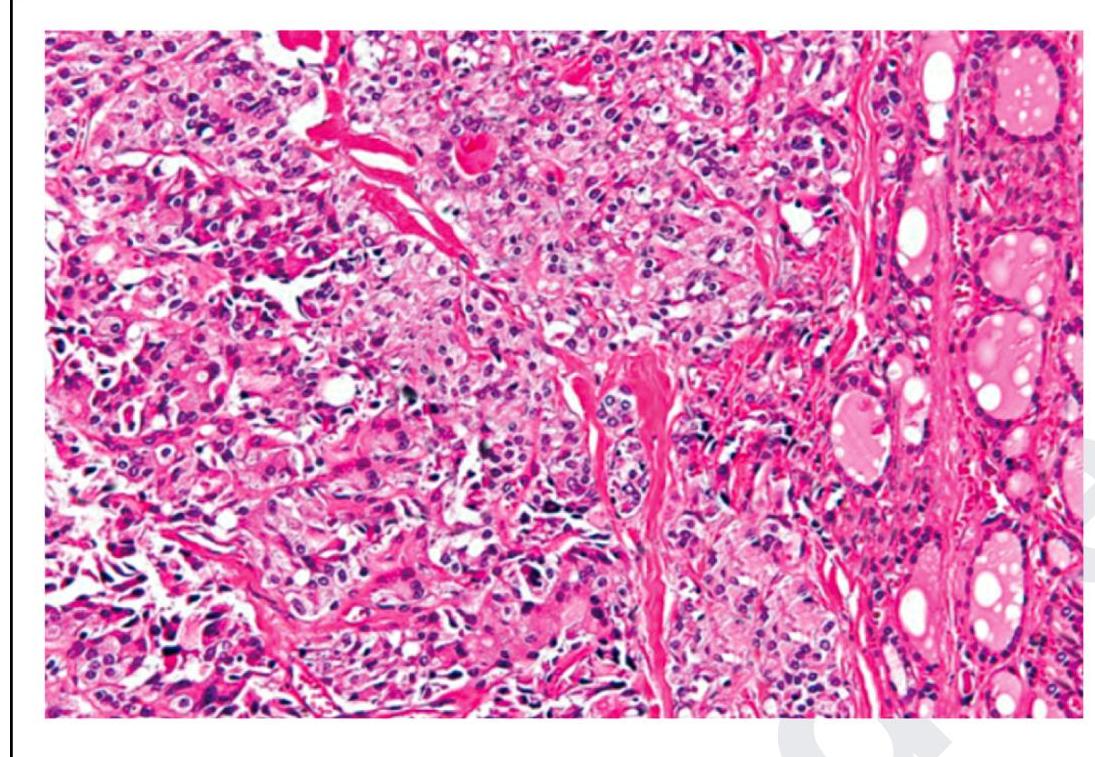
A palpable mass is noted in the right lobe of the thyroid of a 45-year-old man who visits his physician for a periodic checkup. A biopsy is performed and results in a diagnosis of medullary carcinoma of the thyroid. Which of the following histologic features of thyroid disease would most likely be present in this biopsy specimen?
A 35-year-old woman complains of nipple discharge and irregular menses of 5 months duration. Physical examination reveals a milky discharge from both nipples. MRI shows an enlargement of the anterior pituitary. Which of the following is the most likely histologic diagnosis of this patient's pituitary tumor?
Explanation: **Explanation:** **Waterhouse-Friderichsen Syndrome (WFS)** is a catastrophic form of acute primary adrenal insufficiency [3] characterized by bilateral adrenal hemorrhage [1]. **Why Option C is Correct:** The syndrome is classically associated with **disseminated bacterial infection**, most commonly **Neisseria meningitidis** (Meningococcemia). The pathogenesis involves severe septicemia leading to **Disseminated Intravascular Coagulation (DIC)** [2]. This triggers widespread microvascular thrombosis and subsequent massive hemorrhagic infarction of the adrenal glands, resulting in acute adrenal crisis, hypotension, and shock [1]. **Analysis of Incorrect Options:** * **Option A:** Rapid withdrawal of exogenous steroids causes acute adrenal insufficiency due to suppression of the HPA axis, but it does not typically cause adrenal hemorrhage. * **Option B:** While difficult labor can cause neonatal adrenal hemorrhage, this is a localized mechanical/ischemic event and is not termed Waterhouse-Friderichsen Syndrome, which specifically implies a septic/infectious etiology. * **Option D:** This describes an **Addisonian Crisis**. While clinically similar in presentation (acute shock), it occurs in patients with pre-existing chronic insufficiency (Addison’s disease) rather than de novo hemorrhage due to sepsis [3]. **High-Yield Clinical Pearls for NEET-PG:** * **Most Common Organism:** *Neisseria meningitidis* (others include *H. influenzae*, *Staphylococci*, and *Pseudomonas*). * **Classic Triad:** Septicemia, DIC (petechial rashes/purpura), and bilateral adrenal hemorrhage. * **Pathology:** Grossly, the adrenals appear as "sacs of blood" [1]. Microscopically, there is total destruction of the cortex. * **Clinical Sign:** Look for "Purpura fulminans" in the clinical vignette. **References:** [1] Kumar V, Abbas AK, et al.. Robbins and Cotran Pathologic Basis of Disease. 9th ed. The Endocrine System, p. 1133. [2] Kumar V, Abbas AK, et al.. Robbins and Cotran Pathologic Basis of Disease. 9th ed. Red Blood Cell and Bleeding Disorders, pp. 672-673. [3] Cross SS. Underwood's Pathology: A Clinical Approach. 6th ed. Common Clinical Problems From Liver And Biliary System Disease, pp. 423-424.
Explanation: **Explanation:** **Follicular Thyroid Carcinoma (FTC)** is the correct answer because of its unique mode of metastasis. Unlike other thyroid cancers, FTC characteristically spreads via the **hematogenous route** (bloodstream) [1]. It has a high affinity for bones (especially the skull, ribs, and pelvis). Because FTC is a highly vascular tumor, these secondary deposits are often extremely vascular, leading to the classic clinical presentation of **pulsatile bone metastasis.** **Analysis of Options:** * **Papillary Thyroid Carcinoma (PTC):** This is the most common thyroid cancer [1]. It primarily spreads via the **lymphatics** to local cervical lymph nodes ("Orphan Annie eye" nuclei and Psammoma bodies are hallmarks) [1]. Bone metastasis is rare and typically non-pulsatile. * **Medullary Thyroid Carcinoma (MTC):** Derived from parafollicular C-cells, it secretes calcitonin [1]. While it can spread to bones, it does not typically form the hypervascular, pulsatile lesions associated with FTC. * **Anaplastic Carcinoma:** This is a highly aggressive, undifferentiated tumor [1]. It usually presents with rapid local invasion of neck structures (causing dysphagia or dyspnea) rather than isolated pulsatile skeletal deposits. **High-Yield Clinical Pearls for NEET-PG:** * **Pulsatile Metastasis Triad:** The three most common causes of pulsatile bone secondaries are **Follicular Thyroid Ca**, **Renal Cell Carcinoma (RCC)**, and sometimes Hepatocellular Carcinoma (HCC) [3]. * **Diagnosis:** FTC cannot be diagnosed by FNAC because FNAC cannot distinguish between a follicular adenoma and carcinoma; **capsular or vascular invasion** on histology is mandatory for a diagnosis of malignancy [2]. * **Iodine Deficiency:** FTC is more common in areas with dietary iodine deficiency. **References:** [1] Cross SS. Underwood's Pathology: A Clinical Approach. 6th ed. Common Clinical Problems From Liver And Biliary System Disease, pp. 429-430. [2] Cross SS. Underwood's Pathology: A Clinical Approach. 6th ed. Common Clinical Problems From Liver And Biliary System Disease, pp. 428-429. [3] Cross SS. Underwood's Pathology: A Clinical Approach. 6th ed. Common Clinical Problems From Osteoarticular And Connective Tissue Disease, pp. 671-672.
Explanation: **Explanation:** The correct answer is **Follicular Carcinoma (Option B)**. **Understanding the Concept:** Adenomatoid goiter (also known as Multinodular Goiter or MNG) is characterized by prolonged periods of follicular hyperplasia and involution [1]. This chronic stimulation and the presence of numerous follicular nodules create a microenvironment where **Follicular Carcinoma** is more likely to arise. Both conditions share a common lineage (follicular cells) and often present as "cold" nodules on scintigraphy. In regions with iodine deficiency, where goiters are endemic, the incidence of Follicular Carcinoma is significantly higher compared to Papillary Carcinoma [1]. **Why other options are incorrect:** * **Papillary Carcinoma (Option C):** While it is the most common thyroid malignancy overall, it is typically associated with radiation exposure or specific genetic mutations (BRAF, RET/PTC) rather than a pre-existing adenomatoid goiter [1]. * **Medullary Carcinoma (Option A):** This arises from the parafollicular C-cells (neuroendocrine origin), not the follicular cells [2]. It is associated with MEN 2A/2B syndromes and is unrelated to goitrous changes. * **Anaplastic Carcinoma (Option D):** Although it can arise from a long-standing goiter or dedifferentiate from a follicular/papillary carcinoma, it is much rarer than the primary follicular variant in this context. **NEET-PG High-Yield Pearls:** * **Most common thyroid cancer:** Papillary Carcinoma (Orphan Annie eye nuclei, Psammoma bodies) [1]. * **Cancer associated with Iodine deficiency:** Follicular Carcinoma [1]. * **Diagnosis of Follicular Carcinoma:** Cannot be made by FNAC; requires histopathology to demonstrate **capsular or vascular invasion**. * **Hematogenous spread:** Follicular carcinoma is unique among epithelial cancers for spreading via blood (often to bone/lungs) rather than lymphatics [2]. **References:** [1] Kumar V, Abbas AK, et al.. Robbins and Cotran Pathologic Basis of Disease. 9th ed. The Endocrine System, pp. 1094-1099. [2] Cross SS. Underwood's Pathology: A Clinical Approach. 6th ed. Common Clinical Problems From Liver And Biliary System Disease, pp. 428-429.
Explanation: **Explanation:** **Hurthle cells** (also known as oxyphil cells or Askanazy cells) are modified follicular epithelial cells. They are characterized by an abundant, granular, eosinophilic cytoplasm and a prominent nucleolus. This granular appearance is due to the **accumulation of altered mitochondria**. **Why Follicular Adenoma is correct:** Hurthle cells are a hallmark feature of several thyroid conditions, most notably **Hashimoto’s thyroiditis** and **Hurthle cell tumors** (which are variants of Follicular Adenoma or Carcinoma) [1]. In a Follicular Adenoma, if more than 50% of the tumor is composed of these cells, it is specifically termed a Hurthle cell adenoma. **Analysis of Incorrect Options:** * **A. Medullary Carcinoma:** This tumor arises from **Parafollicular C-cells** (neuroendocrine origin), not follicular cells. It is characterized by amyloid stroma and calcitonin production. * **B. Papillary Carcinoma:** The diagnostic hallmarks are nuclear features like **Orphan Annie eye nuclei**, Psammoma bodies, and nuclear grooves, rather than Hurthle cell change. * **D. Pituitary Adenoma:** These are classified based on the hormones they secrete (e.g., Prolactinoma) and consist of acidophils, basophils, or chromophobes, but do not contain Hurthle cells. **High-Yield Clinical Pearls for NEET-PG:** * **Mnemonic:** Hurthle cells = **H**ashimoto’s and **H**urthle cell tumors [1]. * **Staining:** They stain intensely with **PTAH** (Phosphotungstic Acid Hematoxylin) due to the high mitochondrial content. * **Fine Needle Aspiration (FNA):** It is impossible to distinguish between a Hurthle cell adenoma and carcinoma via FNA; vascular or capsular invasion must be seen on histology. * **Scintigraphy:** Hurthle cell tumors are typically "cold" nodules on iodine uptake scans. **References:** [1] Cross SS. Underwood's Pathology: A Clinical Approach. 6th ed. Common Clinical Problems From Liver And Biliary System Disease, pp. 427-428.
Explanation: The correct answer is **A. Amyloid**. In **Type 2 Diabetes Mellitus (T2DM)**, the characteristic histopathological finding in the pancreas is the deposition of **amyloid** within the Islets of Langerhans [1]. This occurs because beta cells co-secrete insulin along with a peptide called **Amylin** (Islet Amyloid Polypeptide - IAPP). In the insulin-resistant state of T2DM, there is a compensatory hypersecretion of insulin and amylin. Over time, this excess amylin misfolds and aggregates into insoluble amyloid fibrils, leading to the "hyalinization" seen on light microscopy [2]. This process is cytotoxic to beta cells, further contributing to the progression of the disease. **Why other options are incorrect:** * **B. Collagen type IV:** This is a major component of the basement membrane. While thickening of the capillary basement membrane (microangiopathy) is a hallmark of diabetes, it is not the primary constituent of the hyalinized islet masses. * **C. Fibrin:** This is involved in acute inflammation and the coagulation cascade (e.g., fibrinous pericarditis). It does not form chronic hyaline deposits in the islets. * **D. Fibronectin:** This is a glycoprotein involved in cell adhesion and wound healing; it is not the material found in islet hyalinization. **High-Yield NEET-PG Pearls:** * **T1DM vs. T2DM Histology:** T1DM is characterized by **Insulitis** (lymphocytic infiltration), whereas T2DM is characterized by **Amyloid/Hyalinization**. * **Staining:** Amyloid shows **Apple-green birefringence** under polarized light when stained with **Congo Red** [1]. * **Amylin (IAPP):** It is the specific precursor protein for amyloid in the pancreas. * **Insulinoma:** Amyloid deposition can also be seen in the stroma of an Insulinoma (a pancreatic neuroendocrine tumor). **References:** [1] Kumar V, Abbas AK, et al.. Robbins and Cotran Pathologic Basis of Disease. 9th ed. Diseases of the Immune System, pp. 268-269. [2] Kumar V, Abbas AK, et al.. Robbins and Cotran Pathologic Basis of Disease. 9th ed. Diseases of the Immune System, pp. 264-266.
Explanation: **Explanation:** Follicular Carcinoma of the Thyroid (FTC) is primarily driven by mutations in the **RAS oncogene** (specifically N-RAS, H-RAS, and K-RAS) or the **PAX8-PPARG** fusion gene [1]. RAS mutations are found in approximately 40-50% of follicular carcinomas and are also frequently seen in follicular adenomas, suggesting they are an early event in follicular tumorigenesis. **Analysis of Options:** * **A. RAS (Correct):** Mutations in the RAS family of oncogenes lead to constitutive activation of the MAPK and PI3K/AKT signaling pathways, promoting uncontrolled follicular cell proliferation [1]. * **B. HGF:** Hepatocyte Growth Factor (HGF) and its receptor MET are more commonly associated with Papillary Thyroid Carcinoma (PTC) and tumor invasion, but are not the primary drivers for FTC. * **C. RET:** Rearrangements in the *RET* gene (RET/PTC) are characteristic of **Papillary Thyroid Carcinoma** [1], while point mutations in *RET* are the hallmark of **Medullary Thyroid Carcinoma** (both sporadic and MEN 2 syndromes). * **D. ABL:** The *c-ABL* gene is typically associated with the BCR-ABL translocation (Philadelphia chromosome) seen in **Chronic Myeloid Leukemia (CML)**, not thyroid pathology. **High-Yield Clinical Pearls for NEET-PG:** * **Spread:** Unlike Papillary carcinoma (lymphatic spread), Follicular carcinoma spreads **hematogenously** (commonly to bone and lungs). * **Diagnosis:** FTC cannot be diagnosed by FNAC; histological evidence of **capsular or vascular invasion** is mandatory to differentiate it from Follicular Adenoma. * **Iodine:** FTC is more common in areas of **dietary iodine deficiency** [1]. * **Hurthle Cell Carcinoma:** A variant of FTC characterized by cells with abundant granular eosinophilic cytoplasm (due to mitochondria). **References:** [1] Kumar V, Abbas AK, et al.. Robbins and Cotran Pathologic Basis of Disease. 9th ed. The Endocrine System, pp. 1097-1099.
Explanation: **Explanation:** **1. Why Papillary Carcinoma is Correct:** Papillary Thyroid Carcinoma (PTC) is the most common thyroid malignancy and has a well-established association with **ionizing radiation exposure**, especially during childhood [1]. Radiation induces DNA damage, specifically leading to chromosomal rearrangements. The most characteristic genetic alteration associated with radiation-induced PTC is the **RET/PTC rearrangement** (a fusion of the *RET* proto-oncogene with the *PTC* gene). This was famously observed in the high incidence of thyroid cancers following the Chernobyl disaster [1]. **2. Why the Other Options are Incorrect:** * **Follicular Carcinoma:** This is primarily associated with **iodine deficiency** and mutations in the **RAS** oncogene or the **PAX8-PPAR̳** fusion protein [1]. It is not classically linked to radiation. * **Medullary Carcinoma:** This arises from parafollicular C-cells. It is associated with **RET point mutations** (not rearrangements) and is often part of **MEN 2A or 2B** syndromes. It has no known link to radiation. * **Anaplastic Carcinoma:** This is a highly aggressive, undifferentiated tumor typically occurring in elderly patients. While it can arise from pre-existing differentiated thyroid cancers, it is not the primary cancer associated with radiation exposure. **3. High-Yield Clinical Pearls for NEET-PG:** * **Most common** thyroid cancer: Papillary Carcinoma [1]. * **Microscopic Hallmarks:** Orphan Annie eye nuclei (empty-appearing), Psammoma bodies (calcifications), and Nuclear grooves. * **Route of Spread:** Papillary spreads via **lymphatics** (cervical nodes), whereas Follicular spreads **hematogenously** (bones/lungs). * **Best Prognosis:** Papillary; **Worst Prognosis:** Anaplastic. * **Diagnosis:** Fine Needle Aspiration Cytology (FNAC) is the gold standard for Papillary, but **cannot** distinguish between Follicular Adenoma and Carcinoma (requires histology to see capsular/vascular invasion). **References:** [1] Kumar V, Abbas AK, et al.. Robbins and Cotran Pathologic Basis of Disease. 9th ed. The Endocrine System, pp. 1098-1099.
Explanation: **De Quervain’s thyroiditis**, also known as **Subacute Granulomatous Thyroiditis**, is a self-limiting inflammatory condition of the thyroid gland, typically following a viral upper respiratory tract infection. ### **Explanation of Options** * **A. Granulomatous thyroiditis (Correct):** The hallmark histological feature of De Quervain’s is the presence of **multinucleated giant cells** and **granulomas** surrounding collapsed thyroid follicles. This is a response to the release of colloid into the interstitium, hence the name. * **B & D. Struma lymphomatosa / Hashimoto's thyroiditis (Incorrect):** These are synonyms for the same condition. Hashimoto’s is a chronic autoimmune thyroiditis characterized by a lymphocytic infiltrate, Hürthle cells, and germinal center formation, rather than granulomas [1]. * **C. Acute thyroiditis (Incorrect):** Also known as Acute Suppurative Thyroiditis, this is a rare bacterial infection (usually *Staph* or *Strep*) characterized by abscess formation and neutrophils. ### **High-Yield Clinical Pearls for NEET-PG** * **Etiology:** Post-viral (Coxsackie, Mumps, Adenovirus). Strongly associated with **HLA-B35**. * **Clinical Presentation:** It is the **most common cause of a painful/tender thyroid gland**. Patients often present with jaw pain and fever. * **Triphasic Course:** Initial hyperthyroidism (due to follicle destruction), followed by transient hypothyroidism, and finally a return to euthyroid state [2]. * **Lab Findings:** Characterized by a **markedly elevated ESR** and a **low radioactive iodine uptake (RAIU)** during the thyrotoxic phase (due to gland damage) [2]. * **Treatment:** Usually self-limiting; managed with NSAIDs or corticosteroids for pain. **References:** [1] Kumar V, Abbas AK, et al.. Robbins and Cotran Pathologic Basis of Disease. 9th ed. The Endocrine System, pp. 1090-1091. [2] Kumar V, Abbas AK, et al.. Robbins and Cotran Pathologic Basis of Disease. 9th ed. The Endocrine System, pp. 1091-1092.
Explanation: **Medullary Thyroid Carcinoma (MTC)** is a neuroendocrine neoplasm derived from the **parafollicular C-cells** of the thyroid [1], [2]. These cells are responsible for secreting **calcitonin** [1]. 1. **Why Option C is Correct:** The hallmark histological feature of MTC is the presence of polygonal to spindle-shaped cells arranged in nests, follicles, or sheets, separated by a fibrovascular stroma containing **amyloid deposits** [1]. This amyloid is formed by the polymerization of excess **procalcitonin** molecules secreted by the tumor cells. On microscopy, this amyloid demonstrates characteristic "apple-green birefringence" under polarized light when stained with Congo Red [1]. 2. **Why Other Options are Incorrect:** * **Options A & B:** "Orphan Annie" eye nuclei (large, pale nuclei with central clearing) and **Psammoma bodies** (laminated calcifications) are classic diagnostic features of **Papillary Thyroid Carcinoma**, the most common thyroid malignancy [1]. * **Option D:** Lymphocytic infiltrates with germinal center formation are characteristic of **Hashimoto Thyroiditis**, an autoimmune condition that increases the risk of B-cell lymphomas, not MTC. **High-Yield Clinical Pearls for NEET-PG:** * **Origin:** Derived from C-cells (ultimobranchial body/neural crest origin). * **Genetics:** Approximately 20-25% are familial, associated with **MEN 2A and 2B** syndromes involving **RET proto-oncogene** mutations [1], [2]. * **Biomarker:** Serum **Calcitonin** is used for diagnosis and monitoring recurrence; Carcinoembryonic Antigen (CEA) is also often elevated [2]. * **Staining:** Positive for Calcitonin, Chromogranin A, and Synaptophysin [1]. **References:** [1] Cross SS. Underwood's Pathology: A Clinical Approach. 6th ed. Common Clinical Problems From Liver And Biliary System Disease, pp. 428-431. [2] Kumar V, Abbas AK, et al.. Robbins and Cotran Pathologic Basis of Disease. 9th ed. The Endocrine System, pp. 1102-1103.
Explanation: **Explanation:** The clinical presentation of **bilateral milky nipple discharge (galactorrhea)** and **irregular menses** (amenorrhea-galactorrhea syndrome) in a young woman, combined with an enlarged anterior pituitary on MRI, is classic for a **Prolactinoma** [1]. 1. **Why Adenoma is correct:** Pituitary adenomas are the most common cause of hyperpituitarism. Prolactinomas are the most frequent type of functional pituitary adenoma [2]. They secrete excess prolactin, which inhibits GnRH, leading to decreased LH/FSH (causing irregular menses/infertility) and directly stimulates milk production (galactorrhea) [1]. Histologically, these are benign epithelial neoplasms characterized by cellular monomorphism and an absence of a reticulin network. 2. **Why incorrect options are wrong:** * **Choriostoma:** This is a mass of histologically normal tissue in an abnormal anatomical location (e.g., gastric mucosa in the ileum). It is not a primary pituitary neoplasm. * **Hamartoma:** A disorganized but mature mass of indigenous tissue (e.g., hypothalamic hamartoma). While they can occur in the CNS, they do not typically present as anterior pituitary masses causing galactorrhea. * **Papilloma:** This refers to a benign epithelial tumor growing in exophytic projections. While Choroid Plexus Papillomas exist in the brain, they do not occur in the anterior pituitary. **High-Yield Clinical Pearls for NEET-PG:** * **Most common pituitary adenoma:** Prolactinoma [3]. * **Microadenoma vs. Macroadenoma:** Cut-off is **10 mm (1 cm)**. * **Histology Gold Standard:** Loss of the **reticulin network** (demonstrated by Reticulin stain) distinguishes an adenoma from normal pituitary acini. * **Treatment of choice:** Unlike most adenomas, Prolactinomas are primarily treated medically with **Dopamine agonists** (Cabergoline, Bromocriptine). **References:** [1] Kumar V, Abbas AK, et al.. Robbins and Cotran Pathologic Basis of Disease. 9th ed. The Endocrine System, pp. 1081-1082. [2] Kumar V, Abbas AK, et al.. Robbins and Cotran Pathologic Basis of Disease. 9th ed. The Endocrine System, p. 1081. [3] Cross SS. Underwood's Pathology: A Clinical Approach. 6th ed. Common Clinical Problems From Liver And Biliary System Disease, pp. 417-418.
Pituitary Gland Disorders
Practice Questions
Thyroid Gland Diseases
Practice Questions
Parathyroid Gland Pathology
Practice Questions
Adrenal Cortical Disorders
Practice Questions
Adrenal Medullary Disorders
Practice Questions
Pancreatic Endocrine Disorders
Practice Questions
Multiple Endocrine Neoplasia Syndromes
Practice Questions
Diffuse Neuroendocrine System
Practice Questions
Pineal Gland Pathology
Practice Questions
Laboratory Diagnosis of Endocrine Diseases
Practice Questions
Get full access to all questions, explanations, and performance tracking.
Start For Free